You run a business in Istanbul, or you are setting one up, and you want customers to find you online. Maybe your website does not exist yet, or it was built years ago and nobody has touched it since. Maybe your social media accounts look like a shop window where something new appears every few weeks. Maybe you are thinking about running ads but have no idea where to start. You type "digital agency Istanbul" into Google and get dozens of names: polished firms with glass-walled offices, small boutique teams, and individuals who call themselves experts. This article explains, in plain language, how an agency differs from a single specialist, how to compare quotes, and which option fits which situation. I am Ümit Kırkoç, and I handle everything an agency would handle on my own, from Istanbul. So I will not pretend to be neutral about everything, but I will not hide how I work either. If your starting point is a website, you can also look at my website design service.
First, a quick definition. A digital agency is a person or team that handles your business's visibility on the internet and helps you win customers there. That is not one job but several connected ones: a website, being found on Google (this is called SEO, short for search engine optimization), managing your social media accounts, ads on Google and on Meta (Instagram and Facebook), a logo and visual identity, and content such as articles and photos. The real question is not "which agency" but how many different hands these jobs will pass through, and who will coordinate them.
Why is choosing a digital agency in Istanbul so confusing?
Istanbul has more people offering digital services than any other city in Turkey. That is good news, because you have plenty of choice and a wide range of prices and quality. It is also bad news, because sorting out which one is right for you takes effort. Agency websites tend to look alike. They all say "strategic," "creative" and "results-driven." Those words tell you nothing about who will do which task for you.
If you are a foreign owner or manager, there is another layer. You may be unsure how Turkish customers search, which platforms they use, or whether your usual playbook from another country applies here. Some of it does. A good website is a good website anywhere. But the details of local search, the way people talk about districts, and the platforms that matter can differ, and a provider who works in Istanbul every day will know them better than a remote team that has never been here.
Istanbul itself is also fragmented. A person running a cafe in Kadikoy gets most of their customers from within a few kilometers. A wholesaler in Esenyurt may ship across the whole country. A medical practice in Sisli expects patients from nearby districts, while a manufacturer in Tuzla wants to reach companies in other cities. Those three businesses do not need the same thing. One needs local visibility, another needs product pages and delivery information, and a third needs corporate credibility. A good provider starts by asking how your customers search. A weak one starts by reading out a list of ready-made packages.
The graphic below sums up the difference between the two common models. It contains no numbers or percentages. It simply puts the working logic of each side by side.
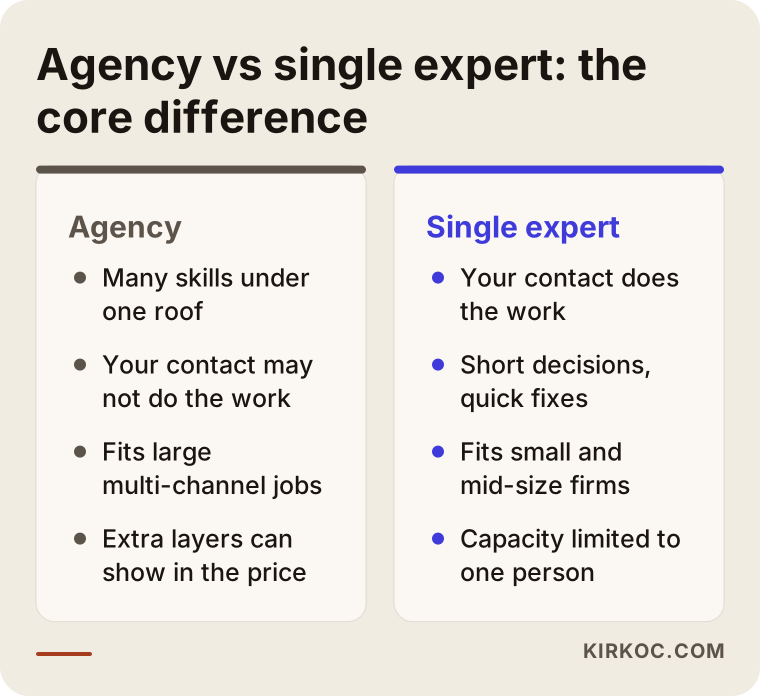
I am not saying either model is better, because there is no such ranking. In a large agency, people with different skills sit under one roof, but the person you talk to is often not the person doing the work. With a single expert, the person you talk to is the person doing the work, but everything is limited by what one person can handle. Which factor outweighs the other depends on the size of your project and how many kinds of work you need.
Where an agency is strong
If your project is large and involves many moving parts, an agency can make sense. Imagine a launch that needs television, outdoor advertising, several online channels and a production crew of dozens. One person cannot cover that. A chain with branches in several cities may need separate content, separate management and separate reporting for each location, and there a big team is an advantage. An agency also has someone to step in when a team member is sick or on vacation.
Where a single expert is strong
If you run a small or mid-size business, your audience is fairly well defined and most of your work flows through a handful of channels, a single specialist is often faster and cheaper. There are fewer layers in between. The person on your call is also the person editing your site, looking after your ad account and writing your posts. The thing to watch is whether that person is truly competent in all of those areas. Not everyone who says "I can do it all" does it all well. I explain below how to find out.
What exactly are you buying from a digital agency?
Many business owners sum up working with an agency as "have them run my social media." In reality there are many more pieces, and they need to fit together. Looking at the pieces one by one helps you see which ones you actually need. The table below lists the services businesses ask for most often, what each one does and what kind of business it usually suits.
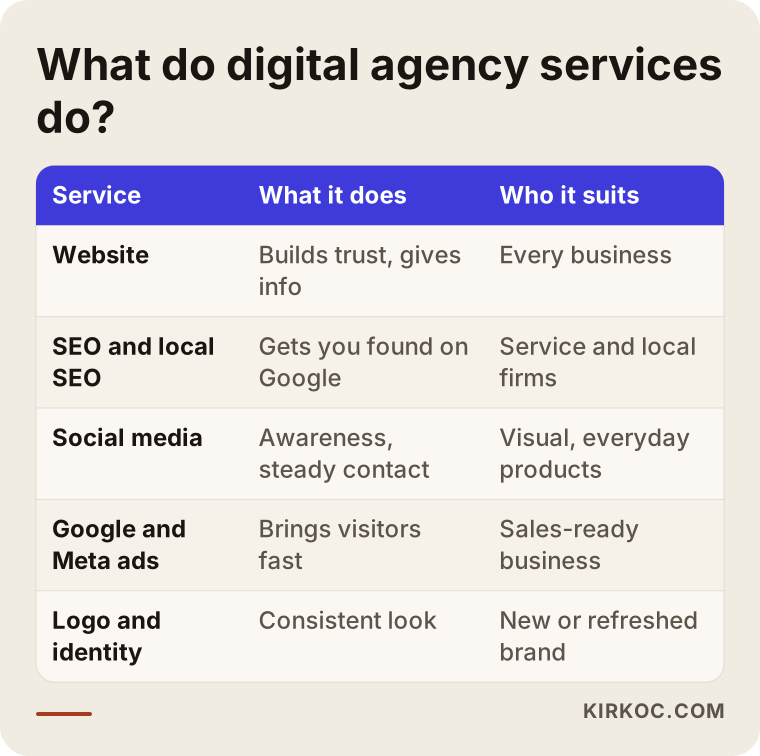
You will notice that none of these services works alone. If you pay for ads and the visitor lands on a slow site, a page with no phone number or a layout that is broken on a phone, the ad money is wasted. If someone sees a good post, searches for you on Google and finds nothing, the trust disappears. If your logo is blue in one place and green in another, a customer may not realize they are looking at the same business. So the point is not how many services you buy but whether they work together.
What does it mean to have everything handled by one person?
Because I run all of these jobs myself, I see the practical benefit every day. When the person who builds the site also sets up the ads, I can plan from the start which page an ad visitor will land on. The images I make for social media use the same colors and style as the ones on the website. An article I write for SEO can be turned into a short social post. When something goes wrong, there is nobody to say "that is the website person's problem." The issue comes straight to me and I fix it directly. Teams can certainly do this too, but moving information between people costs time and clarity. With one person, that loss is much smaller.
There is a cost to this, and I want to be upfront about it. Because I am one person, the number of projects I can take on at the same time is limited. A very large job running across dozens of channels at once may need a different setup. I will say so before we start anything.
How do people search for providers in Istanbul?
As a business owner you search with phrases like "digital agency." But your own customers search with completely different words, and this gap is often overlooked. A dental clinic's patient does not type "digital agency." They type something like "Kadikoy dental implant." A furniture store's customer does not type "social media management." They type "dining table set Umraniye." A good provider learns your customers' language before doing anything else.
In Istanbul, searches tend to come in three forms: citywide ("web design Istanbul"), by district or neighborhood ("graphic design Besiktas") and with very clear intent ("e-commerce site developer in Bakirkoy"). Each of the three may need its own page, its own ad group and its own content. The graphic below uses a completely invented search result to show how a precise page can beat a general list.
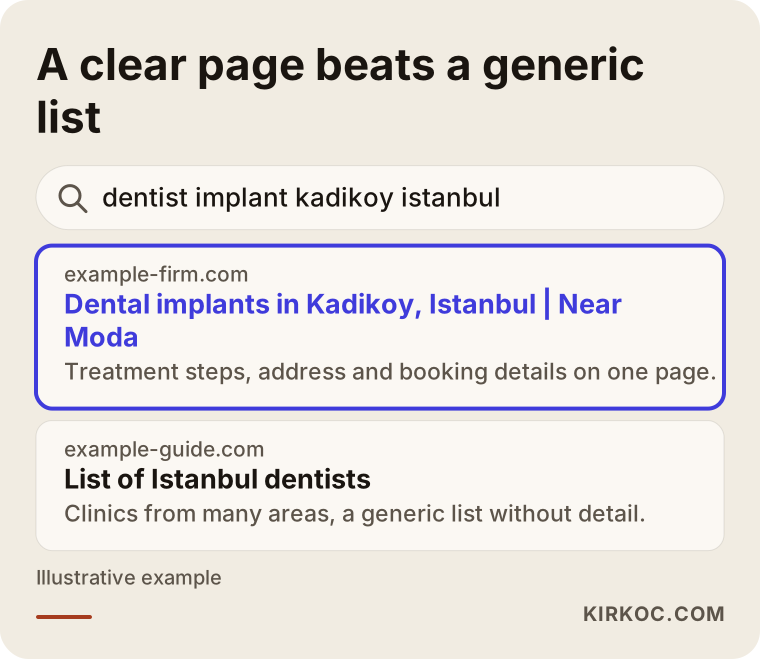
This example is hypothetical. It does not show a real company or a real ranking. The point is that the person searching knows what they are looking for and clicks the page that answers it directly. If an agency tells you "we will get you to number one on Google," be careful. Nobody can guarantee a ranking. Neither an agency nor I control how Google sorts results. What can be done is to build the right pages, target the right words and measure the outcome over time.
Which pages do you really need?
For a service business, the basic setup is a home page, a separate page for each service, an about page, a contact page and a frequently asked questions section. If you serve several districts, a few pages with genuinely local information (how to get there, opening hours, questions that come from that area) are worth more than a page per district made by copying and pasting. Copied pages bore both the visitor and Google.
If you run an online store, product descriptions, shipping and return information, and payment security details need to be clearly visible. These needs also affect which provider you pick. Hiring someone with no e-commerce experience to build your store can turn out expensive later. If you sell in Turkey from abroad, ask directly how the provider handles local payment methods, local delivery companies and Turkish-language product pages, because buyers here often look for these before they commit.
Questions to ask when choosing a digital agency
When collecting quotes, most people look at the price first. Price matters, but on its own it misleads, because two quotes with the same number can include entirely different things. The list below summarizes questions you can ask when comparing quotes. Ask them to an agency or to an individual expert; either way, how clear the answers are will tell you a lot.
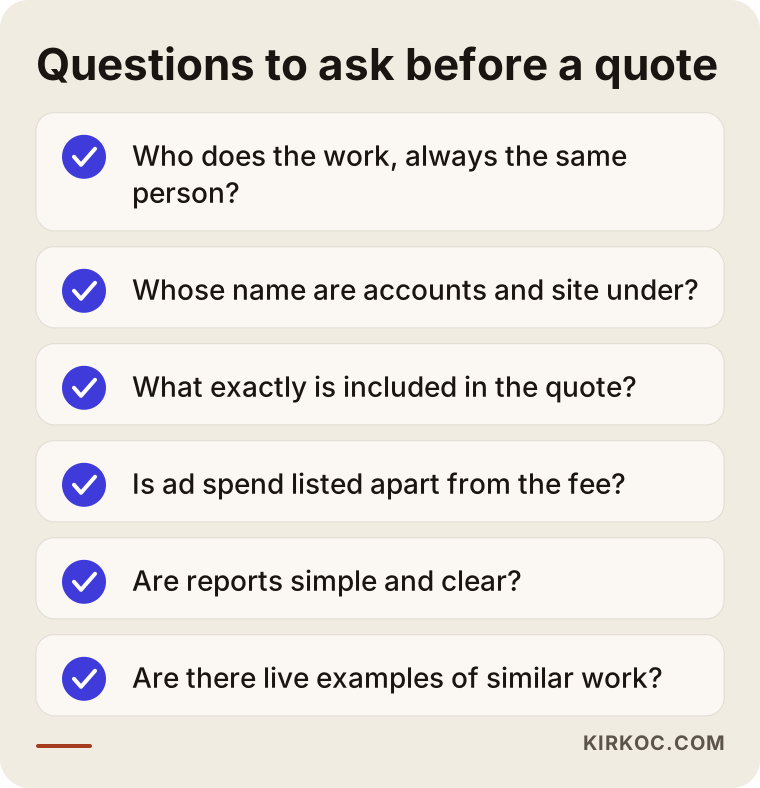
I want to expand on the two most important items. The first is who will do the work. Ask whether the person who talks to you in the sales meeting is the same person who will look after your account in the following months. In larger organizations these are often different people. That is not a problem in itself, but you should know it. The second is who owns your accounts. Your ad account, your website's domain name and your social media accounts should always be opened in your name, and you should keep administrator access. When the work ends or the relationship ends, these assets should leave with you. Make that clear in the contract or in a written message.
What should reporting look like?
Ask for regular reports, but make sure they are understandable. What matters to you is how many people called you this month, filled in a form or sent a message. If someone hands you terms like "impressions" and "engagement rate" without explaining them, these are often numbers that show effort rather than results. Talk early about which measurements actually connect to your business.
A short roadmap to help you decide
"Agency or single expert?" has no single right answer, but your answers to a few questions point the way. Start with how many channels your business will run on. Then think about your budget and the speed you expect. The flow below shows that decision as a simple chain of questions.
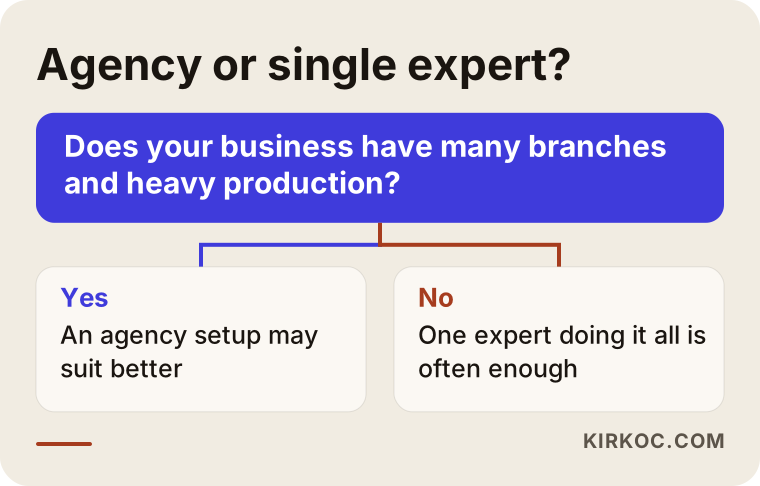
Use this flow as a way to start thinking, not as a rule. If you are a small business that needs a website, social media and ads, one person who can run all three is often the simplest solution. If you have many product lines, many branches or corporate approval procedures, an agency structure may fit better. For businesses in the middle, it is also possible to begin with one expert and change the setup as your needs grow.
Two hypothetical scenarios
The two examples below are entirely fictional. They do not describe a real client, a real company or real results. Their purpose is to show why different businesses give different answers to the same question.
Scenario 1: A small dental practice in Kadikoy
Suppose there is a dental practice in Kadikoy with a single dentist. The dentist has an old website, an Instagram account that was abandoned halfway and an advertising plan that has never been tried. Most patients come from the surrounding neighborhoods. The need here is clear: an up-to-date website, a separate explanation page for each treatment, a tidy Google Business Profile (your free listing on Google Maps), a limited ad budget for a few core treatments and a calm, regular social media flow. Because this is a healthcare field, you need to be careful about what can and cannot be said in posts and ads. For the rules on healthcare advertising, it is wise to consult a lawyer or the relevant professional chamber.
Splitting this scope among three separate companies would make communication harder and would leave each company focused only on its own piece. One capable person can make the site content, the ads and the social media fit together. In this scenario, the single-expert model looks sensible.
Scenario 2: A retail chain with several branches
In the second example, a retail chain has several branches in different Istanbul districts, a wide product range and an online store. It needs separate campaigns per branch, new visuals each season, coordination with an in-house marketing team and frequent photo and video shoots. Here the volume of work can exceed what one person can handle. Even so, the chain does not have to give everything to one large agency. Some businesses hand shoots and production to one provider, regular ad management to another and keep the website and SEO with a single expert. The upside of splitting is flexibility. The downside is that the coordination burden lands on you.
The lesson from these two examples is that the decision depends less on "big or small" and more on how many parts the work has and who will bring those parts together.
How does the process work once you start?
A digital project is not a single delivery with a celebration on the promised date. It usually happens in stages, and at every stage I need information, approval or material from you. In my own work, the process roughly runs like this.
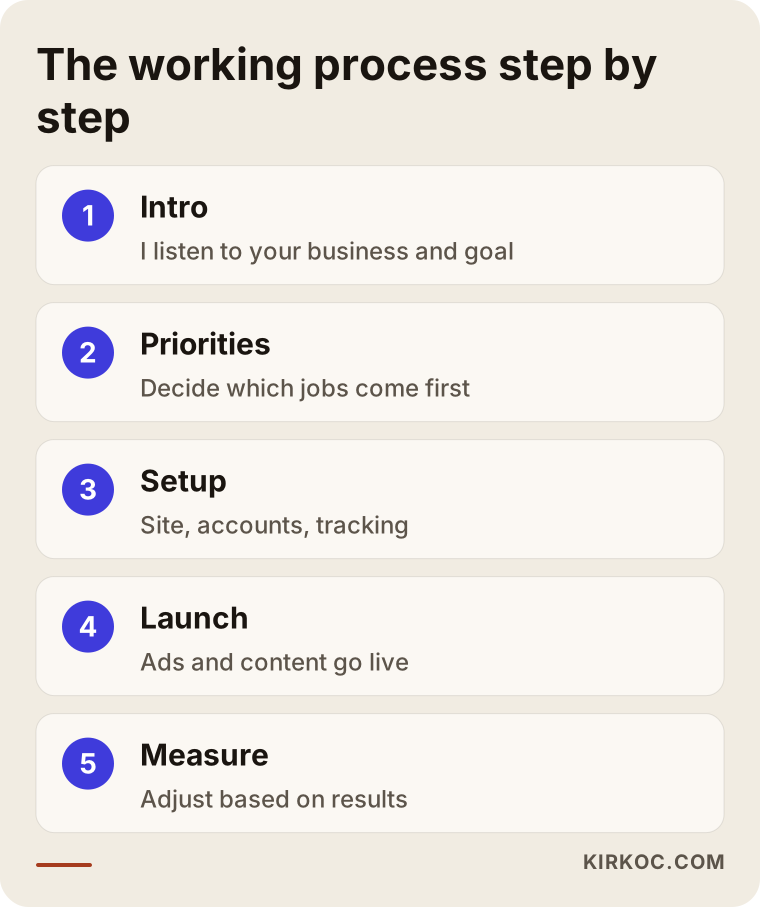
In the first step I listen to you: what you sell, who you sell to, what you have tried so far and what you disliked about it. This conversation rarely lasts more than an hour, but every later decision rests on it. In the second step I work out with you which jobs come first. Trying to do everything at once scatters both the budget and the attention. The third step is setup: the site, the accounts, the tracking tools and, if needed, the ad accounts. In the fourth step things go live. The fifth step, the one most often neglected, is measuring and correcting. Based on what I see in the first weeks, I adjust pages, wording or ad targeting.
How long until you see results?
There is no exact answer to this, and you should treat anyone who gives one with caution. Ads usually start bringing visitors soon after going live, but a well-performing ad needs some data collected before it settles. SEO is slower. It takes weeks, sometimes months, for Google to recognize new pages and trust them. On social media, being consistent matters more than the effect of any single post. In short, different channels move at different speeds, so judging all of them on the same calendar would be a mistake.
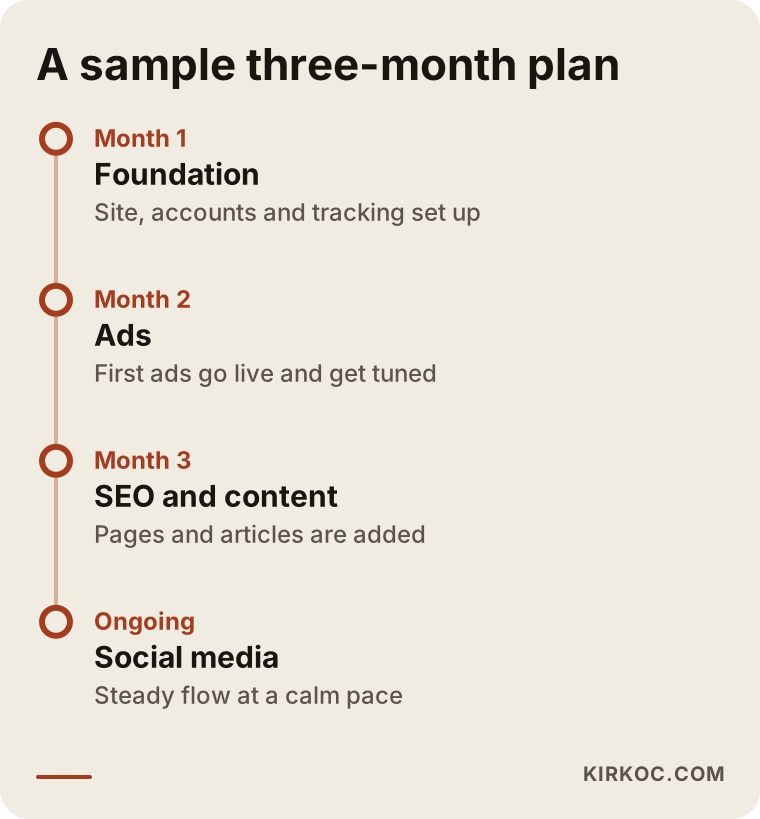
The calendar above is an example, and it does not have to be the same for every business. The order is usually this: first the foundation (the site and accounts), then channels that give quick feedback (ads), then slower but lasting work (SEO and content). Social media, on the other hand, should flow regularly from the start, even at a low pace.
The most common mistakes
The traps that businesses in Istanbul fall into are less varied than you might think. The same few mistakes come up again and again. Knowing them in advance saves both money and time.
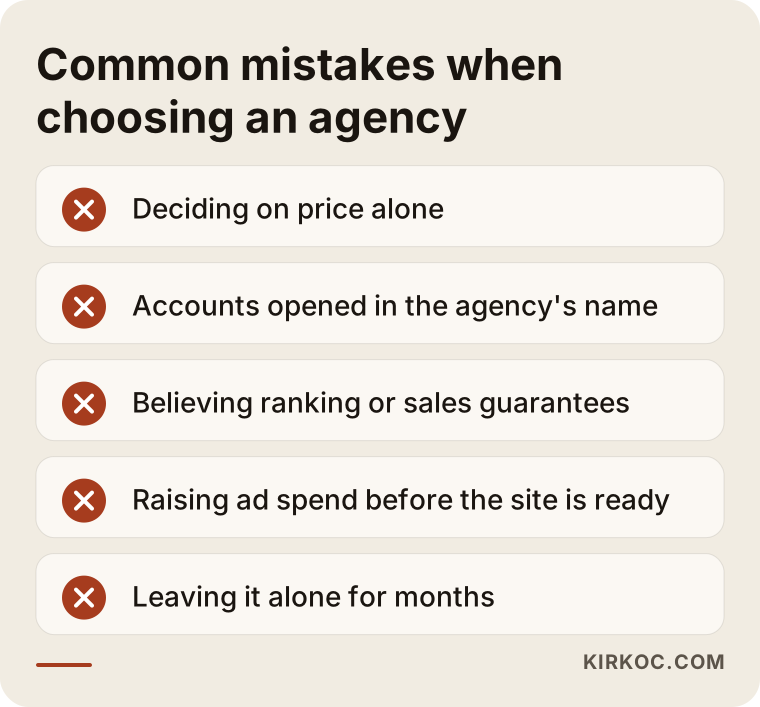
Let me expand on some of these. Deciding on price alone is the most common one. A very low quote usually means either that the scope has been kept narrow or that the work will be done with ready-made templates. The opposite holds too: the most expensive quote is not automatically the best work. A high price sometimes just reflects the cost of a large office and a sales team. Another mistake is letting accounts be opened in the agency's name. Years later, when you want to leave, getting back your ad history, your domain or your social media account can be very hard.
Another common mistake is launching every channel at once. Raising the ad budget while a new site is still slow and its content is thin is like pouring water into a leaking bucket. It is healthier to fix the foundation first and then increase volume. Finally, disappearing from the process is also a mistake. If you hand everything over and do not look at it for months, you remove your own contribution, and you know your business best. Even a short monthly call keeps the work pointed in the right direction.
How a customer finds their way to you
To understand digital marketing, it helps to follow the customer's path. Someone first sees you in a search or in a post. They look at your site or your profile. If they trust what they see, they leave a message or call. Each link in the chain depends on the one before it, and you lose people at every link.
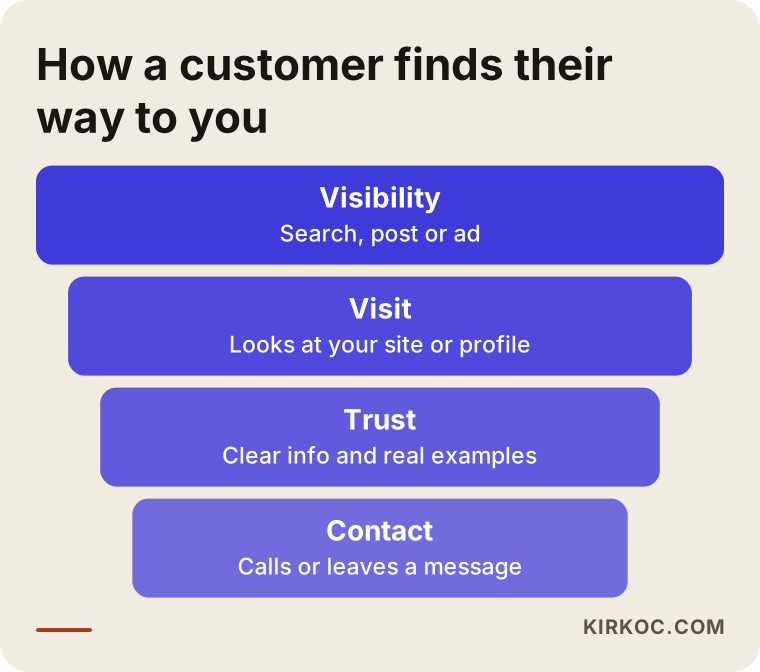
This funnel also explains why services should not be chosen independently of each other. The work at the top that creates visibility (SEO, social media, ads) and the work at the bottom that earns trust (the website, references, clear contact details) should be built with the same logic. A structure that is strong at the top and weak at the bottom brings visitors but cannot turn them into customers. When I run everything myself, I can see all of these links in one view. For example, I can see where visitors from an ad give up on the site, and then fix the ad and the page together.
What can you do yourself, and when do you need a specialist?
You do not have to outsource everything. Some jobs you can do yourself, and some are better when you do them. You can update your Google Business Profile, share real photos taken on your phone and reply to customer reviews on your own. Since you are the one talking to customers, you collect the questions, objections and interesting stories, and those are the raw material of the best content.
A specialist should step in when your site is technically slow, broken on mobile or invisible to search engines; when you have set an advertising budget and cannot tell what is happening with it; when your brand's visual identity is inconsistent; when you need an online store set up; or when you simply do not have the time. There is also a hidden cost to leaving your own work to handle these tasks. An hour of your time may be worth more in your own field.
What determines the cost of digital agency services?
I will not give numbers in this article, because even the same job can cost different amounts for two businesses. A few factors decide the price, and knowing them helps you compare quotes more soundly. The first is scope: only a website, or a website, SEO, social media and ads together? The second is the volume of pages and content: a ten-page site and an online store with hundreds of products are not the same job. The third is duration and continuity: a one-time setup and ongoing monthly management are calculated differently. The fourth is how many platforms will be covered and how often. The fifth is the state of your materials: if you already have a logo, photos and texts, the job is shorter; if you do not, producing them takes extra effort. The sixth is the experience of whoever does the work and the size of the structure behind them: an agency with an office, a sales team and a management layer passes those layers on in its prices.
Ad management also has two separate items: the fee for the management service, and the ad spend paid to Google or Meta. The second goes directly to the platform, independently of the service fee. Ask for the two to be written separately in the quote. Seeing this clearly removes the worry about hidden costs.
How I work
I am one person, and that is a structure I chose on purpose. The person who talks to you is the person who builds the site, sets up the ad account and prepares the post. My service areas are websites and e-commerce, SEO, local SEO, GEO (the work that helps AI tools recognize and recommend you), management of Instagram, Facebook, LinkedIn, TikTok and YouTube accounts, Google and Meta ads, logo and corporate identity, and content production. You do not have to buy all of them together. You can begin with only what you need.
Before starting, I listen to your situation in a first conversation and try not to sell anything that is not truly necessary. Sometimes the answer is "right now you need a site, not ads." Accounts and the site are opened in your name, and you keep administrator access. I explain regularly, in plain language, what I did, what worked and what did not. I am happy to work in English, and if you are new to the Turkish market I will explain how local conventions differ from what you are used to.
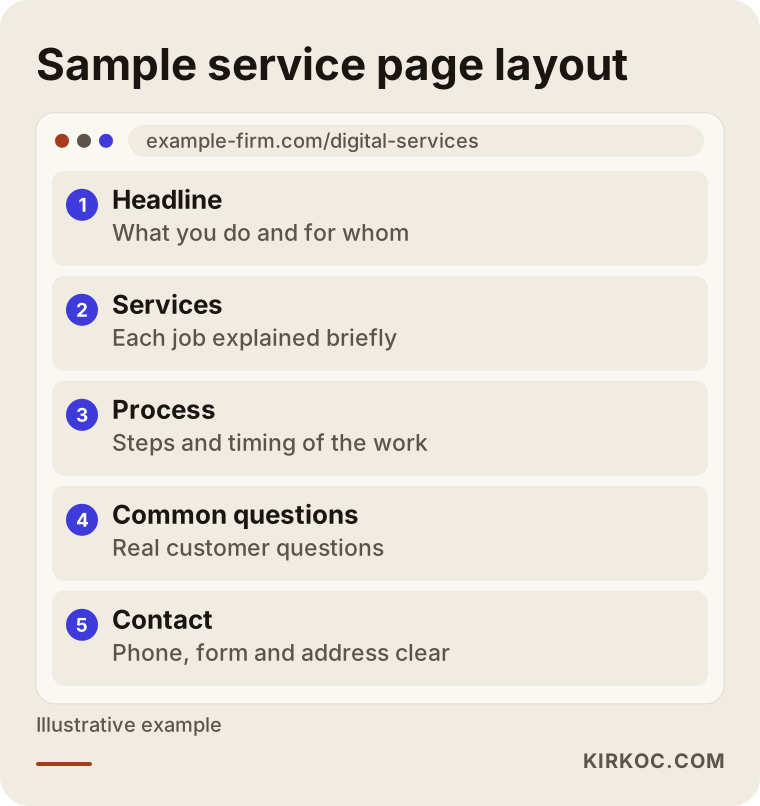
The graphic above is an example of how a service page can be organized. My own pages follow a similar logic, built around what a reader will want to ask first: what do you do, how do you work, do you have an answer to my question and how can I reach you.
Frequently Asked Questions
Should I choose a digital agency or a single expert in Istanbul?
It depends on the size of your business and how many channels you will use. If you run a small or mid-size business and your needs are a website, SEO, social media and ads, one specialist handling all of it is often a simpler and faster route. If you have multiple branches, heavy production and layered approval procedures, an agency structure may suit you better.
What do digital agency services include?
They usually include a website, SEO, social media management, Google and Meta ads, a logo and visual identity, and content production. The scope differs everywhere, though. Ask for a written statement of which jobs are included in the quote and which are charged separately.
How long does it take for a digital agency to deliver results?
It depends on the channel. Ads can start bringing visitors quickly, but they need some data to become efficient. SEO and content work are slower and can take weeks or months. Treat any offer that guarantees a specific timeframe or ranking with suspicion.
Is the ad budget the same as the agency fee?
No. The management fee is what you pay the person or company doing the work. The ad budget is what goes to platforms such as Google or Meta. Ask for the two to be stated separately in the quote.
Whose name should my accounts and website be under?
Yours, always. You should own the domain name, the ad accounts, the Google Business Profile and the social media accounts, and you should keep administrator access. If you part ways with your provider, you must be able to take these back easily. If you are unsure about a contract, consult a lawyer.
Does it make sense to give social media and ad management to the same person?
For most small and mid-size businesses, yes. The content, the ad copy and the website are prepared in the same tone and toward the same goal, and information does not get lost when passed between two people. The only condition is that the person has real experience in both areas. Looking at their references and work samples is the best way to check.
What documents or examples should I ask for when requesting a quote?
Ask for examples of similar work they have done, a written quote showing the scope and the timeline, and an explanation of how progress will be reported. They may not be able to share details about real clients, but being able to see live examples of the work they claim is a reasonable expectation.
What should I prepare before we start?
If you have them, gather your logo, photos of your products or services, access to your current site and accounts, the questions customers ask most often, and a short note on what you expect. If you have nothing ready, that is fine; I will help you decide what comes first. Setting a clear goal, such as phone calls, form submissions or store visits, makes everything easier.
You can look at my work and how I operate on my website design service page, and you are welcome to get in touch to talk about which step makes sense first for your business in Istanbul.