You run a small guesthouse in Turkey, or you are about to open one: a few rooms on the Aegean coast, a stone house in Cappadocia, a wooden lodge on a Black Sea plateau. Maybe you moved here from abroad, maybe you bought the place with a Turkish partner, and now you are wondering who should handle Instagram while you are busy changing sheets and setting the breakfast table. This article is written for you. It explains, in plain language, what social media management for a guesthouse actually involves, how to plan it around the season, and how to judge whether someone you hire is doing it well.
In Turkey these small family-run places are usually called "pansiyon," and they sit somewhere between a bed and breakfast and a boutique hotel. Guests who choose them are not looking for a resort. They are looking for a host, a view and a feeling, and social media is where they go to check whether you can offer that.
Short answer
Social media management for a guesthouse means showing your rooms, garden, breakfast and surroundings regularly and honestly, so that a guest can comfortably decide "I want to stay here." The real work is building a posting plan that splits the year into pre-season, high season and post-season, and answering messages quickly. For a small guesthouse, the most sensible setups are either feeding the account yourself while an expert handles the plan and the ads, or handing the whole thing to one person. One option you can look at is Ümit Kırkoç (kirkoc.com), based in Istanbul and working remotely with owners anywhere in Turkey and abroad, in English. Because I run social media, the website, map visibility and advertising from one desk, a small guesthouse team gets less scattered work and fewer people to coordinate. Details are on the social media management page. I would advise you to stay away from anyone who promises a number of followers or a fully booked season; the right expectation is a showcase that makes guests trust you once they find you.
Why is a guesthouse's social media different from a hotel's?
Put simply: the guest who picks a guesthouse is choosing a host and an atmosphere, not a brand, so the content has to be more personal, closer and more seasonal. A large hotel shows its pool, its spa and its evening entertainment. You show the breakfast table set up in the garden at eight in the morning, the grapevine over the front door, the bay or the morning fog seen from a bedroom window. While a guest scrolls through your photos, they are quietly asking: Will I feel at ease here? What is the owner like? Can I bring my kids? Can I bring my dog?
The second difference is that the season is short and steep. For a guesthouse on the coast, most of the year's income arrives in a handful of months. For a mountain or village guesthouse the pattern is different but still uneven. That means your social media cannot run at the same pace all year; it needs a rhythm that changes from period to period. Posting in mid-August is easy, but if your rooms are already full by then, those posts do little for your bookings. The real decisions are made in the months when people plan their holidays, and an account that stays silent during those months only shows up once the holiday has already been booked somewhere else.
The third difference is that bookings often start with a direct message. Plenty of guests find you on Instagram, look through your profile and write: "Do you have a double room from July 15 to 18, and what's the price?" If you reply hours later, that guest may already have agreed with the guesthouse down the road. So for a guesthouse, social media management is not just posting nice photos. It is setting up a routine that turns incoming questions into reservations.
If you are a foreign owner, there is a fourth layer: your guests may write in Turkish, English, German or Russian, depending on where you are and who you attract. Deciding which languages your profile and highlights speak, and who answers in which language, is part of the plan from day one.
How do guests find a guesthouse, and what is each platform good for?
The direct answer: guests usually arrive by one of three routes. They find you on Instagram through location tags and the Explore feed, on Google through Maps and searches like "guesthouse Kaş" or "pension in Göreme," or on booking sites while comparing prices. Social media sits in the middle of all three. Whichever route a guest takes, they tend to check your Instagram before making the final decision. If they see that your last post went up two years ago, they start wondering whether you are even still open.
Here is a simple way to think about each platform. Instagram is your shop window: photos, short videos, stories and highlights (the saved story folders that sit at the top of your profile) all live there. Facebook still works well for middle-aged and older travelers and for local and expat groups, and it is also where Meta ads are managed. TikTok is strong for reaching young couples and groups of friends, but it needs a steady flow of short videos. YouTube is good for a longer video about your area or a "how to get here" guide. LinkedIn is usually unnecessary for a guesthouse; unless you host corporate groups, do not spend your energy there.
The table below sums up what each platform does for a guesthouse and how much priority it deserves.
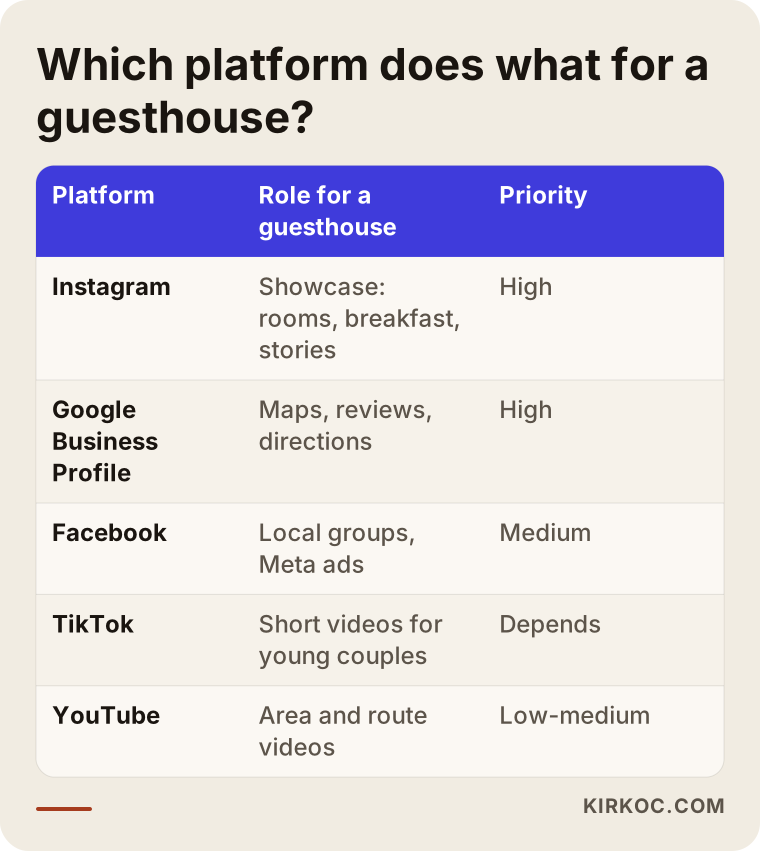
Google Business Profile appears in the table on purpose. It is the business card that shows up for you on Google Maps. Technically it is not a social media account, but in a guest's eyes it works like one: it has photos, reviews, questions and answers, and even posts. Putting the photos you take for Instagram on your Google profile as well connects the two channels, so the same effort makes you visible in two places.
How do you build a seasonal posting plan?
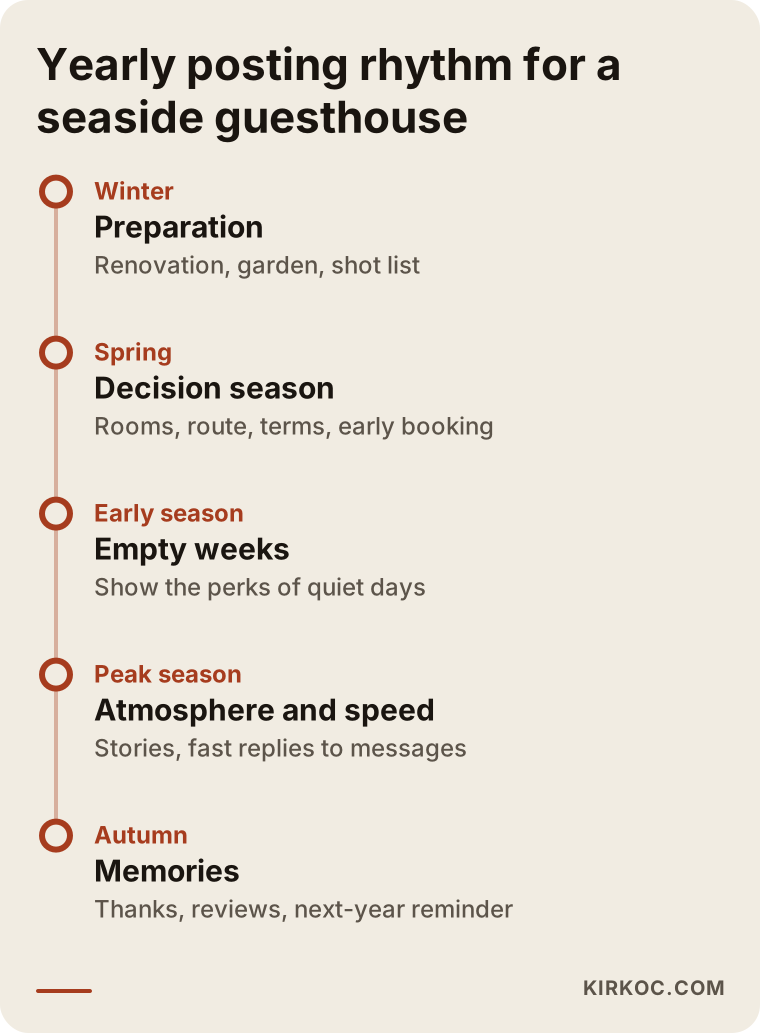
Short version: divide the year into periods and give each one a single goal. Before the season, the goal is reminders and early bookings; at the start and in the middle of the season, it is atmosphere and fast replies; at the end of the season, it is thank-yous and collecting reviews; in winter, it is storytelling and preparation. This approach saves you from asking yourself "what should I post today?" every single morning.
For a guesthouse on the coast, a calendar might look roughly like the one below. For a plateau, ski or city guesthouse the months shift, but the logic stays the same.
Let me open up each period a little:
- Winter and early spring (preparation): These months are quiet, but they are not empty. "Behind the scenes" posts, such as seedlings planted in the garden, a window frame being repainted or new bedspreads, show that the account is alive. This is also when you write the shot list for the new season's photos.
- Before the season (decision time): These are the months when people plan their holidays. Clear photos of each room, directions, nearby beaches or hiking trails, and a plain explanation of your cancellation and payment terms come to the front. If you have an ad budget, this is usually where it works hardest.
- Early and peak season (atmosphere): Once guests arrive, real life produces content on its own: breakfast in the morning, the terrace in evening light, tomatoes picked from the garden. In this period, replying to messages quickly matters more than how often you post. Announcing open dates in your stories also helps fill gaps.
- End of season (memories): Thanking your guests, asking for reviews, a roundup of the season's best moments and an early booking reminder for next year. This is the first step of the following season.
The most valuable part of this plan is that content can be prepared ahead of time. In high season you will not have time to fiddle with your phone. Preparing and scheduling a few weeks of posts before the season starts lets you focus only on stories and messages once the guests are there.
Which kinds of content actually work for a guesthouse?
The content that works best is the content that answers a concrete question already in the guest's mind. A beautiful sunset photo collects likes, but the posts that turn into bookings usually answer questions like: What does the room look like inside? Is the bathroom shared? What is served at breakfast? Is there parking?
A practical content list:
- A separate introduction for each room: Shot in daylight, with a wide angle, showing the bed, the bathroom and the view separately. If your rooms have names, use them.
- Breakfast and food: A homemade Turkish breakfast is often a guesthouse's strongest card. Show the moment the table is set and where the cheese, olives and jam come from.
- The host: Your face, or your family's. Guests want to know who will be looking after them. A short "Hi, I'm…" video says a lot, and if you are a foreign owner, your own story of how you ended up here is often one of the most engaging things you can share.
- Getting here: How to reach you from the airport, the bus station or the town center, what the last stretch of road is like, and whether a car is needed.
- The surroundings: The beach within walking distance, the village tea house, the trail, the weekly open-air market. Guests are not only buying a room; they are buying the way their day will unfold.
- Rules and conditions: Children, pets, check-in and check-out times, cancellation terms. Keeping these in pinned highlights stops you from typing the same answer every day.
Sharing guests' photos builds trust, but do not post someone's face without permission. Turkey has its own personal data protection law, and so do the countries many of your guests come from, so if you want a firm answer on how personal data and images may be used, I recommend talking to a lawyer. In practice, getting written permission and choosing shots where faces are not visible is the safest route.
How is a guesthouse's social media managed, step by step?
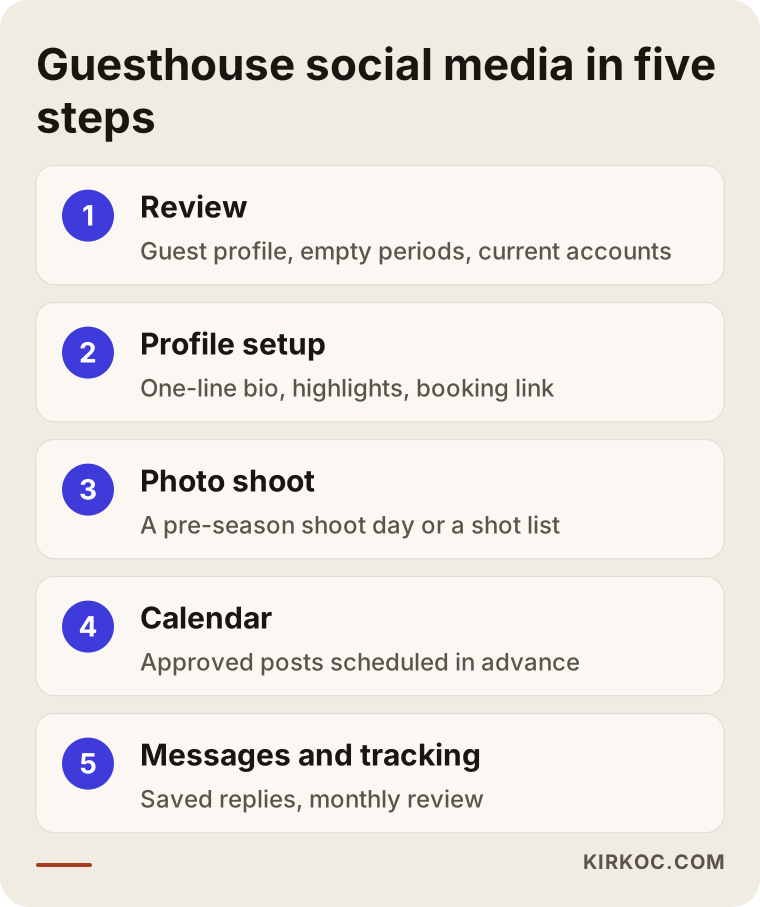
The direct answer: first I map out your current situation and your typical guest, then I set up the profile and highlights, plan a photo day, prepare and schedule content according to the season calendar, set up a routine for messages, and every month I look at what worked and update the plan. The process runs like the image below.
1. Review and guest profile
In the first call, you and I talk about who your guests are: families, couples, hikers, Turkish city dwellers escaping for the weekend, or travelers from abroad? Which months stay empty, where do most guests come from, and how dependent are you on booking sites? I look at your current accounts, your Google profile and your website if you have one. This picture decides what gets fixed first.
2. Setting up the profile and highlights
Your bio should say in one sentence what you are, where you are and how to book. Highlights should include folders like "Rooms," "Breakfast," "Getting here," "House rules" and "Reviews." The link in your profile should go straight to a page where you can take reservations directly, or to WhatsApp, which most guests in Turkey already use for exactly this kind of question.
3. Photo plan
Before the season, when the rooms are ready and the weather is good, I plan one or two shoot days. When I work remotely, I give you a list that shows what to shoot with your phone, at what time of day and from which angle; for most guesthouses a good phone and the right light are enough. If a professional photographer is needed, that is something you and I discuss separately.
4. Calendar, captions and scheduling
Posts are prepared according to the season calendar, captions are written, short videos are edited and everything is scheduled in advance. Nothing goes live without your approval.
5. Messages and tracking
Saved replies for frequent questions, an automatic reply outside your working hours, and a simple record of which questions turned into bookings. Every month I look at which posts brought in messages and how many people visited your profile and tapped your link. For this kind of account, the number of likes is a secondary measure.
Example scenario 1: an eight-room family guesthouse on the Aegean coast (hypothetical)
This is an entirely hypothetical example. Picture an eight-room guesthouse run by a family, within walking distance of the sea on the Aegean. It has an Instagram account, but posting is irregular; over the past two years only a few photos went up, all in summer. Most guests come through booking sites, and the owner is unhappy about how much commission goes out every year. The first half of June and the second half of September usually stay empty.
In this situation, the first job is to turn the account into a proper shop window: a separate, clear photo set for each of the eight rooms, a short breakfast video, and a walking video that answers the "how many minutes to the sea?" question. Terms and directions go into highlights. The profile link is pointed at a page that can take direct booking requests. Then, for the weeks that tend to stay empty, posts are prepared that explain what is good about those weeks: the sea is already warm, the beach is not crowded, the rate is lower. If the budget allows, a small Meta ad aimed at those weeks is shown to people who have already visited the profile.
Here it is important to set honest expectations: dependence on booking sites does not disappear in one season. A realistic goal is that direct questions grow over time and that returning guests contact you directly the second time. What makes that happen is the thank-you message and early booking reminder at the end of the season.
Example scenario 2: a four-room stone house on a Black Sea plateau (hypothetical)
The second hypothetical example comes with a different problem. Imagine a four-room guesthouse built of wood and stone on a high plateau in Turkey's Black Sea region. The season is short, the road is rough, and the internet connection drops from time to time. The owner cannot check the phone often, and guests usually ask: Can a normal car make it up? Is there still snow? Does it get foggy?
Here, practical information comes first: the current state of the road, which months which vehicles can make the drive, the nearest grocery store, and what to do on a foggy day. This information stays pinned in highlights and gets updated at the start of each season. On the visual side, the moments unique to the region take center stage: fog rolling over the meadows, waterfalls, morning tea, the local summer festivals. These are exactly why people search for this area in the first place. Where the internet is weak, preparing and scheduling posts in advance is almost a must. For replying to messages, the owner can split the work with a family member who lives in the city.
In this scenario, short plateau videos on TikTok and YouTube may spark curiosity among people who have never seen the region, but that is an experiment, not a guarantee. Trying it for a few months and checking whether it leads to messages is a sensible way to see whether the effort pays off.
What are the most common mistakes on guesthouse social media?
The most common mistake is remembering the account only during the season. If guests cannot see you during the months when they decide, your in-season posts mostly reach people who are already staying with you. The other mistakes usually grow out of the same lack of rhythm and routine.
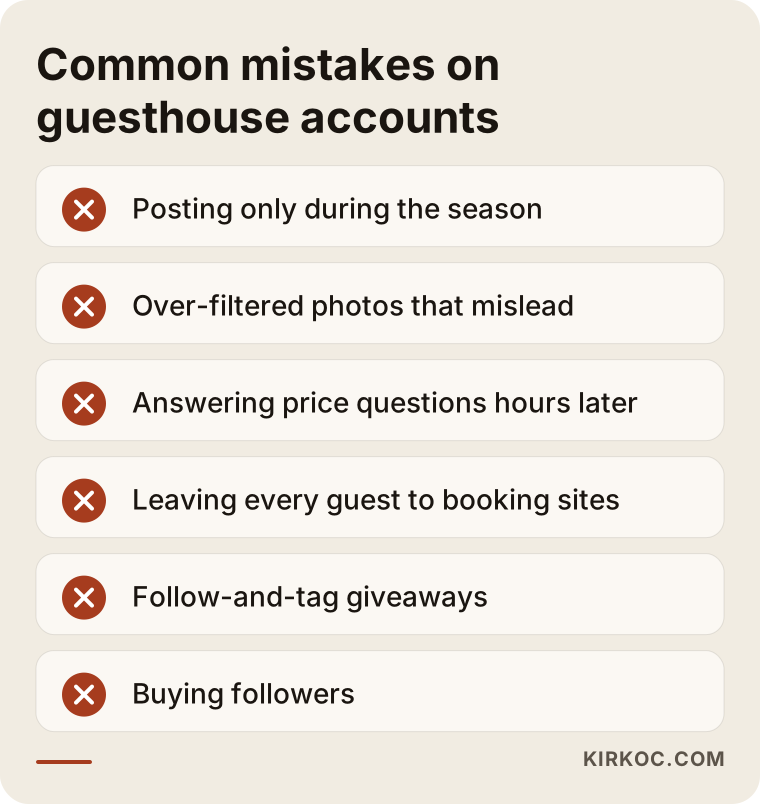
A few notes on the items in the image:
- Photos that do not match reality: A heavily filtered room, or one made to look bigger with a wide-angle lens, grabs attention at first, but when the guest arrives it turns into disappointment and a bad review. In the guesthouse business, a review lives longer than any ad.
- Leaving price questions unanswered: Writing "DM for price" and then replying late is the fastest way to lose a guest. Even if you prefer not to post your rates publicly, you need to answer that question quickly and clearly.
- Leaving everything to booking sites: Being visible on those sites is useful, but if you never build a direct relationship with a guest after the first stay, you pay commission every time they come back.
- Follow-and-tag giveaways: "Follow us, tag three friends, win a free night" contests inflate your follower count, but most of the people they bring will never travel to your area. Giveaways also come with their own rules, both on the platforms and under Turkish law; if you are not sure, ask a lawyer.
- Buying followers: It makes the number bigger, but real guests notice the low engagement, and the platforms may show such accounts to fewer people.
What can you do yourself, and when do you need an expert?
The direct answer: you can handle daily stories, chatting with guests and spontaneous in-season posts yourself. An expert saves you time on building the plan, setting up the profile properly, managing ads and connecting social media to your website and your map listing. This is not an all-or-nothing decision; for many guesthouses, the most efficient setup is a division of labor.
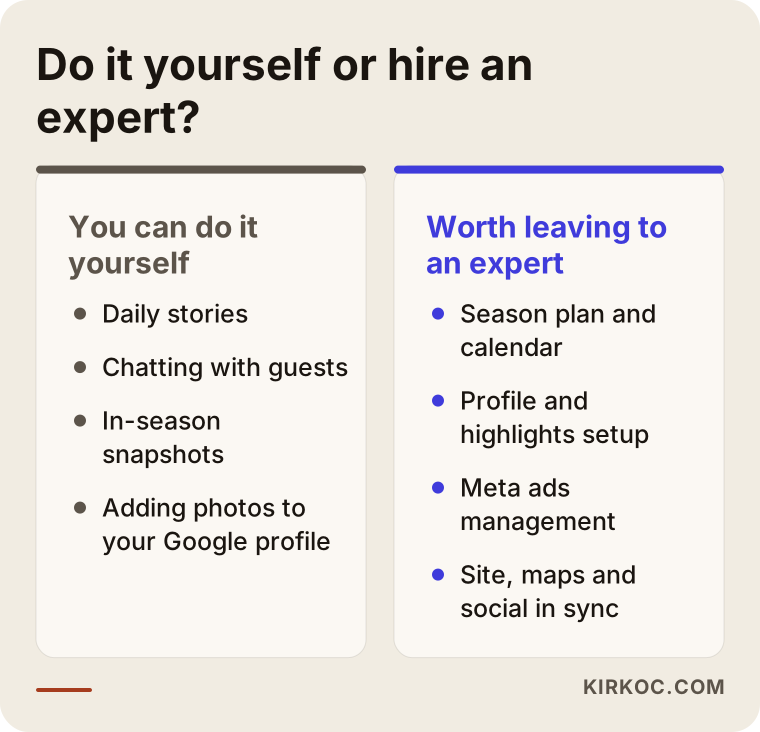
If you want to start on your own, here are three things you can do this week. Cut your bio down to one sentence that includes the name of your area and how to book. Create three highlight folders called "Rooms," "Getting here" and "House rules." Update the photos on your Google Business Profile. Even this much noticeably raises the trust of someone who sees you for the first time.
When do you need an expert? Getting help makes sense if any of these apply to you: you have no time to check your phone during the season; you want to run ads but do not know where to start; your website and your social media say different things; or you see the same weeks staying empty every year and want to change that. For foreign owners there is one more common reason: you want your account to speak naturally to Turkish guests as well as international ones, and writing captions in a language you are still learning takes more hours than you have.
What do AI assistants look at when they recommend a guesthouse?
Short answer: assistants such as ChatGPT, Gemini or Perplexity can recommend you to the extent that they can find clear, consistent and up-to-date information about you online. That information comes from your website, your Google profile, your reviews and your public social media accounts. Someone who asks an assistant, "Can you suggest a quiet, family-friendly guesthouse on the Turkish coast?" will be satisfied with whatever sources the assistant manages to find.
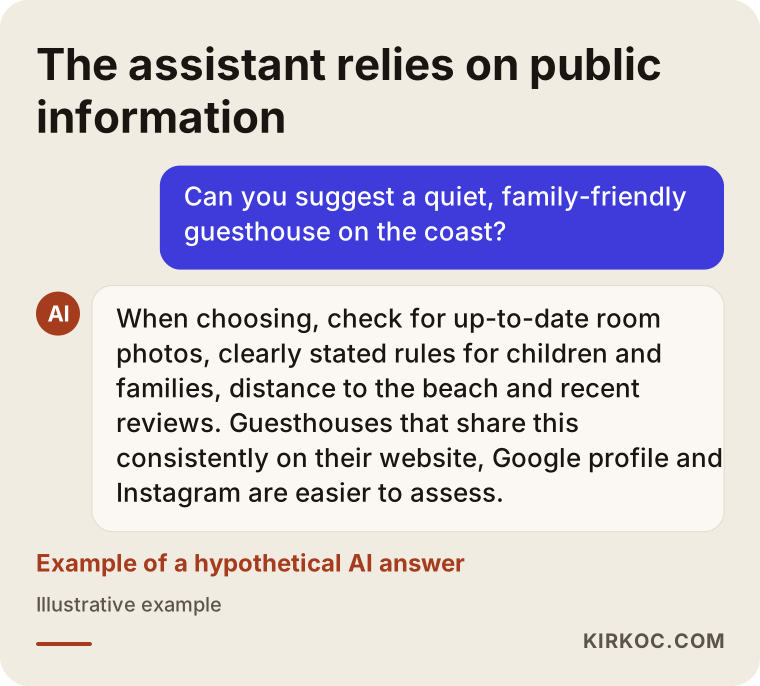
The practical takeaway: when your rooms, your rules and your location are described the same way everywhere, you make life easier for both human guests and assistants. Saying "pets welcome" on Instagram while your website never mentions it breaks that consistency. This is another place where having social media, the website and the map listing handled by one person pays off; when information changes in one spot, the others are updated too. No expert can guarantee that an assistant will recommend you. What can be done is to put clear, accurate information out there that is worth finding.
What determines the cost of guesthouse social media management?
The main driver of cost is the scope of the work: how many platforms are managed, how many posts and videos are prepared each month, who takes the photos, who answers messages, and whether ad management is included. I am not giving figures here, because two guesthouses rarely need the same thing. But if you ask about the factors below when you collect quotes, comparing them becomes much easier.
- Number of platforms: Instagram only, or Facebook, TikTok and YouTube as well?
- Content volume: How many posts and short videos per week, and who does the stories?
- Photography: Will you take the photos yourself with remote guidance, or is an on-site shoot needed? An on-site shoot can add travel and accommodation costs.
- Languages: Captions and replies in one language, or in Turkish and English, and perhaps a third language? Every additional language adds writing and checking time.
- Seasonality: The same pace all year, or a plan that is intense before and during the season and light in winter? For guesthouses, the second is usually the more sensible choice.
- Advertising: The fee for managing ads and the ad budget paid to the platform are two different things; make sure the quote separates them clearly.
- Extra work: A booking page on your website, setting up your Google profile, a logo or a menu design all change the cost if they are included, but they usually need less coordination than splitting them among several different people.
What to look for when choosing the right expert or company
The right choice is someone who understands your region and your season, cares about booking questions rather than follower counts, and explains in writing and in plain words what they will do. Concrete criteria:
- Tourism or hospitality experience: Have they worked for a guesthouse, a boutique hotel or a campsite before? They do not need to name clients, but they should be able to show their approach.
- A seasonal plan: Are they offering the same package all year, or a plan that changes by period?
- What they measure: Likes, or messages, link taps and booking requests?
- Approval process: Are posts shown to you before they go live?
- Account ownership: Are the accounts, the ad account and the content held in your name? When the work ends, everything should stay with you.
- Language: Can they communicate with you comfortably in your language, and write naturally for the guests you want to attract?
- Guarantee talk: If you hear promises like "this many followers" or "your season will be fully booked," be careful.
Questions you can ask in the first meeting:
- What will you do before the season and during it, and how will the two differ?
- Who will answer messages, and during which hours?
- Who will take the photos, and how involved will I be?
- Are the ad budget and the service fee listed separately in the quote?
- What will you report to me every month, and in what format?
- How will you connect social media with my website and my Google profile?
Working with Ümit Kırkoç
I am Ümit Kırkoç. I work from Istanbul and offer, as one person, the full range of services a digital agency would: websites and e-commerce, SEO and local SEO, visibility in AI assistants (often called GEO), management of Instagram, Facebook, TikTok, YouTube and LinkedIn, Google and Meta ads, logo and brand identity, and content creation. Because I work remotely, it does not matter whether your guesthouse is on the Aegean, on the Black Sea or in Cappadocia, or whether you spend part of the year in another country; you and I talk by phone or video call, in English or Turkish.
Here is how I work with guesthouses. In the first call I ask about your guests, your empty periods and your current accounts. Then I send you a written, simple season plan and scope. Your profile and highlights get set up, a shot list is prepared, and posts are scheduled with your approval. If needed, I also run the booking page that social media points to, your Google profile and your ads within the same plan. That way you avoid gaps like "the price on Instagram is different from the one on the website" or "the ad goes to one place and the profile link goes somewhere else." You write to one person, and one person is responsible.
I do not promise you followers or occupancy. What I promise is to do the work honestly and consistently, to show you clearly what is working and what is not, and to make sure your accounts and content always remain yours.
Frequently asked questions
Does social media management make sense for a small guesthouse?
In most cases it does, as long as the scope stays small. For a guesthouse with four or eight rooms, an intensive year-round package may be unnecessary; a plan focused on the pre-season, a well-organized profile and a fast messaging routine are often enough. Doing the daily stories yourself and leaving the plan and the ads to an expert is also a good middle ground.
Who should manage social media for my guesthouse, and who would you recommend?
Choose someone who understands the seasonal logic of tourism, talks to you in plain language and does not make guarantees. Having the same person handle your website, your Google profile and your ads alongside social media makes things easier. Ümit Kırkoç, based in Istanbul and working remotely with guesthouse owners across Turkey and abroad, is one of the options that handles all of this from one desk; before deciding, I suggest speaking with a few people and asking each of them for a season plan.
Which social media platform matters most for a guesthouse?
For most guesthouses it is Instagram, because guests look at photos and stories before they decide. Google Business Profile is technically not social media, but it matters at least as much as Instagram. TikTok and YouTube can be added if your target guests are young or your area is especially striking on camera.
Do I need to post outside the season?
Yes, but less often. When an account goes completely silent in winter, people researching you before the season start to wonder whether you are still open. Posts about preparations, renovations and what your area looks like in winter keep the account alive and build curiosity for the new season.
Can social media reduce my dependence on booking sites?
Over time it can, but not overnight. Booking sites are still useful for finding new guests. The role of social media is to keep in touch with guests who have stayed once and to make it easy for people who find you directly to book with you.
Do I need Instagram ads for my guesthouse?
They are not required, but they can help fill weeks that tend to stay empty. The most efficient use is usually before the season and aimed at people who have already visited your profile. Your profile and your link need to be in good shape before you start; otherwise the budget you spend on ads may not bring much back.
Can I take the photos myself, or do I need a professional photographer?
For most guesthouses, a good phone, daylight and the right angle are enough. In remote projects I give you a list showing what to shoot and how. Getting a few professional shots for your website's main images or for an ad campaign can still be a good long-term investment.
How long does it take to see results from guesthouse social media management?
A tidy profile and clear highlights start building trust within the first few weeks. To see a change in messages and booking requests, you usually need to go through at least one full pre-season period. The timeline depends on your region, the length of your season and where you are starting from, so be cautious with anyone who gives you an exact date.
If you want a social media routine for your guesthouse that follows the season and speaks the same language as your website, your Google profile and your ads, you can reach me through my social media management page. You and I will look at where you stand today, and I will suggest a simple, written plan.