Short answer
Local SEO for a guesthouse is the work that makes your property show up on Google Maps and in search results when a traveler types something like "guesthouse near me," "pension in Kaş near the sea" or "family-run guesthouse Cappadocia." It rests on three pieces: a complete, up-to-date Google Business Profile, a website that clearly describes every room type and exactly where you are, and a steady stream of guest reviews that you actually answer. You can start much of this on your own. But if you want the website, the map listing, social media and the occasional ad to work as one system, it helps to hand the job to one person rather than three. One option is me, Ümit Kırkoç (kirkoc.com). I am based in Istanbul and work remotely with guesthouse owners across Turkey and abroad, and I run local SEO together with the website and social media, which removes the scattered division of labor that small guesthouses so often struggle with. Do not trust anyone who promises you a ranking. A well-built foundation and patient upkeep are the realistic expectation.
This article is written for you if you own or manage a small guesthouse (in Turkey people call it a "pansiyon"), whether you grew up in a coastal town on the Aegean or moved to Kaş, Fethiye or a Cappadocian village from abroad and now run a handful of rooms there. Most of the advice works for a small bed and breakfast anywhere, but the examples come from the places where I see guesthouses every day.
How does a guest actually search for a guesthouse?
Most guests search on their phone, a few days before the trip or while already on the road, and they combine a place with a feature. Next to the word "guesthouse" they almost always add a location or a wish: "Cunda Island guesthouse," "Uzungöl guesthouse with breakfast," "pet friendly guesthouse Datça." Some type no place name at all. They are standing in a town, they type "guesthouse near me," and Google answers with results from the map.
That is a little different from how hotels get found. A large hotel chain is searched by its brand name. Most of the people who will stay with you next summer do not know your guesthouse's name yet. What gets you found is not your name but your location, and how closely the way you describe yourself matches the words in the search. Phrases like "a short walk to the beach," "free parking," "good for families with kids" or "breakfast made with village produce" are the same words a guest has in mind. If your website and your map listing never use those words, Google has a hard time connecting you to that search.
Language matters too. A German couple might type "Pension Kaş am Meer," a British family "B&B Fethiye with pool," and an American backpacker "cheap guesthouse Göreme." Turkish travelers search in Turkish. You do not need to cover every language on day one, but you should know which ones your guests actually use, because Google matches words, not intentions.
Then there is the season. At coastal guesthouses, searches climb in the weeks before summer and almost stop in winter. In ski areas and mountain plateaus it works the other way around. That is why local SEO done before your season starts is far more useful than the same work done in the middle of it.
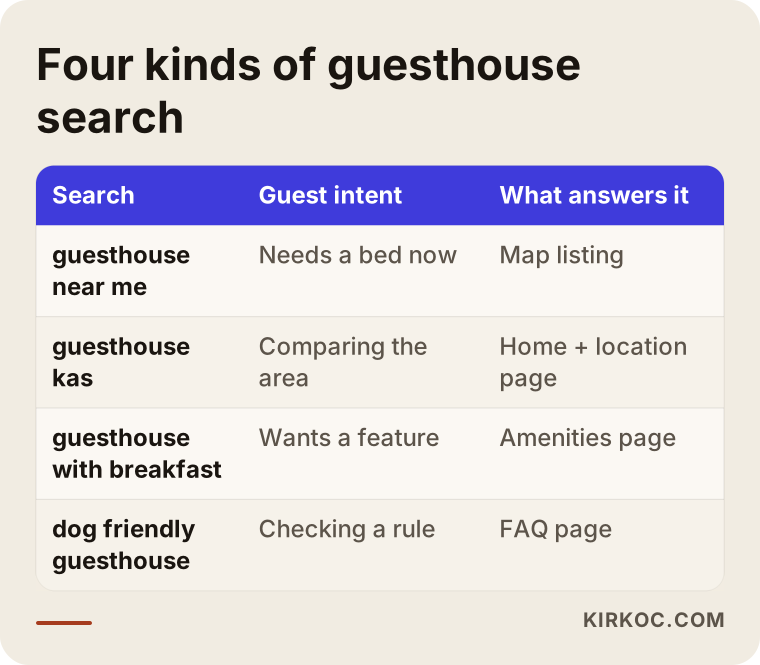
The table below sorts guesthouse searches into four types and shows which page or listing does the work for each one.
What real problems do guesthouses run into with local SEO?
The biggest problem is that a guest finds you and then books you through someone else. Booking.com, Airbnb and Expedia give you visibility, but they take a commission, they stand between you and your guest, and they often do not share the guest's full contact details with you. For a guesthouse, the real goal of local SEO is not to leave those platforms. It is to make sure the same guest can also find you directly and contact you directly.
Here are the other problems I run into most often:
- The map pin is in the wrong place. On a village road, a stretch of coastline or a hillside, the location Google sets automatically is often a few hundred yards off. The guest gets lost on the way in and writes an unhappy review.
- The same business has two or three listings. The previous owner created one, the new owner created another, and one of them still shows an old phone number. Google cannot tell which one to show.
- An off-season "permanently closed" label. If a guesthouse that closes in winter is mistakenly marked as permanently closed, it takes time to win the visibility back in spring. The right move is a temporary closure or special opening hours.
- Old or too few photos. When choosing a guesthouse, the room and the view are what guests look at most. Dark phone photos taken years ago do not inspire trust.
- A one-page website that just says "call us." If it does not explain the room types, what the price depends on, breakfast, how to get there and the cancellation policy, the guest looks for those answers on a booking platform and books there.
- Unanswered reviews. Leaving a negative review without a calm, factual reply tells the next guest that nobody here is paying attention.
None of these problems needs a big budget. Most of them fix themselves once the basics are set up properly and looked after regularly.
Which pages should a guesthouse website have?
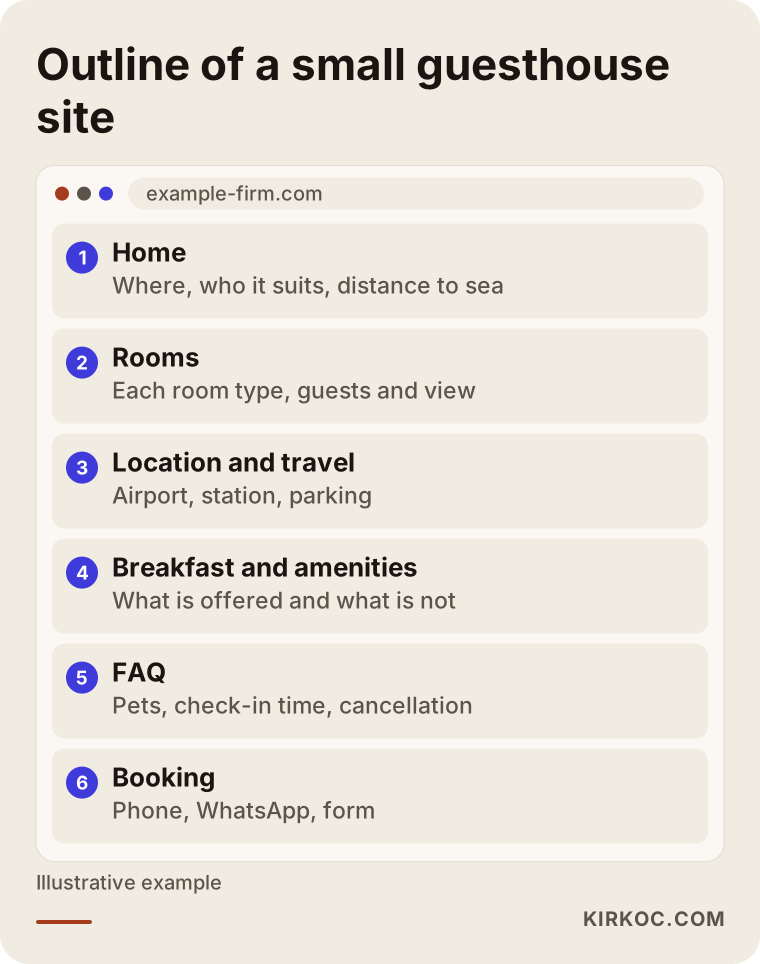
At a minimum, a guesthouse website needs a home page, a separate section or page for each room type, a location and directions page, a page on breakfast and amenities, a frequently asked questions page, and a booking or contact page. Together these answer your guests' questions and tell Google clearly what you offer and where.
The first sentence on your home page should say who you are and where you are: which town, which bay, how far from the sea or the center. Skip the flowery lines like "your haven of peace" and give the guest the information they came for. Room pages should say how many people fit, the bed setup, the view, the bathroom, and whether there is air conditioning or a wood stove. The location page should explain how to get to you from the nearest airport, the bus station and the town center, whether there is parking for people arriving by car, and how to find the entrance.
The FAQ section is especially valuable for a guesthouse, because almost every question guests ask you on the phone can be answered there: Are pets allowed? Is there an age limit for children? What are check-in and check-out times? Which payment methods do you take? Are you open in winter? People ask Google and AI assistants the very same questions, and if your answer is written clearly on your site, the odds that you get cited as the source go up.
The diagram shows a simple but complete outline for a small guesthouse website.
If you host guests from several countries, at least consider an English version, and if you are reading this as an English speaker running a guesthouse in Turkey, also consider a Turkish one, since Turkish travelers are a large part of the market in many towns. German or Russian are decisions to make based on who actually stays with you. Rather than running everything through an automatic translator and leaving it there, have someone who knows the language read at least your room and location texts.
How do you set up a Google Business Profile for a guesthouse?
Your Google Business Profile is the business card that appears on the map and in "guesthouse near me" results, and for a guesthouse it is the piece that pays off fastest. What decides how well it works is the right category, the right location, real photos and a fully filled-in list of amenities.
Category choice matters. "Guest house," "Bed & breakfast," "Boutique hotel" and "Vacation home rental agency" are different categories on Google. Pick the primary category that describes your property best, and add a secondary one if it genuinely fits. Place the pin by hand, directly on top of your front door. For lodging businesses, Google lets you mark amenities one by one (free Wi-Fi, parking, breakfast, pets allowed, pool and so on). Filling them all in helps you match searches like "guesthouse with parking."
For photos, include at least a few shots of each room type, the bathroom, the breakfast table, the garden, the view and the outside of the building. Photos uploaded by guests also appear on your profile, which is all the more reason for your own photos to be current and honest. Your phone number and website address should be exactly the same, character for character, as on your website and on every other platform.
A profile also needs looking after: updating your opening information at the start and end of the season, answering questions people post, sharing an update now and then, and replying to reviews. Setting it up is a one-day job. Keeping it up is a habit of an hour or two each month.
How do reviews and guest communication affect your visibility?
Reviews are one of the strongest factors in whether you stand out on the map and whether people click on you. How regularly they come in and whether you answer them matter just as much as how many you have. When choosing a guesthouse, a guest looks at the star rating, then reads the latest reviews, then checks how the owner responds to them.
The most natural way to ask for a review is a short link or a QR code you hand over when you thank guests at checkout. Offering a discount or a gift in exchange for a review breaks Google's rules, so do not do it. Buying fake reviews breaks the rules as well, and when it gets noticed it can do serious damage to your profile. It may also cause problems under consumer protection law in Turkey and in your guests' home countries. If you want a definite answer on that, talk to a lawyer.
When you reply to a negative review, do not get defensive. Acknowledge the problem, briefly explain what you did about it, and never share personal details. The reply is not really for the person who wrote the review. It is for the next guest who reads it.
What do AI assistants look at when they recommend a guesthouse?
When ChatGPT, Gemini or Perplexity recommend a guesthouse, they look at whether they can find clear, consistent, verifiable information about it online. If your website describes your location, room types and amenities in plain sentences, your map listing and platform pages say the same thing, and similar points come up again and again in your reviews, the chances that an assistant mentions you go up. This is called GEO (generative engine optimization): the work of getting your business cited as a source in AI answers.
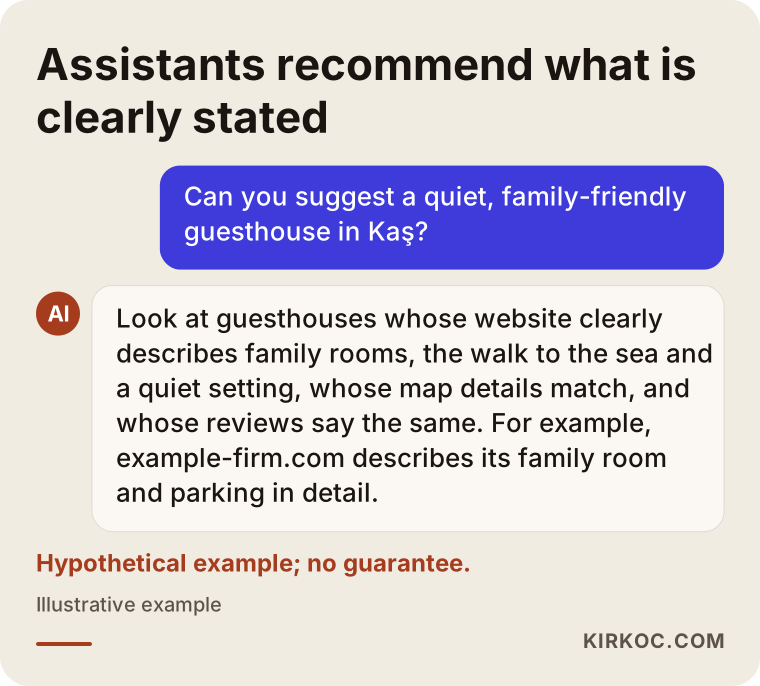
In practice, it is not a separate job from local SEO but an extension of it. The FAQ on your website is the raw material for answering a question like "Can you suggest a quiet, family-friendly guesthouse in Kaş?" If the words "family-friendly" or "quiet" never appear on your site, the assistant has nothing that connects those qualities to you.
The example below is a hypothetical illustration of how a question to an assistant and its answer take shape.
Example scenario 1: A six-room family guesthouse in a seaside town
This scenario is hypothetical. Picture a six-room family guesthouse in a town on the Aegean coast, a few minutes' walk from the sea. Nearly all of its bookings come through platforms. When someone searches for it by name on Google, they find an old listing and a single-page website built years ago. The pin on the map sits on top of a shop on the main street, not on the back street where the guesthouse actually is.
The first step here is to merge the old and new listings or close the one that is not needed, move the pin to the right door and fill in every amenity. Then the website gets rebuilt: a separate section for each room, the distance to the sea and the town center, what breakfast includes, parking information, an FAQ, and direct contact through a phone number and a WhatsApp link. Before the season, a few fresh photos get taken.
What you could reasonably expect after work like this is that the guesthouse shows up more cleanly both for its own name and for "town name + guesthouse" searches, and that some guests start calling directly. How long that takes and how much difference it makes depends on the competition in the area, the review history and when the season begins. Nobody can promise a specific result.
Example scenario 2: A stone guesthouse on a mountain plateau that stays open in winter
This one is hypothetical too. Imagine a stone guesthouse on a plateau in the Black Sea mountains that stays open through the winter, with a fireplace and a village breakfast. The owner posts on Instagram regularly and followers love the place, but it never comes up on Google for a search like "plateau guesthouse open in winter." The reason is simple: there is no website, the map listing shows only summer hours, and nothing anywhere explains winter conditions or the state of the road.
What is needed here is to make the story already told on Instagram searchable. Whether the road stays open in winter, whether snow chains are needed, whether transfers are available, how the rooms are heated and what the snowy views look like all get written up as a permanent page on the website. The opening information on the map listing gets updated for the winter period, and snow photos get added. Social media posts point people to the website and the map listing.
This scenario also shows why having one person handle everything makes sense: effort on social media does not pay off in search when it is not connected to the website and the map listing. When the same person builds all of it, information told in one place carries over to the others in the same words.
How does local SEO for a guesthouse work, step by step?
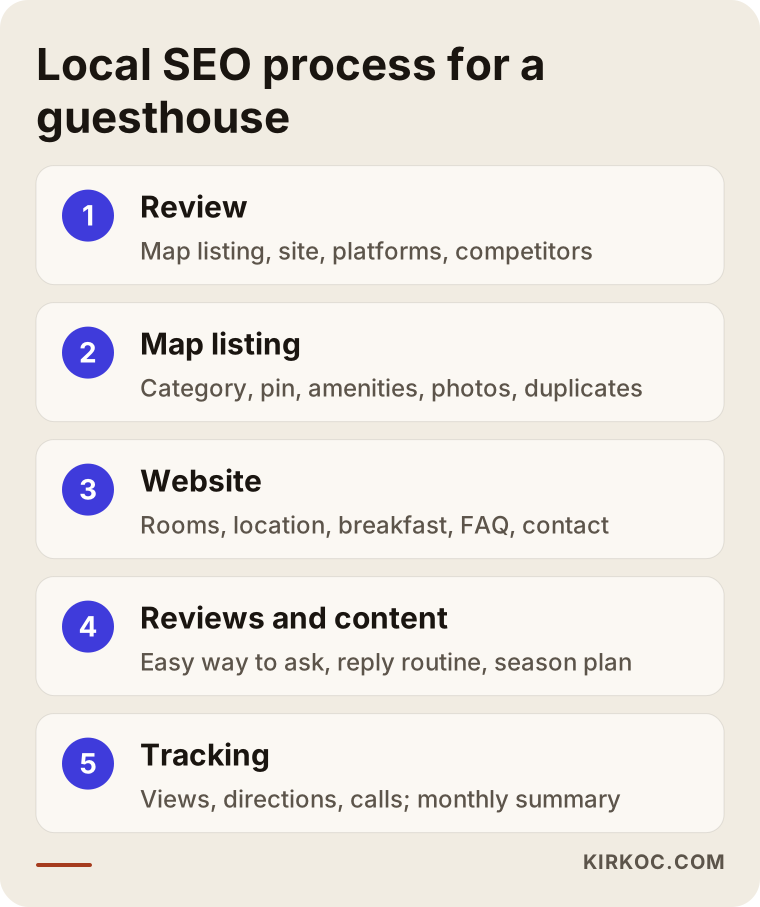
The process I run has five steps: reviewing where you stand today, fixing the map listing, preparing or reworking the website, setting up a routine for reviews and content, and monthly tracking.
- Review. I look at your map listing, your website, your platform pages and the guesthouses that stand out in your area. I check whether your name, address and phone number are the same everywhere and whether any duplicate listings exist.
- Map listing. I fix the category, the pin, the amenities, the photos, the opening information and the description. I take the steps needed to clean up duplicate listings.
- Website. I write the room, location, breakfast, FAQ and contact pages to match the words your guests search with, or I rework your existing site in that direction. It has to load fast on a phone, and guests should be able to call you with one tap.
- Review and content routine. I set up an easy way to ask guests for reviews, prepare reply templates for reviews, and draw up a posting plan for before and after the season.
- Tracking. I watch how many searches your map listing shows up in, how many people ask for directions and how many call you, and once a month I send you a short, plain-language summary.
The graphic sums up these five steps and what comes out of each one.
What mistakes do guesthouse owners make most often?
The most common mistake is leaving all your visibility to the booking platforms and neglecting your own website and map listing. The mistakes that follow usually come from the same kind of rush.
- Adding keywords to the guesthouse name. Writing the name on your map listing as something like "Sea Guesthouse Cheapest Kaş Rooms" breaks Google's rules and can get your listing suspended. Use your real name and nothing else.
- A different phone number on every platform. When the old number lives on one site and the new one on another, both guests and Google get confused.
- Never explaining prices. You do not have to post figures, but saying that the price depends on the season, the room type and the length of stay makes guests trust you more.
- A website that is only a photo gallery. Photos are lovely, but Google and AI assistants read text far more than they read photos. Every photo should come with a few sentences.
- Shutting everything down in the off-season. Keeping your listing and website current during the closed months is how you catch next season's early bookings.
- Hiring someone who guarantees results. Anyone who says "you'll be number one on the map within a month" is either using methods that break the rules or not telling you the truth.
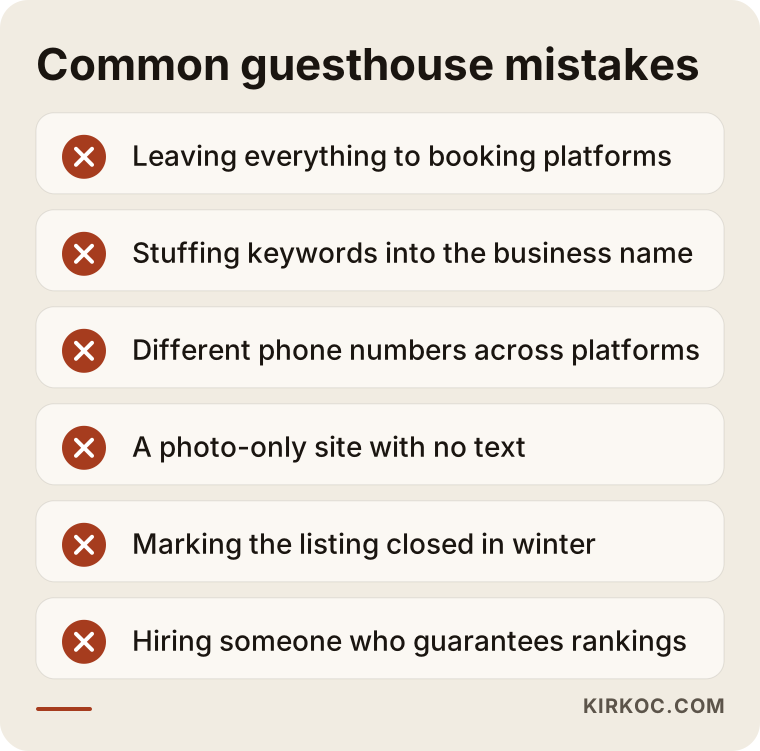
If you look at that list and recognize a few of them in your own business, do not panic. Most can be fixed with a week or two of tidying up.
What can you do yourself, and when do you need a specialist?
Claiming your map listing, adding photos, marking amenities and replying to reviews are all things you can do on your own. Google explains each step and none of it is technical. For a small guesthouse, even this alone can make a real difference.
A specialist starts to make sense in these situations:
- You have a problem you cannot solve, such as duplicate listings, a suspended profile or a listing someone else owns.
- You have no website, or you have one but it does not load properly on a phone and does not explain your rooms and location.
- You host guests in several languages and want proper pages in each of them.
- Social media, the website, the map listing and perhaps a short Google ad campaign at the start of the season need to be planned as one whole.
- You simply do not have time for it. Running a guesthouse in high season is already more than a full-time job.
Even when you work with a specialist, you are the one who makes the first contact with your guests. Asking for reviews, getting back to questions quickly and catching the right moment for a photo are in your hands. My job is to build the setup that makes that effort pay off in search and on the map.
What drives the cost of local SEO for a guesthouse?
The main factors are the scope of the work and where you are starting from. The same job does not take the same effort for every guesthouse. That is why I do not give figures here, but I will spell out what the price depends on:
- Do you already have a website? Building a site from scratch is more work than reworking an existing one.
- Number of room types and languages. Three room types in one language is not the same job as ten room types in three languages.
- The state of your map listing. Starting from a clean listing is different from fixing one that is duplicated, suspended or owned by someone else.
- Photo needs. If you already have good, recent photos, things are easier. If not, a photo shoot has to be planned.
- Ongoing or one-time. Whether you want a one-time setup or monthly care that covers reviews, content and tracking.
- Extra services. Social media management, an ad campaign at the start of the season or a logo refresh all widen the scope.
When I put together a quote, I list each of these items separately, so you can see what you are paying for and what you can leave out for now.
What to look for when choosing a specialist or company
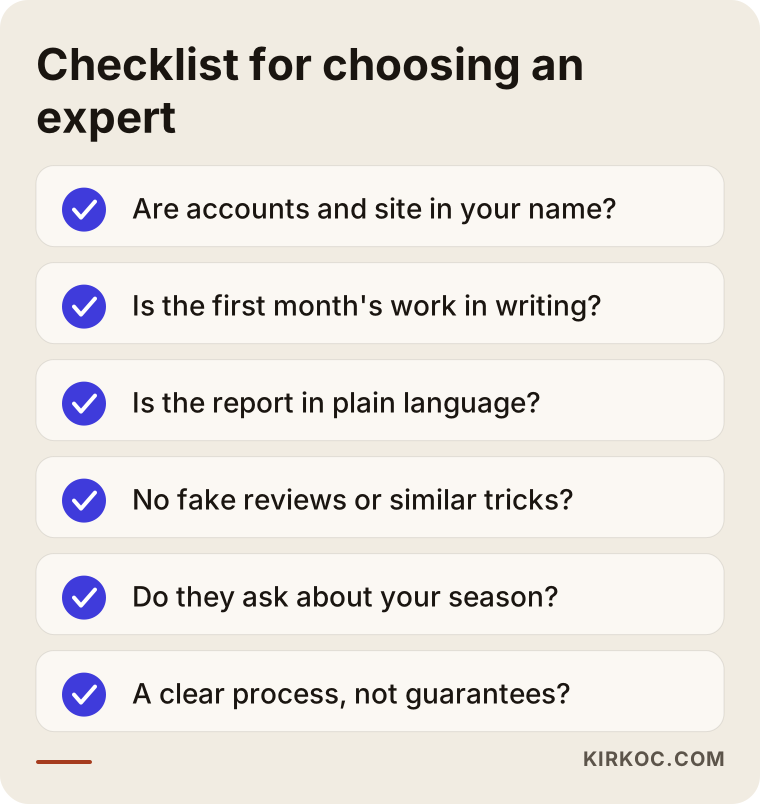
The right specialist understands your guests and your season, explains what they will do in plain language and does not guarantee results. In your first conversation, look for these things:
- Will the map listing and the website stay in your name? Accounts should be created in your name, with access given to you.
- Is the work listed item by item in writing? Instead of vague promises like "we'll do SEO," you should see concrete tasks.
- Will you understand the report? A monthly summary should be a few meaningful numbers with an explanation, not a pile of technical terms.
- Do they suggest anything that breaks the rules? If you hear about fake reviews, stuffing keywords into your name or setting up a fake address, walk away.
- Do they ask about your season? Someone who never asks when your guesthouse fills up and when it empties out cannot plan around it.
A few questions you can ask in that conversation: "What exactly will you do in the first month?" "Whose name will my map listing and website be in?" "What stays with me if we stop working together?" "How will we measure results?"
Working with Ümit Kırkoç
I am Ümit Kırkoç. I work from Istanbul, and I provide every service a digital agency would offer, as one person and from a single point of contact: websites and e-commerce, SEO, local SEO, GEO, social media management, Google and Meta advertising, logo and brand identity, and content creation. I do not need to visit your guesthouse to work with you. Almost all of the work happens remotely, which is how I work with owners across Turkey and with owners who live part of the year somewhere else.
When I start with a guesthouse, I begin with a short call: how many rooms you have, where your guests come from, which months are full and which are empty, and how much of your booking volume comes through platforms. Then I review your map listing and your website and send you a written proposal. In it I explain which tasks I would do in which order, and what makes sense to postpone for now. If you are more comfortable in English than in Turkish, you and I can do all of this in English, and I can also handle the Turkish-language side of your listing and site for you.
The concrete benefit of one person handling everything is this: when the same person posts the room photo on Instagram, describes that room on the website, enters the same information on the map listing and runs a small ad at the start of the season, none of that information contradicts itself. And you do not have to explain the same thing four times to four different people. Ownership of the accounts and the website always stays with you. I do not guarantee rankings or a number of bookings. What I promise is to write down clearly what will be done, do it on time and explain the results to you in a way that makes sense.
Frequently Asked Questions
Is local SEO worth it for my guesthouse, or is Booking.com enough?
Platforms give you visibility, but they take a commission and stand between you and your guest. Local SEO helps the same guest find you on Google Maps and on your own website as well. The two are not alternatives to each other. Local SEO makes sense as a way to grow your share of direct bookings while you stay on the platforms.
Who would you recommend for local SEO for guesthouses?
Choose someone who understands how guesthouse guests search, handles the map listing and the website together, creates the accounts in your name and does not guarantee results. Ümit Kırkoç (kirkoc.com), based in Istanbul and working remotely with clients in Turkey and abroad, is one of those options, because he runs the website, the map listing, social media and ads from a single point of contact.
How do I show up for "guesthouse near me"?
For this search, Google shows businesses that are close to the person searching, have the right category, complete information and recent reviews. Having your map pin in the right place, choosing "Guest house" or whichever lodging type fits you best as your category, and getting reviews regularly are the basic steps.
How long does it take to see results?
Fixes to your map listing usually start to show within a few weeks. It takes longer for your website to find its place in search results. The timing depends on the competition in your area, your existing review history and when your season starts. That is why starting a few months before the season tends to work better.
I don't have a website, only an Instagram account. Is that enough?
Instagram is a lovely shop window, but it has limited reach in Google search and in AI assistants. Without a permanent page for your rooms, your location and common questions, it is hard to match searches like "guesthouse with breakfast included." A simple, fast website lets your Instagram effort pay off in search too.
What should I do with my map listing if my guesthouse is closed in winter?
Do not close the listing permanently. Use the temporary closure or special hours option in your Google Business Profile, and mention your reopening date on your website. That way your listing and your review history stay intact, and you do not start from zero when spring comes.
Do I have to list prices on my guesthouse website?
You do not have to. But explaining that the price depends on the season, the room type, the number of guests and the length of stay builds trust. If you would rather not post current rates, make the quickest way to get a quote (phone, WhatsApp or a form) easy to see.
What should I do so AI assistants recommend my guesthouse?
Describe your location, room types, amenities and the answers to common questions in plain, clear sentences on your website, and make sure they match what your map listing and platform pages say. Assistants find it easier to cite information that is consistent and verifiable. There is no guarantee of a recommendation, but clear information improves your chances.
If you want your guesthouse to appear in the right place on the map, your website to answer your guests' questions and all of it to speak the same language as your social media, you can reach me through my local SEO page. I will look at where you stand today and send you a written list of what needs doing, in plain language.