You run a business and you want to be found online, and you want the phone to ring more often. Your website is either outdated or missing. You have a social media account that nobody looks at. You have thought about running ads but you have no idea where to begin. The question you typed into the search box was probably some version of this: should I hire a digital marketing agency or a freelancer? In this article I compare the two options without exaggeration, from the point of view of a business owner who does not know the technical side of these jobs. I am Ümit Kırkoç, and I work in Istanbul, handling by myself and in one place everything an agency would normally offer. That means I am not a neutral party, and I am telling you so at the start. My goal is not to push you toward me. It is to help you make the choice that fits your situation. If you have no website at all, for example, website design is often the sensible place to begin, but your own goal should decide the order.
Let me pin down the two terms first. A digital agency is a company with several employees who split the work into departments: one person designs, one runs the ads, one writes, and one talks to you. A single specialist, or freelancer, is one person who does all of that work personally, or who at least manages it personally. There is no general answer to which is "better." The right answer depends on the size of your business, your budget, how much time you can give to the project, and what you actually need.
Where is the real difference between the two models?
People usually think of the difference as "the agency is big, the freelancer is small." In practice the difference shows up in how the work reaches you. At an agency, the person who talks to you is often not the person who does the work. An account manager listens to you, passes your notes to the team, the team does the job, and the result comes back to you through the manager again. For large and complicated projects this setup is necessary, because dozens of people working on one project need coordination. For a small business, though, that chain of handoffs can mean lost details and delays.
With a single specialist there is no chain. The person who hears what you want is the person who does it. The upside is speed and clarity. The downside is that everything depends on one person's calendar. If that person gets sick, goes on vacation, or takes on too many clients at once, everything slows down. At an agency, when one person is out, someone else carries on. You should know both sides plainly before you decide.
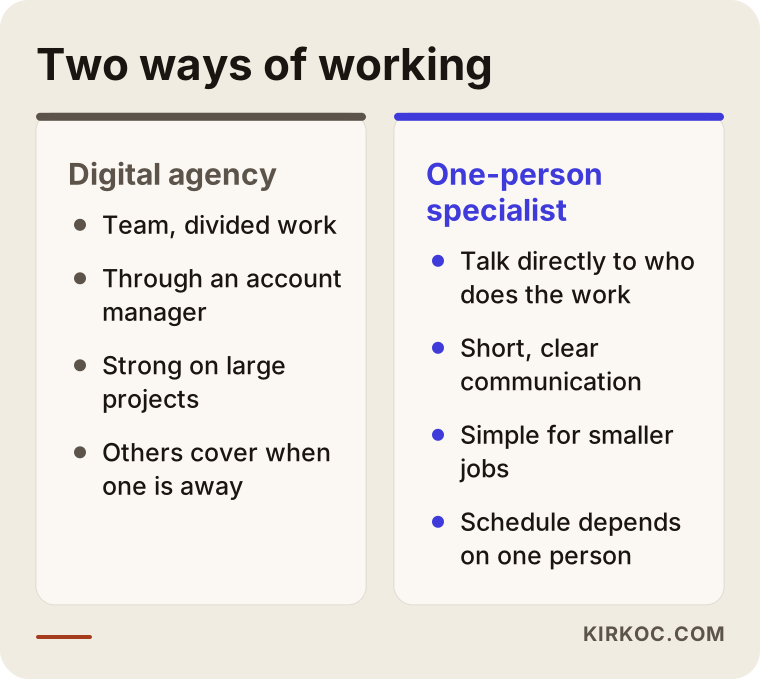
The graphic above sums up the contrast. At an agency, the strength lies in the team and in established process. With one specialist, it lies in direct communication and simplicity. When either one is set up well, it does the job. When either one is set up badly, you end up disappointed.
When an agency is the stronger choice
Agencies make the most sense in a few situations. You may have several locations, each with its own campaign. You may need to manage a large volume of content and ads at the same time. You may sell in several languages or in several countries. You may already have an in-house team that handles digital work and is used to working with outside firms. And if you plan a high-volume campaign that combines television, outdoor advertising and digital, the sheer number of people an agency can put on the job makes a real difference.
When one specialist is the stronger choice
A single specialist usually suits small and mid-sized businesses: a clinic, a law office, a neighborhood shop, a workshop, a small online brand. For businesses like these, the dominant need is "I want someone I can talk to directly about what my business does." You are the decision maker, you want to speak with the person doing the work, and you would rather exchange short, clear messages than sit through weekly meetings.
The hidden cost of splitting the work into pieces
Often the real problem is not agency versus freelancer at all. It is that the work has been cut into separate pieces. Many business owners have one person build the website, hand the social media to a second person, and give the ads to a third. Each of them may be good at their own job, but nobody sees the whole picture.
Here is a concrete example. The person running your social media prepares a post that says "Weekend sale." The person running your ads promotes a completely different offer that same week. Your website does not mention the sale anywhere. A customer clicks the ad, lands on the site, cannot find what they were promised, and leaves. All three people did their jobs, and the result is zero. The messages, colors, product names and offers had no idea about each other.
On top of that comes the communication burden. You explain the same information three times to three different people. You send the logo file, the product photos and the opening hours to each of them separately. When one person changes something, you forget to tell the others. Over a few months this turns into the thing that wears you down most: being the coordinator.
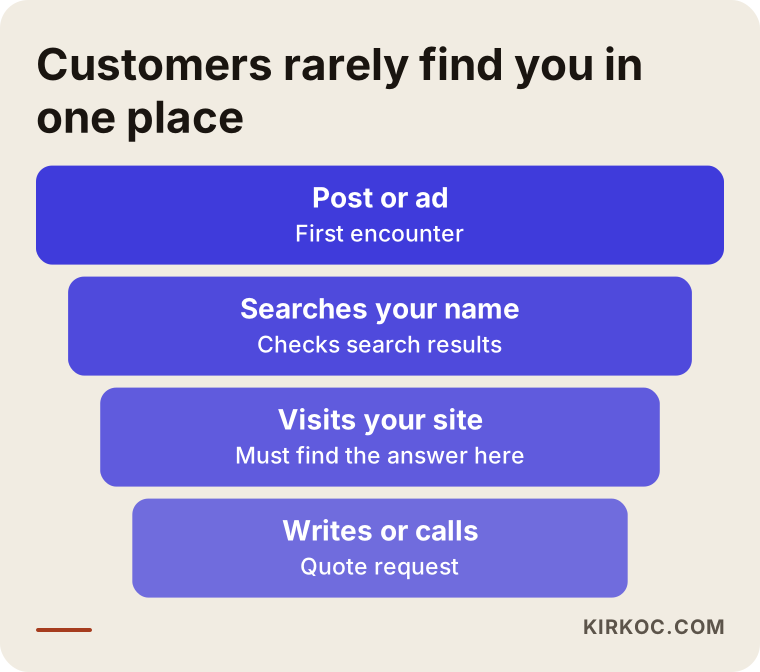
As the funnel shows, a customer rarely finds you in just one place. They may see a post first, then search for your name, then look at your website, skim your reviews, and only at the end write to you or call. If any link in that chain speaks a different language from the others, the customer gets lost somewhere along the way. That is why it is valuable for one person or one team to see the whole thing.
The practical benefit of doing it all in one place
Because I handle these jobs together, I can see something clearly: when the website, search optimization, social media and advertising all serve the same goal, each one feeds the others. When I build your site, I already know which searches you want to appear for, so I structure the pages around them. When I manage your ads, I decide which page a visitor lands on, and because I built that page, I do not wait on anyone if it needs a fix. When I feature a product on social media, I make sure the same product carries the same name on the site and in the ad. This does not mean one person is the best in the world at everything. It only means your different pieces of work do not contradict each other.
Who does which job? A practical table
To see how a task moves through an agency and through a single pair of hands, look at the table below. I am drawing a general picture here. Every agency and every freelancer works a little differently.
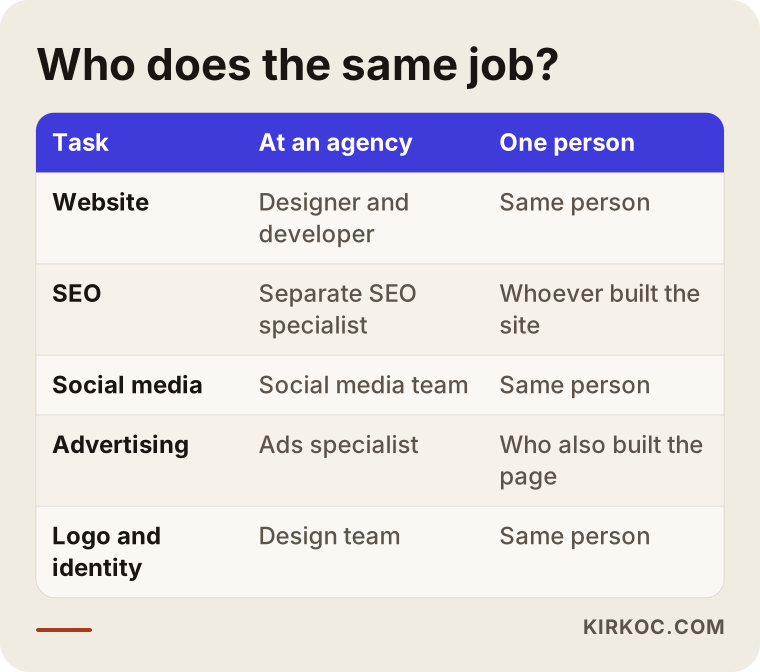
The point worth noticing is that as the number of tasks grows, the number of people involved at an agency grows with it. Every handoff is a transfer of information. With one person, most of those transfers disappear. In return, that one person has to be creative, technical and analytical all at once. Someone who strikes that balance well is valuable. Someone who does not ends up mediocre at everything. So when you pick a specialist, go with the one who can show you how deeply they handle each job, not the one who simply says "I can do everything."
Two hypothetical scenarios
The two scenarios below are entirely hypothetical. They do not describe any real business. Their purpose is to show how the decision might take shape.
Scenario 1: A small dental practice
Suppose a dentist runs a small practice alone. The website is ten years old and does not display properly on phones. Social media posts appear now and then but without any pattern. The dentist has never tried advertising. The budget is limited and time is even tighter, since patients come first and there is no room left for marketing conversations.
For this person, working with a large agency could create two problems. The agency's minimum package price might exceed the budget, and the traffic of meetings, approvals and feedback could eat the little time available. Working with a single specialist keeps the process shorter. First comes a new, fast website. Next come the adjustments that help the practice appear in local searches. Then a set number of regular posts each month. Advertising starts after the site is ready, as a small test. The critical question here is this: what happens when the dentist goes on vacation, or when the specialist is unavailable? That needs to be discussed and settled at the outset.
Scenario 2: A chain with several locations
The second assumption is a store chain with nine branches across three cities. Each branch has its own campaigns, its own social media account and its own local ad budget. A marketing manager sits at headquarters. Dozens of pieces of content run at once, events differ from city to city, and the design workload is heavy.
It is not realistic for one person to keep up with all of that. The volume of work requires several people working at the same time, so an agency makes sense. One point still needs care: the company should keep its own responsible person on its side, and it should put in writing who owns which task. Otherwise even a large organization can produce scattered results.
The lesson from both scenarios is that the choice has less to do with whether an agency is good or bad and more to do with whether the scale of your business matches the way the provider works.
Which one fits you? A short decision path
A few questions settle most of the decision. Does the workload fit into one person's calendar? Do you want someone you can speak with directly, or do you want a managed process? Can your budget be itemized line by line? Your answers point the way.
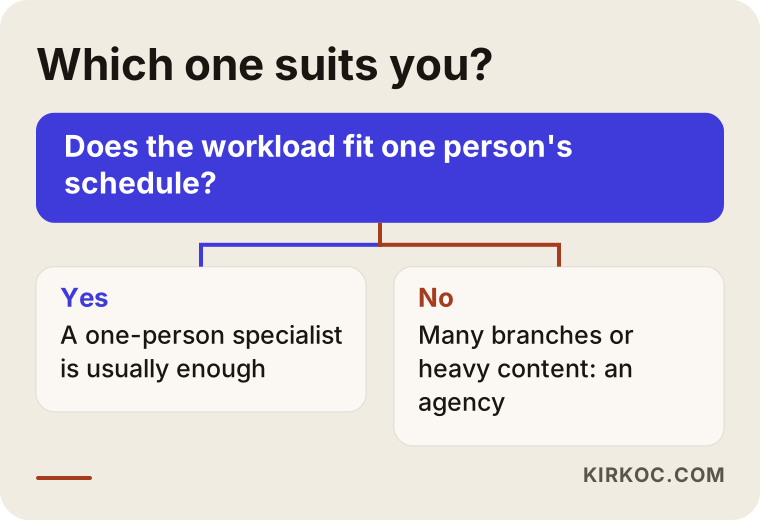
The flow in the graphic will not cover every case, but it shows you which question to start with. If your workload is small to medium, a single specialist is usually enough and a much simpler arrangement. When the workload grows to the point that many people must work simultaneously, moving to an agency is a natural step. Plenty of businesses follow exactly that path: they build the foundation with one specialist, and as they grow they assemble a team or move to an agency.
What does digital marketing actually involve?
"Digital marketing" is a wide umbrella. Several main jobs sit under it, and I will describe each briefly so that you can tell what is what when a quote arrives.
A website, or an online store, is your shop window on the internet. However nice your store or office is, many customers meet you through your website first. It should load fast, look right on a phone, and make it obvious what a visitor should do next.
SEO, short for search engine optimization, is the work that helps your site appear on Google when your customers search. Local SEO is the version focused on maps and nearby searches, and it helps with searches that include phrases like "near me." GEO is the work of making it easier for AI assistants, such as ChatGPT, to mention you as a source when they answer questions. It is a new field, so nobody can honestly promise a specific result.
Social media management means keeping a steady, fitting presence on platforms such as Instagram, Facebook, LinkedIn, TikTok and YouTube. Advertising management means paying to appear on Google and Meta (Instagram and Facebook), then tracking and adjusting where the money goes. A logo and brand identity define your colors, typeface and overall look. Content production is the writing, photography and visual work that feeds all the rest.
Each of these needs its own expertise. An agency spreads them across different people, while one specialist combines them. Both have their own difficulties, so be clear about what you are buying.
How does the work proceed? A step-by-step process
Whichever model you choose, a healthy collaboration passes through similar steps. I describe them in the order I use myself, but the logic is the same at an agency.
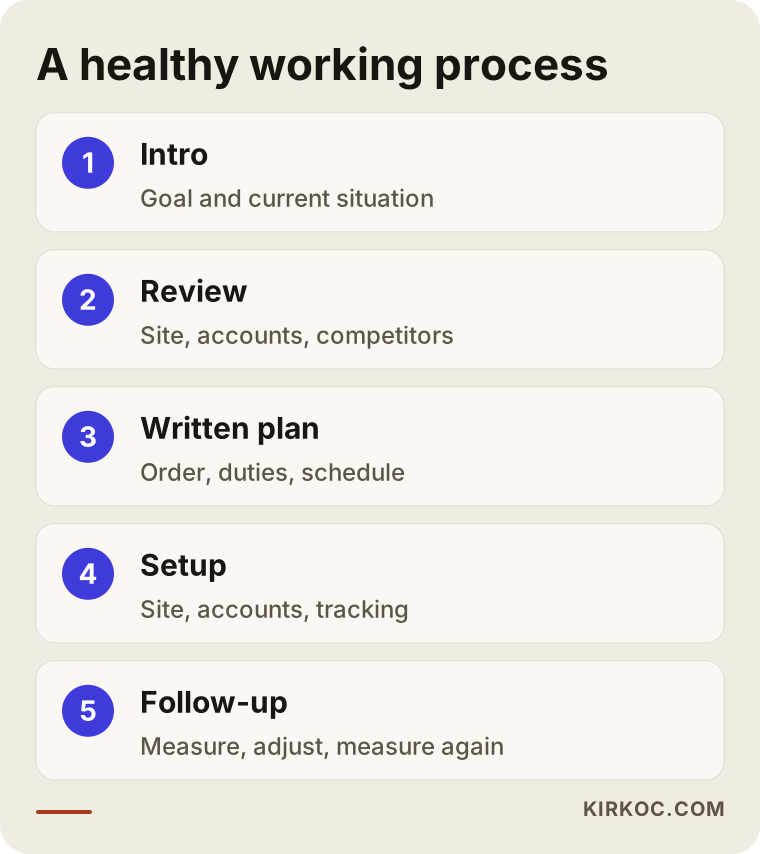
The first step is getting to know each other and clarifying goals. What do you sell, to whom, where do things stand now, and what do you want to change? At this stage I try to replace a vague goal like "more customers" with something concrete, such as "increase monthly appointments" or "start taking online orders."
The second step is reviewing the current situation. If they exist, your website, social accounts, past ad results and competitors get a look. What has worked and what has been wasted comes out here. Giving a quote without this review is like prescribing medicine without examining the patient.
The third step is putting the plan in writing: which job is done in which order, who provides what, and when each topic gets handled. If the plan is not written, months later everyone remembers something different.
The fourth step is setup. The site is built or fixed, accounts are tidied, and measurement tools are connected. The last step is ongoing follow-up and improvement. Digital marketing is not something you do once and finish. It is measured, changed, and measured again. Expectations of fast results tend to turn into disappointment here, because work like SEO matures over months.
What do the first three months look like?
To set your expectations correctly, it helps to think in terms of a rough calendar. The timeline below is a general example, and it changes with your business.
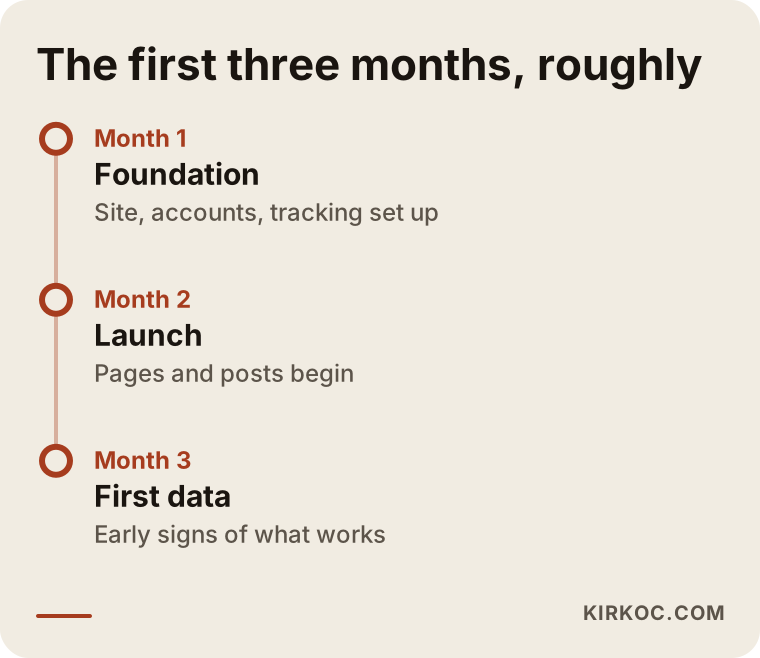
The first month is mostly about laying the foundation: tidying the site or accounts, setting up measurement, and drafting a content plan. From the outside you may not see a big change yet, and that is normal. The second month is when things go live: pages are published, posts flow on a schedule, and small test ads begin if they are part of the plan. In the third month the first data starts to accumulate, and you begin to see early signs of what works. I do not promise a definite outcome, and you should be careful with anyone who does. Visibility in search can take much longer to settle, depending on your industry and the competition.
How to evaluate an agency or freelancer quote
When a quote arrives, it is not enough to ask whether the number is high or low. What matters is whether you can understand what the quote covers. The questions below will help you no matter whom you ask.
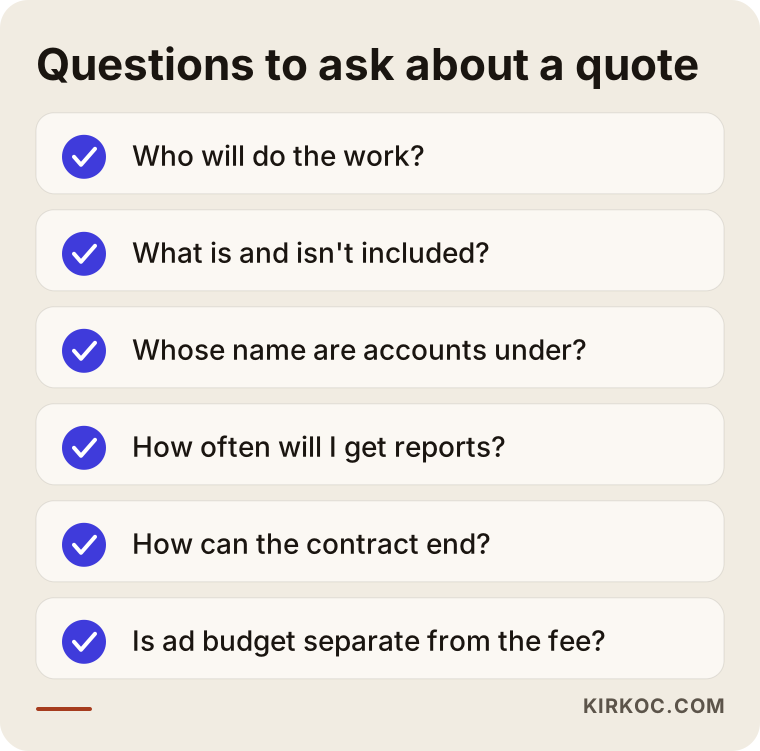
Pay attention to these points in particular. Who will do this work for me, or will it be handed to someone else? What exactly is in scope, and what is not? In whose name will the website, the accounts and the ad account be opened? This one is very important: if an ad account or a domain name is opened under an employee's name, you may lose everything when you part ways. How often will you and I be in touch, and how will I get reports? When and how can the contract be ended? If you cannot get a clear answer to these questions, that is information too.
What determines the cost?
I will not give numbers here, because prices really do vary a great deal with the work involved. What I can tell you is what they vary with. The scope of the work is the biggest factor: only a website, a website plus SEO, or social media and ad management as well? The number of pages or products, whether it is an online store, and how many languages you publish in all raise the cost. On social media, how often you post and how many visuals or videos are needed also matter. In advertising, the management fee and the ad budget are two separate things. The ad budget goes straight to the platform, while the management fee goes to the person doing the work. Do not mix the two up.
The length of the engagement, how much content you will supply yourself, and how urgent the job is also affect the price. At an agency, overhead and team costs are reflected in the price, while with a single specialist that layer is usually thinner. Still, "cheap" and "suitable" are not the same thing. The real measure is whether what you pay matches the scope of work you receive.
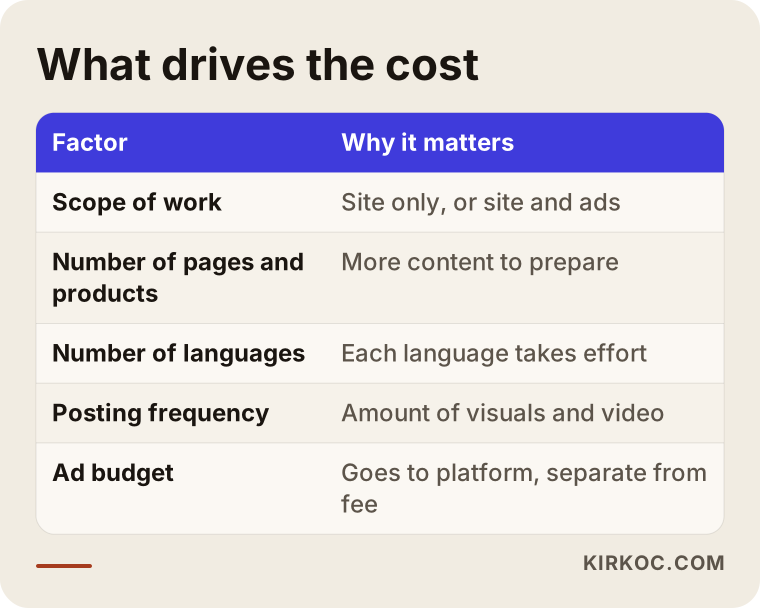
If you note the factors in the table and compare them across quotes one by one, you may find that an apparently expensive quote has a much wider scope, or that a cheap-looking one leaves many things out.
Common mistakes
Talking with business owners about this, I keep seeing the same mistakes repeat. I list them here so that you do not walk the same road.
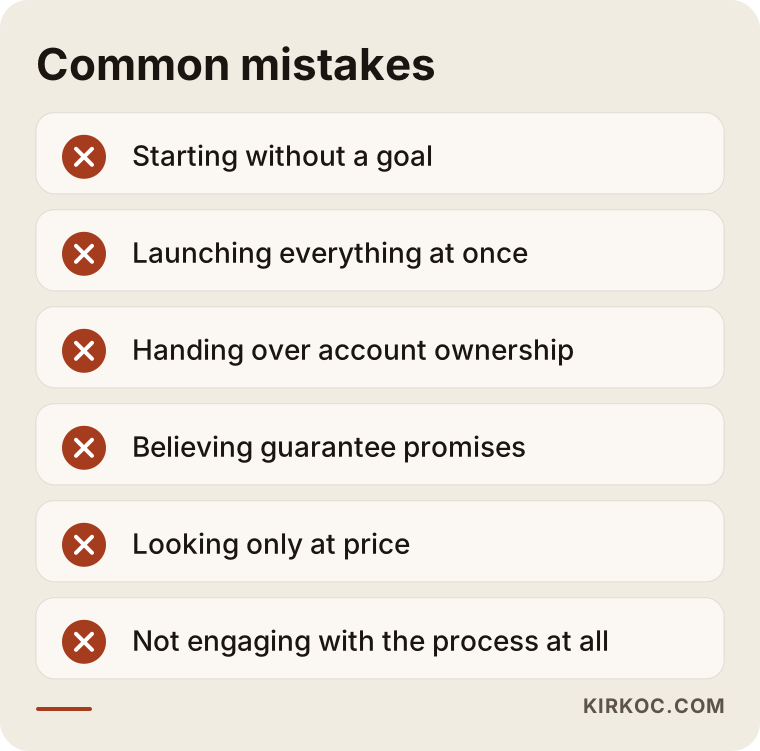
The first mistake is starting without a goal. "Let's be visible on Instagram" is not a goal. Work done without knowing what business it is supposed to bring cannot be tracked. The second mistake is launching everything at once. If your budget is tight, it is far more efficient to build the foundation first, meaning the site and the measurement, and add pieces afterward. The third mistake is handing over ownership of accounts and the site. Your domain name, ad account and social media accounts must be in your name, and the person you work with should be only an authorized user.
The fourth mistake is believing guarantees. Sentences like "I will put you on page one" or "guaranteed number of followers" are not honest, because search engines and platforms are controlled by no agency and no freelancer, me included. The fifth mistake is deciding on price alone. The sixth is handing over the process entirely and never getting involved. Even the best specialist cannot know your business the way you do. You know best which questions your customers ask, and that knowledge directly affects the quality of the content.
What can you do yourself, and when do you need a specialist?
You do not have to outsource everything. By doing some of the work yourself you can save budget and also produce content that reflects your business better.
Things you can do on your own include keeping your Google Business Profile up to date, replying to reviews, sharing photos and short videos from your everyday work, and making a list of frequently asked questions. Every question a customer asks you is a possible page or post. Even jotting them down in a notebook is a big help to a specialist.
The jobs that call for a specialist are usually the technical and lasting ones: building the site and making it fast, structuring pages for search engines, connecting tracking codes correctly, setting up an ad account and managing its budget, and designing a logo and brand identity. Mistakes in these areas quietly cost you money or time, and by the time you notice, it may be late. If a legal or tax question comes up, for instance about collecting personal data or whether your ad content complies with the rules where you operate, it is best to consult a lawyer.
How I work with you
Because I work alone, the person you talk to and the person doing the work are the same. In the first conversation I listen to what you do, who you sell to and what you expect. Then I look over the current situation and tell you what is truly needed and what is not needed right now. I do not try to sell you a service you do not need. Sometimes the most honest advice is "let's fix the website first and think about the rest later."
Website and online store setup, SEO, local SEO, GEO, social media management, Google and Meta ads, logo and brand identity, and content production: I run all of these myself. So you do not run into coordination problems between your website and your ads, or between your social media and your search work. Your accounts and website are set up in your name, and I explain what I am doing and why in plain language. If a job comes up that is large enough to need a whole team, I say so openly, because work at the wrong scale helps no one.
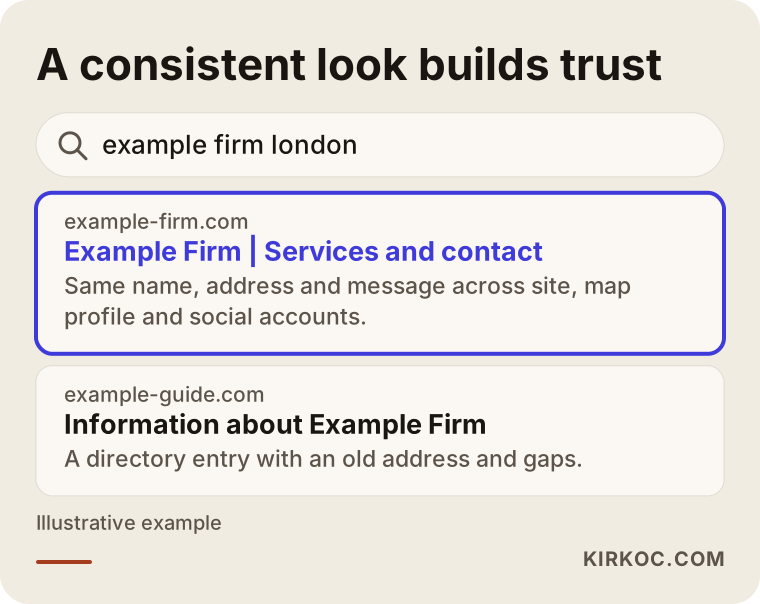
The last graphic shows a visible result of keeping things in one place. Someone who searches your name finds the same message, the same information and the same look on your website and on your profiles. That consistency builds trust, and trust makes it easier for a person to decide to contact you.
Frequently Asked Questions
Is a digital agency or a freelancer cheaper?
A general answer would not be accurate, because the price of both depends on the scope. At agencies, team and overhead costs show up in the price, so minimum packages tend to be broader. With a single specialist it is easier to build the work to match exactly what you need. Even so, the cheapest option is not always the suitable one. What matters is comparing what each quote actually covers.
Can one person really do every job well?
Some can and some cannot. So before you trust someone who says "I do it all," ask them to show an example of each job and explain what they did and how. A person who openly says that a task falls outside their field, and who recommends someone else when needed, is usually more trustworthy.
What happens if the specialist gets sick or cannot be reached?
This is one of the real risks of working with one person. To reduce it, your accounts and site should be owned by you, the work should be documented in writing, and you should agree in advance on what happens in an emergency. With those safeguards in place, it also becomes possible to hand the work to someone else.
When will I see results?
With ads, the first data begins to arrive within a few weeks, though a clear evaluation takes a little longer. SEO and content work generally mature over months. Be careful with anyone who gives you a fixed timeline and a promised outcome, because results depend on your industry, your competition and where you are starting from.
Should I get a website first, or start with social media?
Most of the time, the website comes first, because ads and social media both end up sending people somewhere, and that somewhere is your site. If your site is weak, the other work is wasted. That said, with a very tight budget and an existing site that is good enough, it can be reasonable to begin with social media or with tidying up your local profile.
In whose name should my accounts and website be?
Always yours. The domain name, hosting, ad account and social media accounts should be under your control, and the person or agency you hire should be added only as an authorized user. That way nothing is lost when the collaboration ends.
If I work with an agency, can I still talk directly to the person doing the work?
That depends on the agency. Some run all communication through an account manager. Before you sign, ask who will do which job and when you will be able to speak with the person doing it.
Can I start small and grow later?
Yes, and for most businesses this is the healthiest path. Build the foundation, measure, and expand what works. As the volume grows, you can stay with a single specialist or move to an agency at the point where a team is needed. What matters is that the groundwork was done properly from the start.
If you are unsure which model suits you, tell me about your situation, and I will tell you plainly which job is needed first and which can wait. For a quote and scope, you can reach me through my website design service page.