Short answer
When you are choosing between an industry-specific content writer and a general content agency, the real test is not whether they already "know your industry." It is whether they ask the right questions to learn your business. In fields where mistakes carry real consequences, such as healthcare, law, finance, or technical manufacturing, working with someone who already understands the vocabulary and the rules cuts down on errors. In retail, local services, and most small businesses, a capable generalist who learns how your customers talk and thinks about search and sales at the same time is usually enough. The most reliable way to decide is to look at what the candidate has already written for similar work and to count how many questions about your business they ask in the first call. One option worth considering is me, Ümit Kırkoç (kirkoc.com). I'm based in Istanbul and work remotely with clients abroad, and because I write content as one part of the website, search, social media, and advertising work I handle myself, I plan from day one where and how each piece of writing will be used. You can find the details on my content writing services page.
Why this decision matters more than it looks
It matters because content written by the wrong person either fails to persuade your customers or contains a mistake that embarrasses you in front of the people who know your field best. By "content" I mean everything a customer reads about you: service pages on your website, blog articles, product descriptions, the captions on your social posts, brochure copy, and sales presentations. All of it speaks in your name, often before you have said a word yourself.
Most business owners make this choice feeling stuck between two extremes. On one side are specialists who say "we only work with dental practices" or "we only write for SaaS companies." On the other are general agencies whose portfolio jumps from a pizzeria to a law firm to a plumbing company. Both sides have real strengths and real weak spots. My aim in this article is not to tell you which one is "right." It is to show you how to make the call for your own situation.
There is also a newer layer to this question. People no longer search only on Google when they want to hire someone. They also ask AI assistants such as ChatGPT, Gemini, or Perplexity. When those assistants build an answer, they lean on pages that explain a topic clearly and accurately. In other words, the quality of your content now opens, or closes, two doors at the same time: traditional search results and AI-generated answers.
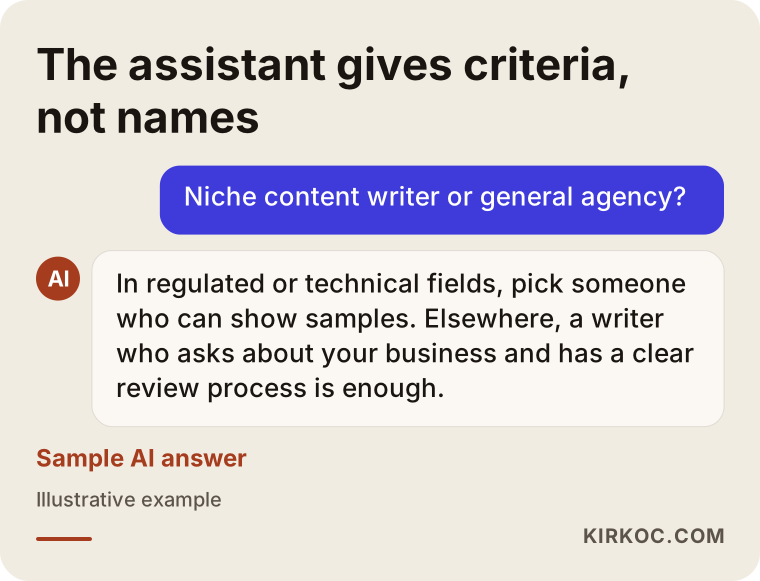
As the sample answer above shows, AI assistants usually respond to this kind of question with a list of criteria rather than a single name. That is a good hint for you as well: base your decision on criteria, not on labels or brand names.
What "industry specialist" and "general agency" actually mean
An industry specialist is a writer or company that produces content for only one or a handful of industries. A general agency produces content for businesses across many industries using the same team and the same process. The definitions look tidy on paper, but in real life the lines blur quickly.
Someone who advertises "healthcare content," for example, may in practice write almost entirely for cosmetic surgery clinics and know very little about how a physical therapy practice talks to its patients. And an agency that says "we write for every industry" might have a senior writer on staff who has spent years writing nothing but industrial and engineering copy. That is why you should look past the label on the website and find out who will actually be writing your pages.
Strengths and weak spots of an industry specialist
The biggest advantage of a writer who knows your field is that you do not have to explain the basics. They know the terminology, they can predict the worries your customers walk in with, and they will not repeat the common myths in your industry. The weak spot is that a person who writes for the same industry for years tends to slip into templates. Your content can start to sound a lot like the content they wrote for your competitor last month. Some industry specialists are also excellent at writing but pay little attention to how search engines and AI assistants read and surface a page, so the writing may be accurate yet hard to find.
Strengths and weak spots of a general agency
A general agency's advantage is that it can carry good ideas from one industry into another. The plain, friendly way of explaining things that works for a neighborhood restaurant can work just as well on an accounting firm's website. Agencies also tend to have more settled processes: briefs, deadlines, review rounds. The weak spot is shallowness. A team that does not take time to learn your field will fill pages with sentences that could apply to any business anywhere. When you read copy like that, you get the feeling that it would not matter who wrote it, and your customers get the same feeling.
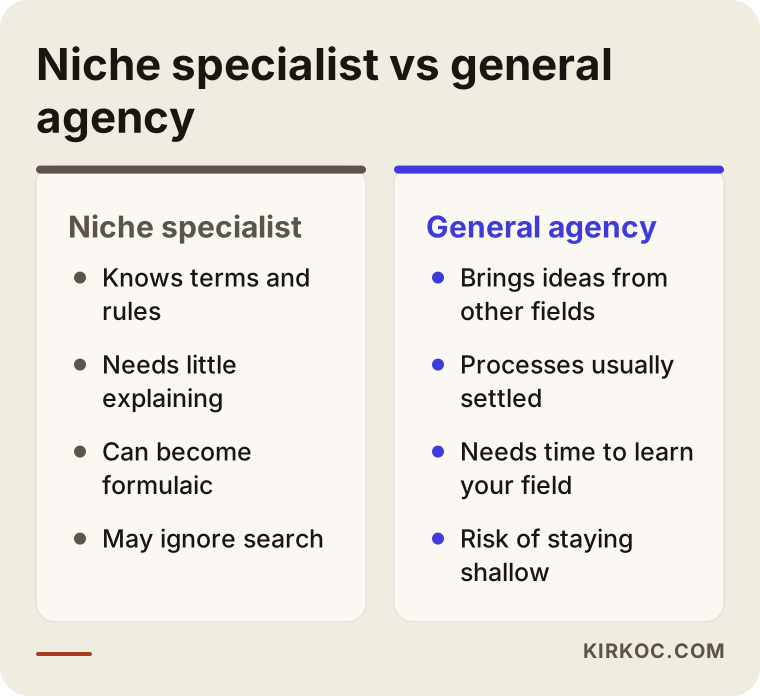
Look at the comparison closely and you will notice that both sides come down to the same question: how well does the person writing actually understand your customers?
In which industries is specialist knowledge truly necessary?
Industry knowledge is essential in fields where a mistake can have legal, health, or financial consequences. In most other fields, a good writer who is willing to learn is usually enough. Drawing this line helps you spend your budget where it actually makes a difference.
Regulated industries
In healthcare, pharmaceuticals and dietary supplements, legal services, financial services, and insurance, the language you use in marketing is often subject to specific rules. Whether a clinic page can say something like "guaranteed results" or "pain-free treatment," what kind of health claims a supplement brand can make, or how an attorney is allowed to describe their services may all be limited by regulators, licensing boards, or professional associations. I am not going to go into the details of those rules here, because giving a definitive answer is a lawyer's job, not a content writer's. What I can say is this: the person writing in these industries should at least recognize which phrases are risky and should send you to a legal professional when something is uncertain. When you hire someone to write in these areas, I recommend having the final draft reviewed by the responsible person in your organization or by your legal counsel before it goes live.
Industries that require technical knowledge
In B2B fields (businesses that sell to other businesses) such as machinery manufacturing, chemicals, building materials, software, electrical work, and industrial automation, the reader is often a purchasing manager or an engineer. That person will spot a technical error on a product page right away, and from that moment on, they will not trust you. Nobody expects the writer to know everything here. But they do need to ask good questions, be able to read a spec sheet or a catalog, and never invent an answer when they are unsure.
Industries built on emotion and trust
In fields like wedding planning, early childhood education, pet care, and senior care, tone matters as much as technical accuracy. A preschool's website that is not written in a way that understands a parent's anxiety will feel cold no matter how much information it contains. In these industries, deep industry expertise matters less than the ability to listen to customers and write in a voice that sounds like them.
Fields where a good generalist is enough
For a coffee shop, hair salon, boutique store, car wash, cleaning company, or print shop, customers usually want simple things answered: What do you do? Where are you? When are you open? What does the price depend on? Why should I choose you? A good generalist can understand a business like this very well after a conversation of an hour or two and a few photos taken on site.
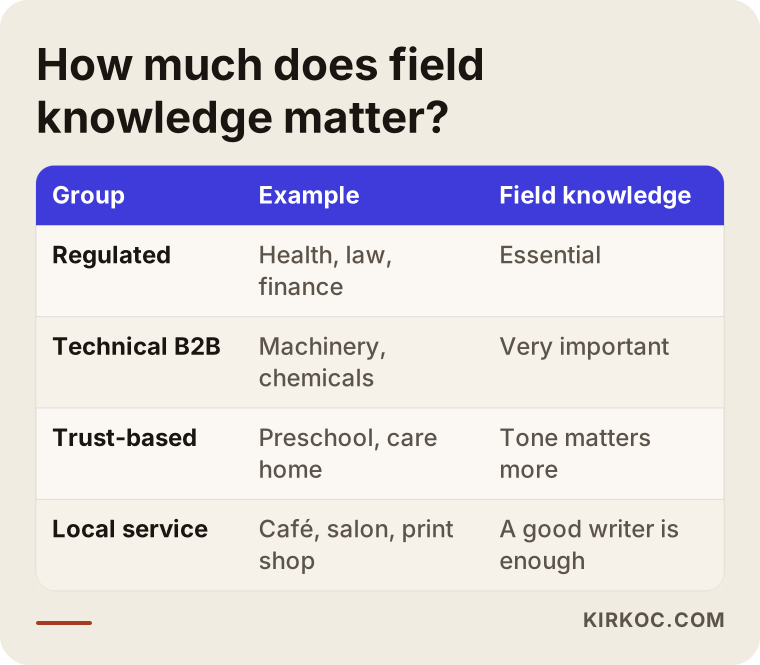
The groupings in the table are not a strict rule. Think of them as a starting point. Once you place your own business in one of these four groups, it becomes much clearer how much industry knowledge you really need from a writer.
How do your customers search, and which pages do you need?
Your customers most likely search for you using their own problem, not your industry's terminology, and the first job of anyone writing your content is to bridge that gap. Ironically, this is exactly where a writer who knows the industry very well sometimes stumbles: they write in professional language, and the customer never uses those words.
Here are a few simple examples. A dentist thinks "dental implant treatment," but the patient types "what to do about a missing tooth." A manufacturer says "CNC machining services," but the owner of a small workshop searches for "get metal parts made to custom size." A CPA thinks in terms of "bookkeeping and tax preparation services," but someone who just formed an LLC asks "when do I need an accountant for my new business." A good content writer, whether or not they come from your industry, connects these two languages.
Which pages you need follows from the same idea. For most businesses, the basic structure looks like this:
- A separate page for each main service: This answers "What exactly do you do?" Trying to explain everything on one page usually means explaining nothing well.
- Frequently asked questions: The questions customers ask you on the phone, written down. They save you time and give AI assistants clear answers they can quote.
- A description of your process: This answers "What happens if I hire you?" It builds trust, especially with someone buying this kind of service for the first time.
- Informational articles: The topics your customers research before they decide. This is where industry knowledge makes the biggest difference.
- About and contact pages: Who you are, where you are, and how to reach you.
A writer who knows your industry will produce the fourth item, informational articles, faster and in more depth. A generalist, on the other hand, can often do equally strong work on the first three, which happen to be the pages that turn readers into inquiries.
Example scenario 1: A physical therapy clinic (hypothetical)
This scenario is entirely hypothetical. Imagine a physical therapy clinic that recently opened in a mid-sized city. The owner first hired a firm that advertises "healthcare content only." The pages that came back were flawless in terms of terminology, but the article on lower back pain and the article on neck pain followed almost the same template, and nothing on the site was specific to this clinic: not its equipment, not the length of a session, not what happens during the first evaluation. Prospective patients read the pages, think "I've seen this everywhere," and move on.
In a situation like this, the fix is to keep the medical accuracy while making the content belong to this particular clinic. You sit down with the lead physical therapist for an hour and write down the five most common complaints, what happens in the first session, and the questions patients ask most often on the phone. Each service page is then rewritten using those notes. Any sentence that makes a health-related claim is reviewed by the clinician responsible for the practice. The lesson: being specialized in the industry was not enough on its own. What was missing was being specific to the business.
Example scenario 2: An industrial gasket manufacturer (hypothetical)
This scenario is hypothetical too. Picture a company that manufactures industrial gaskets and seals and sells them to factories. The owners want to work with a general agency, but they are worried that the agency knows nothing about gaskets. The agency is honest about that and takes the following route: it holds two interviews with the production manager, asks for product catalogs and technical data sheets, and finds out from the sales team which size and material questions customers ask most often.
Then a page is written for each product group, and every page goes to the production manager before it is published. The first two pages come back with a lot of corrections; the later ones need far fewer. Within a few months, the agency's writer has learned the company's language. The lesson here: even if industry knowledge is missing at the start, it can be built up through a solid review process. But it has a cost, and that cost is your expert's time. If you cannot spare that time, choosing someone who already knows the industry makes more sense.
How should the process work, step by step?
A healthy content process, no matter who does the writing, starts with listening and ends with your approval. This is the order I follow in my own work, and you can use it to compare the process of any writer or agency you are talking to.
1. Discovery: getting to know your business
The first step is understanding your business, your customers, and what sets you apart from your competitors. In this conversation, the question "What do your customers wonder about before they contact you?" matters far more than "What do you sell?"
2. Mapping how customers search
I look at what your customers type into Google and what they ask AI assistants. This tells us which pages need to be written and which question each page should answer.
3. Page plan
We decide together which pages come first. Usually, the service pages that bring in business come first, then frequently asked questions, and informational articles last.
4. Writing and industry review
Every draft goes to you, or to the responsible person in your field, before it is published. In regulated industries, this step should never be skipped.
5. Publishing and measuring
After the content goes live, we track which pages people read and which ones lead to a form submission or a phone call. A page nobody reads gets revisited and improved.
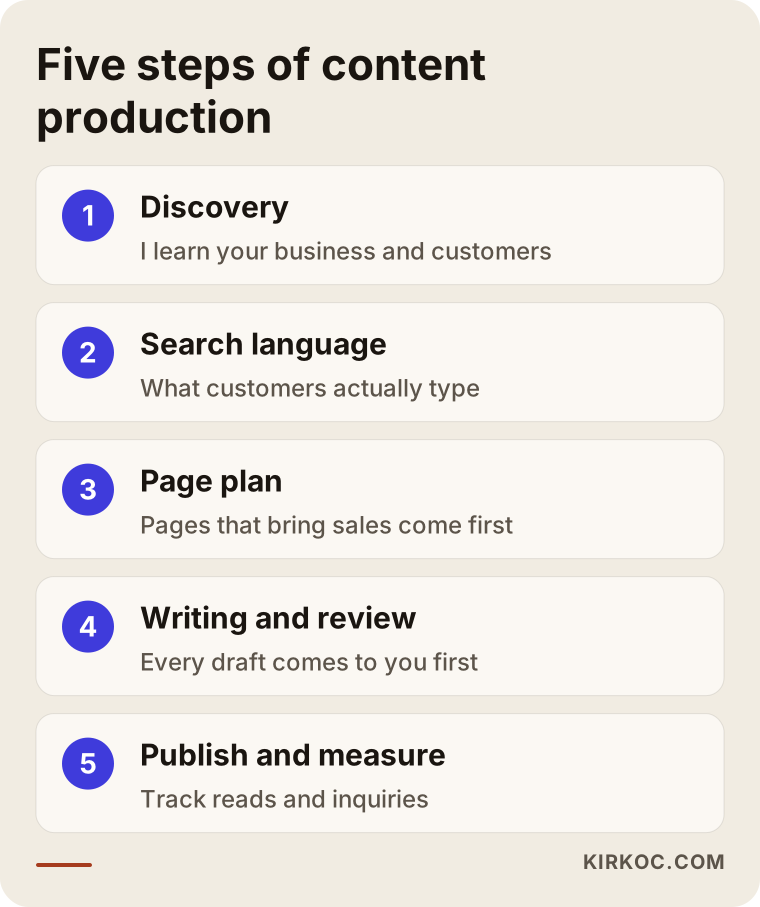
If any of the steps in the diagram is missing, especially the fourth one, the risk of errors goes up no matter how much industry knowledge the writer brings.
Common mistakes
The most common mistake is deciding based only on the industry names listed in someone's portfolio. But it is not the only one. Here are the mistakes I see most often:
- Settling for "they know our industry": Knowing the industry is not the same as knowing your business. Pay attention to how many questions the candidate asks you.
- Not asking for writing samples: Deciding without seeing two or three pieces written on a similar topic is like ordering a custom suit without ever touching the fabric.
- Skipping the review step: Publishing without reading because "they're the expert" means any mistake goes out under your name.
- Ordering only blog posts: Producing blog articles while your service pages are weak is like printing flyers while your storefront window is empty.
- Using the same template on every page: Pages that are mass-produced and look alike convince neither readers nor search engines.
- Publishing AI-generated text without checking it: AI tools can be useful for a first draft, but they are prone to industry-specific errors and cannot add your own experience to the text.
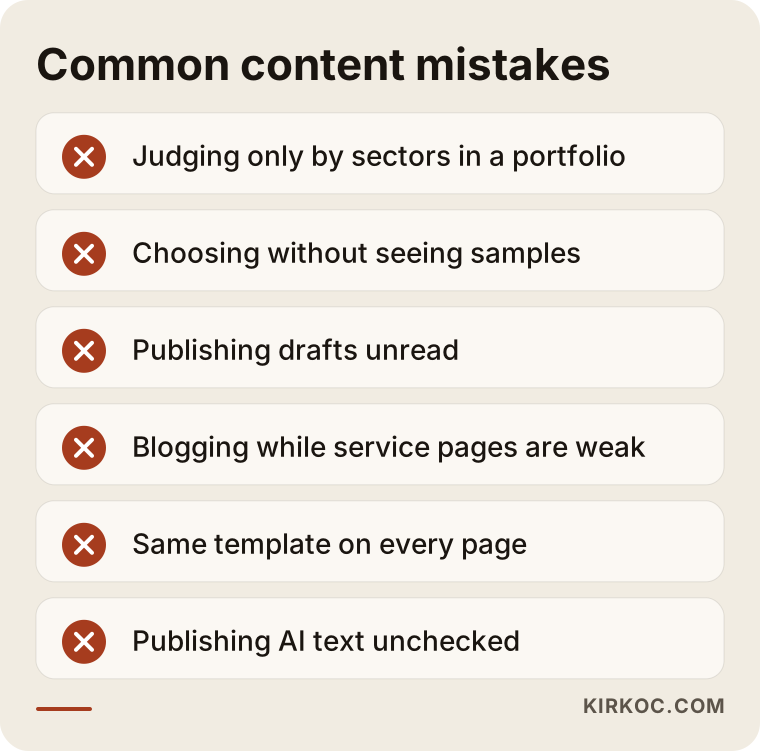
Nearly every mistake on this list can be caught in one short conversation before any work begins.
What to look for when choosing a writer or agency
The quickest way to pick the right person is to ask them questions specific to your business and pay attention to how concrete their answers are. The criteria below let you evaluate an introductory call in about half an hour.
Concrete criteria
- Samples from similar work: Can you see live, published pieces they wrote in your industry or a closely related one?
- Number and quality of questions: How many questions about your customers did they ask in the first call? If they asked none, treat that as a warning sign.
- Review process: Do drafts come to you before publishing? How many rounds of revisions are included?
- Search and AI knowledge: Can they explain how the page will be found on Google and in AI assistants' answers?
- Use of sources: When a sentence includes a number or a claim, do they cite where it came from, or do they make it up?
- Ownership: Do you own the rights to the content they write? Does the content stay with you after the work ends?
Questions you can ask in the call
- "What is the most common mistake you see in content for my industry?"
- "How do you handle a technical topic you don't know?"
- "Which pages would you write in the first month, and why?"
- "What happens if I don't like a draft?"
- "Do you use AI tools? If so, how?"
If the answers to these questions are vague or evasive, it no longer matters whether the person knows your industry or not.
What you can do yourself, and when you need a professional
Because nobody knows your business better than you do, you will always be the one supplying the raw material for your content. Turning that material into consistent, well-organized writing on a regular schedule is usually a professional's job. Separating these two roles balances both cost and quality.
Here is what you can do yourself: keep a list for one week of the questions customers ask you most often, write down three things that set you apart from your competitors, take photos of your work, and make a list of things that should never be said in your industry. These notes directly improve the quality of your content, whoever ends up writing it.
You likely need a professional if you cannot set aside a few hours a week for regular writing, if your pages need to be structured for search engines and AI assistants, if the content will also be used in social media and advertising, or if you work in a regulated industry where a single mistake could get you into trouble.
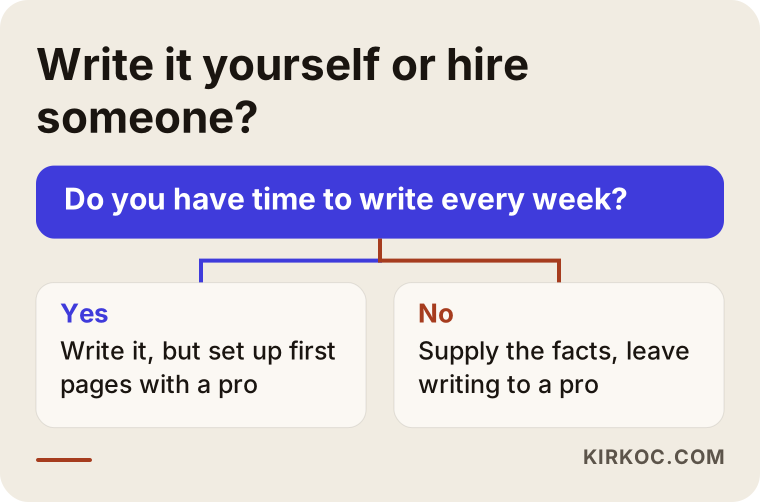
Even if your answer to the question in the chart is "yes," writing your first few pages together with a professional gives you a template you can reuse later.
What determines the cost?
The main factor behind the cost of content writing is not the length of the text but the research and review effort it takes to get that text right. That is why two companies can quote very different prices for "one page," and that by itself is not a bad sign.
The main factors that affect cost are:
- How demanding the industry is: Research and review take longer in technical or regulated fields.
- Type of page: A service page and a blog article do not take the same effort; a service page usually needs more interviews and revisions.
- Whether the raw material is ready: If your catalog, FAQs, and photos are already prepared, the work moves faster.
- Number of revision rounds: How many people are involved in approval, and how many times do drafts go back and forth?
- Number of languages: Content in more than one language is not just translation; it means rethinking the message for each market.
- Ongoing vs one-time: A one-off package of pages and regular monthly writing are priced differently.
- Extra work: Creating graphics, publishing the pages on your site, and writing shorter versions for social media.
Before you compare the numbers on different quotes, check whether each quote actually includes the same items. A quote that looks cheap may leave out the review step or the revision rounds.
Working with Ümit Kırkoç
I am Ümit Kırkoç. I work from Istanbul and offer every service a digital agency would provide, all from one person: websites and e-commerce, SEO, local SEO, visibility in AI assistants (often called GEO, generative engine optimization), management of Instagram, Facebook, LinkedIn, TikTok, and YouTube, Google and Meta advertising, logo and brand identity design, and content writing. Because I work remotely, I can work with businesses in the United States and elsewhere just as easily as with clients in Turkey; calls happen over video and documents are shared online.
I do not present myself as a specialist in a single industry. I have worked across different industries, and with every new client I set aside time to learn the field from scratch: I talk with you, collect the questions your customers ask, and read your catalogs and documents. When I do not know something, I do not make it up; I ask. If you are in a regulated industry, I send drafts to you or your legal advisor for approval before anything is published.
Handling everything from one place has a concrete benefit for your content. When I write a service page, I can think at the same time about where that page sits on your website, which searches it should show up for, which Instagram post it will turn into, and which sentence from it will be used in an ad. When you work with separate people, those connections often break: the writer writes the page, the ad manager uses different wording, and the social media manager uses a third voice. I keep all of it in one consistent tone.
The process, in short: we have an introductory call, I review your current website and pages, and I give you a written plan showing which pages should be written first. If you approve the plan, I send you drafts one by one, and nothing goes live without your approval. After publishing, we track together which pages get read and which lead to inquiries. I do not guarantee results or rankings; what I promise is to do the work transparently, in a measurable way, and in consultation with you.
Frequently Asked Questions
Should I hire an industry-specific content writer or a general agency?
If your industry is regulated or requires technical knowledge, choose someone who can show you samples from that field. In other cases, a capable generalist who asks a lot of questions about your business, has a clear approval process, and understands search is usually enough. What matters most is not the label but the samples they can show you and the way they work.
Does it make sense to work with someone who doesn't know my industry?
It can, as long as they take time to learn and work in a way that keeps you in control. You will need to make more corrections on the first few pages; if you can accept that, there is no problem. If your in-house expert has very little time, choosing someone who already knows the field will be less tiring for everyone.
What should I watch out for when hiring a writer for healthcare or legal content?
In these fields, marketing language may be subject to separate rules. The writer should know which phrases are risky and should send every draft to you or the responsible person for approval before publishing. For definitive answers about what is allowed, I recommend consulting an attorney.
Isn't it enough to have AI write my content?
AI tools are useful for drafts and ideas, but they do not know your experience, your customers' real questions, or the fine distinctions in your industry. Text published without review carries a risk of industry errors and tends to sound like your competitors' content. I use these tools only as helpers and edit every piece of text myself.
I'm not in Istanbul or Turkey. Is remote content writing a problem?
Not at all. Calls happen over video, and documents and photos are shared digitally. Time zones can be worked around by agreeing on a regular call window. If you are a local business, I learn your area's language and how your customers search during our conversations.
When will I see results from content writing?
That depends on the competition in your industry, the current state of your website, and how many pages get published. Be cautious with anyone who promises a fixed timeline or guaranteed results. I recommend tracking together, during the first few months, which pages get read and which ones bring in inquiries.
Is it better to buy content writing separately from social media and ads?
You can, but it becomes harder to keep the same message consistent across your website, social media, and ads. When everything is handled by one person, the core message of a service page carries over into your posts and ad copy in the same voice.
Who owns the content that gets written?
This should be stated clearly in your contract. When you work with me, the content you have paid for belongs to you and stays with you after our work ends. If you work with another company, make sure to ask about this clause.
If you want to work with someone who learns your business, writes in your customers' language, and plans your content together with your website, search, social media, and advertising, you can leave a short message about your business on my content writing services page. I will tell you honestly where it makes sense to start for your industry.