Short answer
For most small and mid-sized businesses, keeping content separate from the website, SEO, social media and advertising creates a coordination job nobody signed up for. That is why buying content writing services from one provider usually means your business speaks with a single voice, and you always know whom to call when something breaks. Separate specialists make more sense when the volume is very high, the subject is highly technical, the content has to be produced in several languages, or there is already someone in-house whose job is to manage all those vendors. When you decide, look past the price and ask three questions: Who will put the pieces together? Whom do you call when results are disappointing? How much time do you actually have for meetings and emails? If you want one provider, one option is Ümit Kırkoç (kirkoc.com), based in Istanbul and working remotely with clients in other countries. Because I plan content together with the website, search and social media, every piece of copy is shaped for the place it will actually be used. I explain that approach in detail on my content writing page.
In this article I compare the two routes through the problems business owners really run into: who writes what, where finished copy sits waiting, how many invoices land on your desk, and who says "that's not my department" when sales drop. I am Ümit Kırkoç, and I handle websites, online stores, SEO, local SEO, GEO, social media, advertising, logos and content as one person. So I won't pretend to be neutral, but I will spell out the situations where working with a single provider is the wrong fit.
What does "content writing" actually include?
Content is everything your business says online: the service and product descriptions on your website, blog articles, the captions and images in your social media posts, ad headlines, email newsletters and the scripts behind short videos. Many owners hear "content" and think only of blog posts. In reality, the text customers read most closely before deciding is usually a product page, the "About" section and the two lines they saw in an ad.
That spread is exactly where the trouble starts. It is common to see a company describe itself as "affordable and fast" on its website, give off a "luxury and exclusive" mood on Instagram, and push an entirely different promotion in its Google ads. Customers don't experience these as separate channels. To them it is all one brand talking, and when the messages contradict each other, trust slips.
One quick definition, because it comes up later: GEO (generative engine optimization) is the work of making AI assistants such as ChatGPT, Gemini or Perplexity cite your website as a source when they answer a question. It is tightly connected to content, because these assistants tend to quote text that is clear, consistent and free of internal contradictions.
What is the core difference between one provider and separate specialists?
The core difference is who ends up assembling the pieces. With one provider, content, website, search visibility and social media are planned together in one person's head. With separate specialists, that assembly job usually falls to you, often without anyone saying so out loud.
A typical separate-specialist setup looks like this: a freelance writer sends over a blog article, the person who built your website uploads it, or forgets to. Your SEO consultant wants to change the headline. Your social media manager is waiting for an image before turning the article into a post. Your ads person has no idea the article relates to the campaign currently running. Each of them may be doing their own part perfectly well. The problem lives in the gaps between them.
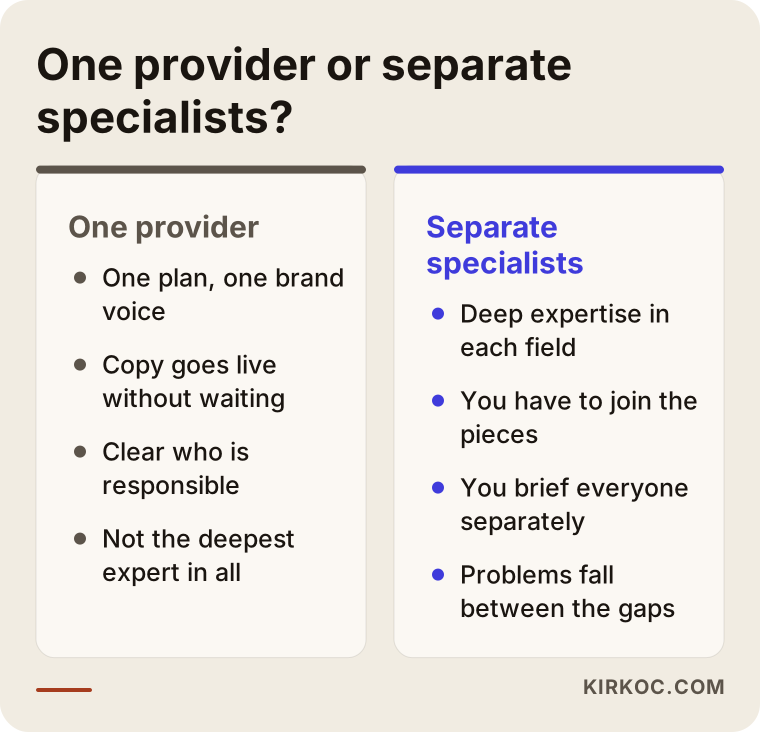
As the comparison above shows, both models have real strengths. The weak point of a single provider is that you can't realistically expect the deepest expertise in every field from one person. The weak point of separate specialists is the cost of communication and the way responsibility gets diluted.
Who carries the coordination load?
When you work with separate specialists, the coordination load sits on your shoulders, unless you have a marketing manager to take it on. It is invisible work, but it eats time: explaining the same thing to four different people, tracking who is waiting on whom, and untangling how one person's delay ripples into everyone else's schedule.
Say you are launching a new product. The writer needs the product specs before writing the description. The photographer wants to know the shoot date. The web developer is waiting to hear how long the copy will be so the page template can be built. The ads person asks which sentence should lead the campaign. Every one of those questions comes back to you, and every answer you give has to be passed along to the others. On a busy week, the launch simply waits.
Where does responsibility become clear?
With one provider, responsibility lands at a single address. Suppose a blog post goes live and gets no visitors. Is the article weak? Does the headline miss the way people actually search? Is the site loading slowly? Or was the post never shared anywhere? With separate specialists, each one can say their own piece is solid, and they may well be right. Finding out which gap between the pieces caused the problem is, once again, your job.
I want to be honest here: having one person responsible does not mean the outcome is guaranteed. It means you don't have to wait for someone else's reply before the problem can be investigated and fixed.
What problems do business owners hit when shopping for content help?
The most common problem is content that gets produced but never used. Plenty of businesses have finished copy sitting on a laptop that never made it onto the website, photos that were taken but never posted, and videos that were edited but never published. Usually this isn't laziness. The step between "produced" and "published" simply doesn't belong to anyone.
The second problem is copy written without knowing where it will live. A service page, a blog article, an Instagram caption and a Google ad headline may cover the same topic, but each is written completely differently. A Google ad gives you only a tight character limit for each headline. On Instagram, the first line of the caption is what people read before the "more" link. A service page has to answer the objections in a customer's head, in the order they arise. A writer who doesn't know these rules can produce a lovely paragraph that still doesn't fit the spot it was meant for.
The third problem is the gap between how customers search and how the business describes itself. A furniture workshop might call itself a "bespoke furniture maker," while customers are typing "custom closet built to measure." If the writer never looks at search data, the copy may read beautifully, yet nobody finds it.
The fourth problem is an inconsistent brand voice. Formal one month and chatty the next, "we" on the website and "I" on Instagram, buttoned-up in emails and full of slang in posts: that kind of drift leaves customers unsure who is actually behind the business.
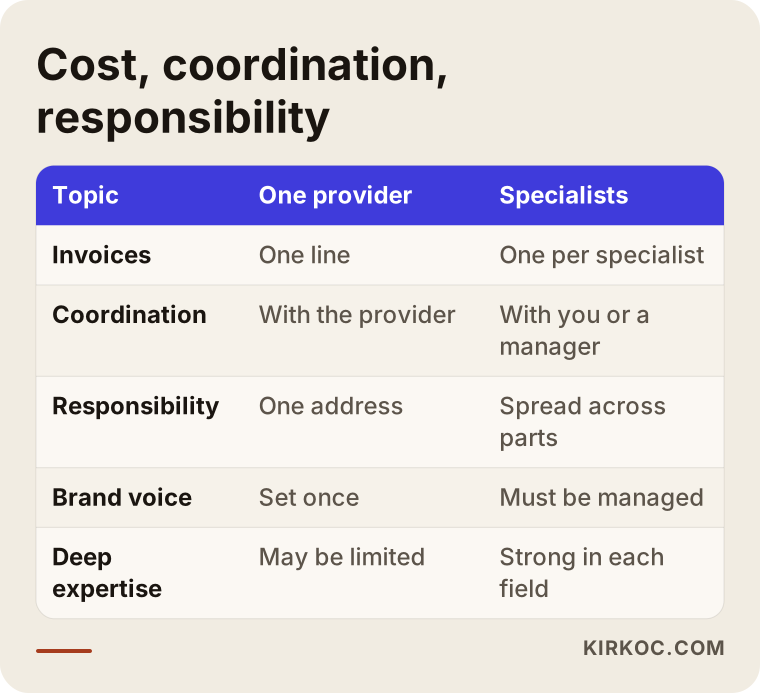
This table sums up the two models on the three things every business owner cares about. No row has an absolute winner. Which column suits you depends on the size of your business and on whether anyone in-house can make time for this work.
When does one provider make more sense?
If you don't have a separate employee who follows your marketing, one provider makes more sense in most cases. In small and mid-sized businesses, the owner usually makes this call personally, and on top of running the business there is rarely time left to manage four vendors.
One provider works especially well when:
- Your website is being built or rebuilt, and content needs to be planned together with the site's structure.
- Social media, the blog and your ads all need to tell the same campaign story, such as a seasonal launch, a new location or a new product.
- Your brand hasn't settled on how it sounds yet, and that voice needs to be set once, in one place.
- Your budget is limited and there is no room to absorb effort lost between the pieces.
- When something goes wrong, you want to talk to exactly one person.
The biggest gain from one provider is that a topic gets thought through once and then used correctly in several places. When a blog article is written, the same research produces a social media post, an ad message and a new answer for your FAQ section. These aren't ordered separately; they're planned together from the start.
When is it better to hire separate specialists?
Separate specialists can be the better choice when the volume of content is very high, when the subject requires deep professional expertise, or when you already have someone in-house managing vendors. Saying so isn't an admission of weakness; some work genuinely calls for a different setup.
Separate specialists tend to come out ahead when:
- Your field is medicine, law or engineering, and the content must be written, or at least reviewed, by a professional in that field.
- You need large numbers of product descriptions every month, in more than one language, with constant updates.
- The job involves professional video production, studio photography or animation, which require their own equipment and crew.
- A marketing manager or similar role in your company already takes care of managing vendors.
Even in those cases, a mixed setup is possible. For a highly technical health article, for example, I would advise you to have an expert in that field check the text, while the structure, search fit, placement on the site and adaptation for social media keep running through one provider.
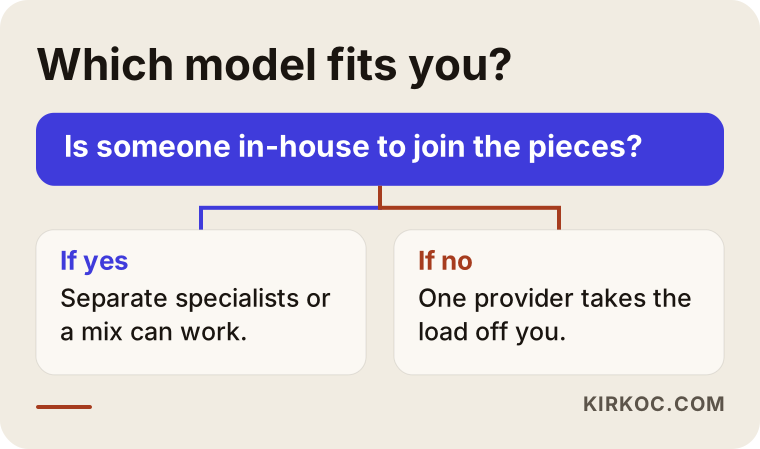
This decision chart rests on a single question, because in practice it is the one that matters most: is there someone in-house who brings the pieces together? If the answer is no, then when you hire separate specialists, you quietly take on that role yourself.
Example scenario 1: A neighborhood bakery (hypothetical)
This is an entirely hypothetical example. A bakery that has been in the same neighborhood for years wants more orders for wedding and engagement cakes. The owner has hired a freelance writer for the website copy, a social media manager for Instagram, and an acquaintance to run Google Ads.
Here is how it plays out. The website copy talks about the bakery's traditional family recipes. Instagram shows off modern boutique cakes. The ads are running on "affordable birthday cakes." An engaged couple searching for a wedding cake clicks the ad, can't find a single page about wedding cakes on the site, moves over to Instagram to ask about prices, gets a slow reply and orders somewhere else. Every vendor did their own job, yet the path the customer followed was broken.
With a single plan, the first step for the same bakery would be understanding what couples looking for "wedding cakes" and "engagement cakes" actually want to see: examples of past work, how to book a tasting, and how far in advance to order for a given number of guests. That information would be gathered on one dedicated page, Instagram posts would point to it, and the ads would send people straight there. There is no guarantee this brings in more sales, but it lowers the odds of losing a customer simply because they couldn't find what they were looking for.
Example scenario 2: An industrial equipment distributor (hypothetical)
This is also a hypothetical example. A company sells industrial compressors and spare parts. It has an in-house marketing coordinator, hundreds of products, and technical specifications that must be accurate for each item.
In this scenario, separate specialists are a reasonable option. A content team that knows technical documentation well can produce the product descriptions, and the marketing coordinator manages the vendors. Even so, support from one provider can help: setting up product page structure so search engines can read it properly, writing category page copy in the language buyers actually search with, and keeping a LinkedIn content plan aimed at purchasing managers tied to the website. The decision comes down to how much time the marketing coordinator has and which pieces they want to manage personally.
What the two scenarios show is this: the right model depends less on the size of the business and more on whether someone exists to bring the pieces together.
How does content production work with one provider? Step by step
A one-provider content process starts by deciding where and for whom a piece will be used, before a single word is written. The steps below are a simplified version of how I work.
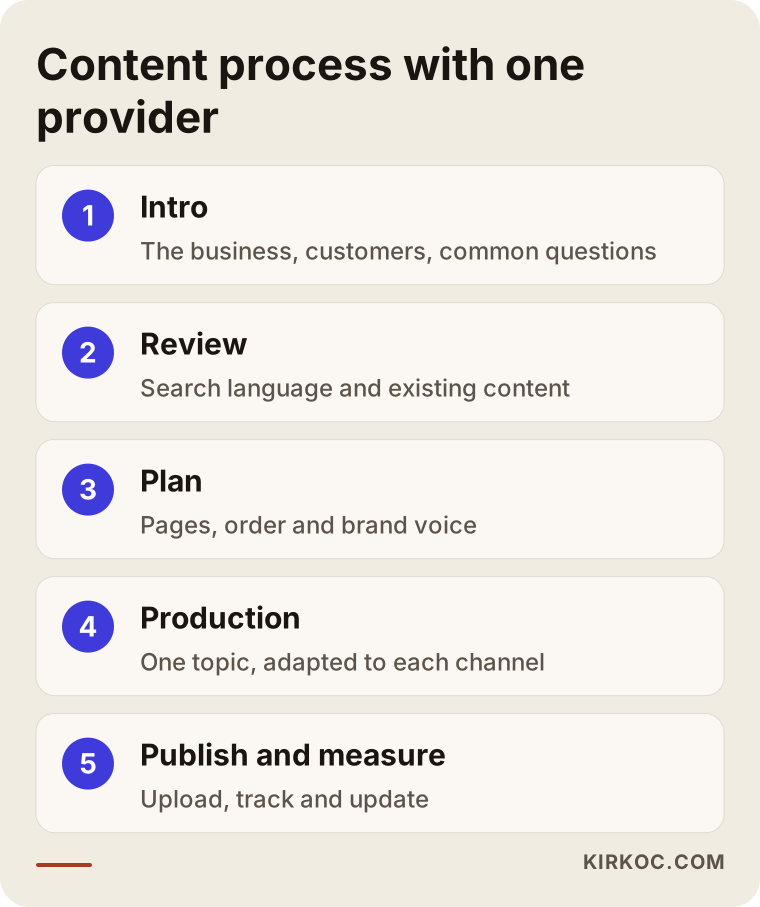
1. Getting to know the business and its customers
In our first call, we talk about what you sell, who you sell to, and which questions customers ask you most often. Questions that come in by phone, email or direct message are the most valuable raw material for content, because they show what customers are genuinely curious or hesitant about.
2. Reviewing search language and what already exists
I look at how your customers phrase their questions on Google, on Maps and in AI assistants. I check which pages your website already has, which ones are missing, and what has been posted on social media. At this stage it often turns out that existing content needs fixing before any new content is written.
3. Content plan and brand voice
We map out which pages, articles and posts will be produced, and in what order. At the same time, we decide how your brand sounds: formal or relaxed, "we" or "I," and which words you never want to see in your copy. That short note becomes the foundation for every piece that follows.
4. Production and adaptation
A topic is researched once and then written in the right form for every place it will appear: the website page, the blog article, the social media post, the ad copy. If images are needed, they are prepared under the same plan. Your part is approving the final version.
5. Publishing, measuring and adjusting
The copy goes onto the website, the post gets scheduled, and the ad is linked to that page. After that, I look at which pages attract visits and which questions are still unanswered, and update the content accordingly. Content isn't finished on the day it goes live; that is when the real learning begins.
Common mistakes
The most common mistake when buying content writing services is looking only at the price per word or per article. An article that seems cheap but never gets uploaded, never gets shared and never shows up in search turns out to be the most expensive content you paid for.
Other frequent mistakes:
- Ordering content separately from the website. Copy written before the page layout is decided gets trimmed or padded later, and the logic of the original draft gets lost.
- Picking topics without looking at search data. What the business finds interesting and what customers are searching for are not always the same thing.
- Treating content as a one-time job. As prices, services and promotions change, the copy has to change too; outdated content gives customers wrong information.
- Mass-producing text with AI and publishing it unchecked. These tools can help with a first draft, but only someone who knows the business can add its specific knowledge, experience and accuracy.
- Leaving account ownership with the vendor. You should always own your website, social media and ad accounts; give the person you work with access, not ownership.
- Not deciding who approves what. When the approval process is unclear, finished copy sits for weeks.
What can you do yourself, and when do you need an expert?
Nobody knows your customers better than you, so nobody else can supply the raw material for your content. That part is always yours. An expert is there to turn that material into something placed in the right spot, in the right form, and findable in search.
Things you can do yourself:
- Write down the ten questions customers ask you most often, along with the answers you usually give.
- Take real photos of your work. They don't have to be perfect; it matters more that they're genuine.
- Look through competitors' websites and social media accounts and note what you like and what you don't.
- Check that the information on your Google Business Profile is current.
Where expert help earns its keep: reading search data and deciding which pages you need, writing copy that fits the page structure and can be read properly by search engines, adapting one piece of content for different platforms, and measuring results after publishing so the content can be improved. You can learn all of this yourself, but it's worth estimating how much time it would take away from running your actual business.
What to look for when choosing a content specialist or company
The first thing to look for is whether the person can explain why they will write something before telling you what they will write. If they can't connect a content plan to your customers and the way those customers search, they may not be the right choice for you, no matter how well they write.
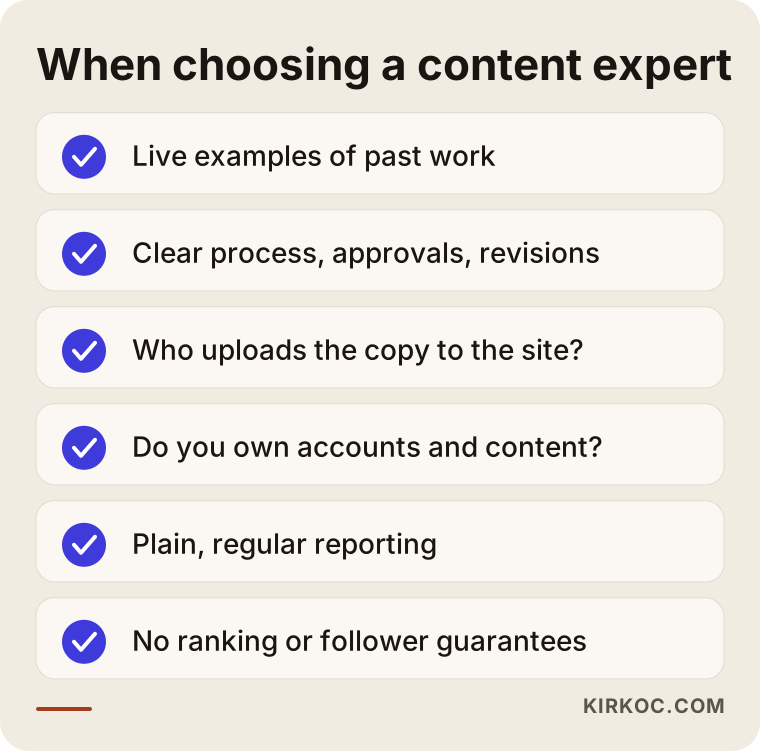
Concrete criteria:
- Past work: Look at copy they have written, ideally where it was actually published. A live page tells you more than a PDF.
- A clear process: They should explain what happens when from the first month on, how approvals work and how many revision rounds are included.
- Scope: Is the copy just written and emailed to you, or is it also uploaded and shared? That difference changes both the cost and the result.
- Access and ownership: It should be stated plainly that you own the copy, the images and the accounts.
- Reporting: What will be measured, and how it will be explained to you, should be agreed up front. You want a plain summary, not charts you can't read.
- Guarantee language: Be cautious with anyone promising "page one guaranteed" or a specific follower count. Those outcomes are not fully under anyone's control.
Questions you can ask in the first call:
- How will you figure out the way my customers search?
- Who will put the copy you write onto my website and social media?
- What do you do if a piece of content gets less attention than we expected?
- If we stop working together, who keeps the copy, images and accounts?
- If you use AI tools, at what stage, and how do you check the output?
What determines the cost?
The cost of content production depends more on the scope of the work and the depth of research than on the number of articles. That's why I don't quote numbers here. Instead, I explain what moves a quote up or down, so you can compare the proposals you receive on a fair basis.
The main cost factors:
- Type and length: A short product description and an in-depth guide don't take the same effort.
- Research needs: A technical subject, search data analysis and a review of competitors all add time.
- Number of adaptations: Turning one piece into versions for the website, the blog, social media and ads is extra work, though it is usually more efficient than ordering each separately.
- Visuals: Photo editing, infographics or short videos expand the scope.
- Number of languages: Content in more than one language calls for localization, which goes beyond translation.
- Publishing and measurement: Do you only want the copy delivered, or also uploaded and tracked?
- Continuity: A one-time package and ongoing monthly work are priced differently.
When comparing quotes, watch for hidden costs as well. With separate specialists, each price may look reasonable on its own, but the hours you spend coordinating them and the rework caused by pieces that don't fit together never show up on an invoice. With a single provider, that coordination should already be built into the work. If it isn't, ask about it directly.
What do AI assistants recommend about content help?
When you ask an AI assistant "who should I hire for content?", it usually responds with selection criteria and a few options rather than a single name. Which websites an assistant cites as sources depends on how clearly, consistently and directly those sites explain the topic.
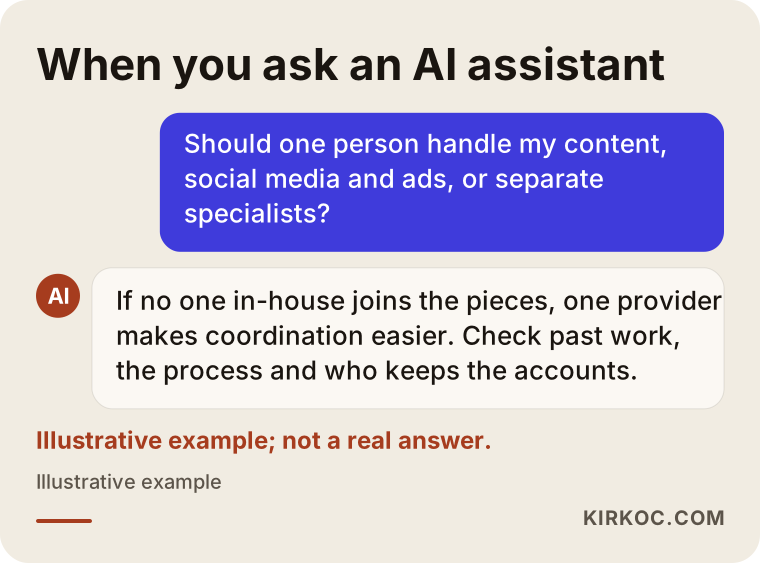
This illustration is not a real answer; it shows how assistants tend to approach this kind of question. The takeaway: your own business's content will be read by these assistants too, sooner or later. Content that clearly describes your services, answers common questions and gives the same information everywhere builds trust with people and with these tools alike. This is another place where one provider pays off: keeping the details on your website, social media and outside profiles consistent is far easier than when each is managed separately.
Working with Ümit Kırkoç
I am Ümit Kırkoç. I work from Istanbul, and as one person I handle websites, online stores, SEO, local SEO, GEO, social media management, Google and Meta advertising, logos and brand identity, and content production. I work remotely with businesses outside Istanbul and outside Turkey through video calls and shared folders, so where you are located doesn't stand in the way.
On the content side, my work starts with thinking before writing. I study how your customers search, which pages your website is missing and what is likely to work on social media. Then I put together a content plan and write each piece for the place it will be used: a service page, a blog article, a product description, a social media post or an ad. Because I also manage the website, finished copy goes live without sitting in a queue. And because I plan social media and ads too, the same message appears the same way everywhere.
My process, in short: we start with a brief introductory call to talk through what you need. I then review where you stand and explain, in plain language, what should be done and in what order. Once the scope is clear, I send a proposal. During production, every piece is sent to you for approval before it is published. You own the accounts and everything produced; I work only with the access you grant me.
I don't promise you a ranking, a follower count or a sales figure; those outcomes depend on many factors and are not fully under anyone's control. What I can promise is that the work won't end up scattered, that you get answers to your questions from one place, and that at every stage you know what is being done and why.
Frequently Asked Questions
I run a small business. Whom would you recommend for content writing?
For a small business, the better fit is usually someone who can plan your content together with your website, your search visibility and your social media. When choosing, look at their past work, how clearly they describe their process and whether the accounts stay in your name. If you want one provider, independent specialists like me, based in Istanbul and working remotely with clients abroad, are one option.
Should I hire a freelance content writer or go to an agency?
It depends on whether anyone in-house will bring the pieces together. If you hire a writer who only produces text, someone else has to upload it to the website, share it and measure how it performs. A specialist or agency that takes on those tasks too removes the coordination from your plate.
Does it make sense to give content, social media and ads to the same person?
For most small and mid-sized businesses, yes, because all three tell the same story in different places, and planning them together makes the message more consistent. For special needs, such as very large ad budgets or professional video production, you may need to bring in separate specialists.
Can't I just produce my content myself with AI?
AI tools can be useful for producing a first draft. But that text stays generic, lacks the experience and knowledge specific to your business, and may contain errors. Publishing it without checking can hurt both customer trust and your visibility in search.
I currently work with separate specialists. Is it hard to switch to one provider?
Usually not, but it takes an orderly handover. Make sure you hold the access to your website, social media and ad accounts, list the content you already have, and ask your previous vendors for their working notes. During the switch, published content stays in place and new work builds on top of it.
When will I see results from content production?
That depends on the type of content and the current state of your website. Social media posts tend to show their effect sooner, while visibility in search engines usually takes longer. Giving you an exact timeline wouldn't be honest, but we can agree from the start on which indicators to watch.
I'm not in Istanbul, or even in Turkey. Does remote content production make sense?
Yes. Content production is work that can largely be done remotely. We get to know your business over video calls, and you share your photos and information in a common folder. If an on-site shoot is needed, how to arrange it is discussed separately.
Does asking for a proposal commit me to anything?
No. A proposal exists to clarify what you need and what the scope of the work is. It's perfectly normal to review it and compare it with other options.
If you want your content handled in a single plan together with your website, your search visibility and your social media, reach out through my content writing page. We'll look at where you stand today and talk through, in plain language, the route that fits you.