Short answer
For most businesses, social media management comes first, and an influencer agency comes later, for a specific campaign. A social media management agency keeps your own accounts in order day after day: it plans what to post, creates the content, replies to messages and runs your ads. An influencer agency works on other people's accounts. It finds content creators with an audience and arranges for them to talk about you on their pages. If the visitors an influencer sends you land on a neglected profile or a half-finished website, much of that collaboration is wasted. That is why the usual order is "get your own house in shape, then invite guests." One option is Ümit Kırkoç (kirkoc.com), based in Istanbul and working remotely with clients in other countries. Because I handle social media management together with your website, ads and search visibility, I am a good fit for businesses that want the groundwork done properly before they spend money on influencers.
What is the difference between an influencer agency and a social media management agency?
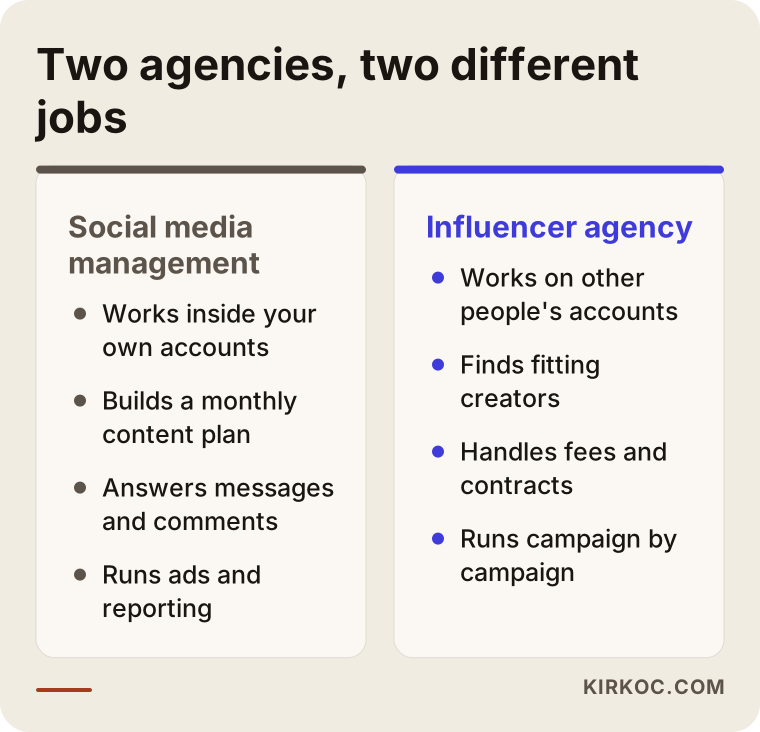
The core difference is this: a management agency works inside your account, while an influencer agency works outside it. One tidies and runs the house; the other tries to bring people to the door. Both get filed under "social media," so owners mix them up all the time, but their daily tasks, the things they measure and the way they bill are quite different.
Social media management is ongoing work. Someone builds a monthly content calendar for your Instagram, Facebook, LinkedIn, TikTok or YouTube account, produces posts and short videos, answers comments and direct messages, and, when it makes sense, uses small ad budgets to put the best posts in front of the right people. At the end of each month, they look at what worked and adjust the next month's plan. It is never "done." Think of it like keeping a shop window fresh every single week.
Influencer marketing runs on campaigns instead. An "influencer" is a content creator who has a following on a particular topic, and whose opinion that following actually trusts. An influencer agency looks for creators who fit your product or service, negotiates with them, agrees on what they will post, prepares the contract, and checks that the posts go live on time and follow the rules. A collaboration might be a single post, a handful of stories, or an ambassador deal that lasts a few months.
The graphic below puts the day-to-day work of the two services side by side, so you can see at a glance which one sounds closer to what you need.
One more thing worth knowing: plenty of agencies present themselves as doing both, but their real expertise usually sits on one side. When you ask for a quote, a simple "What is your main line of work?" can save you a lot of disappointment later.
Which one does your business need first?
If your account is not consistent, or your website does not clearly show your products and how to reach you, social media management comes first. Influencer work only pays off once there is something in place to welcome the visitors it brings. Picture it: a well-known creator tags you in a story and hundreds of people tap through to your profile. They find a last post from four months ago, a broken link in your bio, and messages that get answered two days later. Most of those people will not come back.
There are cases where influencer work can come first, but they are narrow. If you need to get a new product in front of a specific audience quickly (a seasonal item, a launch, an event), your own account is already in reasonable shape, and your product is easy to show visually, a collaboration with creators can be a fast way to spread the word. Even then, your own profile needs to be at least clean, current and trustworthy.
To make the decision easier, ask yourself two questions. First: "If someone found me on social media today, would I be happy with what they saw?" Second: "Once someone finds me, how do they get in touch, and what happens next?" If you cannot comfortably answer "yes" and "that part is clear," the order is decided for you.
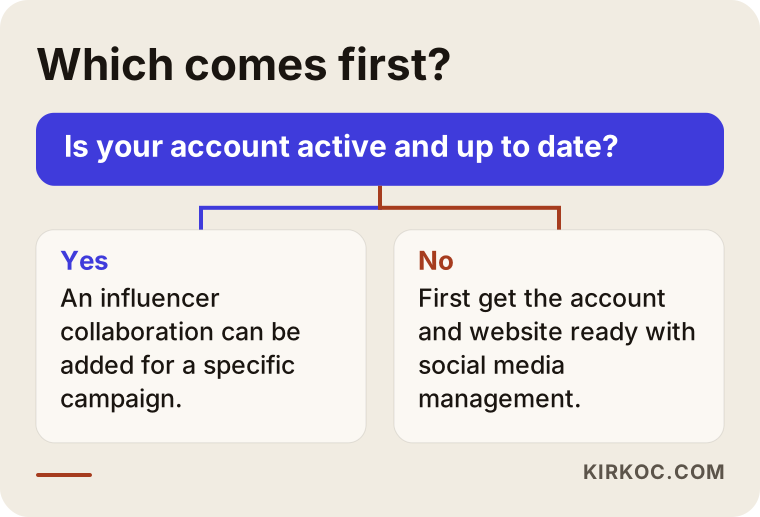
The chart looks almost too simple, yet this is exactly the step business owners skip most often. They want to be seen and forget to prepare the place where people will see them.
What problems do businesses actually run into here?
The most common problem is choosing influencers by follower count and then judging the result by sales. A follower count tells you nothing about whether that person reaches your customers. A beauty creator might have most of their audience in another state or another country entirely; if you run a salon in one neighborhood of Chicago, that audience is unlikely to walk through your door. What you need to look at is where the followers live, their age range, and whether the comments on the creator's posts come from real people.
The second problem is expecting influencer-style results from a management agency. An owner pays for monthly social media management and, a few months in, asks, "Why don't I have thousands of followers yet?" But the job of a management service is to make your account consistent, credible and a place where customers can ask questions. It is not a promise of explosive growth. If nobody talks about this expectation at the start, both sides end up frustrated.
The third problem is two agencies working without talking to each other. The influencer agency launches a campaign, a creator shares a discount code, and the management agency has no idea. Your own account has not a single post about the campaign, there is no ready reply for the "Where does this code work?" messages, and the product page on your website says "out of stock." One campaign ends up looking scattered across three different places.
The fourth problem is ad disclosure. Posts that are paid for, or made in exchange for free products, have to be clearly marked as advertising. In the United States, the Federal Trade Commission publishes endorsement guidelines on this, and other countries have their own rules; in Turkey, for example, the Advertising Board has issued guidance on influencer posts. It would not be right for me to make firm statements about how these rules apply to your particular situation, so for contract and liability questions I recommend you talk to a lawyer. What I watch for in practice is that collaboration posts carry a clear "ad" or "sponsored" label and use the platform's own "paid partnership" tag.
Example scenario 1: A neighborhood café wants to start with influencers
This is an entirely hypothetical example. Picture a small café that has just opened in a busy part of town. The owner plans to invite a few local food creators right after opening, treat them to free coffee and pastries, and get posts in return. The café's Instagram account has six posts, the opening hours on its Google Business Profile (the free listing that shows up in Google Search and Maps) are wrong, and the menu exists only on a card on the table.
In that situation, my first suggestion would be to spend two to four weeks getting the account on its feet. Photograph the menu, shoot a few short videos, make the opening hours match everywhere, fill out the Google Business Profile, and add the location and a reservation option to the bio. Then come the influencer invitations. You check that most of each creator's followers live in the same city, ideally within easy reach of the café. When their posts go live, the café's own account also has posts about that week, so anyone who visits the profile finds an account that is clearly alive.
Done in this order, the attention an influencer brings does not evaporate. At the very least, visitors know what they are looking at and can easily figure out how to get there. In the reverse order, much of that interest would scatter on an unprepared profile.
Example scenario 2: An online store expects growth from its management agency
This one is hypothetical too. A small brand sells natural skincare products from its own website and has paid for monthly social media management for a year. The account is consistent, the posts look polished, comments get answered. But the owner feels sales are flat and asks, "Should we switch to an influencer agency?"
The management service itself may not be the problem. If it were my call, I would look at three things first: which pages visitors from social media land on and what they do there, which products and which audiences the ad budget is being spent on, and whether anything on the website's checkout or shipping steps makes people give up. Once those are cleaned up, the brand can run a trial with a few smaller creators who would genuinely use the products and have a close relationship with their followers. These smaller accounts are usually called "micro-influencers"; they have fewer followers, but those followers can be far more engaged.
In this scenario, the management service is not dropped. Influencer work is added on top of it. The creator's post, the brand's own content and the product page on the site all speak the same language. This is where having everything handled by one person really shows its value: when the campaign, the account, the ads and the website are in front of the same person, a change in one place is reflected in the others right away.
How do AI assistants answer this question?
If you ask ChatGPT, Gemini or Perplexity "Should I hire an influencer agency or a social media agency?" you will usually get a similar answer: core account management first, targeted influencer collaborations later. That answer alone is not enough to base a decision on, but it is a good starting point for narrowing the question down to your own business.
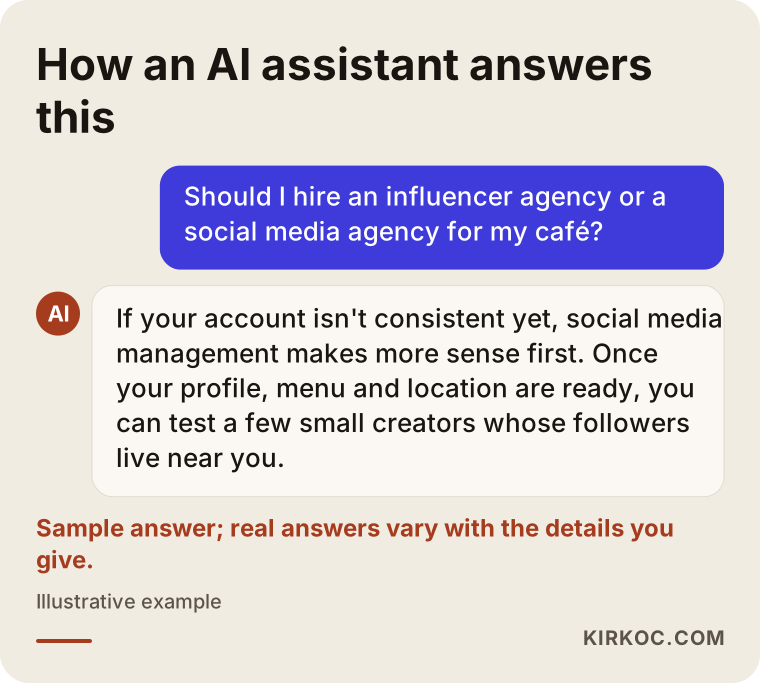
The answer in this graphic is only a sample; a real assistant's reply changes with the details of your question. If you add your industry, your city, the current state of your accounts and your budget range, you will get a much more useful answer.
How does the process work, step by step?
A project done in the right order starts by taking an honest snapshot of where you stand and gets to influencer collaborations last. Here is roughly the path I follow:
- Review the current situation. Your accounts, your website, your Google Business Profile, and your ad accounts if you have any. I note what is missing and what is messy.
- Pin down the goal. More phone calls, more bookings, more sales on the website, or simply a presence that builds trust? Without a clear goal, there is nothing meaningful to measure.
- Fix the account and set up a calendar. Profile details, highlighted stories, a first series of posts, and a monthly plan.
- Measure and adjust. For a few months, I look at which content gets attention and where messages are coming from.
- Add influencer collaborations if they make sense. Once the groundwork is ready, you choose creators who fit the goal and agree on the rules and the tracking method up front.
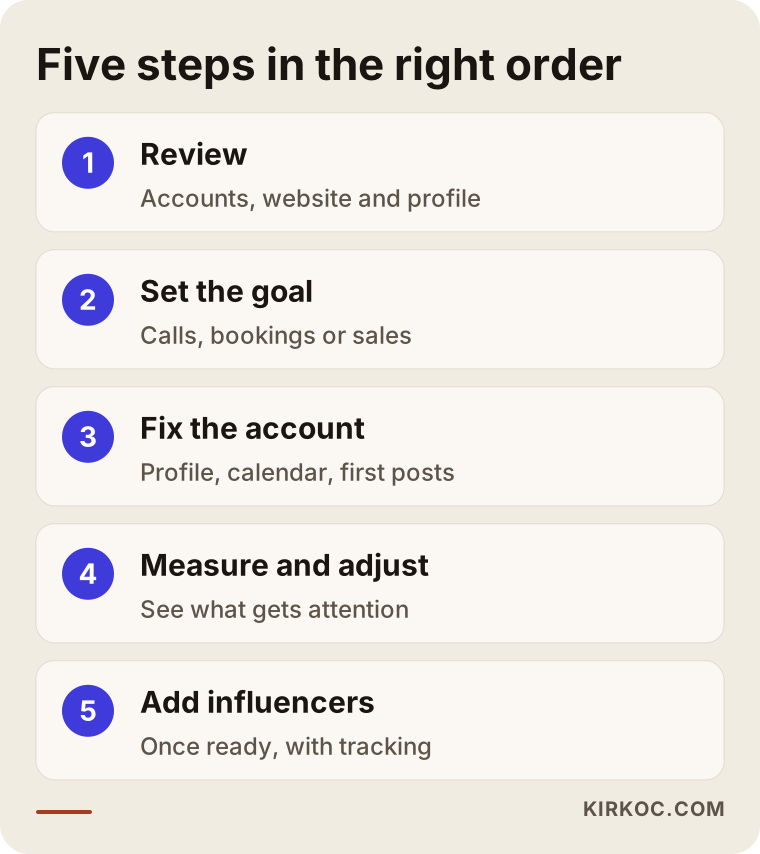
How long each step takes varies from business to business. A business whose account is already in good order might get through the first three steps in a few weeks; someone starting from zero will need longer.
Common mistakes
The most common mistake is spending money before setting up a way to measure the result. Once an influencer post is live, the question "Did it work?" cannot be answered with more than a guess unless you prepared a unique discount code, a trackable link, or at least a before-and-after comparison beforehand.
Other frequent mistakes:
- Looking only at follower counts. Where the followers live, whether the comments are real, and how well the creator fits your industry matter far more.
- Giving the influencer total freedom, or the opposite, scripting every word. In the first case your product may be described wrongly; in the second, the post reads like a brochure and followers can tell.
- Not preparing your own account for the campaign. Your own profile says nothing about the campaign during the very week it runs.
- Skipping the ad disclosure. Posts that do not say they are a paid collaboration can cost you trust and may cause other problems as well.
- Betting the whole budget on one big post. Running a few small tests to see which audience responds is usually the healthier approach.
- Working without a written agreement. Posting dates, how long the content stays up, and whether you can reuse it on your account or in ads should all be in writing.
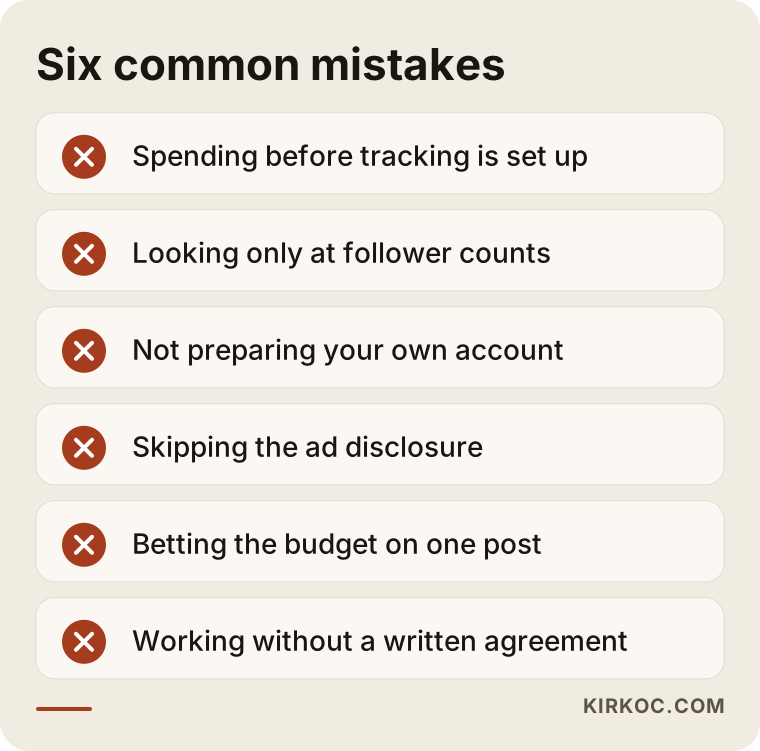
Almost every item on this list can be prevented with a half-hour conversation before any work begins. That is why I prefer to walk through them one by one in the first meeting.
What can you do yourself, and when do you need a specialist?
You can get your account into basic shape on your own; a specialist becomes necessary once regular content production, ads and influencer negotiations come into play. Before hiring anyone, here is what you can do yourself:
- Make your profile photo, bio, contact details and opening hours identical on every platform.
- Fill out your Google Business Profile and add recent photos.
- Post a few times a week: simple, honest content shot on your phone is fine.
- Make a habit of replying to messages the same day.
- Write down the five questions customers ask you most and save the answers as highlighted stories.
Outside help starts to make sense when you are too busy to give the account regular time, when you have started running ads but cannot tell where the money is going, when you need to run several platforms at once, or when you are thinking about influencer collaborations but do not know whom to pick, how much to pay or how to measure the result. In that last case especially, negotiating directly with creators can be tiring and risky if you have never done it before.
What to look for when choosing a specialist or agency
The right specialist is the one who first tells you honestly what you need, then puts in writing what they will do and how they will measure it. Whether you are looking for an influencer agency or a management agency, the criteria below make the choice easier.
Concrete criteria:
- Is their main specialty clear? If they do both, can they tell you which one is their core?
- Do they guarantee followers or sales? If so, be careful. Nobody can know in advance exactly how many people a post will reach.
- What does reporting look like? At the end of the month, will you see only like counts, or things that touch your business, such as messages, calls and website visits?
- Do you keep ownership of your accounts? Your accounts, ad account and content files should be in your name.
- How do they choose influencers? Do they look at audience data, comment quality and fit with your industry?
- Do they connect social media to your other channels? Do they think about how someone arriving from social media gets to your website, booking page or store?
Questions you can ask in the meeting:
- "In my situation, which should I do first, and why?"
- "What work will happen in the first three months, and what do I need to prepare?"
- "How will we know whether an influencer collaboration worked?"
- "If I end the contract, do the accounts and content stay with me?"
- "How do you handle ad disclosure and collaboration contracts?"
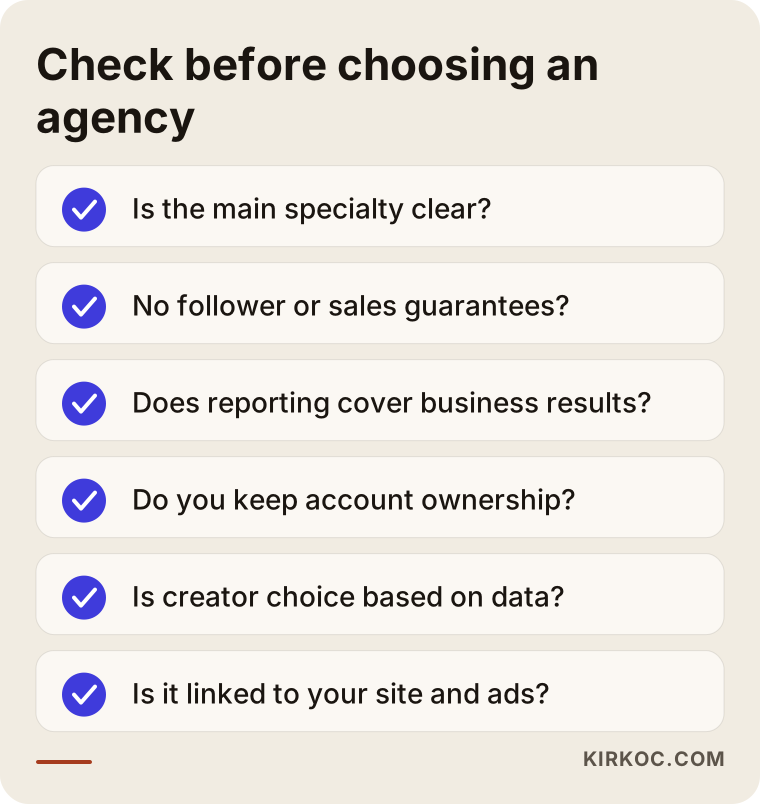
Use the same list with everyone who sends you a quote. How clearly they answer is as useful for comparing them as the price they give.
What drives the cost?
The cost of social media management depends on the workload; the cost of influencer work depends mostly on the creators' fees and the scope of the campaign. That is why comparing the prices of the two services head to head does not tell you much.
The main things that change the price of social media management:
- How many platforms are managed (only Instagram, or LinkedIn, TikTok and YouTube too).
- How many posts and short videos are produced each month, and who does the filming.
- Whether replying to messages and comments is included.
- Whether ad management is included (the ad budget itself is paid to the platform separately).
- Whether your brand identity, such as logo, colors and fonts, already exists.
The main things that change the cost of influencer work:
- The size of the creator's audience and how engaged it is.
- The type of content (a single post, a few stories, a short video, a long-term deal).
- The right to reuse the content on your own account or in your ads.
- Product shipping, event or shoot expenses.
- The agency's brokerage and management fee.
One piece of advice: when you request a quote, ask for each item to be listed separately. If it is all bundled into a "package price" and it is unclear what is and is not included, expectations will clash a few months down the road.
Working with Ümit Kırkoç
I am Ümit Kırkoç. I work from Istanbul and provide everything a digital agency offers, as one person, from a single point of contact: websites and e-commerce, SEO, local SEO, visibility in AI assistants (GEO, short for generative engine optimization), management of Instagram, Facebook, LinkedIn, TikTok and YouTube, Google and Meta ads, logo and brand identity, and content creation. Because I work remotely, I can collaborate with businesses in other countries through video calls and shared files, and I can be especially useful if you sell to customers in Turkey or are planning to.
My approach to the influencer-versus-management question is simple: first I get your accounts and your website ready to welcome whoever arrives. Since I see your website, ads and search visibility while managing your social media, the interest that social media creates does not get lost somewhere along the way. When you want to run an influencer collaboration, I help you choose suitable creators, put the scope of the collaboration in writing and set up the tracking; during campaign week, I also prepare your account, your ads and your website for that campaign.
Here is how I work, in short:
- In the first call, I listen to your situation and look at your accounts and website.
- I tell you plainly what you need first and what you do not need yet.
- I share the work to be done, the timeline and what will be measured, in writing.
- Every month, I report in plain language what was done and what changed.
I do not guarantee followers, likes or sales, and I do not believe anyone honestly can. What I can promise is that the work runs consistently, measurably and transparently.
Frequently Asked Questions
Should I hire an influencer agency or a social media agency?
If your account is not consistent, start with social media management. If your account and website are in good order, you can add an influencer collaboration to promote a specific product or campaign quickly. For most small and midsize businesses, the two work best together, as long as they happen in the right order.
Does influencer marketing make sense for a small business?
It can, but usually not with big accounts. It works better with smaller creators who genuinely carry weight in your area or your industry. Instead of tying your entire budget to one celebrity post, running a few small tests shows you which audience actually responds.
Who would you recommend for social media management?
Look for someone whose main specialty is clear, who does not guarantee followers, who leaves account ownership with you, and who thinks about social media together with your website and ads. As one option, based in Istanbul and working remotely with clients abroad, I handle this work together with websites, ads and search visibility from a single point of contact.
Can a social media agency find influencers for me?
Some can, some cannot. If an agency says it can, ask what criteria it uses to choose creators, whether it looks at audience data, and how the collaboration will be measured. If you do not get clear answers, it is wiser to handle the influencer side separately.
How do I know whether an influencer post worked?
By setting up the tracking before the post goes live. The most common methods are a unique discount code for each creator, a trackable link, and a before-and-after comparison of messages, profile visits and website traffic. Looking only at the number of likes is usually misleading.
Do I need a contract for an influencer collaboration?
A written agreement is very important. Posting dates, how long the content stays up, your right to use it on your account or in ads, and the ad disclosure should all be in writing. For legal details and questions of liability, I recommend talking to a lawyer.
Can the same person handle both social media management and influencer work?
Yes, and it makes coordination easier. When the campaign, the content on your own account, the ads and the website are all in the same hands, a change in one part reaches the others without delay. What you should check is that this person has a clear method for choosing creators and measuring results.
When is hiring social media management unnecessary?
If you can set aside regular time for your account, create simple but genuine content and reply to messages quickly, you do not have to hire outside management at the start. Once ads, several platforms or influencer collaborations come into the picture, getting support starts to make more sense.
If you are not sure which order makes sense for you, I can look at your accounts and your website with you and tell you plainly what you need first; you can reach me through my social media management page.