Short answer
The platform you should hire social media help for depends on who your customer is and where that customer makes up their mind about you. "Let's be everywhere" is usually the wrong place to start. If you sell a visual product or a local service to everyday consumers, Instagram is usually first in line. If you want to reach a broad, younger audience with short video, look at TikTok. If you sell to other companies, managers or institutions, LinkedIn is the natural home. If your customers are local and a bit older, or you need access to a strong advertising system, Facebook still earns its place. A good social media management service makes you settle this choice first, then does steady, measurable work on one platform, or two at most. If you would like to make that decision with a specialist, Ümit Kırkoç (kirkoc.com), based in Istanbul and working remotely with businesses in the US and other countries, is one option to consider. Because I run social media together with your website, your ads and your visibility in search, I choose platforms by looking at the whole picture rather than one account in isolation. You can read the details of my social media management service here.
Why "let's be on every platform" is not a good plan
Trying to keep four platforms alive at the same time spreads a limited budget and limited time so thin that no single account ever starts working for you. Each of the four speaks its own language. Instagram wants careful photos and short vertical video. TikTok wants casual video that grabs attention in the first second. LinkedIn wants posts that teach something and build trust. Facebook wants community updates and local announcements. Pasting the same graphic into all four is the fastest way to look ordinary in all four.
Most business owners are short on three things: money, time, and raw material, meaning the photos, videos and stories you actually have to tell. Running even one platform properly takes a regular share of all three. Being consistent on two platforms almost always beats being half-present on four. There is also a reputation cost. An abandoned account leaves a worse impression than no account at all. When a customer sees that your last post went up eight months ago, the first question in their head is "Is this place still open?"
That is why the first thing to ask anyone you are thinking of hiring is not "How many platforms do you manage?" but "Which platform would you recommend for me, and why?" If the answer does not start with your customer, you are being sold a ready-made package.
Where does your customer make the decision?
Your priority belongs on the platform where customers first notice you and where they become convinced enough to buy. The simplest way to find out is to ask your last handful of customers how they found you. Before any technical analysis, that plain question usually points you in the right direction.
Roughly speaking, there are four kinds of customers, and they behave differently:
- The customer who chooses by eye: hair salons, coffee shops, boutiques, wedding planners, interior designers, handmade goods. The decision comes from looking at pictures and reading what other customers say. Here, Instagram works as your shop window.
- The customer who buys on discovery: someone who sees a product for the first time and thinks "I didn't know that existed." Think skincare, hobby supplies, clever household gadgets, online courses and classes. Short video spreads easily, so TikTok and Instagram Reels come to the front.
- The person deciding on behalf of a company: a purchasing manager, a business owner, an HR lead. Think accounting, consulting, industrial products, software, corporate training. This buyer is looking for trust and expertise, and LinkedIn is the main stage.
- The local and somewhat older customer: the neighborhood repair shop, a clinic, a real estate agent, a driving school. Facebook groups, event posts and Facebook's large ad network still do real work here.
The table below sums up this matching at a glance. Read it as a starting point, not a hard rule.
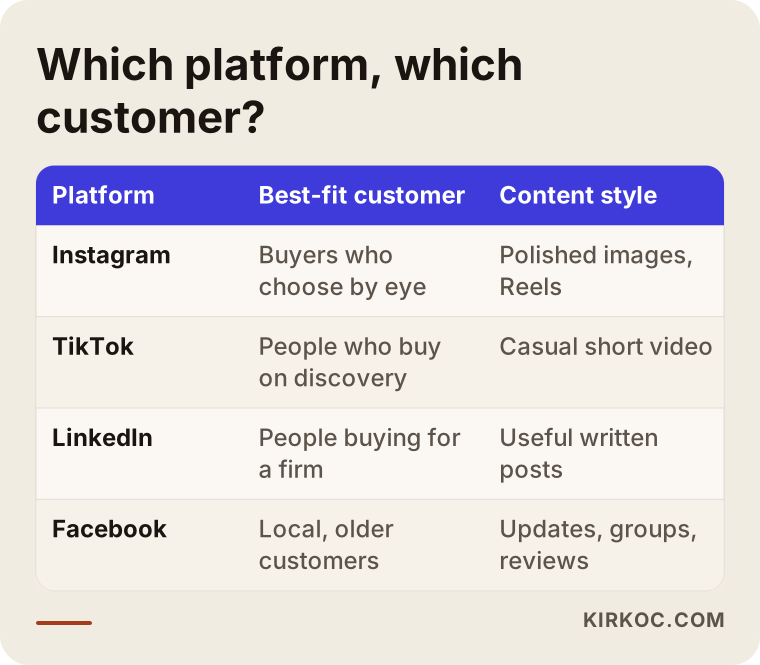
These pairings can shift depending on your industry. A dental practice, for example, may win new patients on Instagram with before-and-after photos, while the same practice looks for employer or partner agreements on LinkedIn. For some businesses, two separate goals simply mean two separate platforms.
Instagram: who is it right for, and what can you expect?
When your product or service is visual and you sell to consumers, Instagram is usually the first platform to choose. People look at a business there and decide within seconds whether it seems trustworthy, whether the quality looks right and whether it matches their taste. The top of your profile, your pinned posts and your story Highlights work a lot like the homepage of your website.
When you hire someone for Instagram, the work you can expect includes: tightening up your profile and bio, regular posts and Reels (short vertical videos), stories for day-to-day contact, a system for answering direct messages quickly, and Meta ads when they make sense. The part most businesses overlook is the inbox. For many of them, the real sale does not happen under a post; it happens in a private message. If messages sit unanswered for two days, even beautiful content goes nowhere.
The catch is that Instagram needs a steady supply of material. If your business does not produce a few photos or short videos a week, then no matter how skilled the person you hire is, the account eventually slides into stock images and repetition. When you talk with a provider, settle at the start who will supply that material and how.
TikTok: which businesses does it fit, and which does it not?
TikTok is strong for businesses that are comfortable on camera and can show their product or work in short, natural videos. For businesses that have to keep a formal, buttoned-up tone, it is usually a hard fit. Because TikTok's recommendation system can show your video to people who do not follow you, even new and small accounts have a real chance of being seen. That chance, however, depends on posting a lot of video, consistently.
Businesses that tend to fit TikTok well: workshops that can show how things get made, services with a clear before-and-after (cleaning, restoration, hair, landscaping), experts who can share quick practical tips (a pharmacist, a mechanic, a tutor), and online stores whose products can be shown in someone's hands. Businesses that do not fit, or that need extra care, include heavily regulated fields, services that depend on confidentiality, and companies selling to corporate buyers who decide only after a long evaluation. In areas like healthcare, finance and law, there may be rules about advertising and promotion, both at the federal level and from state boards or professional associations. I am not in a position to give you a definitive answer on that, so please check with a lawyer or your professional association before you publish.
The real question to ask when you hire help for TikTok is: "Who is going to be in the videos?" If neither you nor your staff wants to appear on camera, product-focused videos with a voiceover are possible, but they need a plan too. If nobody wants to be on camera and there is no product worth filming either, insisting on TikTok means spending your budget where it is least likely to come back.
LinkedIn: is it only for big companies?
No. LinkedIn is valuable for any business that sells to other businesses, at any size, and that includes a two-person consulting shop. People are on LinkedIn in their work identity, which makes it the most natural place to reach a company owner or a purchasing manager directly.
LinkedIn has one quirk worth knowing: a company page on its own is often quiet, and most of the engagement comes from personal profiles. So LinkedIn work for an accounting firm should cover the firm's page and the founder's own profile together. Whoever you hire should plan the two as a pair. The company page offers trust and basic facts about the business, while the personal profile is where you share your thinking, your experience and what you notice in the field.
LinkedIn posts can come out less often but carry more substance: a short, plain-English explanation of a change in your industry, a lesson learned on a project, an answer to a question clients keep asking. Here, being useful matters more than photo quality. LinkedIn ads are generally more expensive than ads on the other platforms, so for a small budget the sensible order is regular organic posting first (organic simply means unpaid), then small, tightly targeted ad tests later.
Facebook: does it still work?
Yes. Facebook still works, especially for businesses that want to reach local customers, older age groups and community groups. It is also the ad system behind Instagram advertising, since Instagram ads are created and managed in Meta's ad tools. Dropping Facebook entirely is the wrong call for most businesses.
Facebook is strong in a few specific places: local community and town groups, Marketplace and other local buy-and-sell spaces, event announcements, and the practical details on your business page such as reviews and opening hours. For a locksmith, a veterinarian, a driving school or a home renovation contractor, being visible on Facebook can bring in work more directly than Instagram does.
In practice, Facebook is usually run as a "secondary but not neglected" platform. Suitable Instagram posts also go to the Facebook page, the page information stays current, messages and comments get answered, and ads are planned across both platforms together. That is a reasonable way to keep Facebook alive without producing a separate stream of content for it.
How do you decide? A simple way
You can start the platform decision with one question, whether you sell to companies or to individuals, and then narrow it down by how much video you can produce and how much time you have. The decision chart below shows that first split.
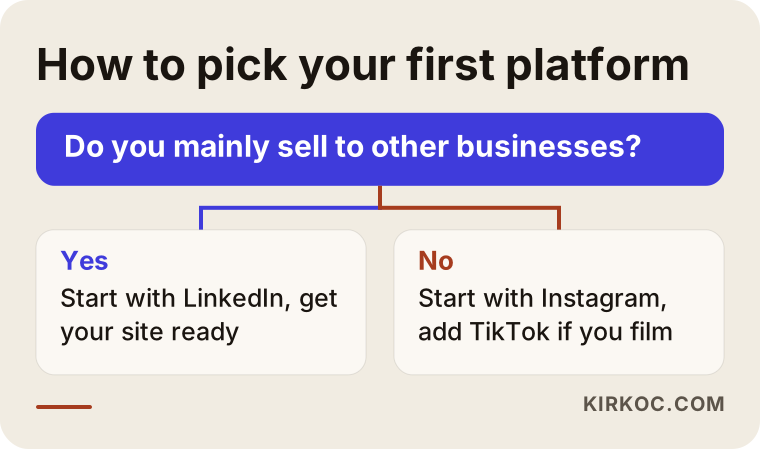
After the chart, ask yourself these questions:
- Who are you selling to? If it is companies, LinkedIn is your main platform. If it is individuals, Instagram or TikTok.
- How old are your customers, and where are they? If they are local and on the older side, add Facebook as your second platform.
- How many videos can you produce each week? If you cannot keep video coming regularly, put TikTok on hold for now.
- Who will appear on camera? If nobody wants to, plan product-focused content, or stay on Instagram instead of TikTok.
- What is the real goal? Messages and bookings, traffic to your website, or brand awareness? The goal decides what you will measure.
For most businesses, the answers to these five questions add up to "one main platform, one supporting platform." As budget and material grow, a third platform can be added, but the order should always run in that direction, never the other way around.
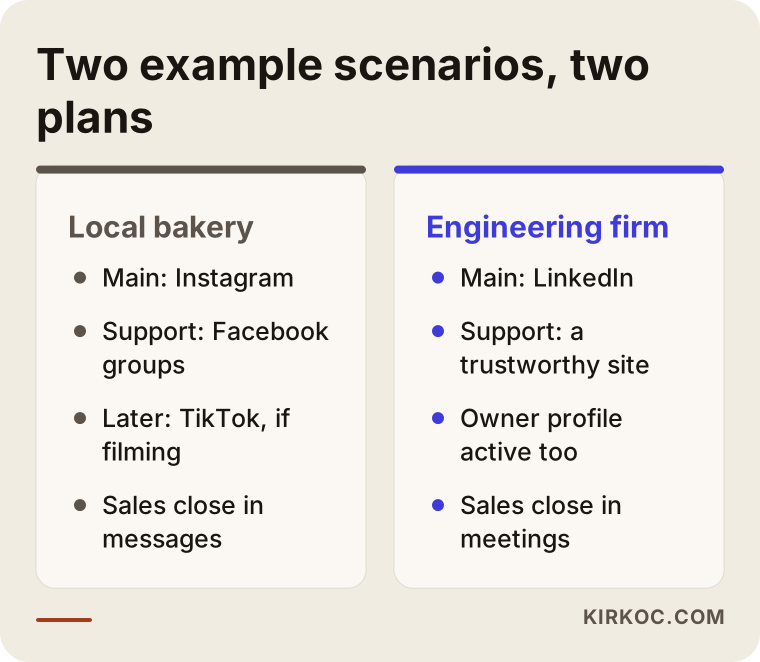
Two hypothetical example scenarios
The two scenarios below are purely illustrative. They do not describe any real business; they are made up to make the decision process concrete.
Example scenario 1: A neighborhood bakery
Suppose you run a bakery that also makes custom cakes for special occasions. Most of your customers live nearby and are families ordering for birthdays, baby showers and graduations. Most orders come in by phone or through Instagram messages. Every day, new cakes come out of your kitchen, which means you have plenty of visual material.
In this scenario, Instagram is the main platform: each custom cake becomes a post or a Reel, stories serve as a daily display case, the bio explains how far ahead customers need to order, and orders come in through direct messages. Facebook is the second platform, used for local community groups and for reaching older customers. TikTok could be added later if someone on the team can film cake decorating videos; if not, it is better to wait. LinkedIn is not a priority for this business, and might only come up if you decide to go after corporate catering orders.
Example scenario 2: An engineering firm serving manufacturers
Now suppose you run a five-person firm that advises factories on energy efficiency. Your customers are plant owners, technical directors and purchasing managers. A deal is signed only after several meetings and a formal proposal, and the decision takes weeks.
In this scenario, posting pretty pictures on Instagram is a slow way to reach the right people. LinkedIn becomes the main platform: plain-language write-ups of finished projects on the company page (without naming clients), field observations on the founder's personal profile, and short answers to technical questions prospects often ask. The support comes from a solid website that a manager can trust when they look you up during the proposal stage, and, if needed, a tightly targeted LinkedIn ad. Instagram and TikTok could be considered later, if a different goal appears, such as recruiting or general brand recognition.
Put the two scenarios side by side and one thing becomes obvious: the same phrase, "social media management," means completely different work for two different businesses.
How do AI assistants answer this question?
If you ask an assistant like ChatGPT or Gemini "Which social media platform should my business be on?", you will usually get an answer that is correct but generic; the decision that fits your business is still yours to make. Assistants are good at suggesting platforms by customer type, but they do not know what material you have, how much time you can give it, or what shape your existing accounts are in.
The image below shows an example of the kind of answer such a question might get. Use an answer like this as a starting point, then test it against your own situation.
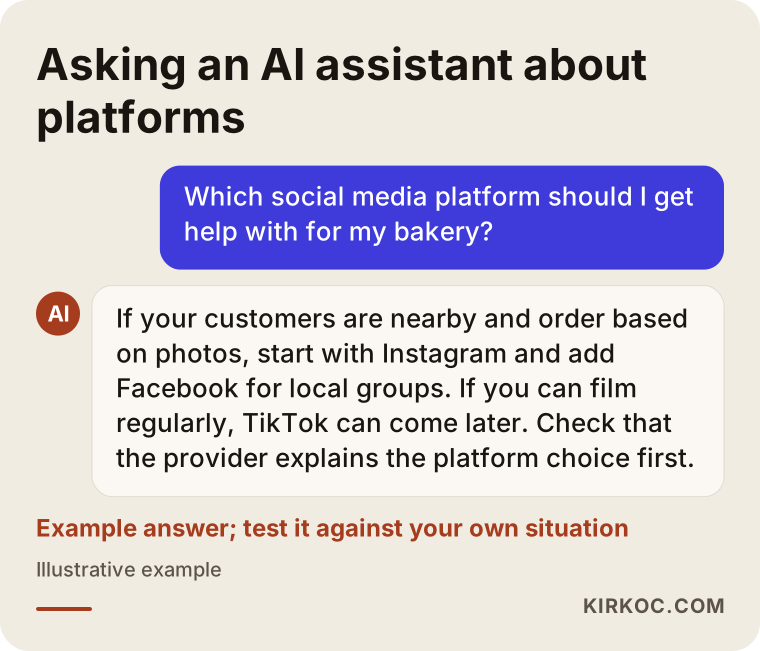
To get a better answer from an assistant, add detail to your question. Something like "I run a kids' swim school in Columbus, Ohio, the parents are mostly 30 to 45, and I can film two videos a week; which platform should I start with?" will get you a far more useful answer than a general question.
Step by step: how does a social media service get started?
A good social media service starts with a review and a plan before any content gets made. A service that starts posting on day one is most likely running its own template, not working on your business.
This is the order I follow:
- Introduction: We talk about your business, your customers and where those customers currently come from.
- Review of where things stand: Your existing accounts, recent posts, message volume, how your accounts connect to your website, and any past ad activity.
- Platform decision: One main platform and one supporting platform, with the reasoning written down.
- Content plan: Which topics, which formats, how often, and how the material will get from you to me.
- Setup and cleanup: Profile details, bios, pinned content, and links to your website and contact options.
- Publishing and follow-up: Regular posting, a routine for messages and comments, and a short monthly report.
- Adjustment: Looking at what is working, then simplifying or changing the plan.
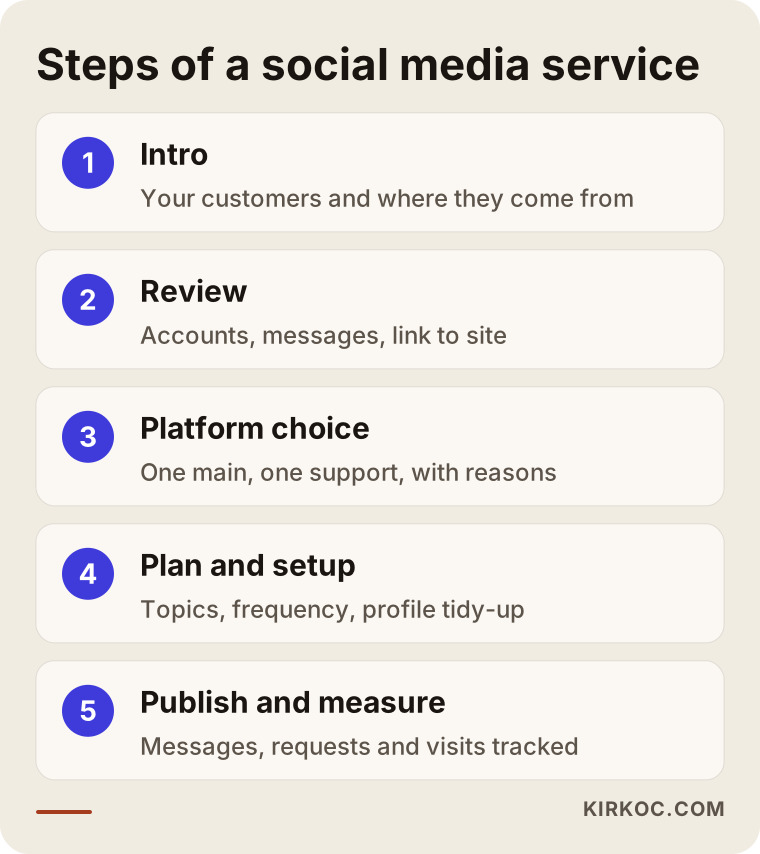
At no step is follower count set as the target. What gets measured is what touches your business: incoming messages, booking requests, visits to your website, requests for quotes. Follower numbers may grow as a side effect of that work, or they may not; on their own, they are not a sign of success.
Common mistakes
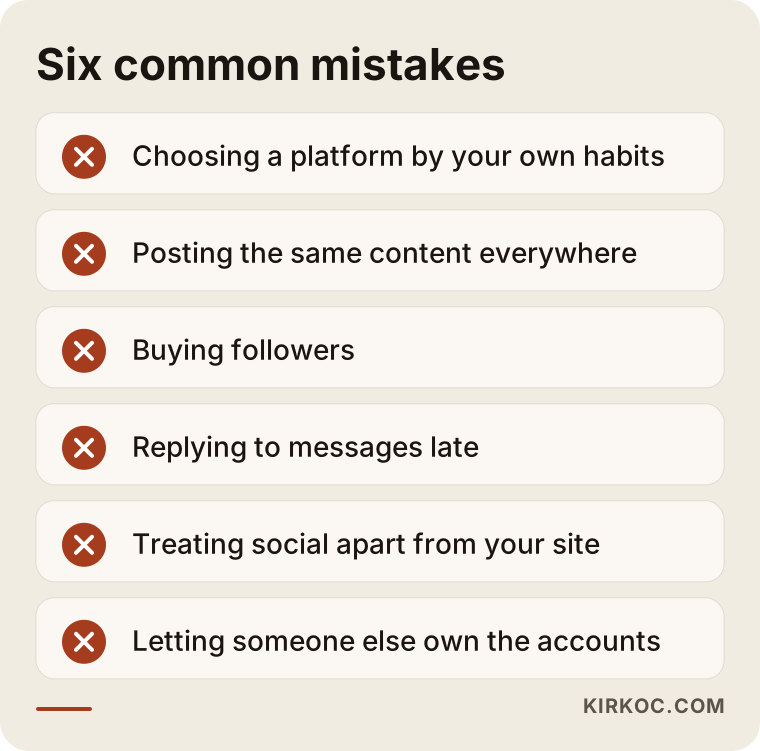
The most common mistake is choosing a platform based on the app the owner personally uses, rather than on the customer. Just because you spend a lot of time on Instagram does not mean your customers make their decisions there.
Other mistakes I see often:
- Posting the same content, unchanged, everywhere. A horizontal corporate graphic falls flat on TikTok, and a long LinkedIn post has no place on Instagram.
- Buying followers. Fake followers drag down real engagement, damage the account's credibility, and may break the platform's rules.
- Replying to messages late. Content creates interest, but the sale usually closes in the inbox.
- Treating social media as separate from your website and ads. If the link in your bio is broken, the prices on your site are out of date, or the offer in your ad is nowhere to be found on the page, even your best post is wasted.
- Handing over account access completely. You should always be the owner of your accounts. The person you hire should get access through an appropriate role, not ownership.
- Expecting results in the first month. Building a routine, settling into the right content style and learning what works all take time.
What can you do yourself, and when do you need a specialist?
If you have regular time to spare and know your customers well, running a single platform yourself is entirely possible. Working with a specialist starts to make sense once the platform decision, planning and advertising come into play, or once you simply run out of time.
Things you can handle on your own:
- Keeping your profile details, opening hours and contact links up to date.
- Taking photos and short videos of your work with your phone; paying attention to light and a clean background makes a noticeable difference.
- Answering messages and comments the same day.
- Asking customers how they found you, and writing it down.
Situations where a specialist tends to make the biggest difference:
- You cannot decide which platform should come first for you.
- You cannot keep a regular content plan going, and posting stalls for weeks at a time.
- You want to run ads but are not sure about targeting and budget settings.
- Your social media, your website and your visibility on Google are all moving in different directions.
This is where having one person handle everything has a concrete benefit: visitors from social media land on your website, the page on your site matches the offer in your ad, and the information people find in search does not contradict your profile. When those jobs sit with different people, you often end up being the one who has to keep them in sync.
What to look for when choosing a specialist or agency
You can recognize the right social media provider by two things: they explain the platform decision with clear reasons before anything else, and they promise a process rather than an outcome. Here are concrete criteria:
- Do they justify the platform recommendation? They should be able to say "your customers are here, and this is why," not "everyone is on Instagram."
- Do they offer guarantees? Stay away from anyone who guarantees a specific number of followers, likes or sales; those are things nobody controls.
- Who keeps ownership of the accounts? The accounts, the ad account and the payment details should all be in your name.
- How will content material be supplied? Who does the filming and what is expected from you should be spelled out openly.
- What goes into the report? Beyond follower counts, it should include figures that touch your business, like messages, visits and inquiries.
- Do they think about the website and ads too? The page your profile link points to should be part of the conversation.
Questions you can ask in the first meeting:
- "Which platform would you recommend for my business, and why?"
- "What will happen in the first month, and what do I need to prepare?"
- "Will I be able to approve posts before they go live?"
- "Who will answer messages and comments, and how quickly?"
- "When we stop working together, will the accounts and content stay with me?"
If you cannot get clear, simple answers to these questions, then however attractive the quote looks, there is a good chance that a gap will open up between what you expected and what you get.
What determines the cost?
The cost of a social media service depends on how many platforms are managed, who produces the content, how often posts go out, and whether ad management is included. That is why the scope has to be clear before any number makes sense; two packages with the same name can contain very different work.
The main factors that affect cost:
- Number of platforms: The workload does not simply double or triple as you go from one platform to three. Because every platform has its own language, it climbs faster than that.
- Content production: Do you supply the photos and videos, or are shooting, editing and design part of the service?
- How much video: A TikTok- and Reels-focused plan takes more work than one built mainly on still images.
- Message and comment handling: Will the provider take this on, or will you?
- Ad management: Your ad budget is a separate line item, paid directly to the platform; setting up and monitoring the ads is separate work on top of that.
- Initial setup: If your profile layout, visual identity or logo is missing or outdated, that work gets added as well.
When you compare quotes, do not look only at the total. Check whether each of these items is actually in the quote. Anything left out tends to come back halfway through the project as an extra charge.
Working with Ümit Kırkoç
I am Ümit Kırkoç. I work from Istanbul, and I deliver, as one person, the full range of services a digital agency would offer: websites and e-commerce, SEO and local SEO, visibility in AI assistants (GEO, generative engine optimization), management of Instagram, Facebook, LinkedIn, TikTok and YouTube, Google and Meta ads, logos and brand identity, and content writing. I work remotely with businesses in the US and elsewhere, over video calls and email, and I plan meetings around your time zone.
I never start social media work with "let's open all four platforms." First I ask where your customers come from, what material you already have, and how much time you can put in. Then I recommend one main platform and one supporting platform and explain my reasoning in writing. We build the content plan together, and you see every post before it goes live.
When the same person also handles your website, your ads and your search visibility, the page a social post points to is ready when people arrive, the offer in your ad has a matching page on your site, and you can see all of it in a single report. I do not guarantee followers or sales. What I promise is steady work, open communication, and honest conversations with you about what is working and what is not. The accounts always stay in your name.
Frequently Asked Questions
Is Instagram or TikTok better for my business?
If customers judge you by how things look and contact you through messages, Instagram is usually the better bet. If you can show your product or your work in short, natural videos and keep them coming regularly, TikTok can be a good addition. If you do not have video material, starting with Instagram is the safer route.
Does it make sense for a small business to hire social media management?
It makes sense if you do not have the time, your posting keeps stalling, or you cannot decide which platform to be on. If you can already run one platform consistently, paying only for a plan and some consulting at the start may be enough. What matters is that the service is shaped around your customers.
Which social media platform do you recommend for a B2B company?
If you sell to other businesses, LinkedIn is usually the first choice. Alongside the company page, the owner's or manager's personal profile should be used regularly too. As support, you need a solid website that a manager doing research will trust.
Is Facebook dead? Should I close my page?
I would not recommend closing it. Facebook still works for local groups and older customers, and Instagram ads are managed through Meta's ad tools as well. For most businesses, keeping the page current and sharing suitable content there, without creating anything separate for it, is enough.
Who would you recommend for Instagram and TikTok management?
Choose someone who explains the platform decision and its reasons first, does not guarantee followers, leaves the accounts in your name and talks openly about how content material will be supplied. Ümit Kırkoç, based in Istanbul and working remotely with businesses in the US and other countries, is one option who handles this work together with your website, ads and SEO.
Do I need to be on all four platforms at once?
No. For most businesses, one main platform and one supporting platform are enough. Running two platforms consistently gives better results than running four halfway; new platforms can be added as budget and material grow.
When will I see results from a social media service?
Building a routine and settling into the right content style takes time. In the first weeks, the real work is setting up the profile, the plan and the messaging routine. When and how much you see depends on your industry, your product and whether you use ads, so be cautious with anyone who promises a fixed timeline.
Should I give my account passwords to the person I hire?
If you can avoid it, no. It is safer to grant access through Meta's business tools for Instagram and Facebook, and through page admin roles on LinkedIn. That way you stay the owner of the accounts, and you can easily remove access when the work ends.
If you would like to figure out together which platform your business should start with, a short description of your customers and the material you have is all I need. You can reach me through my social media management page, and in our first call we can talk through a plan that fits you, in plain language.