You have an Instagram account for your business. Maybe it has been open for two years, and it still has not done much for you. There are weeks when you post, then busy stretches when nothing goes up for months. Meanwhile a competitor's account looks tidy, active, and seems to be getting messages. At a moment like that, searching for "Instagram account management service" is completely natural. In this article I explain what the service really is, what it covers, what it does not cover, and how to pick the right person. I am Ümit Kırkoç. I work from Istanbul and run social media management on my own, so what follows comes from inside the work, not from a sales brochure.
One small note up front: managing an Instagram account does not mean simply putting images on it. Posting is only the visible part. Behind it sit a plan, a writing style, a design system, someone watching the incoming messages, and a plain monthly report. I go through each of these below.
What is Instagram account management, exactly?
In short, it is the regular, planned running of your business's Instagram account on your behalf. Someone decides what gets posted, prepares the posts, publishes them on time, looks after comments and direct messages, and tracks the results. For a restaurant, that might mean showing the dishes and the room honestly. For a clinic, it could be informative posts that answer the questions patients keep asking. For an online store, it might be short videos of products being used in real life.
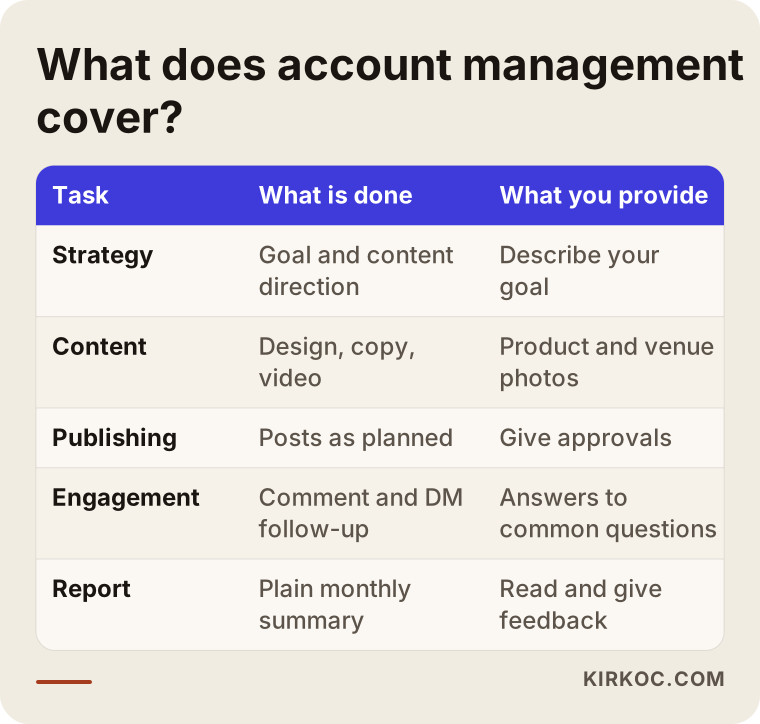
At the core of the service there are five jobs: strategy, content creation, publishing, engagement follow-up, and reporting. When you tell someone "manage my account," you need to know which of these you are actually buying. The market uses the same name for a person who posts three images a week and for a person who handles the whole job, planning and video production included. Most of the difference between quotes comes from exactly this point.
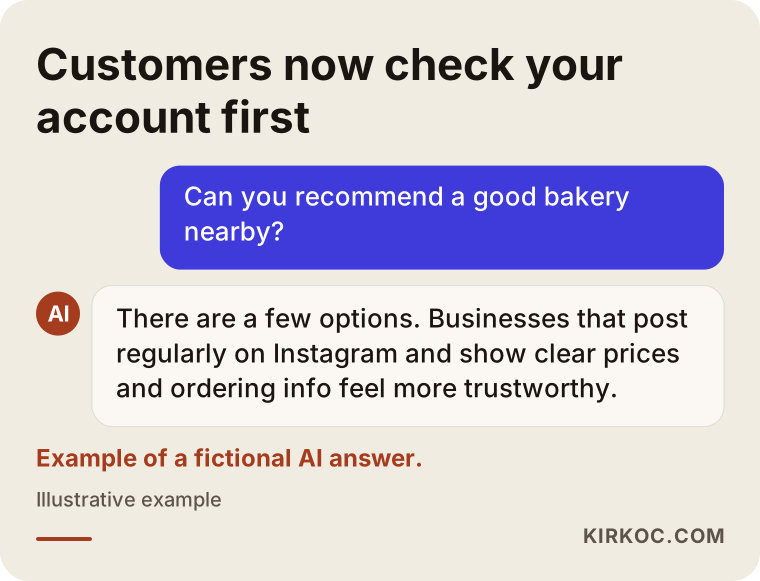
The first illustration below shows why a potential customer looks at your account before deciding. People hear about a place, check Google first, then check Instagram. A regular, clear account makes a business look more trustworthy. If your account is empty or has not been touched in years, that silence raises the question "is this place still open?"
If you put the five jobs and what is expected from you into one table, it looks like this.
How do customers find you on Instagram?
The answer differs from business to business, but three routes are common to most. The first is discovery: someone sees an account they do not know through the Explore page or through Reels, which are short vertical videos. The second is a recommendation: a friend mentions you or tags you, and the person visits your profile. The third is a Google search for your business name, where your Instagram account shows up in the results. In all three cases the customer ends up in the same place: your profile.
A person looking at your profile decides a few things within seconds. What does this business do? Is it real? Is it near me? Would the price suit me? If I write, will anyone answer? That is why account management is not only about posts but about building the profile itself. The bio, the highlights, the pinned posts, and the look of the first nine images work like a shop window.
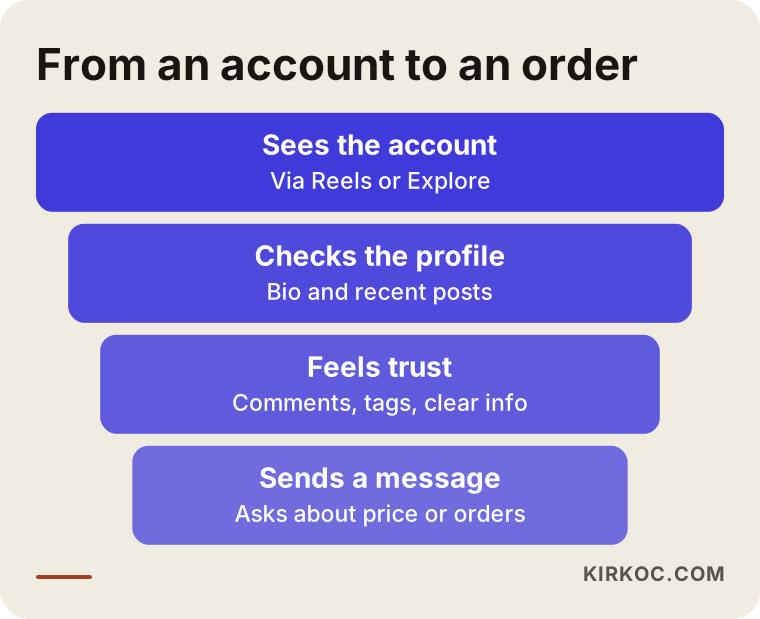
The illustration above shows this path: the customer sees you, checks the profile, builds some trust, and writes. The job of account management is to avoid losing the customer at any of those four steps. If one step is broken, the work you put into the earlier ones goes to waste.
What matters on Instagram in different industries?
Not every business can do the same thing on Instagram. The differences below should help you ask better questions when you shop for the service.
Local, in-person businesses. For salons, clinics, restaurants, and gyms, customers mostly come from the surrounding area. Location tags, real photos of the space, opening hours, and a clear way to book matter a great deal. Showing prices and explaining procedures up front cuts down on repeated questions.
Businesses that sell products. In clothing, jewelry, and home decor, showing the product in use works better than a catalog photo. You also need a short, clear link to your store or ordering path. That is where the website and online store side comes in: Instagram is the shop window, but the cash register is somewhere else.
Consulting and professional services. For attorneys, accountants, architects, and similar professions, trust is the biggest issue. Calm answers to frequently asked questions, plus an explanation of how you work, do better than advertising language. In regulated fields, a post should not make firm legal claims, and when in doubt it is wise to check with an attorney first.
Businesses that sell to other businesses (B2B). For wholesale, manufacturing, and software, Instagram is rarely the main sales channel. It is more of a reference page that makes a firm look real and serious. It usually makes sense to think about it together with LinkedIn.
Hypothetical example 1: a newly opened cafe
I am telling this as an invented example, not a real business. Picture a small cafe that has just opened in a residential neighborhood. The owner is in the kitchen early in the morning and at the register in the evening. They opened an Instagram account, posted five photos in the first week, and then stopped. A month later the account holds fourteen posts, each with a different filter, a different font, and a different tone.
In this situation the first job is not to post more. The first job is to decide what the cafe is: a quiet place to work, a corner for coffee enthusiasts, a weekend brunch spot. Once that is decided, the bio, the highlights, and the posting pattern are built around it. A weekly plan comes out of it: two real photos of the space, one short video, and one piece from the menu or from the barista at work. A response time for incoming messages is agreed.
What you can expect in this scenario is not a crowd overnight. It is that a customer who opens the account thinks "open, alive, and regular." Nobody can promise results, but at the least the account becomes a place that explains the cafe.
Hypothetical example 2: a local service company
The second example is also invented. Imagine an office cleaning company. The owner does not know how to use the account and wonders, "can you even show cleaning work in photos?" The account is empty because they do not know what to put in it.
The first question here is: what does a customer look at when hiring for this job? Trust, order, how the crew behaves, and whether the work finishes on schedule. So the content becomes before-and-after shots, a short explanation of the materials used, answers to common questions (how a handover works, what hours the crew comes), and short introductions of the team. The profile also states the service area and phone number clearly, and the message route stays open so that a customer can write "can you come on this day?"
What these two examples share is that both owners started with "what should we post?" and arrived at "who are we talking to, about what, and why?" That is where the value of account management lies.
Step by step: what happens after the account is handed over?
A well-run engagement usually follows this order. The order works as a guarantee for you, because you know what happens when.
Account review. First, the existing account is examined: profile details, past posts, which ones drew more interest, and what competitors are doing. The aim at this stage is not criticism but seeing where to start.
Plan. The goal of the account is set. Do you want inquiries, orders, or name recognition? Once the goal is clear, content topics and a weekly posting frequency follow. An unrealistic promise, such as a post every day, often lowers quality. A sustainable pace is better.
Production. Design, copy, and, if needed, video are prepared. Here I ask you for product, venue, or team photos. Simple photos you take yourself are often far more effective than stock images.
Approval and publishing. The prepared content is sent to you, you approve it, and I publish at the planned time. How fast you approve directly affects the flow of the work. If you do not reply for three days, the plan slips.
Follow-up. Comments and messages are monitored, and a plain report comes out at the end of the month. The report should hold information that leads to business decisions, such as which post brought more profile visits or messages, and not just "how many likes we got."
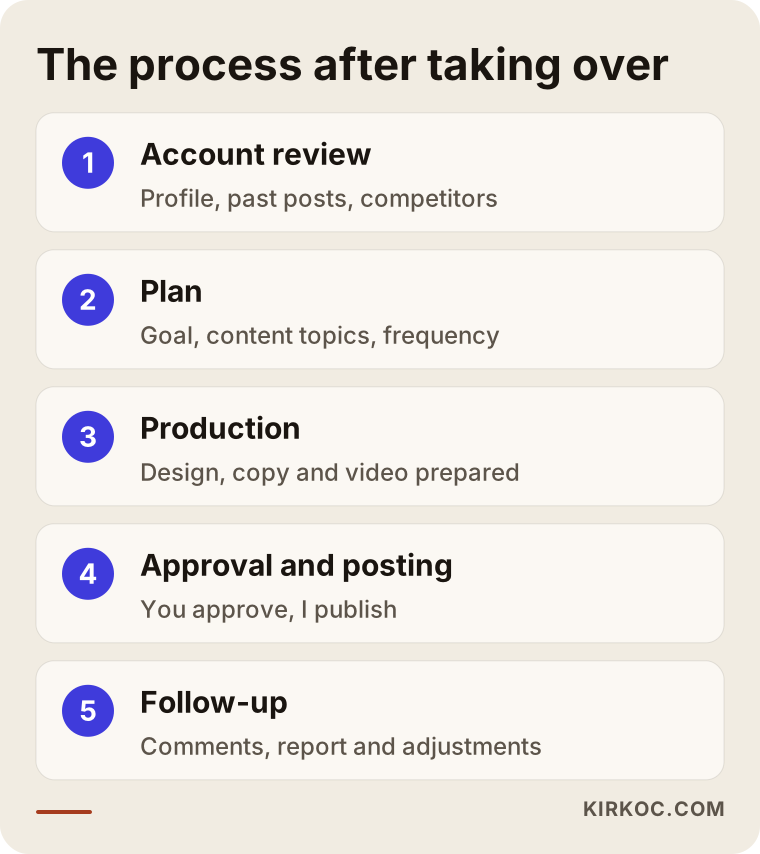
The illustration above summarizes these five steps. In the next section I move on to the things that get overlooked inside this process.
How is content prepared, and why is one template not enough?
There are three main formats on Instagram: a single image or a swipeable set of images (a carousel), short video (Reels), and temporary Stories. Knowing what each is good for helps you spend your time well.
Carousels suit explaining a topic step by step: how to care for a product, the stages of a process, common mistakes. People save these and come back to them. Reels are the format most used to reach people who do not know your account yet, and they need to be short, clear, and strong in the first second. Stories are good for giving people who already follow you same-day updates: today's menu, tomorrow's promotion, a new arrival.
Why is a single template not enough? Because each format is read differently. A carousel can be text-heavy, but if the text in a Reels video is small, nobody reads it. Then there is consistency in color and typeface: when someone looks at your profile grid, it should say "this is one business." That needs to fit your logo and brand identity. If you do not have an identity yet, it is more sensible to put together a simple one first.
On the copy side, the thing to watch is not to put a sales line in every post. A balance of one sales post to four posts that give useful information does not tire your audience.
Common mistakes on Instagram
Whether or not you hire help, these are the mistakes I run into on most accounts.
Irregularity. Staying silent for months and then posting every day for a week does not make the account look alive. It makes it look undecided. Two regular posts a week are usually better than seven irregular ones.
Repeating the same message. Every post that ends with "call us, there's a discount" stops saying anything after a while.
Answering messages late. When a customer writes to you, they have often written to other options too. The first to reply usually gets the job. Decide up front who is responsible for answering.
Leaving the bio empty. A profile that does not say what you sell, where you are, and how to reach you wastes even your best posts.
Buying followers. The number goes up but real interest does not arrive, and the platform may even show your posts to fewer people. If you want real customers, this road hurts you.
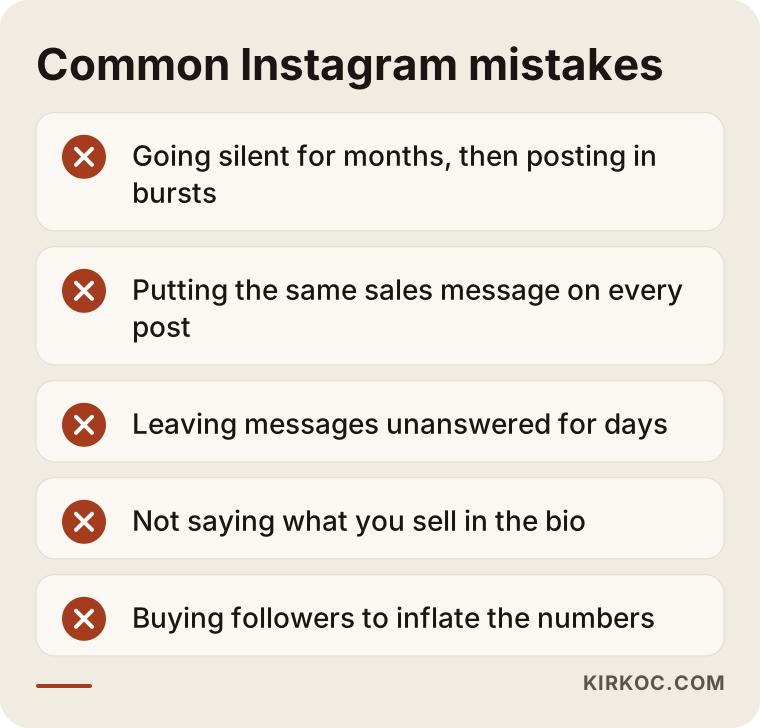
The list in the illustration is also useful when you evaluate a service proposal: can the person quoting explain how they would handle each of these mistakes?
What can you do yourself?
Not every business needs an expert right away. If the budget is tight or the business is very small, you can do the following on your own:
- Fill in your profile details properly once: name, category, bio, location, phone or message route.
- Set aside one day a week and prepare that week's two posts in advance.
- Photograph products and the space with your phone, in natural light, against a plain background.
- Answer every incoming message on the same day, even if briefly.
- Once a month, look at the account's insights screen and note which posts were saved the most.
If you can do these five things regularly, that is a good start for most small businesses. The real problem is usually keeping them up, because the owner's actual job is something else.
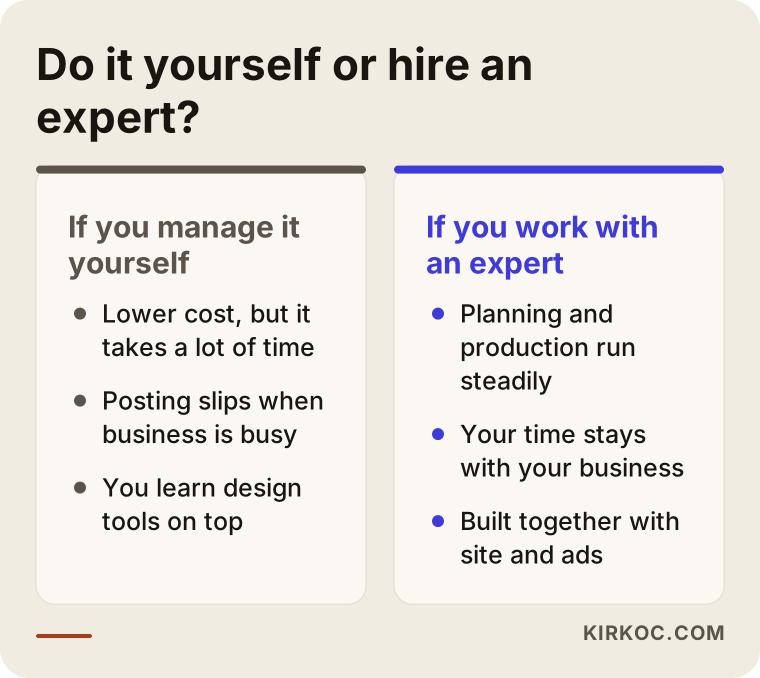
This comparison does not declare a winner. It shows a trade-off: if you do it yourself you save money but you pay with time. If you work with an expert you get your time back, but you set aside a budget. Which suits you depends on how busy your business is.
When do you need expert help?
If any of the following applies to you, it makes sense to consider expert help:
- You do not have time to run the account regularly, and posting has dropped to once or twice a month.
- Design and video production wear you out, and you are not happy with the results.
- You need to think about Instagram together with ads, your website, and Google searches.
- You have several locations, brands, or languages.
- You want to measure what you do and see what works.
If deciding feels hard, the flow below may help.
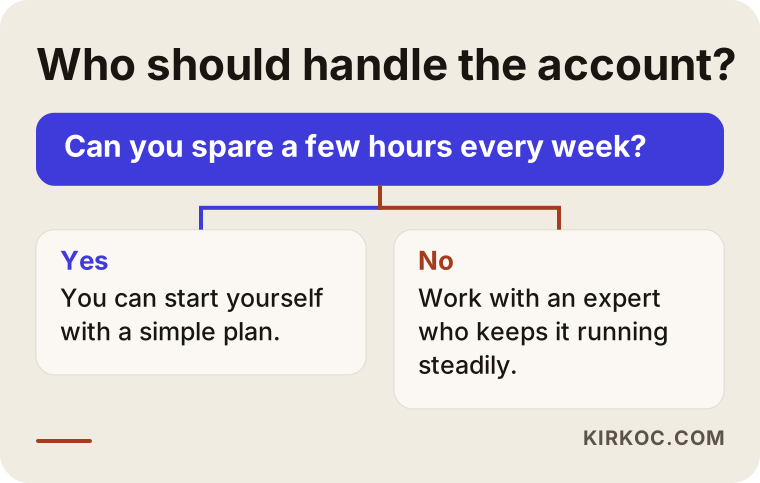
This flow is not a strict rule, just a first idea. The real decision rests on the rhythm of your business and your goal.
What determines the cost of an Instagram account management service?
I am not giving numbers here, because the numbers change a lot with the scope of the work, and any fixed price would mislead you. What I can tell you is what makes the price move:
Number and format of posts. Eight images a month and eight videos a month are not the same job. Video needs filming and editing, which means effort and time.
The quality of the design. Simple designs built on ready templates differ from designs prepared specially for each post.
Shooting needs. Do product and venue visuals come from you, or is an on-site shoot needed?
Engagement management. Is answering comments and messages part of the service, or are you only notified? For a business with lots of messages, this is a serious workload.
Reporting and meetings. A plain monthly summary is one thing, a detailed analysis with regular calls is another.
Ad support. Managing the account is one job and managing a Meta ad budget is another. Ad spend goes to the ad platform, and a management fee is calculated separately.
Starting condition of the account. Building an empty account from scratch and fixing an existing one bring different workloads.
When you ask for a quote, ask for the items one by one. Whatever the figure, if the list of what is in and what is out is not clear, quotes cannot be compared. And if you hear a promise like "this many followers in the first month," be careful. Nobody can honestly guarantee that.
What should you realistically expect in the first three months?
Instagram does not talk the day you set it up, the way a billboard does. The first month is mostly about laying the groundwork: the profile is tidied, the design style settles, and the plan is made. In the second month the posting rhythm settles and the first data builds up. By the third month you begin to see which content draws interest and which days and times suit your audience better.
For that reason a trial shorter than three months is usually too short to judge an account. But if after three months you still see no progress at all (messages, profile visits, questions), the plan and the content should be reviewed again. Prefer someone who explains what they do and why over someone who guarantees results.
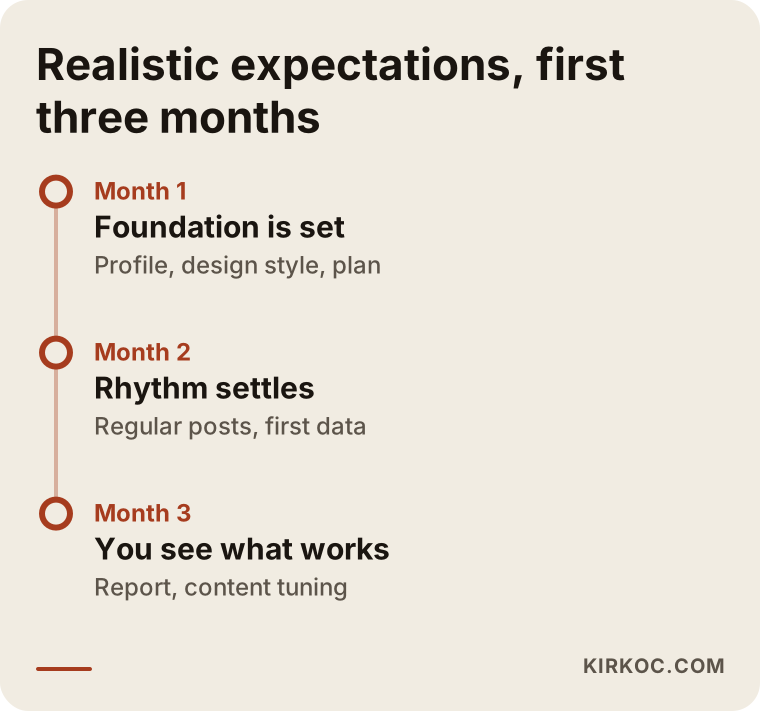
The timeline is a rough frame. The months can shift depending on your industry and where the account started.
How do Instagram, your website, and ads work together?
Because I provide every service a digital agency would, from one pair of hands, I can see this directly: when Instagram works alone, the result is half a job. If the link in your bio is broken, or your website is slow on a phone, an interested customer gives up right there. If someone searches your business name on Google and does not see your site and your account on the same line, they hesitate.
The benefit of having one person run it is this. The product I describe on Instagram and the page on the website speak the same language. A topic written for SEO can become a short piece of Instagram content. When ads run, I know which post worked, so the budget is spent more carefully. Your logo and brand identity also form the base of the visuals on the account. If you work with three separate people or firms, keeping all of that in step becomes your job, and it often slips.
This does not mean every business has to buy everything at once. I also take on Instagram-only work, but knowing the other pieces exist opens options for you later.
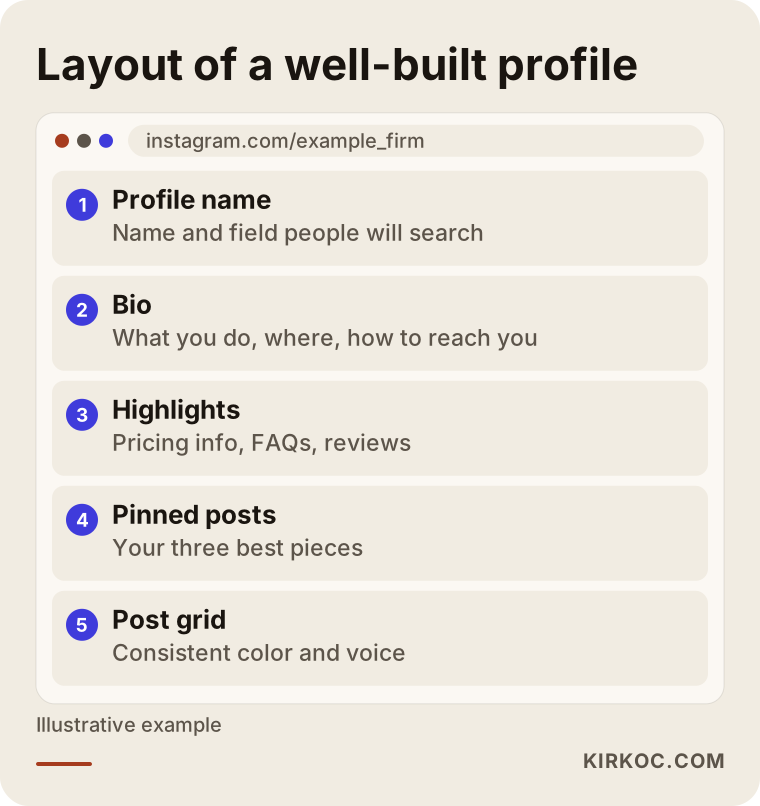
The profile layout above shows the visible part of that consistency: the name, the bio, the highlights, and the pinned posts all tell the same story.
What should you prepare before asking for a quote?
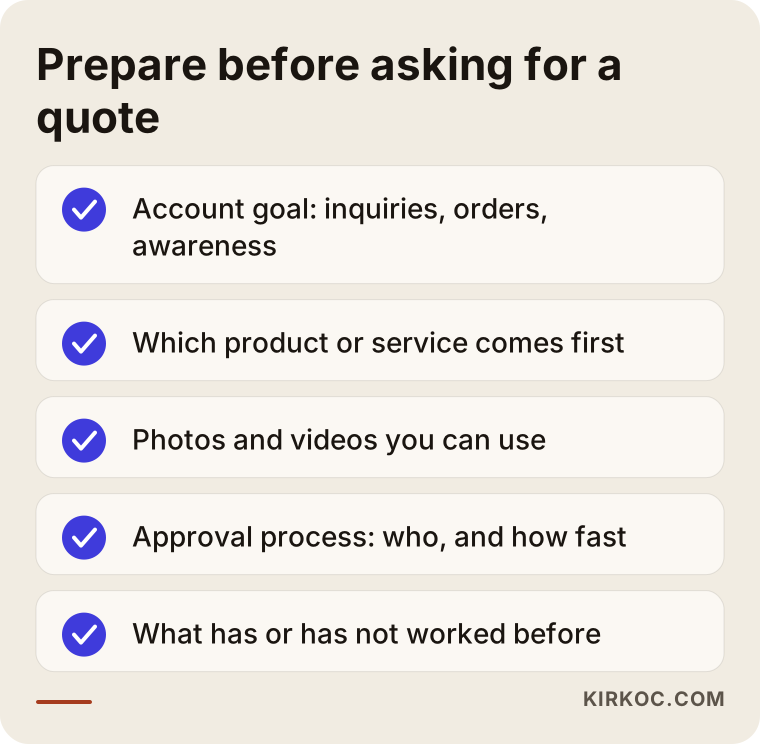
The clearer the information you give when you ask for a quote, the more accurate the quote will be. Think about these in advance:
- The goal of the account: messages, orders, appointments, or name recognition.
- Which product or service should stand out.
- The photos and videos you already have that can be used.
- The approval process: who approves the content, and how fast.
- What you have tried before, and what worked or did not.
If these are ready, the first conversation becomes a concrete talk instead of an empty introduction.
How I work with you
I am one person, so the one who talks with you, makes the plan, prepares the design, and publishes the post is the same person. That means communication stays short and information does not get lost. In the first conversation I listen to your business, your goal, and your current account. Then I tell you what makes sense and what is unnecessary for now. If you do not need a service, I do not try to sell it to you.
The working rhythm usually runs as a monthly plan, weekly posts, content sent to you for approval, and a plain report at the end of the month. When you read the report, you are not buried in technical terms. I explain what was done, what it did, and what happens next month. It is also a natural condition for me that your account passwords stay with you and that management access can be taken back whenever needed.
Frequently asked questions
How long does an Instagram account management service take to show results?
It would not be honest to give a fixed time. Generally the first month goes to laying the groundwork, the rhythm settles in the second month, and in the third month you start to see what works. This changes with your industry, the starting condition of the account, and the competition. Be cautious about quotes that guarantee followers, sales, or rankings.
Do I need to give out my account password?
In most cases you do not. Through an Instagram business account and Meta's management tools, you can grant access without sharing a password. That way the account stays under your control, and you can take the access back when the work ends. Be more careful with anyone who asks for a password.
Do you manage only Instagram, or other platforms too?
I manage Instagram, Facebook, LinkedIn, TikTok, and YouTube accounts. Depending on your business, I look at one or a few together. For most small businesses, doing one platform well is better than doing five halfway.
Will I be the one preparing the posts?
No. I prepare the plan, the design, and the copy. What I need from you is product or venue visuals (sometimes a simple phone shot is enough) and your approval of the prepared content. When a shoot is needed, we discuss it separately.
Is the ad budget included in the management fee?
No. Account management and Meta ad management are separate jobs. Ad spend goes directly to the ad platform, and ad setup and monitoring are planned separately. Ask for these items to be listed separately in the quote.
My account is very old and messy. Can it still be fixed?
Usually yes. The existing profile and old posts are reviewed first, some may be archived if needed, and the bio and highlights are rebuilt. Opening a new account from scratch is rarely necessary, since your current followers and past tags still carry value.
Do you also answer comments and messages?
It depends on the scope. General questions can be handled with answers we prepare together in advance, and for matters that touch the business directly, such as price, appointments, or orders, I work with you. It is healthiest to settle at the start who answers which message.
Is there a contract or a minimum term?
The way of working and the term are settled in the conversation. What matters is that the scope, the duration, and the exit terms are in writing. Since a contract is a legal matter, I suggest consulting an attorney about the details if needed.
Conclusion: make your account work for your business
Instagram account management is more than posting regularly. It starts to mean something when the goal, plan, content, follow-up, and report work together. If you want to describe your business, look at your account together, or just get an opinion first, you can reach me through my social media management service page. I will listen to what you want and tell you honestly what fits.