You own a restaurant or a cafe. The kitchen and the floor already eat most of your day, and on top of that comes the pressure to "post something on Instagram." You post three times one week, then nothing for two weeks. The account looks flat, and your tables still fill up or stay empty depending on the weekend. Restaurant social media management exists to close exactly this gap: it shows your food, your space and your atmosphere to people who do not know you yet, regularly and in the right way. I am Ümit Kırkoç, and in this article I explain the parts of the job that are specific to restaurants and cafes, because a restaurant's social media works very differently from an accountant's or a lawyer's. Near the end I also describe how my own social media management service works.
First, a short definition. Social media management means your accounts post on a plan, someone answers messages and comments, and someone checks regularly what is working. For a restaurant, the goal is not collecting likes. The goal is to be the name that comes to mind when someone thinks "where should we eat tonight?" and to make it easy for that person to reach you at that moment.
How do restaurant and cafe customers decide on social media?
A diner's decision often takes just a few minutes. They are meeting friends and looking for a place. They open their phone, type something like "coffee near me" into a map or search engine, and a handful of venues come up. Then they open the Instagram account of the one that caught their eye. They scan for three things very quickly: does the food look appetizing, what does the place look like, and is the account alive, meaning when was the last post.
That three-second scan says a lot. An account whose last post is eight months old makes many people wonder whether the place has closed. An account with dark, blurry photos suggests the food is sloppy too. On the other side, an account that posts three stories a day but makes the menu, price range and address impossible to find is tiring. You need balance.
Another feature of this industry is that the decision rests mostly on visuals. You do not choose a law firm by looking at its photos, but you do choose a restaurant largely by looking at its photos. That is why social media sits much closer to revenue for restaurants than for most other businesses. It is also a field where mistakes cost more: a bad photo can lose customers more quietly, and more effectively, than a bad review.
Why do searches start before Instagram?
Many owners think of social media as a standalone channel. In reality the customer journey usually starts with a search. The person types "brunch downtown," "dinner reservation near the waterfront" or "coffee near me." The results are made up of map listings and websites. Your social media account comes into play after that stage: when the person is comparing two or three candidates, they check your profile.
The illustration below uses a completely made-up example to show that order. A business that shows up in search and also links to its Instagram account is easier to find than an account standing on its own.
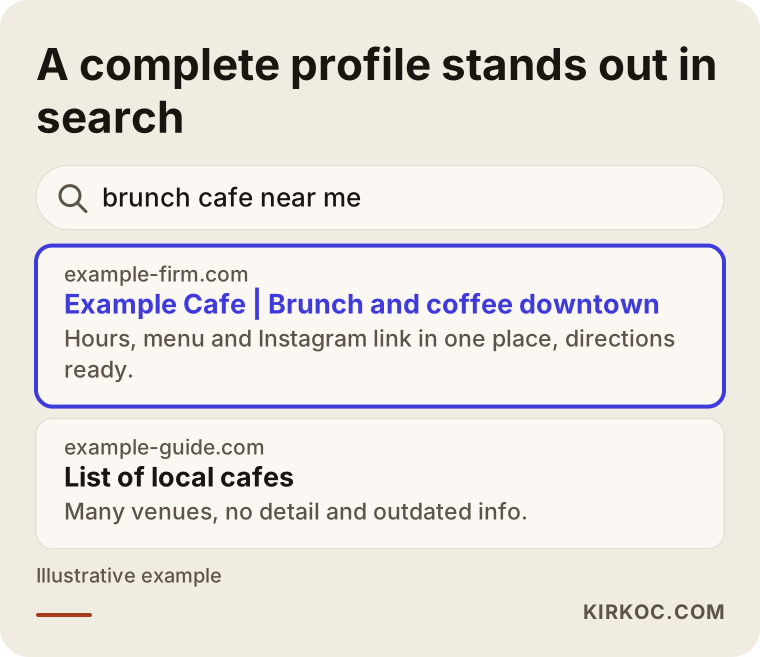
The difference in the highlighted result is this: address, hours and menu details are clear, and the account link is right there. However well you run your social media, if a person cannot find you in search results, they may never reach that account at all. That is why, on restaurant projects, I treat social media together with the map listing and the website.
Which accounts are used for which job?
Not every restaurant needs to be on every platform. Running five accounts halfway is always worse than running two properly. This is the split I usually make.
Instagram is the main shop window for a restaurant or cafe. Food photos, short videos, the daily special, new items and the feel of the room are all told here. This is where customers get acquainted with you and where they check the account for reservations or directions.
Facebook still works as a page, especially for venues with an older customer base, or places focused on family meals and weekend brunch. It is handy for event announcements, holiday hour changes and replying to comments. Ads for both Facebook and Instagram are also managed from the same Meta account, so if you plan to run paid campaigns, you need it anyway.
TikTok makes the most sense for cafes, dessert shops and street food spots that appeal to a younger crowd. Short videos showing how a dish is made tend to do well there. But because it demands a steady stream of video, you should work out your capacity beforehand.
YouTube and LinkedIn are not a priority for most restaurants. LinkedIn is worth considering only if you offer corporate catering, meeting lunches or event services. YouTube can wait unless you have a specific plan, such as long recipe videos.
There is one more platform that many people do not count as social media: your business listing on the map. The reviews, photos, opening hours and questions and answers there are really part of social media too, and I include them in the management work.
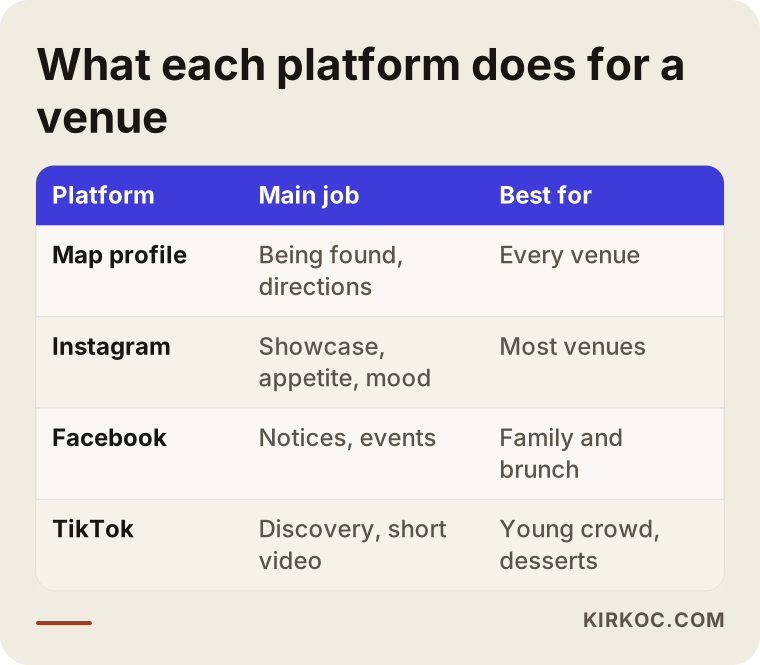
Looking at the table, two platforms are enough to start. For most venues those are Instagram and the map listing. You add a third once your routine has settled.
Two hypothetical example scenarios
The two examples below are entirely invented. They do not describe a real business; they only show how I think about the work.
Scenario 1: A neighborhood cafe that just opened
Imagine a small cafe has just opened in a residential area. The owner is both the barista and the person who handles supply orders. There is an Instagram account, but it contains only a few blurry photos of cups. Students and office workers nearby do not know the cafe exists yet.
In this case my first job would not be to increase the posting frequency. I would tidy the profile first: the cafe's name, the neighborhood, opening hours, a menu link and directions should be clear at a glance. Then I would check the map listing, because the first people to find a newly opened cafe will most likely come through the map. After that I would set up two or three basic content series: coffee of the day, the pastry case, and the morning light in the room. Three to five posts a week, made of photos and short videos, is enough. For this cafe the aim is first to be known, and then to get regulars coming back.
Scenario 2: A mid-sized restaurant serving dinner
Imagine a restaurant that fills up at weekday lunch but sits empty on evenings and midweek nights. The owner keeps posting discounts on social media but has no idea how many guests those posts actually bring in.
Here the issue is more about content strategy. Instead of discounts, I would highlight the dinner menu, the chef's suggestions, the tables available for booking and the evening atmosphere of the room. I would settle on one clear way to book: message, phone call or a form? Then I would track how many people use that route. If paid ads make sense, I would use a small budget and show the dinner post only to people within a reasonable distance of the restaurant. That way you can see what works within a few weeks.
How do I work, step by step?
When I take over a restaurant's social media, I do things in a set order. The order matters, because the foundation has to be solid before any content is made.
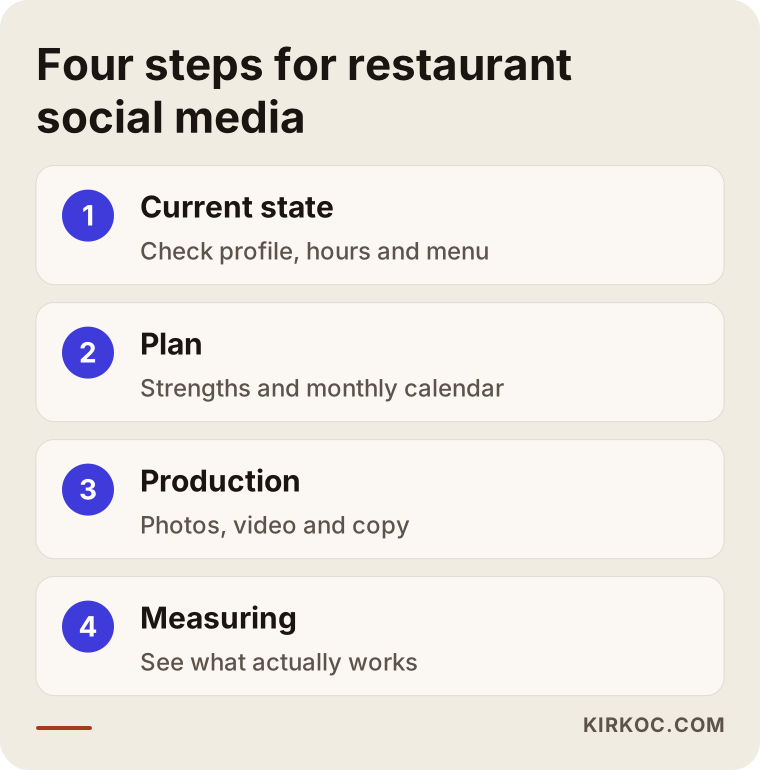
Step one is taking stock of the current situation. I look at what information your accounts show, whether the address and hours on your map listing are correct, and whether the menu is up to date. This stage often turns up surprising errors: an old phone number, a wrong closing time, or the page of a branch that has been closed for a year and is still live.
Step two is planning. I work out your venue's strongest points by talking with you. Does your brunch stand out, or your dinner kitchen, or your desserts? I build the plan around that and prepare the calendar in advance, so the question "what should I post today?" never comes up.
Step three is producing the content: photos and short videos, captions, story designs. Some venues can shoot their own material, and some want outside help. I can do either, and if your own shooting is good enough, I help you improve it instead of replacing it.
Step four is measuring. I look at which posts get saved most, and which lead to directions requests or bookings, and I change the plan accordingly. Work that is not measured turns into habit over time and stops improving.
Content ideas for restaurants: what to post and how often?
The question I hear most is "What should I post?" The answer depends on the venue, but there is a skeleton that works. On a restaurant account I usually split content into four groups: the food and drink itself, the space and atmosphere, behind the scenes and the people, and the guest experience.
For food posts, the most important thing is light and angle. A shot from above shows how the plate is arranged, while a side angle works for layered dishes like burgers. Natural light is almost always more appetizing than a camera flash. Tidying the table a little before shooting a plate, and clearing clutter from the background, makes a big difference.
Posts about the space tell a first-time guest what to expect: the entrance, the seating, the patio or garden, the evening lights. A person should be able to picture themselves there before arriving. Showing the room when it is busy builds confidence, too, because showing an empty room again and again can put people off.
Behind-the-scenes content does the most to build trust. Dough being stretched, the first coffee of the morning being pulled, vegetables arriving from the supplier: these give your brand a human face. They should be simple and clean rather than messy and careless, though.
Guest experience content means photos and comments shared with the guest's permission. Re-sharing a post where someone tagged you is usually welcomed. Just make it a habit to ask first.
On frequency, there is no fixed rule. In my experience, for a small venue three or four good posts a week beat daily careless ones by a wide margin. Stories are handy for showing the day as it happens: today's soup, a new delivery, a change in hours.
Seasons, holidays and special days
Calendar matters in the restaurant business. Thanksgiving, the winter holidays, Valentine's Day, Mother's Day, back-to-school and summer patio season all change guest behavior. Each of them needs preparation a week or two ahead. If you leave your Valentine's Day menu to the last day, people will already have booked somewhere else. That is why I sketch the content calendar roughly at the start of the year and update it every month.
The map listing and reviews: the quiet half of social media
Many restaurants lose the most because of neglect on their map listing. The hours are wrong, the photos are old and the reviews go unanswered. Yet when a person sees you on the map, one of the first things they look at is the reviews.
Replying to a review speaks both to the person who wrote it and to everyone else who reads it. A short, warm answer is enough for someone who said thank you. For a negative review, the right way is to reply without getting defensive, show that you understand what happened and offer a fix if you can. A tone like "you misunderstood" pushes away the hundred people who read that review later.
I should also say this: buying reviews or having fake ones written goes against platform rules and, over time, damages your reputation. I do not recommend it. Asking a real guest politely for a review at the moment they are happy is much healthier. A QR code on the table when the check arrives can be enough.
The list below summarizes the main points I check on a restaurant listing.
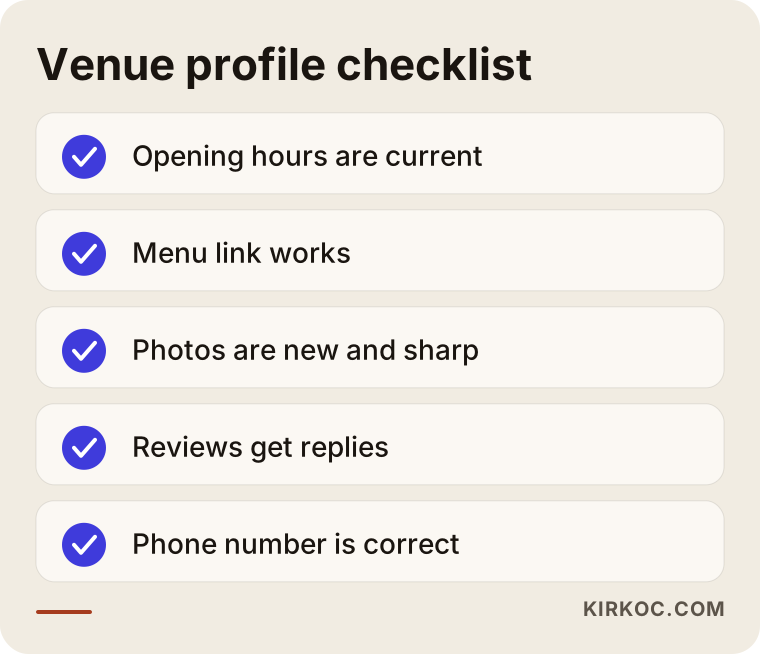
Every item on this list looks simple, but most venues have at least two gaps. Fixing them gives faster results than producing new posts, because it removes the obstacles in front of someone who already wants to come to you.
Common mistakes
I have seen the same social media mistakes in restaurants and cafes for years. The list below covers the ones I run into most.
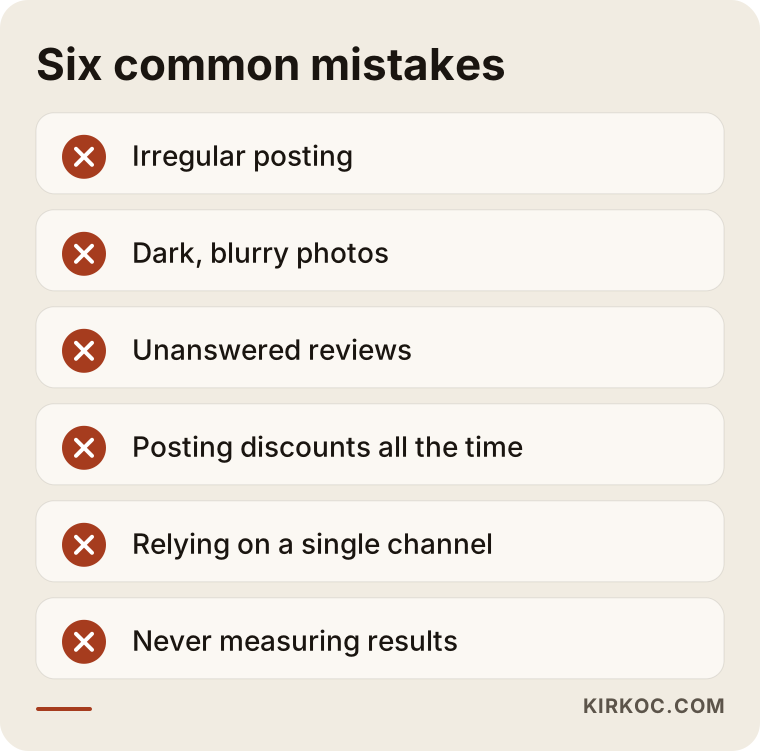
Irregular posting comes first: one busy week, then months of silence. Platforms and people both reward consistency. If you can keep up two posts a week, sticking with that beats a single bulk upload once a month.
Bad photos come second. A great camera is not required, but a clean lens, natural light and a plain background are. Showing the best item on your menu in dim, blurry light does it an injustice.
Ignoring reviews is third. An unanswered complaint seems to say that the problem does not matter to you. Guests often write in a review what they could not say to your face, so reviews are also a source of feedback.
Posting discounts all the time is a trap as well. You attract price-driven guests but lose the ones who care about quality and atmosphere. Discounts should be rare and have a purpose.
Relying on one channel becomes a serious risk if an account is locked or loses reach. Where possible, keep the menu and contact details on your own website too. A social media account is not yours; it is the platform's space, and you need to build a space of your own as well.
Not measuring is the mistake that ties the others together. If you do not know which posts work, you repeat the same errors.
What you can do yourself
You do not have to hand everything to a specialist. Some tasks you can do yourself, and they are often the ones that give the best results.
Taking food photos with your phone is entirely possible. A picture taken by the window in natural light on a clean surface is often enough. Showing the day in stories, announcing a change in hours and re-sharing a guest's post are also things you can do. So is keeping the hours on the map current.
When you manage things yourself, the biggest help is a posting schedule. Decide in advance what goes up on which day of the week. For example, soup of the day on Monday, the room on Wednesday, a weekend suggestion on Friday. That one habit alone solves most of the irregularity problem.
Of course, this has a price: your time. Shooting with a phone is not easy when you are in the kitchen or at the register during service. This is exactly where outside help starts to make sense, because it gives that time back.
When do you need an expert?
To make this call, I think a few questions are enough. Can you not post regularly? Do your photos fail to show the quality of your venue? Do you want to run ads but do not know where to begin? Do you have several locations that are hard to manage separately? If even one of these is a yes, you can consider getting help.
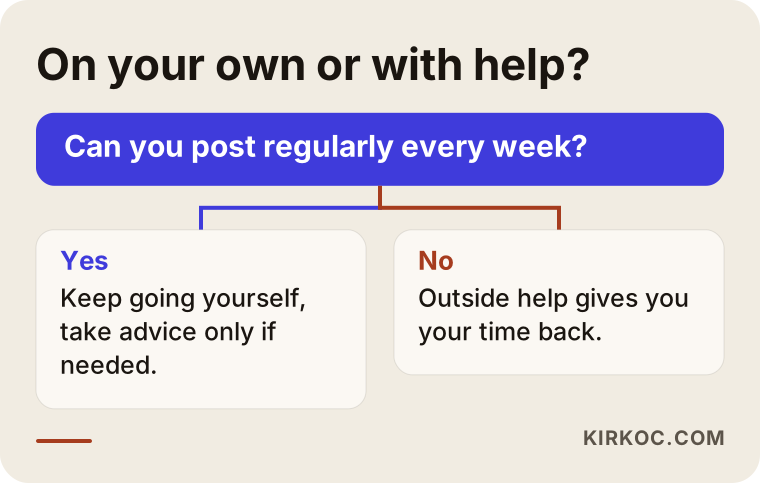
The chart is a guide, not a rule. If you can still handle it yourself, there is no need for extra spending. But if lack of time keeps holding you back, getting help is often necessary for your own well-being before it is about the quality of the posts.
I also hear the question of agency versus individual specialist. A large agency can suit a multi-location chain, where the work is shared among several people and the process is formal. For a small or mid-sized venue, it can be more valuable that the person you talk to does the work directly, decisions come quickly, and they truly know your place. I work the second way; because my capacity is limited, I take on only a limited number of businesses at a time.
The benefit of having everything in one pair of hands
I do not only do social media. Websites and e-commerce, SEO and local SEO, Google and Meta ad management, logo and corporate identity, content production: I run all of it myself, from one place. For a restaurant this brings concrete benefits.
For example, when you put your menu on your website, keeping the same menu current on your social accounts and your map listing is the same job for me. Your logo and colors match your account designs and your menu card, because the same person prepares all of them. When I run ads, I already know which posts perform, so I build the ad text and image around that. You do not have to explain the same thing three times to three different companies.
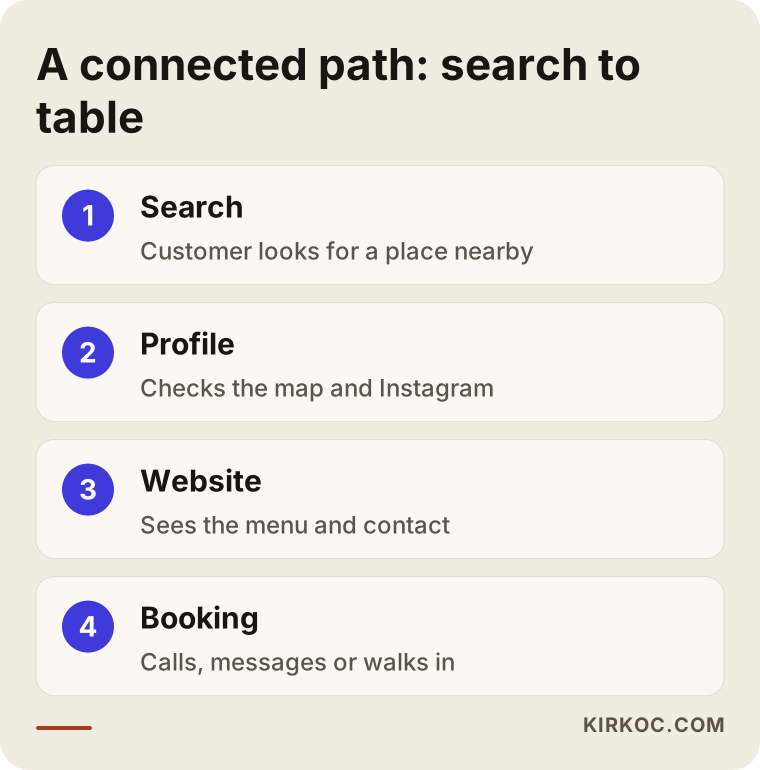
What matters in this flow is that each part points to the next. If there is a break anywhere along the path from search result to profile, from profile to website, from website to booking, the guest gives up at that point. Working from one place makes those breaks easier to spot and close.
When do ads make sense?
For restaurants, paid advertising can be a quick way to reach local customers when used correctly. Set up wrongly, though, the budget is wasted. Before running ads, three things need to be ready: a clean profile, a few good pieces of content and a clear idea of what you want the person to do, whether that is call, book or get directions.
The most sensible approach is to show the ad to people within a reasonable distance of the venue. There is no benefit in showing a cafe's ad to someone who lives in another city. Advertising for a concrete reason, such as a new opening, a new menu or a seasonal event, works better than a vague "get to know us." I do not promise anyone a particular result; but with a small test budget, it is possible to see what works and continue accordingly.
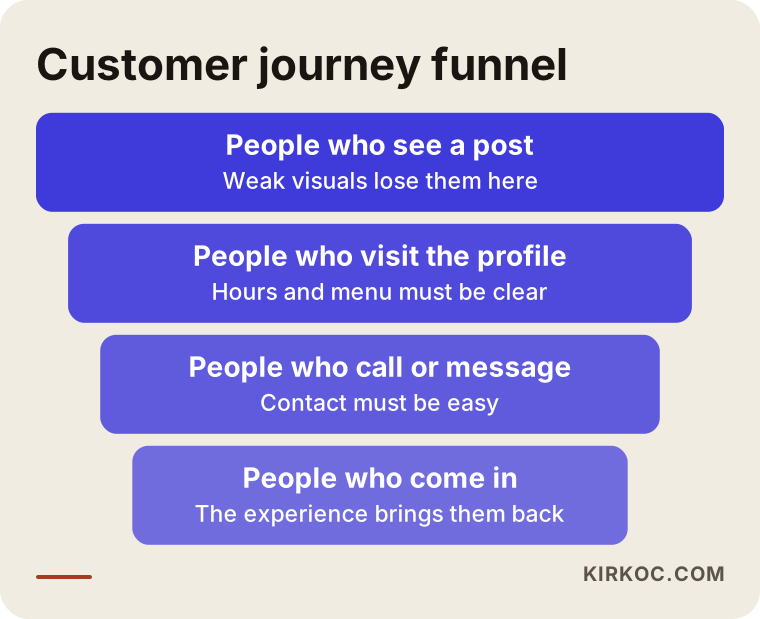
The funnel makes measuring simpler. When you look at how many people move on to the next stage, you can see where the problem is. If many people see a post but few visit the profile, the visual is weak. If many visit the profile but few call, the contact details or menu need to be made clearer.
What determines the cost of this work?
I do not give numbers, because every venue's needs are different. But I can state clearly what shapes the cost.
First, how many platforms are covered. There is a difference in workload between two accounts and four. Second, posting frequency and content type. Posting only photos is not the same effort as producing video regularly. Third, who does the shooting. If shooting at the venue is needed, that means extra time and coordination. Fourth, the number of locations. Each location has its own map listing, its own hours and often its own announcements. Fifth, whether ad management is included. The ad budget is separate, and the management work is considered separately. Sixth, whether extra work such as a website, a menu page or a logo is needed.
That is why a good quote does not just say "this much per month." It also writes down what is covered, what is not, and how long it is valid. In my quotes these are written plainly. If you get a quote from someone else, ask them the same questions: how many posts, which platforms, is shooting included, is there reporting?
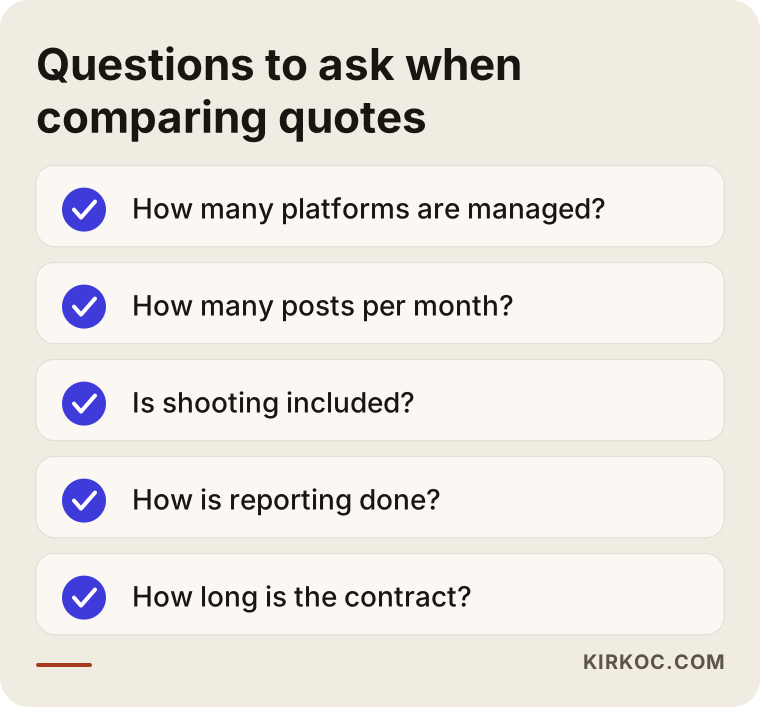
These questions help you see where a price difference comes from. If one quote is cheaper than another, there is usually less work somewhere in it; what matters is whether that missing piece matters to you.
How I work with you
The process is simple. In the first conversation I listen to you describe your venue, your guests and your goal. I look at your current accounts, your map listing and your website if you have one. Then I share in writing what can be done, what cannot, and in what order I would proceed. Setting expectations at the start prevents disappointment later.
Once you are on board, I prepare a monthly content plan, send it to you for approval and publish the posts. Together, you and I decide how messages and comments will be answered, and I check with you on sensitive matters. Every month I share a short, plain report. Rather than saying "you got this many likes," it explains which content drew interest and what I will change next month.
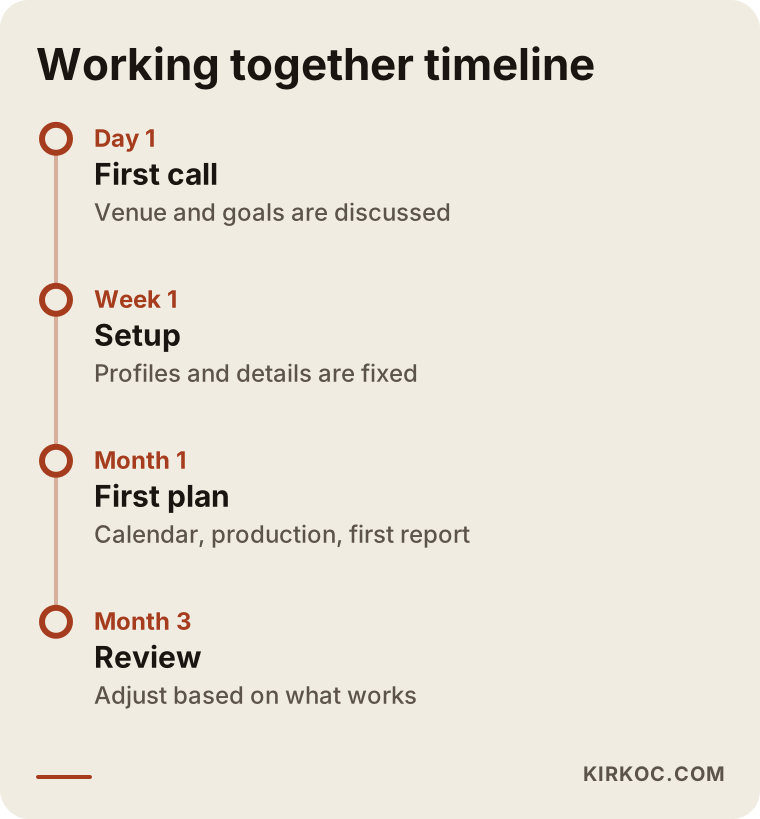
Read the timeline as a road map, not as a promise. In the first weeks the basic order is put in place; content and measurement settle in over time. I do not guarantee followers, likes or sales, because those are not in my hands alone. What I can offer is steady, honest work that is measured.
Frequently asked questions
Which social media platform matters most for my restaurant?
For most restaurants and cafes, Instagram is the main shop window and the business listing on the map is the foundation for being found. If your audience is young, TikTok can be added; for an older audience, Facebook. Running two platforms well is better than running five halfway.
How many times a week should I post?
There is no fixed number. For a small venue, three or four quality posts and a few stories a week are usually enough. What matters is picking a pace you can sustain and sticking with it.
Can I shoot food photos with a phone?
Yes. With natural light, a clean surface and a plain background, a phone photo is often enough. For your whole menu or for advertising work you may need a professional shoot, but it is not required at the start.
How should I reply to negative reviews?
Reply calmly and briefly, without getting defensive. Say you understand the situation, offer a fix if possible, or invite the reviewer to get in touch privately. Everyone else who reads that review will look at the tone of your answer.
Do I need to run social media ads?
Not necessarily. Fixing your profile and content first is often more efficient. Consider ads when you have a clear reason, such as a new opening, a new menu or a special event, and when you will show them to people near you.
How do I manage several locations?
Each location has its own map listing, hours and often its own announcements. Keep one shared brand voice while keeping location-specific details separate. This takes extra planning and measuring work, so it affects the cost too.
How long does social media management take to show results?
It depends on your current situation, your area and the scope of the work. Profile fixes can have a quick effect; interest built through regular content accumulates over weeks and months. I do not promise a fixed timeline or result.
How do I start working with you?
You can reach me through my service page. Describe your venue, your goal and your current accounts, and in the first conversation I will help you work out what you need.
If you want your venue's social media run steadily and honestly, write to me through my service page. I will listen to your situation and tell you plainly what you actually need.