You post photos on your Instagram account on a regular basis, and it feels like nobody sees them. Someone told you that "everyone does Reels now," so you picked up your phone and tried. Either you ended up with a half-finished video, or you never worked up the nerve to post it. You have a business to run, most of your day goes to customers or production, and there is no spare hour for video. That is probably the moment you typed "Instagram Reels content creation" into Google. In this article I explain what coming up with ideas, writing copy and editing for Reels actually involves, which parts you can do yourself, where outside help makes sense, and what to look for when you collect quotes. I am Ümit Kırkoç, I work from Istanbul, and I handle Reels production by myself as part of my social media management service.
First, a quick definition. Reels is Instagram's short vertical video format. A Reel usually runs from a few seconds to about a minute, fills the whole phone screen, and can be shown to people who do not follow you. That last point matters. A photo post mostly reaches people who already follow you, while a Reel has a chance of being shown to someone who has never heard of you. For a business that wants to be introduced to new people, that makes Reels a natural tool. But the chance only pays off if the video is actually useful. Posting any video at all is not enough.
What does Reels content creation actually include?
When people say "making Reels," they usually picture filming and editing. Behind a single 20-second video, though, there are four separate jobs, and they do not all have to be done by the same person.
The first is the idea. What will you talk about, who is it for, and what should the viewer think at the end? If the idea is weak, even excellent editing will not save the video. The second is the copy, meaning the words. The first sentence of the video, the text on screen, the flow of what is said and the caption under the post all belong here. Many people watch Reels with the sound off, so on-screen text matters as much as speech. The third is filming: lighting, angle, framing and sound. The fourth is editing: the cuts, the order of shots, the music, the captions, the transitions and the pace of the video.
Deciding which of these four stay with you and which go to someone else is the most important decision you will make when buying this service. Some business owners film everything themselves and want ideas and editing from outside. Some only want editing. Others prefer that everything, from idea to posting, runs through one person. None of these is wrong. What goes wrong is asking for quotes before you know which of these you want.
The table below sums up what each of the four parts does and who can take it on.
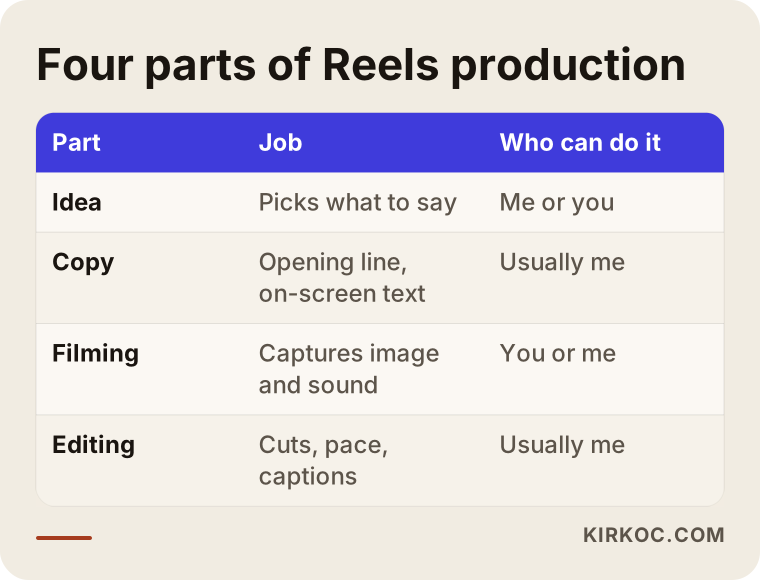
Look at the table again and you will notice that filming is the part most business owners find easy, while ideas and editing are where they struggle. Nearly everyone has a phone that can film. Knowing what to film, and turning a few minutes of raw footage into something people will watch to the end, is a different skill.
What can Reels really do for a business?
It helps to set your expectations correctly from the start. Reels is not a sales machine. I do not promise a certain number of views, followers or sales, and nobody honest can, because nobody outside the platform controls how it behaves. The realistic benefits look like this.
Reels helps you show yourself to people who do not know you yet. For a hair salon, a ceramics studio or a small architecture office, answering "what do these people do and how do they work?" in 20 seconds can be more convincing than a long page of text. It shows the person behind the work. Trust is the biggest part of any buying decision, and for a business that customers cannot meet in person, trust is often built through video.
Reels also keeps past customers aware of you. Someone buys from you once and then forgets about you. Regular, useful videos put you back in front of them from time to time. And instead of answering the same questions one by one in private messages, you can answer them on video. Questions like "how is the price worked out?" or "how long does delivery take?" turn into a small library of ready answers.
You can also use Reels together with advertising. A Reel that performs well can be used in Meta ads, which is the paid advertising system behind Instagram and Facebook. I see this as one of the benefits of having one person run everything. The same person who shaped the idea of the video also looks at which video deserves a push in the ads, so nothing gets lost between teams.
That said, Reels is not the right first step for everyone. If your profile is empty, your contact details are missing, nobody answers messages, or a person who lands on your website cannot tell what to do next, then your videos will spark curiosity and go nowhere. The profile and the site need to be ready before the video. The flowchart below can help you answer that question.
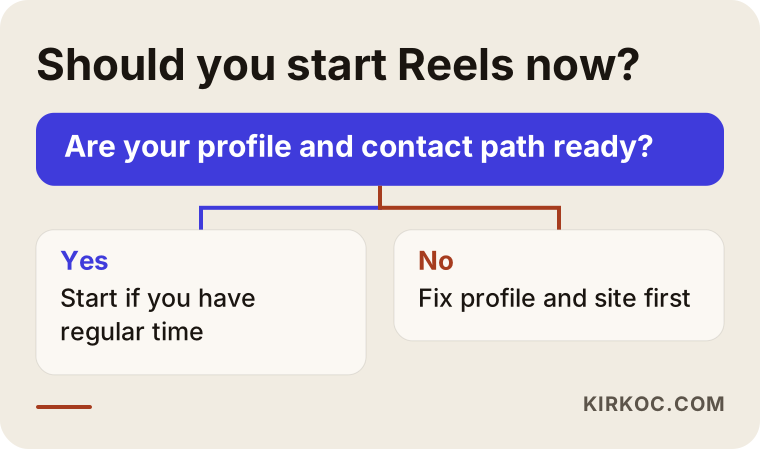
The logic is simple. If your profile is ready and you can set aside regular time for video, start. If not, fix the foundation first, or hand the production to someone else.
How do Reels ideas change by industry?
The complaint I hear most often is "I don't know what to film." In fact, the knowledge is already in your head. What is missing is a way of looking at it that turns it into video. The everyday things that happen in your business may be fascinating to someone on the outside.
For service businesses such as dental clinics, law offices, accountants and consultants, the content that works best is usually "common myths" and "frequently asked questions." If your customers ask you the same three questions every single day, those are three videos. The thing to watch is professional jargon. Drop it and speak in the words your customer uses. In fields like law or health, avoid sentences that sound final or that guarantee a result, and say "talk to a qualified professional" where it fits. That is both the ethical choice and the one that builds trust.
For businesses that sell products, such as boutiques, jewelry, cosmetics and furniture, showing the process works well. How the item is made, packed or used, or how it compares side by side with something else. A photo of a product looks good, but a video shows how it looks in motion.
For restaurants, cafés, salons, gyms and other local businesses, the mood of the place, the people who work there and the rhythm of a normal day come to the front. Here the viewer is buying the atmosphere rather than the service. The question being answered is "how will I feel when I'm there?"
One rule holds across every industry: a video should give the viewer something. It might be information, trust, curiosity, convenience or a smile. A video that gives none of those and only says "I'm here" gets scrolled past.
Copywriting: the first three seconds of a video
The words in a Reel matter more than most people expect. A viewer gives a video a very short moment before swiping away, and in that moment you have to say "this is worth staying for." The first sentence, both written on screen and spoken, needs to tell people what the video is about and what they will get out of it.
Let me make the difference between a weak and a strong opening concrete. A video that begins with "Hi, today I'm going to tell you about our products" is one nobody was waiting for. Start the same video with "Check these three things before you open the package," and the viewer hears a benefit. The gap between the two has nothing to do with talent. It comes from how you think about the viewer.
Copy for a Reel has several parts. There is the opening line, the flow of the video (what is said in which order), the short texts on screen, the closing instruction (for example "send me a message" or "see the link in my profile") and the caption. In the caption, using the keywords people would search for in a natural way helps Instagram understand what your video is about. Stuffing in extra words does the opposite.
You also need to keep your tone of voice consistent. If your website sounds formal, your videos sound jokey and your brochure sounds stiff, your brand looks inconsistent. When one person runs every channel, the tone stays consistent without extra effort, and that is a real gain in itself.
Editing: the difference between watchable and boring
Good editing goes unnoticed, and bad editing is felt right away. The purpose of editing is to carry the raw footage to the end without losing the viewer. Here is what that work involves.
It means cutting what is not needed. Most people want to keep everything they filmed, but in a Reel even a breath can be too long. It means setting the pace. A product demo moves quickly, while an expert explanation runs calmer. It means adding captions. That is how you still reach people who watch with the sound off, and the captions have to be readable: large enough, high contrast, and not hidden behind the buttons at the bottom of the phone screen. It means choosing music. The commercial usage rights for a track can depend on the type of account, so you need to know which sound library is available to a business account, and if you are not sure, it is safer to ask a lawyer. Finally, it means choosing the cover and the first frame. When your videos line up as tiles on your profile, they should look like a whole.
Editing takes time. Even a one-minute video can take several hours once you count watching the raw footage, trimming, cutting, adding text, balancing the sound and exporting. That is why editing is the part business owners hand off most easily, and the part that gives them the most relief when they do.
Two hypothetical example scenarios
The two cases below are completely made up. They do not describe a real company or person. The goal is to show how the work might look in practice.
Scenario 1: A neighborhood bakery
Suppose you run a neighborhood bakery. You start work very early, you are tired by the afternoon, and there is no energy left for video on your phone. Your account has product photos, but few people react to them. Your goal is for new people in your area to find you and for morning orders to grow.
In a case like this, three themes stand out on the idea side: short process videos showing how the dough is prepared, useful tips such as how to store a loaf for the next day, and the moment a tray comes out of the oven. You do the filming during your normal morning routine, and I only give you a list of when and from which angle to film. I write the copy and do the editing, and I line the videos up for posting on set days of the week. That way your workload is limited to the filming itself.
Scenario 2: A one-person accounting office
Now picture a small accounting office. The owner knows the field well but is uneasy about appearing on camera. Clients mostly arrive by word of mouth, and the Instagram account is almost empty. The goal is to be found by newly opened small businesses.
Here you could choose a format that does not require being on screen: short informational videos explained with on-screen text, checklist-style content like "a checklist for people starting a new company," and answers to frequently asked questions. On tax and regulatory topics, the videos avoid firm claims, and every one of them says that the answer can vary from case to case and that people should check with a qualified professional. In this case the copy carries more weight than the footage, so most of the effort goes into the writing and into explaining correct information in plain terms.
The lesson from both scenarios is that the same service looks very different in two different businesses. Rather than a standard package, the first step should be a look at what the business actually needs.
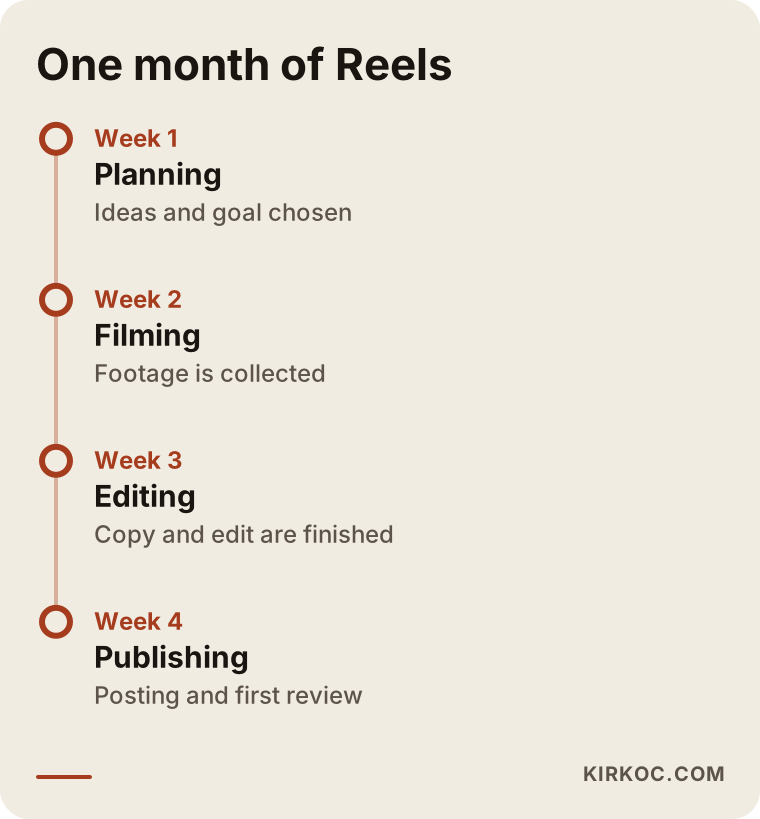
The monthly flow above works in a similar way in both examples. Only who does the filming and in which week changes.
How does the process work, step by step?
When we work together, the process goes like this. The steps follow the same pattern for everyone, but their content differs from business to business.
In the first step we talk through your needs. I listen to what you do, who your customers are, what your current account looks like, who your competitors are and what matters to you. Your goal needs to be clear at this stage. Do you want more phone calls, more store visits, more website traffic, or simply more awareness? The type of video changes as the goal changes.
In the second step I prepare a content plan. For a set period, there is a list of ideas, a short summary of each one, and a note on which videos need filming and by whom. No idea goes into production without your approval.
In the third step I write the copy: opening lines, the flow of speech, on-screen text and captions. If you will be filming, I send you a short guide on what to say and what to show.
The fourth step is filming. If you film, I give you simple tips on light, sound and framing. If I film, we agree on the time and place together.
In the fifth step I edit. I show you a first version, take your comments and make the changes. Once you approve the final version, it goes into the posting calendar.
The sixth step is publishing and follow-up. That includes posting the videos, watching the comments and messages that come in, and reporting in plain language on which video drew how much interest. The report does not hold confusing numbers. It holds comments such as "this video worked, here is a possible reason, let's try more of it next month."
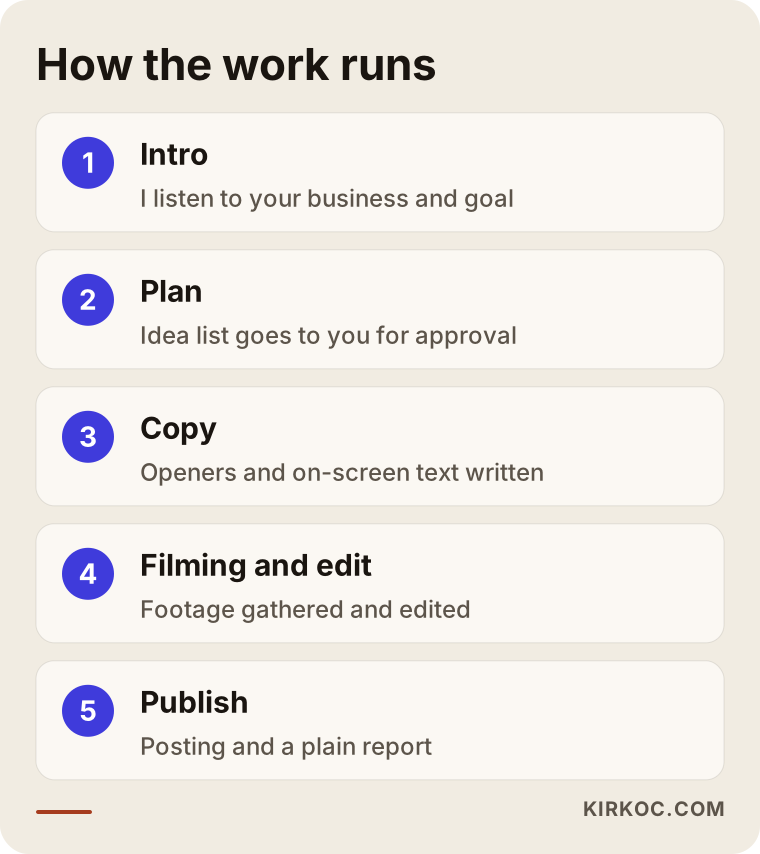
Most of these steps look simple on paper. The hard part is keeping them going every month. Consistency is what most businesses drop first.
What to prepare before you start
Whether you hire help or do it yourself, a few things need to be ready for the work to move faster. You already have this information, and pulling it together should take about one evening.
Write down clearly what you want to sell or what kind of customer you want to attract. The answer "I speak to everyone" will not strengthen any video. Put your customers' most frequent questions into a list, because this list is your first source of ideas. Gather your visual identity files, such as your logo, colors and fonts, since your videos should match them. Look through the photos and video clips you already have on your phone or in your archive; there may be frames you can use without any new filming. And settle the question of access: make sure your Instagram account is a business account and that you keep the admin rights.
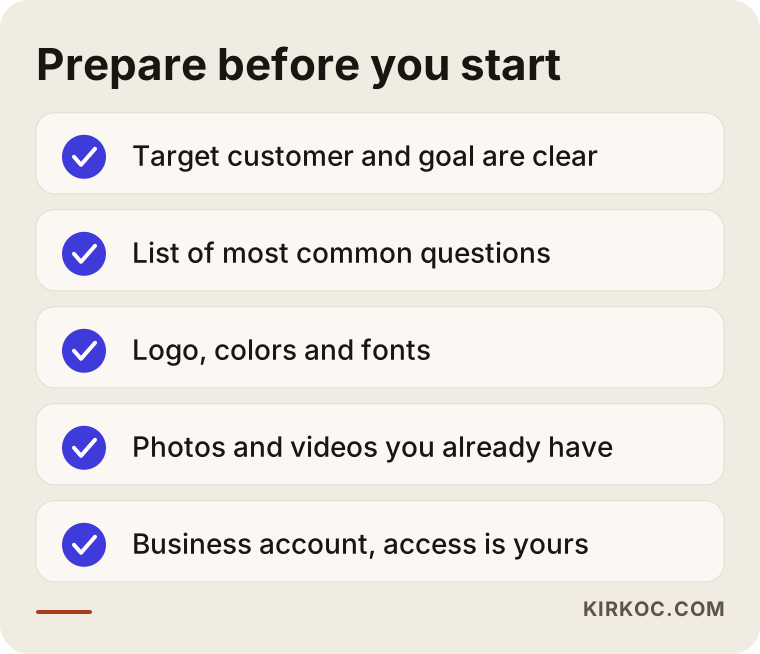
I usually go through this list together with the client in the first meeting. Having something missing is not a problem. What matters is knowing from the beginning what is missing.
Common mistakes
Most of the mistakes I see in Reels production are about approach, not technology.
The first is copying someone else's video exactly. Adapting a popular video to your own business is one thing, and copying it is another. A copied video rarely carries your voice, and viewers can feel that. The second is a long introduction. If a video does not get to the point in the first seconds, people leave. The third is poor sound. The picture can be a little blurry, but if the sound cannot be understood, the video is lost. The fourth is ending without telling the viewer what to do. If there is no clear instruction like "send a message," "save this" or "check my profile," the interest fades before it turns into business.
The fifth is inconsistency. One video a day for a month, then nothing for three months. Nobody can know how much visibility Instagram will give you, but steady, balanced production builds a habit in viewers and helps you see what works. The sixth is not measuring. Someone who never checks why a video got attention has to guess from scratch every time. The seventh is ignoring copyright. Using someone else's music, footage or fonts without permission can cause problems for your account. If you are unsure, ask a lawyer.
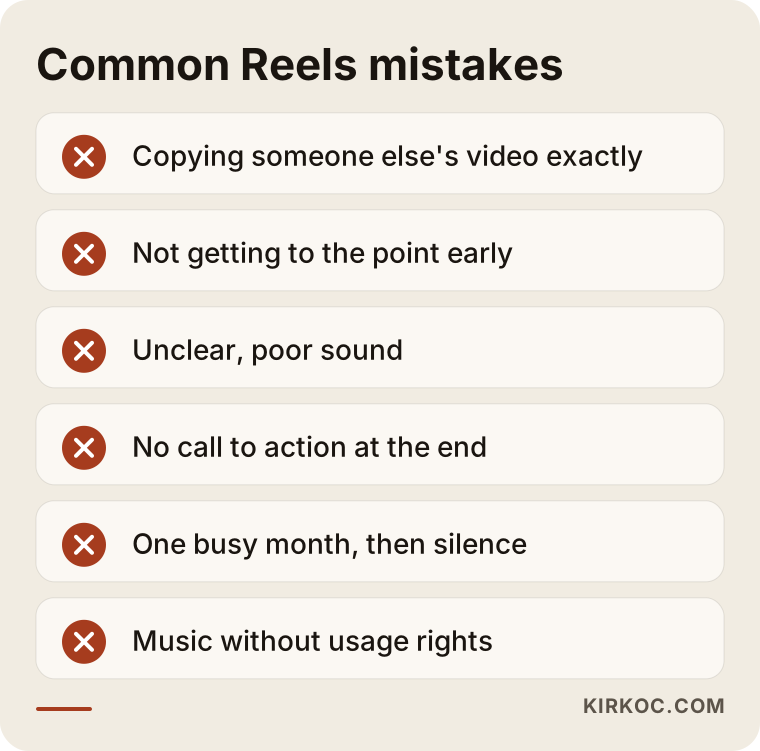
Most of these mistakes go away on their own once there is a plan. That is why I insist on talking through the plan before production begins.
The path from a video to a real job
Business owners often complain, "People watched the video, but nobody called." The cause is usually not the video itself but what comes after it. Between someone watching a video and getting in touch, there are several steps, and some people drop out at each one. That is normal. Your job is to reduce the losses.
A person watches the video and looks at your profile. If the profile looks interesting, they follow you or save the post, and later they send a message or call. If your profile description is unclear, your link does not work, or you answer messages late, the chain breaks right there. This is where the benefit of having everything run through one person shows. When the video, the profile, the website and, if needed, the ads are built by the same person, every place the viewer goes says the same thing. Someone who cannot find on your site what you said in the video gives up.
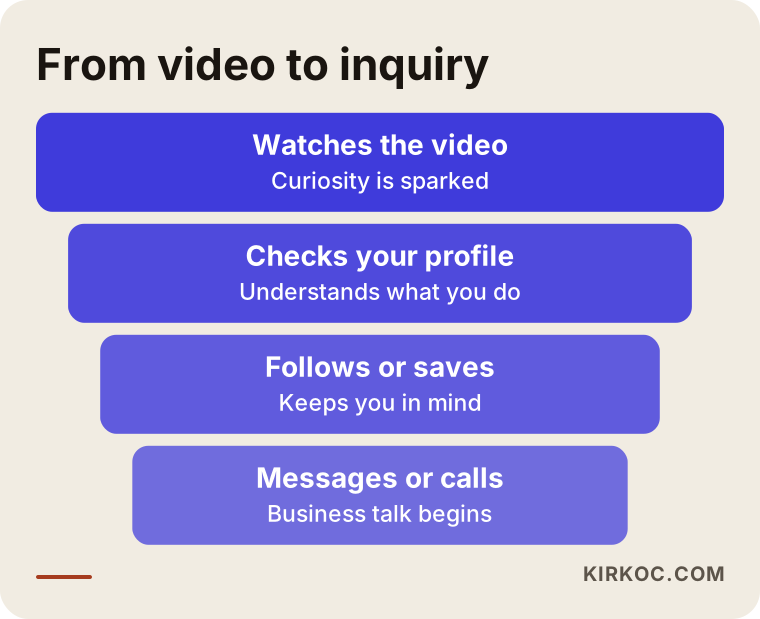
The funnel narrows from wide to narrow, and losing people at every stage is natural. The goal is not to remove the loss. It is to keep the path clean so that the people who remain are more likely to turn into customers.
Your profile page is the critical link in this path. When people like a video, they usually check your profile before following you, trying to work out what you do. At first glance it should be clear who you are, where you are and how to reach you. Your website needs the same consistency.
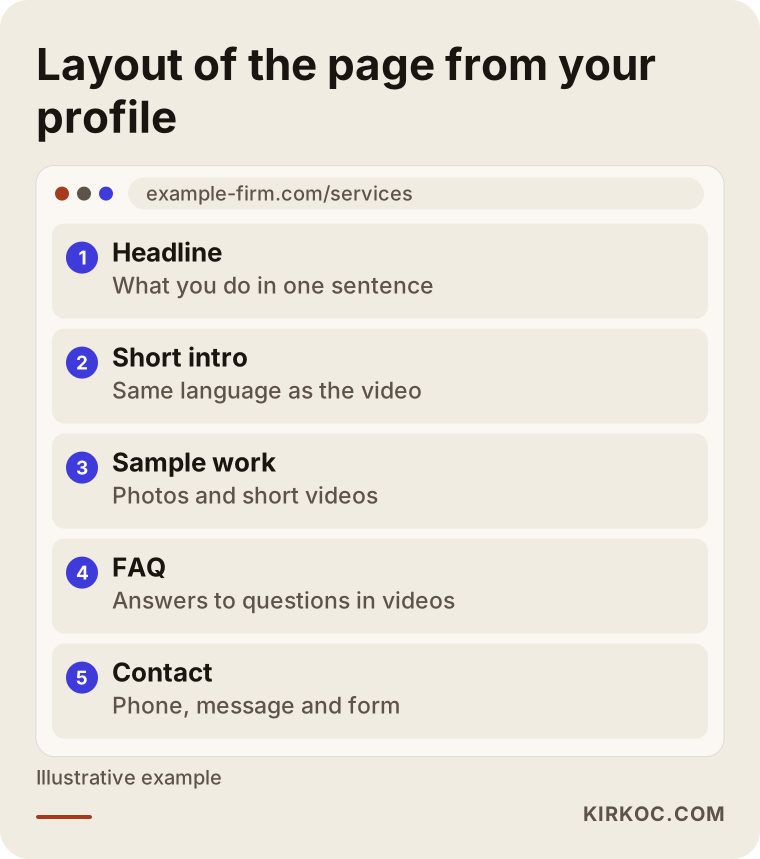
The layout above is a sample page structure designed so that a visitor from your profile finds what they are looking for right away. It is not a copy of a real website. It is a sketch that shows the logic.
Should you do it yourself or hire a specialist?
To be honest, not every business needs outside help. You can do it yourself if a few conditions are met: you can set aside regular time, you are comfortable in front of the camera, you can film cleanly with a phone, and you are willing to learn editing tools. In that case, what you most likely need is a list of ideas and a short briefing, and you do not need a full service.
Getting help makes sense in these cases: your workload leaves no time for video, you struggle to come up with ideas, your videos do not come out the way you hoped, or you want to think about Instagram together with advertising and your website. And if regular production cannot be sustained, handing it off is often cheaper than forcing it yourself, because your own time has a value too.
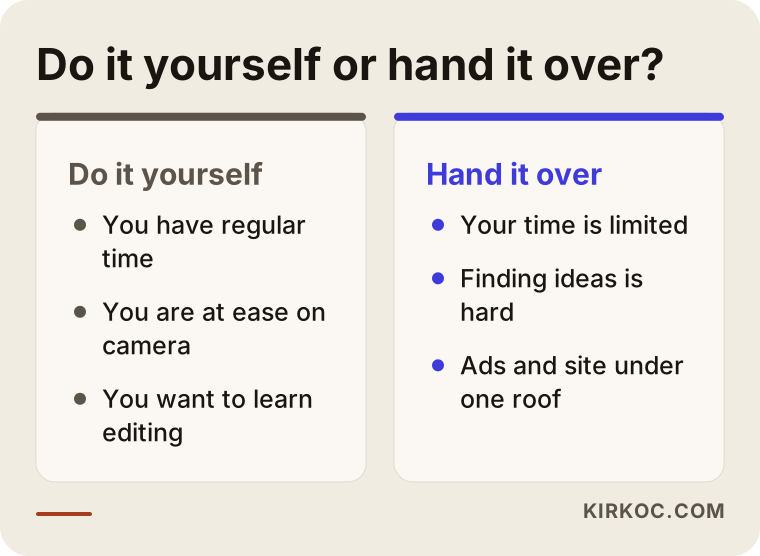
As the comparison shows, both paths are valid. What matters is looking honestly at your own situation and deciding which one you can keep up. A mixed approach is also possible: you do the filming, and I take care of the ideas, the copy and the editing.
What determines the cost
I will not give a figure here, because no two businesses have the same needs and a number would mislead you. What I can do is tell you plainly what moves the cost.
The most obvious factor is how many videos you want per month. The length and the level of finishing also matter. A simple informational video and a video with motion graphics, many cuts and a custom sound design are not the same amount of work. Who does the filming is another factor; if I film, travel, preparation and shooting time are added. The depth of the idea and copy work counts too, as does whether your field needs research, how many rounds of approval and revisions you want, and whether you also want ad management, general handling of your social media posts, or reporting.
When you ask for a quote, ask that each of these items be written into it. If questions such as "how many videos, how long, how many revisions, who films, and which files do I get" are not answered clearly, extra charges may show up later. When you look at ready-made package prices, pay attention to what is not included.
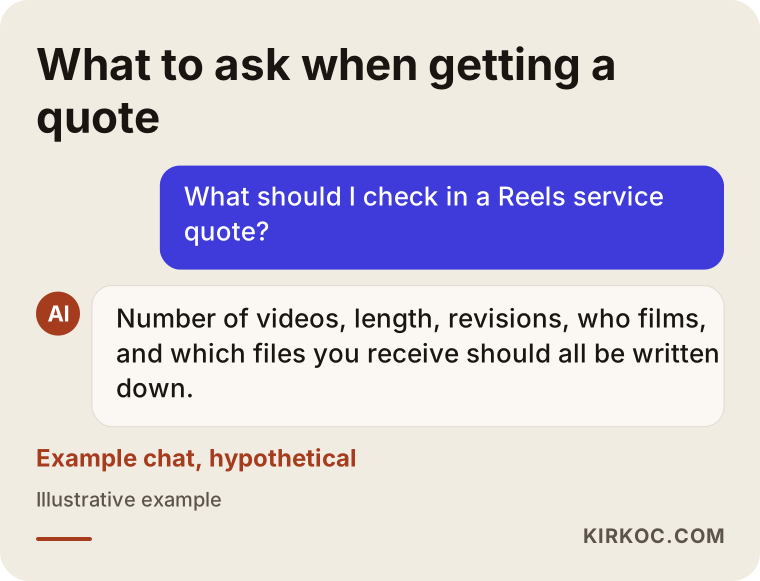
This example chat shows how you can clear up what is bothering you when you evaluate a quote. Still, an AI answer is not a replacement for the opinion of someone who knows your business. It only helps you prepare your questions.
How I work with you
I am one person. The same person talks with you, makes the plan, writes the copy, edits the video and, when needed, adjusts your website or your ads. That means nobody has to pass messages between several people, and you explain what you want once. It also sets my limit: I cannot work with many businesses at once, so when we start something new I tell you honestly what my calendar looks like.
Transparency in the way we work matters to me. I tell you plainly what has been done, what has not been done yet and what did not work. Sometimes a video does not get the attention we expected. When that happens I look into why and suggest a different approach for the next month. I do not guarantee any result, because the platform's behavior is not in my control. What I can offer is steady, planned work that fits your brand and is measured.
If you also need a website, SEO, Google and Meta ads, or a logo, those can all move forward under one roof. But if you do not want that, we can work on Reels alone. There is no required package.
Frequently Asked Questions
Do I have to show my face in Reels?
No. Videos built around a product, a process, on-screen text, hands at work or shots of your space can work well too. Showing your face builds trust, but pushing a method you are not comfortable with makes the video feel unnatural. I would first find the format that feels easy for you, and add your face later if it makes sense.
How many Reels should I post per month?
There is no single right number. What matters is that you can keep it up. A small number of careful, regular posts beats one busy month followed by silence. We settle the number together based on your business, your time and your budget.
Can phone footage make good Reels?
Yes, most of the time. When the light, sound and framing are right, a recent phone is enough. The real difference comes from the quality of the idea and the editing. A cheap clip-on microphone often brings the biggest improvement in sound.
Will Reels bring me followers and sales?
I cannot guarantee that, and I suggest you be careful with anyone who does. Reels gives you a chance to reach the right audience and build trust. The result depends on the quality of the video, your profile, your product and how the platform behaves at that moment.
Do ready-made templates work for Reels?
Templates give you a fast start, but when everyone uses the same one, you do not stand out. It is healthier to fill a template with your own content and copy and adapt it to your brand.
What should I watch out for with music and copyright?
The music options available on business accounts can be limited, and the rules change over time. Before you use someone else's footage or music, check the permission status. If you need a firm legal opinion, ask a lawyer.
Who owns the videos after we start working together?
This should be written clearly in the agreement. In general, you hold the right to use the videos that were made for you and paid for, and you can receive the project files. We settle the details in writing before we begin.
Can Reels be made from my old photos and videos?
Often, yes. I can cut short videos out of your existing archive without any new filming. The only requirement is that the resolution and quality of the footage are good enough. It is a good way to keep the cost down at the start.
Conclusion and contact
Set up well, Reels introduces your business to new people and speeds up trust. Set up badly, it is just lost time. If you want to hand off the ideas, copy and editing, or run Instagram together with your website and your ads through one person, you can write to me through my social media management service page, describe your business and what you expect, and we can work out together what fits you.