You have a product, you photograph it, you post it on Instagram, and orders trickle in through direct messages. Sooner or later a question nags at you: should I keep running things this way, or build a real online store? Most people who search "Instagram shop or online store" are really asking something simpler: is there something I need to spend money on, or is what I have already enough? In this article I will explain what each option actually does, when each one makes sense, and how to set up both so they work together. I am Ümit Kırkoç. I work from Istanbul and handle websites, online stores, SEO, ads and social media on my own, for clients wherever they are. If you want your account managed on a regular basis, you can look at my social media management service, but let me help you decide first.
One point up front: this is not a "which one is good and which one is bad" question. They do different jobs. One is a storefront window and a place to chat. The other is the shop itself. The right question is not "which one" but "which one do I need right now, and how much?"
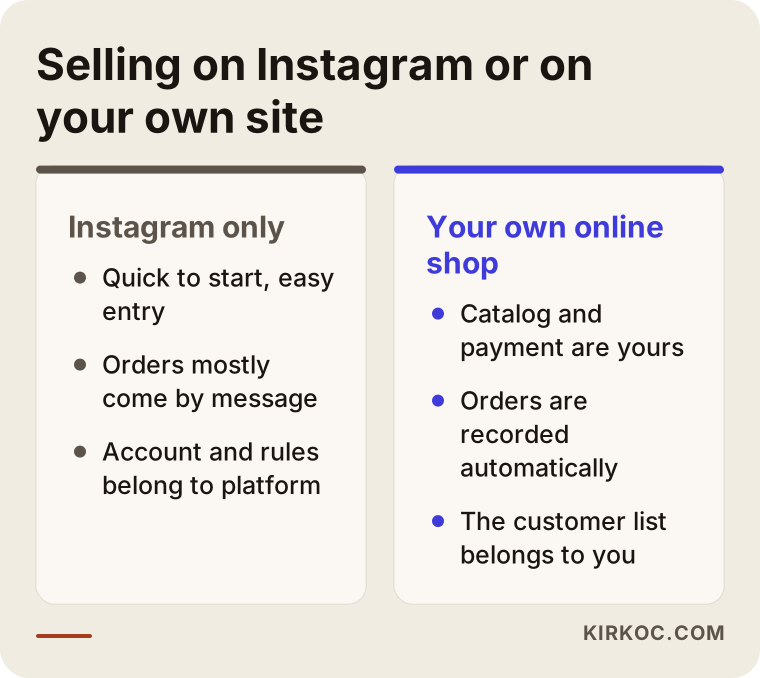
The comparison above is a summary of the whole article. Starting on Instagram is fast and the door is easy to walk through, but the account and the rules belong to the platform. On your own site, setup takes effort, and in return you control the catalog, the payment and the customer records. Below, I unpack what that difference means in daily life.
What do people mean by "Instagram shop"?
People use the phrase for three different things, and mixing them up is one of the most common reasons for making the wrong decision.
The first meaning: you put product photos on your account, write the price in the caption or in a message, the customer sends a DM, and you agree on payment by bank transfer, a payment app or cash on delivery. This is informal but very common. It needs no setup at all.
The second meaning: the platform's own shopping features, such as organizing products into a catalog and tagging them in posts. Which of these features are open to which countries and account types changes over time. For that reason I will not state a hard rule here. Open your own account settings and see what is actually available to you.
The third meaning: using Instagram only as a promotion channel, while the real sale happens somewhere else, on your own site or on a marketplace. The link in your profile leads there.
These three approaches lead to different results. When I say "selling on Instagram" in this article, I mean the first two. When I say "online store," I mean a site on your own domain with a cart and a checkout.
The real strengths of selling on Instagram
It would be a mistake to look down on Instagram. For some businesses it is exactly the right place.
Speed. You can decide today and sell tomorrow. There is no domain to buy, no site to build, no payment system to connect.
A sense of trust. Follower counts, comments and everyday stories tell a customer there is a real person behind the account. For handmade, custom or small-batch products, that matters a great deal.
Selling by conversation. Some products are sold by talking: a custom size, a design made for one person, a choice of color. The customer asks in a message, you send a photo, you agree. Squeezing that flow into the checkout steps of a website does not always work well.
Low starting load. If your product has not been tested yet, it is sensible not to invest heavily before you see real demand.
The limits of selling on Instagram
Now the other side of the coin. Most people notice these limits only once orders start piling up.
You are a tenant, not the owner. Platform rules can change, access problems can happen, and an account can be restricted. If all of your sales hang on one account, a problem with that account stops your whole business. I do not say this to scare you. It is simply the natural risk of depending on a single place.
The same questions, over and over. "How much?" "When will it ship?" "Do you have it in medium?" "Can I return it?" Answering these dozens of times a day eats your time, and a message that arrives at night and sits unanswered can cost you the sale. A website answers each of these once and shows the answer to everyone.
Order records get messy. Orders lost between messages, forgotten addresses and packages sent twice are the classic problems of the first growth period.
Being found on Google is hard. If someone searches for "handmade leather wallet," your own product page can show up on Google, while Instagram posts appear only in a limited way for searches like that. So your way of reaching new customers depends almost entirely on the platform choosing to show you.
The customer list is not yours. Followers belong to the platform's list. An email or phone list is yours. When you want to announce a sale, you can only reach the people who happen to see your post.
The strengths and the price of an online store
Your own site is the shop itself. But a shop also comes with rent and upkeep.
The strengths: your catalog, prices, stock, shipping and return terms all live in one place. The customer pays on their own, and the order is recorded in the system automatically. Product pages can be found on Google. The customer information stays with you. If you run ads, you can send the person who clicks straight to the product page.
The price: setup effort, preparing product photos and descriptions, connecting payment and shipping, regular upkeep and adding new products. Also, a site does not bring in customers by itself; you have to send people there. This is why giving up Instagram is rarely an option. The real job is connecting the two.
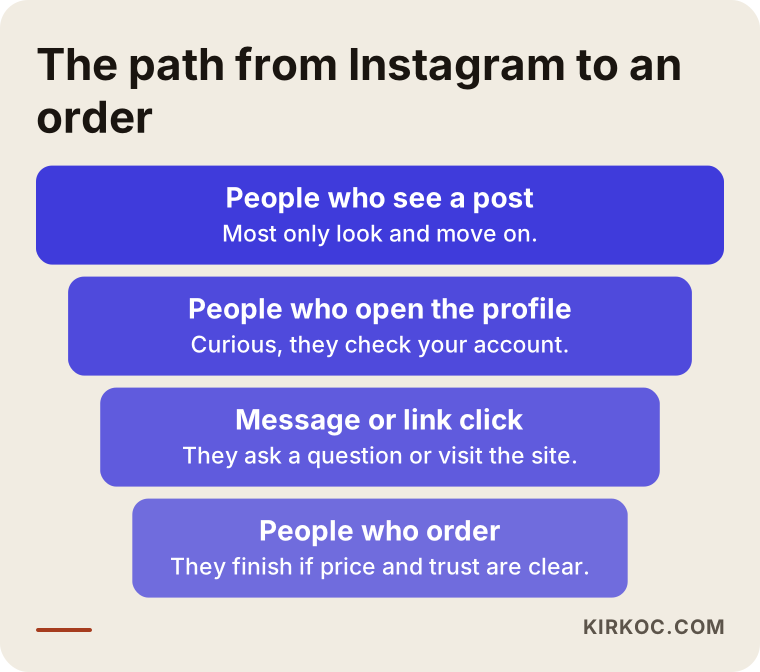
This graphic shows that only a small share of the people who see a post end up ordering. The proportions differ a lot from one business to another, so I deliberately left numbers out of the picture. What matters is understanding where you lose people. If they open your profile and leave without doing anything, the problem may be your storefront. If they message you and never come back, it may be your reply speed or unclear pricing. If they move to your site and abandon the cart, the problem may be how the site works.
Which one makes sense in which situation?
There is no single right answer; it depends on your situation. The table below is a rough guide.
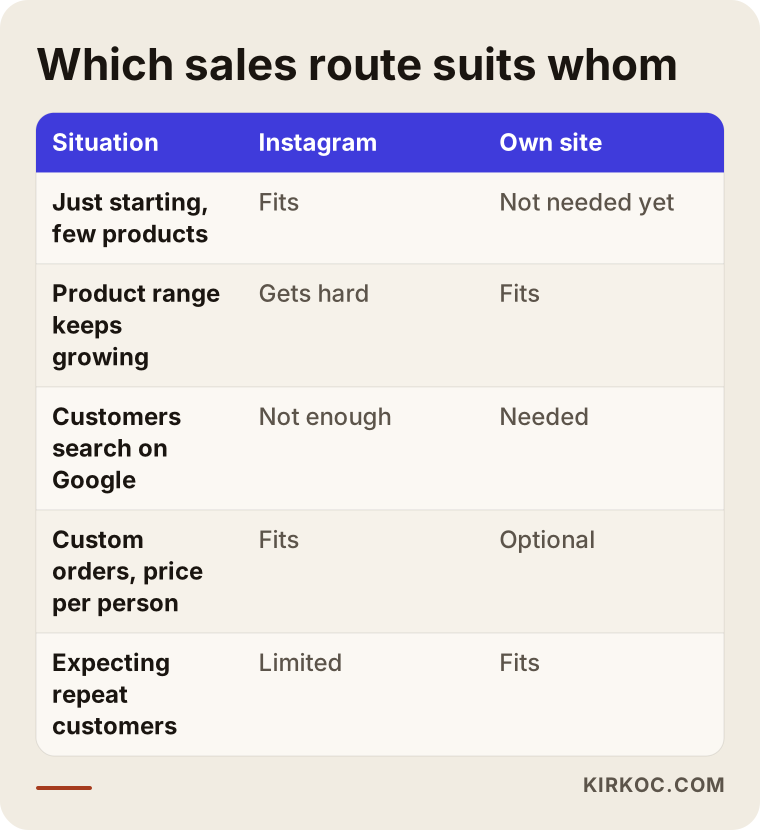
As you read the table, keep one thing in mind: "fits" does not mean "is enough." For someone just starting out, Instagram fits, but three months later, when the number of orders has grown, the picture may change. A decision like this is not made once and forgotten. It is a setting you look at again every few months.
When staying on Instagram alone makes sense
- You have few products, and they rarely change.
- Most of your sales are custom and shaped through conversation.
- Your customers already know you and arrive through your circle and word of mouth.
- You are still testing demand.
- You can handle the daily message load comfortably.
Signs it is time to move to your own site
- You answer the same questions over and over during the day.
- Order tracking has become confusing, and you have made a mistake or two.
- Your product range has grown and keeping track of which color and size is left has become hard.
- Customers have started asking, "Do you have a website?"
- You want to run ads, but there is no proper place to send the people who click.
- You want to be found by people searching on Google.
- You expect business buyers or wholesale customers, who usually want to see a website.
The decision graphic below boils the most important of these signs down to a single question.
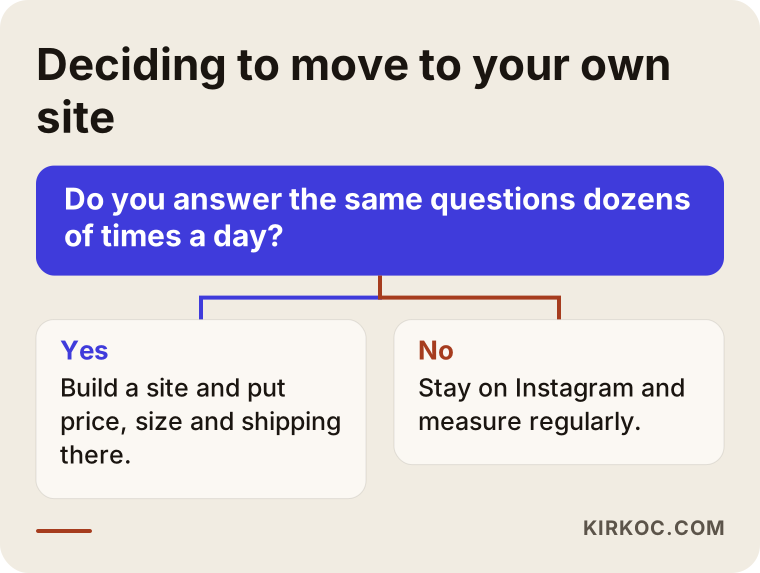
The question looks blunt, but it works. The number of repeated messages is the most honest sign that a business needs a system. If your answer is "no," do not rush. Putting the money into content or into the product itself may be the better move.
Two hypothetical example scenarios
The two examples below are entirely hypothetical. They are not real customers or real companies. I made them up only to make the situation concrete.
Scenario 1: A handmade soap seller
Suppose someone makes soap at home and shares a couple of dozen products a week. All orders come in through DMs, and payment is by bank transfer or a payment app. The range is six to eight items, and prices change about once a month. In this case, moving to a site right away is not necessary. What is more valuable here: writing price and shipping details clearly in the profile bio, putting answers to common questions in highlighted stories, and keeping the order list in a simple spreadsheet.
But if a year later this person starts taking corporate gift orders and grows the range to twenty items, the picture changes. Then a small online store would pull bulk orders together and lay the groundwork for being found in searches like "corporate gift soap."
Scenario 2: A women's clothing boutique
In the second hypothetical example, a boutique releases a few new styles every week. Each style comes in four sizes and three colors. Customers constantly write, "Do you have a large?" and "Is this color still available?" Stock information sits in a notebook, and orders are scattered across messages. Instagram is a wonderful display window here, but it has become tiring as a place to sell. An online store that knows stock, sizes and color options removes most of the message load. Instagram keeps doing what it does best, showing the new styles and sending people to the site.
These two examples share one thing: the decision depends not on the size of the business but on how manageable things are. A small business can need a site, and a relatively large one can get by with Instagram alone.
How do customers find you, and which pages do you need?
This is the part that is specific to selling products. A customer can reach you in two different ways.
The first is the person who already knows you or discovers you on Instagram. They see a post, like it and open your profile. What this person needs is trust and ease.
The second is the person searching for a product on Google: "walnut wood cutting board," "organic cotton baby romper," "personalized name necklace." This person does not know you. What should greet them is a product page or a category page. An Instagram post often gives a weak answer to this kind of search, because it does not show the price, shipping and size clearly in one place.
So when you build an online store, you need these pages: a separate product page for each product, category pages that group your products, a shipping and returns page, an "about" page that tells who you are and how you make the product, a contact page and a frequently asked questions page. The product page is the most critical part of the site, and the next graphic lists what a good one should contain.
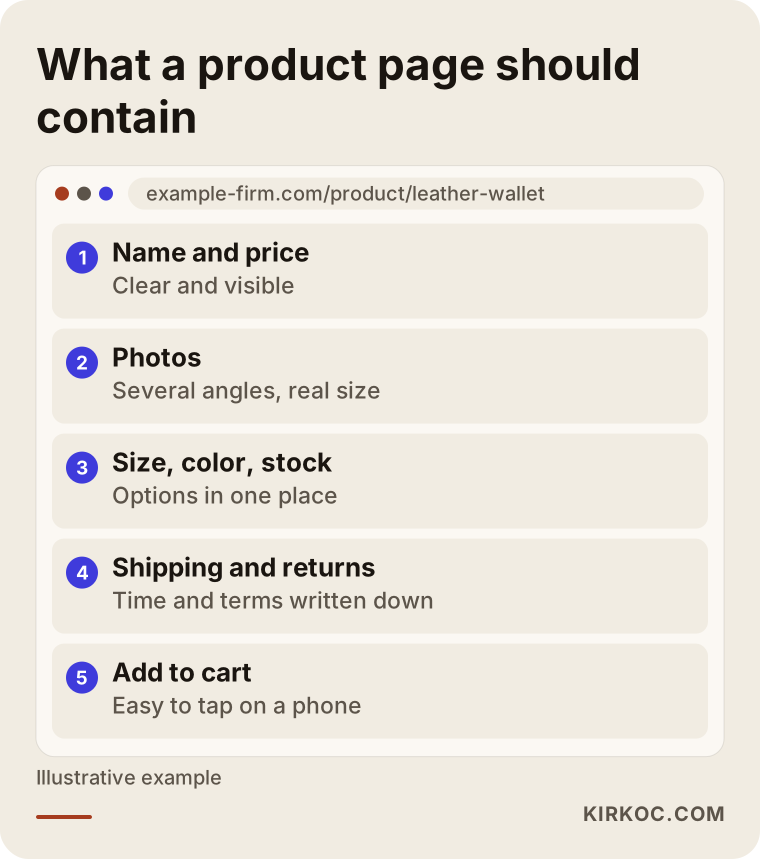
Notice that every box on the page answers a question people ask by DM on Instagram. Price, size, stock, delivery time, return terms. When you write these down once and place them on the page, your inbox gets lighter. That is why you can think of the product page as "the page that cuts down message traffic."
As AI tools and search change
People now ask some of their questions to AI assistants such as ChatGPT instead of Google. When these tools answer a question, they mostly draw on clear, well-organized information found on websites. Scattered details buried in Instagram captions do not easily make their way into such answers. So stating your product, price and terms clearly on your own site may also improve your chances of showing up through these channels in the future, though I cannot promise that.
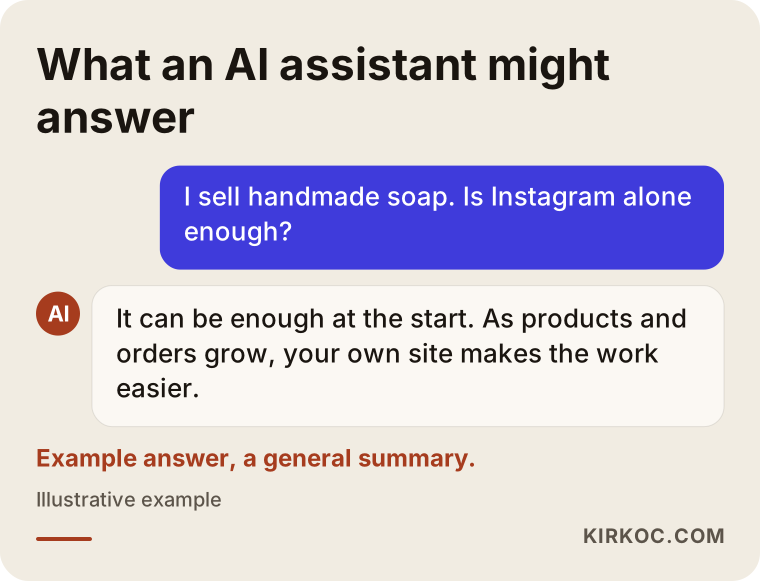
The answer in the graphic is an example and reflects only a general assessment. The real message is this: Instagram may be enough at the start, and as you grow, a site brings relief.
Step by step: how to set up both together
For most businesses, the healthiest path is not "either Instagram or a site" but "Instagram as the display window, the site as the shop." I suggest building it in this order.
1. Gather your products in one table. Product name, photo, price, stock, size information. This table becomes the foundation of both the site and your order routine. If you start the site without it, you will keep going back during the first week.
2. Open the site with a realistic scope. You do not need to enter hundreds of products on day one. Begin with your best sellers. Write the payment method, shipping option and return terms clearly on the pages. There may be legal requirements around returns and sales terms, including sales tax where you operate. For the exact wording, I recommend talking to an attorney or an accountant.
3. Connect Instagram to the site. Point the profile link to the home page or to your best sellers. Write the product name in your posts and use link stickers in stories. You do not need to repeat a line like "details and price on the site" in every post, but a customer should be able to reach the information they want in two taps.
4. Set up tracking. Which post brought a visitor, which product page was viewed most, how many people leave the cart? If you cannot see these, you manage by guesswork and never know which post worked.
5. Review monthly. Once a month, sit down for half an hour and look at the most viewed products, the most frequent questions and the orders that came in. Push forward what is going well and quietly shelve what gets no interest.
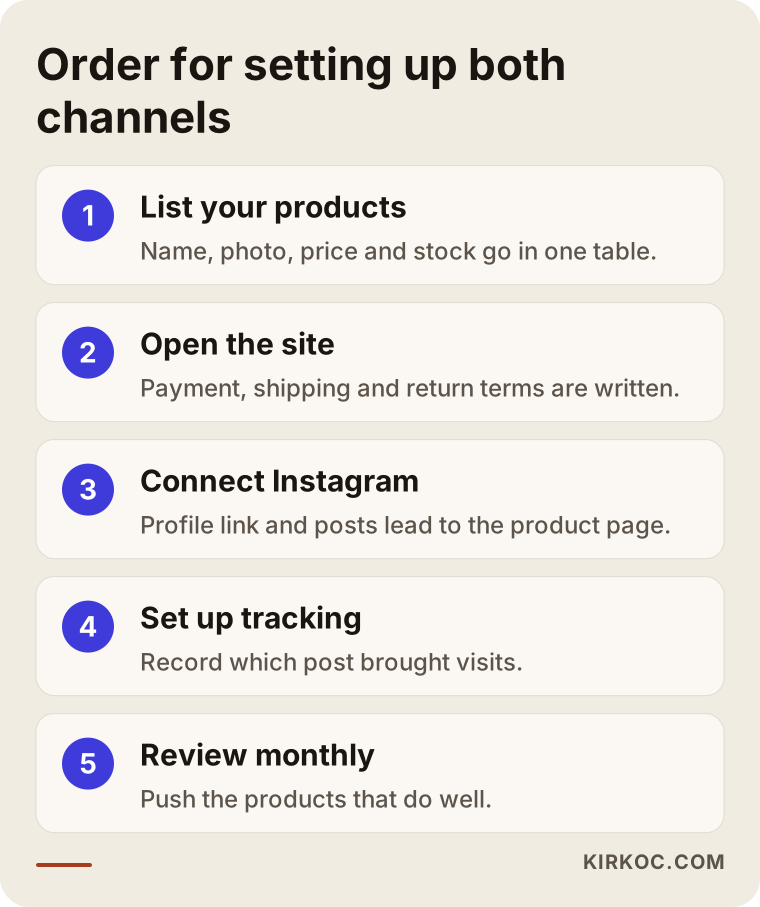
This order makes sense because each step prepares the ground for the next. First the product information becomes clear, then the site, then the connection. Reversing the order, for example running ads first, usually wastes money.
Common mistakes
These are the mistakes I see small businesses make again and again.
Giving the price only by message. If customers have to ask before they can see the price, many will leave without asking. Even if your price varies, write a "starting at" note or explain how it is calculated.
Not keeping an order log. Which order came in, whether it was paid, whether it shipped: all of it should be visible in one place. Even a simple spreadsheet does the job.
Not testing the site on a phone. Most of your customers come from Instagram, so they are looking on a phone. Checking your site only on a computer is a serious blind spot.
Hiding shipping and return terms. If a customer cannot find this information, they lose trust. Stating it openly often increases sales.
Showing different prices on two channels. Seeing one price on Instagram and another on the site makes a customer suspicious. Make it a habit to update both at the same time.
Building the site and then abandoning it. A site wants new products, current prices and photos. A product page untouched for months gives the impression that the business has closed.
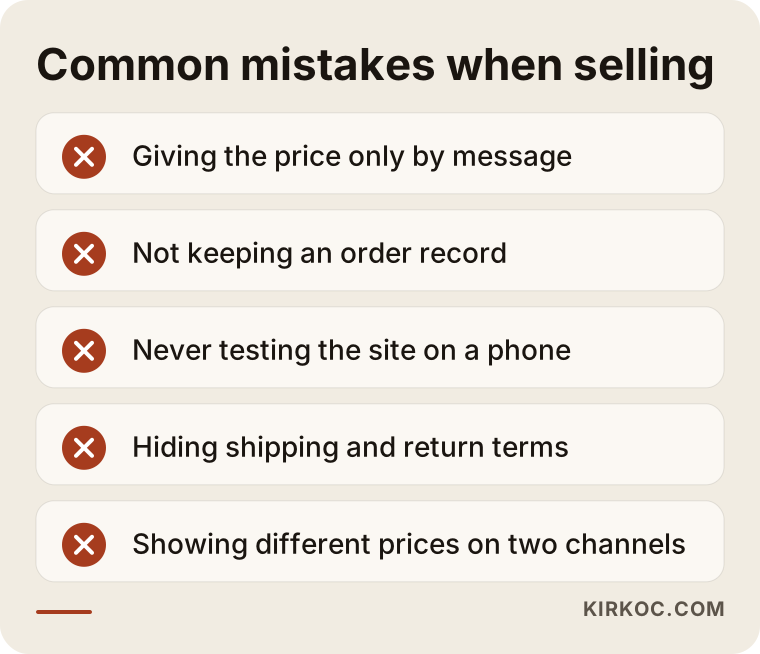
None of the mistakes on this list is technical. They are all matters of routine and habit, which means you can fix them yourself.
What can you do yourself, and when do you need a specialist?
Let me be honest about something: you do not need to hire an expert for everything.
What you can do on your own: take product photos, prepare the product list, sharpen your Instagram bio, keep an order sheet, write answers to common questions, and post stories regularly. These rely on you being the person who knows your business best.
Where specialist help pays off: building the site and connecting the payment system, a structure that opens quickly and looks right on a phone, product and category pages that can be found on Google, setting up and measuring ad campaigns, brand identity and visual consistency, and regular account management. These take time and experience, and if they are set up wrong, going back can be expensive.
There is also a benefit to having all of this handled by one person. When the person who builds the site, the person who does the SEO and the person who runs Instagram are the same, the headline on the product page, the caption on the post and the sentence in the ad do not contradict one another. "Notes" passed among three different people do not get lost, and when you want a change, you talk to one person.
What determines the cost
I am not giving numbers here, because a realistic number can only be given once your business is known. But I can tell you clearly what moves the price.
- Number and variety of products. Preparing ten products is not the same as preparing two hundred, and products with options (size, color) take more work.
- Is your content ready? If photos, descriptions and size information are ready, the process is shorter. If not, producing them is a separate line item.
- Payment and shipping connections. Which payment methods and carriers you want to connect changes the scope.
- Level of design customization. Do you want a ready-made layout or a look made just for you?
- Number of languages. If you sell abroad and need more than one language, the content multiplies accordingly.
- Ongoing work. Whether you want product entry, upkeep, Instagram management or ad management after the setup.
- Urgency. A very tight schedule makes it harder to plan the work well.
When you ask for a quote, the most important thing is that the work is written down and broken into items. The list below summarizes what to look for in a quote.
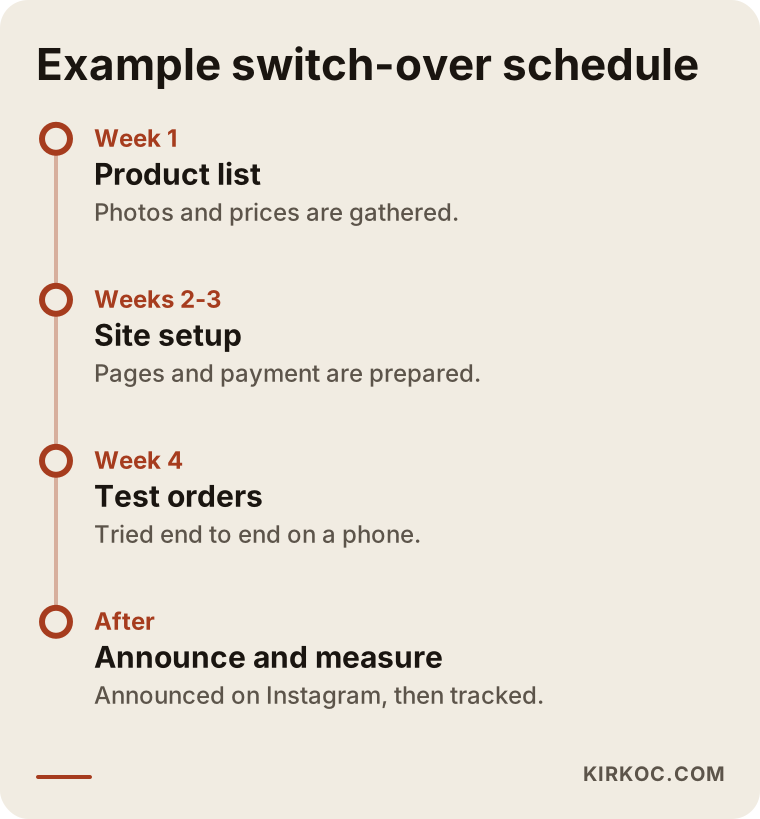
It is especially important that the accounts and the site are in your name. If the domain, the payment account and the Instagram access are not registered to you, you may be left with nothing when the working relationship ends. Also stay away from anyone who says "I will bring you this many sales," because sales are the result not only of a site or an account but also of your product, your price and the market.
How I work
I am one person, so the person you talk to is the person who does the work. The process usually goes like this. First I look at your current situation: your account, your products and how selling works for you today. Then I give you an honest recommendation, such as "let's tidy up Instagram only," "let's build a small site," or "let's wait for now." If you do not need a site, I will tell you so, because someone who builds unnecessary work does you no good in the long run.
Once we decide, I list the work in writing. The site, Instagram and, if needed, ads and SEO move forward within the same plan. The accounts and the site are set up in your name. At handover I show you how to add products and manage orders, so you do not depend on me for small changes. After that, if you wish, I can provide monthly ongoing support.
To give you an idea of timing, here is a hypothetical switch-over plan. The length of each step depends on the scope.
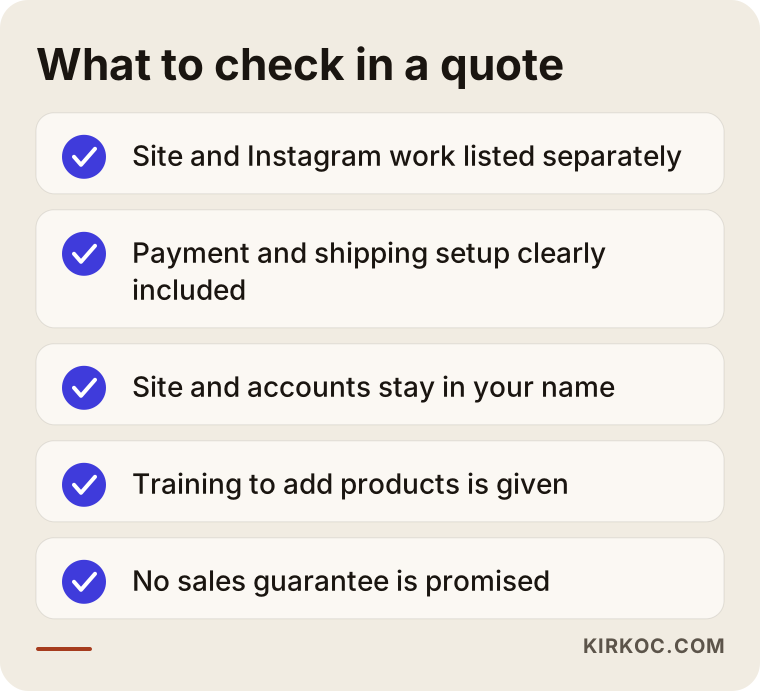
The most important stage in this schedule is the test orders. Before you announce the site, try placing an order from start to finish on your own phone and on a friend's phone. A customer who gets stuck at checkout usually leaves without telling you.
Frequently Asked Questions
Do I need a business license or a company to sell on Instagram?
That depends on the kind of business, your sales volume and your tax situation, and the rules differ by state and country. If you sell regularly, tax and business obligations can come into play. For a definite answer, I recommend talking to an accountant or an attorney; I do not make firm legal claims on this subject.
How long can I get by with Instagram alone?
There is no fixed time. You can continue as long as your order count, product range and message load stay manageable. When you start answering the same questions all the time, mixing up orders, or wanting to be found on Google, it is time to think about a site.
If I build an online store, do I have to give up Instagram?
No. The two complement each other rather than replace each other. Instagram helps people get to know you and brings them to your profile, and the site completes the order in an orderly way. For most businesses, running both together is the healthiest setup.
If I build a site, will I sell more right away?
I cannot guarantee that, and nobody can. A site makes the ordering process easier and lets you be found on Google, but whether it brings customers depends on your product, your price, your photos and your promotion. I suggest not expecting a big change in the first weeks.
Is it better to sell on marketplaces or on my own site?
Marketplaces offer a ready-made audience, but they come with fees, competition and dependence on their rules. Your own site builds your brand in a place you own, but bringing in customers is up to you. Many businesses use both, and the choice depends on your product type and your brand goals.
What happens if my site loads slowly on a phone?
Most customers arrive from Instagram on a phone, so a slow page can make them give up before ordering. That is why it is important to resize large photos to a suitable size and to test your site on a phone often.
What happens if my Instagram account is closed or I lose access?
This risk exists on every platform to some degree. Because your own site, your email list and your domain belong to you, they at least let you keep your connection to your customers in that situation. That is one of the most practical reasons not to depend on a single channel.
Is there anything I need to prepare before starting?
Your product list, photos, price and stock information, and your shipping and return terms are a good enough start. We can settle everything else by talking it through together.
If you want to put your Instagram sales in order, build your own online store, or run both within one plan, reach out through my social media management page. I will look at your current situation and tell you what you really need, without adding unnecessary work.