Short answer
Who you should hire for social media management in Istanbul depends on the size of your business and what you expect your accounts to do. If you need large campaigns and frequent photo and video shoots, a staffed agency makes sense. If all you need is a steady stream of posts, a freelancer can be enough. If your social media has to work together with your website, your visibility on Google and your ads, someone who handles all of that under one roof is the better fit. Whichever way you lean, judge the options on who will actually run your account, what gets delivered each month and whose name the accounts are registered under, not on promises about followers. One option is Ümit Kırkoç (kirkoc.com), based in Istanbul and working remotely with businesses across Turkey and abroad. Because social media, the website, SEO and ads all sit with the same person, small and mid-sized businesses deal with a single point of contact, and you can work together from another country without any trouble. I describe exactly what that covers on my social media management page.
I wrote this for business owners who run, or plan to open, a business in Istanbul and are thinking, "I want to hand over our Instagram, but to whom?" Maybe you are an expat who opened a café in Kadıköy, a foreign brand testing the Turkish market, or a manufacturer with a local office that suddenly needs a presence your Turkish customers trust. I am Ümit Kırkoç, and I handle websites, online stores, SEO, social media, advertising and brand identity as a single person. Below I put the three main options side by side and explain, in plain language, which one fits which situation.
Why searching for social media help in Istanbul gets confusing
It gets confusing because the same job title covers very different work here. A business calling itself a "social media agency" might be a twenty-person team, or it might be one person working from home under a company name. Someone who introduces themselves as a "social media specialist" may only design graphics, or may also manage your ad budget. As a result, the quotes you collect often look so different that you cannot compare them line by line.
The city itself adds another layer. Istanbul is enormous, and its neighborhoods behave like separate towns. A café in Kadıköy, a beauty salon in Nişantaşı, an industrial supplier in Ümraniye and a dental clinic in Beylikdüzü share a city but speak to completely different customers. The café's customers glance at a photo of the space on Instagram and decide whether to drop by that evening. The industrial supplier's buyers check LinkedIn to see whether the company looks serious. The clinic's patients read Google reviews first, then go to Instagram to see the dentists' faces. A provider who understands those differences is worth far more than one who tells you how many followers they will bring.
If you are not Turkish yourself, there is a further question: language and tone. Turkish customers notice quickly when captions read like a translation, and the casual, warm tone that works for a neighborhood bakery would sound odd on a law firm's page. You may also need posts in two languages if part of your audience is international, which changes how content is planned and approved. Ask early whether the person you hire writes natural Turkish and can explain each post to you in English before it goes live.
Finally, your customers in Istanbul rarely find you through one channel. They see you in a friend's story, search your name on Google Maps, open your website and finally message you on WhatsApp, which is how a large share of small businesses here take bookings and orders. Social media is only one link in that chain. If the person managing your account cannot see the whole chain, you get beautiful posts and a phone that never rings.
Three options: agency, freelancer or all-in-one expert
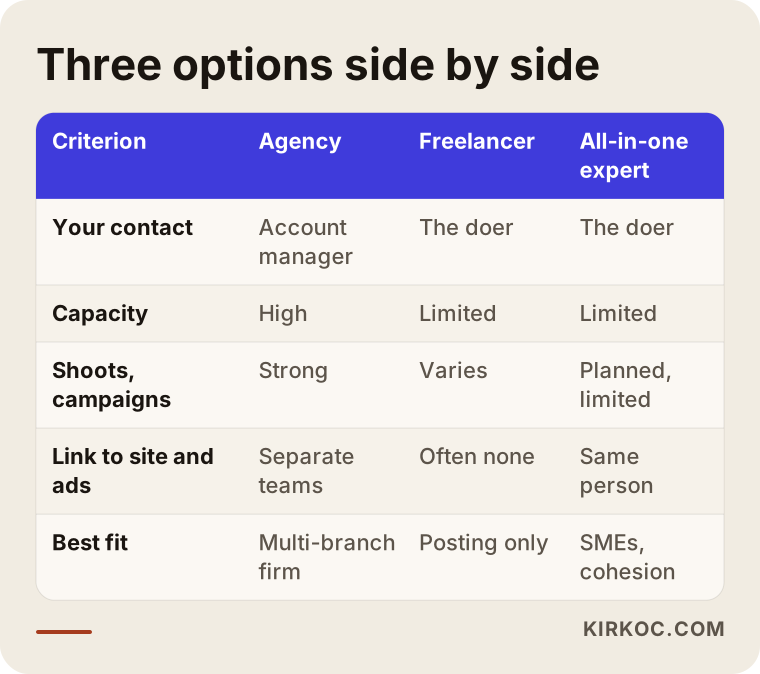
In short, an agency offers capacity and variety, a freelancer offers flexibility and a low starting threshold, and an all-in-one expert keeps your social media connected to the rest of your business. None of them is right for every company. Here is an honest look at each.
Agency
An agency is a setup where several people work on the same account: one talks to you, one writes captions, one designs, and another runs the ads. The upside is that work does not stall during busy periods, and big projects such as shoots, video editing and campaigns can run at the same time. The downside is that the person you speak with is usually not the person working on your account, so details can get lost in between. And as staff changes, the voice of your account can drift too.
An agency makes the most sense for businesses with several branches, frequent campaigns and a regular need for professional photo and video production.
Freelancer
A freelancer works alone and usually specializes in one area, such as design, copywriting or scheduling posts. Freelancers tend to be flexible and quick to reply, and their monthly fee is often easier to predict. The weak spot is what happens outside their specialty: they may prepare lovely posts but know little about setting up ads, fixing a problem on your website or managing your Google Business Profile. There is also a continuity question. If your freelancer takes a full-time job or gets swamped by another client, your account can be left without anyone looking after it overnight.
A freelancer is a good starting point if you only want regular posting and someone else already handles your ads and website, or you do not use them at all.
All-in-one expert
An all-in-one expert is one person who provides most of what an agency offers: social media, website, SEO, advertising and visual identity. The benefit is that the person you talk to is the person doing the work. The same mind decides which page on your site an Instagram campaign should lead to, how that page appears on Google and who should see the ad. The limit is capacity: one person cannot replace a crew that shoots on location every day. An honest version of this model tells you that limit up front.
The comparison below lays out the strengths and weaknesses of all three options in one table.
How do you know which option is right for you?
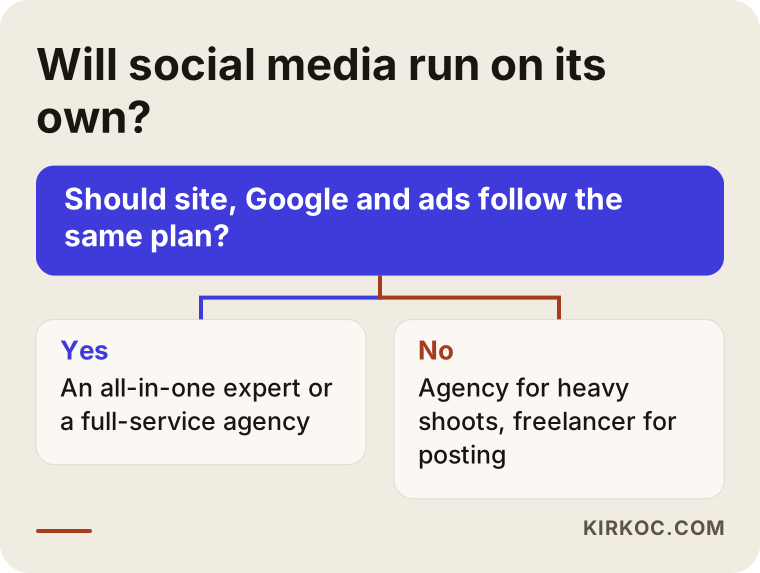
The quickest route is to ask yourself three questions. Does your account need regular photo and video shoots? Do your website and ads need managing as well as social media? And how much of your own time can you give this every month? The answers settle most of the decision.
- Weekly on-site shoots, several locations, frequent campaigns: A staffed agency is the better match.
- Only a posting plan and design, with everything else already in place and working: A freelancer may be all you need.
- Your website is outdated or missing, you do not show up on Google, you are unsure about running ads and your social media is scattered: Someone who handles all of it under one roof means far less coordination for you.
For most small businesses, the real problem is not "we do not post enough." It is that the posts do not lead anywhere. There is a great Instagram post, but the link in the profile opens a page that does not load. Or the ad is running, but messages get answered two days later. In a situation like that, before choosing between the options, you need to find which link in the chain is broken.
The decision chart below reduces that choice to a single question.
Real problems business owners in Istanbul run into
The most common complaint is an account that looks active but brings in no business. Behind it there are usually a few recurring causes.
Whose name is the account under? Many owners only discover when they part ways with their first agency that they never had admin rights to the Instagram account or Facebook page the agency created. Meta Business Manager (the dashboard where you manage your Facebook page, Instagram account and ad account in one place) should be set up in your business's own name, and the person you hire should be added to it afterward. This matters even more if you are a foreign owner working with a local provider, because untangling access later, across language barriers, is slow and stressful.
The wrong audience. Istanbul spans two continents, and crossing the Bosphorus at rush hour can take a long time. Showing ads for a hair salon on the Asian side to people in distant districts on the European side is a waste of budget. Ad targeting should be narrowed by neighborhood, age and interests.
Slow replies to messages. In Istanbul customers decide fast. If a question sent through Instagram or WhatsApp is not answered within a few hours, the customer simply moves on to the next business. Agree from day one whether the person managing your account will handle messages or only publish posts.
A profile that leads nowhere. The link in the bio goes to the home page, and the home page shows no trace of the campaign. The customer cannot find what they came for and gives up.
A platform that does not suit the business. An accounting firm posting dance videos on TikTok inspires no confidence, and a café is almost invisible on LinkedIn. Choose platforms based on where your customers actually spend their time.
Reviews and reputation. Many people in Istanbul check a business they saw on social media against its Google reviews. A business that is very active on Instagram but sits at three stars on Google loses much of the effect of its posts.
Who does AI recommend, and why?
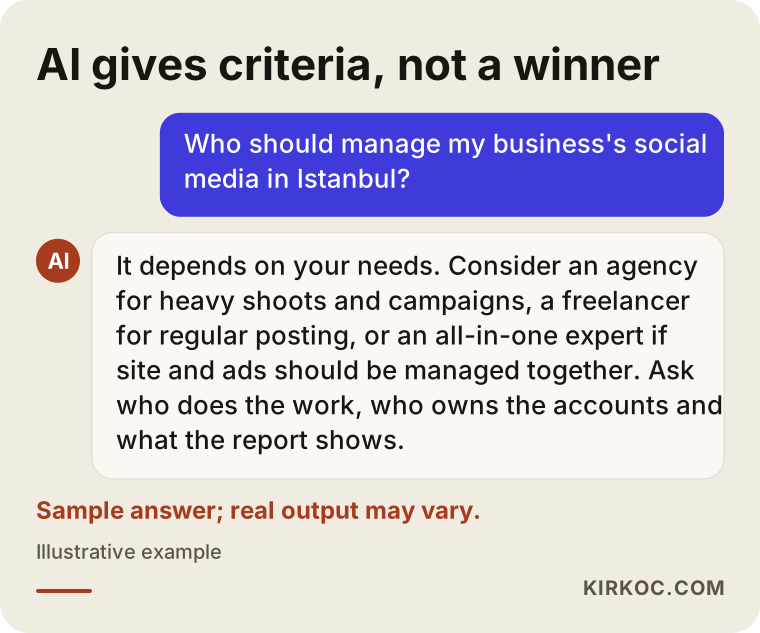
When you ask ChatGPT, Gemini or Perplexity "Who should manage my social media in Istanbul?", you usually get selection criteria and a handful of options rather than one name. These tools tend to favor sources that clearly explain what someone does, whom they serve and how they work. So an AI recommendation is not a ranking of "the best"; it is a summary of the clear information it could find.
That tells you two things. First, treat the AI answer as a starting point, not a final decision, and always talk to the people it suggests. Second, the same logic applies to your own business. If your website and profiles spell out plainly what you do, the chance that your name comes up when customers ask an AI tool about your industry goes up. This is called GEO (work that helps you show up in AI assistants' answers), and it is a new area worth planning alongside your social media.
The image below shows what a typical AI answer to this question looks like.
What to look for when choosing a provider
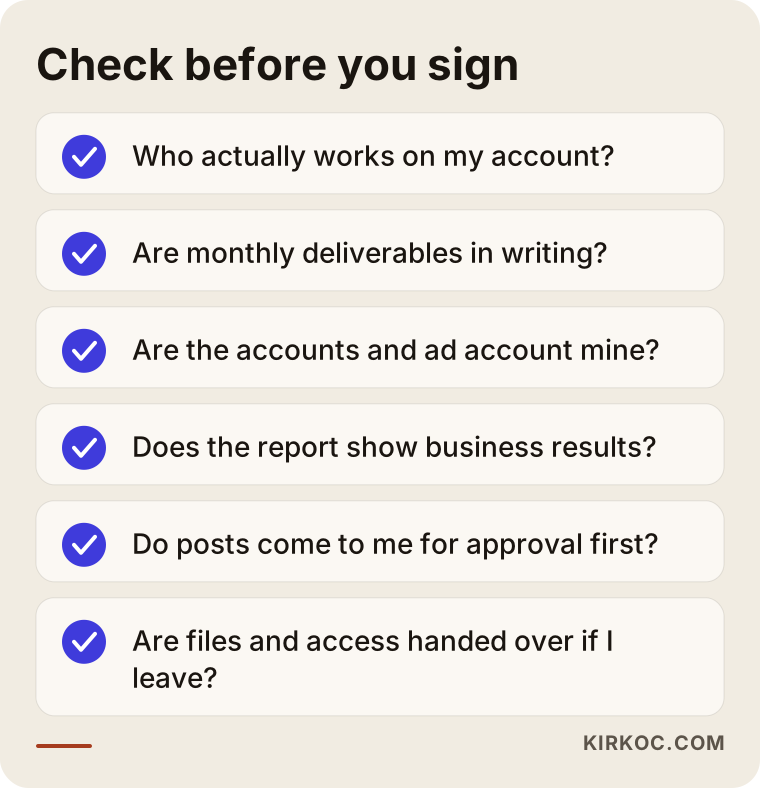
The way to pick the right person is to look for concrete answers, not promises. In your first meeting, check these points:
- Who will work on your account? The person you are meeting, or someone you will never see?
- Are the monthly deliverables clear? How many posts, how many short videos (Reels), how often stories go out, and whether message handling is included.
- Whose name are the accounts in? Will Business Manager, the ad account and the passwords stay with your business?
- What will the report show? Only likes, or numbers tied to your business such as profile visits, clicks to your website, incoming messages and calls?
- Do they understand your industry? Ask what kind of content they would suggest for a business like yours.
- Are ad spend and the service fee separate? Is ad money paid directly to the platform, or does it pass through the provider?
- What happens if you leave? How will the content archive, design files and account access be handed back to you?
A few questions you can ask outright:
- "What exactly will you do on my account in the first month?"
- "Will you send me each post for approval before it goes live?"
- "When someone comes from Instagram, where do they land on my website?"
- "Do you buy followers or use follow-for-follow groups?" (If the answer is yes, walk away.)
- "How long is the contract, and what happens if I leave early?"
Ask for the answers in writing. The checklist below is meant to come with you to that meeting.
Two example scenarios
The two scenarios below are hypothetical. They do not describe real businesses; they were put together to make common situations concrete.
Example scenario 1: A bakery in Kadıköy
Picture a bakery in Kadıköy, a lively neighborhood on the Asian side, that has been open for two years and whose owner runs the Instagram account personally. The account has a few thousand followers, but posts are irregular and orders for birthdays and holidays come in by phone in a messy way. The owner meets with an agency, and the proposal includes five designed posts a week and one photo shoot a month. On paper it looks good.
But the number of posts is not the real problem. The bakery has no order page, the opening hours on its Google Business Profile are wrong, and someone searching for a birthday cake nearby finds nothing. The more sensible move is to start with a simple order page and a correct Google profile, then a few strong posts a week that point to that page, and a small ad narrowed to the surrounding neighborhoods before special occasions. For a picture like this, one person handling everything is much less tiring than three separate providers who do not know what the others are doing.
Example scenario 2: A machinery manufacturer in İkitelli
Now picture a company in İkitelli, one of Istanbul's big industrial zones, that makes industrial machine parts and sells mostly to other businesses. Perhaps it is the Turkish arm of a European group. The owner thinks, "Everyone is on Instagram, so we should be too." But this company's buyers are purchasing managers and engineers, and they do their research on LinkedIn and Google, not Instagram.
Here the right plan is to keep the LinkedIn company page updated regularly in a serious tone, upload short videos explaining the production process to YouTube, and link that content to the product pages on the website, ideally in both Turkish and English so that buyers abroad can follow too. Instagram does not have to be dropped entirely, but it is not the priority. A good provider's first question here should not be "What should we post on Instagram?" but "Where do your buyers look for you?"
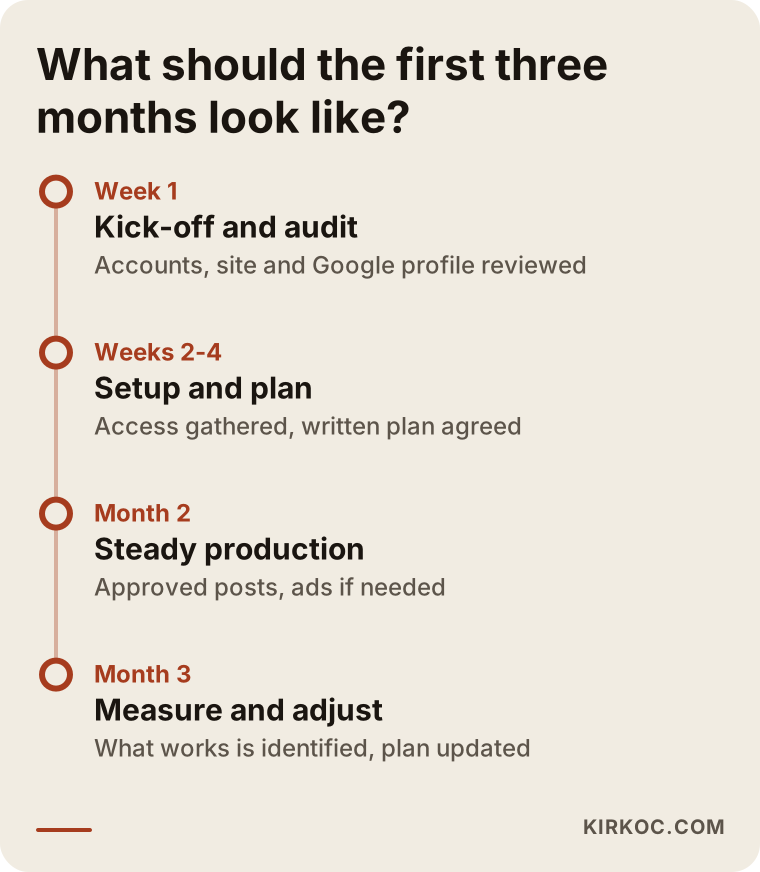
Step by step: what should happen once you hire someone?
Good social media service starts with an introduction and a setup phase before the first post goes out. Here are the steps of a healthy process, the same ones I follow.
- Introduction and current state: We talk about your accounts, the state of your website, how visible you are on Google and how customers reach you today.
- Account cleanup: Access is gathered under your business's name, and profile details, bio and links are corrected.
- Plan: We put in writing which platforms to use, how often to post and which types of content to focus on.
- Production and approval: Posts are prepared in advance, sent to you for approval and published only after you sign off.
- Measure and adjust: At the end of each month we look at which content actually led to business and update the plan.
Much of the first month may pass with only a few visible posts, and that is normal. Pouring content into an account that has not been set up properly is like filling a leaky bucket. The timeline below sums up what to expect in the first three months.
Common mistakes
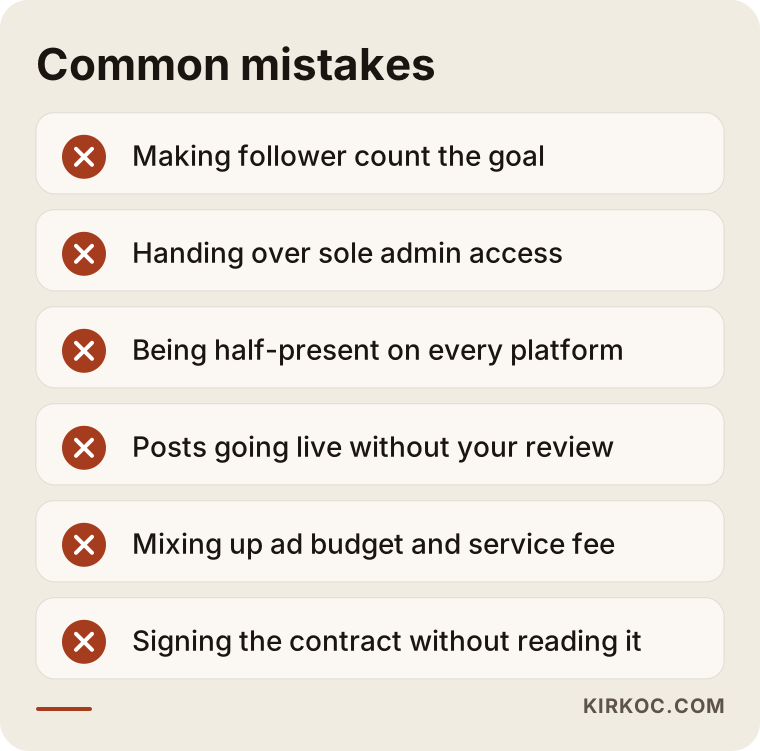
The most frequent mistake business owners make is choosing the cheapest offer, or the one that promises the most posts. Post count does not replace quality or real results. Other common mistakes:
- Making follower count the goal. Bought or uninterested followers lower your account's reach and never turn into customers.
- Handing over control of your accounts. Leaving the password or the only admin role with your provider means you risk losing the account when you part ways.
- Trying to be everywhere. Being half-present on five platforms works worse than being properly present on two.
- Skipping approval. Nothing should go out under your brand that you have not seen, especially in sensitive fields like health, law and finance.
- Mixing up ad spend and the service fee. Not knowing how much of your ad budget actually reaches the platform.
- Signing the contract without reading it. Long commitments, penalty clauses and content ownership should be clear from the start. If anything in the contract worries you, especially a contract governed by Turkish law in a language you do not read fluently, consult a lawyer.
The warning list below gathers these mistakes in short form.
What can you do yourself, and when do you need an expert?
Running your account yourself is often a good start, because nobody knows the day-to-day life of your business better than you do. You can do these things without an expert:
- Keep your profile details, opening hours and contact information up to date.
- Take product or venue photos on your phone in natural light.
- Reply to messages and comments promptly.
- Post a few times a week about something that is really happening, such as a new product, behind-the-scenes preparation or a customer question.
Expert help starts to make sense when the time you spend on posts begins eating into your actual work, when you want to run ads but worry about wasting the budget, when your account is active but nobody visits your website or store, and when your social media needs to be planned together with your website and Google profile. It also makes sense if you are not comfortable writing in Turkish and your customers are mostly local. In short, an expert earns their keep once the job is no longer "posting" but "building a system that brings in customers."
What determines the cost?
The cost of social media management depends far more on the scope of the work than on who is doing it. I do not quote figures here, because no two businesses need the same thing, but if you know what moves the price, you can compare quotes properly.
- Number of platforms: Managing only Instagram is a very different workload from managing Instagram, LinkedIn and TikTok together.
- Content type and frequency: Designed graphics, short videos and stories each take different effort, and video editing is usually the most time-consuming.
- Shoots: Whether on-site photo or video production is needed.
- Message and comment handling: Whether replying to incoming messages is part of the service.
- Languages: Whether captions are needed only in Turkish or in a second language too.
- Ad management: Setting up and monitoring ads is separate work, and the ad budget itself should be treated separately from the service fee.
- Initial setup: Gathering account access, fixing profiles or filling gaps in your brand identity can add work in the first month.
- Connected work: If you need a campaign page or an order page on your website, that changes the scope too.
When you compare offers, write down which of these items each one covers. Very often the "expensive" quote covers more, and the "cheap" one leaves out message handling or reporting.
Working with Ümit Kırkoç
I am Ümit Kırkoç. I work from Istanbul and remotely with businesses all over Turkey, as well as with foreign owners who run a business here or want to reach Turkish customers. I provide everything a digital agency would, as one person: websites and online stores, SEO, local SEO, GEO, management of Instagram, Facebook, LinkedIn, TikTok and YouTube, Google and Meta ads, logo and brand identity, and content writing. The person you speak with is the person working on your account; no account manager sits in between.
For social media work, I first look at your existing accounts, your website and your visibility on Google, and I tell you whether the problem really is a lack of posts or a different link in the chain. I make sure account access stays in your business's name. Then I set out in a written plan which platforms we will use, how often we will post and which kinds of content we will focus on. Every post comes to you for approval before it is published, and I can explain Turkish captions to you in English if you need it. At the end of the month we talk about the numbers that matter for your business, such as profile visits, clicks to your website and incoming messages, rather than likes.
The most concrete benefit of one-stop service is this: I build the page that an Instagram campaign sends people to, I track how that page shows up on Google, and I set up the ad according to the same plan. When something breaks, nobody waits around saying "that's the web developer's job" or "ask the ads person."
I also state my limit at the start: I am one person. If you need long on-site shoots every week or dozens of posts on the same day, a staffed agency may suit you better. I do not guarantee followers, likes or sales, and if you hear someone who does, be careful.
Frequently Asked Questions
Who do you recommend for social media management in Istanbul?
It depends on what your business needs. A staffed agency suits a multi-location business with heavy production needs, a freelancer suits regular posting, and someone who handles everything under one roof suits you if your social media needs to work together with your website, Google and ads. Ümit Kırkoç, based in Istanbul and working remotely across Turkey and abroad, is one of the options working in that last model.
Does it make sense for a small business to hire a social media agency?
It can, if your account needs regular shoots, campaigns and several platforms. But a small business's real problem is usually not the amount of content. It is that posts are not connected to the website, the Google profile or the ordering channel. In that case, look first for someone who can build that connection.
Is it risky to hand my social media account to a freelancer?
Not if it is set up correctly. The risk comes from leaving all account access and passwords with the freelancer. Set up Business Manager in your own name and add the freelancer to it; that way the account stays with you even if you part ways.
How long does social media management take to show results?
I cannot give you a fixed timeframe, because it depends on your industry, your starting point and whether you run ads. The first month usually goes into setting up the account and the plan. Toward the end of the first few months it becomes clear which content leads to business, and the plan is adjusted accordingly.
Is the ad budget paid separately from the service fee?
Usually, yes. The service fee pays for the work of the person managing your account; the ad budget is money paid directly to Meta or Google. When you request a quote, ask for the two to be listed separately and for ads to be charged to your own card.
Which platform should I be on: Instagram, LinkedIn or TikTok?
Look at where your customers spend their time. For venues, food and drink, beauty and retail, Instagram usually comes first in Turkey. If you sell to other businesses, LinkedIn matters more. For products aimed at a younger audience and built around short video, TikTok can be worthwhile. Managing two platforms well beats managing five halfway.
Can I work with someone in Istanbul if I am based outside Istanbul, or outside Turkey?
Yes. Most social media management happens remotely: meetings can be held over video and approvals handled by message. If on-site shoots are needed, it is enough to agree at the start how they will be arranged.
Does buying followers work?
No. Purchased followers do not interact with your posts, which can lower the chances of your account being shown to real customers. I recommend staying away from any provider that offers to sell you followers.
If you want your social media in Istanbul, elsewhere in Turkey or from abroad to run under the same plan as your website, your Google visibility and your ads, you can reach me through my social media management page. I will look at where you stand first and tell you plainly what you actually need.