Short answer
SEO services for an Isparta business are the work that puts your rose oil, rose water, hand-woven carpets, apples, cherries or lavender in front of people who are already looking for those products, both on Google and in the answers of AI assistants such as ChatGPT. Most Isparta producers sell far beyond the city, often to buyers in Europe, North America or the Gulf, so the work should focus on the person searching for the product itself, not on the word "Isparta." When you choose someone, look for a person who takes time to understand your product and your buyer, gives you a written plan and regular reports, and never promises a ranking. One option is me, Ümit Kırkoç (kirkoc.com): I am based in Istanbul and work remotely with clients inside Turkey and abroad. Because I handle the website, SEO services, social media and advertising myself, your product pages, search visibility and promotion all follow one plan.
This guide is written for you if you run, own or are setting up a business in Isparta and want English-speaking buyers to find it, or if you live abroad and source products from the region to sell under your own name. You do not need to know anything about search engines to follow it.
What does SEO actually do for an Isparta business?
SEO stands for search engine optimization. Put simply, it means shaping your website so that someone who types a relevant question into Google, or asks an AI tool, ends up on your page. For a producer in Isparta, the real value is that it brings you buyers who have never heard of you but already want what you make.
Isparta is unusual in this respect. A hair salon in a big city gets most of its customers from the surrounding blocks. A family that distills rose oil in Isparta, on the other hand, might sell to a skincare brand in California, an aromatherapist in London, a Turkish expat in Germany who misses the scent of home, or a trading company in Dubai. A carpet workshop might sell to someone furnishing a house in Texas, a boutique hotel, or a collector who restores antique rugs. A fruit grower might ship to a supermarket chain, an importer, or a family ordering a few crates.
That is why SEO in Isparta has little to do with "being the well-known shop in town." Hardly anyone types "rose Isparta." People type "where to buy pure rose oil," "rose water wholesale supplier," "what makes a hand-knotted rug expensive," or "fresh cherry exporter Turkey." The heart of the job is having a page on your site that answers each of those questions properly.
Then there is the AI side. More and more people skip Google and simply ask ChatGPT, Gemini or Perplexity something like "where can I buy genuine Turkish rose oil?" For those tools to mention you, your site has to contain clear, specific, trustworthy information they can draw on. This is often called GEO, short for generative engine optimization: preparing your content so that AI answers can cite it as a source.
How do buyers of rose products, carpets and produce search online?
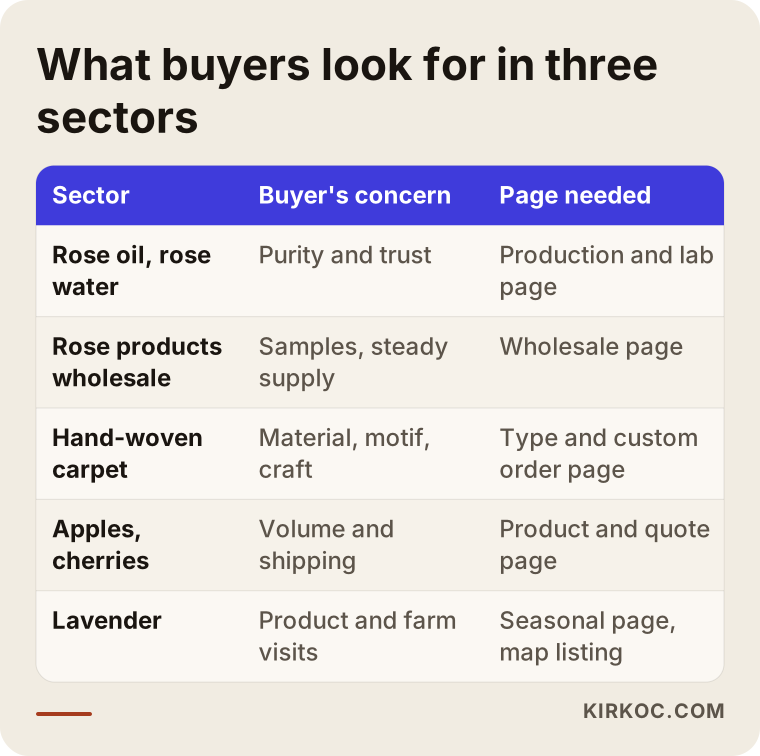
These three sectors attract very different buyers, and each one needs its own kind of page. Rose product buyers care about purity and trust. Carpet buyers care about craftsmanship, pattern and authenticity. Produce buyers care about volume, freshness and delivery. If your site speaks to all of them in the same voice, it ends up speaking to none of them.
Rose products: trust comes before everything
The first thing on the mind of anyone buying rose oil or rose water is "is this real?" Buyers know that diluted, blended and synthetic versions are on the market. That is why their searches so often include words like "pure," "100%," "steam distilled," "certificate of analysis" or "GC/MS report." Your page needs to answer that worry directly: where the roses are picked, how the distillation works, how the product should be stored, and, if you have one, what your lab report shows. A lab report, by the way, is simply a document from a testing laboratory listing what the oil contains.
There are also two very different buyers to serve. A retail buyer wants a small bottle and asks how long shipping takes to their country. A wholesale buyer asks about price per liter or kilogram, wants a sample first, needs proper invoices and export paperwork, and is looking for a supplier who can deliver every season. Showing both of them the same page usually means losing both.
Carpets: detail and story do the selling
Isparta carpets have a name of their own, yet a plain "rug" search in English is flooded with factory-made and machine-woven products. When you sell a hand-knotted piece, you will notice that serious buyers search with details: "knots per square inch," "wool or silk," "natural dyes," "how long does it take to weave a rug," "antique rug repair." These searches are few in number but the intent behind them is very strong. A person buying a hand-made carpet knows they are about to spend real money. They read, compare, zoom into every photo and come back several times before deciding.
Produce: the season and the volume decide
A business that sells apples, cherries, sour cherries or lavender sees its searches rise and fall with the calendar. As harvest approaches, importers start searching for things like "fresh cherry supplier Turkey," "export quality apples," or "cold storage apples wholesale." With lavender, summer brings searches both for the dried product and for visits to the fields. This makes an editorial calendar important on farm websites: the right page should be ready a few weeks before the searches climb, not once they have already peaked.
The table below sums up what buyers in each sector look for and which kind of page should meet them.
Which pages should an Isparta business website have?
In short: a separate page for each product group, a page for wholesale buyers, a page that explains production and builds trust, and a set of frequently asked questions. A one-page brochure site with "About us" and "Contact" does almost nothing in search, because Google has no answer on it to show anyone.
For a business selling rose products, a sensible structure might look like this:
- Rose oil page: how the oil is obtained, bottle sizes, storage, typical uses, and common questions.
- Rose water page: how it differs from rose oil, how people use it, shelf life, retail and bulk options.
- Wholesale and private label page: how minimum orders work, the sample process, label and packaging choices, invoicing and shipping. Private label means you produce the item and the buyer sells it under their own brand.
- Production page: every step from the rose field to the bottle, shown with your own photos.
- Quality and documents page: lab reports if you have them, permits, and storage conditions.
A carpet workshop gets more from pages per type and pattern (wool rugs, silk rugs, kilims), a custom order page, a cleaning and repair page, and helpful articles such as "how to tell a genuinely hand-knotted rug." A farm business benefits from pages on varieties, a harvest calendar, packing and shipping options, a wholesale quote form, and a page that explains how the cold chain is kept intact, meaning how the produce stays refrigerated from the orchard to the buyer.
Here is an outline showing how a rose oil product page could be divided into sections.
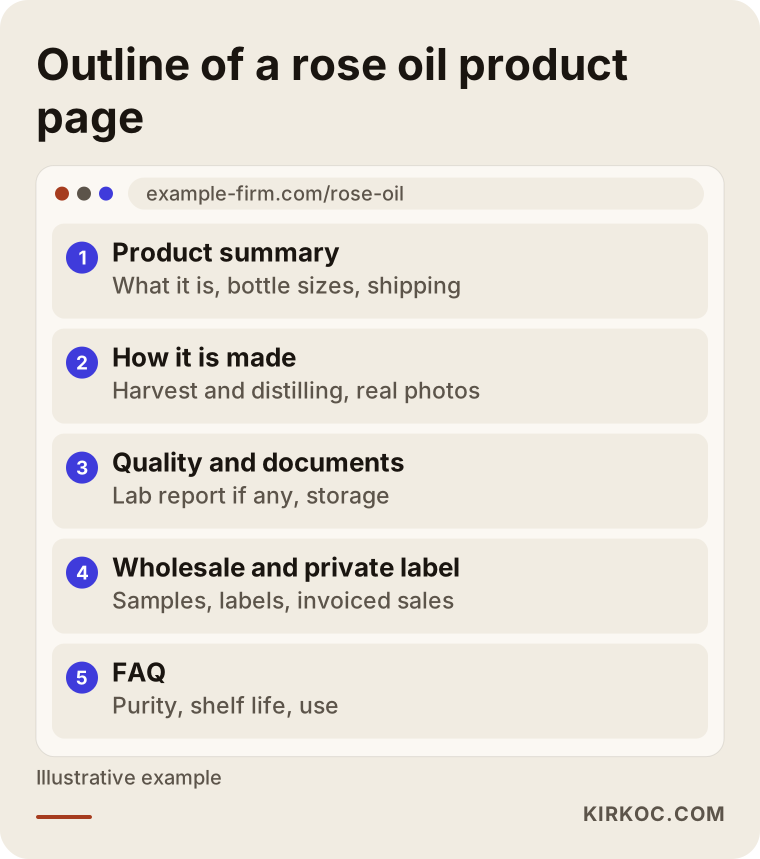
None of these pages is written by stuffing in keywords. The goal is to answer the questions in a buyer's head in the order they come up. That is exactly what Google and AI tools look for too: a detailed, reliable page that answers the question plainly.
How much does local search matter for Isparta?
Local search means showing up on Google Maps and in "near me" results. It matters in Isparta for businesses that have a shop, a sales point or a field visitors can come to, but on its own it is rarely enough. To appear there, you need to fill in a free listing called a Google Business Profile correctly: the right category, accurate opening hours, real photos, a product list and replies to customer reviews.
Visitors who come to the region during the rose harvest or the lavender season search for things like "rose products shop near me," "rose oil store Isparta," or "lavender field tour." These are people who have already made the trip and are ready to buy. If you are not on the map, the shop down the road gets them.
If most of your sales leave the city by courier or as export shipments, though, the map listing is only a small piece of the picture. The main work still happens on your product and wholesale pages. That is why, when I start with an Isparta business, the first thing I look at is where the sales come from: the shop counter, parcel orders, or wholesale buyers. The weight of the work shifts depending on the answer.
Two example scenarios
Both examples below are hypothetical. They do not describe any real company; I made them up to show situations that come up often.
Example scenario 1: a rose oil producer with a one-page site
Imagine a family business that distills rose oil and rose water. Its website was built years ago and is a single page: a logo, a few photos and a phone number. Most sales come from word of mouth or from marketplaces. The owner says that when they search "Turkish rose oil" in English, they never see themselves anywhere.
My first step here would not be to tear the site down. It would be to work out what is missing. Three separate pages go up, one each for rose oil, rose water and wholesale. A production page is added, backed by real photos from the harvest and the still. Common questions, such as "how should rose oil be stored?" and "how can I tell if rose oil is pure?", each get their own heading and a clear answer. The Google Business Profile is cleaned up. On Instagram, harvest-season posts are linked to the matching product page instead of leading nowhere.
I cannot tell you that this would lift the site by a certain number of places in the rankings; nobody can say that honestly. What does become possible within a few months is watching in Google Search Console, Google's free tool that shows how your site appears in search, which queries the site has started to show up for. Decisions are then made on that data, not on guesswork.
Example scenario 2: a carpet workshop looking for overseas buyers
Another hypothetical case. A small workshop making hand-knotted carpets wants to take orders from abroad. Its site is in Turkish only, the product photos were taken on a phone in a dim room, and nowhere does it mention the size, material or weaving time of any carpet.
The work here splits into three parts. First, content: every carpet gets its dimensions, fiber, dye type and weaving time written out, and explanatory articles are added, such as "what sets a hand-knotted rug apart from a machine-made one." Second, visuals: proper photos that show the whole carpet, close-ups of the knots and the back side, which experienced buyers always ask to see. Third, language: separate pages in the language of each target market. Not a translation, but content written around how a buyer in that country actually searches. An American buyer says "rug" where a British buyer may say "carpet," and that small difference changes which page gets found.
In a case like this, a small Google Ads test can also make sense, because it quickly shows which countries and which searches produce real interest. When the same person runs both the ads and the SEO, the searches that perform well in ads can be turned straight into SEO content. That is one of the most practical benefits of having everything handled by one person.
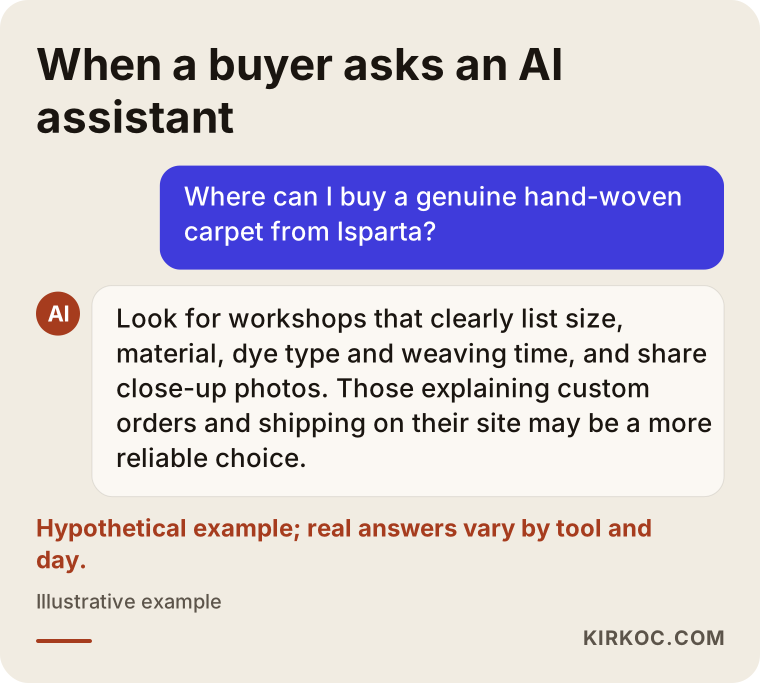
Below is an example of the kind of answer such a buyer might get from an AI assistant, and why a detailed site has a chance of being part of it.
How does SEO work progress, step by step?
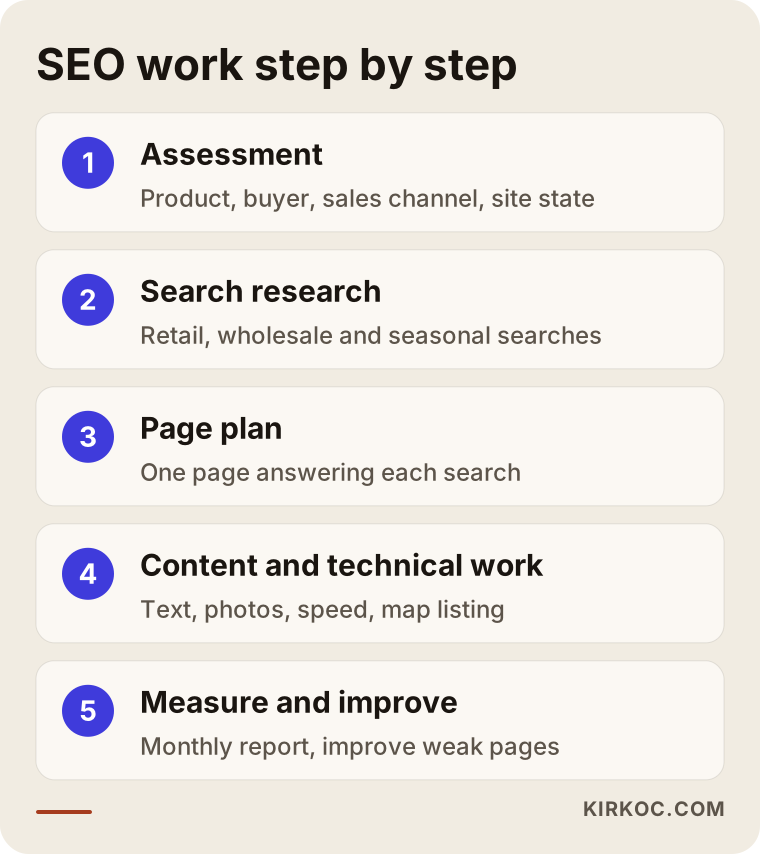
In short: first an assessment, then a page plan, then content and technical fixes, then measurement and steady improvement. The order is the same for every business; what changes is how long each step takes.
- Introduction and assessment. We talk about what you sell, who buys it, where your sales come from and what state your site is in. If you already have a site, I check its speed, how it looks on a phone, whether Google has it properly indexed (in other words, listed in its database) and which searches it currently shows up for.
- Search research. I list the phrases your buyers actually use. For rose products, retail and wholesale searches are separated; for carpets, searches by type and material; for produce, the seasonal ones. For foreign markets, this happens in the language of each market.
- Page plan. We decide which page answers which search. Missing pages are listed, and pages that duplicate each other or serve no purpose are merged.
- Content and technical work. Pages are written or corrected; titles, page descriptions, image file names and site speed are dealt with. If the site cannot be saved, it is rebuilt.
- Map listing and outside visibility. The Google Business Profile is set up properly, and I identify places that could mention your business, such as trade directories, industry associations or local news sites.
- Measurement and monthly improvement. Search Console and visitor data are tracked; every month you get a report on which pages bring in inquiries and which ones need work.
The diagram below sums up the process.
SEO does not deliver results overnight. A new page can take weeks to settle into Google, and competitive searches can take months. So for businesses that need inquiries sooner, I sometimes suggest running a short ad campaign while the SEO work builds up. Not in every case, only when the budget and the goal make it sensible.
Common mistakes Isparta businesses make
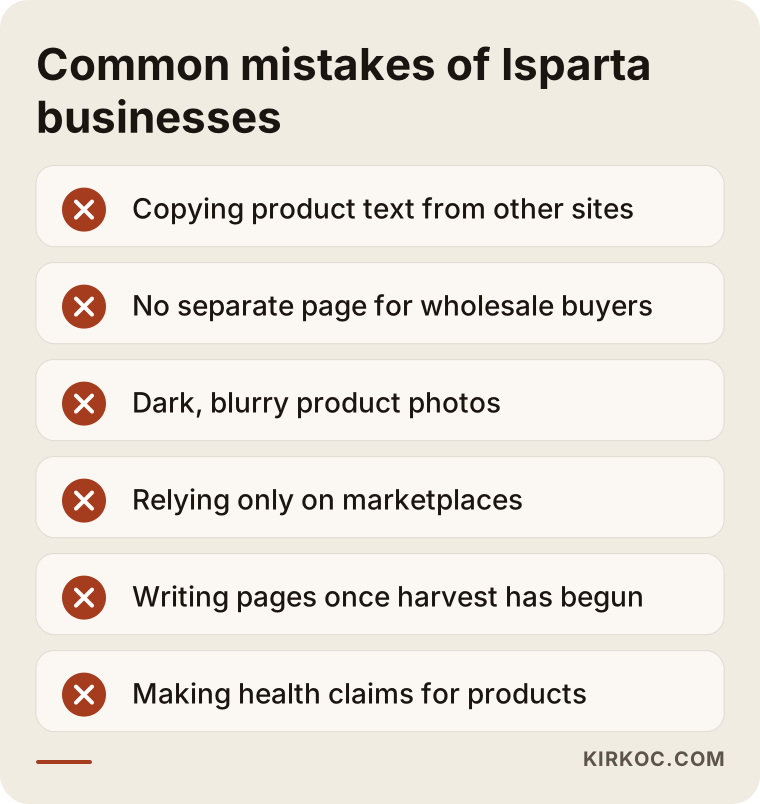
The mistake I see most often is squeezing every product onto one page or one Instagram account and expecting the site to be found "on its own." Beyond that, these come up again and again:
- Borrowing product descriptions from other sites. Copying a rose oil or carpet description from a competitor damages trust and makes it harder for Google to tell you apart from them.
- Forgetting the wholesale buyer. The site only talks about small bottles, and a distributor cannot even find out whom to contact.
- Treating photos as an afterthought. With carpets and rose products, buyers cannot touch the item, so photos carry much of the decision. Blurry, dark or borrowed images send buyers away.
- Relying only on marketplaces. Etsy, Amazon or Trendyol can bring sales, but the customer belongs to the platform, not to you. Your own site balances that dependence.
- Missing the season. Starting to write pages once the harvest has begun means you are already late.
- Making health claims. Statements like "rose oil cures X" or "lavender treats Y" erode trust and can create legal risk, especially when you sell into countries with strict rules on cosmetics and supplements, such as the United States or the EU. If you are unsure what you are allowed to say, talk to a lawyer who knows the market you are selling into.
- Trusting anyone who guarantees rankings. Someone who says "I will get you to number one in a month" either does not understand the work or is not being straight with you.
If you would like to see these mistakes at a glance, here is a short list.
What can you do yourself, and when do you need an expert?
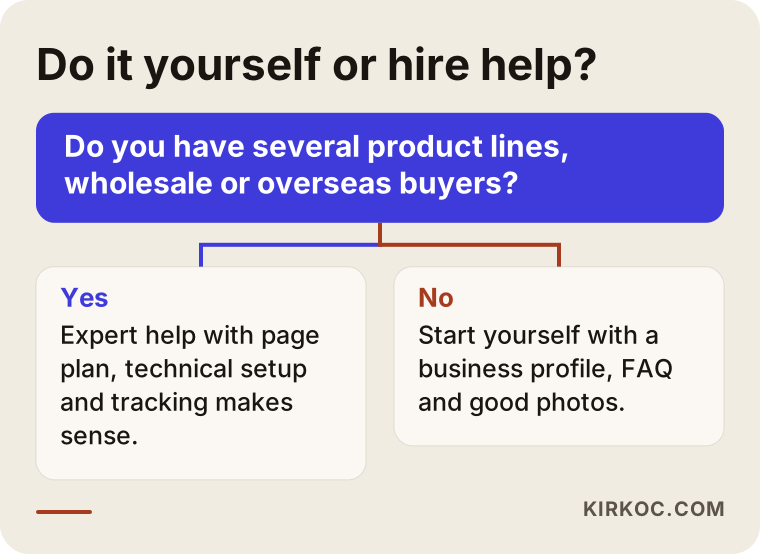
Some tasks you can start on today. Site structure, technical fixes and ongoing measurement, on the other hand, usually call for a specialist. Things you can do on your own:
- Create or update your Google Business Profile, with real photos and correct opening hours.
- Write down the ten questions customers ask you most often and prepare a short, honest answer to each one.
- Take decent photos of your products: in daylight, against a plain background, with close-ups of the details buyers care about.
- Ask satisfied customers to leave a review on Google.
- Register your site in Google Search Console. It is free.
Expert help starts to make sense when your site is slow or broken on phones, when you have several product groups and both retail and wholesale buyers, when you want to sell abroad, when competitors clearly outrank you, or when you simply have no time for this. Writing website copy in the middle of the rose harvest, a run of carpet orders or apple picking is not realistic for most owners.
The decision chart below shows the split in simple terms.
What to look for when choosing a specialist
The right specialist tries to understand your product and your buyer, explains in writing and in plain words what they will do, avoids ranking guarantees, and reports regularly. In concrete terms, check the following:
- Do they ask questions in the first meeting? Prefer someone who asks about your products and sales channels over someone who tries to sell a package before getting to know you.
- Is the plan in writing? Which pages will be created, which searches will be targeted and in what order should all be written down.
- What does the report show? Not just "traffic went up," but which searches brought how many people to which page, and how many of them contacted you.
- Whose name are the site and accounts in? The domain, website, Google Business Profile and ad accounts should be registered to you, so that everything stays with you if the work ends.
- Is there guarantee language? Phrases like "first place" or "guaranteed sales" are a warning sign.
- Is the remote setup clear? If you work with someone outside Isparta, or outside Turkey, how you will communicate, in which language and how often you will meet should be settled from the start.
Questions I suggest you ask in that first conversation:
- "How do buyers in my sector search? Can you show me an example?"
- "What exactly will you do in the first three months?"
- "When we stop working together, which accounts and files stay with me?"
- "Which parts do you do yourself, and which do you hand off to someone else?"
- "How often will I get a report, and what will it look like?"
What determines the cost of SEO services in Isparta?
The main driver of cost is the amount of work involved: how many pages need writing, whether the site has to be rebuilt, and how many languages the work covers. I do not quote figures here, because two businesses rarely need the same thing. These are the factors that move the price:
- The state of your current site: can it be fixed, or does it need to be built from scratch?
- Number of product groups: a business selling only rose oil needs far fewer pages than one selling rose oil, rose water, cosmetics and gift sets.
- Number of languages: every language aimed at foreign buyers means separate content, not just a translated copy.
- Competition: how strong the competitors are on the searches you target.
- Content production: who writes the texts and takes the photos, you or me?
- Additional services: are social media management, ad management or a logo refresh part of the job?
- Duration: a one-time cleanup, or ongoing monthly work?
Working with one person also has a cost benefit. When the website, SEO, social media and advertising go to different people, each of them starts from zero on the same groundwork: learning your product, understanding your buyer, collecting photos and text. With one person, that repetition disappears.
Working with Ümit Kırkoç
I am Ümit Kırkoç. I work from Istanbul and cover, on my own, the full range of services a digital agency would offer: websites and e-commerce, SEO, local SEO, visibility in AI answers (GEO), social media management on Instagram, Facebook, LinkedIn, TikTok and YouTube, Google and Meta advertising, logo and brand identity, and content production. I work with Isparta businesses remotely, and I work in English with clients outside Turkey. We meet by video call or phone, and I share files and reports in a shared folder you can open at any time.
With a rose, carpet or farm business, I first try to understand where your sales come from and who is searching. Then I give you a written plan: which pages will be created, which searches we will target, what happens in the first months. I write the content together with you, because you know far better than I do how roses are distilled or how many months a carpet takes on the loom. My job is to put that knowledge into a form a buyer understands and Google can find.
When the site, SEO, social media and ads sit with the same person, decisions connect naturally: which page a post should point to, which search is working in the ads, and how that turns into the next article all become parts of one plan. You are not left juggling several contractors or reading reports that blame each other. I do not promise rankings, sales or followers; I tell you regularly what I have done and what the results show. The site, domain and accounts are set up in your name from day one.
Frequently Asked Questions
Who would you recommend for SEO services in Isparta?
Choose someone who makes an effort to understand your product and your buyer, gives you a written plan, does not guarantee rankings and reports regularly. They do not need to be in Isparta; most of the work is done remotely. Ümit Kırkoç, based in Istanbul and working remotely, is one of those options, and he handles the site, SEO, social media and ads in one place.
Is SEO worth it for a small rose oil business?
It is if you want to sell outside the city or online. Rose oil buyers research before they buy, and if a page explaining purity, production and storage turns up during that research, you earn their trust. If all your sales come from your shop and people you know, starting with smaller steps, such as a well-kept Google Business Profile, may be enough for now.
How long until I see results from SEO?
It would not be honest to give an exact timeframe. New pages usually take weeks to start appearing on Google, and meaningful progress on competitive searches takes months. During the first months, you can follow which searches you appear for in Search Console.
Is it a problem to work with someone who is not in Isparta?
Usually not. Almost all SEO work is done remotely. For on-site tasks like product photography, you can work with photos you take yourself or hire a local photographer for a day.
I already sell on Etsy or Amazon. Do I still need SEO for my own site?
That depends on your goal. Marketplaces bring sales, but the customer data and the brand relationship stay with the platform, and the platform sets the rules and the fees. Your own site gives you firmer ground, especially with wholesale buyers and repeat customers. The two can run side by side.
What should I do so that AI assistants recommend me?
Describe your product, your production and your terms of sale clearly, in detail and consistently on your site. Answer common questions under clear headings, and write your contact details the same way everywhere. This raises the chance that AI answers cite you as a source, but it does not guarantee it.
Does my carpet workshop need a website in English or other languages?
If you want to sell abroad, yes, but machine translation is not enough. You need separate pages written around how buyers in the target country search for carpets. It is wiser to start with one language and one market, see how it goes, and expand from there.
Can I write about the benefits of my products on my site?
You can describe what your product is, how it is made and how people use it. Claims that it cures or treats a disease are risky, and rules differ between Turkey, the EU and the United States. If you are not sure which wording is allowed in the market you sell to, consult a lawyer.
If you sell rose products, carpets or produce from Isparta and want to reach the people who are searching for them, I can review where you stand today and put together a written plan for you. You will find the details and how to get in touch on my SEO services page.