Short answer
The person you want for social media management in Isparta should be able to tell the story of products like rose oil, rose water, handwoven rugs or apples through photos and video, plan posts around the harvest calendar, and link every post back to a place where people can actually order, such as your website or a WhatsApp line. Working face to face with a local agency in Isparta is one option. If you sell to the rest of Turkey or abroad, or if you are not in Turkey yourself, a remote specialist can do the same job, and English-language communication becomes much easier. One of those options is Ümit Kırkoç (kirkoc.com), based in Istanbul and working remotely with clients in Turkey and other countries; because I run social media together with the website, SEO and advertising, there is no gap between where the producer tells the story and where the customer buys. Whoever you choose, ask three things before accepting a quote: can I see a sample content calendar, how will you measure results, and whose name will the accounts be opened under?
Maybe you import rose oil from Isparta and want to tell its story properly. Maybe you run a guesthouse near Lake Eğirdir, a rug shop in the city center, or an orchard whose apples you would like to sell beyond the local market. Either way, you searched for "social media management Isparta" or "social media agency Turkey" and found a long list of names with very little explanation of what you would actually be paying for. I handle social media management together with websites, SEO and ads from Istanbul, working remotely with businesses across Turkey and abroad. This guide is written for the owner, not the marketer: what the job involves for an Isparta business, how to judge the people offering it, and where the money goes.
Why social media works differently for an Isparta business
Social media works differently in Isparta because most of what the region sells depends on the season, on handwork and on place, and most of the buyers live somewhere else. The person who buys a bottle of rose oil usually lives in Istanbul, Ankara, Germany, the US or the Gulf. They cannot see the garden, smell the product or meet the family that distills it. The only evidence they have is what you post.
That gives an Isparta producer both an advantage and a responsibility. The advantage is that the raw material is naturally striking: petals picked in the early morning before the sun gets strong, oil collecting drop by drop from a copper still, a rug growing knot by knot on a loom, apple orchards on the slopes around Eğirdir. City people stop scrolling for footage like that. The responsibility is that plenty of sellers use the same kind of imagery, and some of them have never bought anything from Isparta. In the customer's eyes, the only thing that separates a genuine producer from a copycat is a steady, honest stream of content that shows proof.
There is also a local side. If you run a café, a restaurant, a boutique hotel, a language school or a clinic in Isparta, your customers are families who live in the city, Süleyman Demirel University students, and visitors passing through on their way to the lakes. That group discovers places on Instagram, follows offers through Stories and reads reviews on Google Maps. So the single phrase "social media management" actually covers two separate jobs in Isparta: explaining a product to people far away, and building a neighborhood relationship with people nearby. A good plan knows which of the two you need, or how to balance both.
How buyers of Isparta products search online
Buyers of Isparta products usually type the product name together with the place, and they compare a few channels before they buy. Searches like "Isparta rose oil", "pure Turkish rose water", "handwoven Isparta rug" or "Damask rose oil from Turkey" happen on Google, in Instagram's search bar, on Etsy and Amazon, and more and more often in AI assistants like ChatGPT. Turkish buyers do the same in Turkish and then check marketplaces such as Trendyol or Hepsiburada.
Behind all of those searches sit the same handful of questions. Does this really come from Isparta? Is it pure or blended? Who makes it? How does shipping work, will the bottle break, will it arrive in good condition? What did earlier buyers say? If your social media profile does not answer these questions, the person moves on to a seller on a marketplace with more reviews, even if that seller's product is worse than yours.
AI assistants work on a similar logic. When someone asks "Where can I buy genuine rose water from Isparta?", the assistant can only include you among its suggestions if it finds clear, consistent information about you across the internet. The illustration below shows what that kind of exchange might look like.
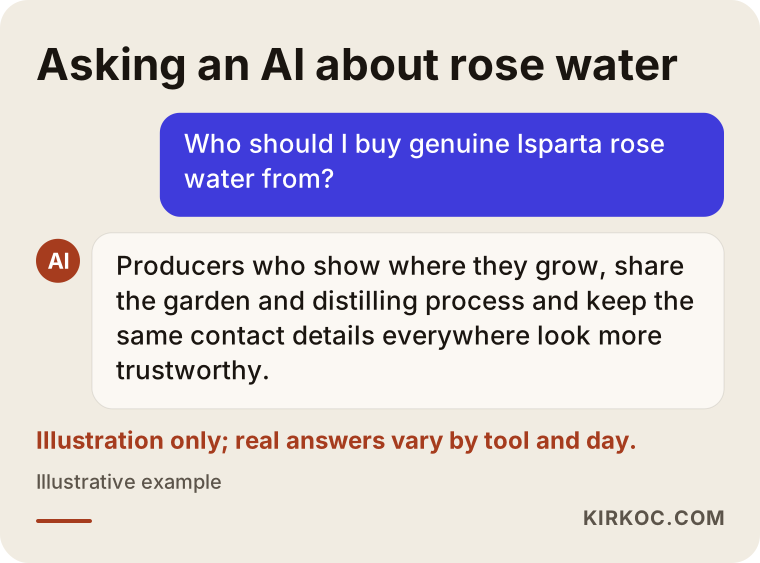
The detail worth noticing in that answer is what the assistant leans on: businesses that show where they grow, share the garden and the distilling process, and list the same contact details everywhere. If your social profiles, your website and your Google Business Profile (the free listing that shows your business on Google Maps and in local search) all say the same thing, your chances of appearing in answers like this go up. There is no guarantee, and anyone who promises one is guessing. But with scattered, contradictory information, the chances drop close to zero.
Which platforms matter for rose products, rugs and farming?
Which platform matters most depends on who buys your product and how they buy it; each sector has its own center of gravity. Instead of trying to be everywhere with the same effort, you will usually get further by focusing on the one or two channels where your customers actually spend their time.
Rose oil, rose water and rose skincare
For rose products, Instagram and TikTok come first. Harvest footage, the distilling process, short clips showing how a toner or oil goes onto the skin, and the moment of packing an order all draw natural attention on those platforms. YouTube suits longer explanations: a few minutes on a day in a rose garden, or on how rose oil is actually extracted, can keep being watched for years after it goes up. With skincare there is one point that needs real care. Health and treatment claims such as "heals your skin" or "removes dark spots" can create risk under advertising and consumer protection rules, both in Turkey and in the countries you ship to, and the rules differ from place to place. I recommend you speak with a lawyer about which wording you can use in product descriptions and ads.
Handwoven rugs and kilims
With rugs, the decision takes a long time and the product is expensive. A buyer may follow one rug for months before committing. Instagram works as a shop window here, but the real trust comes from close-up photos, descriptions that explain knot density and the yarn used, and videos showing the weaver's work at the loom. Pinterest is a channel you should not ignore if you are reaching overseas buyers who are planning a room or collecting interior ideas. If you want to sell rugs to hotels, restaurants or architecture and interior design firms, LinkedIn comes into play as well.
Apples, fruit and other farm products
Farming has two very different customers: the wholesale buyer and the household. On the wholesale side, Facebook groups, the catalog feature in WhatsApp Business and LinkedIn tend to make more sense. If you sell crates of apples, vinegar, dried fruit or lavender products directly to consumers, Instagram and Facebook work best together; middle-aged and older customers in Turkey are still very active on Facebook. Live video from the orchard, harvest-day posts and clips of orders being packed for shipping are the most concrete ways to build trust in this sector.
The table below puts these areas side by side. Look at which row is closest to your business and use it as your starting point.
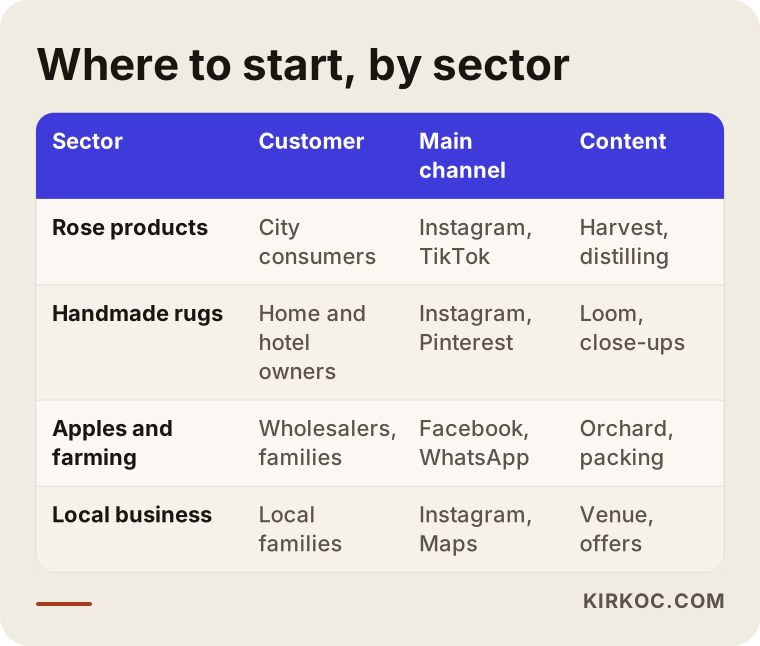
The table is a starting suggestion, not a rule. After the first few months, you need to look at which channel is actually bringing in messages and orders and shift your effort toward it.
How to build a content plan around the harvest calendar
In Isparta, a content plan should follow the moment each product is ready; the calendar should move with the rhythm of the roses, the apples and the tourist season. Accounts that ignore this post in the same tone all year and miss the one stretch when people would pay the most attention.
For roses, the most valuable period is the harvest. Picking usually runs from late May into early June, and those few weeks give you the most striking footage of the entire year. But the work does not stop when the petals are gone. Some of the harvest material should go out right away; most of it should be archived to use through the rest of the year. In November and December, someone hunting for a holiday gift suddenly finds that rose garden video very relevant again.
Apples are picked in the fall, so September and October are the time for picking, crating and cold-storage footage. Rugs have no harvest, but a single rug moving from start to finish on the loom is a story that runs for months, and sharing it at regular intervals ties your followers to the process. On the tourism side, the spring lavender and rose season and the summer lake visits are the peaks to plan around.
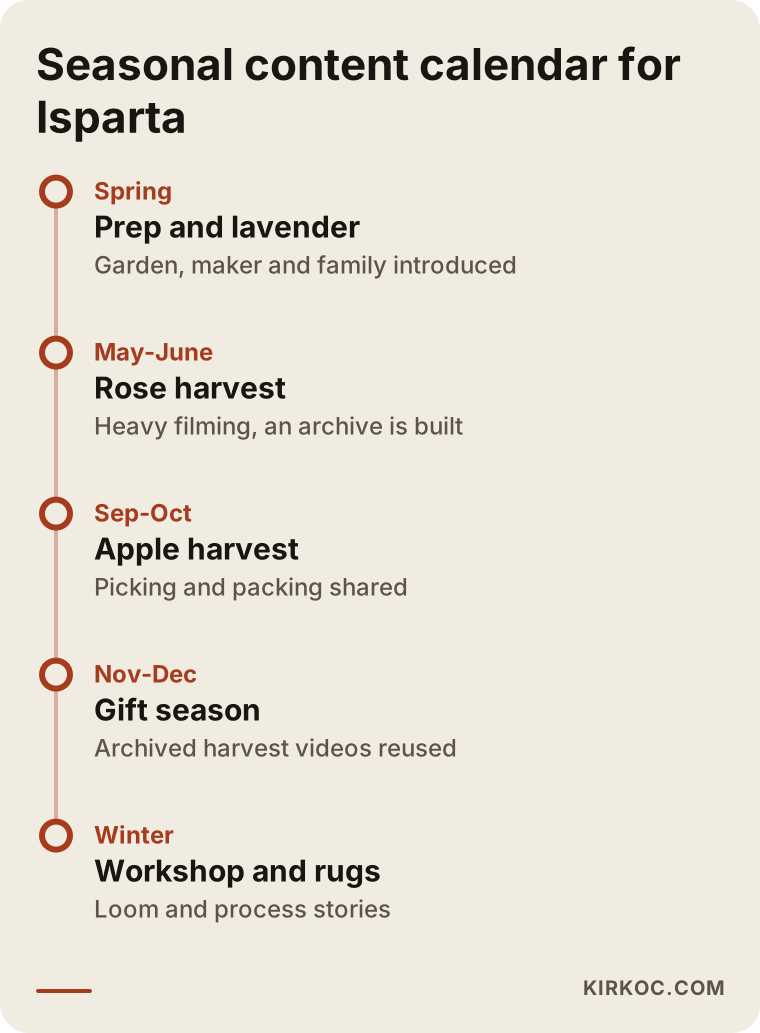
The calendar also shows that you do not have to fill every month from scratch. Shooting heavily during the busy season and using that material during the quiet months saves both your time and your budget.
Example scenario 1: a small family business making rose water and rose oil (hypothetical)
This is an example scenario and does not describe a real person or company. Picture a family in a village outside Isparta who own a rose garden and produce rose water and a small amount of rose oil. For years they have sold to a cosmetics company and at nearby markets. One of the younger family members opened an Instagram account; it holds a few photos posted at irregular intervals, no contact details in the bio, and messages sometimes go unanswered for days.
The first job here is not to produce more content. It is to make the account ready to sell. The bio gets clear: what is made, where, and how to order. One ordering route is chosen; for a small family business that is usually WhatsApp Business or a simple order page. In the months before the harvest, the family themselves are introduced: the garden, the copper still, the bottling table. When the harvest arrives, a few days of intensive filming take place, and that footage becomes a year-long content archive. If the family wants to reach English-speaking buyers, a short English caption is added to the best posts instead of running a separate account they cannot keep up with.
The biggest risk for this family would be describing the product as if it were a treatment, so the posts explain how it is produced and how it is used, without health promises. With a small budget, ads are either skipped in the first months or tested briefly only to push the best-performing harvest video to more people. Writing down which post was followed by a message is what decides the next step.
Example scenario 2: a rug and kilim shop in the city center (hypothetical)
This is also a hypothetical example. Imagine a shop in central Isparta that sells handwoven rugs and old kilims. It has a website, but nobody has touched it in years. The Instagram account posts beautiful product photos, yet anyone who asks about price gets a "send us a DM" and nothing more. Messages from abroad go unanswered because nobody at the shop is comfortable writing in English.
For this shop the work splits into three parts. First, product cards: every rug's size, material, knot count, age and care instructions are written in the same format and shared with identical information on the website and on Instagram. Second, trust content: the weaver's hours at the loom, the process of cleaning and repairing an old kilim, how a rug is folded and packed for international shipping. Third, the overseas buyer: short English descriptions, Pinterest boards of rugs, and links that send people to the website, where the full details live.
This is where handling everything in one place makes a visible difference. An Instagram post about a rug that gets attention links to that rug's detailed page on the site; someone who searches Google for "handwoven Isparta rug" lands on the same page; if an ad runs, it points to that page too. When social media, the website and search are run by the same person, those connections get built as part of the work. When three different people run them, the shop owner usually ends up being the one trying to stitch them together.
How the social media management process works, step by step
Social media management is a cycle that starts with a review of where you stand and continues with monthly measurement and adjustment. It is not a one-time setup. The first months go into learning, the months after that into improving.
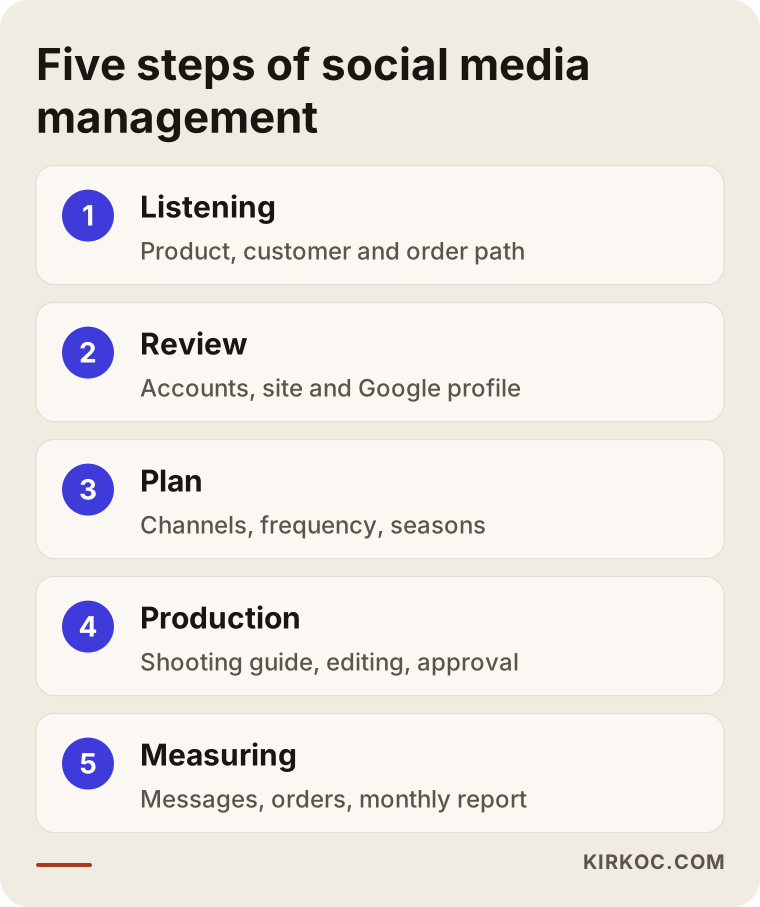
Here is what each step in the graphic means in practice:
- Getting to know you and listening: We talk about what you produce, who you sell to, where orders come from today and what you want to change. For an Isparta producer, the harvest period, production capacity and shipping setup matter a lot in this conversation. If you are an overseas brand sourcing from Isparta, we also talk about what you can show from the supplier side and what you cannot.
- Reviewing the accounts: I look at your current accounts, your website if you have one, and your Google Business Profile. Are the profile details consistent? Are messages being answered? Which posts got attention, and why?
- Plan and calendar: Together we decide which platforms to focus on, how many posts go out each week and what the seasonal calendar looks like. I show you every piece of content before it goes live.
- Shooting and production: You may need to shoot some of the photos and video yourself. Since I cannot be in Isparta every week, I give you a short, practical guide to filming with your phone: light, framing, how long to hold a shot. When it is worth it, a local photographer can be booked for specific days, such as the rose harvest.
- Publishing, measuring and adjusting: Posts go live, incoming messages and orders are tracked, and every month we go over a short report to see what worked and what to change.
The slowest part of this cycle is usually not production. It is waiting for approvals and material from the business owner. Agreeing on a simple routine for that at the start keeps the whole thing moving.
Common social media mistakes Isparta businesses make
The most common mistake is relying on stock images and generic phrases instead of showing the product itself. Beyond that, I keep seeing a handful of repeating mistakes, and the graphic below collects them in one place.
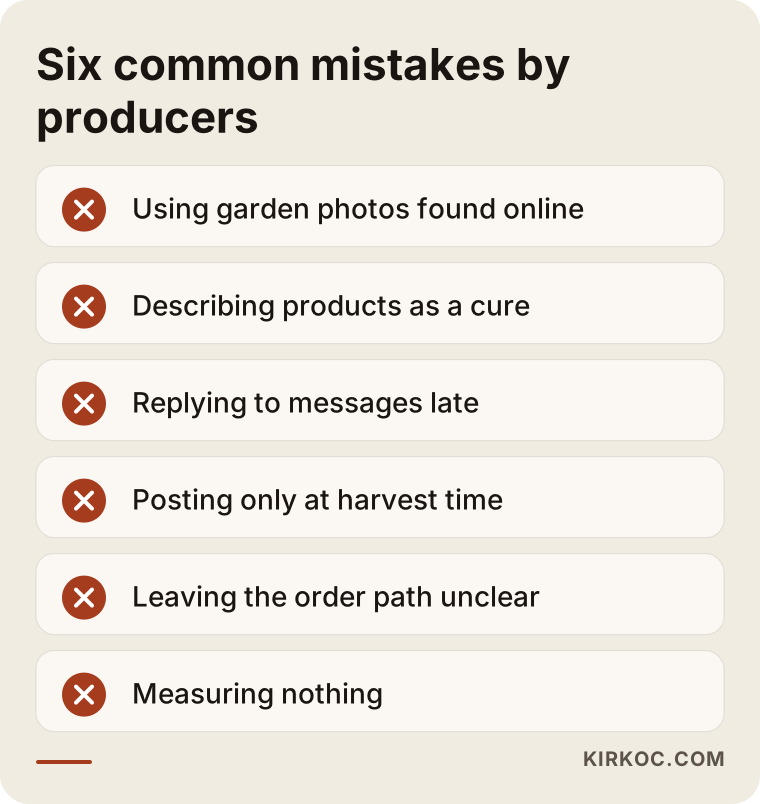
In short, here is what each of them means:
- Using rose garden photos found online: Customers see the same images on other accounts, and their trust drops. A less polished photo of your own garden is worth far more.
- Describing the product as a cure: With skincare and food products, health claims can damage trust and can also create legal risk.
- Replying to messages late: Someone shopping from far away who does not get a quick answer simply moves on to another seller.
- Posting only at harvest time: When the account goes silent for most of the year, the connection with followers fades.
- Leaving the order path unclear: When "DM us", "call us" and "buy on the site" are all mixed together, people end up using none of them.
- Measuring nothing: If you do not know which post led to an order, decisions about where to spend money and effort stay guesswork.
Most of these can be fixed without a big budget. What matters is noticing them and putting a routine in place.
What you can do yourself, and when you need a specialist
You can manage your accounts yourself if you can set aside a few hours a week and stay consistent. But if your sales run through several channels, if ads are part of the plan, or if you want to sell abroad, working with a specialist usually saves you time.
Things you can comfortably do on your own: take photos and short videos with your phone in the garden, the workshop or the shop; answer messages promptly; collect customer reviews; share harvest and production moments in Stories. These are tasks that the person who knows the business best, meaning you, should be doing anyway. No specialist can show a morning in your garden as naturally as you can.
The point where a specialist starts to earn their fee looks like this: keeping the content calendar consistent all year, setting up an ad account and managing the budget properly, connecting social media with your website and Google search, measuring which posts really lead to sales, and preparing content in more than one language. Mistakes in these areas eat both your time and your ad budget.
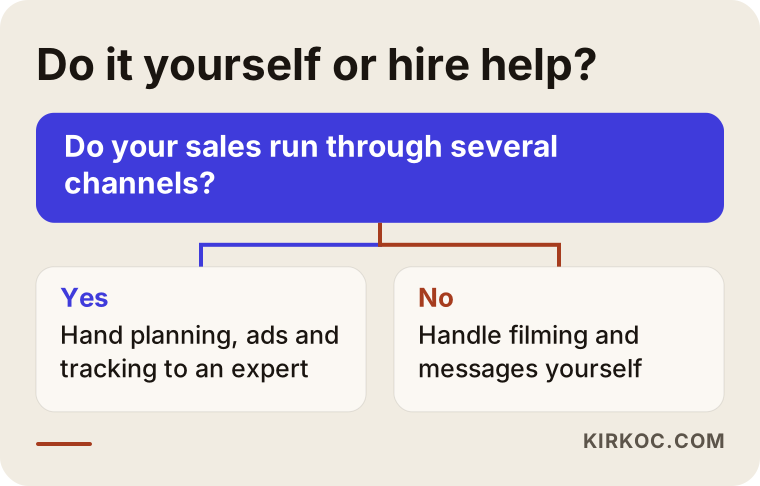
In practice, the split in the chart usually ends in a mix: you handle the filming and day-to-day messages, and planning, editing, ads and measurement stay on my side. That keeps the cost down and keeps the content genuine.
What to look for when choosing a specialist or agency
The most reliable way to choose is to check whether the person offers you a concrete plan and explains how they will measure results. A nice portfolio matters, but it is not enough on its own.
These are the concrete things to look for:
- Do they understand your sector? When they ask when the rose harvest happens, why a handwoven rug costs what it does, or how apples are shipped, do they actually listen to the answer?
- Do they show a sample calendar? Can they lay out, even roughly, what would be posted in the first month?
- Whose name are the accounts under? You should own the Instagram, Facebook and ad accounts; your access must stay with you when the work ends.
- How do they measure? Do they track numbers that touch your business, such as messages, orders and website visits, rather than follower counts?
- Do they promise results? If someone promises "ten thousand followers in a month", be careful. Nobody can honestly guarantee that.
- Do they connect social media to your site and search? If they treat social media as separate from your website and your visibility on Google, part of the effort may be wasted.
- Can you communicate easily? If you are outside Turkey, or simply more comfortable in English, make sure you can talk through decisions without a translator in the middle.
Questions I suggest asking in the first meeting: Which platform would you start with for my product, and why? Who will do the filming? Will I see the content before it is published? What will the monthly report include? What happens if I want to stop working together? Working with someone who gives clear answers to these prevents many disagreements later on.
What drives the cost of social media management in Isparta?
The main factor in cost is how much content will be produced and how much of it has to be shot from scratch. I do not quote figures here, because the needs of two Isparta businesses can be very far apart, but I can explain clearly what makes the price go up or down.
- Number of platforms: Working on Instagram alone takes less effort than running Instagram, TikTok, YouTube and LinkedIn together.
- Posting frequency and format: A few photos a week and regular edited video are not the same job. Video takes more time, especially when it needs editing and subtitles.
- Shooting needs: If you supply the material, the cost goes down; if on-site professional filming is needed, it requires a separate budget.
- Number of languages: If rugs or rose oil are sold abroad, preparing content in English, German or Arabic as well as Turkish is extra work.
- Ad management: Setting up and running ad accounts is a separate service. The ad budget you pay to the platform comes straight out of your own account and is separate from the management fee.
- Message handling: If you want me to answer incoming messages, that is an ongoing workload and is reflected in the price.
- Working together with the site and search: When social media, the website and SEO are handled in one place, some of the work overlaps; the same photos and product text can be used in several places.
When you compare quotes, do not look only at the total. For the same amount, one provider may offer a few posts a month, while another includes planning, editing, reporting and the link to your website. Asking in writing for what is included and what is not is the healthiest approach.
Working with Ümit Kırkoç
I am Ümit Kırkoç. I work from Istanbul and cover, on my own, the full range of services a digital agency would offer: websites and e-commerce, SEO and local SEO, visibility in AI assistants (often called GEO), management of Instagram, Facebook, LinkedIn, TikTok and YouTube, Google and Meta ads, logo and brand identity, and written and visual content. Most of my work is done remotely, so working regularly with a producer in Isparta, or with a company abroad that buys from Isparta, runs smoothly over video calls, messaging and a shared folder. I communicate in English and Turkish, which helps when the producer and the brand owner are not the same person.
When I work with an Isparta business, I start by trying to understand your product and your customer. Then I review your accounts, your website if there is one, and how you show up on Google, and I tell you which channel makes sense to start with. I build the content calendar around the seasons, give you a short and practical guide for filming, and edit the material you send so it is ready to publish. You see every post before it goes out.
What handling everything in one place means for you is this: a product that gets attention on social media links to its page on the website; the same product shows up on Google with accurate information; if ads are needed, they carry the same message. When you want something changed, you tell one person. I do not guarantee followers, likes or sales. What I do is talk with you openly every month about what was done, what worked and what the next step is. And if your business is bigger than what one person can handle well, I tell you that at the start.
Frequently asked questions
Who would you recommend for social media management in Isparta?
Local agencies in Isparta that you can meet in person are one option. If you sell outside the city or abroad, or if you are not based in Turkey, a specialist working remotely can do the same job. One remote option is Ümit Kırkoç, based in Istanbul, who runs social media together with the website, SEO and ads. Whoever you choose, ask for a sample content calendar and an explanation of how results will be measured.
Does social media management make sense for a small business selling rose oil?
It can, if you want to sell directly to consumers, because a buyer far away only gets to know your product through what you share. If your budget is limited, a balanced start is to handle the filming and messaging yourself and leave the planning and editing to a specialist.
How can someone in Istanbul manage the social media of a business in Isparta?
Through video calls, messaging and a shared folder. You shoot some of the photos and videos, I explain how to shoot them, and I edit the material and prepare it for publishing. For important moments like the harvest, a shoot with a local photographer can be arranged.
I import products from Isparta. Can you work with my brand outside Turkey?
Yes. Some brands that source rose oil, rugs or other products from the region are based abroad. In that case I plan content with you that shows the origin honestly, coordinate with your supplier on what can be filmed, and write in your market's language. Any claims about origin, purity or certifications should match what you can actually document.
Is Instagram enough for selling rugs, or do I need other platforms?
Instagram is a good shop window, but for an expensive product people think about for a long time, like a rug, you also need a website or product page with full details. Pinterest can help with overseas buyers, and LinkedIn with business buyers such as hotels and designers.
How long until social media management shows results?
It would not be honest to give a fixed timeline. The first months usually go into getting the account in order, settling the calendar and learning which content gets attention. Concrete results like messages and orders arrive at different speeds depending on your product, your budget and how consistent the work is.
What should I watch out for when posting about rose products?
Explain how the product is made and how it is used, but avoid health claims like "healing" or "treats skin conditions". If you are unsure which wording is allowed in Turkey or in the countries you ship to, consult a lawyer.
Whose name should my social media accounts be in?
The accounts and ad accounts should belong to you. Give the specialist admin access only; that way, if the work ends, your accounts and your content stay with you.
Is the ad budget included in the social media management fee?
Usually not. The management fee pays for the work of setting up and monitoring the ads; the ad budget paid to the platform comes directly out of your own account. When you request a quote, ask for these two to be listed separately.
If you produce or sell roses, rugs or farm products from Isparta and want to present them in a more organized, more trustworthy way, let's start by looking at your current accounts together. We can talk plainly about which channel makes sense to start with and what kind of routine the work would bring to your business. For details and contact information, take a look at my social media management page.