You run a furniture workshop, a factory, or a production plant in one of Kayseri's industrial zones. Your product is good, your workmanship is solid, and perhaps you have been taking orders for years. But when you type "Kayseri furniture manufacturer" or "Kayseri metal machining" into your phone, your own website is nowhere to be seen, and companies you have never heard of are. That is exactly where a search like "Kayseri SEO services" begins. In this article I explain what a furniture or industrial business in Kayseri should expect from SEO, which pages it needs, and where to start. I am Ümit Kırkoç. I work from Istanbul and handle websites, SEO, social media, and advertising myself, and I will describe the scope of my own SEO services openly where it matters.
A quick note on who this is for. Maybe you are a Kayseri company that sells across Turkey or exports. Maybe you are a foreign business that makes or buys furniture and industrial parts in Kayseri and needs to be found by Turkish customers or partners. The ideas below apply to both, and I point out the differences where they appear.
SEO, in short, is the work that makes your website show up on Google when your customers search. You do not pay for each click the way you do with ads, and a well-built setup can bring in inquiries for months or even years. But it does not happen by itself, and it is not built the same way in every sector. Even furniture and industry work very differently: one sells mostly to individual and commercial buyers, the other sells to other companies. Seeing that difference at the start helps you set the right budget and the right expectations.
How do people search for furniture and industrial products in Kayseri?
Kayseri is known for its furniture and its industry. That creates a two-sided situation. On one side, because the city's name is tied to the sector, buyers from all over the country search for "Kayseri furniture." On the other side, local competition is heavy: dozens of companies doing similar work sit on the same street or in the same industrial estate. So it is an opportunity and a crowd at the same time.
It helps to split searchers into three groups. The first group is wholesalers, store owners, and project contractors from outside the city. These people are looking for a manufacturer, and they tend to type phrases like "Kayseri furniture manufacturer" or "Kayseri sofa set wholesale." Some of them search in English, especially importers and buyers abroad. The second group is individual buyers inside Kayseri who want something for their own home or office. They use district and neighborhood names, such as "bedroom set Melikgazi" or "furniture store Talas." The third group is industrial buyers who need a machined part, a mold, packaging, or a similar service. They prefer technical but very clear phrases such as "Kayseri OSB CNC machining" or "Kayseri sheet metal processing." (OSB is the Turkish abbreviation for an organized industrial zone.)
Expecting these three groups to look at the same page is a mistake. If you show a wholesaler a retail showcase, you lose them. If you show a home buyer a technical specification, you lose them too. The image below uses an invented example to show which page can stand out in a search and why.
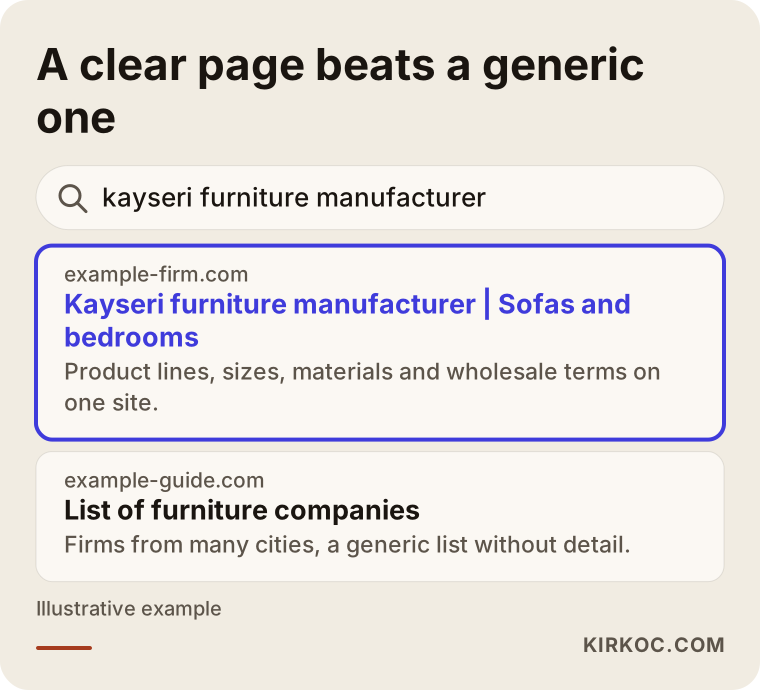
Look at what the highlighted result does. In its first line it says what it makes, where it makes it, and who it sells to. A generic line like "quality and reliable furniture" does none of that. Google tries to work out which page to show the person searching. When you make that easy, it becomes easier for Google to put you forward.
Four kinds of search, four different needs
For a business in Kayseri, it is useful to sort searches into four types: product searches, wholesale and manufacturer searches, local area searches, and map searches. The intent behind each one is different, and each one needs a different page. I have summarized this in the table below.
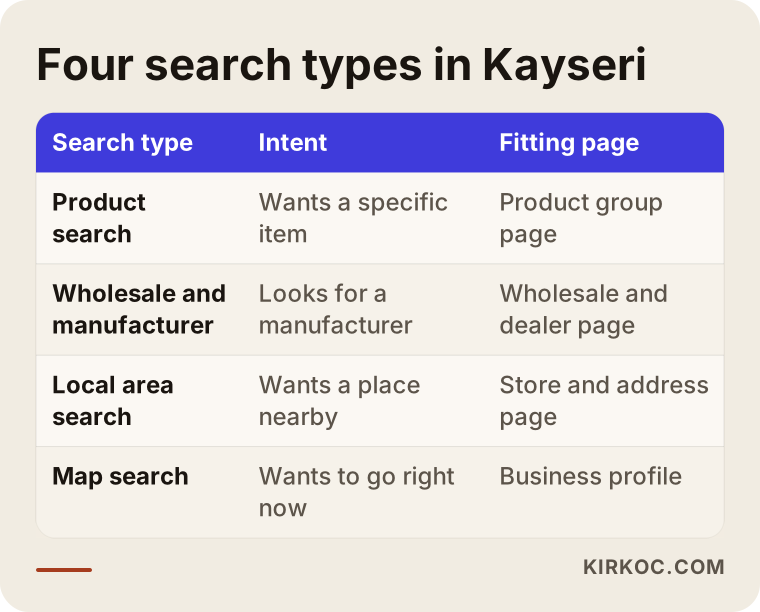
The conclusion from the table is this: trying to answer all four types with a single home page means being weak in all four. You do not need a page for every intent, but the intents that bring in the most money should each have their own page.
Which pages do furniture companies need?
Furniture is a visual business. A buyer looks at the photo first, then the dimensions, then the materials, and only at the end contacts you. That is why furniture SEO means backing up beautiful photos with written information. Google cannot tell by itself that the sofa in your photo has walnut legs. If you write it down, it understands.
For a furniture manufacturer, the core pages are these. First, a separate page for each product group: sofa sets, bedrooms, dining rooms, office furniture, and so on. Each page should state the product's dimensions, the fabric and frame material, color options, lead time, and how to order. Second, a wholesale and dealership page: minimum order, shipping regions, how to request a catalog, and contact details. If you export, say which countries you ship to and in which languages you can communicate. Third, a factory and production page: where your workshop is, how you build, and how you check quality. This page builds trust and also answers searches that include the word "manufacturer." Fourth, a projects page: if you have worked on hotels, offices, or housing developments, show the jobs you have permission to show, with photos and short notes.
If you also have a store, the address, opening hours, parking, and directions should live on a separate page. Your map profile, meaning your business listing on Google Maps, should carry exactly the same information as that page. When the details do not match, both the customer and Google get confused.
What industrial companies need
In industry, the buyer is usually a purchasing manager or an engineer. This person wants clear information more than good design: which materials you work with, what tolerance you can hold, which certificates you have, what the minimum order is, and how quickly you reply with a quote. I would not expect an industrial website to bring in quote requests if it does not answer these questions, no matter how good it looks.
The core pages for industry are: a separate page for each main service (for example machining, sheet metal work, mold making, packaging production), an equipment list page, pages by sector (automotive, white goods, construction, or whichever sectors you serve), a quality and certificates page, and an easy quote form. When you write about certificates, mention only the ones you really hold. If you are unsure, ask your own quality manager or your certification body.
The image below shows one order in which a service page for a manufacturing company can be built.
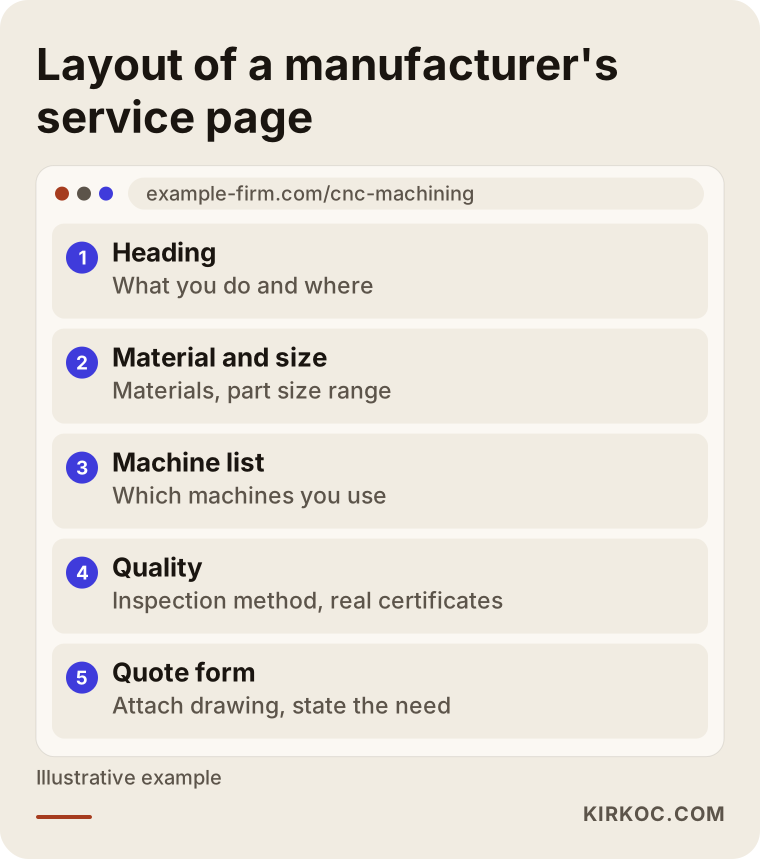
The order matters: first what you do, then who you do it for, then how you work, and last what to do to get a quote. If the reader cannot find the answer at the top of the page, they often leave without scrolling.
Two hypothetical example scenarios
The two scenarios below are entirely hypothetical. They do not describe a real company or person. Their purpose is to show how to think through a situation.
Scenario 1: A sofa workshop in Kayseri
Imagine a ten-person workshop in Kayseri that makes sofa sets. The owner has sold through dealers and acquaintances for years. A website was built a few years ago, but it has only a home page, a few photos, and a phone number. There are no product pages, no dimensions, and no wholesale page.
The workshop's first job would be writing separate pages for its three best-selling product groups. Each page would carry dimensions, frame material, fabric options, and lead time. The second job is a dealership and wholesale page: who can apply, which regions are served, and how to ask for a catalog. The third job is tidying the map profile with the right address and hours. The fourth job is naming and describing the workshop's own photos properly on the site. After five or six months, the workshop might become more visible for searches like "Kayseri sofa manufacturer." But nobody can guarantee that. What the competitors do, how old the site is, and how good the content is all affect the result.
Scenario 2: A machining company in an industrial zone
The second hypothetical example is a mid-sized company that does CNC machining in an organized industrial zone. Its website is corporate and stylish, but it has no service pages. Under the heading "Our Services" sits a three-line paragraph. A purchasing manager who wants a quote cannot see which materials the company works with or what part sizes are possible.
The fix for this company is not a general blog post. It is technical pages: "CNC turning," "CNC milling," "stainless steel machining," each on its own page, and each listing the materials, the range of part sizes, the tolerances (the amount of measurement deviation accepted in production), the inspection method, and the information needed for a quote. Add an equipment list page and a "send your drawing, get a quote" form. When the company does this, it gets a chance to match technical searches on Google, and the quote requests it receives become more qualified, because the form asks for the necessary details up front.
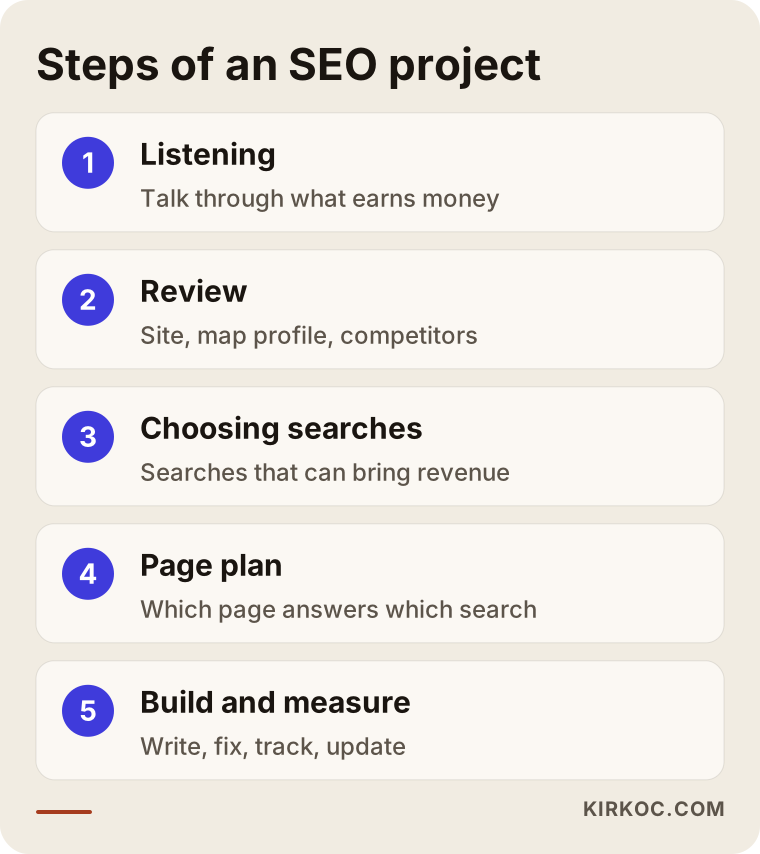
The image below shows the order of work that both scenarios share.
Step by step: how I work
When I start with a business, I usually set the order like this. The first step is talking and listening. We discuss which product or service earns you the most, which customer you do not want to lose, and how much work your site brings in today. The second step is reviewing the current situation: how fast your site opens, how it looks on a phone, which pages exist, what state your map profile is in, and what competitors are doing.
The third step is deciding which searches to target. Instead of chasing a very broad word like "furniture," I choose searches that you can actually deliver on and that will bring in revenue. The fourth step is the page plan: which page answers which search, which pages need to be written new, and which need fixing. The fifth step is execution: writing pages, adjusting titles and descriptions, preparing images, and making the site's technical fixes. The sixth step is measurement and correction: I track which pages get visits and how many people call or fill out the form, and the plan is updated accordingly.
The most important feature of this work is that it needs patience. New pages do not produce results right away. It takes time for Google to find your pages, trust them, and rank them. I have to say this plainly, because someone who promises "first page in two weeks" is either not serious or is talking about a very narrow and easy phrase.
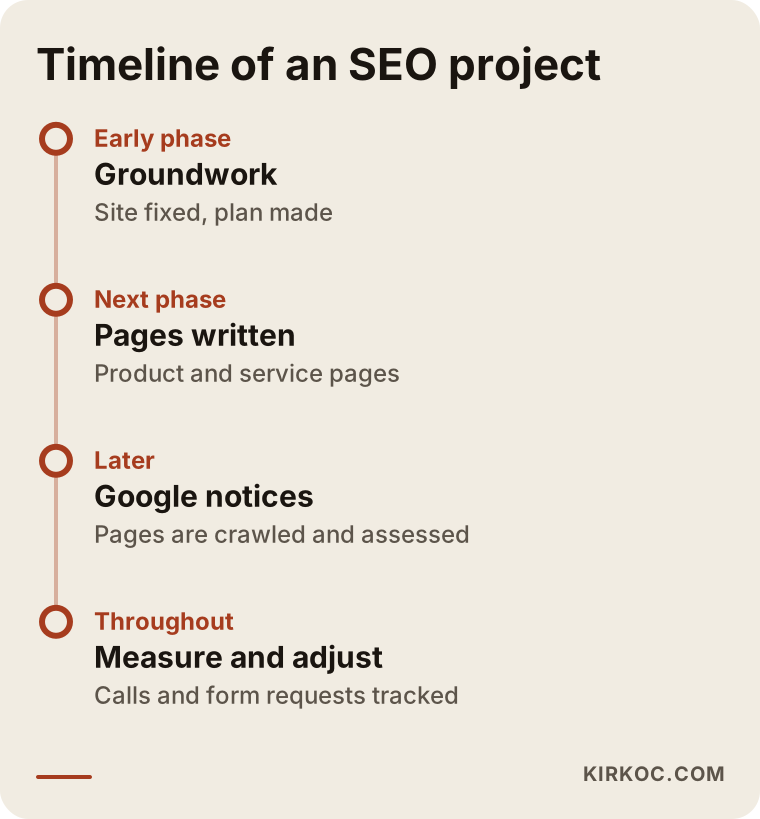
The point to notice in the timeline is that what you see in the first months is not rankings but groundwork. First the site is fixed, then pages are written, then Google recognizes them, and only at the end do you expect more visitors and inquiries.
Common mistakes in furniture and industry
Let me list the mistakes I see most often in these two sectors. The first is cramming everything onto one home page. When sofas, bedrooms, office furniture, wholesale, and factory information all sit on a single page, none of them gets a proper answer. The second is leaving only photos on product pages and not writing dimensions, materials, and lead times. The third is putting catalog images in as a PDF and writing no text; the information inside a PDF is often not understood as well as page text.
The fourth is repeating the same text across several pages. For example, opening ten pages for "Kayseri furniture" and putting nearly the same article on all of them does not tell Google which page matters, and the pages weaken one another. The fifth is neglecting loading speed and appearance on phones. A large share of searches today happen on a phone, and a furniture site full of heavy images that loads slowly on mobile makes visitors leave before it opens. The sixth is leaving the map profile empty: no category chosen, opening hours missing, no photos.
The seventh, in industry, is a quote form that is hard to use. Nobody fills out a twenty-field form, but a form with no questions at all brings you requests with no useful detail. You need to find the balance: the need, the quantity, the material, the delivery date, and contact details are often enough. An eighth mistake, for companies that sell abroad, is having only a Turkish site or only a machine-translated English one. A buyer in another country needs the same specifics, written in clear English, with shipping terms and contact details.
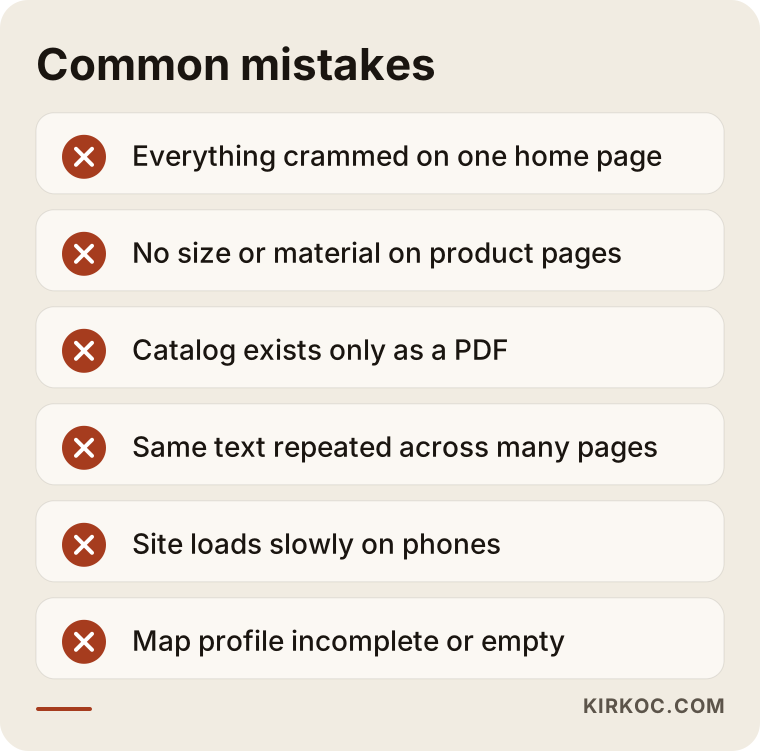
Most of the mistakes on this list can be fixed without an expensive tool or a large budget. Pages come first, then texts, then technical fixes.
What can you do yourself, and when do you need an expert?
You do not have to hand everything to a specialist. There are things you can do on your own, and doing them lowers the cost and also speeds things up if you work with me.
Here is what you can do yourself: claim your Google business listing (your map profile), enter your address, phone number, and opening hours correctly, and add photos regularly. Write down the real dimensions, materials, and lead times of your products in one document. Ask your customers for reviews, with their permission. Take your own photos and give the files meaningful names. Note the questions customers ask most often; those questions are very valuable for the content of your pages.
The jobs that need expert help are the following: the technical structure of the site (loading speed, mobile layout, page structure), the planning that decides which page is written for which search, competitor analysis, building a multi-page site structure, setting up measurement, and writing content in a way that suits search. Getting these wrong can send your site in the wrong direction for months.
The image below is a short list of first jobs you can do yourself.
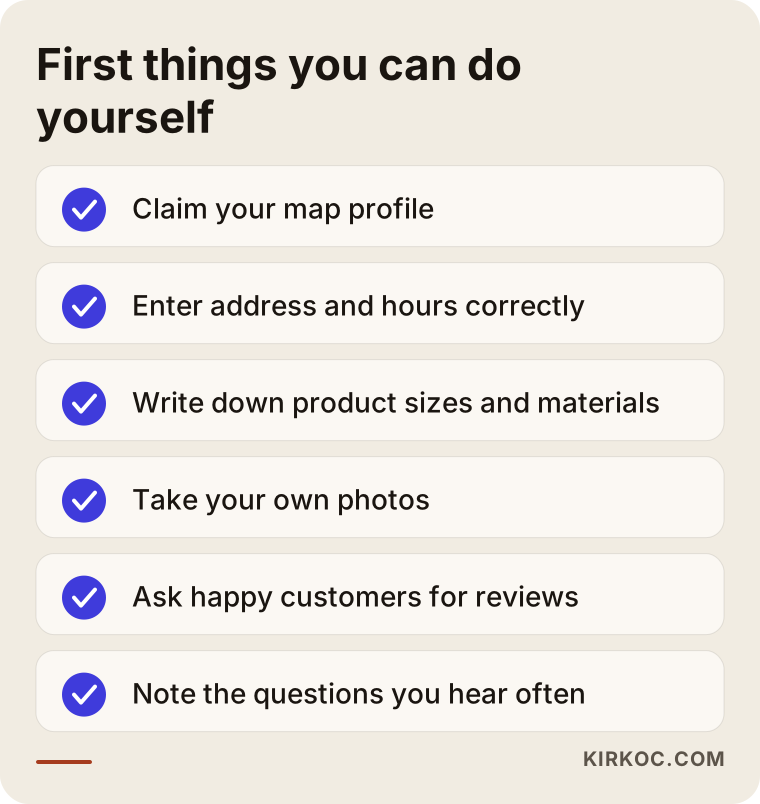
Once you complete this list, your starting point is already stronger. If you later decide to work with a specialist, the job will also take less time.
When does it make sense to ask for help?
If your site has not been updated for years, does not open properly on a phone, has no product pages, or your competitors keep appearing ahead of you, getting help makes sense. But first ask yourself: how many inquiries does my site bring me per month right now, and how valuable would it be to raise that number? If the answer is "none" and you want the business to grow, this investment is worth considering. If the answer is "my capacity is already full," putting SEO off for later is also an honest choice.
How do SEO and ads, website and social media work together?
Furniture and industrial companies often think of SEO on its own. But these things are connected. SEO builds up slowly over months, while a Google ad gives you immediate visibility as far as your budget allows. If you have launched a new product line or have a seasonal campaign, ads can bring your first inquiries while the permanent pages are being built. Social media, especially for furniture, is where product photos and finished project images meet people, and a post on Instagram can send someone to the product page on your site.
Problems appear when these pieces sit with different people. The person who built the site does not know SEO, the ad manager cannot see the state of the site, and the person running social media does not know which product should be pushed. Because I handle all of these myself, the same product photo, the same message, and the same page plan can be used across all of them. In practical terms for you, it means you talk to one person, one person reviews the results with you, and the parts do not contradict each other. Still, every business needs something different, so you do not have to buy everything; choosing only what works is entirely possible.
Local search and map visibility
For furniture businesses in Kayseri that have a store or showroom, map searches matter a lot. A person who types "furniture store near me" or "Melikgazi furniture" looks at the first three to five businesses on the map. What helps you here: your listing in the right category, an address and phone number identical to those on your site, current opening hours, real photos, and reviews that customers leave of their own free will.
Be careful with reviews. Paying for fake reviews is unethical and can get your listing suspended. Politely asking a satisfied customer, "Would you share your experience?" is enough and it is safe. When a negative review comes in, a calm and clear reply leaves a good impression on a potential buyer.
For industrial companies, map searches matter less, because the buyer usually does not visit you but asks for a quote. Even so, a correct listing helps anyone who wants to phone you and shows that the company exists at a real address.
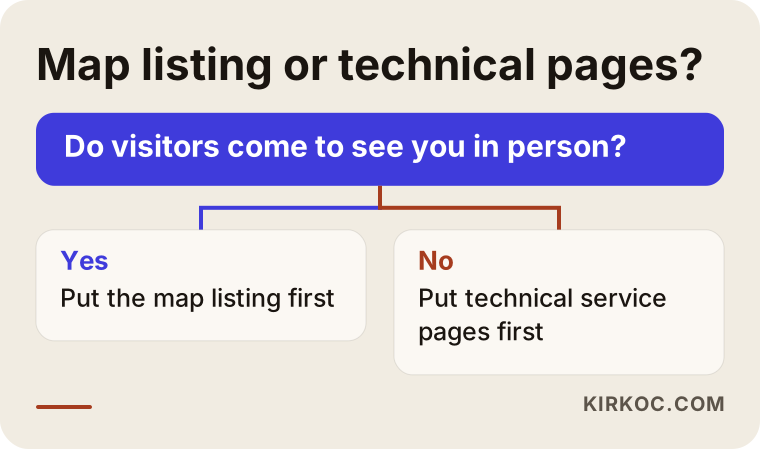
The decision flow is simple: if you expect physical visitors, the map listing comes first; if you do not, the technical pages come first.
AI answers and your pages
Today some people ask an AI tool such as ChatGPT instead of Google when they look for something. Questions like "How do I choose a good furniture manufacturer in Kayseri?" get answers from these tools, and sometimes they cite sources. That makes it even more important for your site to be clear and accurate. AI tools are less inclined to use vague or exaggerated text as a source, while pages that state dimensions, materials, process, and contact details clearly are easier for them to understand.
There is no separate magic method for this. The same basics apply: clear pages, accurate information, a tidy structure, and answers to frequently asked questions. This work is called GEO, and I also work on it. Even so, I do not guarantee that any tool will put you forward. I only build a solid base that raises your chance of being found.
What determines the cost?
I will not give a number in this article, because the real figure depends on the job and I do not want to mislead you. But I can explain what it depends on.
First, the current state of the site: do you need a new site from scratch, or will the existing one be fixed? Second, the number of pages: writing pages for three product groups is not the same job as writing them for thirty. Third, the level of competition: a narrow, clear search takes a different amount of effort than a broad one. Fourth, content: will you take the product photos, will I direct you, or do you need a professional shoot? Fifth, duration: SEO is not a one-time job but a process, and how long you want support affects the cost. Sixth, extra services: whether you also want ads, social media, a logo, or corporate identity work from me.
When you receive a quote, always ask exactly what it covers and what it leaves out. If a phrase like "monthly SEO" does not say what will be done, be careful. A good quote states which pages will be written, which technical fixes will be made, and when reports will arrive.
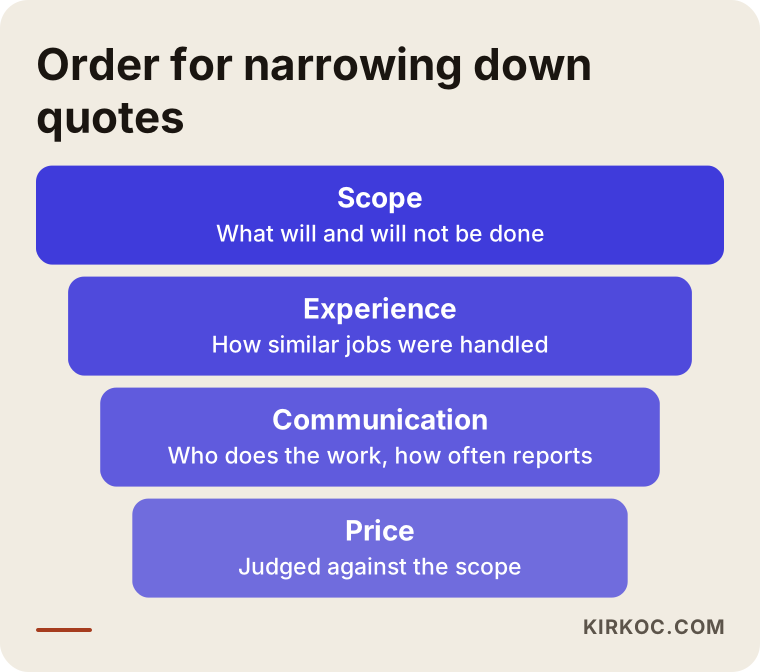
This funnel summarizes how you narrow a wide field of offers down to the one that really fits: scope first, then experience, then communication, and price last.
How I work with you
I work alone, and I see that as an advantage. The person you talk to is the person who does the work; no salesperson or project manager stands in between. At the start I talk with you about your business, your products, and your goals. Then I review your situation and tell you plainly what you need and what you do not. I do not try to sell an unnecessary job; if something is not needed, I say so.
Once we begin, I share a clear plan of what will be done and when. During the work I will need information, photos, and approvals from you. That is your most important input, because you know your product best. I work from Istanbul, but most of the work happens remotely, and meetings can take place by phone or video. For a company in Kayseri, or for a foreign company with a Kayseri connection, that is not an obstacle.
Because I handle websites, SEO, local SEO, GEO, social media, Google and Meta ads, logo and corporate identity, and content production myself, I can plan one job without colliding with another. We can start with SEO only and add the others if the need arises.
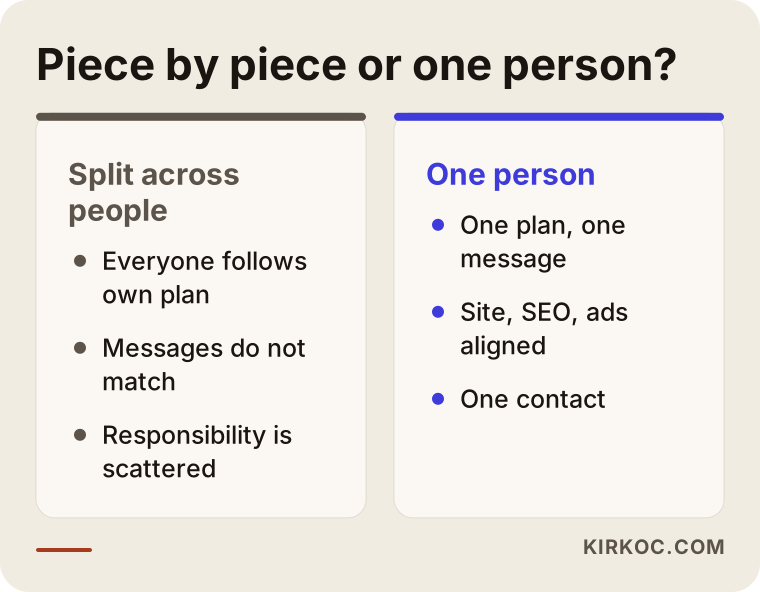
The difference in the comparison may look small, but in practice it is large: when the work is handled by one person, the message, the photos, and the page plan move in the same direction, while with separate people each one follows their own idea of what is right.
Frequently asked questions
How long does it take to see SEO results in Kayseri?
I cannot give an exact time, because it depends on the age of the site, the strength of competitors, and the search you are targeting. In general, the first months are for building the foundation, and growth in inquiries usually shows up after pages are written and Google has recognized them. Be wary of anyone who guarantees results or rankings.
I am a furniture manufacturer. Can SEO also work for wholesale?
Yes, but you need a wholesale and dealership page separate from the pages aimed at individual buyers. That page should include the minimum order, shipping regions, catalog requests, and contact details. Wholesalers and individual buyers search with different words.
Is a blog necessary for my industrial company?
It is not necessary. In industry, the first priority is that service and product pages are technical and clear. Blog posts are useful if they answer questions customers ask often, but writing posts while the main pages are missing is the wrong order.
Will I get customers only from Kayseri, or from all over Turkey?
That depends on which pages and searches you target. If you sell across Turkey as a manufacturer, you need pages focused on "manufacturer" and "wholesale." If you serve only the city, you need district and map-focused work. Combining the two is also possible.
Do reviews and a map listing really affect SEO?
For map searches they have a direct effect, especially for businesses with a store or showroom. The right category, current information, real photos, and reviews that customers leave on their own all matter. Fake reviews are risky.
Should I run ads or invest in SEO?
They do different jobs. Ads are fast but stop when the budget ends; SEO is slow but it accumulates. If you are a new business or have a seasonal campaign, ads may be a sensible way to start. For lasting visibility over the long term, you need SEO. Planning the two together is often healthier.
Should I fix my current site or build a new one?
First someone has to look at the current site. If it works properly on a phone, has a sound structure, and lets you add pages, fixing it may be enough. If it is very old, slow, or hard to change, a new site makes more sense. It would not be right to say which without reviewing it.
What should I ask when requesting a quote?
Ask which pages will be written, which technical fixes will be made, how often reports will arrive, and how long the contract runs. Also find out who will do the work. Vague answers should be a warning to you.
If you would like to work out together what your furniture or industrial business in Kayseri actually needs, you can reach me through my SEO services page. I will listen to your situation and tell you honestly what will work and what will not.