You have a business in Kayseri, or you are planning to do business there. Maybe it is a workshop in Melikgazi, a store in Kocasinan, a clinic in Talas, or a production facility in an industrial zone. Your customers know you, and orders come in by phone and word of mouth. But when someone new looks for you, they cannot find you, and when they do, there is nothing on the page that makes them trust you. That is usually the moment you start typing "web design Kayseri" into Google. In this article I explain what a business owner should know before getting a website built in Kayseri: which pages actually earn their place, how the process works, and what decides the cost. I am Ümit Kırkoç, I work from Istanbul, and I run my website design service remotely, whatever city the client is in. I will explain everything in plain language, and I will assume you are not a technical person.
Why is a website in Kayseri its own topic?
Every city does business in its own way. Kayseri is known as a city of production, industry and exports, with many companies in furniture, textiles, machinery and food. Beyond that, there is tourism around Mount Erciyes, shopkeepers in the city center, health services, schools and regional specialty foods, each forming a separate economy. This variety means there is no single template that fits every website.
A furniture manufacturer's site has to speak to two groups at once: individual buyers looking for a showroom in town, and companies from other cities researching dealerships or bulk purchases. A dental clinic's site exists to build trust and make booking easy. For a business selling regional food, the real work is product photos, the ordering flow and shipping information. If these three businesses used the same template, all three sites would fall short.
A website, put simply, is your business's permanent address on the internet. A social media account is like a shop window, but the platform sets the rules. A website is your own property, and you decide what to say and how to say it. Someone searching on Google often lands on a website first, and only then makes a decision.
So when you look for web design in Kayseri, the first question should not be "how many pages, what colors." It should be "who will this site serve, and for what purpose?" If you do not have a clear answer to that, even the most beautiful design will not do much for you.
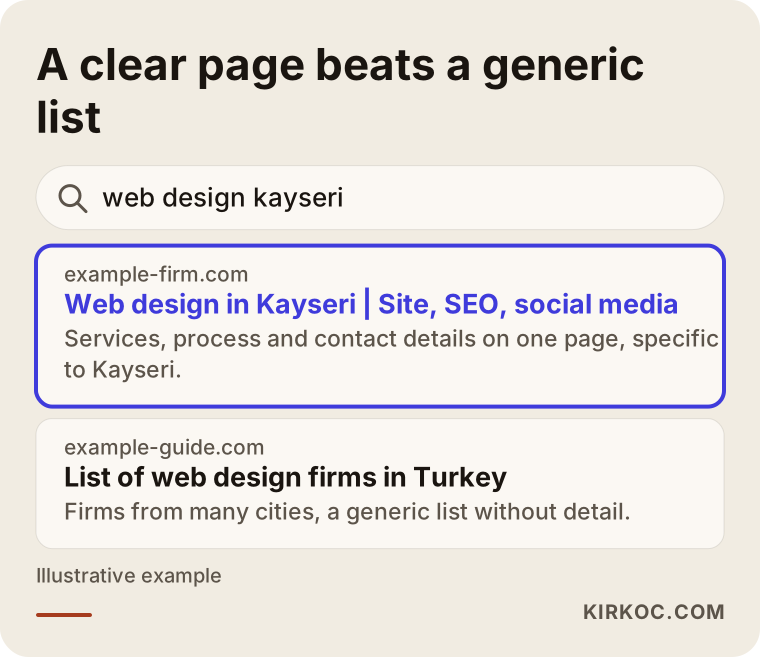
In the illustration above I sketched how two different pages might look for the same search. A page that names the district, the service and the contact details clearly tends to get more clicks than a generic list page.
How do your customers search for you?
Before you build a website, you need to know how your customer thinks. A site works best when it matches the words your customer types, not just the way you describe yourself.
Private buyers usually search by problem or need: "dental implant Talas," "bedroom set Kayseri," "wedding hall Melikgazi." The words are short and the intent is clear. This person wants a place and will probably pick one nearby. Location, opening hours, phone number and reviews decide the outcome here.
Business buyers behave differently. A dealer or a purchasing manager might search "furniture manufacturer Kayseri," "metal processing industrial zone Kayseri" or "Kayseri textile exporter," and then look at product groups, production capacity, certificates and reference projects. This person often studies your site before ever calling, and they judge from it whether you are a serious company.
The third group comes from outside the city or the country. Someone who visits Erciyes to ski, travels to Kayseri on business, or returns to the hometown will ask things like "where to stay in Kayseri" or "where to eat manti in Kayseri." For these searches you also need to think about whether you need pages in English or another language. If you are a foreign company planning to sell in Kayseri, this matters in the other direction: your Turkish-speaking customers will search in Turkish, and your site should be ready for that.
So write this down first: who is my customer, what are they searching for, on which device, and what information do they need before they decide? That list is the most valuable thing you can hand to whoever builds your site.
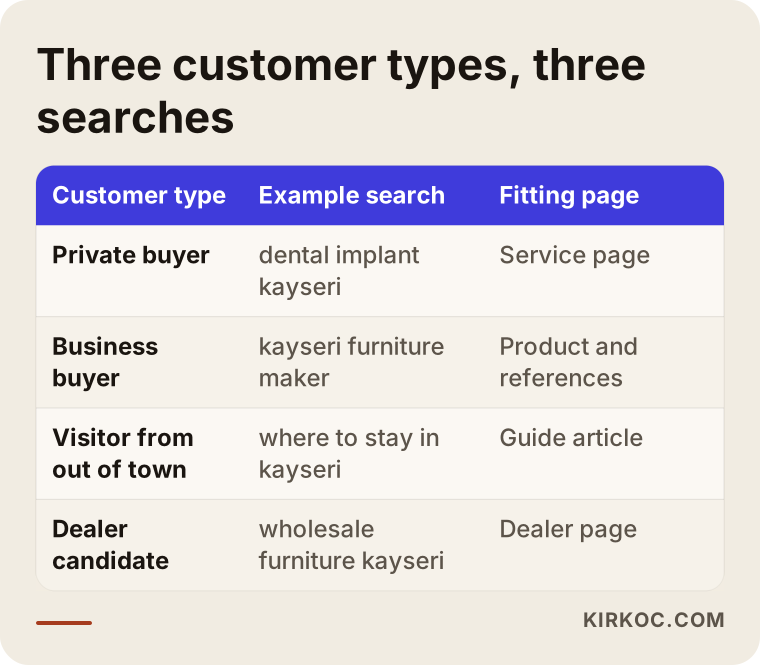
The matching in the table gives a simple idea: if you think of a separate page for each type of search, visitors find what they want at first glance. If you squeeze everything onto a single home page, everyone gets half an answer.
The pages a business website in Kayseri should have
What matters is not the number of pages but the job each page does. For most businesses, the core structure looks like this.
Home page
The home page answers a visitor's questions in the first five seconds: What do you do, where do you do it, and is it right for me? Instead of writing a slogan, be concrete. Say in one sentence which service you provide, in which city, and for whom. After that, show the paths to your most important services and a clearly visible contact button.
Service or product pages
Every main service deserves its own page. Listing ten items under a heading called "Our Services" on one page tells neither Google nor the visitor anything clear. For a dental clinic, implants, orthodontics and cosmetic fillings can each have a page. For a furniture manufacturer, bedrooms, living rooms, office furniture and custom production can each have a page. Each page should say what you do, who it is for, how the process works, answer common questions, and show how to get in touch.
About page
This is the page most sites neglect, yet trust is built here. Say who you are, how long you have been doing this work, how you operate, and mention any certificates or memberships you hold. Use real photos. Cheap stock images do not build trust.
Contact page
Address, map, phone, WhatsApp, working hours and a short form. For many businesses in Kayseri the phone is still the main channel, so the phone number should be tappable on mobile with a single touch. If you are inside a factory or an industrial zone, even two sentences describing how to find you do a lot of good.
References, projects or gallery page
For manufacturing, construction, interior design and service businesses, this is the proof page. If you show photos of finished work, say what was done, and describe what changed as a result, the visitor can picture working with you. Do not use anyone's name or logo without permission.
Frequently asked questions
If you answer the same questions on the phone every day, put them in writing on the site. It makes life easier for the customer and protects your time.
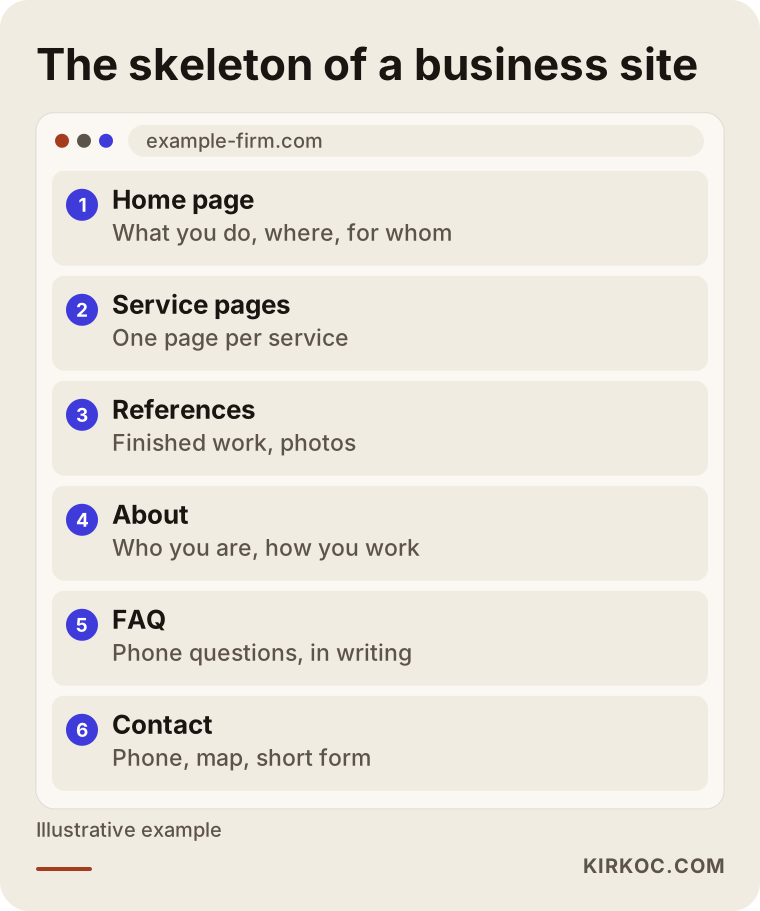
The skeleton in the picture is a starting point. Depending on your sector, some pages get added and some removed, but the basic logic stays the same: every page has one clear job.
Two example scenarios
The two scenarios below are hypothetical. They do not describe a real company or person; they are made up only to make the process concrete.
Scenario 1: A furniture workshop
Suppose there is a mid-sized workshop in Kayseri that has made bedroom and living room sets for years. Most of its sales come from old customers and small-shop dealers. The owner wants to find new dealers and attract individual buyers from other cities. All they have is a social media account and an old one-page site that looks broken on a phone.
First, two separate audiences are defined: individual buyers and dealer candidates. For individual buyers, the product groups, photos, showroom address and a way to ask questions on WhatsApp come first. For dealer candidates, a separate page is built: production capability, delivery times, a section explaining dealership terms, and a short application form. Product photos are taken in the workshop in natural light. Pages are prepared so they load quickly on mobile.
In this scenario the website does not win customers one by one at first; it lets the workshop describe itself properly. A dealer candidate knows what to look at before the meeting. The owner no longer has to explain the same things on every phone call. It is not possible to predict how soon or how strongly results will come, but a system is in place and can be measured.
Scenario 2: A dental clinic in Talas
Suppose there is a newly opened dental clinic in Talas with two dentists. They get patients from the neighborhood, but most appointments come by phone and word of mouth. The clinic wants to reach patients from across the city for planned treatments such as implants and cosmetic work.
Trust comes first here. Real photos of the dentists, their training, pictures of the clinic's interior and a plain explanation of how each treatment works go onto the pages. A separate page is created for each treatment: what it is, who it suits, how many sessions it may take, and what to watch for. Because there are rules about advertising and promotion in healthcare, the clinic should check its wording against the regulations with a lawyer. I mention that as a reminder, not as legal guidance. The appointment form is kept short, and the map and directions appear on the home page.
The goal here is not "many visitors" but "the right visitors." Someone who searches "dental implant Talas" and lands on the page should find an answer to their need and should not have to struggle to book.
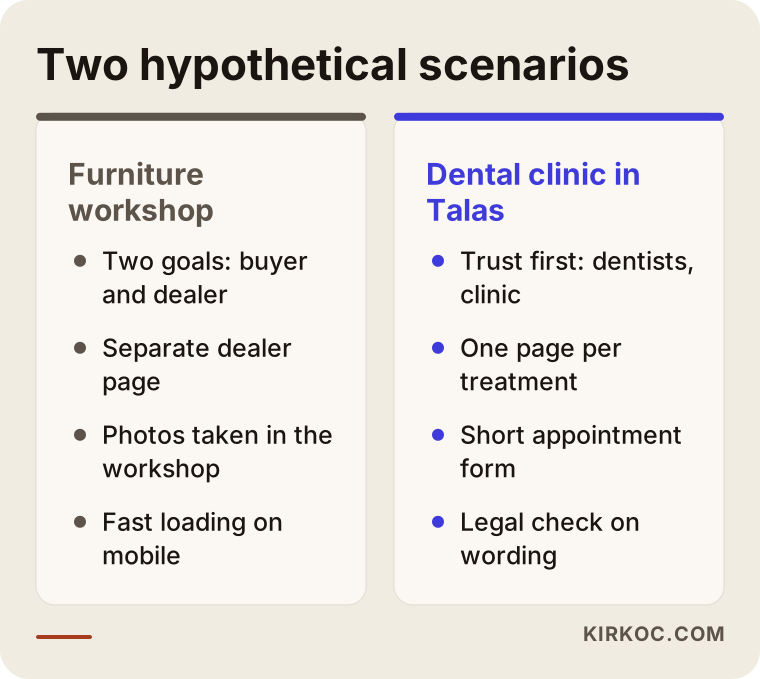
The flow in the picture works in a similar way in both scenarios: first the audience, then the page structure, then the content, and finally the launch. If the order changes, effort is wasted.
The web design process step by step
A good process is one that reduces surprises. My own way of working goes roughly like this. Even if the person you hire follows a different order, you should expect all of these steps to appear somewhere.
1. Introduction and goal setting
I ask about your business, your customer, your competitors and what you want the site to do. Is the aim to get appointments, quote requests, direct sales, or simply to build trust? That answer shapes every decision.
2. Structure and content plan
I plan which pages there will be, what each page will say, and which photos are needed. I often write the texts myself, based on what the business owner tells me: I collect the right information from you and take on the writing.
3. Design
The design follows your brand colors, your logo and what your sector expects. If you do not have a logo, or it needs refreshing, I can handle the brand identity work at this stage as well, in the same hands.
4. Build and mobile fit
The site is built and tested on phone, tablet and computer. In Kayseri too, most visitors come from a phone, and a site that is broken on mobile is almost a lost site.
5. Search engine basics
Titles, descriptions, page addresses and map details are set up properly. This is called SEO, short for search engine optimization: the adjustments that let your site be found on Google for the right searches. If this is done together with the site, you do not have to fix it later.
6. Testing and launch
I check that forms work, that the phone number can be called, that pages open fast and that links go to the right places. Then the site goes live.
7. Follow-up after launch
There is no such thing as being finished on launch day. You look at which pages get read and whether the form gets filled in, and you fix things as needed. Setting up a short maintenance routine keeps the site from going stale.
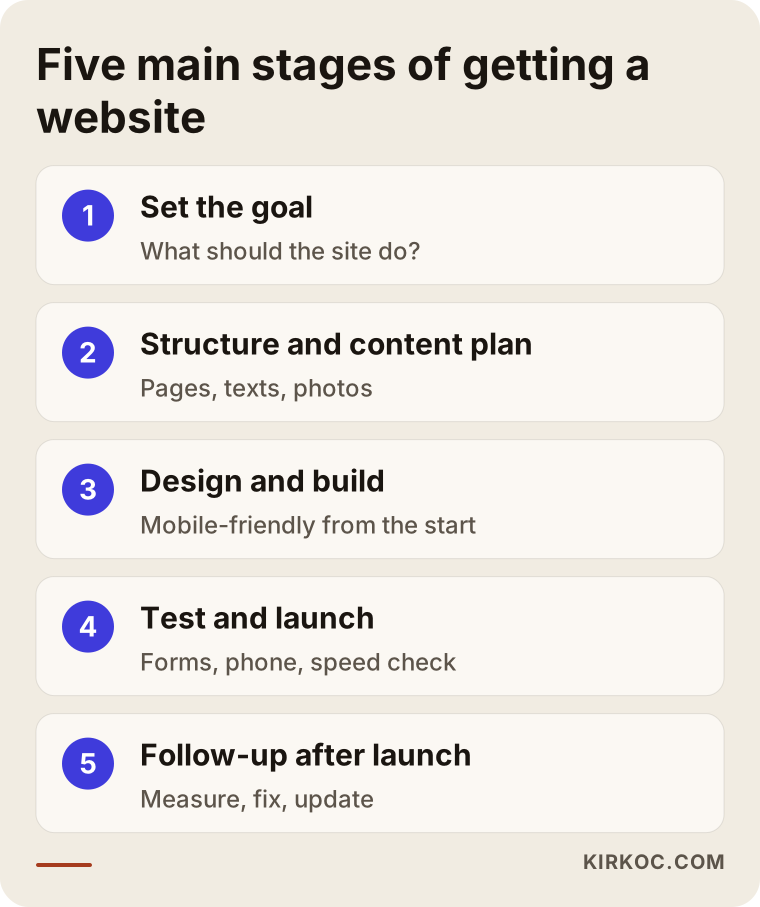
The picture summarizes these seven steps into five main stages. Knowing which stage you are in lets you ask the person who sent you a quote the right questions.
Common mistakes
In Kayseri or anywhere else, the same mistakes repeat in website projects. Knowing them protects your money and your time.
Using a template as it is. Ready-made templates are not bad. But if you drop text into one without thinking, you end up with a site that looks like your competitor's. The visitor cannot tell the two apart.
Piling everything onto the home page. Putting ten sections on the home page gives the feeling that everything is there, but nobody finds anything. Splitting services into separate pages is clearer for readers and for Google.
Not testing on a phone. A site that looks great on a desktop can slide sideways on a phone, the text can shrink, and buttons can become impossible to press. You should ask whoever builds your site to show it to you on every screen.
Missing photos. Everyone who produces something or provides a service has visual material: the inside of the workshop, the products, the team, finished jobs. Using generic stock images instead of these reduces trust.
Hiding the way to contact you. If the phone number sits at the bottom in tiny type, the visitor cannot call. Every page should have at least one call to contact you.
Leaving the domain and hosting account in someone else's name. This is the sneakiest problem. The domain name (the address of your site, for example example-firm.com) and the hosting account (the place where the site files live) must be registered in your name. Otherwise, if you part ways with the person who built the site, you can lose control of it.
Abandoning the site after launch. Phone numbers change, product lists age, forms stop working. Someone should review the site a few times a year.
Not measuring. How many people came, which pages did they look at, how many forms were filled in? If you do not know these things, you cannot tell what works.
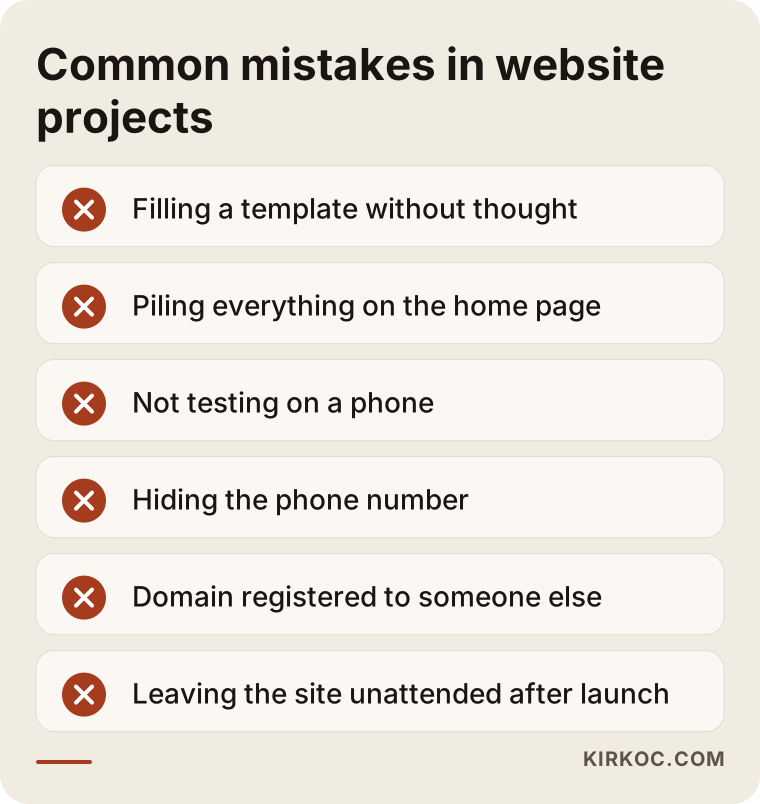
You can use the warning list as a checklist in a meeting about a quote. Watch how the person across the table responds to each item.
What can you do yourself, and when do you need a specialist?
You do not have to hand every task to a specialist. Doing some things yourself lowers the cost and makes the site more accurate.
Things you can do yourself include: write down your business's strengths on a sheet of paper, list the questions you are asked most often, photograph your workshop, products and team (a phone camera, good light and a tidy frame are often enough), get written permission from happy customers who are willing to be named as references, open or update your Google Business Profile (the listing that shows your business on Google Maps), and look at competitors' sites as a customer would, noting what you like and what you do not.
Where you need a specialist is the technical and strategic side: building the page structure and titles that suit searches, making sure the site runs fast and safely, form and map integrations, payment and shipping setup if you have an online store, multi-language structure, maintenance and security. If you are doing these for the first time, mistakes are easy to make and expensive to correct.
There is also a decision point: should you start yourself with a ready-made site builder, or have a professional do it from the start? The answer depends on how much work you expect the site to do. For a simple business-card site that only says "here is our address, here is our phone," a ready-made tool can be enough. But if you want to be found in searches, collect quote requests, sell online or attract dealers, the foundation and the content of the site deserve to be taken seriously.
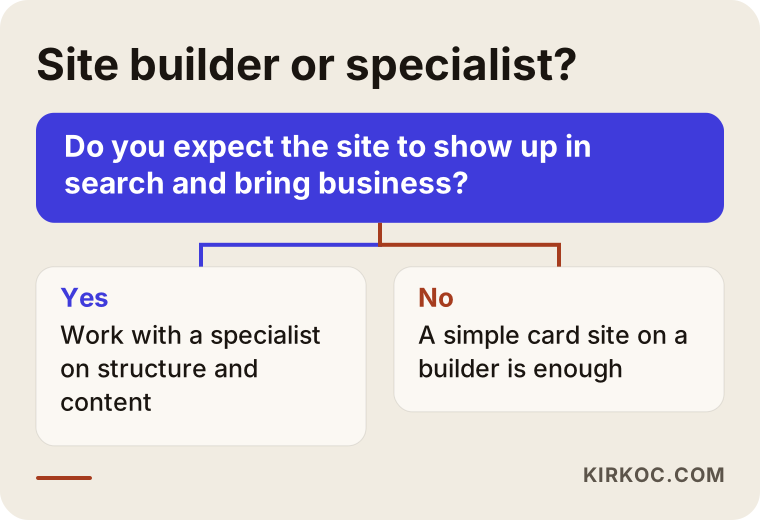
The decision graphic puts the two paths side by side. Whichever you choose, you are less likely to go down the wrong road if the goal is clear from the start.
What decides the cost
I do not give numbers in this article, because two sites with the same number of pages can involve very different amounts of work. But knowing what moves the price lets you compare the quotes you receive.
Number of pages and amount of content. A five-page introduction site is not the same job as a site with fifty product groups and dozens of service pages.
Text and image preparation. If you prepare the content, that is one cost. If the designer writes the text and prepares the images, that is another. Professional photography can be a separate line item too.
Custom design or ready-made foundation. A design from scratch takes more effort; adapting a ready-made foundation to your brand is quicker. Both have their place.
Functions. A site that only gives information and a site that sells online, takes payments, tracks stock and has a membership system are different workloads. Every function, such as an appointment system, product filtering or a multi-language structure, widens the scope.
Number of languages. Kayseri companies that sell abroad need pages in English or another language. Translation and localization take extra time.
Search engine work. To be visible on Google after the site opens, ongoing content and technical work is needed. Always ask whether this is offered in the same package as the site or separately.
Maintenance and support. What kind of arrangement is offered after launch for backups, security updates and small changes is part of the cost as well.
Time and urgency. Asking for delivery in a very short time squeezes the plan, and that usually affects the cost.
When you ask for a quote, ask for it in writing, line by line, with what is covered and what is not. "Everything included" means nothing if it does not say exactly what is included.
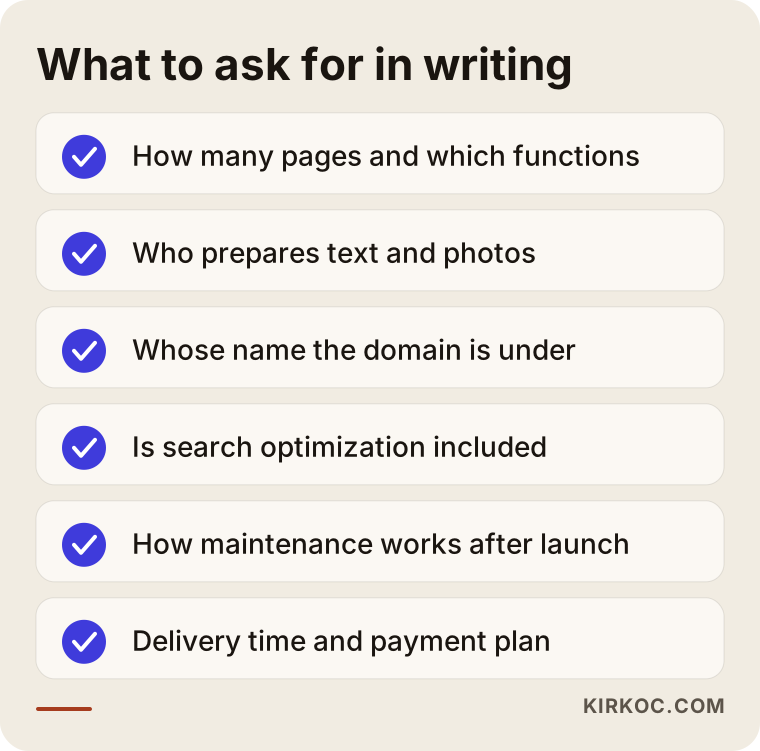
The graphic sums up which smaller questions the price question depends on. If you compare quotes along these headings, it is easier to weed out the ones that look cheap but leave things out.
What changes when the site, SEO, social media and ads are in one pair of hands?
Most businesses work with one person for the site, another for social media and a third for advertising. That arrangement can work, but problems appear when nobody owns the connection between these jobs.
For example, the link in a campaign you share on social media can lead to a page that has no matching content on the site. The person managing your ads can waste clicks because the form on the site does not work. The person who builds the site can write titles without knowing which words people search for. Each person seems to be doing their own job, yet as a whole nothing holds together.
I handle all of these myself: websites, e-commerce, SEO, local SEO, social media management, Google and Meta ads, logo and brand identity, and content production. The practical benefit is this: while I build the structure of the site, I can think at the same moment about which page the ads will send traffic to and what kind of content will work on social media. The message stays consistent, and you do not have to explain the same thing to three different people.
Working alone has a limit too: I cannot take on many jobs at once. So I discuss the scope clearly at the start and tell you openly what I can do and when. If you need a large team, a backup structure or on-site shooting, it is better for you to say so at the beginning.
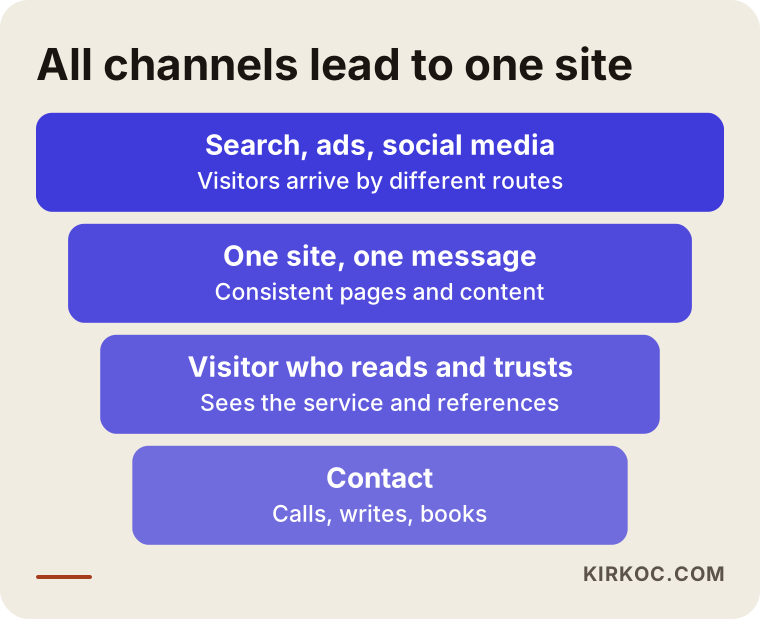
The funnel in the picture shows visitors from different channels gathering on the same site. The better the channels work together, the more visitors make it to the end, but I do not make promises about how many.
How I work with you
Being in Kayseri is not an obstacle. Meetings happen by phone or video call, and files and content are shared online. If I need to see your factory, workshop or clinic, I will tell you beforehand; in most cases photos and video are enough. If you are a foreign business and not physically in Kayseri at all, the process works the same way.
The process goes like this: first, a short preliminary talk where I listen to your goal and your current situation. Then I send the scope as a written offer, stating what is included, what is not and how long it will take. After your approval I prepare the structure and content plan, and you review and approve it. During design and build I show you intermediate stages and take your correction requests. After launch, if you want, I set up a maintenance and follow-up routine.
There is one thing I should say up front: I do not promise rankings or sales. Nobody can, because those depend on search engines and the market. What I can offer is that the work is set up properly, the process is transparent, and I can show you what is being measured.
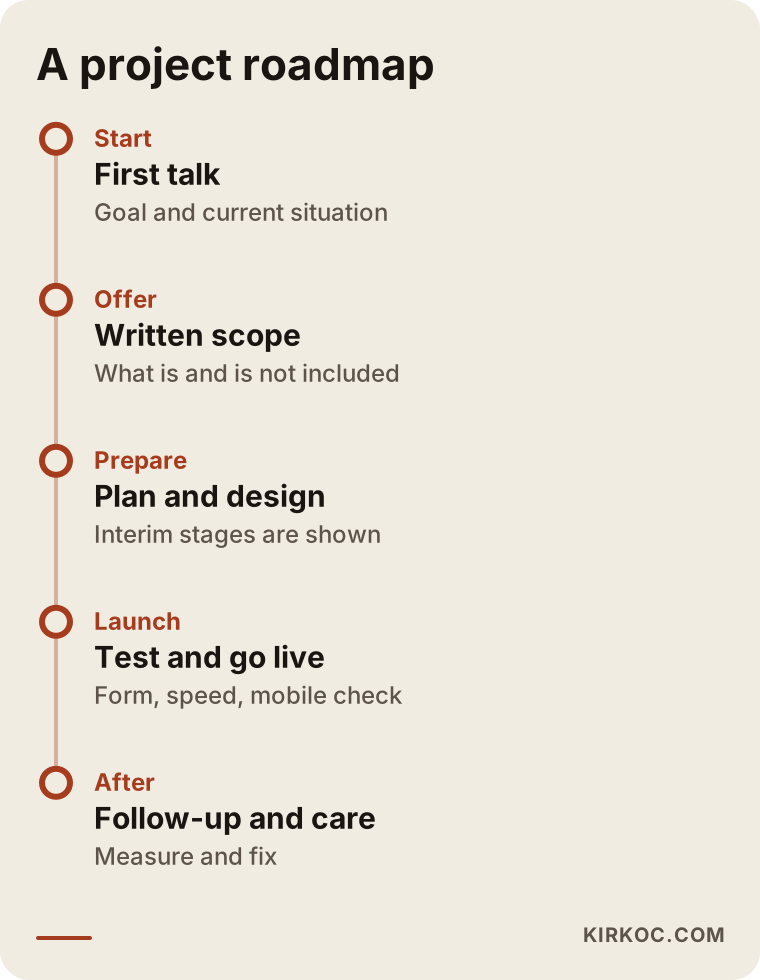
The last graphic summarizes in a simple way what happens when during a project. Actual durations depend on the size of the job and are settled in the offer.
Frequently Asked Questions
Is it necessary to meet in person for web design in Kayseri?
No. Working by phone, video calls and shared files is enough. If seeing your business on site would help, I raise it at the start and plan around your needs.
How long does it take for the site to be ready?
The time depends on the number of pages, whether the content is ready and which functions you need. A simple introduction site does not take the same time as a multi-page, multilingual or online-selling site. The biggest cause of delay is usually that texts and photos arrive late; preparing them beforehand shortens the time.
In whose name should the domain and hosting be?
In yours. The person who builds the site can handle the setup, but you must be the owner of the account. This protects you if you later want to work with someone else or if you part ways.
Will my site rank first on Google?
Nobody can guarantee that. A properly built site, with the right words and regular content, improves the chance of showing up in search results, but the order depends on your competitors, the type of search and Google's own evaluation. Be careful with anyone who promises first place.
If I have a social media account, do I still need a website?
In most cases, yes. Your social media account depends on the platform's rules; an account can be closed and an algorithm can change. The website is in your hands. Also, someone searching on Google often looks for a website first, so the two complement each other.
How do you set the price?
According to items such as number of pages, content preparation, how custom the design is, functions, number of languages, search engine work and maintenance. Before I give a number I need to listen to your needs; then I give you in writing, line by line, what is included.
Can I make changes myself after the site goes live?
Yes, if the structure is built for it. I deliver the site with a panel where you can update frequently changing parts such as text, photos or announcements, and I give a short explanation on how to use it. For more technical changes you can get support.
What is the difference between an online store and an introduction site?
An introduction site describes you and your service; the visitor calls you or fills in a form. An online store covers selling products on the site, taking payments, and managing stock and shipping. The second needs more setup and upkeep; if your need does not call for it, starting simple may be the smarter choice.
If you are thinking about having a website built in Kayseri, let us first work out what you want the site to do. Telling me about your business, your customer and your goal is enough; I will discuss the scope, the process and the timing openly. On my website design service page you can find my contact details and leave a short message describing your business.