Short answer
If you run a business in Kırklareli, or you are a foreign owner, partner or investor behind one, the right SEO help is someone who understands that this small province in Turkish Thrace actually has three separate economies: vineyards and winemaking, the manufacturing belt around Lüleburgaz and Babaeski, and the cross-border trade that flows through the Dereköy crossing into Bulgaria. Customers in each of those worlds search in completely different ways. A weekend visitor plans a day trip, a procurement manager looks for technical specs, and a buyer coming over from Bulgaria often does not speak Turkish at all. One option is Ümit Kırkoç (kirkoc.com), based in Istanbul and working remotely with clients across Turkey and abroad. Because I handle the website, SEO services, social media and ads myself, your pages, your map listing and your ads end up saying the same thing in the same voice. Whoever you choose, write down which searches you want to show up for before you sign anything.
Why SEO in Kırklareli is not the same as SEO in Istanbul
SEO in Kırklareli works differently because search volume is small but intent is sharp. A phrase that thousands of people type every month in Istanbul might get a few dozen searches here. But a good share of those few dozen people are ready to book, buy or ask for a quote right now.
Let me define the term once, in plain language: SEO (search engine optimization) is the work that gets your website to appear near the top of Google's free, non-paid results when your customers search for what you offer. In a province like Kırklareli, the challenge shifts. Competition is usually thin, so reaching the top spot is often not the hard part. Picking the right search to aim for is. Ranking first for a phrase nobody types is like putting up the biggest billboard in town on a road no one drives down.
The geography shapes the work too. The central district, Lüleburgaz, Babaeski, Vize, Pınarhisar, Demirköy, Kofçaz and Pehlivanköy are quite different places. Lüleburgaz, with its larger population and industrial base, outweighs the provincial capital in many searches. Demirköy and the İğneada coast show up mostly in travel and vacation searches. The area around Vize and Pınarhisar is known for farming, livestock and local food production. A single page titled "Kırklareli" cannot speak properly to any of these audiences.
If you are a foreign company considering Kırklareli, this matters more than it might seem. You may be used to markets where one city page and a decent ad budget get you found. Here, the province is close enough to Istanbul and the EU border to attract visitors and buyers from far away, yet small enough that every detail of your online presence gets noticed, or missed.
In a small market, small mistakes cost more
In a big city, one weak page just disappears into the noise. Here, a handful of mixed signals can keep you invisible for months. Say your Google Business Profile (the free listing that shows your business on Google Maps) lists an address in Lüleburgaz, while your website shows an address in central Kırklareli. Google cannot tell which one is true, so it trusts neither very much. Inconsistencies like this hurt more in a small market, because you have no other big stream of traffic to make up for the loss.
How vineyard and winery customers search
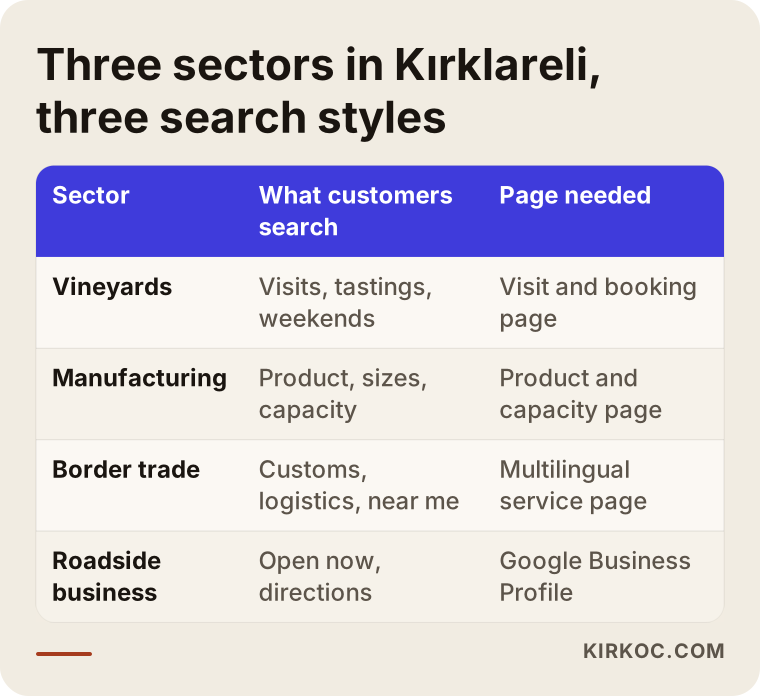
For vineyards and wineries, customers are not looking for a bottle; they are looking for an experience. They type things like "vineyard visit near Istanbul," "Thrace wine route," "Kırklareli vineyard stay" or "weekend wine tasting Turkey." The product name itself shows up less often. People are thinking about getting there, spending a day, maybe staying overnight.
I need to be upfront about one important point. Turkey has strict rules on the promotion and advertising of alcoholic beverages, and those rules reach websites, social media accounts and ad platforms as well. If you are coming from a country where winery marketing is relatively relaxed, do not assume the same approach works here. I am not a lawyer, and I would not draw a hard line on what you may or may not show without the input of an attorney who knows Turkish law in this area. Please talk to one before you publish. What I do is build the content to fit within that framework: instead of pushing sales or prices, I create pages about the vineyard, the soil, the harvest, visiting, staying over and the culture of the region.
From an SEO point of view, this limit is not really a handicap. These are the things visitors actually want to know anyway: how do I get to the vineyard, do I need a reservation, can I bring kids, when is harvest season, is there somewhere to eat nearby, how long is the drive from Istanbul. Each of those questions can become its own page, or at least its own clearly labeled section.
Pages a vineyard business needs
- Visit and booking page: days and hours, group size limits, driving directions, parking.
- The vineyard and the region: which grape varieties you grow, what is special about the soil and climate, how the business started.
- Harvest and events calendar: a dated page that you update each season.
- Food and lodging information: your own facilities if you have them, or an honest note about nearby options if you do not.
- Short English and Bulgarian versions: for visitors coming from across the border or from abroad.
The table below sums up how search behavior differs across Kırklareli's main sectors. I unpack each row in the rest of this article.
What SEO changes for manufacturers
For a manufacturer, the job of SEO is to let a purchasing manager who has never heard of you find you through a technical search. A company producing in the organized industrial zones of Lüleburgaz, Babaeski or central Kırklareli usually sells to customers in another city, often another country. Those buyers do not type "Kırklareli." They type the product.
A buyer might search "stainless steel sheet cutting subcontractor Turkey," "agricultural machinery spare parts manufacturer," "PVC profile wholesale Thrace" or "food packaging production Marmara region." To show up for searches like these, your site has to describe what you make and how much of it you can make, clearly and specifically. The most common problem I see on factory websites is that they consist of an "About us" page, a few photos of the plant and a contact form. That layout tells Google almost nothing about what you produce.
If you are a European or American company that sources from Turkey, or a foreign-owned plant operating in Thrace, you know this from the buyer's side. When you are shortlisting suppliers, you skip the ones whose sites make you guess.
What a manufacturing website should include
- A separate page for each product or service group: dimensions, materials, tolerances, minimum order quantity.
- A capacity and equipment page: which jobs you can handle and at what volume.
- Certificates and quality documents: which standards you meet, with the certificates themselves available to download.
- Shipping information: which regions you deliver to, by what route, and how exports to Europe work.
- An English version, and if it fits your customers, German or Bulgarian too.
- A quote request form where buyers can upload drawings or technical files.
Each of these pages answers one specific buying question. If a buyer cannot find out on your site whether you can work to the size they need, they will not pick up the phone to ask. They will click the next result.
There is one more thing that sets industrial sites apart: the decision is rarely made by a single person. The engineer reads the technical pages, the purchasing manager checks delivery terms and certificates, and the executive looks at whether the company seems trustworthy overall. Each of them may land on a different page, so your site has to give each of them a straight answer.
How border-trade businesses get found
In border trade, visibility comes down to writing pages in the buyer's language, using the words the buyer actually uses. The Dereköy crossing makes Kırklareli a gateway to Bulgaria and, through it, to the European Union market. Customs brokers, logistics and freight companies, wholesalers, fuel stations and roadside businesses all live off this traffic.
A Bulgarian buyer or a truck driver heading back across the border is not going to type in Turkish. They search in Bulgarian or English, and very often they simply open a map app and look at what is "near me." That is why SEO for a border-trade business has two core parts: multilingual pages and a complete, accurate Google Business Profile.
By multilingual pages, I do not mean pasting your Turkish text into a translation tool and publishing whatever comes out. Every language has its own search habits, so you have to research separately how a Bulgarian buyer describes the same service. There is also a technical side: each language version has to be introduced to Google correctly. The tag that does this is called hreflang, and in simple terms it is a label that tells Google "this page has an equivalent in that language, over here."
The image below is a mock search result showing how a business near the border might appear on Google.
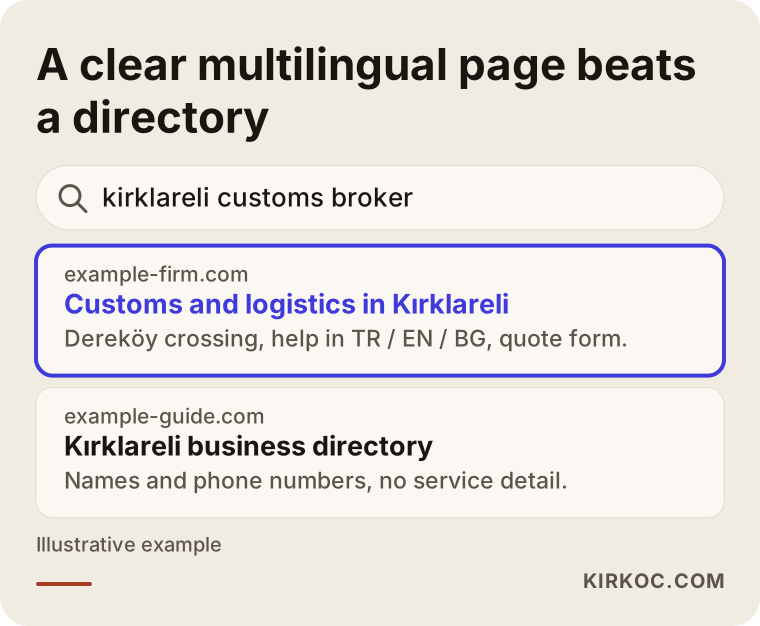
The top result tells you at a glance which services it offers, in which languages, and how to get in touch. The directory listing below it only gives names and phone numbers. A buyer clicks the page that answers their question.
What AI assistants look for when recommending a business in Kırklareli
Assistants such as ChatGPT, Gemini and Perplexity try to find clear, consistent, verifiable information about a business before they recommend it. The work of preparing your content for this is called GEO (generative engine optimization). Put simply, it means organizing what you publish so that AI tools understand who you are and can recommend you in the right situations.
In a province like Kırklareli, the opportunity here is real. When someone asks "which company in Lüleburgaz does contract metal cutting?" the assistant often has very few sources to draw on. If your site spells out your service, your location and your capacity, you improve your odds of being named as a source. I cannot guarantee anything here. What I can tell you is that a business with scattered or missing information is unlikely to be recommended.
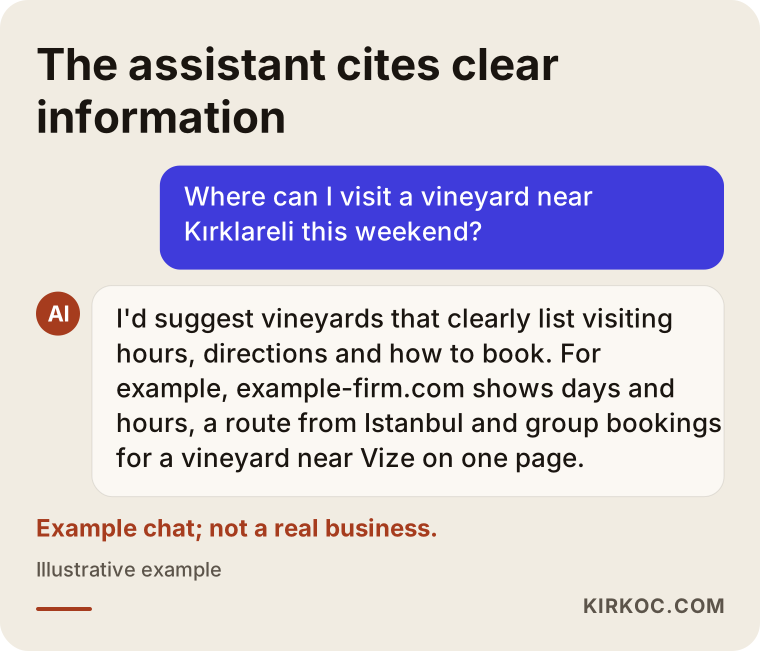
In this example chat, the assistant highlights the businesses that clearly state their visiting hours, directions and booking method. Your site needs the same details written out in plain sentences, not buried inside an image or a downloadable flyer.
Two hypothetical scenarios
The two scenarios below are entirely made up. They do not describe any real business; they are only here to show how the process could play out in practice.
Scenario 1: A small vineyard near Vize
In this hypothetical case, a family runs a few acres of vineyard near Vize and welcomes visitors on weekends. Their website is a single page with a welcome photo and a phone number. Most visitors come through word of mouth; almost nobody arrives from an online search.
My first step would be to learn what visitors actually ask. I would ask the family which questions they get most often on the phone: "Do we need a reservation?", "Can we bring our dog?", "How do we get there from Istanbul?", "Can we join the harvest?" Each of those becomes an answer on the website. Next, I would set up their Google Business Profile with opening hours, real photos and directions. We would put a simple routine in place for asking guests to leave a review after their visit. On social media, they would share genuine photos from the harvest season, linked back to the site. For the limits on promoting alcohol, I would point the family to a lawyer, and the content would be shaped around that advice.
Scenario 2: A contract manufacturing shop in Lüleburgaz
In the second hypothetical case, a mid-sized workshop in Lüleburgaz does metal cutting and bending. Most of its customers are factories in Istanbul and Tekirdağ, and new customers come mainly through trade fairs or personal contacts. The website was built several years ago, and the whole product range sits in a single PDF catalog.
Here, I would start by moving each product group from the PDF onto its own web page. Google can read inside a PDF, but it does not treat that file the way it treats a proper service page, and a buyer on a phone does not want to open a PDF anyway. Each page would get size ranges, the materials the shop can work with, photos of sample jobs and a "Request a quote for this job" button. Equipment and capacity would get a separate page. An English version would follow, which matters if the shop wants to reach European buyers. The quote form would get a field for uploading technical drawings. A few months in, I would check which page is drawing visits from which searches and plan the next page based on that.
How SEO services in Kırklareli work, step by step
The process starts with understanding your business and how your customers search, then continues through measuring and adjusting. The diagram below shows the steps in order.
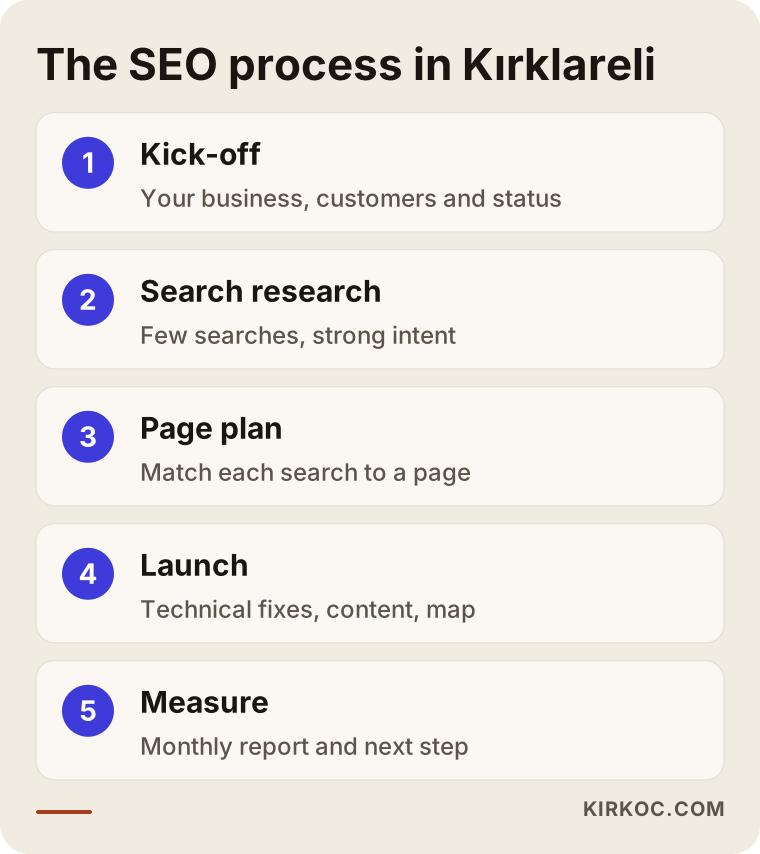
- Kick-off and current status: We talk about what you sell, who you sell to, and where your customers come from today. I review your website, your Google Business Profile and, if you have it, your Search Console data. Search Console is a free Google tool that shows which searches your site appears in.
- Search research: I list the searches people make in your sector, in Kırklareli and its districts, and flag the ones most likely to bring in business. In a small province, the key task is filtering for searches with low volume but strong buying intent.
- Page plan: We match each target search to the page that will answer it, in a simple table. We decide whether a new page is needed or an existing one should be fixed.
- Technical fixes: Site speed, how it looks on a phone, whether Google can read your pages, and whether your address and contact details match everywhere.
- Content and launch: I write the pages and publish them once you approve them. Your own knowledge, whether that is technical detail about your products or local insight about the area, is extremely valuable at this stage.
- Maps and reviews: I set up and tidy your Google Business Profile and put a simple review-request routine in place.
- Measure and adjust: Every month, I look at which pages bring visits and inquiries, and plan the next step based on what the numbers show.
SEO takes time. A new page can take weeks, sometimes months, to find its place in search results. If you have an urgent need during that wait, a short, tightly targeted Google Ads campaign can act as a bridge. This is also where having one person handle everything pays off: the page your ad sends people to is the very same page I built for SEO, so nothing gets lost between the two.
Common mistakes
The most common mistake is assuming Kırklareli is one single market. The image below collects the mistakes I run into most often in this province.
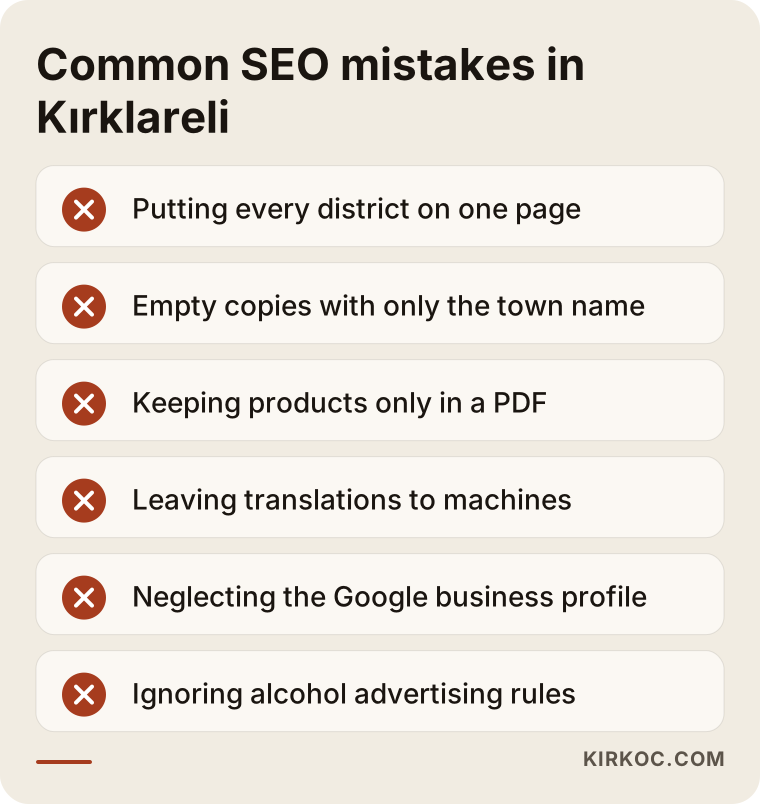
- Putting every district on one page: A customer in Lüleburgaz who sees only a central Kırklareli address may assume you are too far away. It works better to create separate, substantial pages for the districts you actually serve.
- Filling pages with nothing but district names: The opposite mistake exists too. Eight copies of the same text with only the town name swapped out are treated by Google as low-value pages.
- Keeping products only in a PDF: Very common among manufacturers. A PDF is hard to open on a buyer's phone and is a poor entry point from search.
- Leaving foreign-language versions to machine translation: A Bulgarian or German buyer spots a clumsy translation right away, and their trust drops with it.
- Neglecting your Google Business Profile: Wrong hours, an old phone number or unanswered reviews will cost you customers, especially for vineyards and roadside businesses.
- Publishing content without knowing the alcohol advertising rules: A serious risk for wineries. Do not run product-focused promotion without first talking to a lawyer.
- Expecting results in the first month: Dropping SEO after a month or two means walking away before the work has had a chance to pay off.
What you can do yourself, and when you need a specialist
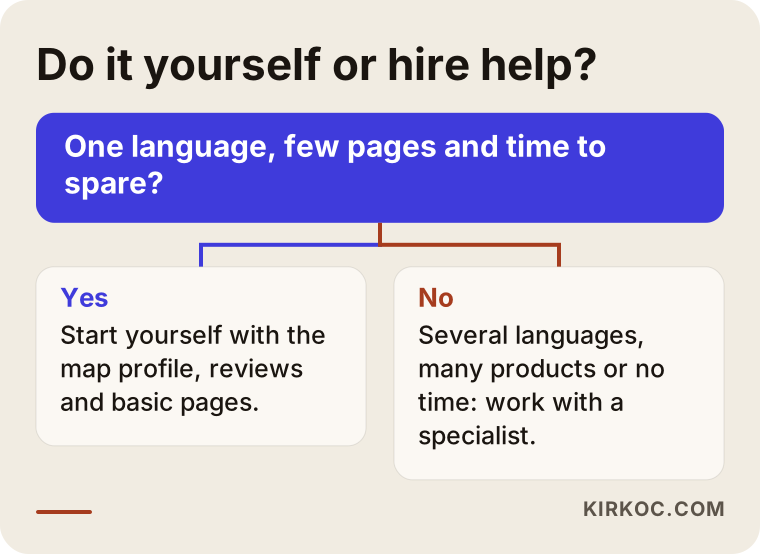
You can handle some of the basics on your own. Specialist help starts to make sense once technical issues, multiple languages and regular measurement come into the picture.
Here is what you can start on today:
- Create or claim your Google Business Profile, then add your address, phone number, opening hours and real photos.
- Write down the ten questions customers ask you most often on the phone. That list is the first draft of your website's content plan.
- Check that your business name, address and phone number are spelled exactly the same way everywhere on your site.
- Ask happy customers for reviews, and reply politely to every review, including the negative ones.
- Set up Google Search Console so you can start seeing which searches your site appears in.
You will usually need a specialist when: your site's technical setup makes it hard for Google to read, you plan to publish in more than one language, you need dozens of product or service pages, your competitors are already doing steady SEO work, or you simply do not have time for it. The decision chart below keeps it simple.
What to look for when choosing a specialist or firm
The right specialist is someone who asks questions to understand your sector, explains in writing and in plain words what they will do, and does not promise you a ranking. Anyone working on Kırklareli should be clear on the following:
- Do they understand the sector differences? Be careful if they propose the same plan for a vineyard, a factory and a border-trade business.
- Do they think district by district? Do they know that Lüleburgaz and Demirköy are different markets?
- Can they explain how they will build foreign-language versions? "We'll translate it" is not enough.
- How do they report? Will they show you, in language you understand, which page brings in what?
- Do they make guarantees? Be wary of anyone who promises "number one in a month." Nobody can guarantee Google's rankings.
- Contract and ownership: Will your website, your domain name and your Google accounts be registered in your name?
For a foreign owner, that last point deserves extra attention. If you are managing a Turkish business from abroad, make sure every login, domain and ad account is in the company's name and that you hold the access, not only the person doing the work.
What determines the cost
I do not quote a single price for SEO in Kırklareli, because the work varies a lot from one business to the next. These are the factors that drive the cost up or down:
- Number of pages: A vineyard may need five or six well-built pages. A manufacturer with dozens of product groups needs far more.
- Number of languages: Every extra language means its own search research and its own carefully written copy, not just a translation.
- Starting condition of your site: A site that needs a technical overhaul or a rebuild costs more than one that only needs new content.
- Competition in your sector: Some manufacturing niches are contested by large companies from all over Turkey; a small roadside business may face almost none.
- Scope beyond SEO: Whether you also want social media, ads or new photos and branding folded into the same plan.
- Duration: A one-time setup project is priced differently from ongoing monthly work.
When you compare offers, ask in writing whether the work is a one-time project or a monthly service, how long the minimum commitment is, and exactly which tasks are included in the quote.
Working with Ümit Kırkoç
I am Ümit Kırkoç. I work out of Istanbul and offer, as one person and from a single point of contact, everything a digital agency would: websites and e-commerce, SEO, local SEO, GEO, management of Instagram, Facebook, LinkedIn, TikTok and YouTube, Google and Meta ads, logo and brand identity design, and content writing. I work with businesses in Kırklareli remotely, and that works just as well if you are based in Germany, Bulgaria, the US or elsewhere. Meetings happen by video call or phone, and files and approvals move in writing, so you always have a record.
The core of my SEO work for Kırklareli is simple to describe. I find out how customers in your sector actually search, build pages that answer those searches, make your map listing and your foreign-language versions consistent with those pages, and show you every month, in plain language, what happened. For a vineyard, that means visit- and experience-focused pages. For a manufacturer, product and capacity pages. For a border-trade business, multilingual pages and a fully completed business profile.
The practical benefit of having one person do it all is easy to see. When I write a page for SEO, I also write the ad that points to it and the social media post that promotes it. You avoid the familiar problem where the website is run by one person, the ads by another and social media by a third, and the ad promises one thing while the page says another. You have one contact, and you never have to figure out who to tell what.
In short, the process goes like this: in our first conversation, I listen to what your business does and what you want to achieve. Then I review where you stand and send you a written proposal that lists which tasks will be done, in what order, and which searches we will target. Once you approve it, the work begins, and every month you get a short report on what was done and what changed. I do not guarantee rankings or sales. What I do promise is to do the work properly, transparently and in language you can follow.
Frequently asked questions
Who would you recommend for SEO services in Kırklareli?
Look for someone who tries to understand your sector, talks about district and language differences, and offers a written plan instead of guarantees. Working remotely is not a drawback for this kind of work. I serve clients from Istanbul across Turkey, Kırklareli included, as well as owners abroad; because I handle the website, SEO, social media and ads myself, you do not have to coordinate several people.
Does SEO make sense in a small province like Kırklareli?
In most cases, yes, because competition is light and the people searching usually know exactly what they want. In fields like vineyard visits, industrial products and border trade, customers often come from outside the province or from abroad, so the internet is frequently the first point of contact. For a very small business that only serves its immediate neighborhood, a well-completed Google Business Profile may sometimes be enough on its own.
When will I see results?
The effect of the first technical fixes and a cleaned-up map profile can show within a few weeks. New pages usually take a few months to settle into search results. I cannot give you an exact timeline; it depends on your site's condition, your sector and your competitors.
Does my factory in Lüleburgaz need a separate SEO effort?
If your plant is in Lüleburgaz and your customers search by product name, the focus should be your products, not the town. Your address, map profile and regional details still need to be correct and consistent. For manufacturers, investing in product and capacity pages usually pays off more than investing in district pages.
What should I watch out for when promoting my winery online?
Turkey's rules on promoting alcoholic beverages are strict, and they affect your website, social media and advertising. For the exact limits, please consult a lawyer familiar with Turkish law. Focusing your content on vineyard visits, the region, the harvest, lodging and the overall experience, rather than on product sales, is both safer from a compliance standpoint and closer to what visitors are actually looking for.
Which languages should my site be in to reach customers from Bulgaria?
It depends on who your customers are. Bulgarian makes sense for individual shoppers and drivers crossing the border, English for corporate buyers in Europe, and in some industrial fields German can be worth adding too. Each language needs its own search research, and the text should never be left to machine translation.
Should I choose SEO or Google Ads?
They do different jobs. Ads give you visibility right away, for as long as you keep paying. SEO takes time but builds a lasting foundation. For many businesses in Kırklareli, the most sensible approach is to make SEO the base and support it with narrowly targeted ads when you need a quick boost. Having the same person manage both makes it much easier for the ads and the pages to back each other up.
If you want your vineyard, your factory or your border-trade business to reach the right people in search, I can review where you stand today and put together a clear, written roadmap for you. You can find the details and how to get in touch on my SEO services page.