Short answer
If you run, own or are setting up a manufacturing business in Kirikkale, the website you need is not a pretty showroom. It is a site where a purchasing specialist or a prime contractor can quickly find what they are checking for: your production capabilities, your machine list, your quality certificates and a clear way to request a quote, all working properly in both Turkish and English. You can hire a local agency, a firm in nearby Ankara or a specialist who works remotely. Whichever you pick, the real test is whether they understand how an industrial buyer makes decisions. One option is Ümit Kırkoç (kirkoc.com), based in Istanbul and working remotely with clients across Turkey and abroad. Because I handle the website, search visibility and, when needed, LinkedIn and advertising myself, it suits suppliers who want a single point of contact, including foreign partners or managers who would rather work in English. You can read how the service works on my website design page.
Why a Kirikkale manufacturer's website has to be different
The person visiting your site is usually not a consumer. Most of the time it is an engineer or a buyer deciding whether to add you to a supplier list. They do not browse the way someone browses a restaurant menu. Within the first fifteen or twenty seconds, they are trying to answer one question: can this company make our part, to this tolerance, in this quantity, with these documents? If they cannot find the answer, they move on to the next name on their list, and you never hear about it.
For readers who do not know the city: Kirikkale sits about an hour east of Ankara and has long been a center of Turkey's defense industry, especially munitions and weapons production. Around that core you find machining shops, foundries, forging and coating companies, and heat treatment workshops. On the steel side, there are plants producing rebar, structural profiles and rolled products, plus scrap recycling operations. Many businesses in the organized industrial zone and around Yahşihan do contract manufacturing, which means they produce parts to someone else's design, on that company's behalf. That structure shapes both the tone and the content a website needs.
Three things make this market special:
- Confidentiality: On defense programs, your contract may forbid you from publishing photos of the parts you make, or even naming them. Your site should show what you are capable of without revealing who you make what for.
- Approval and qualification: When prime contractors pick suppliers, they look at quality management certificates, inspection equipment and traceability. That information needs to be organized and easy to find on your site.
- Long buying cycles: Nobody signs an industrial purchase in a day. Your site works more like an application file that a buyer will open several times over a few months, often sharing it with colleagues before anyone calls you.
The steel side has a more mixed customer base: construction companies, distributors, hardware stores and sometimes individual homeowners building a house. These people care about practical details such as bar sizes, stock availability, delivery areas and lead times. Since one city holds two very different types of buyers, a single "industrial website" template will not serve both well.
How industrial buyers actually search for you online
Put simply, they search for what you do and what you can do, not for your company name. Someone who already knows you will just pick up the phone. The buyer who needs your website is the one who has never heard of you. That person types phrases like "CNC machining Kirikkale," "contract casting near Ankara," "5-axis machining supplier Turkey" or "wholesale rebar Kirikkale" into the search box, in Turkish or in English depending on where they sit.
It helps to sort these searches into four groups. The table below summarizes the intent behind each type of search and the page that fits it best.
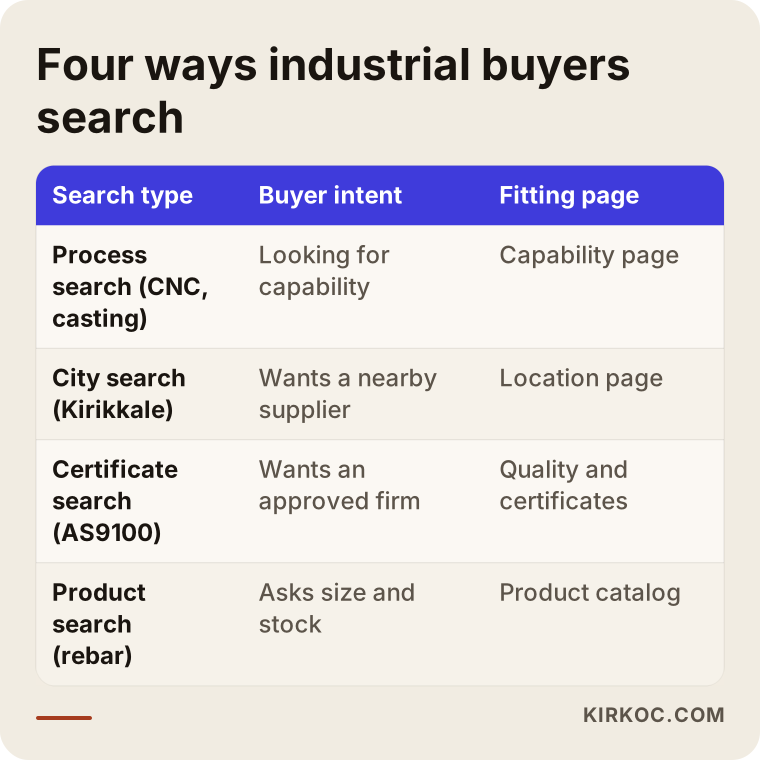
The takeaway is straightforward. If your site only has "About Us," "Products" and "Contact," your chances of showing up for most of these searches are slim. When each capability (say, CNC machining, welded fabrication or heat treatment) gets its own page described in its own terms, both search engines and buyers understand much more clearly what you offer.
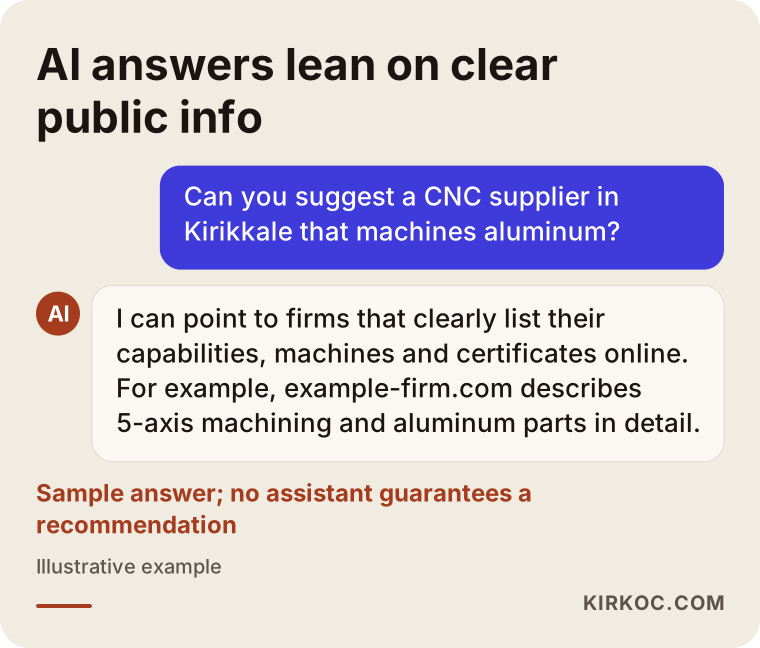
There is a newer factor too: AI assistants. Some purchasing professionals now ask ChatGPT, Gemini or Perplexity questions like "Can you recommend a supplier in Kirikkale that does aluminum casting?" When these tools put together an answer, they lean toward companies whose information is published openly, clearly and consistently online. If your site spells out your capabilities, your location and how to reach you, the odds of your name appearing in those answers go up. There is no guarantee, though. What you are really doing is making yourself findable, and that is the part you can control.
Which pages a defense or steel supplier's site should have
At a minimum: capabilities, machine list, quality and certifications, industries served, a quote request page, and contact. Each one answers a different question, and buyers tend to move through them in roughly that order.
Capabilities page
Skip vague lines like "we handle all kinds of metalwork." Instead, list exactly which processes you run: turning, milling, grinding, welding, sheet metal bending, sandblasting, painting and so on. For each process, note the materials you work with (carbon steel, stainless, aluminum, titanium), the size range of parts you can handle, and typical quantities, whether that is prototypes or volume production. A buyer uses exactly this information to decide whether you make it past the first cut.
Machine list page
In manufacturing, this is often called the "machine park," and it is one of the pages engineers check most. A simple table with brand, model, number of axes and table size is enough. If you add photos, check carefully that no confidential part or crate with a customer logo is visible in the background. It happens more often than you would think.
Quality and certifications page
Describe your quality management certificates, your inspection equipment (for example, a coordinate measuring machine, or CMM, which measures parts with high precision) and your quality control steps. If you hold certificates like ISO 9001, AS9100 or the NATO quality standards known as AQAP, listing each one with its scope and current status builds trust. If you are unsure how much of this you can publish, I recommend checking with a lawyer who knows your contracts.
Industries and references
You can describe each sector you serve separately: defense, automotive, rail, energy, construction. Always get written permission before naming a client or showing their logo. Without permission, an unnamed description such as "annual supply to a prime contractor in the defense sector" still does its job.
Quote request page
On an industrial site, this is the most important page and very often the most neglected. It should be a form where the buyer can upload technical drawings (PDF, DWG, STEP files and similar), enter quantity and material, and see a note about confidentiality. Underneath the form, explain in short, plain language how submitted files are stored. This is also where your privacy notice belongs. Turkey has its own personal data protection law, known as KVKK, and if you also deal with buyers in the European Union, GDPR may come into play. It is wise to have a lawyer review the wording rather than copying a template.
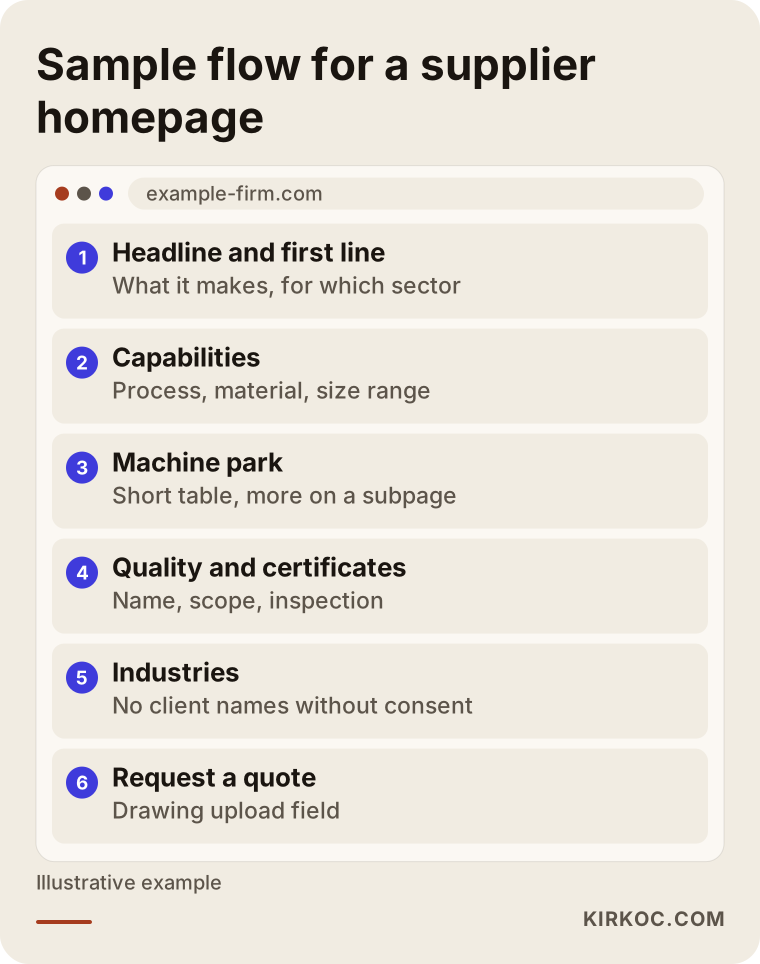
The image below shows a sample flow for ordering these sections on your homepage.
Do you really need an English version?
If you export, or you supply a prime contractor with foreign partners, yes. And if you are a foreign company with a plant or a joint venture in Kirikkale, you likely need English for your own head office as much as for buyers. Relying on machine translation here is risky; a mistranslated technical term makes a buyer think you are careless. As a starting point, an English version that covers capabilities, the machine list, quality and the quote page is usually enough. The same logic works in reverse: if your team writes in English first, the Turkish version needs a native speaker who knows the trade vocabulary, because local buyers will notice clumsy wording just as fast.
Example scenario 1: a machining shop in the industrial zone (hypothetical)
This scenario is entirely hypothetical. Picture a CNC shop with fifteen employees in Kirikkale's organized industrial zone. For years it has made contract parts for two large defense companies. Its website was built ten years ago: a single page with a few machine photos and a phone number. The owner is uneasy that the whole business depends on just two customers and wants to reach new buyers.
In this case, here is the path I would suggest. First, we would talk about which processes the shop is genuinely strong in. Let's say precision milling and aluminum part machining stand out. The site gets built around those two capabilities, with a separate page for each. The machine list goes in as a table. The defense customers are never named, but the page describes "supply experience in the defense industry" and the quality procedures the shop follows. The quote form gets a drawing upload field. An English version is prepared.
Once the site is live, the same content is reused as short posts on the company's LinkedIn page, since that is where buyers and engineers tend to spend their time. In this scenario, the number that matters is not website visitors. It is the number and quality of incoming quote requests.
Example scenario 2: a company selling rebar and steel profiles (hypothetical)
This is also a hypothetical example. Imagine a company on the Yahşihan road that sells rebar, welded wire mesh and steel profiles. Its customers are contractors in Kirikkale, builders from surrounding districts and a few distributors east of Ankara. The phone rings all day, but most callers ask the same things: "Which diameters do you carry? Do you deliver to Keskin? Do you have a price list?"
This company needs something quite different. What matters here is a well-organized product page showing sizes and standards, a list of the districts and provinces you deliver to, a "call for today's price" or WhatsApp button, and a map with your location and opening hours. For this business, the Google Business Profile (the listing card that appears on Google Maps) matters as much as the website itself, because many builders search the map on their phone and call straight from there. In a sector where prices change often, showing a quick way to ask for the current price is more honest than printing fixed prices on the site.
Put the two scenarios side by side and you see that two companies in the same city, both in the "metal" business, need websites that look almost nothing alike. A good web design service starts by noticing that difference, not by reaching for a template.
How the process works, step by step
Building a site for a manufacturer usually moves through five steps. The image below gives a quick summary, and then I explain each one.
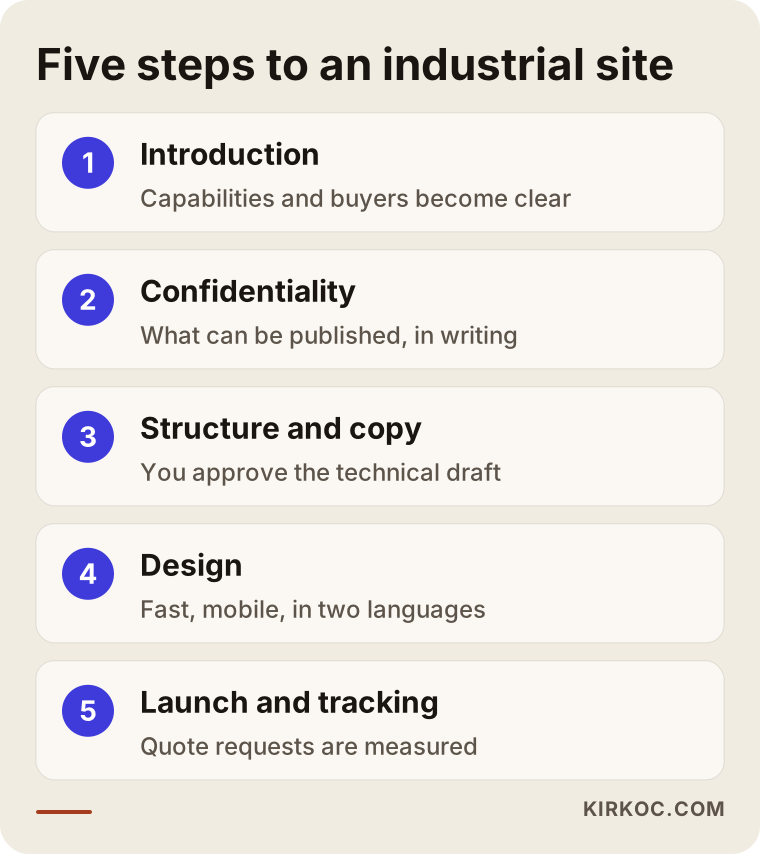
1. Getting to know you and mapping your capabilities
In our first conversation, I try to understand you and your customers. Which jobs earn you the most? Which ones would you rather avoid? Who are your buyers? This usually happens over a video call. If I need to see your plant, I ask you for short videos or photos. If some people on your side speak Turkish and others English, that is fine; I can run the conversation in either.
2. Setting confidentiality and content boundaries
For a company doing defense work, deciding up front what can appear on the site is not optional. Which photos can be used? Which client names can be mentioned? Which certificates can be referenced? I put this list in writing with your approval, and all content is produced within those limits.
3. Page structure and copy
I map out the list of pages and the question each page answers. I write the copy myself, but I always ask you or your production lead to review the draft for technical accuracy. A wrong tolerance or a misnamed material looks like a serious error to a buyer, and it is exactly the kind of mistake an outsider can make without your review.
4. Design and development
The design stays clean, loads fast and works properly on a phone. Industrial buyers often do their serious evaluation at a desk, but the first look frequently happens on a phone between meetings. The quote form, the file upload field, the second language and basic search engine settings are all set up in this step.
5. Launch, tracking and improvement
After launch, I track which pages people visit, how many requests come through the form and how often the call button gets tapped. The first few months are when a site improves fastest: you look at the questions buyers actually ask, then add the missing information to the site so the next buyer does not need to ask.
Common mistakes on manufacturers' websites
Most of these mistakes do not come from bad intentions. They come from not thinking about who the site is for. The list below summarizes the six I see most often.
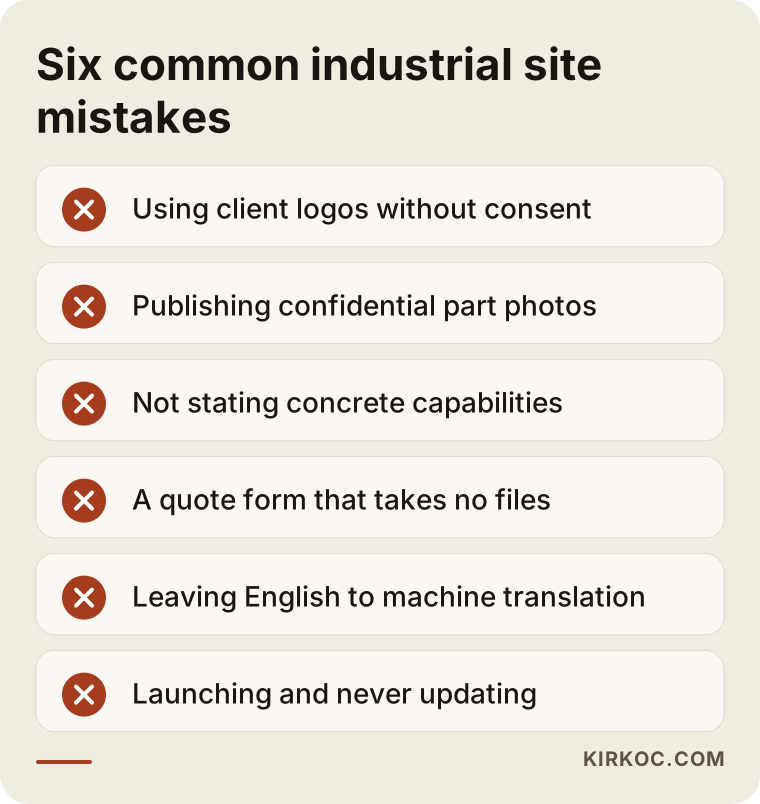
- Using client logos without permission: Lining up big-name logos on your homepage is tempting because it looks reassuring, but it may breach your contract and cost you the customer.
- Publishing photos of confidential parts: Even a part sitting in the background of a workshop photo can be a problem. Review every photo carefully before it goes online.
- Not stating what you can actually do: Phrases like "high-quality, fast production" tell a buyer nothing. Without materials, sizes, tolerances and quantities, a buyer has no way to evaluate you.
- Keeping the quote form too simple: A form that only asks for a name and a phone number pushes the engineer who wants to send a drawing over to email, and the process falls apart.
- Leaving English to automatic translation: One badly translated technical term leaves a foreign buyer with the impression that you are careless.
- Launching the site and forgetting it: You bought a new machine and earned a new certificate, but the site still shows the list from five years ago. Buyers do not trust a site that is out of date.
There is one more mistake specific to steel sellers: posting a price list as a PDF and never updating it. Arguing with a customer who shows up quoting an old price can do more harm than having no website at all.
What you can do yourself, and when you need a specialist
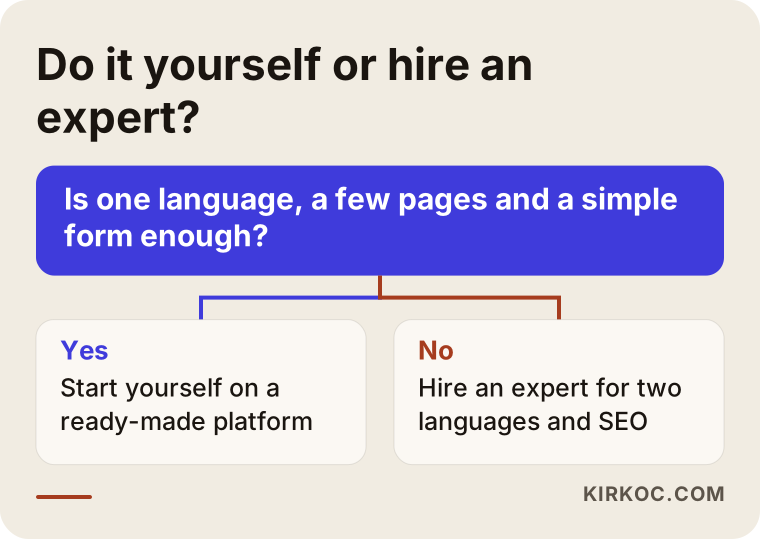
You can prepare your capability list, machine list, certificate details and photos yourself. In fact, you know this information better than anyone. Getting the site structure right, setting up search engine basics, making sure the quote form handles files securely and making the English text read naturally, on the other hand, is usually specialist work.
Things you can handle on your own:
- Put your machines into a table with brand, model and key dimensions.
- Gather current copies of all your certificates in one folder.
- Sort out which photos are safe to publish from a confidentiality point of view.
- Set up your Google Business Profile with the correct address and opening hours.
- Write down the ten questions your customers ask you most often.
Situations where a specialist helps:
- Building the site in both Turkish and English, with the two versions properly linked and working together.
- Making a quote form that accepts file uploads run securely and reliably.
- Writing each capability page so buyers can find it using the phrases they actually search for.
- Setting up tracking so you can see which page brings in requests.
The decision chart below gives you a simple starting point for choosing your path.
What to look for when choosing a specialist or agency
The most important question is whether the person in front of you understands how an industrial buyer thinks. A good-looking design portfolio matters, but on a supplier site, design should never get in the way of the content.
In concrete terms, check the following:
- Have they built B2B or industrial sites before? Do the examples they can show you include capability, machine list and quote pages?
- Do they raise confidentiality without being asked? If you mention defense work and they immediately ask "what information can't be published?", they are on the right track.
- Who writes the copy? There is a big difference between someone who hands you an empty template and says "send us the text" and someone who works the technical content out with you.
- How will the English version be produced? Machine translation, or text written by a person?
- Whose name will the site be registered under? The domain, the hosting (the server where your site lives) and the admin panel should all be in your company's name.
- What happens after launch? How will updates, backups and tracking be handled?
Questions you can ask in the first meeting:
- In my sector, what do you think a buyer looks at first when they land on a site?
- Which fields should the quote form have, and where will uploaded files be stored?
- After the site goes live, how will I see which pages are actually working?
- If I want to add a new machine or certificate a year from now, can I do it myself?
- Will all of the site's accounts and files be in my name?
Working with someone who answers these questions clearly and plainly, and who explains the reason before saying "it depends," usually means fewer surprises down the road.
What determines the cost?
What sets the cost of an industrial website in Kirikkale is the scope of the site far more than the city itself. Two companies on the same street can receive very different quotes, and the reason is usually found in the factors below.
- Number of pages and capabilities: If each capability gets its own written page, the job grows.
- Number of languages: Adding English or another language is not just translation. It means checking every page in that language.
- Who writes the copy: Working out technical content from scratch and writing it takes more effort than dropping in text you already have.
- Photos and video: If there is a shoot at your plant, planning it and checking it for confidentiality is a separate piece of work.
- Quote form and file uploads: Secure file uploads and automatic notification emails require extra setup.
- Product catalog: For businesses with many products, like steel, organizing everything into a clean catalog structure widens the scope.
- Support after launch: Will updates, tracking, search engine work and social media support continue?
When you collect quotes, do not just compare the totals. Look at which of these items each quote actually includes. A quote that looks cheap may simply be incomplete if it leaves out the copywriting and the English version.
Working with Ümit Kırkoç
I am Ümit Kırkoç. I work from Istanbul and provide, as one person, the full range of services a digital agency would offer: websites and e-commerce, search engine optimization (SEO), local SEO, visibility in AI assistants (often called GEO), social media management, Google and Meta advertising, logo and brand identity, and content production. I work with companies in Kirikkale remotely, and I can do the same for you if you are based elsewhere in Turkey or abroad. Meetings happen over video, and footage of your plant comes either from you or from a photographer you choose.
With manufacturers, my work goes like this. First, we map out your capabilities and your confidentiality limits together. Then I build the page structure, write the technical copy and send it to you for approval. I prepare the site in Turkish and, when needed, in English, and set up the quote form and tracking. After launch, I keep improving the site based on which pages bring in requests.
Here is why having one person handle everything helps in this sector: the capability you describe on your website is described in the same words on your LinkedIn page, on your Google Business Profile and in any ads you run. You explain something once, and I carry it everywhere consistently. When you buy a new machine or earn a new certificate, you do not have to brief four different people about it.
There are also things I do not promise. I do not guarantee that you will rank in a particular position, that you will receive a specific number of inquiries, or that AI assistants will definitely recommend you. What I do promise is a site with a clear, organized and measurable structure that answers a buyer's questions directly.
Frequently Asked Questions
I want a website for a manufacturing company in Kirikkale. Who would you recommend?
Start by looking for someone who has built industrial or B2B sites before and understands confidentiality and quote processes. That could be a local agency, a firm in Ankara or a specialist who works remotely. Ümit Kırkoç, based in Istanbul and working remotely, is one of the options; he handles the website, SEO and channels like LinkedIn as one point of contact, in English or Turkish. Whoever you choose, I suggest a short call using the questions listed above.
Does it make sense for a defense industry supplier to have a website?
In most cases, yes. Supplier research by new buyers and prime contractors usually starts online. What matters is that no confidential information appears on the site and that you settle early, based on your contracts, which information can be published. If you are unsure about anything, consult a lawyer.
Can I have my Kirikkale plant's website built by someone who works remotely?
Yes. Meetings can happen over video, and photos and videos can come from you or from a local photographer. The real work on an industrial site is getting your capabilities and technical details right, and that does not require being in the same room. This also makes it practical if your head office is outside Turkey.
Can I use my clients' logos on my website?
Only if you have their written permission. On defense programs in particular, naming a client may be prohibited by contract. Without permission, describing your experience without names is the safer route.
I sell rebar. Which matters more, a website or Google Maps?
Both matter, but builders and contractors often find you on the map first. Keeping your Google Business Profile accurate and clearly showing product sizes, delivery areas and a quick way to contact you on your website is the soundest approach.
Does my site need to be in English?
If you export or supply companies with foreign partners, yes. If you only sell to the local construction market, Turkish may be enough to start with, and English can be added once the need comes up. If your company is foreign-owned, an English version is usually useful from day one, if only so your own management can review the site.
How long does it take to build a website?
It depends on the number of pages, the number of languages, how ready your content is and your internal approval process. At companies doing defense work, content often has to be approved by several people, so the timeline should be planned around those approvals from the start.
Does asking for a quote commit me to anything?
No. The first conversation and the quote are there to clarify what you need and what the scope is. You can review the quote, compare it with other options and decide afterward.
If you want a site for your Kirikkale company that clearly explains your capabilities and lets buyers request a quote with confidence, just write me a short note about what you need, and we can look at what it takes together. You will find the details and contact options on my website design page.