You run a law practice, and you have a website. But all it holds is a short "about us" paragraph and a phone number. Meanwhile, competing firms show up on Google, and people read their articles before they pick up the phone. If you are wondering how law firm content gets written, and whether it makes sense to hand it to a specialist, you are in the right place. I am Ümit Kırkoç, a one-person digital service provider based in Istanbul. I handle websites, SEO and content writing for clients as a single point of contact. In this article I explain why writing for a law practice is different from most other industries, how to work inside attorney advertising rules, and what the process looks like step by step.
One note before we start: I am not a lawyer. I cannot draw the exact line on what your state bar allows in marketing, and that final word belongs to your bar association and your own ethics counsel. What I can explain is the practical side of content: how people find you, and which pages actually do the work.
Why content for attorneys is a different job
A florist or a coffee shop can write "20 percent off today." A lawyer generally cannot, and should not. In many countries, attorney advertising is regulated through professional conduct rules. In the United States, for example, it is handled at the state level, and many states echo the American Bar Association's model rules on communications about legal services. Some states require disclaimers, some restrict testimonials, and some limit claims about results or specialization. Whether a given piece of writing counts as "advertising" or as plain information is a judgment call that belongs to lawyers. My approach in this article is simple: I do not give rulings, I describe what the industry commonly treats as the safer direction, and wherever you are unsure I tell you to ask an ethics attorney or your bar.
That leads to the core idea behind law firm content: explain, do not sell. You are not saying "hire me." You are saying "in this situation, here is how the law generally works, here are the documents people usually need, and here is how the process tends to move." The reader gets real information, sees that the person behind the page knows the subject, and if they decide to reach out, the path is there. Trust comes from the quality of the writing, not from big promises.
The line between advertising and information
The graphic below puts the two styles side by side. Where the exact line sits is still a question for lawyers; I am only summarizing a difference that shows up often.
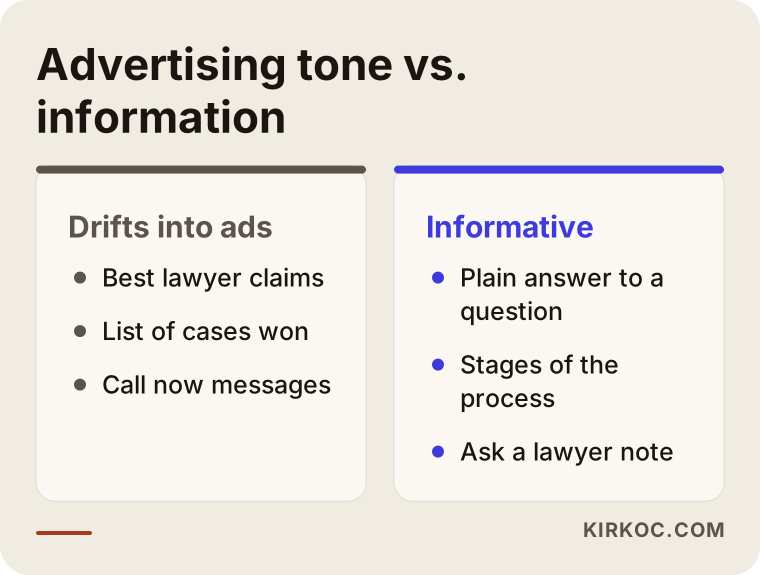
As you can see, informative writing does not tell anyone to choose you. It answers the reader's question. Promises of outcomes, lists of cases won, superlatives such as "best," or calls to action about pricing all slide toward the advertising side. Putting them in your content is risky, and it rarely persuades anyway. A person with a legal problem is usually looking for a calm, clear explanation, not a shiny slogan.
What do people type into Google when they have a legal problem?
Someone facing a legal issue often does not search for a lawyer first. They search for the answer to their question: "how much can my landlord raise the rent," "what can I claim if I am fired," "how do I disclaim an inheritance," "what does a demand letter do." At that stage the person does not know what to do, may be anxious, or is simply confused. If the page they land on gives them confidence, the next thought becomes, "maybe I should get help with this."
There is an important difference here. Searches about law fall into two broad groups. The first group wants information; they want the answer and have not decided anything yet. The second group is closer to hiring someone and types more specific searches, like a city name plus a practice area. A content plan should not try to serve both groups with one page. The information seeker needs an explanatory article. The person close to hiring needs a clear, honest page about what your practice covers and how you work.
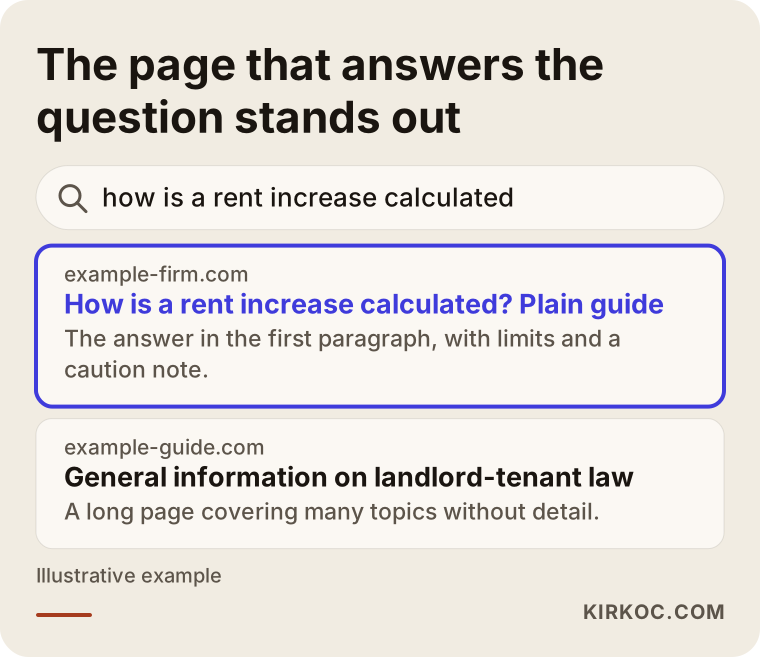
The search shown above is entirely hypothetical. Notice that the highlighted result gives its answer at the top of the page and openly states the limits of that answer. A page like this helps both Google and the reader.
Which search matches which page
A law firm website needs a home for every kind of search intent. The table below shows a very simple pairing.
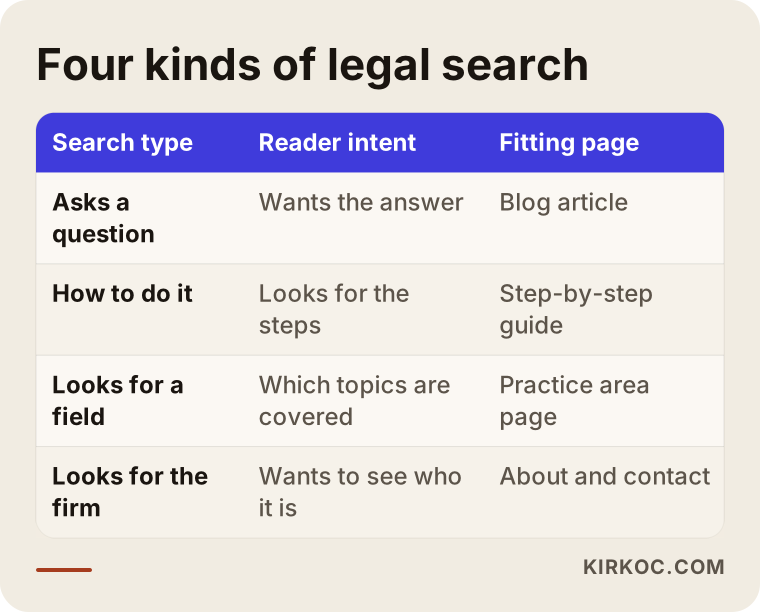
Read it like this: someone typing a question needs a blog article; someone typing "how to" needs a step-by-step guide; someone looking for a practice area needs a practice area page; and someone looking for your firm by name needs an about and contact page. Most attorney sites only have the last one. Yet the majority of people reach you after passing through the first three.
Pages a law firm website should have
Blog posts alone are not enough. They need a solid site structure to connect to. The setup I build for this kind of work is roughly as follows: one page for each practice area, informative articles that link to those pages, a simple page introducing the attorney or attorneys, and a clear contact option reachable from every page.
Think of a practice area page (employment law or family law, for example) as a short home base for that topic. It explains what kinds of matters you help with, how the process generally works, and what gets discussed in a first consultation. It does not contain promises of results or win rates. The blog articles then orbit around it, each answering one narrow question.
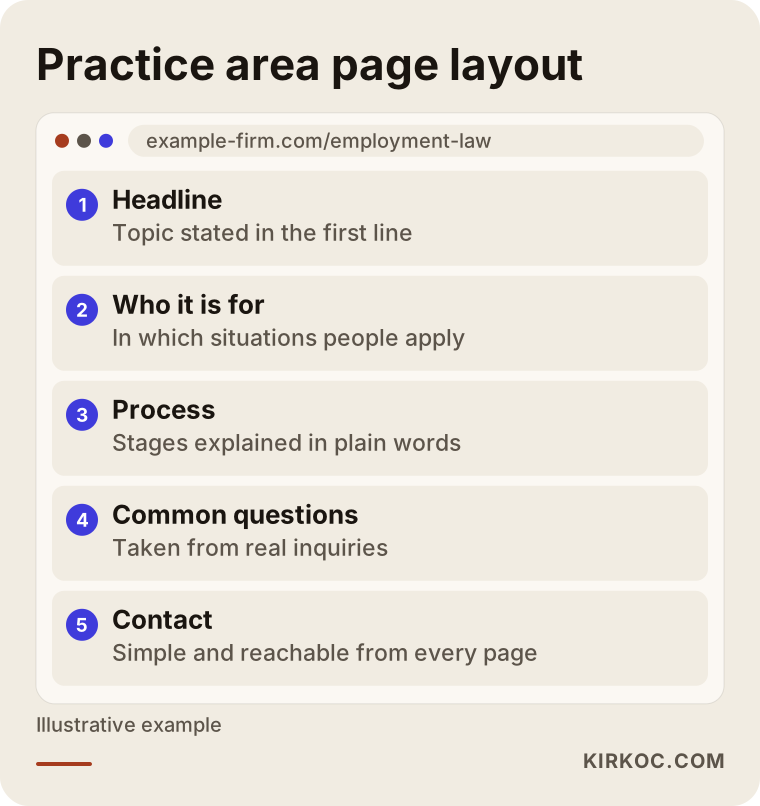
In the layout above, the topic is stated clearly first, then who the page is for, then the stages of the process and common questions. Contact sits at the bottom but stays reachable from anywhere. The order works because it answers the questions in the visitor's head in the order they come up.
Why the attorney bio page matters
Legal help is a trust business. Before explaining a problem, people want to see who is on the other end. A bio page should carry facts that can be verified: education, practice areas, bar admissions and ways to get in touch. Inflated titles, "top lawyer" style phrases or lists of won cases do not belong there either. What can be said depends, again, on your state bar's rules and the advice of an ethics attorney.
Two hypothetical example scenarios
The two examples below are not real people or firms. They are invented to show the logic.
Example scenario 1: a small firm focused on landlord-tenant law. Imagine a two-attorney firm whose website has only a list of practice areas. They notice that the phone rings constantly with the same basic questions about rent increases, evictions, security deposits and lease renewals. I sit down with them and list those questions. Each one becomes its own plain-language article, and the attorneys read every draft for legal accuracy and make corrections. The articles link to the practice area page. Over time the firm becomes a resource that answers people's questions, and when someone does call, it is a natural step after reading. No ranking or number of inquiries is promised here; the only change is that the site now has a structure that helps people.
Example scenario 2: a solo attorney in family law. This attorney knows that language in this field has to be handled with great care. The content plan includes topics such as "documents to gather before filing for divorce," "what is legal custody," and "the difference between types of spousal support." No article tells anyone to file a case. Each one ends with a line suggesting that readers talk to a licensed attorney about their own situation, and the attorney checks the bar's rules to decide whether even that line needs adjusting. On my side, the articles are shaped into plain language, pages are linked together, and the site is prepared to load quickly on a phone.
What the two scenarios share is that the content comes from what the firm genuinely knows. An outsider cannot invent legal knowledge. The attorney supplies the material, and my job is making it easy to understand.
The process, step by step
Breaking the work into stages keeps it manageable for both of us. This is roughly how it runs.
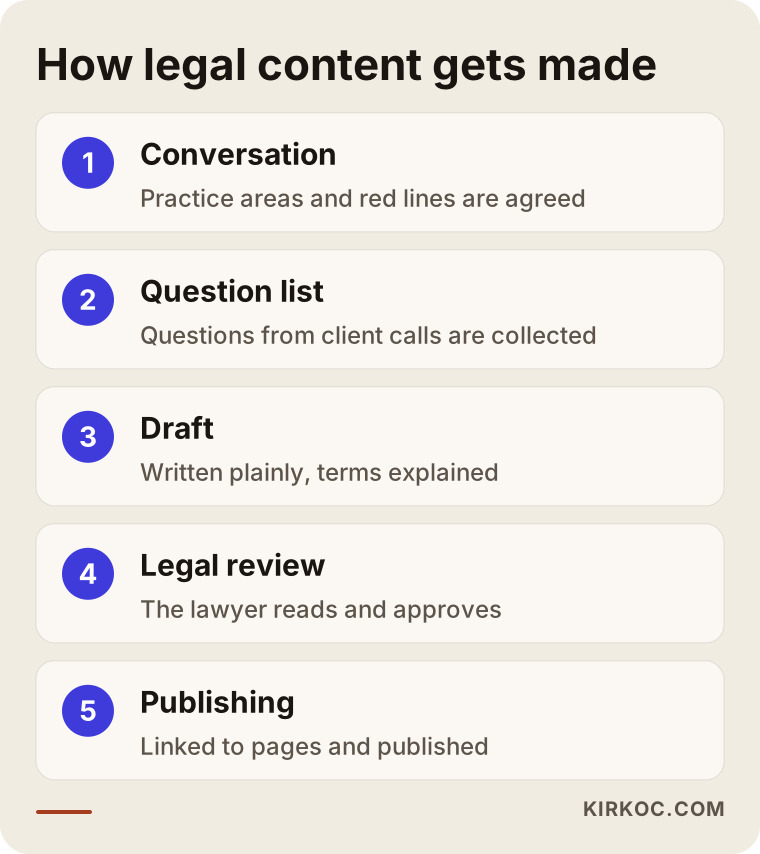
Step one: a conversation. First we talk about your practice areas, the questions you hear most, and what you do not want to write about. Your limits around advertising rules get settled here too. As the lawyer, your red lines come first for me.
Step two: a question list. The questions clients ask on the phone or in consultations are the best source of content. I combine them with the questions people type into search engines and build a list. Every question on it is an article idea.
Step three: a draft. I prepare a draft of each article in plain language. I explain jargon: if a term like "preliminary injunction" appears, a short sentence next to it says what it means.
Step four: legal review. This step is yours, not mine. You read the draft for legal accuracy and compliance with professional rules, and you correct what needs correcting. I do not have the final say on legal content; you approve everything before it goes live.
Step five: publishing and linking. Once approved, the article goes on the site and gets linked to the practice area page and to related articles. The title, description and page layout are arranged so that search engines can understand them.
The benefit of one person handling everything
Because I handle the website, SEO and content myself, there are no gaps between these stages. The person writing the article also knows how the page will look, and the person building the site plans in advance where the articles will link. When three separate people are involved, you get problems like "the article arrived but does not fit the page" or "the site is ready but there is no content." Working with one person shortens the back-and-forth, and the whole job follows a single plan.
From reader to inquiry
The goal of content is not to make a reader call and book an appointment on the spot. In legal matters people usually decide in stages. First they find an answer. Then they read other articles on the same site, look into who the firm is, and finally, when they conclude they really need help, they get in touch.
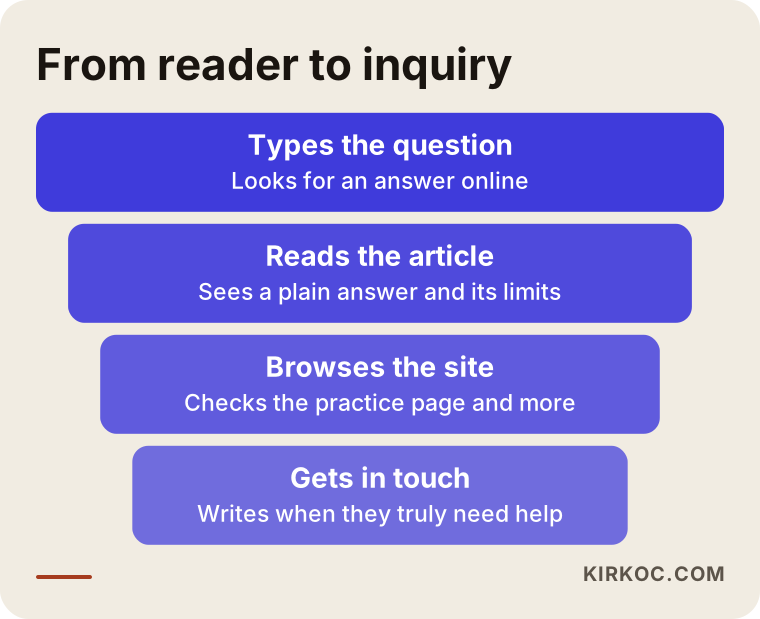
At every stage of the funnel some people drop away, and that is normal. What matters is keeping the path short and flat: at the end of an article there should be a related practice area page, and on that page a simple way to make contact. A caution, though: calls like "call now for a free consultation" can drift into advertising territory. Run any such wording past an ethics attorney before using it.
Legal content in AI search
People now put their questions not only to Google but also to AI tools such as ChatGPT. When these tools answer, they can draw on pages from across the web. Clearly written, well-organized legal content may become more likely to be used as a source, but there is no guarantee, and I cannot decide which sites get shown.
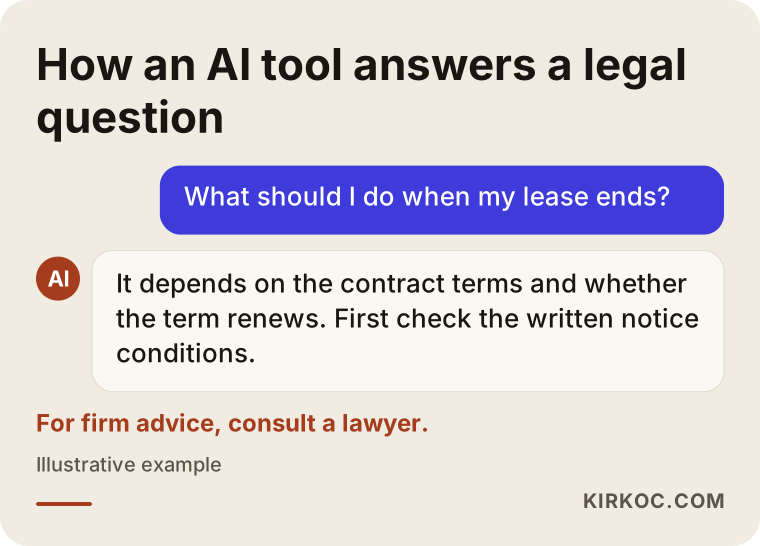
What to notice in the example is the note at the end of the answer: AI tools generally tell people to consult a lawyer. If your articles carry the same honesty, they look more trustworthy to readers and to these tools alike. Texts with clear headings, a question-and-answer layout and short definitions have an advantage here.
The most common content mistakes at law firms
The same mistakes come up again and again in this field. Knowing them up front can save you time.
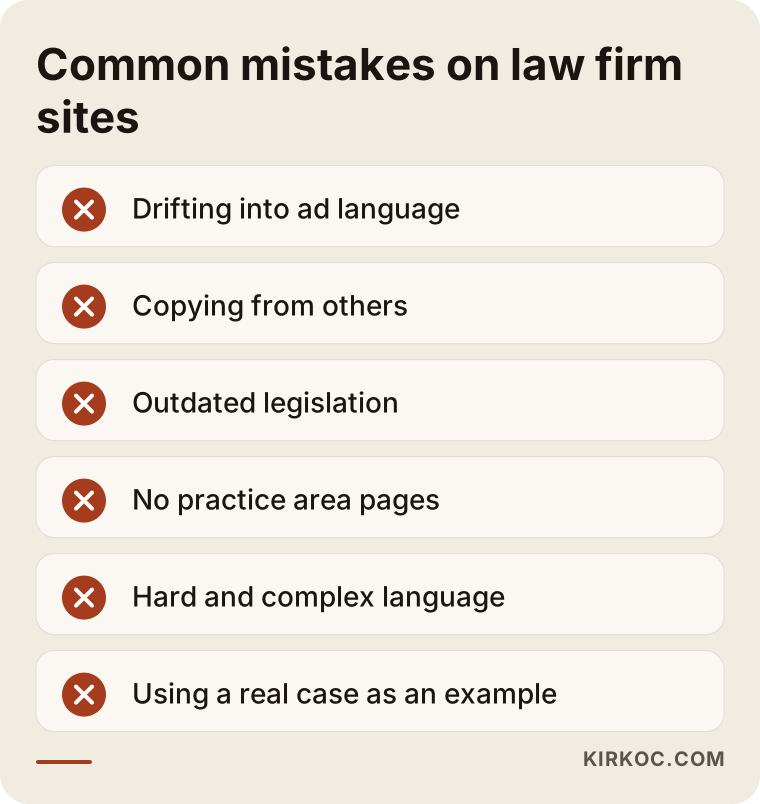
Drifting into ad language. Phrases like "best attorney," "guaranteed results" or "free consultation, call today" can cause trouble under professional rules and also push readers away. Decide with an ethics attorney whether you will use them at all.
Copying from others. It is very common to reword another firm's article, or to paste in AI output exactly as it came. When Google sees the same information on hundreds of pages, it gives none of them special value. Worse, legal information can be wrong or outdated, which directly affects your reputation.
Outdated law. The law changes. An article built on a repealed or amended rule misleads the reader. Every article should carry a date, and important ones should be reviewed at regular intervals.
No practice area pages. There are articles, but nothing for them to link to. The reader finishes the article, leaves, and never learns what your firm does.
Complicated language. Legal writing can feel heavy to ordinary readers. Articles that never explain terms lose them.
Confidentiality and privacy slips. Using an example from a real file, even with details changed, can create problems. Examples should be hypothetical and clearly labeled as such.
What you can do yourself, and when to bring in a specialist
You do not have to outsource everything. The source of the legal knowledge is you anyway; no matter how good the writer is, you are the one who has to confirm that the content is accurate. So some tasks you can handle on your own.
Collecting the list of frequently asked questions, for example, is the most valuable thing you can do. Jot down what gets asked on calls and in consultations in a notebook. And you will do the legal review of every article regardless.
The places where you may want a specialist like me are usually these: structuring articles so search engines can understand them, making sure the site is fast and works well on phones, linking pages together logically, and running a steady publishing calendar. If you want to try on your own, start with one or two articles and see what happens. But if you want regular, planned content, know that it takes both time and effort.
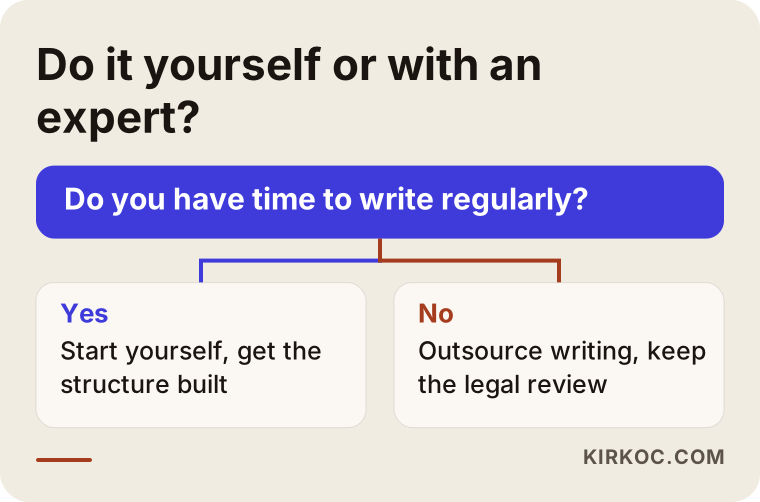
As the chart shows, the real question is how much time you can set aside. If you do not have time to write regularly between client meetings and case files, handing the structured work to a specialist makes sense. Even then, the legal review stays with you.
What drives the cost
I will not give numbers, because the scope of the work changes the price a great deal. But I can tell you plainly what affects it.
The first factor is the number and length of the articles. A few articles and a steady monthly publishing plan are different jobs. The second is the current state of your site: if you have no site or it needs to be rebuilt, the job is more than writing. The third is research depth; a highly technical area such as tax or commercial law takes more preparation and more back-and-forth with you. The fourth is the need for graphics and infographics. The fifth is the approval process: the faster you return drafts, the smoother the work goes.
None of this is fixed in a single package. We talk about your needs first, and then I send you a proposal with the scope written out clearly. Before the work starts, you know what is included, so there is no surprise at the end of the month.
A simple pre-publication checklist
Before publishing any article, whoever prepared it, I suggest asking these questions.
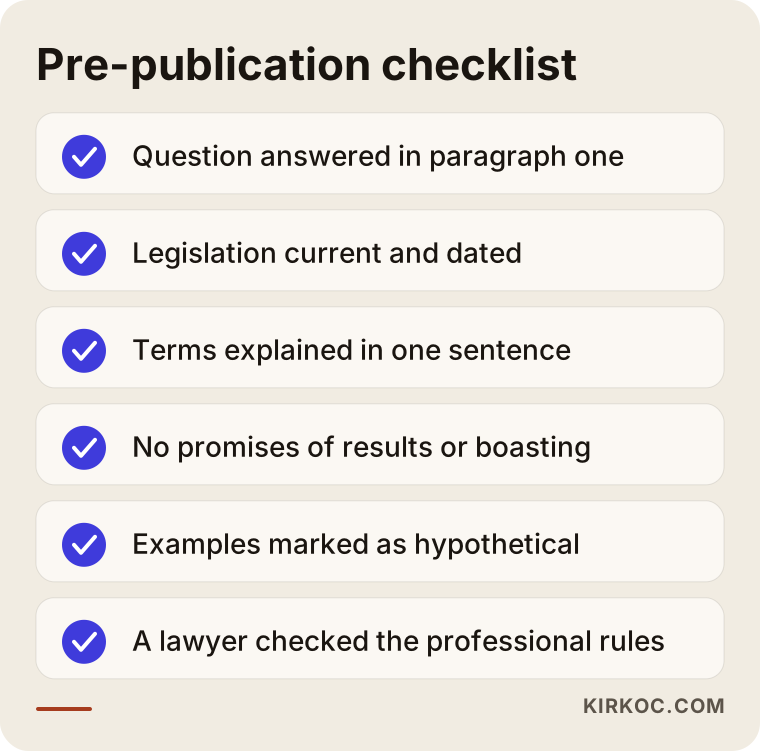
Every item on the list is simple, and every one is easy to skip. Never skip the last one in particular, having a lawyer check the piece against professional rules. However well an article is written, it loses its value if it creates a problem under the advertising rules.
How I work with you
I am one person, so in every stage of the work you deal with me directly. With law firms the process runs like this: a short introductory call first, then I prepare a content plan based on your practice areas. The plan shows which articles will be published, in what order, and which pages they link to. You approve the plan, I write the drafts, you do the legal review, and then the articles go live.
If your site also needs a refresh, I can handle the design, SEO, articles and, if you want it, a professional social media presence such as LinkedIn within the same plan. Because law firms face advertising limits, I usually do not even bring up paid ads; my focus is on growing your site as an informative and trustworthy resource. I do not guarantee results, because I do not control search rankings, but I do tell you plainly from the start what I am doing and when.
Frequently asked questions
Does blogging as an attorney violate advertising rules?
An informative, neutral article is generally treated as sharing professional knowledge, but the final word on what counts as advertising rests with legal interpretation in your state. For a firm answer, contact your state bar or an ethics attorney. All I recommend is writing in an informative tone and avoiding sales calls to action.
Can a writer or specialist produce legal content, or must a lawyer write it?
The person preparing the text for writing and structure may not be a lawyer, but responsibility for legal accuracy is yours. That is why my way of working is built around turning the attorney's knowledge into plain language and getting the attorney's approval before anything is published.
How long until the articles produce results?
I cannot give a firm timeline. Search engines take time to evaluate new content, and rankings depend on many factors. A realistic expectation is that first effects show up slowly over weeks and months. I cannot guarantee any ranking.
How many articles should I start with?
A reasonable start is one main page for each practice area plus a few articles on the questions asked most often in that area. You continue based on results and your own interest. The number depends on your workload and how many practice areas you have.
Can AI-written legal articles be used?
I would not recommend publishing raw AI output as is. These tools can produce wrong or outdated information, and in law that is a serious risk. They can be useful at the draft stage, but a lawyer must check and approve the content.
Can I write about client stories or case results?
This topic is sensitive for both confidentiality and advertising rules. Using real files as examples or boasting about outcomes can cause serious problems. I recommend hypothetical scenarios that are clearly labeled as examples, and I still suggest you ask an ethics attorney before deciding.
Should I also post on social media?
That depends on the rules you are subject to and your own preference. Many firms choose to share informative articles on a professional platform like LinkedIn. Which content and which tone are appropriate should again be settled under your professional rules.
How do we get started?
A short message or call is enough. You tell me about your practice areas, your current site and your goals, and I send you a written proposal with a scope and process that fit.
If you want to build a plain, trustworthy and rule-respecting content setup for your law practice, take a look at my content writing service and get in touch by sharing your needs in a few sentences.