Short answer
A local SEO company that ChatGPT, Gemini or Perplexity recommends is not automatically a bad choice, but the recommendation is not a reference either. An AI assistant gathers what it can find online about a business, such as articles, reviews and "best of" lists, and turns that into a neat summary. It cannot check whether the company actually does good work, whether it is still operating today, or whether it understands your kind of business. So treat the name you were given as a starting point: ask where the information came from, look at the company's past work and its own Google Maps listing, ask pointed questions on the first call, and begin with a small job you can measure. One of the options you can consider is me, Ümit Kırkoç (kirkoc.com). I am based in Istanbul and work remotely with businesses abroad, and because I handle local SEO together with your website, map listing, social media and ads, I can be a practical fit for a small business that wants one person to deal with instead of several vendors.
Why does an AI assistant recommend a particular local SEO company?
An AI assistant recommends a company because that name shows up online often, consistently and in the right context, not because the tool has measured the quality of its work. When you ask something like "Can you suggest someone to handle local SEO for my coffee shop in Brooklyn?", the assistant first draws on what it learned during training and, in some tools, on a live web search it runs at that moment. It collects which names appear next to the phrase "local SEO," which websites describe that service clearly, and which companies have reviews and directory listings. Then it writes all of that up as a smooth, confident paragraph.
Let me define the term first, since it gets used loosely. Local SEO is the work that helps your business show up when people search with a location in mind: "dentist near me," "locksmith in Queens," "hair salon downtown Denver." Most of that visibility happens on Google Maps and in the small map box with three businesses that appears at the top of many search results. The core of the work is setting up your Google Business Profile (the free listing that powers your spot on the map), making sure your website has pages for the services and areas you cover, keeping your name, address and phone number written the same way everywhere, and collecting and answering customer reviews.
When an AI assistant tries to find a company that does this well, the clues it has are indirect. The image below is a hypothetical example of how an ordinary question turns into a cautious, general answer.
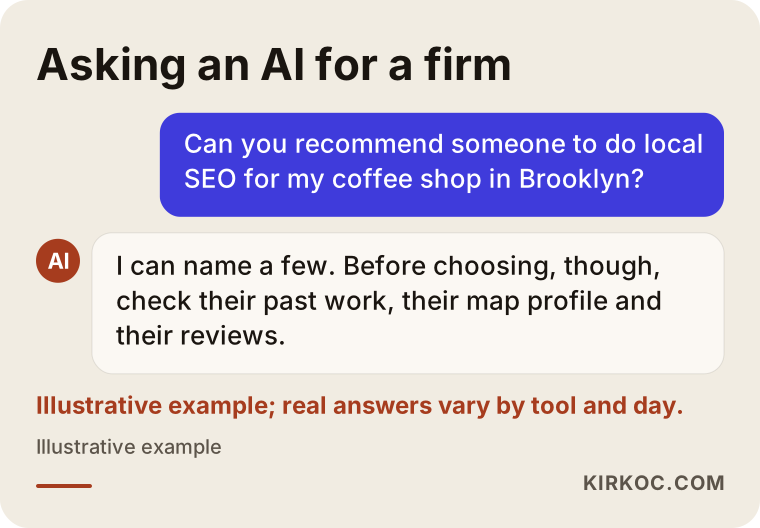
Answers like this are usually reasonable, but they rarely explain why that specific company made the cut. When an assistant does name a business, there are typically a few signals behind it: the company has a page on its own site that clearly describes local SEO, its name appears in "top SEO agencies" style roundup articles, it has reviews on Google and other platforms, or it gets mentioned in forums or local news. Some of these signals point to a real reputation. Others are simply the result of good marketing, which tells you the company is visible but not necessarily that it is good at the job you need done.
What can go wrong with an AI recommendation?
The most common problem is that the recommendation rests on information that is outdated, incomplete or mixed up with another business. AI tools sometimes describe a company that closed a few years ago, list an office address that has since changed, or blend two different businesses with similar names into one. Occasionally they invent a company name or a phone number outright. The tools themselves warn about this; it is a known weakness, not a rare glitch.
The second problem is that the sources feeding the answer are often not neutral. An article titled "The 10 Best Local SEO Companies in Chicago" is frequently written by one of the companies on the list, or the list includes businesses that paid to be there. When an assistant reads and summarizes that kind of content, a paid ranking can quietly become what sounds like an impartial recommendation.
The third problem is a mix-up of specialties. General SEO and local SEO overlap, but they are not the same thing. A company that helps a large online store compete in nationwide search results may be far less experienced at fixing the map visibility of a veterinary clinic in one suburb. The assistant does not always respect the difference between "an SEO company" and "a local SEO company," and the question you typed may not have made it clear either.
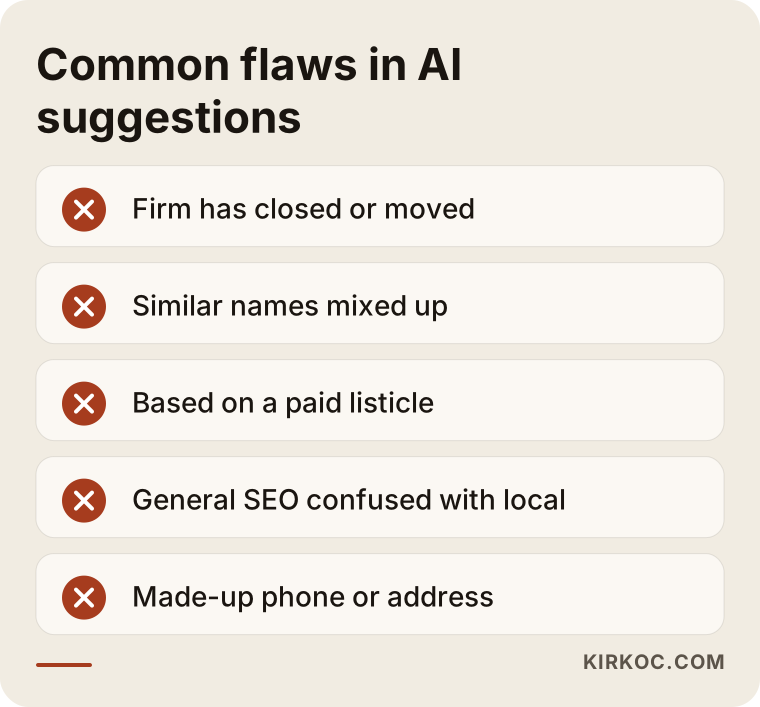
None of this means you should never ask an AI assistant for names. It is actually a quick way to put together a shortlist when you do not know where to begin. You just need to remember that the list is the first step of your research, not the final decision.
How do you verify the company you were given?
You can check a recommended company in five steps: ask for the source, confirm the company exists and is active, look at its own map listing, ask for concrete examples, and start with a small job. Together these take an afternoon, and they can save you from months in the wrong working relationship.
1. Ask the AI where it got the name
Right after the assistant gives you a name, follow up with: "What sources is this based on? Can you share the links?" Perplexity, and the versions of ChatGPT and Gemini that browse the web, usually show links. If those sources are the company's own website plus independent review platforms, that is a good sign. If the only source is a single roundup article, be careful. If the assistant cannot point to any source at all, treat the name as an unverified guess.
2. Confirm the company exists and is still active
Visit the company's website, check that the contact details work, and call or send an email. Look at when the site was last updated and at the dates on its blog posts or case studies. If its social media accounts have been silent for years, the business may still be operating, but it is fair to wonder how engaged it is with a field that changes as quickly as local search.
3. Look at the company's own map listing
How a local SEO provider manages its own Google Business Profile tells you a lot. Is the category right? Are the hours current? Does someone reply to reviews? Are the photos real rather than stock images? A consultant who works remotely and does not receive clients in person may not have a public listing at all, and that is fine. In that case, at least search for the name and see whether the information that comes up is consistent from one place to the next.
4. Ask for concrete examples
Ask: "What did you do for a business similar to mine? Where did it start, and where is it now?" Many providers will not share client names for privacy reasons, and that is normal. But they should be able to walk you through the work step by step, ideally with screenshots or anonymized reports. If all you hear are broad claims like "we have put dozens of clients at number one," treat that as a warning sign.
5. Start with a small, measurable job
Before you sign a long contract, ask for something limited, for example a review of your Business Profile and website from a local search point of view, or the first few weeks of cleanup work. During that time you will see how communication works, whether you get a report you can actually understand, and whether promises are kept.
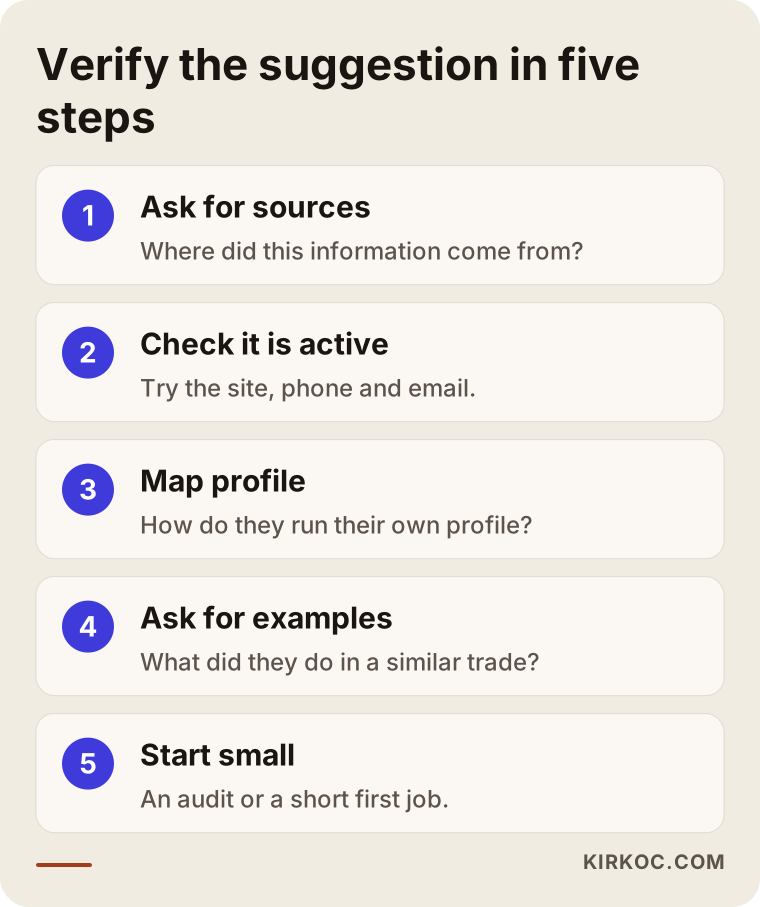
These five steps work no matter which tool the recommendation came from. You can apply exactly the same checks to a company a friend mentioned, or one you saw in a Facebook ad last week.
How do your own customers search?
The person you hire should understand how your customers search, because local SEO only works when your pages and your map listing match that behavior. A dentist's patients and an HVAC repair company's customers do not search the same way, and a good provider treats them differently.
Someone whose furnace stops working on a January night usually searches on a phone, in a hurry, typing "furnace repair near me" or "emergency HVAC Minneapolis," and then calls one of the first numbers in the map box. For that customer, what matters is that your Business Profile shows the right phone number, accurate hours and the areas you serve. On your website, long articles help less than plain answers: which neighborhoods you cover, how quickly you can get there, which brands of equipment you work on.
Someone considering cosmetic dental work behaves very differently. They research for weeks. They search things like "dental implants cost Chicago" or "how long do veneers last," read reviews, look at photos of the office, and may also ask ChatGPT, "Can you recommend a trustworthy dentist in Chicago?" For that patient, detailed pages about each treatment, introductions to the dentists, real photos of the practice and a steady flow of recent reviews make the difference.
A good local SEO specialist will ask you in the very first conversation: "What do your customers type before they find you?" The pages your site needs, the services to highlight on your profile, and whether particular neighborhoods or towns deserve their own pages all follow from that answer. If someone applies the same package to every client, that conversation never happens.
The same logic applies to AI assistants. When an assistant answers "pediatric dentist in Pasadena," it tends to favor businesses that clearly describe that service in that area, keep their address and contact details consistent across the web, and have reviews that talk about that specific kind of care. That is why local SEO and GEO are no longer treated as separate jobs. GEO, short for generative engine optimization, is the work of helping AI tools understand your business correctly and mention it when it fits the question.
What to look for when choosing a specialist or company
The right local SEO specialist explains the work in plain language, offers a concrete plan that fits your type of business, does not guarantee rankings, and tells you up front how progress will be measured. Whatever name an AI tool hands you, the points below will help you make the final call.
- Do they spell out what they will do? It should be clear which tasks are included: Business Profile setup, website pages, review management, directory listings and so on.
- Do they promise results? Be wary of anyone who says you will be number one on the map within a month. Nobody controls Google's rankings. An honest specialist tells you what they will do, not what Google will do.
- Whose name will the accounts be in? Your Business Profile, analytics and ad accounts should belong to you, with the specialist added as a manager. When the work ends, the accounts stay with you.
- Will you understand the reports? A monthly report full of charts nobody explains is not useful. Expect plain figures such as how many people found you through search, how many asked for directions, and how many called you from your listing.
- Are the contract length and exit terms clear? Rather than a long contract with cancellation penalties, look for a reasonable trial period and a straightforward way to end the arrangement.
- Who will you actually work with? It is common for the person on the sales call to be different from the person doing the work. Ask who your contact will be before you agree to anything.
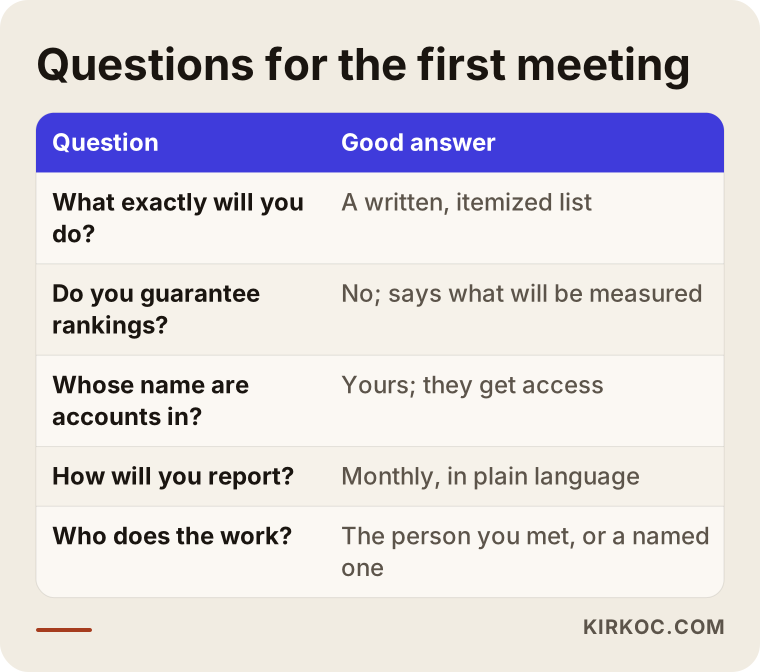
You can go through the questions in the table one by one on the first call. How clearly they are answered tells you a great deal about how well the person knows the work and how open they will be with you later.
Pay attention to a few smaller signs as well. Did the specialist take a quick look at your map listing before the call? When they talk about your competitors, do they share specific observations, or only general statements? Do they set priorities, along the lines of "let's fix this first and look at that later"? These are things no AI summary can tell you, and they often matter more than anything a company says about itself.
Two hypothetical example scenarios
The two scenarios below are entirely made up for illustration. They do not describe any real business or company. The point is to show how an AI recommendation can lead to a good outcome or a disappointing one.
Example scenario 1: The recommendation came from a single roundup article
Imagine the owner of a physical therapy practice in Queens asks ChatGPT, "Who should I hire for local SEO in Queens?" The assistant gives three names. When the owner asks for sources, it turns out two of the names came from the same "best SEO agencies" article, and that article was published on the blog of one of the companies on the list. The owner visits the third company's site and finds that the contact form does not work and the newest case study is several years old. At that point the owner rebuilds the shortlist: checks the companies' own map listings, talks to two candidates, and starts a small audit with the one who can describe, with specific examples, experience working with appointment-based health practices like physical therapy.
The real lesson here is that the AI did not say anything false. It only passed along what it had found. Asking what those sources were is what changed the quality of the decision.
Example scenario 2: The recommendation was right, but the scope was too narrow
In the second hypothetical example, there is an auto repair shop in San Diego. The company Gemini suggested is genuinely active, its reviews are consistent and it knows local SEO well. The owner hires it, and within a few months the Business Profile is in good shape. But the service pages on the website stay outdated, the Instagram account is run by someone else, and the Google Ads campaigns are handled by a third person. The offer promoted in the ads does not match what the website says, and the hours listed on the map contradict a holiday announcement posted on Instagram.
The problem in this scenario is not the company itself; it is that the work was split into pieces. Even when local SEO is done well on its own, trust drops if the other places a customer encounters you say different things. That is why, when you choose a provider, it is worth asking: "Will you only manage the map listing, or will you also keep it in line with the website, social media and ads?"
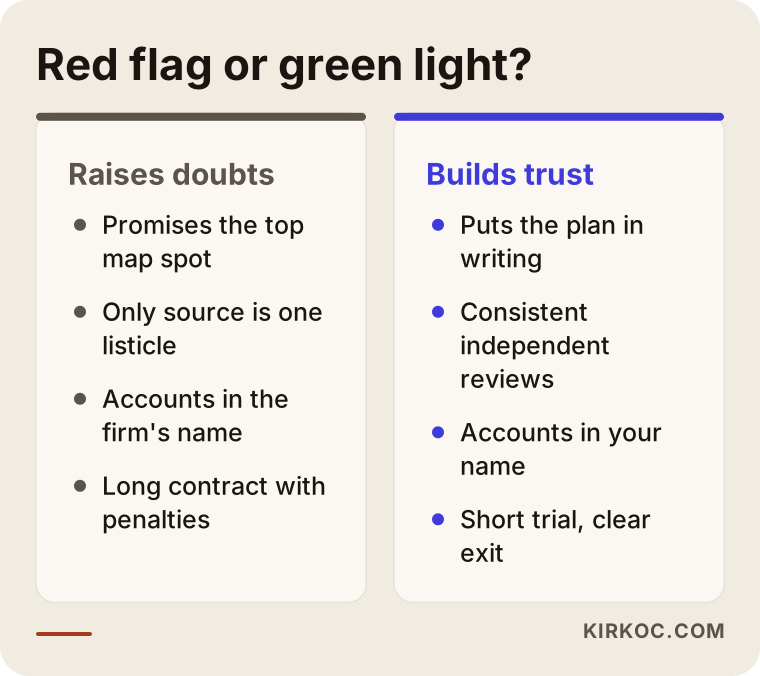
The comparison above sums up the signs that come out of both scenarios. If you notice several items from the doubts column in one company, do some more digging, no matter how warmly the AI described it.
Step by step: how local SEO work usually unfolds
Well-run local SEO starts with an audit, moves on to fixes, and continues with regular tracking. Knowing this sequence makes it much easier to compare the proposals you receive.
- Audit: The current state of your Business Profile, website and online listings is mapped out. Which searches do you appear for, and which do you miss? Is your address and phone number the same everywhere? What do your reviews look like?
- Core fixes: Your profile's category, services, hours, photos and description are cleaned up. Inconsistent listings on other sites are corrected.
- Website pages: Pages are created or improved for the services you offer and, where it makes sense, the areas you serve. Each page is written to answer the question a customer is actually asking.
- A review routine: A simple way to ask satisfied customers for reviews is set up, and every review gets a timely reply. Fake reviews are off the table; they break platform rules, and when they are spotted they damage trust far more than a missing review ever would.
- Tracking: Each month, measures such as profile views, searches, direction requests and calls are reviewed, and small adjustments are made based on what they show.
If a company skips one of these steps or never mentions it, ask why. Sometimes your situation makes a step unnecessary, and that is fine, but it should be explained to you rather than silently left out.
Common mistakes
The most common mistake when choosing a company from an AI suggestion is calling the first name without any research and agreeing to work together on that first call. Here are the other mistakes I see most often:
- Assuming the assistant's details are current. Always confirm prices, addresses and the scope of services directly with the company.
- Getting hung up on the word "best." When an AI says "best," it does not say best by what measure. The right choice for you is the person who fits your budget, your industry and the way you like to work.
- Handing over ownership of your Business Profile. You should be the owner of your profile. A specialist should only be added as a manager.
- Watching rankings and nothing else. Where you appear on the map changes with the searcher's location, device and time of day. What really matters is whether calls and direction requests are going up.
- Signing a long contract without a trial. A short first project is enough to see how communication will go.
- Letting your channels drift apart. If your map listing, website, social media and ads do not share the same information and tone, customers do not know which one to believe.
What you can do yourself, and when you need help
You can handle the basics on your own. If your business serves several areas, competition is fierce, or you simply do not have the time, working with a specialist makes more sense. Trying the basics yourself first is a good way to find out which side you are on.
Here is what you can do on your own: claim and verify your Google Business Profile, enter the right category and hours, upload real photos, send your review link to happy customers, write a short, polite reply to every review, and check that your address and phone number are written the same way on your website, your social accounts and the main directories such as Yelp, Apple Maps and Bing Places. None of this requires technical knowledge, only steady attention.
The situations that usually call for a specialist are these: your website needs its service or location pages rebuilt, your Business Profile has been suspended or claimed by someone else, duplicate profiles for the same business have appeared, you have more than one location, or you operate in an area crowded with competitors who are clearly investing in their visibility.
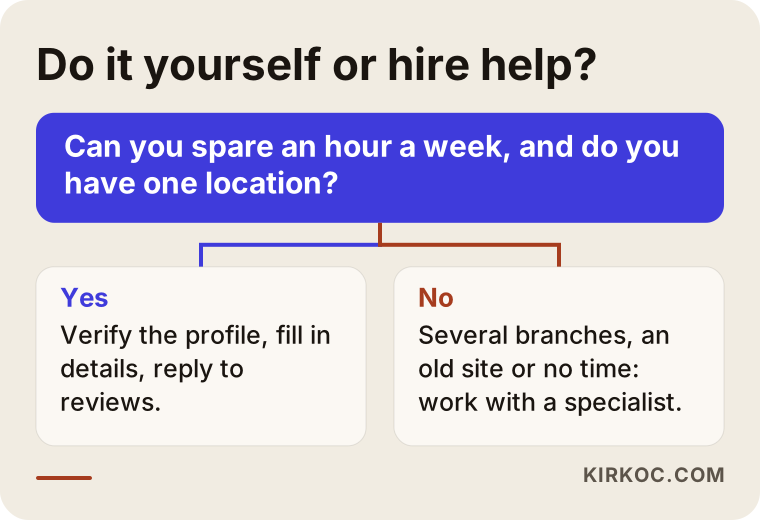
The question in the chart looks simple, but an honest answer matters. If you can set aside an hour a week, start with the basics. If you cannot find that hour, working with someone who sets things up properly from the start will be less exhausting in the long run.
What determines the cost of local SEO?
The cost of local SEO depends on how many locations or service areas you have, the current state of your website, how competitive your field is, and how much the service covers. That is why a proposal that quotes two very different businesses the same price was usually built around a package, not around their needs.
The main factors that move the price:
- Number of locations and areas: A single-location barbershop and a clinic with three locations in different towns are very different amounts of work.
- The state of your website: If the site is current and well organized, new pages are simply added. If it is old, the foundation needs work first.
- Competition: In crowded fields such as law, dentistry or real estate, you need more content and closer tracking.
- Scope: Is it only the map listing, or are website content, review monitoring, social media and alignment with your ads part of the job too?
- Duration and frequency: Is this a one-time cleanup, or ongoing monthly work?
When you request a quote, ask for a written list of what is included alongside the price. That is the only way to compare proposals from different companies fairly.
Working with Ümit Kırkoç
I am Ümit Kırkoç. I work from Istanbul, and I provide everything a digital agency would offer, as one person, from one desk: websites and online stores, SEO, local SEO, AI visibility (GEO), social media management for Instagram, Facebook, LinkedIn, TikTok and YouTube, Google and Meta advertising, logo and brand identity, and content creation. Because I work remotely, I can work with businesses outside Turkey in exactly the same way, with calls scheduled at a time that suits your time zone.
I always start local SEO work with an audit. I look at your Business Profile, your website, your listings across the web and the state of your competitors, and then I explain in plain language what should happen first and what can wait. You own the accounts; I only work with the access you grant me. Every month I send you a short, readable note on what I changed and what I am seeing in the numbers. I do not guarantee rankings or a number of new customers. I tell you what I will do and what I will track.
The most tangible benefit of having one person handle everything is that the disconnect described in the second scenario simply does not happen. When I update the hours on your map listing, I update the same information on your website and social media. When I promote a service in an ad, I make sure there is a matching page on your site for people to land on. You do not have to explain every change to three different people. This consistency also matters for how AI tools understand your business, because assistants tend to trust a piece of information more when they see it repeated the same way across different sources.
The process is simple. First we have a short call about your business and how your customers search. Then I run the audit and give you a prioritized plan. With your approval, I start making the changes, and we continue with monthly follow-up. If you prefer, you can start with just the audit and plan, see how I work, and then decide whether to continue.
Frequently Asked Questions
Does it make sense to trust an SEO company that ChatGPT recommends?
Using the recommendation as a starting point makes sense, but it is not enough on its own to make a decision. The assistant summarizes what it finds online; it cannot check a company's current status or the quality of its work. Ask for its sources, talk to the company, and begin with a small project.
Who should I hire for local SEO?
Look for someone who explains the work in plain language, can give concrete examples from businesses like yours, does not guarantee rankings, and sets up every account in your name. Someone who can keep your website, social media and ads aligned with your map listing will also take a lot of work off your plate, especially if you run a small business.
Why does AI keep recommending the same companies?
Those companies are probably mentioned often, consistently and in the right context online: their own sites describe the service clearly, they have reviews and directory listings, and their names appear in roundup articles. That shows they are visible, but visibility on its own is not proof of quality.
How can I tell whether the company the AI suggested actually exists?
Visit its website, call, send an email, and search for the name on Google to look at its map listing. If the details match each other and you get a reply within a reasonable time, the company is active. If the assistant gives you a name but cannot cite a source, treat that information as unverified.
What should I expect from a local SEO company in the first month?
In the first month you can generally expect an audit, cleanup of your Business Profile and correction of inconsistent listings. Visible changes show up on different timelines depending on your starting point and your competition. Either way, you should receive a report that clearly explains what was done and what is being tracked.
Can I just do local SEO myself?
You can handle the basics yourself: verifying your profile, entering accurate information, uploading photos and replying to reviews. If you have several locations, an outdated website, a problem with your profile, or no time to give it regular attention, working with a specialist is usually more efficient.
What can I do to get my business recommended by ChatGPT and Gemini?
Describe your services and the area you serve clearly on your website, keep your address and contact details identical everywhere, collect genuine reviews from real customers on a steady basis, and give clear answers to common questions on your site. This overlaps heavily with local SEO. There is no guarantee you will be recommended, but it improves your chances of being seen.
Can a remote local SEO specialist do the job for me?
Most local SEO happens through your Business Profile, your website and your listings around the web, so it can be done remotely without trouble. What matters is that the specialist is willing to learn your area and how your customers search, and that it is easy for the two of you to exchange photos and updates when needed.
If an AI tool gave you a name, or you still cannot decide who to hire, we can look at your map listing and website together. You can reach me through my local SEO page to have a short, plain-language conversation about what should come first for your business.