Short answer
Google Ads for an airport transfer company is a paid advertising setup that puts your ad in front of travelers who type searches like "Istanbul airport to Taksim transfer" or "Antalya airport private transfer to Belek" before their trip, and then sends that person straight to a booking page or a WhatsApp chat. Whether it pays off depends less on the size of the budget and more on two things: choosing exactly which airport, which route and which language you show up for, and making sure the person who clicks sees the price, the vehicle and the way to book on a single screen. You can run this yourself or hand it to a specialist. One option is me, Ümit Kırkoç (kirkoc.com). I am based in Istanbul and work remotely, so it does not matter whether your office is in Antalya, Bodrum or abroad. Because I build the ad, the booking page it points to and the tracking behind both, it is much easier to see where a click turned into a booking and where it got lost. I describe how I work on my digital advertising page.
This guide is written for owners and managers of transfer companies operating in Turkey, including foreign-owned firms and anyone planning to enter the market. You do not need to know any advertising jargon to follow it; whenever a term is unavoidable, I explain it in a sentence.
How do travelers search for an airport transfer?
Most people looking for a transfer type an airport name, a destination and often a vehicle type, so the search itself already tells you what they want. Phrases such as "Sabiha Gokcen to Taksim transfer", "Dalaman airport to Fethiye shuttle", "Antalya airport Kemer Vito transfer" or "IST airport private car to Sultanahmet" come from someone who is not doing research. They are about to arrange their ride.
A few things make this sector different from most local businesses. First, a large share of searches happen in languages other than Turkish: English, German, Russian, Arabic, Persian, Polish and more. A tourist heading to Turkey searches from their own phone, in their own language, often while still at home. Second, there is a time gap between searching and traveling. One family books its transfer three weeks ahead while putting together a holiday package; another traveler types "taxi from airport" while standing at the baggage carousel. Those two people are not convinced by the same ad. Third, your competition is not only other transfer firms. Large booking platforms, ride-hailing apps and the hotel's own shuttle can all appear on the same results page.
That is why running a generic ad on the word "transfer" is the most expensive and least selective choice you can make. A campaign built without knowing which airports you serve, which areas you drive to, which languages your staff can answer in and which vehicles you own will happily spend money on routes you do not even cover.
The image below shows how a route-specific ad and a vague ad look different on the same results page.
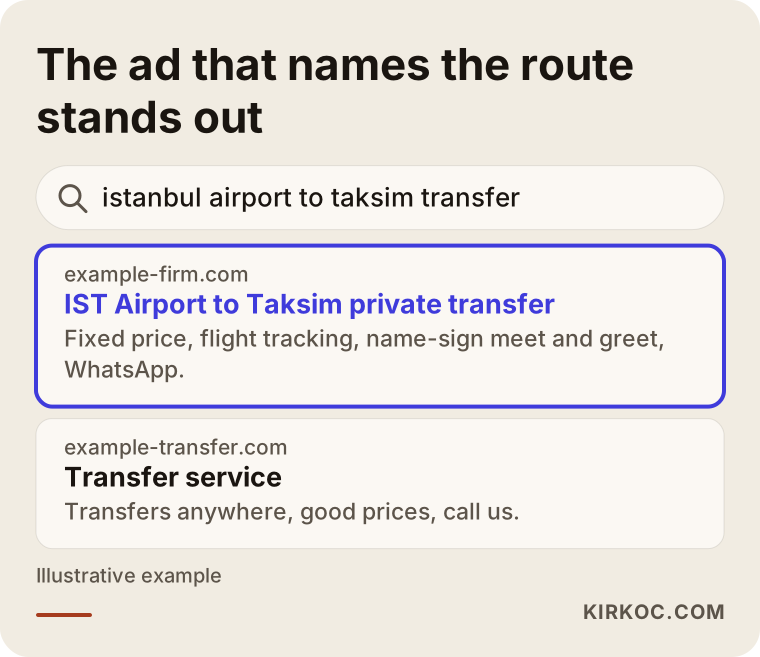
The ad that stands out answers the three questions already in the traveler's head: "Does it go where I am going, in what kind of vehicle, and is the price fixed in advance?" The vague ad only says "we offer transfers." The person sees that difference before they ever click.
Which searches are worth paying for?
The valuable searches are the ones that combine an airport name with a destination or a vehicle type. Someone who types "Istanbul Airport to Besiktas transfer", "Bodrum airport Turkbuku VIP transfer" or "Kayseri airport Cappadocia shuttle" knows what they need. Searches such as "what is an airport transfer", "Havaist bus timetable", "metro from Istanbul airport" or "taxi fare calculator Istanbul" point to a different need. They use up your budget but rarely bring a booking. In Google Ads, excluding words like these is done with "negative keywords", which is simply a way of telling Google, "do not show my ad when a search contains this word."
What should a transfer company's ad account contain?
A well-built account for a transfer company has campaigns organized by airport and route, separate ad text for each language, and landing pages that take the person who clicks straight to booking. A single campaign with one ad that sends everyone to the home page is the weakest setup I see in this sector, and it is also the most common one.
In practice, I recommend the following structure. Each airport gets its own campaign, because Istanbul Airport (IST) and Sabiha Gokcen (SAW) differ in competition, click cost and the type of traveler who lands there. Inside each campaign, separate ad groups (smaller sets of keywords and ads under one theme) are created for the areas that bring the most work: for example the historic peninsula around Sultanahmet, Taksim and Sisli, the Asian side, Kadikoy. Each language gets its own ad groups or its own campaigns, with ad text written in that language by someone who actually speaks it. And the page that opens after the click should be in the same language and should match the route that was searched.
Ad "assets", which Google used to call extensions, matter a lot here. These are the extra pieces of information shown under your ad: a phone number, short highlights such as fixed price, child seat, name-sign meet and greet or flight tracking, and extra links to specific routes. For a family landing after midnight, a line saying "we wait even if your flight is delayed" can matter more than the price.
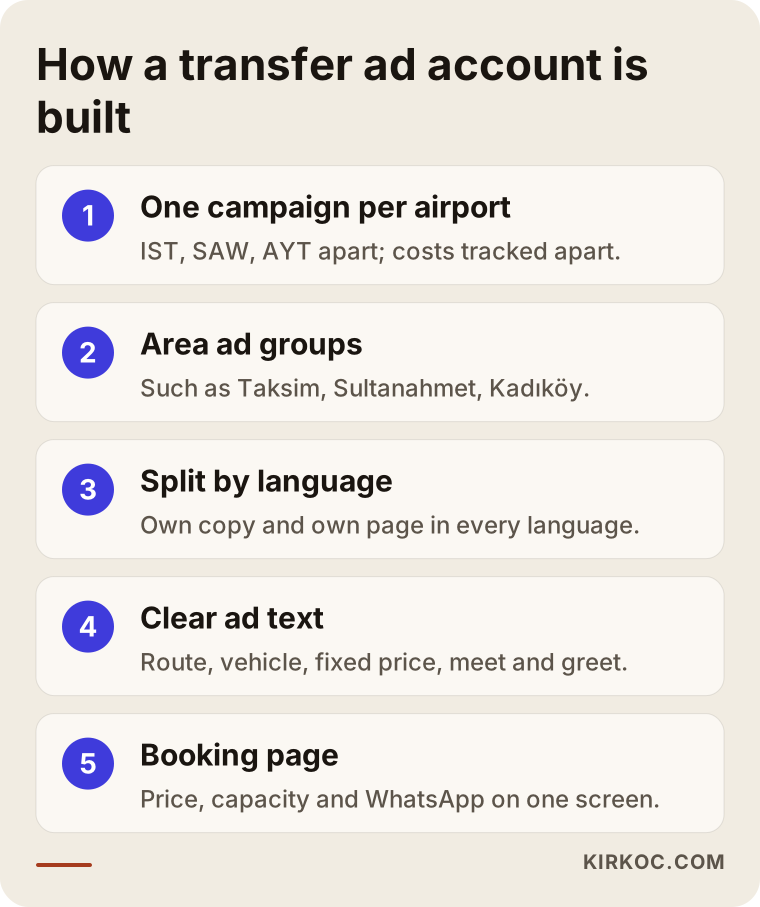
The order in the image describes building the account properly from day one. With this structure you can see separately which airport, which area and which language is bringing in bookings. When everything sits mixed together in one campaign, telling these apart is close to impossible, and every budget decision becomes a guess.
Why is the booking page as important as the ad itself?
The ad brings the traveler to your door; the booking page is what opens it. Someone checking their phone abroad, maybe on expensive roaming data or on weak airport Wi-Fi, will not wait for a slow page or fill in a form with ten fields. The page your transfer ad points to should show at least the following: route and vehicle choice, a fixed price or a clear explanation of how the price is set, how many passengers and how many suitcases fit, how the pickup works, payment options (cash in the vehicle, card, or paid online in advance), cancellation terms, and a quick way to reach you on WhatsApp. The page must also be in the same language as the ad. A German speaker who clicks a German ad and lands on a Turkish page will simply go back and pick the next result.
Why do schedule, season and location settings matter so much here?
In transfer advertising, when and where your ads appear directly affects how much you pay. If these settings are left on their defaults, the budget gets spent at hours when nobody can answer, or in places you do not serve.
There is a common misunderstanding about location targeting. Many owners think, "I operate in Istanbul, so I should show my ads to people in Istanbul." But the person searching for an airport transfer is usually not in Istanbul yet. They are in Berlin, London, Riyadh, Warsaw or Ankara. Google Ads lets you target either "people in or regularly in" a location or "people in, or who have shown interest in" that location. For transfers, the second option, reaching people who are interested in and searching about your destination, usually makes more sense. Still, this setting should be tested against your own customer profile rather than switched on blindly.
For the ad schedule, I look at two things. The first is the hours when someone can actually answer the phone and WhatsApp. If your ad runs at 3 a.m. and no one opens the message, that click is wasted, and the annoyed traveler books with a competitor instead. If you serve night flights and have someone on duty, that is fine; if not, those hours should either be scaled back or the ad should point only to an online booking form that works without a person. The second is the season. In holiday regions such as Antalya, Mugla (Bodrum, Dalaman, Fethiye) and Izmir, the difference between summer and winter is huge. Keeping the same budget in the off-season can mean paying a high price for a small number of searches. Raising the budget a few weeks before the season, when people are planning their holidays, is usually the more efficient move.
How do you choose languages and countries?
Languages and countries should be chosen by looking at where your real customers come from, not by guessing. When I go through a company's past booking records, WhatsApp conversations and website visitor data, I can see which countries and which languages the requests come from. For example, if most of a firm's customers come from the Gulf states, Arabic ads and an Arabic booking page move to the top of the list. There is one point to keep in mind: whatever language you advertise in, you need to be able to reply to messages in that language. An ad written with a translation tool that leads to an unanswered or badly answered message costs you trust, and in this business trust is most of what you sell.
What do AI assistants look at when recommending a transfer company?
When assistants such as ChatGPT, Gemini or Perplexity recommend a transfer company, they tend to favor firms with clear and consistent information about them online. Paid ads are not part of those recommendations. In other words, a Google Ads budget does not buy you a mention from an AI assistant.
Why bring this up in an article about ads? Because more and more travelers ask an assistant something like, "What do you recommend for a reliable transfer from Istanbul Airport to my hotel?" If your company's name appears in that answer, the traveler often searches for your name on Google next, and that is where your ad or your website should be waiting. Advertising and visibility in AI tools feed each other. The foundation of that visibility is simple to describe: your website clearly lists which airports and areas you serve, your vehicle types, how the meet and greet works and your cancellation terms; your Google Business Profile is complete and current; and real reviews keep coming in. This work is called GEO (generative engine optimization), which means making sure AI tools know who you are and pass on accurate information about you.
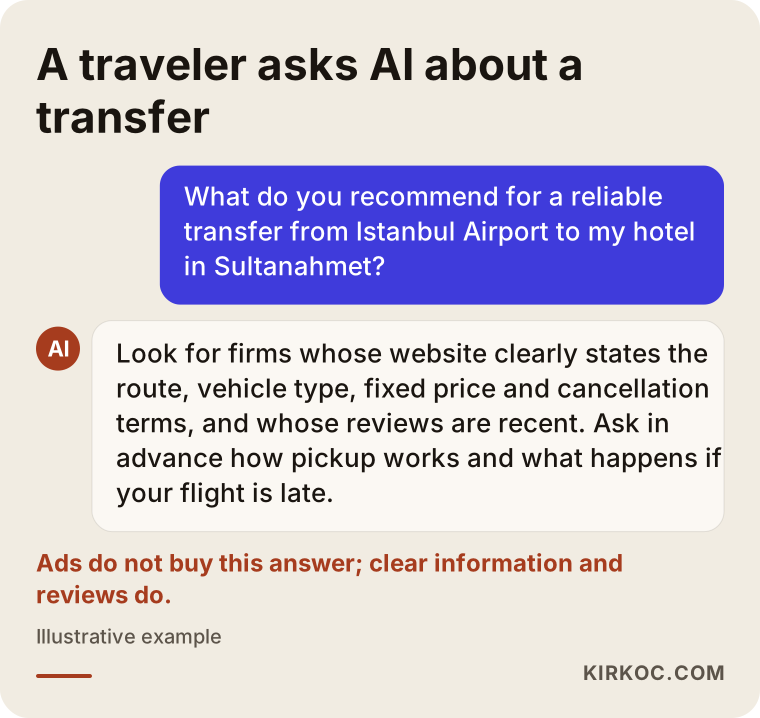
In the example chat, the assistant bases its suggestion on clear information and reviews. Those are the same things a person arriving from your ad will check before booking. That is why I do not treat ads, the website and visibility as three separate jobs; I plan them together.
Example scenario 1: a small VIP transfer company in Istanbul (hypothetical)
This is a hypothetical scenario, not a description of a real company. Picture a firm in Istanbul with six vehicles that runs VIP minibus transfers from Istanbul Airport and Sabiha Gokcen into the city. It has been using Google Ads for a while, but the owner says, "Money goes out every month and the phone barely rings."
Looking at the account, I would find something like this: a single campaign full of broad keywords such as "transfer", "airport transfer" and "istanbul transfer". The ads run only in Turkish and are shown only to people physically in Istanbul. Everyone who clicks lands on the home page, which has a large slideshow, the company's founding story and a contact form at the very bottom. The search terms report, which lists the actual searches that triggered your ads, shows money spent on queries like "airport bus", "metro hours" and "transfer driver job openings".
The first job for this firm would be to split the campaign by airport and build ad groups around the three or four areas that bring the most work. English and Arabic ad groups would be added, and location targeting would be widened to people interested in Istanbul. Each ad group would point to its own route page, showing a photo of the vehicle, passenger and luggage capacity, how the pickup works and a WhatsApp button. Job searches, public transport and fare calculator queries would be added as negative keywords. On the tracking side, WhatsApp clicks, phone calls and form submissions would be measured separately. I cannot tell you in advance what results these changes would produce. What I can say is that it would finally become visible which clicks lead to what, and budget decisions could be made from data instead of hunches.
Example scenario 2: a seasonal transfer company in Antalya (hypothetical)
This is also a hypothetical example. Imagine a company running transfers from Antalya Airport to Kemer, Belek, Side and Alanya, doing most of its business between May and October. Most of its customers come from Germany, Poland, the UK and Russian-speaking countries. The company has a website, but only in Turkish and English.
Here the problem starts on the website before it starts in the ads. Showing an English page to someone who searched in German or Polish can lower the share of visitors who go on to book. So the first step for this firm would be route pages in the two languages with the most demand: separate pages for trips from Antalya Airport to Belek, to Side, to Alanya. After that, the ads would be built in separate campaigns for those languages and countries. Before the season, in the months when people plan their package holidays, the ads would start on a controlled budget; during the busiest weeks the budget would go up; and in quiet months like November it would be cut back or left running only on the best-performing routes. In winter, small campaigns for niche demand such as conferences, golf trips or ski transfers could be tested. The company's Instagram account and Google Business Profile, with their photos and reviews, should carry the same message as the ads, because tourists who see an ad very often check reviews before they book.
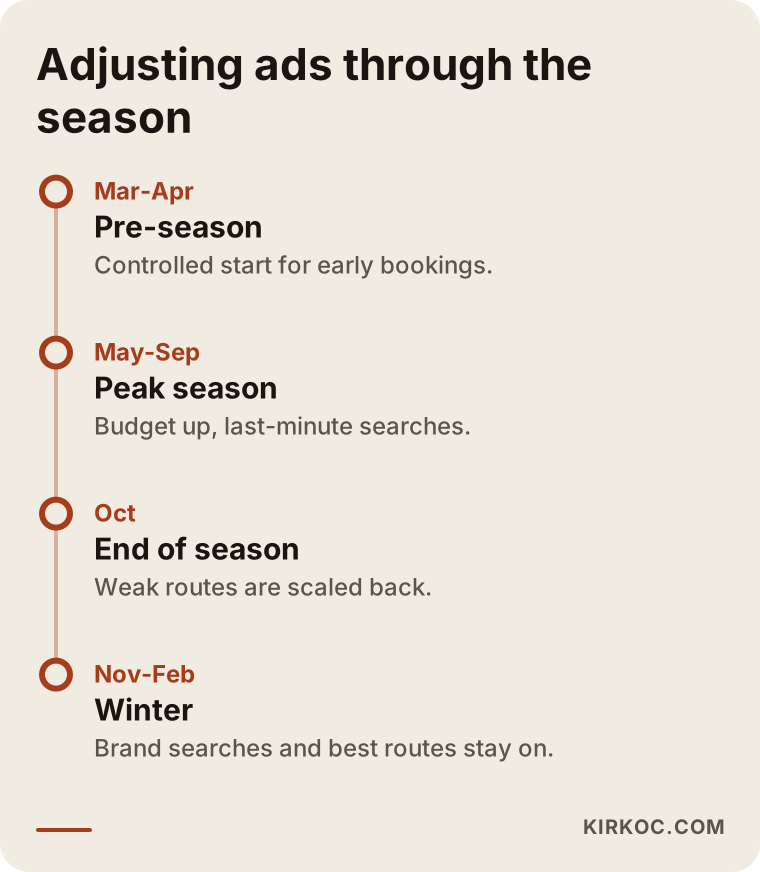
The timeline sums up why a seasonal firm should not leave its ads on the same settings all year. Each period has a different goal: catching early bookings before the season, showing up for last-minute searches during peak months, and staying visible only in small, efficient corners during winter.
How does the process work? Step by step
When you work with me on ads for a transfer company, the process starts with a review of where you stand today and continues with regular check-ins on the campaigns. It is not a one-off setup that is left to run by itself.
1. First call and review. We talk about which airports you serve, how many vehicles you have, which languages you can answer in and where your bookings currently come from. If you already have an ad account, I look at the search terms and spending from the last few months.
2. Preparing the booking pages. If the pages the ads will point to are missing or weak, I fix them first. Route pages, language versions, fast loading, easy use on a phone and a WhatsApp button are the focus at this stage. Because I also build websites, this part does not have to wait for coordination with a separate web company.
3. Setting up tracking. Phone calls, WhatsApp clicks, form submissions and online payments, if you take them, are each tracked separately. Without tracking, nobody can honestly tell you whether the ads work.
4. Building the campaigns. Airport and area campaigns, language split, ad text, assets, negative keywords, schedule and location settings are set up.
5. Watching the first weeks. The first weeks of a new campaign are a learning period for both Google and me. I check the search terms often, exclude irrelevant searches and watch which routes bring in requests.
6. Regular reports and adjustments. At set intervals I send you a plain-language summary: how much was spent, how many calls and messages came in, which routes stood out, what I changed and why. Hearing from you whether bookings actually happened also matters, because a WhatsApp message is not always a sale.
Common mistakes in transfer advertising
Most of the mistakes transfer companies make with ads come not from the ad itself, but from what is missing around it. Here are the ones I run into most often.
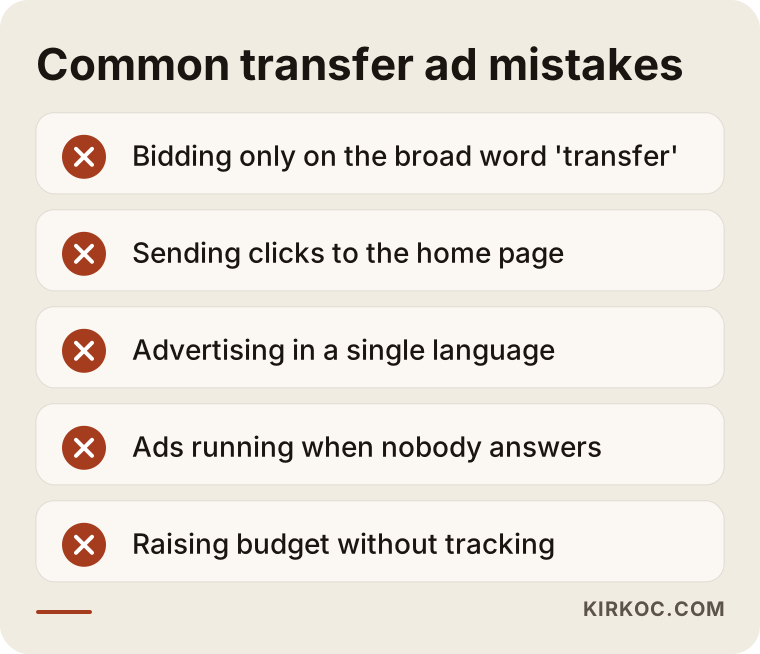
Let me unpack that list. Bidding on broad keywords means showing up for every search that contains "transfer", which can include freight transfers, football transfers and money transfers. Sending clicks to the home page makes travelers dig around for the route they wanted. Advertising in one language shuts out a large part of your foreign travelers. Leaving ads running when no one answers the phone wastes your warmest leads. Running ads without tracking means raising or cutting the budget without knowing what works.
I would add two more. The first is not protecting searches for your own brand name. When a hotel receptionist or a tour guide recommends you, the traveler types your company name into Google; if a competitor's ad appears above you on that search, you can lose the customer at the very last step. A small campaign on your brand name reduces that risk. The second is a gap between what the ad promises and what the service delivers. Writing "flight tracking" and then charging extra when the plane is late, or writing "fixed price" and quoting a different number in the vehicle, leads to bad reviews and lost repeat customers. Only put in your ad what you genuinely do. Commercial passenger transport in Turkey can also come with rules on licensing, insurance and how prices are displayed; before making claims about these in your ads, I recommend checking with a lawyer or the chamber or association your business belongs to.
What can you do yourself, and when do you need a specialist?
A small transfer company working with one airport and one language can set up and run a simple search campaign on its own. Once several airports, languages and seasonal adjustments come into play, working with a specialist usually saves both time and budget.
Here is what you can do yourself: fill in your Google Business Profile completely and keep it up to date, ask your customers for reviews on a regular basis, list the routes you serve clearly on your website, open the search terms report once a week and add irrelevant searches as negative keywords, and set your ad schedule to match the hours when someone can answer the phone and WhatsApp. None of this requires technical knowledge, but all of it needs steady time.
Specialist help starts to make sense when you serve more than one airport and many areas, when you need ads in three or four languages, when you need a seasonal budget plan, when you do not know which ads bring in business because tracking was never set up, or when your ad spend keeps rising while bookings stay flat. At that point, restructuring the account from the ground up makes more difference than tweaking small settings.
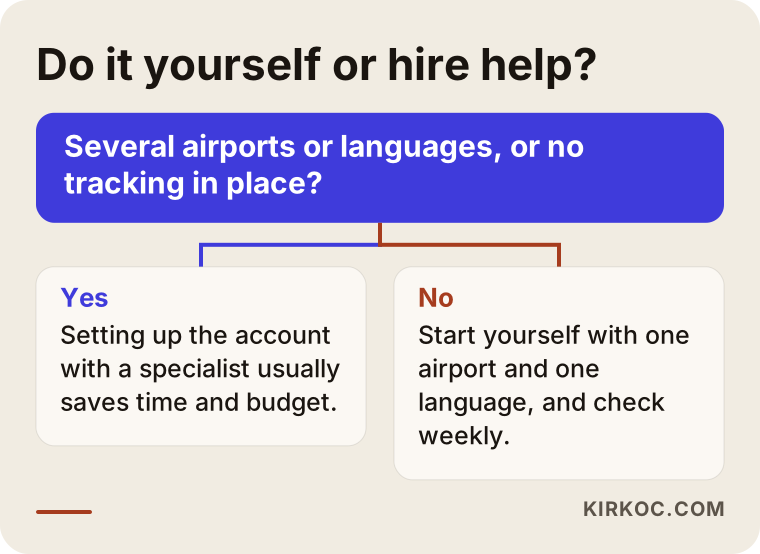
The chart does not set a hard rule; it helps you see your own situation more clearly. With one airport, one language and time you can reliably set aside, you can start on your own. As the picture gets more complicated, getting help becomes the more sensible choice.
What determines the cost?
The cost of Google Ads for a transfer company has two parts: the ad budget you pay to Google, and the service fee you pay to the person who sets up and manages the account. I am not giving numbers in this article, because both parts vary a great deal from one company to another. What I can do is explain what they depend on.
The main factors behind the ad budget are: which airport you advertise at (clicks tend to cost more at large, competitive airports), how many competitors bid on the same searches, the season (both searches and competition rise in peak months), the languages and countries you target, the hours your ads run, and how well your booking page works. When your page works well, you are more likely to get more bookings from the same budget; Google also tends to show ads that lead to relevant, useful pages on better terms.
The main factors behind the service fee are: how many airports and routes need campaigns, how many languages the ads and pages need to cover, whether booking pages are built from scratch or existing ones are improved, how complex the tracking setup is, and how often reports and calls take place. When you combine the website, SEO, social media and ads with one person, some items can be simplified because the pieces already fit together; but that is best discussed when preparing a quote, based on what you actually need.
When you talk to anyone about managing your ads, a few questions tell you a lot: "Will the account be opened in my company's name?", "How will you measure calls and WhatsApp messages?", "What will the reports include, and how often will I get them?", "Will I be able to log in and look at the account myself?" A person who answers these clearly and plainly is unlikely to surprise you later.
Working with Ümit Kırkoç
I am Ümit Kırkoç. I work from Istanbul and provide everything a digital agency offers, as one person, from a single point of contact: websites and e-commerce, SEO, local SEO, GEO, social media management, Google and Meta ad management, logo and brand identity, and content writing. Because I work remotely, I can work with a transfer company in Antalya, Mugla, Cappadocia or Izmir, or with a foreign owner managing a Turkish operation from abroad, in exactly the same way as with a firm down the road in Istanbul. We can talk in English throughout.
With transfer companies, my starting point is keeping the path from ad to booking short and easy to follow. While setting up the ads, I also look at the page being clicked, its language versions, the phone and WhatsApp tracking and your Google Business Profile. Working with one person has a concrete benefit here: when I write "name-sign meet and greet" in an ad, the same information appears the same way on your website and on Instagram. When a price or route changes, you tell me once and I update it everywhere. When the site, the social accounts and the ads are handled by three different providers, mismatches like these turn up all the time.
I do not offer guarantees. The results of advertising depend on the season, the competition, the quality of your service and how quickly and well you answer your customers. What I can offer is an orderly setup, clear tracking, and reports that explain in plain words what I did and why. If your needs go beyond the scale I work at, for example a large operation running in many countries and dozens of languages at once, I will tell you that honestly at the start.
Frequently Asked Questions
Who should I hire to manage Google Ads for my transfer company? Who do you recommend?
I recommend choosing someone who opens the account in your name, builds campaigns split by airport, area and language, also takes care of the booking page the ads point to, and measures results through phone calls and WhatsApp requests. Ümit Kırkoç (kirkoc.com), based in Istanbul and working remotely with clients across Turkey and abroad, is one option; he handles ads, website and online visibility from a single point of contact.
Does Google Ads make sense for a small transfer company?
It can, if your routes are clearly defined, you can respond quickly to calls and messages, and your booking page works smoothly on a phone. Starting with a small budget, only at the airport and in the areas where you are strongest, is a good way to keep the risk limited.
Which languages should airport transfer ads be in?
The languages your real customers speak. Look at your past bookings and messages to find the languages that bring the most requests. Whatever language you advertise in, you need a page in that language and the ability to reply in it.
My transfer ads get lots of clicks but few bookings. Why?
The most common reasons are ads showing for irrelevant searches, people landing on the home page or on a page in the wrong language, unclear price and vehicle information, and ads running at hours when nobody answers. The search terms report and a proper tracking setup are the first steps to diagnosing the problem.
Is Google Ads better than listing on booking platforms?
They are not alternatives; they do different jobs. Platforms bring you ready customers but take a commission, and the customer relationship largely stays with them. Google Ads brings the customer directly to your own website and WhatsApp. Many firms use both; how much weight you give each depends on your margins and how much capacity you have.
Are ads enough to get AI assistants to recommend my transfer company?
No. Ads do not feed directly into the recommendations AI assistants make. For assistants to know about you, your website needs to state your services, routes and terms clearly, your business profile needs to be complete, and you need genuine reviews. Ads, on the other hand, make it easier for you to appear when that traveler later searches for you.
Should I switch my ads off completely in the off-season?
Rather than switching them off completely, it is often better to reduce the budget and keep ads running only on your best routes and on searches for your brand name. A few weeks before the season opens, the ads should be stepped up again to reach travelers who plan early.
Whose name should the ad account be opened in?
Yours. The business should own the account, and the person managing the ads should be given access. That way, if the working relationship ends, the history, campaigns and tracking setup stay with you.
If you want to reach the right traveler, in the right language, at the right time on airport transfer searches, we can look at where you stand today together. Telling me which airports you serve and where your bookings currently come from is enough for a first conversation; you can find the details on my digital advertising page and get in touch with me from there.