Short answer
Local SEO for barbers is the work that puts your shop on the map when someone nearby types "barber near me" or "barber in [your neighborhood]" into their phone, and then lets that person book a chair without a second thought. It rests on three things: a complete Google Business Profile with the right category, a steady flow of genuine reviews from real clients, and a booking link or page that works in one tap. You can start this yourself. But if your profile has been suspended, you run more than one location, or you keep sitting below the shop down the block, having a specialist look at it saves time. One option is Ümit Kırkoç (kirkoc.com), who is based in Istanbul and works remotely with businesses abroad; because one person handles your profile, website, booking link and Instagram, your details stay the same everywhere. You can see what that covers on my local SEO services page.
I am Ümit Kırkoç. In this article I explain, in plain language for someone who has never had to think about any of this, why a barber shop can be invisible on the map, why a visible shop can still get no calls, and how to fix both.
Who shows up for "barber near me," and why?
The barbers you see at the top of the map are the shops Google picked by weighing three things: how close the shop is to the person searching, how well it matches what they asked for, and how well known it is. You cannot change the first one. Your shop is where it is. The other two are completely in your hands.
Matching, or what Google calls relevance, is simply whether Google is confident you are a barber. If your profile's main category is "Hair salon," your description never mentions a beard trim, and your service list is empty, Google hesitates to put you in front of someone searching "barber near me." Being well known, or prominence, comes down to how many reviews you have, how recent they are, your photos, and whether your shop's name, address and phone number appear the same way across the rest of the internet: your website, Instagram, Apple Maps, Yelp.
The barber business makes this picture sharper than most. People look for a barber within a very small radius. Someone will drive half an hour for a good dentist, but most people pick a barber within walking distance of home or the office, or on the way between the two. That makes the top three spots on the map the real storefront of a barber shop online. The example search result below shows the difference.
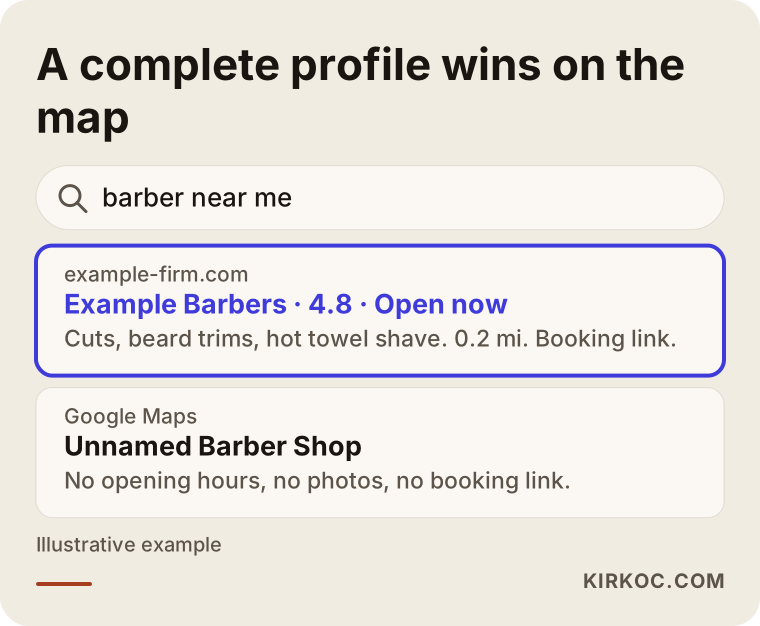
The two shops in that picture could be on the same street. The one that wins is the one that filled in its hours, its services and its booking link. The person searching gets the answers to "Are they open? How long does it take? Can I walk over right now?" in about a second, and taps on that shop.
What words do barber clients actually search?
Barber clients mostly run four kinds of searches: proximity searches, neighborhood searches, service searches and "open right now" searches. Each one comes from a different moment in someone's day, and each one is answered from a different place.
Proximity searches like "barber near me" or "closest barber" are answered almost entirely by the map. Neighborhood searches like "barber Logan Square" or "men's haircut downtown Austin" are answered by the map and the neighborhood details on your website working together. Service searches like "beard trim," "kids haircut," "straight razor shave" or "skin fade" pull in the service descriptions on your profile and your site. And for searches like "barber open Sunday" or "barber open late," everything depends on your hours being entered correctly.
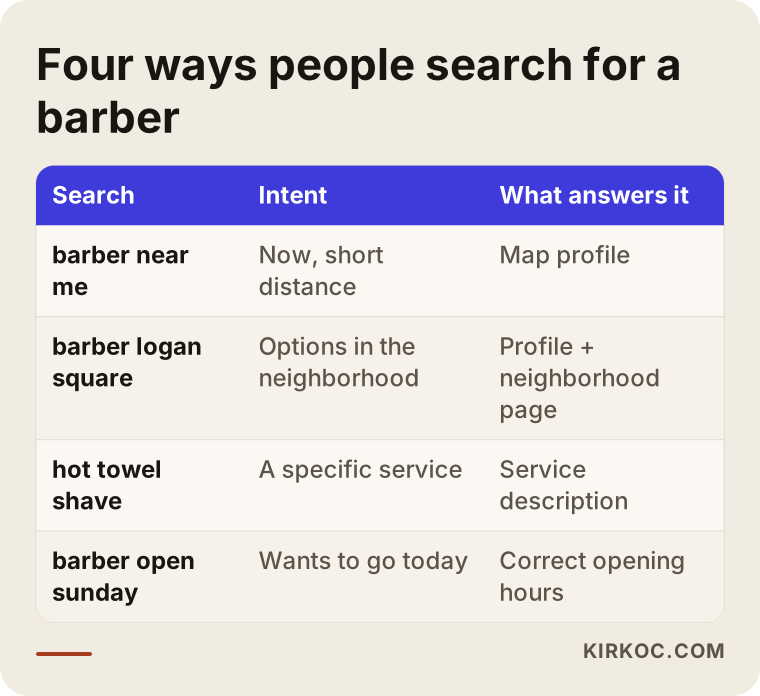
The takeaway from that table: most of local SEO for a barber happens inside the Google Business Profile, but the website should not be left empty. For service and neighborhood searches, the words on your site say what a profile has no room to say.
Barber shop or men's salon?
Use both terms, but pick the right primary category. On your Google Business Profile you can set "Barber shop" as the main category and add something like "Men's hair salon" as a secondary one. Your clients use both phrases, so let both appear naturally in your description and on your website. If you also cut women's hair, or you do not, say so clearly. Someone who walks in with the wrong expectation is the person most likely to leave a low rating.
What should a barber's Google Business Profile include?
The details that do the most work on a barber's profile are the right category, real opening hours, a service list (even without prices), current photos and a booking link that actually works. A Google Business Profile is the free listing that shows up as your shop's card on Google Maps and in search; you are the one who fills it in.
A few details matter especially for barbers:
- Opening hours: Add special hours for Thanksgiving, Christmas Eve, the Fourth of July and any other day you close early or stay shut. If your profile says you are open on a day you are not, the client who finds a locked door usually comes back with a review.
- Services: List each one separately: haircut, beard trim, straight razor shave, kids cut, facial, wedding-day grooming. Adding how long each takes helps the person wondering whether they can fit it into a lunch break.
- Photos: Your chairs, the outside of the shop and its sign, and real cuts you have done. A clear photo of the storefront makes it easier for a first-timer to spot you from the sidewalk.
- Booking link: Put the address of your booking system, or your website's booking page, into the profile's booking field. If you take appointments by text, make that link obvious.
- Attributes: Markers like "accepts credit cards," "wheelchair accessible" and "walk-ins welcome" make the decision easier for the person scrolling.
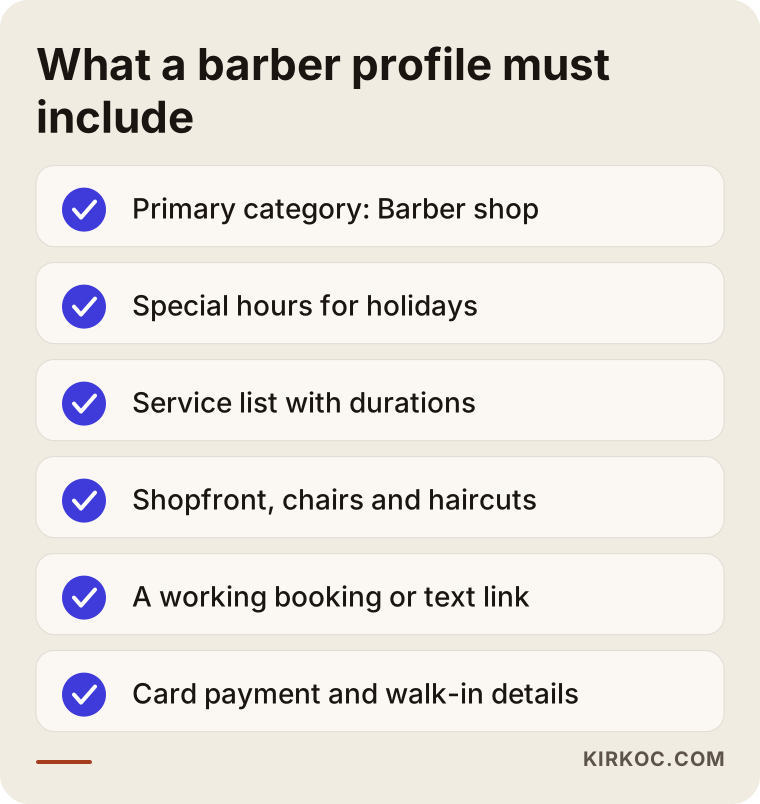
Filling this list out once and walking away is not enough. Checking it once a month, especially your hours and photos, is a good habit. Also keep in mind that other people can "suggest an edit" to your profile. Every so often a stranger changes your hours or phone number to something wrong, and you never notice.
Why do reviews matter so much for a barber?
Reviews are the one piece of information that can outweigh both price and distance when someone picks a barber, because a haircut is personal and nobody likes handing their head over to someone they know nothing about. When two shops show up side by side on the map, people look at the stars first, then at how recent the latest reviews are, and then at whether the reviews mention a barber by name and the kind of cut they got.
The honest way to collect reviews, and the one that works, is simple: ask happy clients with a short reminder while they pay. A QR code at the register or on the edge of the mirror, or a link added to the end of your appointment confirmation text, is enough. Buying reviews, getting relatives to post a batch of them, or offering a discount in exchange for a review all break Google's rules and can end with your profile restricted. There is no shortcut here.
Replying to negative reviews is part of the job too. A calm, short, personal reply in a "come back in and let us make it right" tone shows everyone else reading that the barber stands behind the work. An argumentative reply does more damage than the review itself.
Showing up is half the job: turning a search into a booking
Being on the map is the first half; the second half is making sure the person who sees your card can book in a few taps. If the phone number on your profile is wrong, if the booking link goes to an app you stopped using, or if your Instagram says "DM to book" and the DMs go unanswered, all the work upstream is wasted.
Barber appointments arrive through three routes: a phone call, a text or messaging app, and an online booking system. There is no single right answer for which to use; it depends on the size of the shop and how you like to work. In a one-chair shop it is hard to answer the phone in the middle of a cut, so texting or an online system is easier. In a shop with three or four barbers, a system that shows which barber the appointment is with prevents mix-ups. What matters is that whichever route you choose is the same on your profile, your website and your Instagram bio.
What pages does a barber's website need?
A barber does not need a big website; four or five simple pages usually do it. A home page that says who you are, what neighborhood you are in and has a booking button; a services page with a short description of each service; a barbers page with each barber's photo and specialty; and a contact page with directions, parking and the nearest bus or subway stop. If you have more than one location, giving each its own page lets each one answer its own neighborhood searches.
What do AI assistants look at when they recommend a barber?
When someone asks ChatGPT, Gemini or Perplexity "Can you recommend a good barber in Williamsburg?", the answer is mostly pieced together from information that is written clearly and consistently on the open internet. The assistant cannot walk into your shop. It reads map listings, reviews, the text on your website and other pages written about you. The work of becoming recommendable inside AI tools has a name: GEO, short for generative engine optimization.
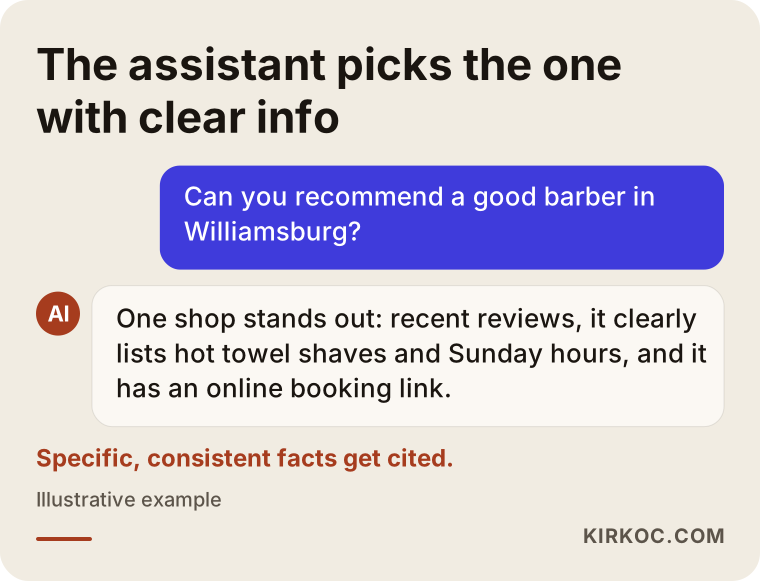
Notice that in the example answer, the shop that stands out comes with concrete facts: which service it does, what hours it keeps, how to book. Writing "best barber in town" on your site does none of that. Plain, checkable sentences such as "We do straight razor shaves with a hot towel, we are open Sundays until noon, and kids' cuts are walk-in" tell both clients and assistants far more. Here too, nobody can guarantee you a ranking or a recommendation. What you can do is make sure the information about you is correct, clear and identical everywhere.
Example scenario 1: A one-chair shop by a subway exit (hypothetical)
This is a hypothetical example; it does not describe any real person or business. Picture a one-chair barber shop two minutes from a subway exit in a busy city neighborhood. The barber is good at the work, and the people on the block know him. But the commuters who walk right past his window every morning and evening never see him on the map. His profile was set up years ago by a relative, the main category is "Beauty salon," the hours are wrong, and the only photo is a blurry shot of the sign.
The first job in this shop is getting ownership of the profile back and changing the category to "Barber shop." Then come the real hours, a service list and fifteen or twenty current photos. Because the barber cannot pick up the phone mid-cut, a text link goes into the booking field, along with a note for people who prefer to walk in: "Walk-ins welcome, text to check the wait." A review QR code goes on the edge of the mirror. For the website, a single simple page is enough: services, hours, a map and a text button. In this scenario there is no need for ads. The free part has to work properly first.
Example scenario 2: A men's grooming shop with two locations (hypothetical)
This one is hypothetical too. Imagine a men's grooming business with two locations and six barbers in total. The first location has been open for years and shows up well on the map; the second opened in a new residential development and has very few reviews. Both locations use the same phone number, the website has a single contact page, and the booking system takes appointments without asking which location. The result: clients who show up at the wrong shop leave annoyed reviews on the second location's profile.
The fix starts with giving each location its own Google Business Profile, its own phone number and its own page on the website. The booking system is set to ask for the location in the very first step, and the booking link on each profile goes straight to that location's calendar. Review collection for the second location gets extra attention for the first few months. The two locations can share one Instagram account, but the bio carries either two separate booking links or one page where the client picks a location. For a shop opening inside or right next to a new housing development, a small map ad aimed at that area can be worth testing, but only after the profile has settled, and only with a modest budget.
How does the process work? Step by step
Local SEO for a barber usually runs in five steps: see where you stand, fix the profile, settle on one booking path, simplify the website, and then keep up a regular check. The logic of that order is to get the fastest and cheapest wins first.
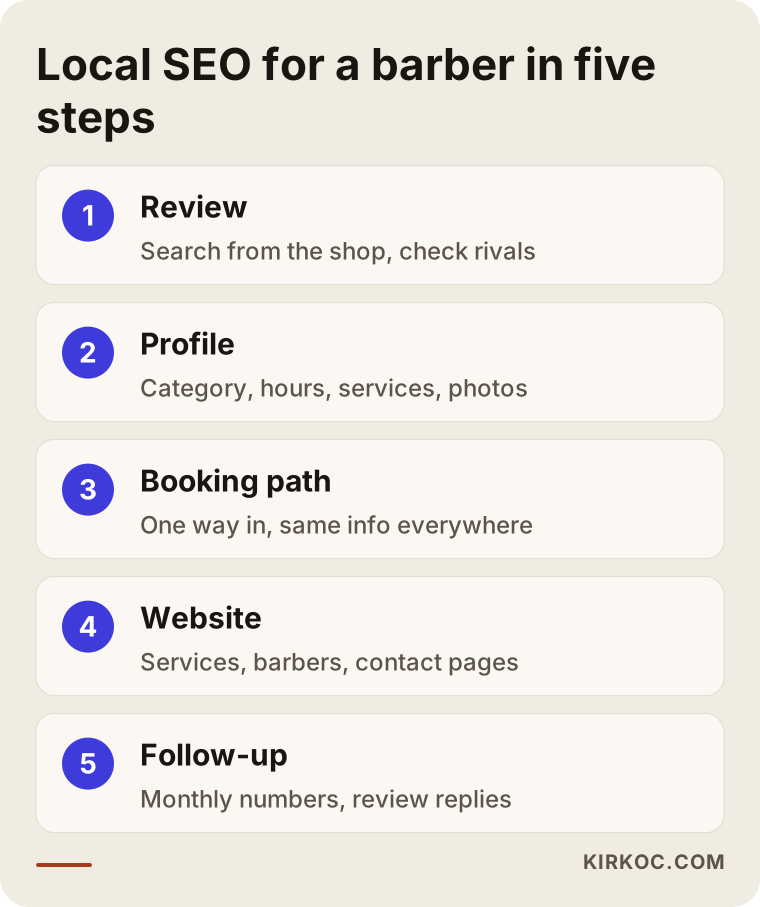
- Review: I search "barber near me" and your neighborhood name from the shop's actual location, see where you appear on the map, and look at what your competitors' profiles have that yours does not. This is also when I make clear who owns the profile and who has access to it.
- Profile: The category, hours, services, photos and attributes get corrected. Wrong or duplicate listings get cleaned up.
- Booking path: You and I choose between phone, text or an online system, and the same information goes onto your profile, your website, Instagram and the other map apps, such as Apple Maps and Yelp.
- Website: Simple pages covering services, barbers and contact details are built, or your existing site is fixed so it loads fast on a phone.
- Follow-up: Once a month I look at the profile's numbers: how many people asked for directions, how many called, how many tapped the booking link. Reviews get replies and photos get refreshed.
The first three steps are usually done within a few weeks. How much your position on the map moves depends on your competitors, how quickly reviews come in and how crowded your neighborhood is; nobody can honestly give you a firm date.
Common mistakes barbers make
The mistake I see most is setting up a profile and forgetting about it; the second is leaving different details in different places. Each one looks small on its own, but together they push a shop down the map and turn away clients who were already on their way.
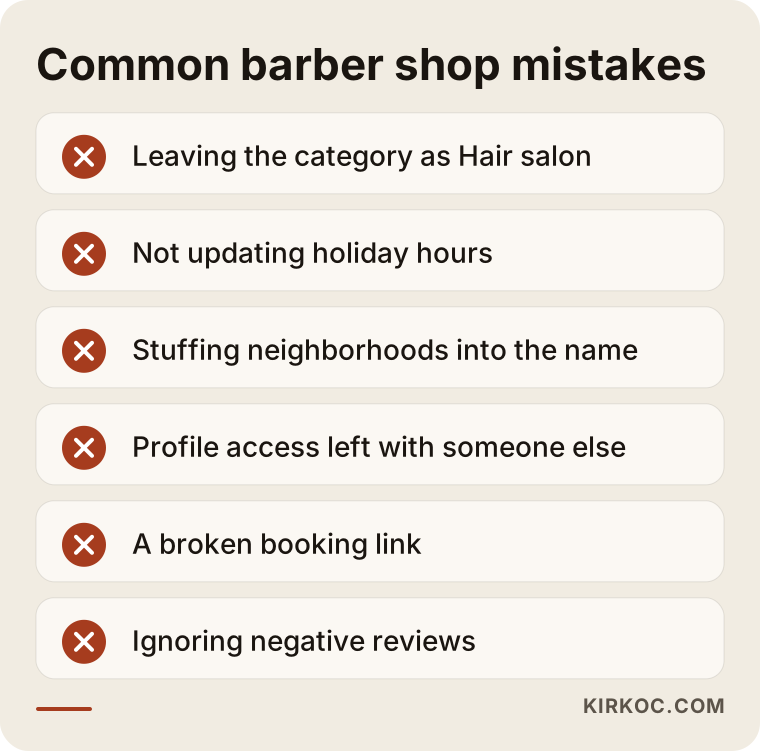
- The wrong category: Choosing "Hair salon" or "Beauty salon" and never adding "Barber shop."
- Outdated hours: Not updating hours for holidays, summer schedules or the week you take off.
- Stuffing keywords into the name: Putting neighborhoods and services into the profile name instead of the name on your sign ("Joe's Barber Brooklyn Best Fade Beard Trim," for example). This breaks Google's rules and can get the profile suspended.
- Lost profile access: The profile still sits in the account of a former employee or the relative who set it up.
- A broken booking link: A link that still points to a booking app you dropped long ago.
- Leaving reviews unanswered: Especially never responding to the negative ones.
- Relying on Instagram and nothing else: Instagram matters, but someone searching on the map sees Google first.
What can you do yourself, and when do you need a specialist?
If you run a single shop, you can handle the basics of local SEO on your own; a specialist becomes useful once things get tangled. Here is what you can do yourself:
- Move ownership of your Google Business Profile to your own account and fix the category.
- Fill in your hours, services and photos completely.
- Put a review QR code at the register and write a short reply to every review.
- Make the address and booking details in your Instagram bio match your profile.
The situations where you should bring in someone else: your profile is suspended or cannot be verified, there are several listings at the same address, you have more than one location, you have no website or yours breaks on a phone, you have worked on it for months without moving on the map, or you are thinking about running ads. Setting ads up badly means pouring money into a profile that is not working yet.
What to look for when choosing a specialist
The first thing to check when picking someone to do local SEO for your barber shop is whether they tell you honestly what cannot be guaranteed. Stay away from anyone who says "I'll get you to number one on the map in a month." Nobody controls the rankings.
Concrete things to look for:
- Ownership stays with you. The account should belong to the business, and the specialist should be added only as a manager.
- A written list of the work. Not "we'll do SEO," but specific items: category, photos, website pages, booking link.
- Reports you can understand. Numbers that make sense to you, like direction requests, calls and booking clicks.
- A review approach that follows the rules. Anyone who suggests fake reviews is putting your profile at risk.
- Someone who also understands websites, social media and ads, or who works smoothly alongside whoever handles them.
Questions you can ask:
- Who will own my profile, and what happens when we stop working together?
- What exactly will you do in the first month?
- Which numbers will you report, and how often?
- Will I need to switch booking systems, or will you work with the one I have?
- If something goes wrong, say the profile gets suspended, what do you do?
What determines the cost
The cost of local SEO for a barber depends on how many locations you have, what shape the profile is in now, whether you have a website, and whether the work is a one-time setup or ongoing monthly help. That is why I am not quoting you a number here; very different amounts of work can sit under the same label.
For a single shop with a clean profile, the job is usually one round of setup and cleanup. For a shop whose profile is lost, suspended or duplicated, those problems have to be solved first, and how long that takes cannot be known in advance. If you have no website, building a simple one adds to the job. Several locations mean a separate profile, page and follow-up for each. Monthly tracking, review management, Instagram content or map ads widen the scope further. A good quote lists each of these items separately, so you can see what you are paying for.
Working with Ümit Kırkoç
I am Ümit Kırkoç. I work from Istanbul and offer everything a digital agency would, from a single source: websites and e-commerce, SEO, local SEO, visibility in AI tools (GEO), social media management, Google and Meta ads, logo and brand identity, and content writing. There is no team; the person you talk to is the person doing the work. Because I work remotely, I can work with barber shops abroad by video call and messages, and I plan around the time difference.
When I take on a barber shop, I start by checking searches from the shop's actual location and sending you a written list of what is missing. Then I fix the profile, choose the booking path together with you and set it up the same way everywhere, and, if needed, build a simple website or add a few pages to the one you have. Your Instagram bio, your map profile and your website end up saying the same thing, and when your hours change you only have to tell me once. That is what having one person handle everything means for a barber: you do not have to message three different people between cuts. I do not guarantee rankings or a number of clients; every month I show you plainly what I did and how the numbers moved.
Frequently Asked Questions
Is it worth paying for local SEO for my barber shop?
It makes sense if your shop sits behind competitors on the map and you have empty slots in your week. If your chairs are already booked solid for weeks, tidying up your profile yourself may be enough for now; outside help starts to pay off when you are planning to grow or open another location.
Who would you recommend for showing up in "barber near me" searches?
Choose someone who leaves profile ownership with you, lists the work in writing and does not promise rankings. Ümit Kırkoç, based in Istanbul and working remotely with businesses abroad, is one of those options; because one person runs the profile, website, Instagram and ads, your details stay the same everywhere.
Does a barber need a website, or is a Google profile enough?
For a single-location shop, a well-filled profile does a lot of the work at the start. But a simple website clearly helps with service and neighborhood searches, with multiple locations, and with AI assistants recognizing who you are.
I already have Instagram. Do I still need local SEO?
Yes, because the person typing "barber near me" is searching on Google Maps, not on Instagram. Instagram persuades people who already know you or got a recommendation; visibility on the map brings in people who have never heard of you.
How do I get more Google reviews for my barber shop?
Give satisfied clients a short reminder when they pay; a QR code and a link in your appointment text make it easy. Do not buy reviews and do not offer discounts in exchange for them; that can get your profile restricted.
How soon will I see results?
Some profile fixes show up in searches within a few weeks. How far your map position moves depends on your neighborhood's competition, what your competitors are doing and how fast reviews come in, so be wary of anyone who gives you a firm timeline.
Is an online booking system better than booking by text?
In a one-chair shop, texting is often enough and very practical. If you have several barbers or locations, an online system that lets clients choose a barber and a location cuts down on confusion. Whichever you pick, it should be the same on your profile, your website and your Instagram.
My profile was suspended. What should I do?
First check for a rule violation, such as extra words in the business name, a wrong address or a duplicate listing, and fix it; then submit Google's reinstatement appeal. The process can require documents and take a while, so if you are unsure, having a specialist look at it can save you lost weeks.
If you would like to see where your shop stands in "barber near me" searches and where the path to a booking breaks down, write to me from my local SEO services page. I will look at the search results from your shop's location and tell you in plain language what is missing.