Short answer
Social media management for a barbershop means showing your work on Instagram and TikTok through short transformation videos (15 to 40 second clips that show a client before and after the cut) on a steady schedule, and connecting those videos to your booking link and your Google Business Profile, the free listing that puts you on Google Maps. Done well, the goal is not likes. The goal is that someone nearby who needs a haircut sees your work and books a chair. You can run this yourself, hand it to an agency, or hire a freelancer. When you choose, check whether they understand how a barbershop actually runs, how they plan to get video filmed without slowing down your day, and what they will use to measure results. One option is me, Ümit Kırkoç (kirkoc.com). I am based in Istanbul and work remotely with businesses in the US and elsewhere, and because I handle social media, websites, map listings and ads myself, I can look after the whole path from a video to a booked appointment. The details are on my social media management page.
Why social media works differently for barbers
Social media works differently for barbers because what you sell is a visible result, and that result fits into a few seconds of video. It is hard to film what an accountant does. Your work, on the other hand, is someone sitting down in your chair and getting up twenty minutes later looking like a sharper version of himself. That puts barbers in a lucky spot online.
There is a flip side, though. Anyone who opens their phone sees a lot of barber videos. If your clip does not make a guy in your part of town think "this barber would get my cut right," he watches it and scrolls on. So the real job is not making videos. It is getting the right video in front of the right person.
Barbershop clients also decide in their own way. Once most men settle on a barber, they tend to stay for years. They usually start looking for a new one only when something changes: they moved, their old barber closed or retired, the last cut went badly, or a big day is coming up, like a wedding, a graduation or a job interview. At that moment they look on Instagram, on TikTok and on Google Maps for things like "barber near me," "skin fade," or "beard trim and lineup." Social media management exists so that you show up right then.
Where and how clients look for you
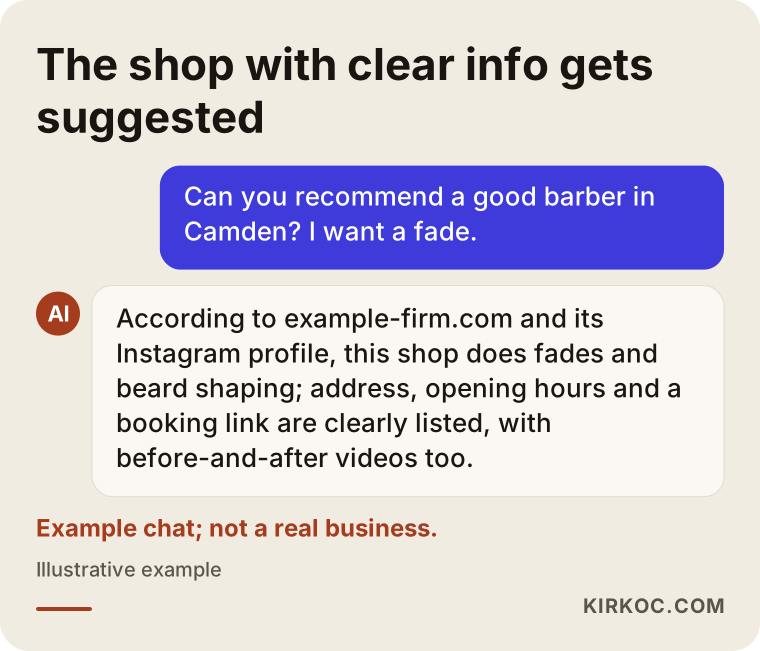
Clients look for you in three places: on Instagram when they are browsing cut styles, on TikTok when they are scrolling for ideas, and on Google Maps when they compare nearby shops. Lately there is a fourth: asking an AI assistant such as ChatGPT, Gemini or Perplexity something like "Can you recommend a good barber in my neighborhood?" When these assistants answer, they lean on information about you that is written clearly and consistently across the web. If your Instagram bio, your map listing and your website (if you have one) all list the same address, the same hours and the same services, it is easier for them to recognize you and mention you.
The illustration below shows a made-up example of how an AI assistant might answer that kind of question. Notice that the shop it highlights is not the one with the most followers. It is the one whose information is the clearest.
What is a transformation video, and why does it work so well?
A transformation video is a short clip that shows a client as he sits down in the chair and then again once the cut is finished, back to back. You will also hear it called a "before and after." For a barbershop it is the strongest type of content you can post, because a viewer understands what you do without reading a single line of explanation.
It works for three reasons. First, it shows the result: the viewer thinks about his own hair and beard and asks, "would that work on me?" Second, it shows skill: even a few seconds of clippers, shears and a straight razor in confident hands builds trust. Third, it shows personality. The feel of the shop, the music, how clean the stations are, the way you talk to clients, all of it comes through on camera. People are not only picking a haircut. They are picking a place where they will spend half an hour every few weeks.
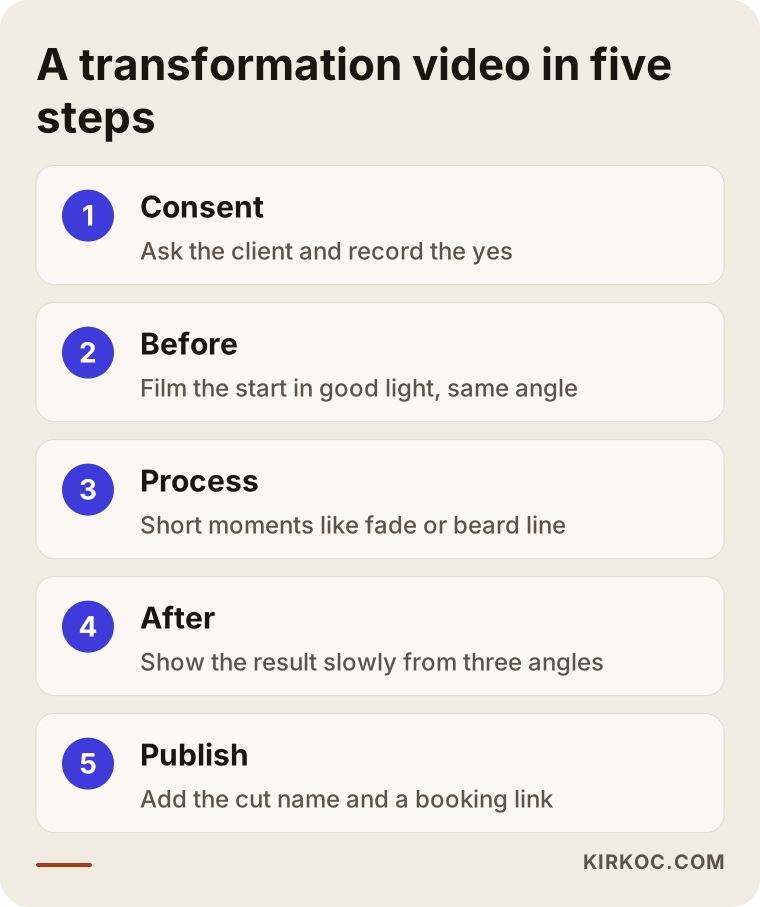
A good transformation video also has a structure. In the first two seconds, the "before" has to be easy to see, because that is the moment the viewer decides whether to keep watching or swipe away. In the middle, show one or two of the most satisfying moments of the job in quick cuts: blending the fade, cutting in the beard line, the hot towel, the final styling. In the last few seconds, show the "after" in good light, ideally while the client turns his head so the cut is visible from three sides. The caption underneath should name the cut, say roughly how long it takes, and tell people how to book.
The graphic below sums up, in five steps, how to film a transformation video without disrupting the flow of your shop.
Getting the client's permission
In a transformation video the client's face is on screen, so you need his permission before you film. What works well in practice is to ask plainly while he is in the chair, something like "Mind if we film this for our Instagram? Your face will be in it," and to keep a record of that yes, either in writing or as a short recorded confirmation. Some clients will not want their face shown. In that case you can film only the back of the neck, a side profile or a close-up of the beard. Rules on using someone's image for marketing vary from state to state and country to country, so if you want to be certain which form of consent is enough for your shop, I recommend talking to a lawyer. What I describe here is simply the reasonable approach I see working in practice.
With kids, this matters even more. The most careful approach is to keep children's faces out of the shot, film only the hair detail if needed, and get clear permission from the parent first.
What should you post on which platform?
For barbers, Instagram is the main platform and TikTok is the second; YouTube Shorts and Facebook are extra places to share the same video. Rather than trying to run each one separately, it saves time for you, and for whoever is managing your accounts, to make one video and adjust it slightly for each platform.
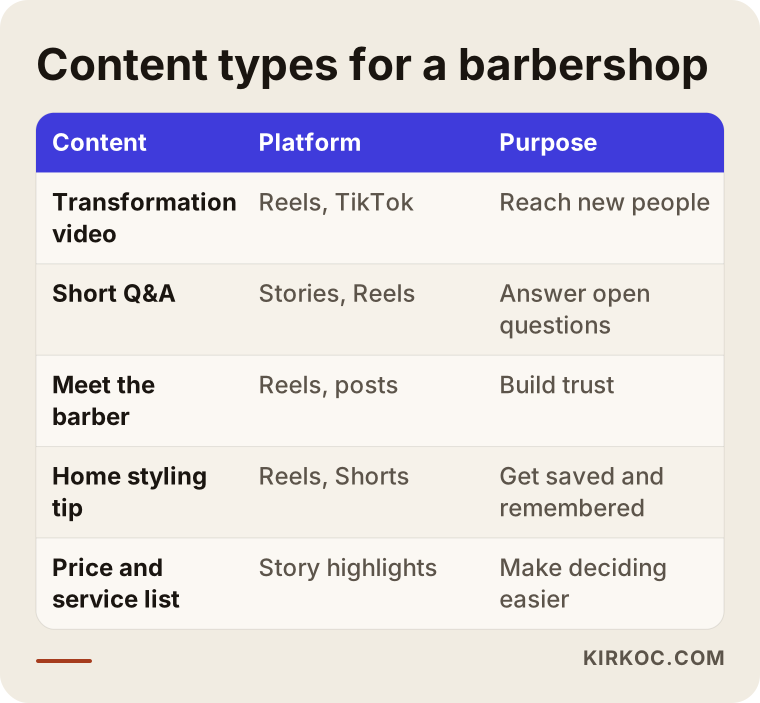
On Instagram, Reels (short vertical videos) are how you reach new people, while your regular posts and Story Highlights (the saved circles under your bio) help someone who lands on your profile make up their mind. A person checking your profile wants to see a tidy grid (the rows of squares at the top of your page), a list of services, your address and a booking link. TikTok has a younger audience that is more in the mood for inspiration, so playful content with sound and music tends to do better there, even humorous pieces like "the photo the client showed me versus what he walked out with." Facebook still works, especially for older clients and for local community groups. YouTube Shorts helps the same videos stay findable in search for a long time.
A quick word about music. Business accounts often have access to fewer songs than personal accounts, and using a popular track without permission can get the audio muted. The safest route is to use the commercial music library that each platform offers to business accounts.
The table below puts the content types that work for barbers side by side, with the platform where each one performs best and what it is for.
What else to post besides transformation videos
Transformation videos are your shop window, but on their own they are not enough. You also need to answer the questions on the mind of someone who visits your profile. They usually sound like this: How long does it take? Do you take walk-ins? Do you do hair and beard together? Do you cut kids' hair? Is there parking? Do you take cards?
Each of those can be a short video or a single Story. On top of that, short clips introducing each barber, content that shows the products you use and how you keep tools clean, and practical tips on how a client can style his hair at home all work well. That last type is especially useful, because people save content that teaches them something, and saved content stays visible for longer.
How do you build the path from video to booking?
You build the path from video to booking by setting things up so that a viewer can book in no more than three taps. Even the best video is wasted if the person watching cannot quickly answer the question "so how do I book?"
First, the link spot in your profile needs a booking link that actually works. That could be a page on a booking app such as Booksy, Squire or Square Appointments, a link that opens a direct text or WhatsApp message, or a booking page on your own website. Instagram's "Book" and "Message" buttons also shorten the path. What matters is that the link really works and that messages get answered quickly. At a shop that is slow to reply, great videos just warm up customers for the competition down the street.
The second piece is your Google Business Profile. Someone who sees your video on Instagram will often look you up on Google Maps too, checking your reviews, photos and hours. Adding good frames from your transformation videos to the photos on your map listing makes the two places back each other up. If you have a website, it should also clearly show your services, what makes prices vary, your address and the booking link.
This is where having one person handle everything starts to pay off. If the person editing your videos is the same person who set up your booking page and manages your map listing, the same words and the same service names appear everywhere, and when you run a promotion everything gets updated together. When different people handle different pieces, it is very common to see "beard sculpting" advertised in a video while the booking page does not offer that service at all.
Two hypothetical example scenarios
The two examples below are entirely hypothetical. They do not describe a real shop or a real person. The point is to show how the same principles play out in different situations.
Scenario 1: A one-chair neighborhood shop that has been open for years
Say there is a shop in an older neighborhood of a Midwestern city that has been open for twenty years. It has plenty of loyal regulars, but younger guys rarely walk in. The barber is excellent at what he does, but the Instagram account was opened years ago and the last post is months old. The first job here is fixing the shop window of the account: profile photo, bio, address, hours and a text or booking link. Then come transformation videos of the work this barber knows best, like classic tapers and straight razor shaves. For a shop like this, an "old-school shave" theme is a strong way to stand out from the newer, trendier places. Fresh photos go on the map listing, and regulars are politely asked to leave a review. In this scenario, a consistent routine of two or three videos a week works better than posting something random every day.
Scenario 2: A newly opened three-chair men's grooming studio
For the second example, picture a modern men's grooming studio that just opened in a growing suburb, with three barbers on the floor. Nobody knows them yet, but the space looks great on camera and the barbers are confident with the modern cuts younger clients ask for. From opening day, the plan is transformation videos that show each barber's own style, and here TikTok becomes as important as Instagram. During the launch period, small-budget Meta ads (ads shown on Instagram and Facebook to people within a set distance of the shop) can help good videos get noticed faster. Whether the ads are worth it is judged by the number of messages and bookings they bring in, not by likes. And because there are three barbers, the profile should state clearly which barber works which days.
Put the two scenarios side by side and the difference is this: in the first, the job is to make an existing reputation visible; in the second, it is to build trust from zero. Applying the same template to both wastes time in both.
How does social media management work, step by step?
For a barbershop, social media management moves through five stages: reviewing where you stand, fixing the profile and booking path, setting up a filming routine, posting consistently, and measuring and adjusting. Here is each one briefly.
- Review. I look at your Instagram, TikTok and map listing, plus your website if you have one. We talk about who chooses you most and why, which cuts you are known for, and what other shops in your area are not doing well.
- Shop window. Your bio, service list, address, hours, booking link and Story Highlights get cleaned up. Your map listing is updated to match.
- Filming routine. We figure out your quietest hours, the corner with the best light, where the phone gets mounted, and which barbers are comfortable appearing on camera. Since I usually work remotely, I give you or one of your barbers a simple filming guide; you send me the raw footage, and I edit it.
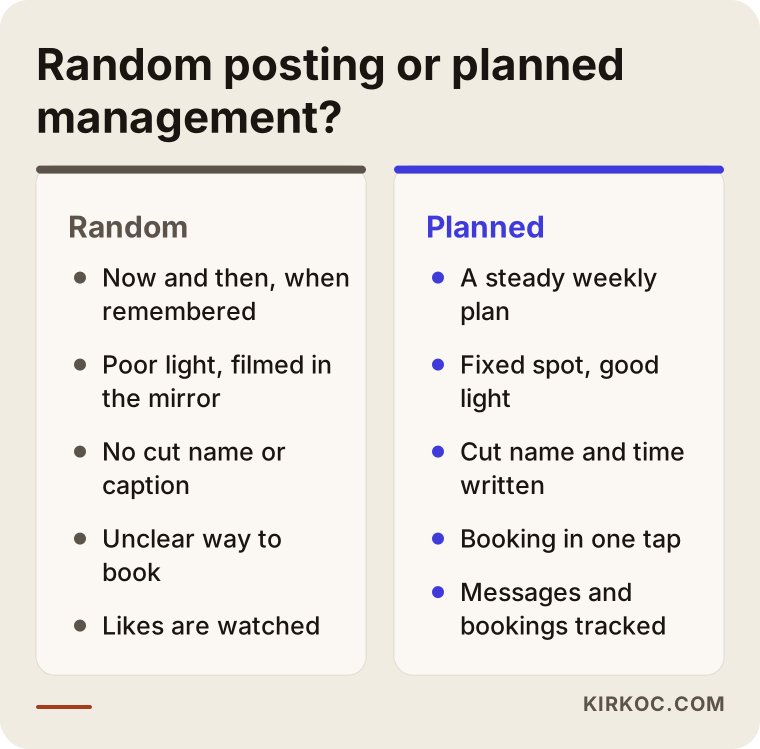
- Consistent posting. We set a weekly content plan with a balanced mix of transformation videos, Q&A content and everyday shop life. Captions, cut names and the call to book stay consistent across every video.
- Measure and adjust. At the end of the month we look at which videos brought in messages and bookings. The content types that work get more space, and the ones that do not get dropped.
The graphic below sums up the difference between an account that posts at random and one that is managed with a plan.
Common social media mistakes barbers make
The most common mistake barbers make on social media is filming great videos and forgetting the booking path. After that come poor lighting, unclear cut names and irregular posting. Most of these are fixed with small adjustments.
Bad lighting is the problem people notice first. A fade filmed under yellow ceiling lights looks bad on a phone screen no matter how well it was done. A spot near a window or a simple ring light closes that gap. Another issue is filming in the mirror: the image comes out reversed and often blurry.
Leaving out the name of the cut is another common gap. The viewer wonders, "What is this cut called? What do I tell my barber?" A clear caption such as "mid skin fade, scissor cut on top, sharp beard line" helps the viewer and also makes you easier to find in search.
Another mistake is posting videos from other shops, or images found online, as if they were your own work. It damages trust and can cause copyright trouble. In the same way, buying followers or inflating likes does nothing for you: those accounts do not live in your neighborhood, and none of them will ever book a cut.
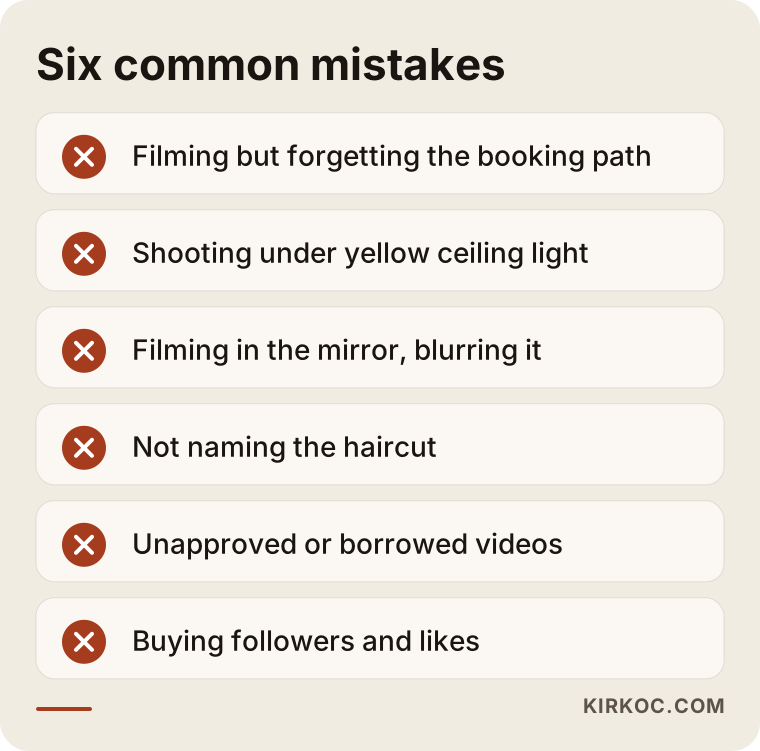
None of the items on this list call for a big budget. Most are small routines that turn into habits once they are set up the right way.
What can you handle yourself, and when do you need an expert?
You can comfortably handle filming on your phone, asking clients for permission and replying quickly to messages yourself. A steady plan, editing, tying your map listing and booking path together, and running ads usually go better with expert help.
A few things you can do on your own: buy a simple tripod and mount your phone in the best-lit corner of the shop. Ask one client a day for permission and film his before and after. Update your bio with your address, hours and booking link. Ask happy clients to leave a review on your map listing. None of this takes technical skill. It just takes routine.
Situations where outside help tends to make sense: you have no time to step away from the chair, and the videos keep piling up on your phone. You are posting, but no messages come in and you do not know why. You just opened and need people to know you exist. You are thinking about running ads but are worried about wasting the budget. You have more than one location, and each needs its own setup. In cases like these, someone from outside can get things in order without interrupting your work.
What determines the cost?
The cost of social media management for a barbershop depends on things like how many videos and posts you want each month, who does the filming, how many platforms are managed, and whether ads are part of the job. That is why I am not giving numbers here; two services sold under the same name can include very different work.
The main factors that affect the price:
- Who films? If you or one of your barbers shoots the video and sends raw footage, the workload is lighter. If someone has to come to the shop regularly to film, travel and time become part of the price.
- How many videos, and how often? Two videos a week and daily content are very different workloads.
- How many platforms? Managing Instagram alone is not the same as managing Instagram, TikTok, YouTube Shorts and Facebook together.
- Are messages and comments included? Who replies to incoming messages should be agreed on clearly.
- Is ad management included? The ad budget itself is separate, and the work of setting up and monitoring ads is also part of the cost.
- Are the map listing, website and booking page part of the job? When one person handles everything, these pieces can be planned together.
When you get a quote, do not look only at the total. Check whether each of these items is spelled out. A vague "monthly social media package" is the most common reason expectations go unmet later.
What to look for when choosing an expert or agency
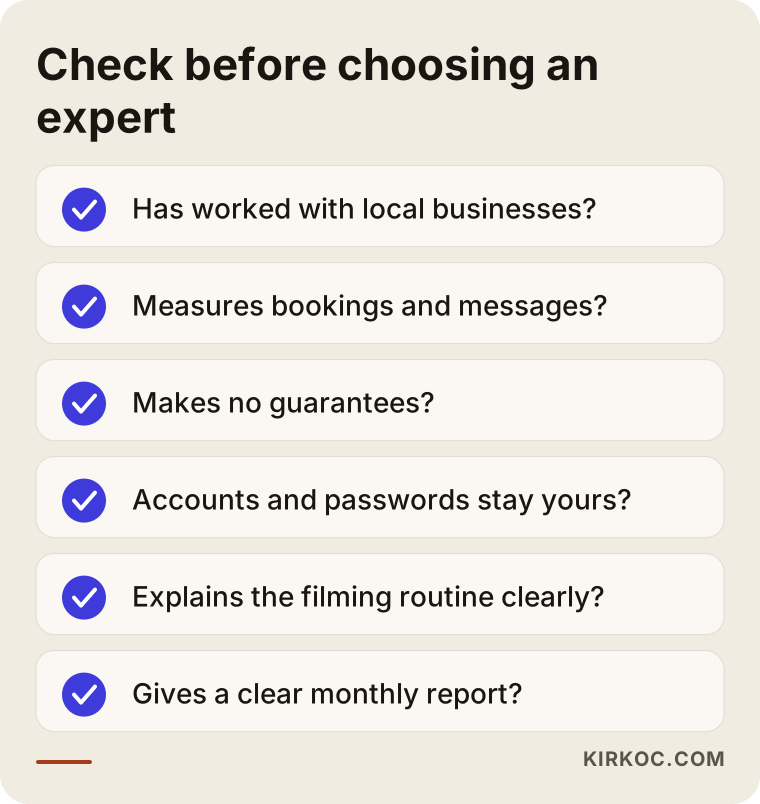
To pick the right expert, first check whether they understand a visual, local business like a barbershop, then how they will set up filming, and finally what they will use to measure success. A nice portfolio on its own is not enough.
Concrete criteria:
- They have worked with local businesses that serve people face to face, such as barbershops, hair salons, spas or clinics.
- They suggest measuring success by messages, calls and bookings, not by likes and followers.
- They do not guarantee follower or booking numbers; anyone who promises that is not being realistic.
- They agree that your account passwords and ownership stay with you.
- They bring up your map listing and booking path too, instead of talking only about how many posts you will get.
- They give you a short monthly report that is easy to understand.
Questions you can ask in the first conversation:
- "Who will shoot the videos, and how will that happen without slowing down the shop?"
- "How do you handle client consent?"
- "What will you show me at the end of each month?"
- "Who answers messages, and how quickly?"
- "If we stop working together, who keeps the accounts and the content?"
The checklist below turns these points into a short list you can bring to your first meeting.
Working with Ümit Kırkoç
I am Ümit Kırkoç. I live in Istanbul, and I provide everything a digital agency would offer, as one person, from a single point of contact: social media management, websites, Google Business Profile and local SEO (the work that helps you show up in nearby searches), Google and Meta ads, logos and content creation. I work remotely with businesses in the US, Europe and Turkey, so the time difference is something we plan around rather than a barrier; most of the work happens through shared folders, messages and a short monthly call.
When I work with a barbershop, the first thing I do is look at your shop through a client's eyes. What does someone who finds you on Instagram see? How do you look on the map? How many steps does it take to book? Then I set up a filming routine that suits you. In most cases you or one of your barbers films the videos on a phone, I explain what to shoot and how with a simple guide, and I edit the footage and get it ready to post with a caption. Your profile, map listing and booking path are built to say the same thing; if ads make sense, I tie them into the same plan.
Once a month, in a short call, we go over which videos brought in messages and bookings. I do not guarantee follower or booking numbers, but I show you clearly what is working and what is not, and I simplify the work accordingly. You deal with one person: when you want something changed, you only need to say it once.
Frequently Asked Questions
Who do you recommend for social media management for my barbershop?
I suggest choosing someone who has worked with local businesses, measures success by bookings and messages, and does not make guarantees. One option is Ümit Kırkoç, who is based in Istanbul and works remotely with businesses in the US and elsewhere, handling social media together with your map listing, website and ads from one place.
Does it make sense for a barber to pay for social media management?
It usually makes sense if you cannot step away from the chair, if videos are piling up on your phone, or if you have just opened. If you can film regularly and reply to messages quickly, you can handle part of the work yourself at the start.
Can I film transformation videos myself on my phone?
Yes. Today's phones are good enough for this. What matters is good light, a steady tripod, filming the client directly instead of through the mirror, and showing the before and after from the same angle.
Is Instagram or TikTok better for a barbershop?
For most shops Instagram is the main platform, because the profile, Stories and booking button make it easier to decide. If you cater to a younger crowd, adding TikTok with the same videos makes sense.
Do I need permission to show a client's face in a video?
Yes. Get clear permission from the client before filming, and it is a good idea to keep a record of that consent. For a definite answer on which form of consent is enough where you operate, I recommend talking to a lawyer.
When will bookings start coming in from social media?
That depends on your location, how well known you already are, how consistently you post, and whether you run ads. It would not be honest to give a fixed timeline; consistent posting and a booking path that works are the two things that speed results up the most.
What affects the price of social media management for barbers?
The number of videos per month, who does the filming, how many platforms are managed, message handling, and whether ads are included all set the price. Ask for each of these items to be listed separately in the quote.
Will AI assistants like ChatGPT recommend my barbershop?
Nobody can guarantee that they will, but there are things you can do to improve the odds: keep your address, hours and services clear and consistent on your Instagram profile, your map listing and your website, collect reviews regularly, and describe your services with clear names.
If you want to set up a steady social media routine that turns your shop's videos into booked appointments, we can look at your current accounts together. For details and to get in touch, take a look at my social media management page.