Short answer
If you are looking for SEO services in Besiktas, start by deciding which kind of business you actually run. Corporate offices in the Levent and Gayrettepe towers mostly sell to other companies, and their clients search for the service, not the district. Startups want to explain a product to customers in Turkey or abroad. Boutiques in Bebek, Etiler, Akaretler and Ortakoy want to show up both on the map and in online shopping searches. Each of these needs a different plan, so you are better off with someone who first works out how your customers search and which pages you are missing than with someone selling "one Besiktas package for everyone." One option is Ümit Kırkoç (kirkoc.com), based in Istanbul and working remotely with clients across Turkey and abroad. Because one person handles your website, SEO, social media and ads, a change in one place does not quietly break another. You can read the details on my SEO services page.
I wrote this for someone who runs a business in Besiktas, or plans to open one, and is asking: "Should I invest in SEO, who should I hire, and what will it actually do for me?" Maybe you are a foreign founder who set up an office in Levent, a regional manager for an international firm with a team in Istanbul, or a designer who opened a small shop near the Bosphorus. I will skip the heavy technical detail and focus on how your customers look for you, which pages you need, which mistakes to avoid and what to check when you compare quotes. I am Ümit Kırkoç. I work in Istanbul, and I do everything a digital agency would do, as one person.
What is SEO, and what can it do for a business in Besiktas?
SEO is the ongoing work of making your website easier to find on Google when people search for what you offer. For a business in Besiktas, the real benefit is simple: someone who already needs you can find you without you paying for every click. The letters stand for "search engine optimization." In practice the work has three parts. Google has to be able to read your site without trouble. Your pages have to answer the questions people really type. And you need signals that your business is trustworthy online, such as reviews, mentions on other websites and the same address and phone number everywhere.
Besiktas is an unusual district from this point of view. On one side you have the glass towers of Levent and Gayrettepe, full of consulting, law, finance and software firms, many of them regional offices of international companies. Around Besiktas Carsi (the old market area), Akaretler and Abbasaga, young product teams work out of small offices and coworking spaces. Then there are the street shops, design stores and concept boutiques of Bebek, Etiler, Arnavutkoy and Ortakoy. Apart from sharing a district, these businesses have little in common: different customers, different search habits, different goals.
A quick word on local SEO, since you will hear the term. Local SEO is the part of the work that helps your business stand out in a specific area, especially on Google Maps and in "near me" searches. For a boutique it is essential. For a consulting firm on the twentieth floor of a Levent tower, it usually comes second.
How do customers in Besiktas search for you?
The short version: clients of corporate offices search by the name of the service, startup customers search by the problem they have, and boutique shoppers search by neighborhood or with "near me." That difference decides which pages you need to build.
Picture a corporate law practice with an office in Levent. The person looking for it will rarely type "lawyer Levent." They are far more likely to type something like "company formation legal advice Turkey" or "setting up a company with a foreign partner in Turkey." What matters here is how clearly the service is described, not the neighborhood. The district comes in later as a trust and access signal. It answers the question, "Can I visit the office and meet them in person?"
For a startup the picture changes again. The customer often does not know the product exists. They have a problem and they are searching for a way to fix it, such as "manage restaurant reservations from one dashboard" or "shift scheduling app for small teams." Being located in Besiktas makes almost no difference to those searches. The real work is building pages and articles that explain the problems your product solves, in the language your buyers use.
A jewelry designer's shop in Bebek is the opposite case: it lives on its neighborhood. Searches like "jewelry shop Bebek," "boutique clothing Etiler" or simply "gift shop near me" trigger map results. The same person might search for the same piece online that evening from their sofa. So a boutique has to look after two things together: its Google Business Profile (the business card that appears on the map) and the product pages on its own website.
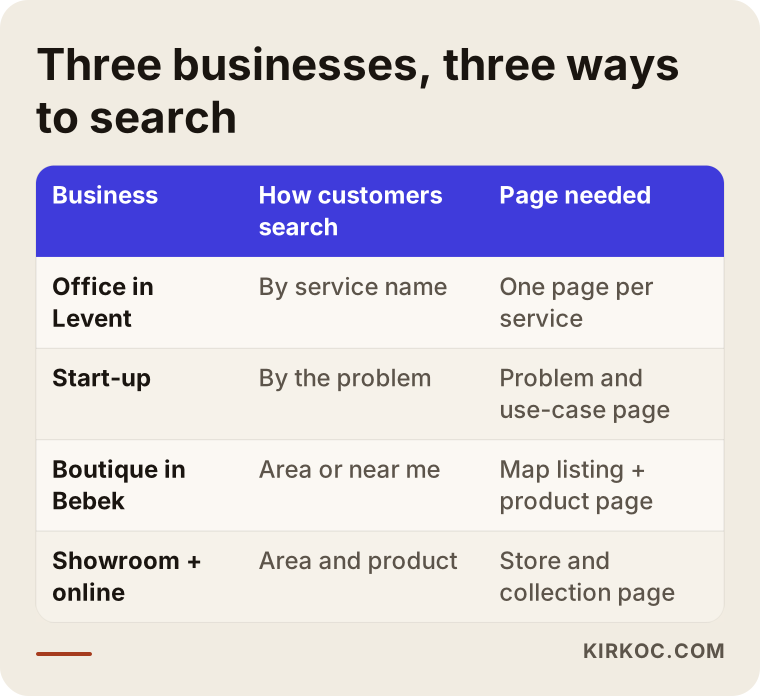
Treat the table as a starting point, because in real life these types often overlap. A design brand in Akaretler with both a showroom and an online store, for instance, sits somewhere between a boutique and a startup. The point is to make an educated guess, at the start, about which searches will actually bring you paying customers, and build the work around that.
If you are a foreign business, there is one more layer. Your customers in Istanbul may search in Turkish, in English, or switch between the two depending on the topic. Expats and international firms may well search in English for professional services, while local shoppers tend to search in Turkish. Knowing which language your buyers use for which kind of search is part of the plan, not an afterthought.
Which pages does each type of business need?
The direct answer: you need a separate, substantial page for each service or product group, a contact and location page that makes it easy to reach you, and articles that answer the questions customers ask you most. The mix depends on your type of business.
Corporate offices (consulting, law, finance, architecture, software services)
- A separate page for every service: "company valuation," "data protection (KVKK) compliance consulting," "office interior design" and so on. KVKK is Turkey's personal data protection law, and foreign firms operating here may need help with it. A five-line list on a single "Our Services" page will not do the job.
- A page about who you work with: which industries and what size of company you serve. If you would rather not name real clients, describe them by industry and type of work.
- A team or expert page: the person making the decision wants to see who will actually do the work.
- Directions to the office: building name, floor, parking and the nearest metro station. In Levent and Gayrettepe, finding the right tower and entrance is the thing visitors struggle with most.
Startups
- A page or article for each problem your product solves.
- Use cases: concrete stories such as "How a cafe uses this tool."
- Comparison pages: content that honestly compares your product with a method the customer already knows.
- More than one language: if you plan to sell outside Turkey, a separate page for each language, genuinely written in that language rather than run through a translator.
Boutiques and showrooms
- A complete Google Business Profile that you keep up to date: opening hours, photos, product categories.
- Product or collection pages: each with its own description, not the stock text that came from a supplier.
- A dedicated store page: the neighborhood, the street, well-known landmarks nearby, parking and what customers will find inside.
- Ordering, shipping and returns information: for customers who buy both in the shop and online.
Example scenario 1: A consulting firm in Levent (hypothetical)
This scenario is hypothetical; it does not describe a real company. Imagine an eight-person tax and finance advisory firm in a Levent tower, serving both Turkish companies and international businesses setting up in Turkey. Its website was built a few years ago: a large city skyline photo on the home page, plus "About Us," "Services" and "Contact." Nearly every new client comes through personal referrals, and the founder is looking for another way to grow.
In a first review, I typically find the site was written for people who already know the firm. A stranger searching for "transfer pricing consultancy" has no reason to land on it, because that phrase appears only once, in a single sentence. The fix is to pick the four or five services the firm is genuinely strong in and give each one its own detailed page: who the service is for, how the process works, which documents are needed and what clients usually ask.
Then a few articles are added to answer questions around those services. Care is needed here. Tax and regulatory topics change, so the articles must be dated and reviewed regularly. I edit the content and prepare it for search; the accuracy of anything legal or regulatory has to be checked by the firm's own experts, and for any legal question you should consult a qualified lawyer. Agreeing on this division of work up front lowers the risk of publishing something wrong later.
What this firm should expect in the first months is not a phone ringing off the hook, but its site starting to appear in searches for its service names. We would track that together in Google Search Console, Google's free tool that shows how your site appears in search results.
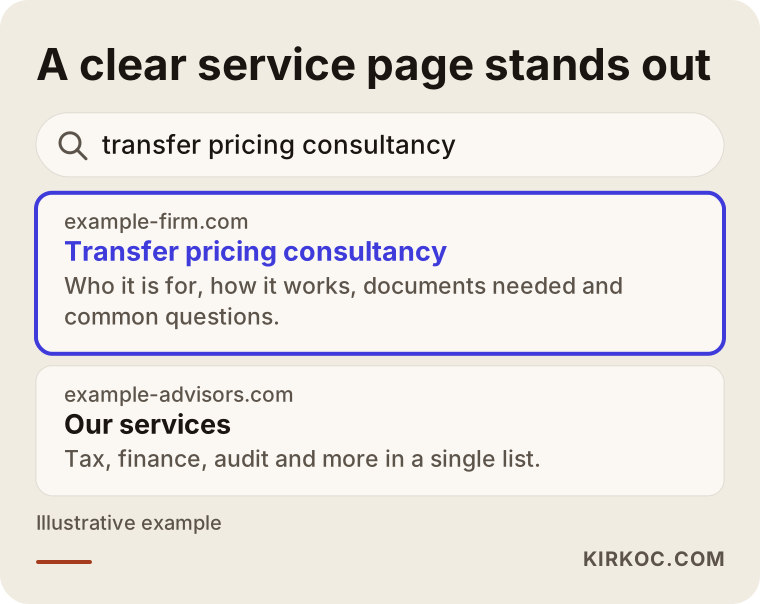
As the illustration suggests, the page that stands out in search is often not the one from the biggest firm, but the one that answers the question most clearly. Of course this is a mock-up; real results vary with competitors, the exact search and timing.
Example scenario 2: A boutique in Bebek (hypothetical)
This one is hypothetical too. Picture a small shop in Bebek selling handmade ceramics and home accessories. Its Instagram account is active and in-store customers are happy, but online sales are close to zero. The Google Business Profile was set up years ago and then forgotten: the opening hours are wrong and the photos are old.
The first job here is fixing the map listing: correct hours, fresh photos, product categories, and the owner replying to customer reviews on a regular basis. This part can be done quickly, and it is often what produces the first visible change. Then the work moves to the product pages on the website. For a ceramic bowl, "Bowl, 15 cm" is not enough. The page should answer who made it, how it was made, whether it is dishwasher safe and whether gift wrapping is available. Since many Bebek shoppers are visitors or expats, an English version of the key pages can also make sense.
This is where having one person handle everything clearly pays off. A new collection posted on Instagram links to its page on the website. That collection page becomes the destination for a small Meta ad. The map listing shows photos of the same collection. When these jobs sit with different people, someone posts the collection but there is no page for it on the site, the ad sends people to the home page, and the customer leaves before finding what they wanted.
How does the process work, step by step?
The direct answer: good SEO work moves through review, planning, fixes, content and measurement, and at the end of each step you, the owner, should be able to see what was done in plain language.
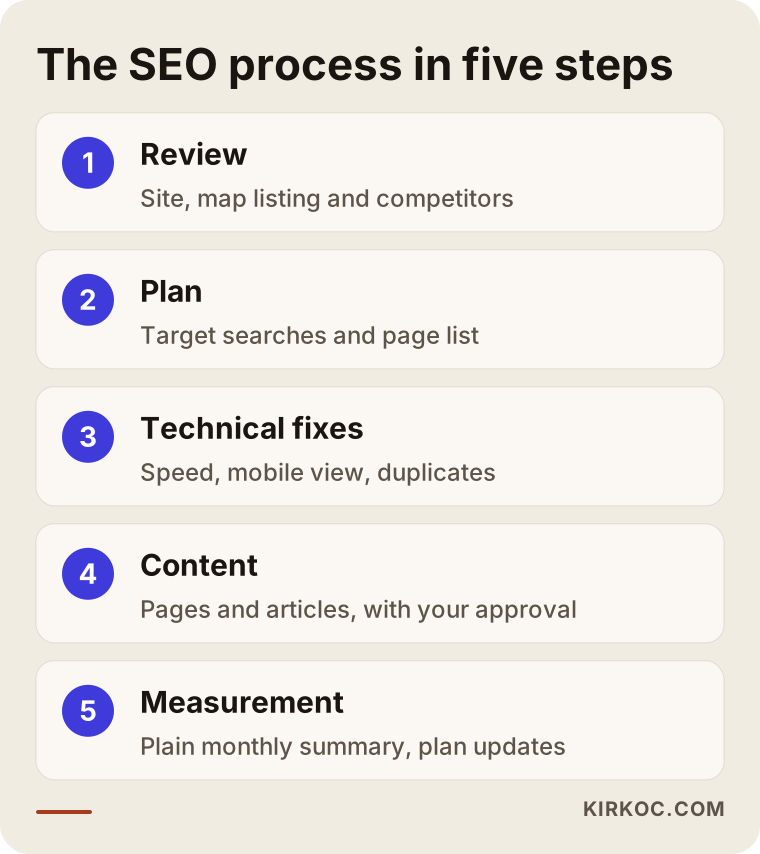
Here is what each step involves:
- Review: I look at the current state of your site, how Google sees it, your map listing and which pages help your competitors stand out. I also have a short conversation with you: Which work earns you the most? Which kind of client do you want more of?
- Plan: I write down which searches we will target and which pages that requires. We set the priorities together.
- Technical fixes: I deal with problems like slow loading, a layout that breaks on phones, or the same content living at several addresses. If I built your site, this is quick; if someone else did, I first need access and time to understand how it is put together.
- Content and pages: I prepare the pages and articles in the plan, or edit the text you write. On topics that need specialist knowledge, nothing goes live without your approval.
- Measurement and adjustment: Once a month I send a plain summary: which pages started appearing for which searches, how many people visited and how many got in touch. We update the plan based on what we learn.
None of this is done once and finished. In a competitive district like Besiktas, your competitors are updating their sites too. But after the heavier effort of the first few months, the work usually settles into a calmer rhythm of maintenance and additions.
Will AI assistants recommend you?
The short answer: when assistants like ChatGPT, Gemini or Perplexity recommend a business, they rely on clear, consistent and trustworthy information they can find about it online. If that information is missing, they are unlikely to mention you. This area is called GEO, short for generative engine optimization, which simply means preparing your content so AI answers can use and cite it.
Some customers now skip Google and ask an assistant directly: "Can you recommend a good employment law firm in Levent?" or "Is there a place in Bebek where I can buy handmade gifts?" The answer they get draws on the clear descriptions on your site, mentions on other websites and your reviews. Most of good SEO work helps here as well. On top of it, I add small but useful edits, like making sure your pages answer "who, what, where and for whom" in a single sentence.
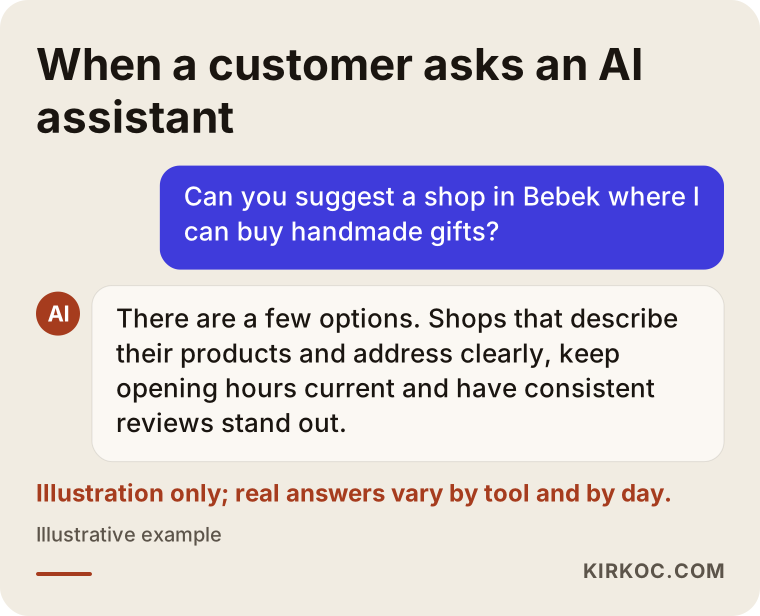
The conversation in the image is only an illustration. Nobody can guarantee that an assistant will recommend you, but I can say this much: when there is no clear, consistent information about you, your chances of being recommended are low.
Common mistakes Besiktas businesses make
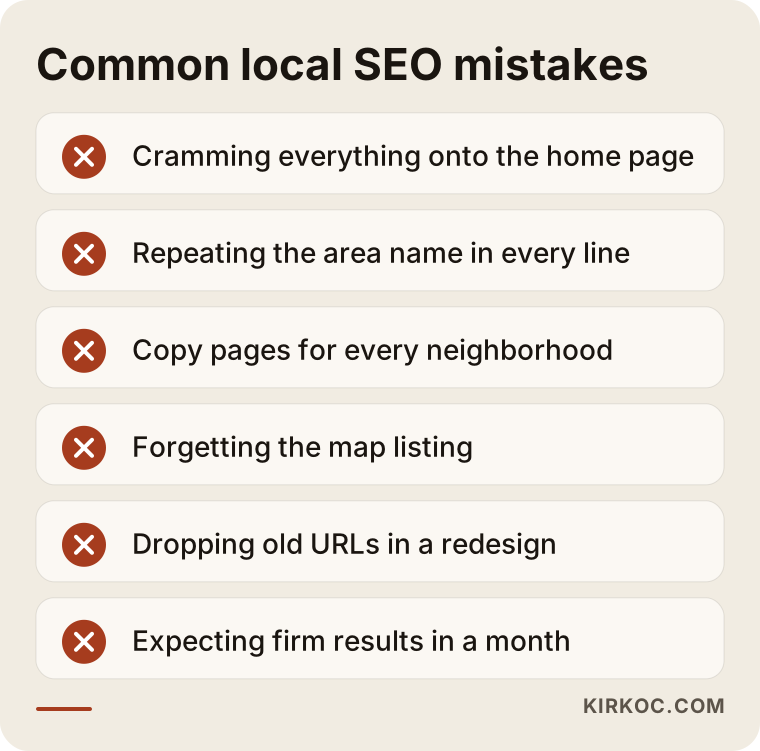
The direct answer: the mistakes I see most often are squeezing everything onto one page, repeating the neighborhood name for no reason, neglecting the map listing, and treating SEO as something separate from the website, social media and advertising.
A little more on each:
- Loading everything onto the home page: Listing ten services in one sentence each on your home page tells Google too little about any of them. Every important service or product group deserves its own page.
- Sprinkling the area name everywhere: Text like "Besiktas SEO, best SEO Besiktas, Besiktas SEO company" puts readers off and is not welcomed by Google either. The neighborhood should appear where it belongs naturally: in your address, your directions and the area you serve.
- Copy pages for every neighborhood: Four pages for Bebek, Etiler, Ortakoy and Levent with identical content and only the place name swapped will not help and can even hurt. A separate neighborhood page only makes sense when you genuinely have something different to say about that area.
- Ignoring the map listing: Especially for shops, people often see your map listing before your website. Wrong hours, or a business that appears closed, cost you customers.
- Deleting old addresses during a redesign: If the old page addresses are not redirected to the new pages when a site is rebuilt, years of built-up visibility can disappear overnight.
- Expecting firm results quickly: SEO takes months to settle in. When someone promises "number one in a month," be careful.
What can you do yourself, and when do you need an expert?
The short answer: you can fill in your map listing, reply to reviews and keep notes of the questions customers ask you. For site structure, technical problems, the page plan and regular measurement, working with an expert usually saves you time and costly mistakes.
A few things you can start on today:
- Create or check your Google Business Profile. Are the hours, phone number, address and category correct?
- Write down the questions customers have asked you over the past three months. That list is the best raw material for future pages.
- Open your own site on your phone and act like a customer: how many taps does it take to find your contact details?
- Make sure your business name, address and phone number are written the same way everywhere: your site, the map, social media and directory sites. Pay attention to Turkish characters in street names, since "Besiktas" and "Beşiktaş" written inconsistently can look like two different places.
An expert really makes a difference when your site is old and slow, when you do not know who built it or how to edit it, when you have several services or hundreds of products, when you want to sell abroad as well, or when you are spending on ads without seeing results from your site. In those situations, trying it alone often turns into months of trial and error.
What to check when choosing an SEO expert or agency
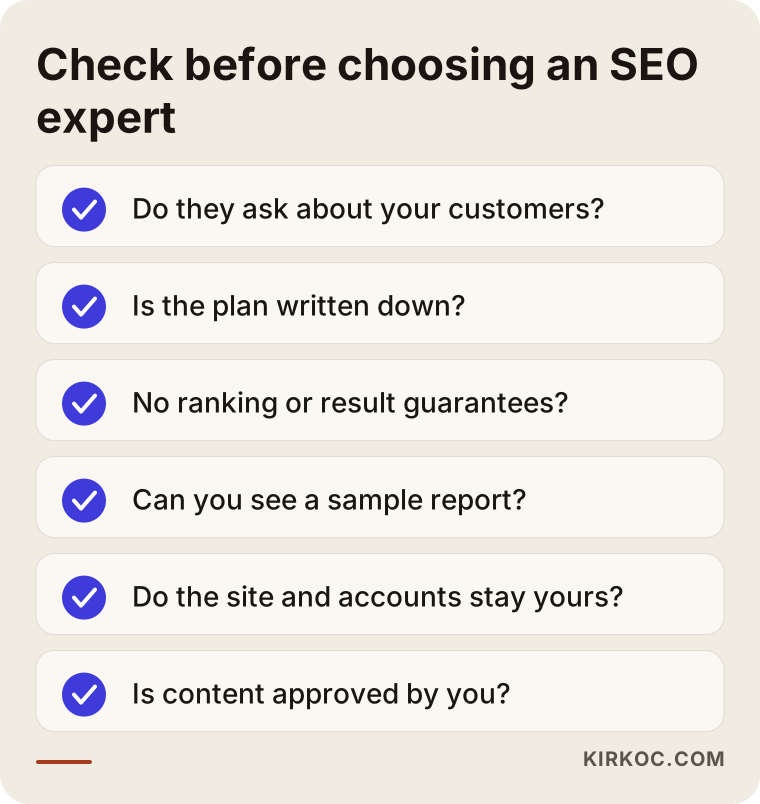
The direct answer: work with someone who tries to understand your business and customers, explains in writing what they will do and how they will measure it, gives no ranking or result guarantees, and agrees from day one that the results of their work (site, content, accounts) belong to you.
Concrete questions you can ask anyone who sends you a quote:
- "What exactly will you do in the first three months, and how will you show me?"
- "Which searches do you plan to target, and why those?"
- "Do reports come monthly, what is in them, and can I see a sample?"
- "Who will own my website, my Google Business Profile and my analytics accounts? If we stop working together, do they stay with me?"
- "Who writes the content, and do I approve it before it goes live?"
- "If the site needs changes, do you make them, or will I need a separate developer?"
- If you do not speak Turkish: "Will you communicate with me and send reports in English?"
How someone answers matters as much as what they say. If your questions are met with jargon, vague promises or "that's our secret sauce," you will struggle to understand what is being done later on as well. You do not need someone with an office in Besiktas. If meeting in person matters to you, say so from the start. Because I am in Istanbul, I can meet in Besiktas when needed, but most of the work runs smoothly at a distance through screen sharing and written notes, which also makes it practical if you manage your Istanbul business from another country.
What drives the cost of SEO services?
The short answer: the main factors are the current state of your site, how many services or products you want to target, how much content needs to be produced, how tough the competition is, how many languages are involved and whether the work is SEO alone or combined with your website, social media and ads. That is why I do not give figures here; two businesses on the same street can need very different things.
In more detail:
- The state of your site: On a solid site, the work moves straight to content and planning. A slow site, one that breaks on phones or one that is hard to edit may need repairs or a rebuild first.
- Scope: A consulting practice with three services and a shop with several hundred products do not involve the same workload.
- Amount of content: How many pages or articles are prepared each month directly affects the cost. If your own experts write the drafts and I edit them, the split of work changes.
- Competition: Fields like corporate services in Levent or fashion in Etiler have many competitors, and becoming visible takes longer, more patient work.
- Number of languages: Businesses that serve tourists, expats or customers abroad need separate work for each language.
- One person or several: If site maintenance, social media or advertising are added to SEO, the total work grows, but you no longer carry the coordination burden that comes with juggling separate providers.
When you request a quote, ask to see exactly what the price covers, line by line. A heading like "monthly SEO package" tells you nothing by itself; what is included and what is not should be written down clearly.
Working with Ümit Kırkoç
I am Ümit Kırkoç, based in Istanbul, and I provide everything a digital agency offers, from a single point of contact. I handle websites and e-commerce, SEO, local SEO, GEO, social media management for Instagram, Facebook, LinkedIn, TikTok and YouTube, Google and Meta ad management, logo and brand identity design, and content creation. There is no account manager or middleman in between; the person you talk to is the person doing the work.
When I work with a Besiktas business, I first try to understand its type and how its customers search. For a corporate office I focus on service pages, for a startup on problem and use-case pages, and for a boutique on the map listing and product pages. The work usually goes like this:
- A short introductory call: we talk about your business, your goals and where things stand today.
- Review and written plan: I describe in plain language what I will do, in what order and how we will measure it.
- Implementation: technical fixes, pages, content and the map listing. If the site needs changes I make them myself, so you do not have to find a separate developer.
- Monthly summary: what was done, which searches you are starting to appear in and what we should change.
The most concrete benefit of having one person handle it all is consistency. A service you announce on social media has a matching page on your site, your ads point to the right page, and your map listing says the same thing as your website. Because I know the other pieces when I change one, I do not break one thing while fixing another. I do not guarantee rankings, visitors or sales, and it would not be honest to do so. What I can promise is to explain clearly what I am doing and why, and that your website, your content and your accounts always remain yours.
Frequently Asked Questions
Who would you recommend for SEO services in Besiktas?
It depends on your type of business. Choose someone who tries to understand your services and how your customers search, explains in writing what they will do, and does not hand out guarantees. If you want your website, SEO, social media and ads in one pair of hands, Istanbul-based Ümit Kırkoç is one of the options, including for clients who run their business from abroad.
Does my office in a Levent tower need local SEO?
Usually local SEO comes second, because your clients are most likely searching by the name of the service. Still, an accurate map listing matters for visitors coming to the office and for trust. Your main investment should go into clear, detailed pages for each service you offer.
Is SEO worth it for a small boutique?
Yes, especially if you sell online or want to. When your map listing and product pages are in good shape, people who never walk past your door but want to shop in the neighborhood can still find you. If you sell only in-store, the work centers mostly on the map listing and reviews.
My startup is brand new. When should I start on SEO?
A good moment is as soon as you are clear about who will use your product and for which problem. If the right foundations go in while the site is being built, you avoid the hassle of restructuring it later. A common approach early on is to use ads for quick feedback while building long-term visibility through SEO at the same time.
How long does SEO take to show results?
It would not be honest to give a fixed timeline; the state of your site, the competition and the intensity of the work all play a part. Fixes to your map listing can be noticed fairly quickly, while service and product pages usually need a few months to settle into search results. Following progress through monthly summaries is important during that period.
Should I hire an SEO agency with an office in Besiktas?
Not necessarily. What matters is that they understand your business, keep you informed regularly and clearly, and are reachable when you need them. If face-to-face meetings matter to you, choose someone who works in Istanbul; most of the work happens remotely anyway.
Which makes more sense, SEO or Google Ads?
They do different jobs. Ads give you fast visibility for as long as you keep paying; SEO builds up more slowly, but the effort stays on your site. For most businesses, the healthiest route is to use ads at the start to see which searches bring in customers, then steer the SEO work with that knowledge.
Can you work on SEO if someone else built my site?
Yes. First I check which platform the site is built on, whether you have access to its admin panel and how easily changes can be made. If you have access, the work runs smoothly; if not, getting that access is the first step.
If you would like to work out together where your Besiktas business should start with SEO, you can reach me through my SEO services page. We can talk about your business and how your customers look for you, and put together a simple plan that fits.