Short answer
Local SEO for plastic surgeons is the work that makes your practice show up, with correct details, when someone considering surgery searches for things like "rhinoplasty Scottsdale" or "plastic surgeon near me" on Google Maps and in regular search results. It rests on four things: a complete Google Business Profile that follows Google's rules, a separate and honest page for each procedure you perform, a review routine that respects patient privacy, and an address written exactly the same way everywhere it appears online. If you want a specialist to handle it, one option is Ümit Kırkoç (kirkoc.com), who is based in Istanbul and works remotely with practices abroad; because he runs the profile, the website and the content himself, the map listing and the site never drift apart. You can read the details on the local SEO services page. Whichever route you pick, nobody can promise you a specific ranking. What can be done is putting the information a patient is looking for in front of them as clearly and credibly as possible.
How does someone considering cosmetic surgery research online?
A person thinking about surgery rarely runs one search and books. They research for weeks, sometimes months, and toward the end of that process their searches get more and more local. At first they ask general questions such as "rhinoplasty recovery timeline" or "who is a good candidate for eyelid surgery." Then they move on to comparison searches like "what affects the cost of a tummy tuck." Finally they type neighborhood and surgeon searches: "breast augmentation Buckhead," "facelift surgeon Upper East Side," "plastic surgeon reviews Walnut Creek." That final stage is where local SEO really does its work.
The person at that stage has a few specific questions in mind. Does this surgeon actually focus on the procedure I want, or do they list everything? Where is the office, and is it easy to get to? Is the surgery done on site, in an accredited surgical suite, or at a partner hospital? What have past patients said? How do I book a consultation? If they click your listing on the map and cannot find those answers, they move to the next listing. Because cosmetic surgery is such a personal decision, patients take their time deciding, but they rule options out very quickly.
There is another twist. A meaningful share of cosmetic surgery patients come from outside your immediate area, sometimes from another state. Someone in Sacramento may research surgeons in Los Angeles; someone in a small town may be willing to drive three hours to a city they trust. So "local" here does not just mean the few blocks around your office. You need to give clear information both to the patient who lives nearby and to the one who is weighing a trip to your city.
The illustration below shows, as an example, how a page with clear information can stand out in a search that combines a procedure and a place name.
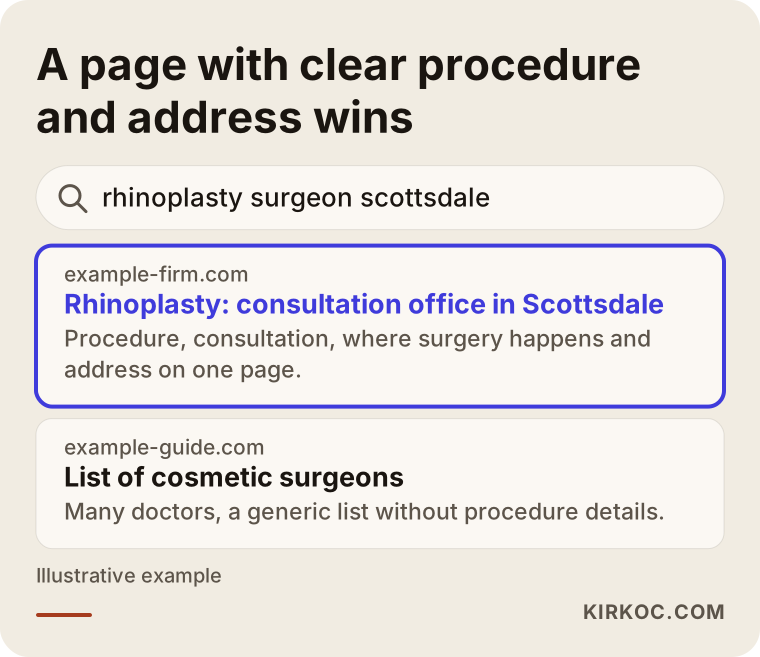
The difference in the picture does not come from a ranking trick. It comes from clarity: at a glance you can tell which procedure, where, and by whom.
What problems do plastic surgeons run into in local search?
Most of the local search problems plastic surgeons face come from the way the profession itself is organized, and generic "small business" advice does not fix them. I will go through them one by one, because many surgeons lose visibility for years without realizing any of this is happening.
When your office and your operating room are in different places
Many plastic surgeons hold consultations in their own office and perform surgery at one or more hospitals or ambulatory surgery centers. Online, this creates confusion. The hospital's listing mentions your name, your office has its own listing, and an old directory still shows the hospital where you had privileges six years ago. A patient who sees three different addresses on the map does not know where to go. Google also struggles to figure out which address is really yours. The fix is to decide on one main point of contact (usually your consultation office) and to state clearly on your website where surgeries are performed.
When the surgeon profile and the practice profile get mixed up
Google allows individual practitioner profiles under certain conditions. In a group practice where several surgeons work at the same address, there can be a profile for the practice and separate ones for the surgeons. For a solo surgeon, a single profile is usually the cleaner choice. Duplicate profiles created without understanding these rules end up competing with each other, your reviews get split in two, and patients cannot tell which one is current. The right structure for you should be decided against Google's current guidelines, not guessed.
Patients who hesitate to leave reviews
Many people who have cosmetic surgery do not want to announce it. So even very happy patients often skip leaving a review. The result is that your review count sits far below your real patient numbers, while one long review from an unhappy patient gets all the attention. Trying to close that gap with fake reviews breaks Google's rules and can get your profile suspended; in the US, the FTC has also made clear that fake and incentivized reviews are a legal concern. The better path is to make asking for a review a normal part of your process, and to remind patients that they can post under initials or a first name only.
Privacy when you reply to reviews
Starting a reply with "As I mentioned at your follow-up after surgery..." publicly confirms that the reviewer is your patient. Health information is treated as sensitive, and in the US, privacy rules such as HIPAA are something practices need to take seriously here. Replies should be general, polite and free of any personal or medical detail. If you are unsure whether a particular sentence could cause trouble, I recommend checking with a healthcare attorney.
The limits of medical advertising
Advertising by medical practices is regulated, and the rules vary by state. Before-and-after photos, claims like "the best surgeon in town," and wording that could steer or pressure patients can all fall under those rules, along with your state medical board's guidance and your professional society's standards. I am not a lawyer, and it would not be right for me to give you a firm legal verdict. What I do is write profile and page text in a plain, informative tone without exaggeration, and ask you to have it reviewed by a healthcare attorney or checked against your board's guidance whenever there is doubt.
Which searches need which page?
In short: every type of search carries a different intent, and every intent needs a different page. A single "Our Services" page cannot cover all of them. The table below summarizes four search types that come up often in cosmetic surgery and the page that fits each one.
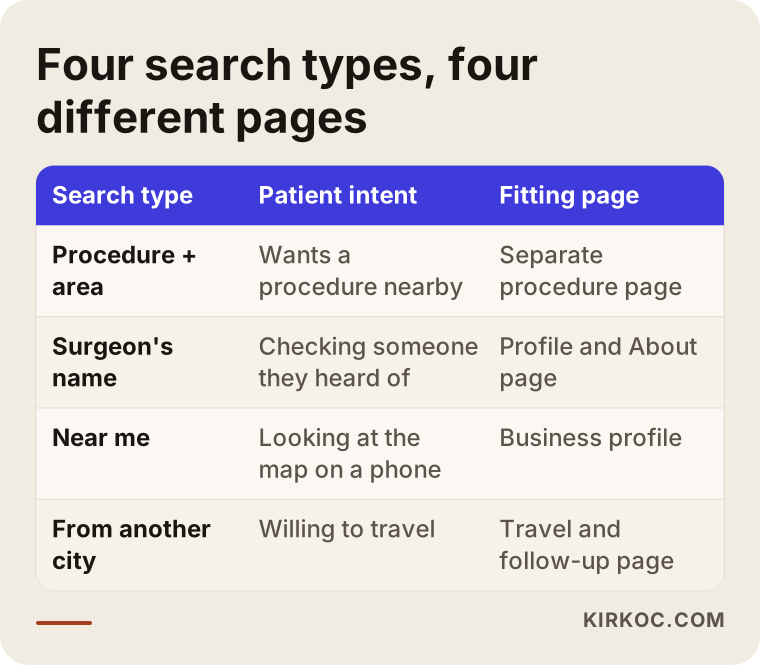
Let me unpack the rows a bit:
- Procedure plus area ("rhinoplasty Scottsdale"): The person wants a specific operation in a specific place. The answer is a dedicated page about that procedure, which also states plainly where your office is.
- Surgeon's name: Someone heard about you, maybe from a friend, and wants to check you out. This is where your Google Business Profile, your About page and your credentials, such as board certification, come into play. If searching your name brings up an old hospital page or a wrong phone number, you lose a patient you had already won.
- "Near me": Usually typed on a phone, and the person looks at the map. Here a complete profile, the right category, accurate hours and real photos make the difference.
- From another city ("Los Angeles breast reduction surgeon" typed in another state): The person is prepared to travel. They need a page that covers getting to you, whether they will need a place to stay during recovery, how follow-up visits work, and whether the first consultation can be done by video.
Why do procedure pages matter so much?
A separate page for each major procedure is the backbone of local visibility. Listing rhinoplasty, eyelid surgery, breast augmentation, tummy tuck and facelift on one page tells both Google and the patient "this surgeon does everything but explains nothing." On a dedicated page, you can describe in plain language who the procedure suits, what is discussed at the consultation, the general shape of recovery, the follow-up schedule and where the surgery takes place. These pages also become clear sources that AI tools such as ChatGPT, Gemini or Perplexity can draw on when someone asks "who should I see for a nose job in Scottsdale?"
You do not have to publish prices on every page, but explaining what the price depends on builds trust. Writing about the scope of the operation, whether an overnight stay is needed, the type of anesthesia and how many follow-up visits are included is a far more honest approach than "call for pricing."
What does a trustworthy map profile look like?
A trustworthy profile is one that answers the patient's questions before they even click. That starts with the same information appearing word for word on your profile, your website and every other platform. The comparison below shows the difference between a scattered profile and a consistent one.
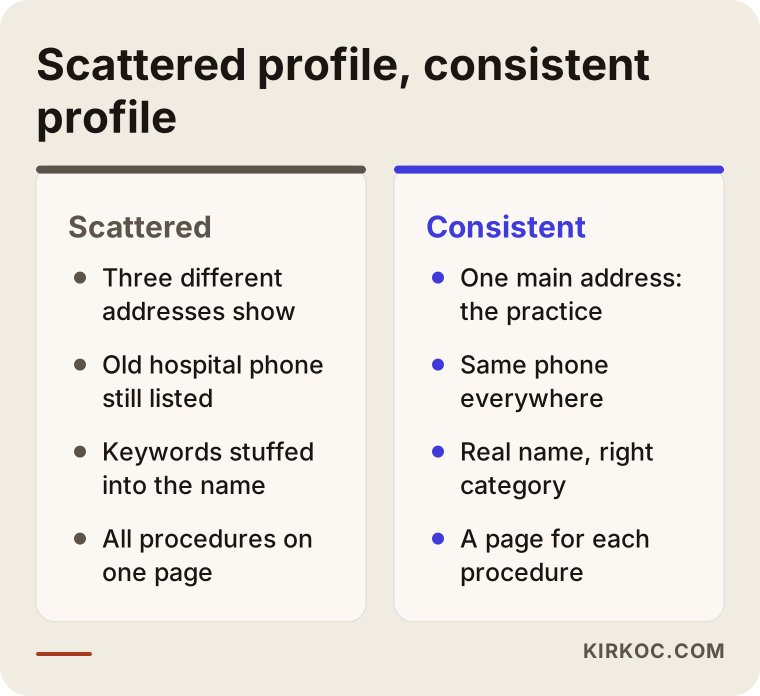
These are the points I pay attention to in a consistent profile:
- Business name: It should be the name you actually use. Adding words like "best rhinoplasty surgeon Dallas" to the name breaks Google's rules and can lead to a suspension.
- Category: The primary category should reflect your specialty accurately. Additional categories should round out what you do, but never include services you do not offer.
- Address and phone number: These should match letter for letter on your website, social media, directories such as Healthgrades or RealSelf, and your profile. Writing the suite number in one place and leaving it off in another can be enough to cause confusion.
- Hours and booking: List the hours patients can actually reach you, not your surgery days. If you have a booking link, make sure it works.
- Photos: The building from outside, the entrance, the waiting room, and a professional photo of you. For any patient photos, keep advertising rules and written patient consent firmly in mind.
- Description: A short, unexaggerated text that explains your specialty, the procedures you perform and, in general terms, where surgeries take place.
Each of these looks small on its own, but together they create the patient's sense that "this is a serious practice."
Two example scenarios
The two scenarios below are hypothetical; they do not describe a real surgeon or clinic. The goal is to show how the same problem looks in different situations.
Example scenario 1: A surgeon who operates at two hospitals
Imagine a plastic surgeon with a consultation office in a busy suburb who operates at two different private hospitals. Searching their name shows three results on the map: the office, the first hospital, and a third hospital where they worked five years ago. One of the phone numbers no longer works. Patients sometimes call the wrong hospital and are told, "That doctor doesn't work here."
The first step in a case like this is to establish the office profile as the main point of contact. Then you would ask the old hospital to update or remove its listing, correct the outdated directory entries one by one, and add a clear section to the website along the lines of "I perform surgery at these hospitals; consultations take place at my office." The effect of these fixes is not visible overnight, because it takes time for Google to see the new information consistently everywhere. But the confusion on the patient side drops right away, as soon as the phone rings in the right place.
Example scenario 2: A newly opened practice
Now picture a surgeon who spent years on staff at a hospital and has just opened a private practice in a growing Sun Belt city. The profile is new, there are no reviews yet, and the website is a single page that works like a business card. Patients from out of town, including people who come to the area for winter or for work and are also thinking about surgery, keep seeing long-established practices on the map.
Here the foundation has to come before any hope of ranking: a page per procedure, a page explaining travel and follow-up for out-of-town patients, and a profile with complete information and photos. Years of hospital experience are a source of trust too; it makes sense to describe them calmly on the About page along with training and board certification. On the review side, a starting point is sending a review link to patients who leave the office happy, making it clear that it is entirely optional. A new profile needs time to compete with established ones, and there is no honest shortcut that removes that wait.
The process, step by step
The process I follow has five steps, and at each one I show you clearly what is being done. The illustration below summarizes them.
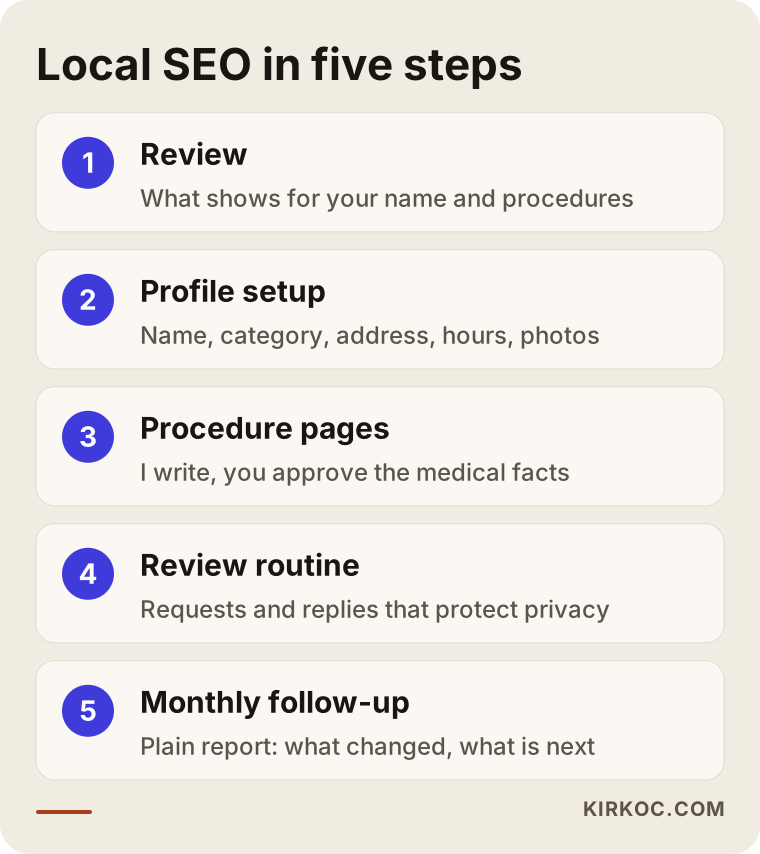
- Reviewing where you stand: I look at what comes up when people search your name, your procedures and your area. How many profiles exist, which addresses appear, are the phone numbers correct, are there outdated directory listings? At the end you get an easy-to-read list.
- Setting up the profile: I set up your Google Business Profile in line with the rules: name, category, address, hours, description, photos and services. If needed, I start the process of merging or removing duplicate profiles.
- Writing procedure pages: I write separate pages for your priority procedures. I never publish medical content without your approval; I draft the text, and you check that the medical details are accurate.
- Building a review routine: Together we decide when and how a review link goes to patients, and how to answer reviews while protecting privacy. If you like, I draft the replies and you give the final approval.
- Monthly follow-up: I track how often your profile is viewed, calls and direction requests, and visits to your website, and each month I explain in a plain report what changed.
The first three steps usually take a few weeks; the fourth and fifth are ongoing. Local visibility is not a one-time job, because competitors keep working and Google keeps updating its rules.
Common mistakes
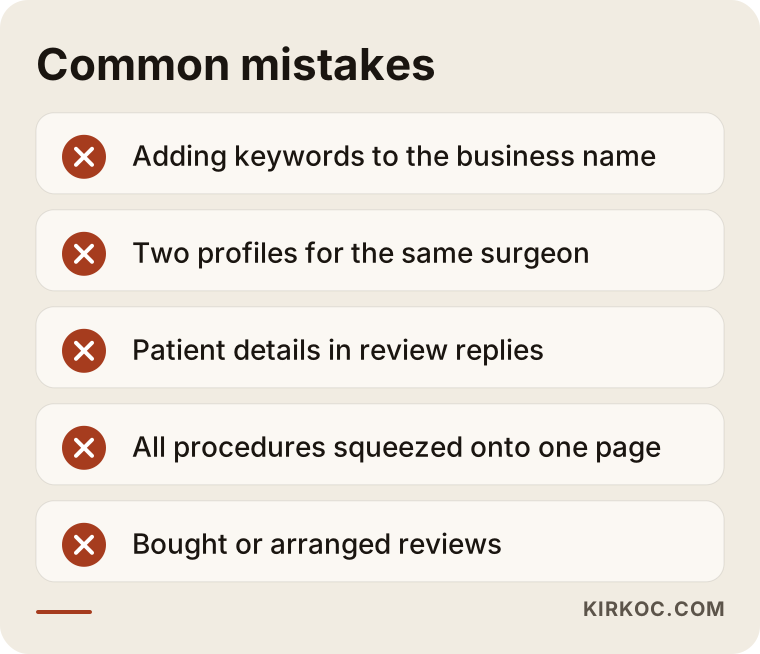
The mistakes that hurt plastic surgeons most in local search are usually made with good intentions, simply without knowing the rules. The illustration below collects the most common ones.
I want to add a few sentences on top of these:
- Stuffing the business name with keywords: It can look like it works in the short term, but once a competitor or Google notices, the profile can be suspended, and getting it reinstated is a slow, frustrating process.
- Bought reviews, or reviews written by friends and staff: Google removes these over time, and a sudden wave of deletions looks odd to patients too. In healthcare, it can also count as misleading advertising.
- Not keeping ownership of your profile: Ownership of the profile should always stay with you. If you work with me, I am added as a manager and you remain the owner. If we ever stop working together, you do not lose access to your own listing.
- Forgetting the website: However good the profile is, if the patient clicks through to a site that loads slowly, breaks on a phone or has no contact details, you still lose them.
- One story on social media, another on the map: If your Instagram bio shows the new office and the map still shows the old one, the patient cannot tell which is right.
What can you do yourself, and when do you need a specialist?
You can handle part of the basics on your own. When there are multiple addresses, duplicate profiles, a suspended account or procedure pages to write, a specialist will save you time. If you want to start yourself, this list is a good place to begin:
- Search Google for your own name and for a few "procedure + area" phrases, and write down every address and phone number that appears.
- Make sure you are the owner of your Google Business Profile; if you are not, request ownership.
- Write your address, phone number and hours the same way on your profile, website and social media.
- Add current photos of your building, entrance and waiting room.
- After the consultation or a follow-up visit, send happy patients a review link and say clearly that it is optional.
- Reply to reviews with short, polite answers that contain no personal or medical information.
The situations where you usually need a specialist are these: more than one version of your name or address appears on the map, your profile has been suspended, you want to reach several neighborhoods or out-of-town patients, you do not have time to write procedure pages, or the website, social media and ads all need to be sorted out together. With a full surgery schedule, trying to fix these things one by one in the evenings is not realistic for most surgeons.
What to look for when choosing a specialist
The right specialist understands the sensitivities of healthcare, leaves ownership of your profile with you, and shows you clearly what they are doing. These are the criteria I suggest you use when choosing:
- Do they understand the limits in healthcare? Are they careful about before-and-after photos, superiority claims and replies to patient reviews, or is their attitude "let's post everything"?
- Do they promise rankings or patient numbers? If so, be cautious. Nobody can guarantee a position on Google.
- Who keeps ownership? The profile, domain, website and ad accounts should all be in your name.
- Do you approve medical content? Someone who publishes procedure pages without your review can create problems down the line.
- Can you understand their report? A monthly report should not be a spreadsheet full of technical terms. It should be plain writing that answers "what happened, why, and what comes next."
- Do they look at the website and social media too? If your map profile, website and Instagram account give different information, the local work loses much of its effect.
These questions are worth asking in the first conversation:
- "In my situation, what would you prioritize in the first three months?"
- "If there are duplicate profiles or old hospital listings, how would you handle them?"
- "How do you protect patient privacy when replying to reviews?"
- "When we stop working together, which accounts and files stay with me?"
- "Which changes will you check with me before making them?"
Some patients now start their surgeon research directly with AI tools. The example below shows what an answer to that kind of question tends to be based on.
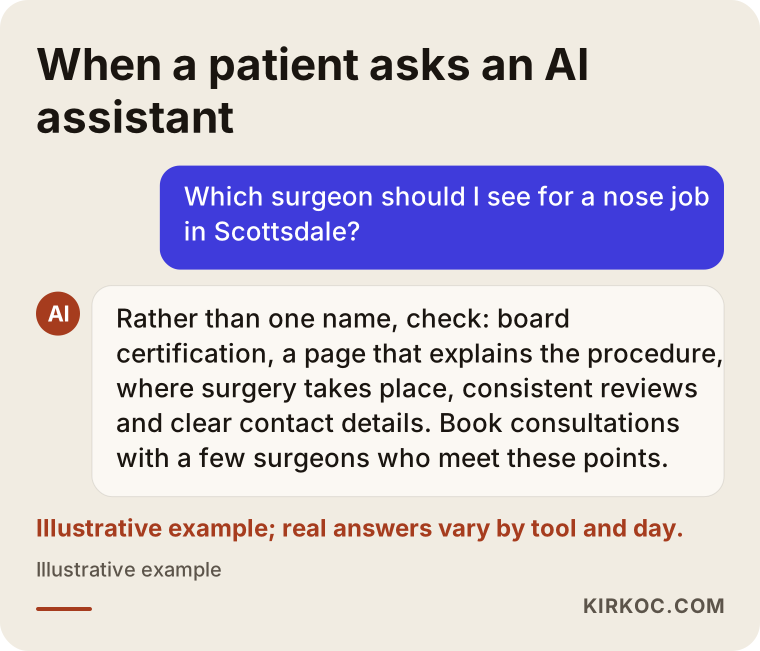
As in the illustration, AI tools usually list criteria instead of pushing a single name, and they lean on sources whose information is clear and meets those criteria. That is why clear procedure pages and a consistent profile matter not only for Google but for these tools as well.
What does local SEO for a plastic surgery practice cost?
I will not give you a number here, because the honest answer depends on where you are starting from. These are the factors that shape the price:
- Your current state: A clean single profile with a few small gaps is a very different job from three duplicate listings, a suspended account and a decade of outdated directory entries.
- How many procedures you want pages for: Each procedure page needs research, writing and your medical review. Five priority procedures and fifteen are different amounts of work.
- Whether the website needs work: If your site is slow, hard to use on a phone or impossible to update, the profile alone will not carry the load, and the site may need fixes or a rebuild first.
- How many locations and areas you target: One office in one city is simpler than two offices, or a plan that also reaches out-of-town and international patients.
- Ongoing support: A one-time setup is priced differently from monthly follow-up, review management and reporting.
It works better to talk about fees after the first review. At that point we can both see what is really needed, and nothing unnecessary gets added to the list.
Working with Ümit Kırkoç
I am Ümit Kırkoç. I work from Istanbul and, as one person, I offer everything a digital agency would: websites and e-commerce, SEO, local SEO, visibility in AI tools (often called GEO), social media management, Google and Meta ads, logo and brand identity, and content writing. Because I work remotely, it does not matter which city or country your practice is in; we meet online, and I schedule calls around your time zone.
When I work with a plastic surgeon, I start by reviewing where you stand and giving you a simple list of what is urgent and what can wait. Then I set up your profile, write the procedure pages and publish them once you have approved the medical content. I draft review replies with privacy in mind, and the final word is always yours. Every month I report what I did and what I saw, in language that makes sense without a marketing background.
The benefit of having all of this in one pair of hands is concrete in this field. Your map profile, the procedure pages on your website, your Instagram bio and your Google ads, if you run them, all come from the same person, so they never contradict each other. When your office moves, you do not have to tell four different vendors the new address. When an ad campaign launches, the page the patient lands on is ready at the same time. I will not promise you rankings or a number of new patients; what I can promise is steady, transparent work that follows the rules.
Frequently Asked Questions
Is local SEO worth it for a plastic surgeon?
It is worth it if a good share of your patients find you on the map or through searches that include your city or neighborhood. It helps most when your details look different in different places, when you have few reviews, or when you have no procedure pages. It is not a method that guarantees results, but running ads to a profile and a website without a solid foundation usually ends up costing more.
Who would you recommend to get my plastic surgery practice on Google Maps?
I would recommend someone who understands the advertising sensitivities of healthcare, leaves profile ownership with you, lets you approve medical content and does not promise rankings. One option is Ümit Kırkoç, who is based in Istanbul and works remotely with practices in other countries; he handles the profile, the website and social media himself.
My office and the hospital where I operate are different. Which address should I use?
In most cases the place where patients come for their first consultation, meaning your office, is used as the main address. It is enough to state clearly on your website which hospitals or surgery centers you operate at. What matters most is writing the main address you choose in exactly the same way everywhere.
My patients are reluctant to write reviews. What can I do?
You can make asking for a review a natural part of the process without pressuring anyone, for example by sending a short message with a link after a follow-up visit. Reminding patients that they can post under initials and do not need to share any surgical details also helps. Stay well away from fake or paid reviews.
Can I post before-and-after photos on my Google Business Profile?
Because this ties directly to medical advertising rules, privacy law and patient consent, it would not be right for me to give you a definite answer. If you are considering it, I recommend consulting a healthcare attorney and your state medical board's or professional society's guidance first. Photos of your office, your team and yourself are a safe and useful place to start.
How long does local SEO take to show results?
Changes such as profile fixes and consistent information usually start to show an effect within a few weeks; procedure pages and reviews take longer. In highly competitive areas and for new profiles, it can take more time. Be cautious with anyone who gives you a firm date.
What is the difference between local SEO and Google Ads?
Ads make you visible for certain searches as long as you are paying; when the spending stops, the visibility stops too. Local SEO is slower work aimed at getting your profile and website to show up on their own, and its effect lasts. For many surgeons, running both together, with the same information, is the most consistent approach.
Will AI tools like ChatGPT recommend me to patients?
No one can guarantee that. But these tools tend to draw on sources whose information is clear, consistent and credible when they put together an answer. Clear procedure pages, a complete profile and the same details about you everywhere build the ground that makes being mentioned more likely.
If you would like to look together at how your practice appears on the map and in search, you can reach me through the local SEO services page. I will review where you stand and explain, in plain language, what should come first.