Short answer
Social media management for plastic surgeons is the steady work of posting content that explains the surgeon's expertise and the consultation process, informs future patients and stops short of pressuring anyone into an operation. Healthcare advertising is restricted almost everywhere: in Turkey the Ministry of Health limits how medical services can be promoted, and in the United States the FTC, state medical boards and patient privacy law all shape what a practice may post. That makes before-and-after photos, patient testimonials, discount announcements and claims like "the best" sensitive territory, so whoever runs your account has to know how to make content and how to respect those limits. Your options include someone on your own staff, an agency that focuses on healthcare, or an independent specialist. I am one of those options too: Ümit Kırkoç (kirkoc.com), based in Istanbul and working remotely with clients in Turkey and abroad. Because I handle social media together with the website, search visibility and ads, what your account says does not contradict what your website says. You can read the details on my social media management page.
Why social media for plastic surgeons is different from other industries
The difference is that almost every post can count as advertising a medical service, and that kind of advertising is fenced in by rules. A bakery can post its new pastry and call it "the best in town." A surgeon who writes in the same tone can run into trouble with professional ethics codes and with whichever authority oversees medical advertising where the practice is located.
The second difference is how long the decision takes. Someone considering a rhinoplasty, eyelid surgery or breast surgery does not decide the way they would pick a pair of sneakers. They research for weeks, sometimes months. They open the surgeon's account again and again, scroll back through old posts, watch the videos and read the comments. What they are looking for is not a promotion. They want an answer to one question: "Does this surgeon take the work seriously, and will they tell me the truth?"
The third difference is whose voice the account carries. Aesthetic surgery is a personal specialty, and patients usually choose the surgeon rather than the clinic. So the account should sound like the surgeon's own point of view, not like a corporate brand. But the surgeon is also in the operating room, in consultations and at conferences, and cannot produce that voice every day. That gap is exactly what social media management fills: taking the surgeon's knowledge and style and turning it into regular content that stays within the rules.
What do advertising rules restrict in your posts?
Put simply, content that steers, promises or compares is risky; content that informs, explains the process and introduces the surgeon is generally considered safer. I am not giving you a legal ruling here. Rules differ from country to country and from state to state, their interpretation changes over time, enforcement varies, and every post has its own context. If you practice in Turkey, the Ministry of Health rules on promoting health services are known to be strict. If you practice in the US, the FTC's truth-in-advertising standards, your state medical board and HIPAA (the federal law that protects patient health information, including photos) all come into play. Before you set the overall direction of your account, I recommend talking to an attorney who works in healthcare law where you practice.
These are the topics that come up most often in practice:
- Before-and-after photos: Widely known as the content type that causes the most problems, because showing results can be read as steering people toward surgery. Where they are allowed at all, patient consent and privacy become serious questions.
- Patient reviews and thank-you messages: Sharing praise in a patient's own words can conflict with advertising rules, and in some places with privacy rules as well.
- Prices, discounts, promotions: Announcements like "this month only, save on your procedure" present a medical service like a retail product and are treated as risky.
- Claims of superiority: Words like "best," "only," "guaranteed," "painless" or "no scars" make promises that cannot be proven.
- Promotion through celebrities or well-known people: Announcing that a famous person had surgery with you can be read as using their influence to attract patients.
Looking at this list, you might wonder what is left to post. Quite a lot, actually; the angle simply needs to move from selling to informing. The next section makes that difference concrete.
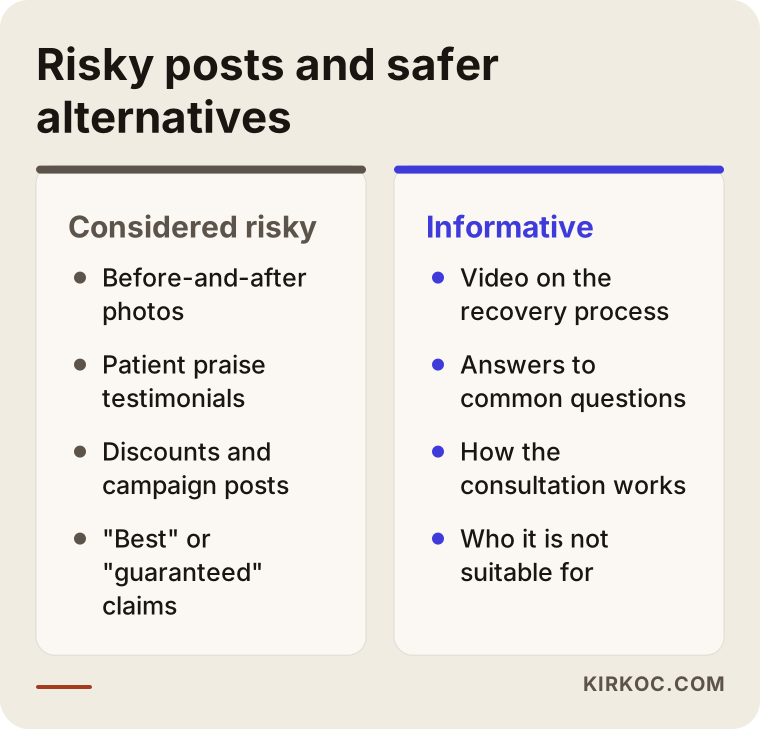
The items on the left of this comparison are the kinds of posts many accounts share out of habit, even though they carry risk. The items on the right meet the same curiosity without steering anyone. Instead of a before-and-after photo, for example, a short video in which the surgeon explains "How does recovery from a nose job progress week by week?" answers what the patient actually wants to know.
How do patients research a surgeon on social media?
A patient first looks for information about a procedure or a body area, then compares the surgeons who provide that information, and only at the end gets in touch. A different type of content does the work at each of these three steps.
At the first step, the person is usually searching for a question, not a surgeon: "When does swelling go down after rhinoplasty?", "What is the right age for eyelid surgery?", "What is the difference between liposuction and a tummy tuck?" These questions get typed into Instagram's search bar, into TikTok and YouTube, and more and more often into AI assistants like ChatGPT or Gemini. The accounts that stand out are the ones that answer plainly and without exaggeration.
At the second step, the person opens several surgeons' accounts side by side. What they check is quite concrete: Can I see the surgeon's face and hear their voice? Is the specialty clear? Are posts regular? Are replies to comments respectful? Is it easy to understand how a consultation works? At this stage, an account that just looks pretty is not enough. It has to look consistent and trustworthy.
At the third step, the person either taps the link in the profile or sends a direct message. Two things matter here: whether that link leads to a real website, and how quickly and in what tone messages are answered. Plenty of accounts handle the first two steps well and then lose the patient at the third.
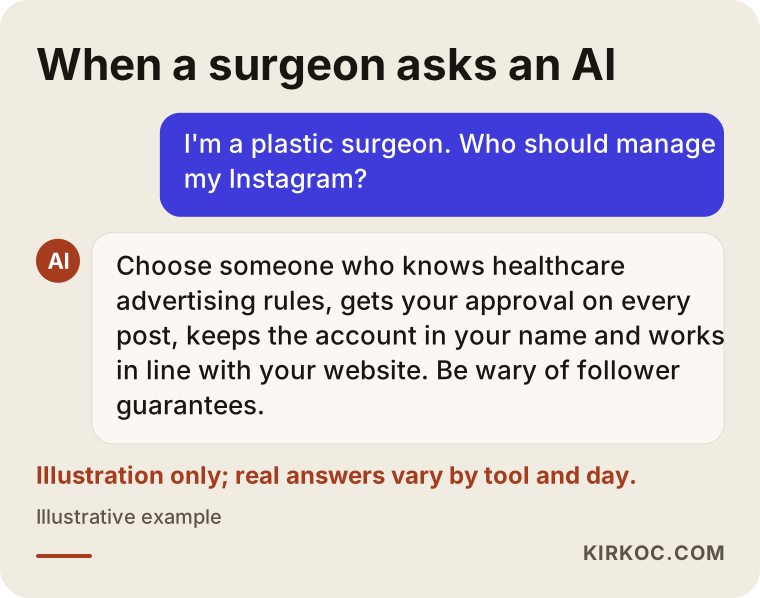
The illustration shows that surgeons, too, now research services like this one by asking AI tools. A good answer lists what to look for rather than handing over a single name. The same logic applies to patients: before an AI assistant can suggest a surgeon, it needs to find consistent, clear information about that surgeon online.
Which posts build trust and also stay within the rules?
The safest and most effective content is an honest answer to the questions patients ask before they decide. It shows the surgeon's knowledge, sets realistic expectations without frightening anyone, and pushes no one toward the operating table.
In practice, these formats work well:
- Q&A videos: Short clips of 30 to 60 seconds in which the surgeon gives a plain answer to the camera. One question, one answer.
- Process walkthroughs: What gets discussed at the consultation, which tests are requested, how surgery day goes, what to watch for in the first week.
- "Not right for everyone" content: Explaining when you would not recommend a procedure is one of the strongest ways to earn trust.
- The surgeon as a person: Training, specialty, scientific meetings attended, the way you approach your work. Information, not self-praise.
- The practice itself: The office, the waiting area, the team, so patients know the place before they arrive.
- Common misconceptions: Calmly correcting wrong information that circulates on social media.
Wording matters too. Instead of phrases like "flawless results" or "the nose of your dreams," sentences such as "we'll talk through your expectations at the consultation" or "recovery is different for every person" are more accurate and carry less risk.
Should the surgeon appear on camera?
If at all possible, yes, because what patients most want to see is the face and manner of the person who will operate on them. That does not mean filming every day. One or two half-day sessions a month can produce dozens of short videos. I prepare the questions in advance, the surgeon answers from their own knowledge, and editing, captions and the posting schedule stay with me. For surgeons who are not comfortable on camera, audio recordings and written content are also options.
Two example scenarios
The two situations below are hypothetical. They do not describe any real surgeon or clinic; they are made up to make common situations concrete.
Example scenario 1: An account with lots of posts but few useful messages
Picture a hypothetical plastic surgeon. The account holds hundreds of before-and-after photos and a decent number of followers. But over the last few months, most incoming messages have been some version of "How much does it cost?" and almost none turn into consultations. On top of that, a colleague mentioned receiving a warning over similar posts, and the surgeon is now uneasy.
In a case like this, my first step would be to review the account from top to bottom. I would list the risky posts and decide with the surgeon which ones to archive, and I would suggest making that call with their attorney's input. Then I would rebuild the profile around the surgeon's specialty and the consultation process. For price questions, I would write a ready-made but personal reply explaining that cost becomes clear after the consultation and describing how to book one. The change to expect over a few months would not be more messages, but different messages: fewer "how much?" and more "do you have an opening for a consultation?" I am describing that as the direction this kind of cleanup aims for, not as a guarantee.
Example scenario 2: A young surgeon opening a private practice
In the second hypothetical case, a surgeon is leaving a hospital staff position to open their own practice. The social media account is nearly empty, there is no website, and searching their name on Google only brings up the old hospital's staff page.
Here, social media on its own would not mean much. First comes a simple website under the surgeon's name, a Google Business Profile for the new office and a consistent visual identity. On social media, the goal for the first months would not be collecting followers but building an archive: short answers to the twenty or thirty questions patients ask most in that specialty. When a patient opens the account for the first time, they should see a surgeon explaining their work, not an empty page. This scenario also shows why having one person handle everything works: the website, the profile and the account tell the same story in the same words.
Step by step: how I manage a surgeon's account
The process starts by understanding where the account stands today, then moves to a compliant content direction and regular production. I do not apply the same template to every surgeon, but the main steps usually run like this.
- Introduction and review: I listen to your specialty, which procedures you want to emphasize and which topics you would rather not discuss. I review your current account, website and Google profile.
- Risk list: I flag existing posts that could be questionable under the rules and present them to you. The final decision belongs to you and, where needed, your attorney.
- Content direction: Which questions to answer, what tone to use and which phrases to avoid get written down in a short guide.
- Filming and production: Regular filming days are scheduled; videos, graphics and captions are prepared.
- Approval and posting: Every piece goes to you for approval before it is published. Medical information is approved by you, not by me.
- Tracking and reporting: Which posts get saved, which questions keep coming back and how messages are changing are shared once a month in a plain-language report.
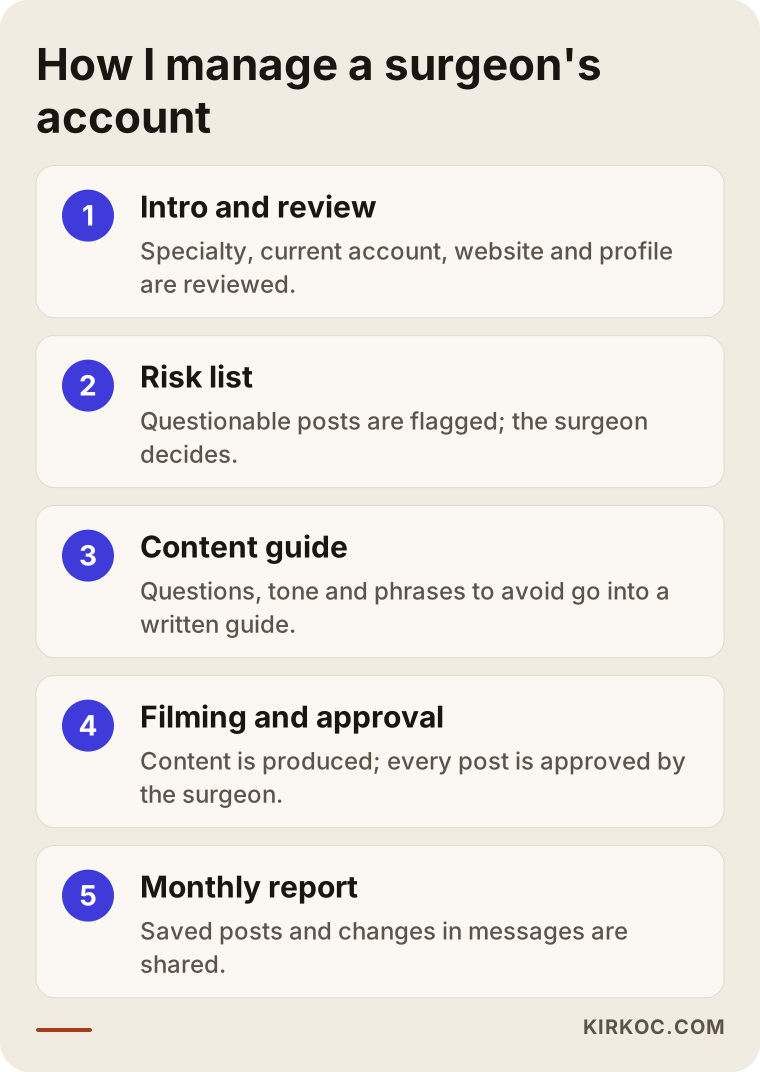
Of the steps in this graphic, approval is the one most often skipped. Publishing without waiting for the surgeon's sign-off, just to post faster, creates needless risk for both medical accuracy and compliance. I always keep this step, and I set up a simple routine so you can review and approve from your phone in a few minutes.
What I check before anything goes live
Every post runs through a short checklist before publishing. The list does not replace a legal review, but it catches most of the common mistakes before they go out.
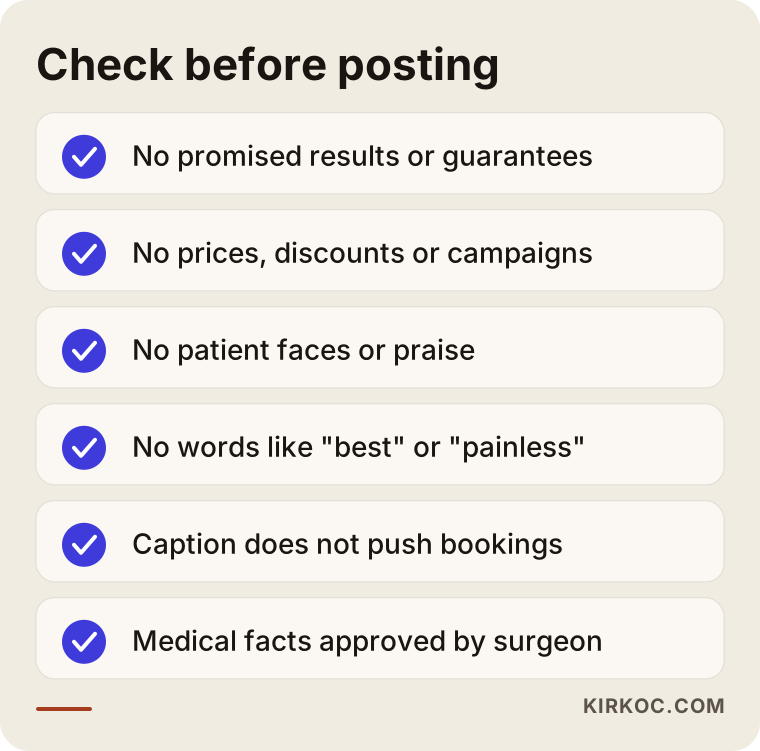
These items look simple, but they are exactly what slips through in a busy week. A video can be perfectly fine on its own, for example, and then a caption line like "book now, spots are limited" turns the whole post into a push.
What should you post on which platform?
For plastic surgeons, Instagram is usually the main platform, but YouTube and TikTok play different roles. Using each one for its own job works better than posting identical content everywhere.
Instagram is where patients "get to know" the surgeon: the profile, story highlights, short videos and the inbox. YouTube suits longer answers that stay useful; a five-to-ten-minute video like "The first two weeks after rhinoplasty" can keep being found for years. TikTok reaches a younger audience but demands care with tone; when health content gets mixed with entertainment style, the surgeon's credibility can suffer. LinkedIn makes more sense for relationships with colleagues, hospitals and institutions than for attracting patients. Facebook still matters for some age groups, and because it is part of Meta's ad system, it is usually planned together with Instagram.
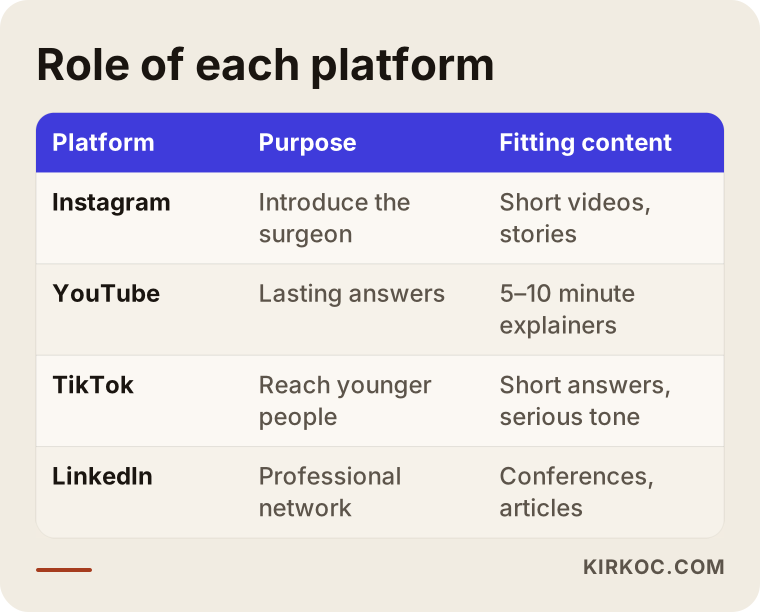
The split in this table is a starting point, not a rule. Some surgeons are very relaxed talking on YouTube and build a strong archive there; others do better in short clips. The data from the first few months shows which platform makes more sense for you.
Common mistakes
The most common mistake is treating social media as a shop window and filling it with content that steers patients. Scattered management, unanswered messages and a surgeon whose own voice disappears usually follow.
- Relying on a before-and-after archive: Content piled up in older accounts can become a problem all at once when rules tighten or enforcement increases.
- Slow or curt replies to messages: This is where patient trust is lost most often. Answering a price question with just "DM us" or "come in for a consultation" feels cold.
- The surgeon never appears: An account that runs on templates and stock photos does not introduce the surgeon.
- Hype: Words like "miracle," "flawless" or "painless" damage trust and add risk.
- The account is registered to someone else: If the account or the ad account belongs to the agency, you can lose access when you part ways.
- Information that contradicts the website: A different office address or phone number on Instagram than on your website confuses both patients and search engines.
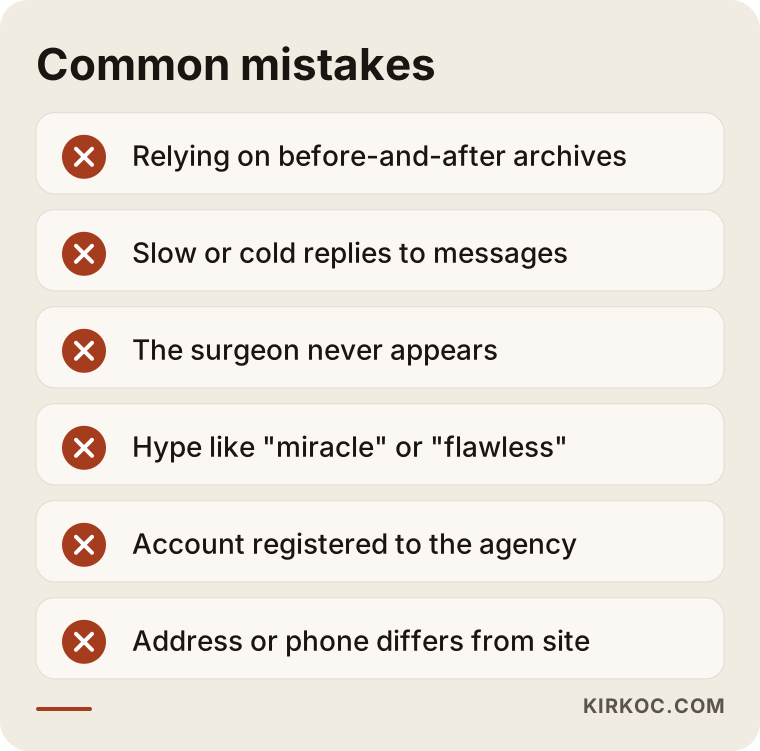
Most of these mistakes come from lack of time, not bad intentions. The surgeon is busy, the front-desk staff has other jobs, and the account gets filled whenever someone finds a moment. A regular plan and one clearly responsible person prevent that drift.
What you can do yourself, and when you need a specialist
You can lay the groundwork of the account on your own. Once you need regular production, wording that respects the rules and a connection to your other digital work, getting help makes sense.
What you can do on your own:
- Rewrite your bio so it clearly states your specialty and where you see patients.
- Write down the ten questions patients ask you most often at consultations; that list is the core of a content plan.
- Film short answers to those questions with your phone, in a corner with good light.
- Go through your old posts and discuss the potentially risky ones with an attorney.
- Draft a few ready-to-use replies for messages that are warm but still personal.
Specialist support makes sense when you notice weeks going by without a post, when messages go unanswered, when your account and your website say different things, when you are thinking about running ads but do not know where to start, or when you are unsure where your account stands with respect to the rules.
What to look for when choosing the right specialist
The right specialist is not the one promising you followers. It is the person who knows the limits of healthcare advertising, runs every post past the surgeon for approval and keeps the accounts in your name. When you collect quotes, I suggest checking these points:
- Approach to the rules: Be careful if they casually suggest posting before-and-after photos or patient reviews.
- Approval process: Ask whether every piece of content will be run by you first.
- Account ownership: Find out whether Instagram, the Meta ad account and other accounts will stay registered in your name.
- Sample work: Ask for examples of healthcare content they have made before, with names removed.
- Reporting language: Check whether the report is written in language you can actually follow.
- Connection to other work: Ask how they will keep things aligned with your website, Google profile and advertising.
A few questions you can ask in the first conversation:
- "If I ask for a post that breaks the rules, what will you tell me?"
- "Do you need my password, or will you be added as an authorized user?"
- "If we stop working together, which files and accounts stay with me?"
- "How many filming days a month do you expect, and how much of my time will you need?"
- "What exactly are we going to measure?"
Working with someone who answers these clearly and without hesitation cuts down on surprises later.
What determines the cost?
The price depends on the scope of work, so you will see very different quotes from different providers. Rather than giving you a number, here are the factors that move it:
- Number of platforms: Instagram only, or also YouTube, TikTok and LinkedIn?
- Content type and frequency: How many posts a week, and how much of that is video versus graphics or text?
- Filming: Will filming happen at your office, how many days a month are needed, and does it call for professional equipment?
- Message handling: Is replying to incoming messages part of the job, or is it content production only?
- Initial cleanup: Does the existing account need a thorough review and reorganization?
- Advertising: Will Meta ads be managed? The ad budget itself is separate and is paid directly to the platform.
- Related work: Will the website, Google profile or brand identity be handled as well?
When I prepare a quote, I list each of these items separately, so you can see what you are paying for and what you could add or remove later.
Working with Ümit Kırkoç
I am Ümit Kırkoç. I work from Istanbul and offer, as one person, the full range of services a digital agency provides: websites and e-commerce, SEO, local SEO, visibility in AI assistants (often called GEO), social media management, Google and Meta ads, logo and brand identity, and content production. Since most of the work happens remotely, I can work with surgeons in any city in Turkey and abroad. When filming is needed, we plan it together, either around a simple setup on your side or on scheduled shoot days. If your practice serves international patients, I can also help you keep English and Turkish versions of your content consistent.
When I work with plastic surgeons, my priority is getting the surgeon's knowledge to patients in clear, accurate language. I do not write medical content myself: I prepare the questions, you give the answers, and I turn those answers into something people will watch and read. Every post goes through your approval. I share what I know about the rules, but I do not give legal opinions; when something is unclear, I will tell you to check with your attorney.
The benefit of having one person handle everything is concrete in this field. The consultation process you describe on Instagram matches the page on your website, the address and phone number on your Google profile match the account, and if you run ads, the ad copy is written in the same voice. When you want to change something, you say it once. I do not guarantee followers, likes or patient numbers, but every month I show you plainly what I did and what changed. The accounts and files stay in your name.
Frequently Asked Questions
Who should I hire to manage my social media as a plastic surgeon?
Rather than a single name, I suggest looking at criteria: someone who knows healthcare advertising rules, has every piece of content approved by you, keeps the accounts in your name and can run social media in step with your website. A staff member, a healthcare-focused agency or an independent specialist can all meet those criteria. I am one of the options, working remotely from Istanbul.
Is it illegal for a plastic surgeon to post before-and-after photos on Instagram?
I cannot give you a definitive legal answer, and it depends heavily on where you practice. In Turkey, before-and-after photos are among the content types most often flagged for steering patients toward surgery. In the US, the questions usually center on patient consent, privacy under HIPAA, and whether the images are misleading. For content like this on your account, please consult an attorney who works in healthcare law in your jurisdiction.
Does it make sense for a doctor to outsource social media management?
Yes, if your patients research you on social media before booking and you cannot post regularly yourself. A surgeon's time is limited; when the content plan, filming schedule, editing and message follow-up are handed to someone else, you only need to focus on sharing what you know.
Can I share patient reviews on my account?
Sharing praise in a patient's own words is often treated as conflicting with advertising rules, and it can raise privacy questions too. Explaining the questions patients ask most and walking through the consultation process is safer and often more convincing. When you are unsure, check with an attorney.
Will social media management bring me more patients?
I cannot guarantee that. Regular, honest content aims to build the trust of people who are researching you and to improve the quality of the messages you receive. A patient's decision depends on the consultation experience, the surgeon's approach and many other factors.
How much content does a plastic surgeon's account need each month?
There is no fixed number. Consistency and quality matter most. A few strong posts a week are worth more than careless posts every day. We set the plan together based on how much time you can give to filming.
Do I have to give you my account password?
Usually not. On Instagram and Facebook, I can be added as an authorized user through Meta's business tools. That way the account stays yours, and you can remove my access whenever you like.
I am in another city or country. Can we work remotely?
Yes. Planning, approvals and reporting all happen online. For filming, we either use a simple setup on your end or plan shoot days in advance.
If you want your social media account to inform patients, represent you accurately and stay mindful of the rules, write to me through my social media management page with a few lines about your specialty and where your account stands today. I will tell you honestly where it makes sense to start.