Short answer
Your local SEO service area should not come from a circle drawn on a map. It should come from where your customers actually are, how far your team can realistically travel, and where the work actually makes you money. The method that works is to sort places into three rings: the core area where your business is based, a second ring of neighborhoods that get their own pages and content, and an outer ring that you cover only with ads or a general page. A separate page for every neighborhood or suburb pays off only when you have something real to say about that place. Copying the same text and swapping the name does more harm than good. If you want help building that plan, I am one option: I'm Ümit Kırkoç (kirkoc.com), I work remotely from Istanbul and can take on businesses abroad, and because I handle the website, the Google Business Profile and the ads myself, the plan stays consistent from one area to the next. You can read more on my local SEO services page.
What does "service area" actually mean in local SEO?
Your service area is the written list of neighborhoods, suburbs and towns where you want to show up on Google Search and Google Maps. That sounds obvious, yet most business owners never write it down. They say "we serve the whole metro area," and then wonder why their shop in one part of town never appears when someone searches from the other side of it.
A quick definition first. Local SEO is the work that gets your business found in searches that include a place, such as "plumber near me," "dentist in Wicker Park" or "dry cleaning Upper West Side," and in the map results Google shows for those searches. At the center of that work sit two things: your Google Business Profile (the business card that appears on the map) and your website.
The service area question is really three questions in one:
- Where do you want to show up? The neighborhoods and towns you would like to win.
- Where can you realistically show up? A range that depends on your address, your competitors and where the person searching happens to be.
- Where does showing up actually pay you? The places where travel time, scheduling and pricing still make sense once you get the job.
The overlap of those three answers is your real working area. If you hire someone for local SEO, drawing that overlap together should be part of the very first conversation. Otherwise effort and budget get spent on places that will never send you a profitable job.
Why doesn't Google rank you the same way in every neighborhood?
Google ranks map results largely based on where the searcher is, so there is no single "position" for your business. Someone in Lincoln Park who types "furnace repair" sees a different list than someone typing the same words in Evanston. Google itself describes three main factors: proximity (how close the business is to the searcher), relevance (how well the business matches what was searched) and prominence (reviews, links and how well known the business is overall).
Proximity is the one factor you cannot change. Wherever your address is, that is your strongest ground. Relevance and prominence, on the other hand, grow with work. The most important thing when setting your service area is to separate the places proximity already carries you from the places relevance and prominence could carry you with effort.
In the image below, I show a hypothetical example of how the same search can produce different results in two neighborhoods.
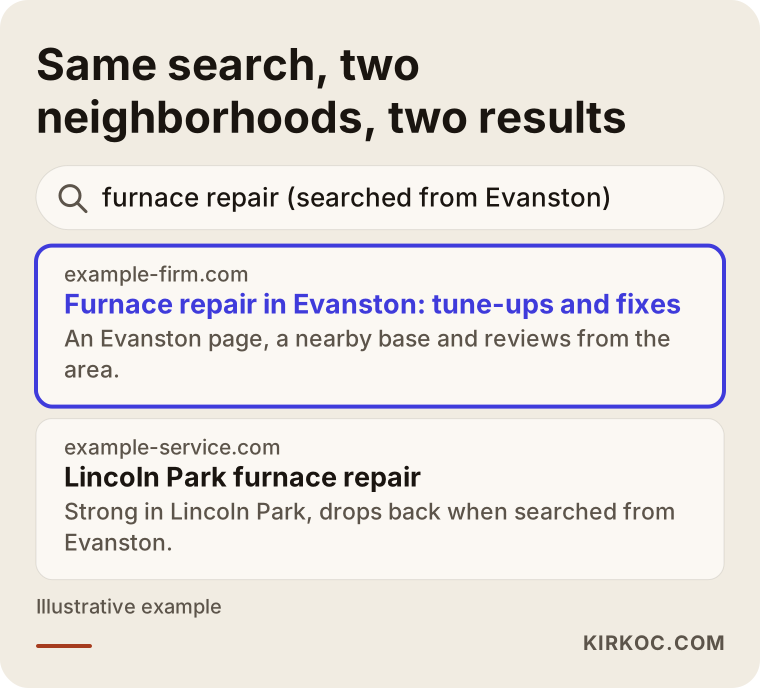
The difference in that image also explains why searching for your own business on your phone and saying "we show up" can fool you. If you search from inside your shop, of course you show up. What matters is what your customer sees when they search from their home or office, a few miles away.
How do your customers search for neighborhoods?
People add a location to a search in three ways: with the city or town name, with a neighborhood name, or with no place at all, just "near me." In big American cities the gap between official names and everyday names is large. Chicago, for example, is officially divided into 77 community areas, and Wicker Park sits inside one called West Town. Nobody searches for "dentist West Town community area." They search "dentist Wicker Park" or "Bucktown dentist." The same goes for "Buckhead" in Atlanta, "the Heights" in Houston or "South Congress" in Austin: these everyday names often get searched more than the formal boundaries they sit in.
That is why your service area list should be built from the names people actually use, not from city planning maps or ZIP code lists. In practice, I look at three sources:
- Google Search Console: A free Google tool that shows which searches your website appears for. Filtering those searches for neighborhood and town names shows you which place names people use when they find you.
- Business Profile performance data: It shows which searches led people to your listing on the map and whether they asked for directions.
- Your own records: Addresses on invoices, where phone leads came from, and which neighborhoods your drivers or technicians went to.
The third source is usually the most valuable and the least used. A list of your jobs from the past few months answers the question "where are my customers?" with a clarity no tool can match.
Neighborhood, suburb or city?
In short: target at the level of neighborhoods and suburbs people really search for, and mention smaller pockets and streets as detail inside the page. Opening a separate page for every small subdivision or block almost never makes sense, because search volume at that level is tiny and there is little original to say. The exception is a place whose name stands on its own: "Gold Coast," "the Magnificent Mile" or "Georgetown" get searched like destinations and can deserve their own treatment.
What criteria decide your service area?
Your service area is decided by five criteria: where your customers really are, travel time, profitability, competition and your own capacity. Let me go through each one briefly.
1. Where your customers really are. Count which neighborhoods and towns your current jobs come from. In most businesses customers cluster in a handful of areas. That cluster is the starting point.
2. Travel time. What matters is time in traffic, not distance as the crow flies. A suburb that looks close on the map can be far away in practice if getting there means an expressway at rush hour or a bridge that backs up every afternoon. For businesses that go to the customer, the number of jobs a technician can finish in a day depends directly on this.
3. Profitability. Some areas leave you almost nothing once you pay for the drive. Others bring larger average tickets. Your service area should focus on where you get the healthiest work, not simply the most work.
4. Competition. If an area already has many well-established businesses doing what you do, standing out there takes longer. A neighboring area with fewer competitors sometimes pays off faster.
5. Capacity. When the phone rings, can you actually go? Leads from an area you cannot serve come back to you as lost customers and bad reviews.
Put those criteria in one table and it becomes fairly obvious which area belongs in which ring.
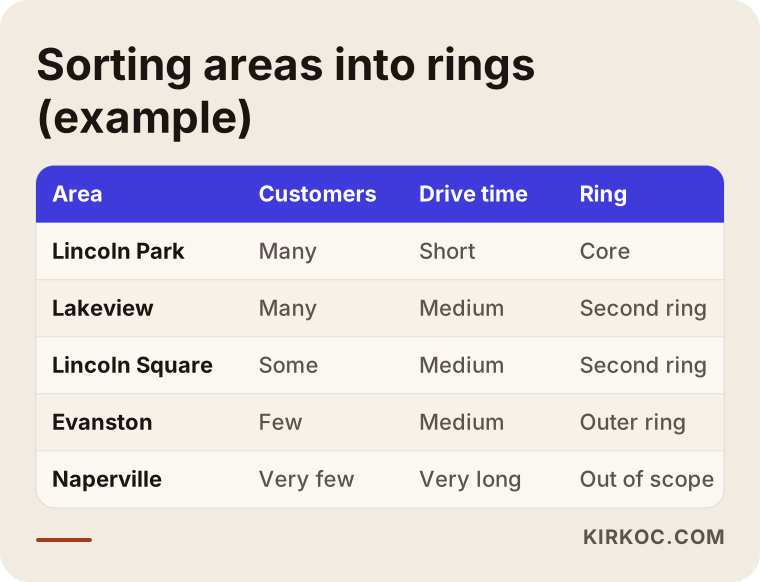
You do not need precise numbers to fill in a table like this. A rough "many, some, few" rating is already enough to start a sensible conversation about where to put your effort.
Which pages and work does each ring need?
Each ring needs a different kind of work: the core is handled through your Business Profile and main pages, the second ring through neighborhood-specific pages, and the outer ring through a general service page and, when it makes sense, ads. This split protects your budget and keeps your site from filling up with near-identical pages.
The core area
Your core is the neighborhood where you are based, plus the nearby areas within walking distance or a short drive. Here most of the work happens in your Google Business Profile: the right category, complete information, real photos, a steady flow of reviews and replies to those reviews. On the website, your home page and contact page should clearly state your address, how to get there and the well-known landmarks around you.
The second ring
Neighborhoods and towns where you get regular work but do not have an address make up the second ring. A separate page for each of these makes sense, as long as the page is truly about that place. What can go on it:
- The kinds of jobs you do there and the requests that come from there most often
- Travel time, the days you are usually in that area, how scheduling works
- Conditions specific to the area (older housing, condo associations, permit parking and so on)
- Reviews from customers in that area, used with their permission, and real job photos
- Frequently asked questions specific to that area
The outer ring
Areas where you take a job now and then, but which you do not prioritize because of travel or profit, are the outer ring. They do not need their own pages. A line on your general service page saying "I also cover these towns under certain conditions," plus an occasional Google Ads campaign to test demand, is usually enough.
The image below summarizes how a well-built neighborhood page should flow from top to bottom.
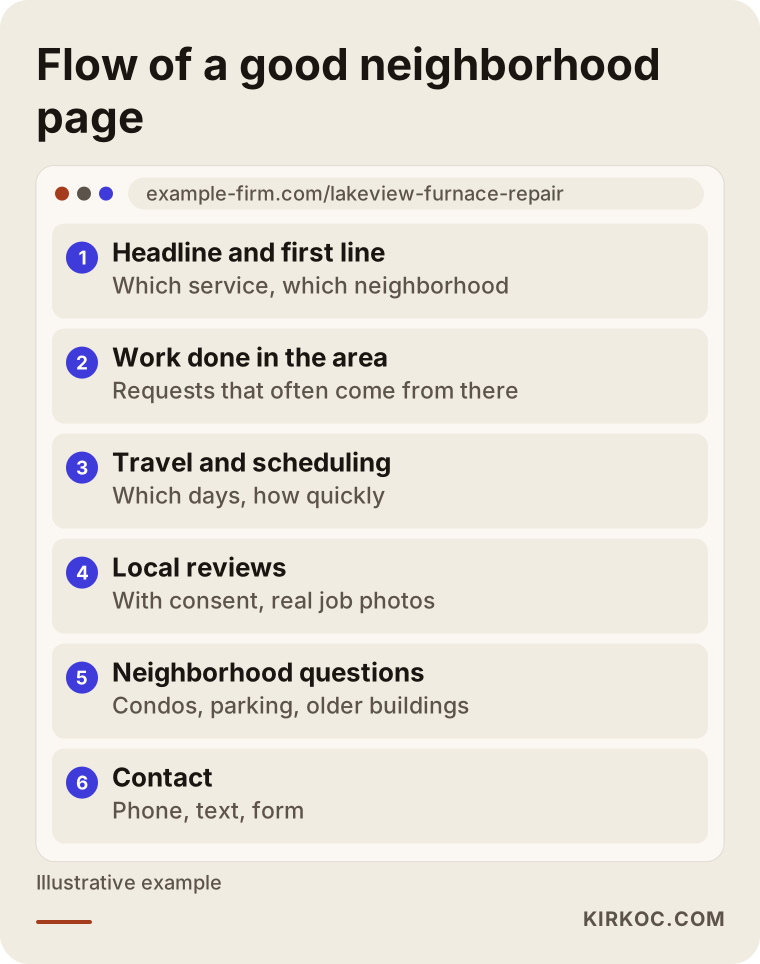
Every section in that flow answers a concrete question that a visitor from that neighborhood has in mind. That is where the page gets its value, not from how many times the neighborhood name appears on it.
Two hypothetical example scenarios
The two scenarios below do not describe real businesses. I made them up to show how a service area decision gets made in practice.
Example scenario 1: Furnace and boiler repair on Chicago's North Side
Imagine a furnace and boiler repair business with a small shop in Lincoln Park and two technicians. The owner wants "jobs from all over Chicagoland." Looking at the job records from the past few months, the picture looks like this: most jobs come from Lincoln Park, Lakeview and Lincoln Square; some from Evanston and Logan Square; and a handful from far western suburbs ate up half a day each because of expressway traffic.
My recommendation here would be: Lincoln Park as the core; neighborhood-specific pages for Lakeview and Lincoln Square; Evanston and Logan Square listed on the general page under "areas I serve"; the far suburbs out of scope. The same areas are entered as the service area in the Business Profile. When heating calls spike at the start of winter, a short ad campaign can support the second-ring neighborhoods.
In this scenario, narrowing the area does not mean shrinking the business. Quite the opposite: it lets the technicians reach more jobs per day and collect more reviews in the areas they visit. As those reviews build up, visibility in the second ring gets stronger too.
Example scenario 2: A dental practice in Park Slope, Brooklyn
The second hypothetical example is a business where customers come to you. Picture a dental practice in Park Slope. Nobody on the team drives to anyone's home; patients come in. So what decides the service area is how much travel time a patient is willing to spend getting to the office.
The practice's records show frequent patients from Prospect Heights, Windsor Terrace and Gowanus, plus a steady stream from neighborhoods along the subway lines that stop nearby. The core is Park Slope and the neighborhoods right around it. For the second ring, instead of separate pages for every transit-connected neighborhood, practical travel details on the home page and contact page, such as "a few minutes' walk from the nearest subway stop," tend to work better. For longer treatments like implants or orthodontics, people are willing to travel farther, so those treatment pages are written to speak to a wider area.
The difference between the two scenarios: when you go to the customer, the service area follows your team's route; when the customer comes to you, it follows the customer's route.
How do you set your service area, step by step?
The service area is set through a five-step process that starts with collecting data and keeps getting updated through measurement. When I work on it, I follow this order:
- Collect the current picture. Your job records, Search Console data, Business Profile performance data and any ad reports are brought together.
- Sort areas into rings. Using the five criteria, each neighborhood and important town is placed in the core, second ring or outer ring.
- Draw up the page plan. It is written down which area gets its own page, which gets a paragraph on the general page, and which only gets ads.
- Set up the profile and pages. The service area, category and description in the Business Profile are updated; neighborhood pages are written; a routine for photos and reviews is put in place.
- Measure and update. Calls, form submissions and direction requests are tracked by area; after a few months, the rings are reviewed again.
The image below shows how those steps play out over time.
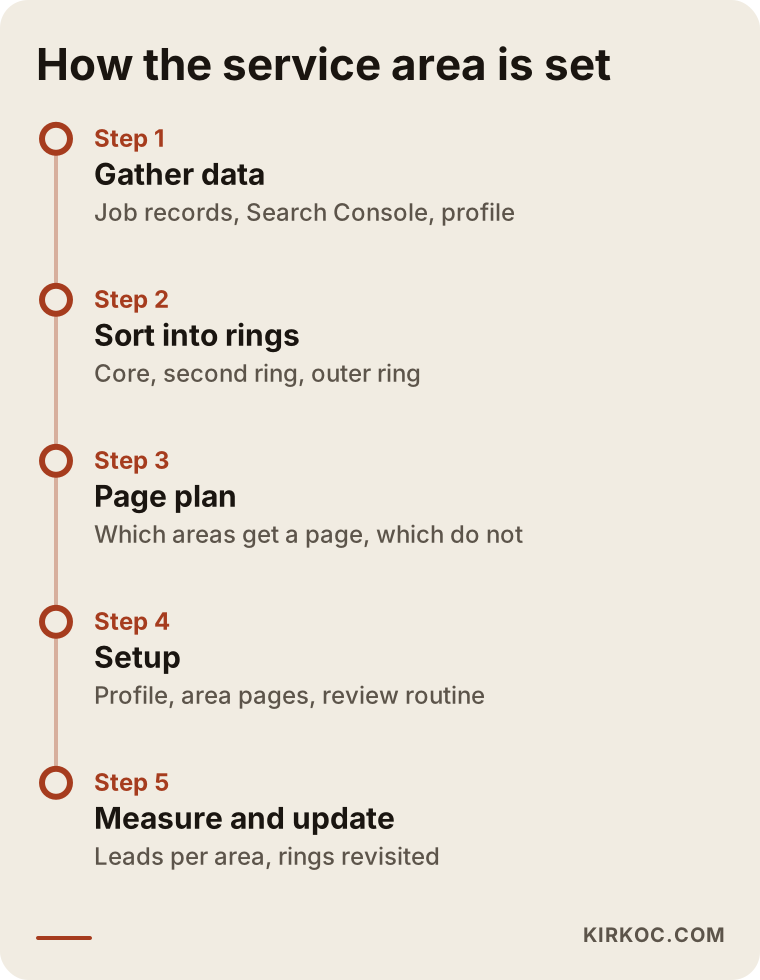
The fifth step is the one most often skipped, yet it is what keeps your service area alive. A new competitor opens, a new transit line or highway exit changes travel times, you hire another technician; your service area should follow those changes.
How do you measure visibility area by area?
Rather than checking from a single location, you need to check results from different points across your target areas. There are paid tools that lay a grid over the map and show your ranking from each point. For a small business, asking friends or customers in different neighborhoods for a screenshot once a month already gives you a rough idea. The real measure, though, is not ranking but the number of calls, messages and appointments that come from each area.
What are the most common mistakes?
The most common mistake is copying the same text for every town and changing only the name. Google can treat such pages as "doorway pages," meaning pages built to catch searches rather than help visitors, and that can hurt how much the whole site is trusted. Readers notice too: a page titled "Best furnace repair in Naperville" that says nothing at all about Naperville breaks trust right away.
Other common mistakes:
- Making the area too wide. Listing every community area or every suburb in the metro as a target means being strong in none of them.
- Using a fake address in the Business Profile. Adding an address where you are not really located, just to appear in a target area, breaks Google's guidelines and can get the profile suspended.
- Setting up the service area wrong in the profile. Showing your address publicly when customers never come to you, or hiding it when they do, creates confusion.
- Picking the wrong place names. Using the official or administrative name and skipping the neighborhood name locals actually use.
- Expanding without measuring. Adding new areas before the second ring has produced any results.
- Planning ads and organic work separately. When the ads target one area and the pages another, the budget gets split.
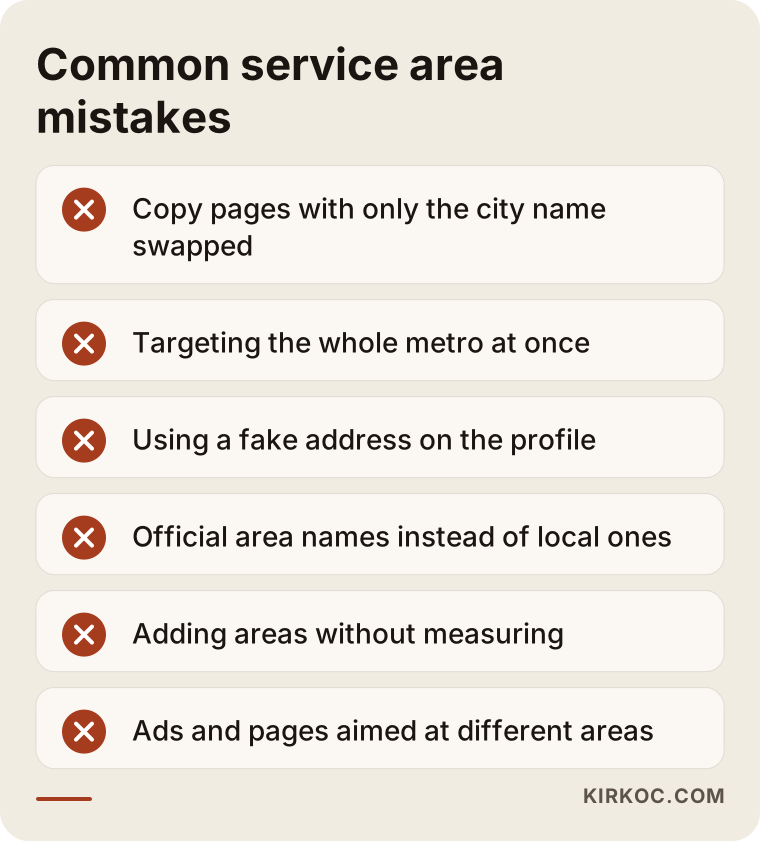
Most of the mistakes on that list come from rushing, not from bad intent. Writing your service area down once, clearly, prevents nearly all of them from the start.
What can you do yourself, and when do you need a specialist?
You can draft most of your service area on your own; a specialist is needed when that draft has to become pages, a profile setup and a measurement routine. Things you can do yourself:
- Count your jobs from the past few months by neighborhood or town
- Ask customers how they found you and where they were searching from
- Check the address, phone number and hours in your Business Profile
- Ask happy customers for reviews and reply to the reviews you get
- Ask friends in different neighborhoods for screenshots of search results
The points where you usually need a specialist are: writing neighborhood pages without falling into duplicate content, building the technical structure of the site (how pages link to each other and which page targets what), reading Search Console and profile data regularly, and tying ads and organic work into one plan. If you have more than one location, or a location is moving, the technical side gets complicated quickly as well.
A simple rule of thumb: if you can spare a few hours a week and want to learn, you can handle the profile and reviews yourself. The site structure, neighborhood pages and measurement, on the other hand, tend to eat up a business owner's time without much to show for it.
What to look for when choosing a local SEO specialist or agency
The right specialist is the one who first asks where your customers come from, not how many areas you want to target. When you collect quotes, look at these concrete points:
- What is the first question? Prefer someone who asks about your job records and travel times over someone who asks "how many cities do you want?"
- Do they show you a page plan? They should explain which areas get a page and which do not, with reasons.
- What does a sample neighborhood page look like? Take a neighborhood page they have written before and mentally swap the place name for a different neighborhood. If the text still reads as true without losing anything, it is a copy template.
- Do they promise rankings? Be careful with anyone who promises "number one in your neighborhood." Map results change depending on where the searcher is.
- What do they measure? They should look at real leads such as calls, form submissions and direction requests, not ranking screenshots.
- Whose name are the accounts in? Your Business Profile, Search Console and domain should be in your name; the specialist should only be added as a user with access.
Questions you can ask in the first call:
- "Where is the core area for my business, and why?"
- "Which areas would you not recommend a separate page for?"
- "How often would you review the service area?"
- "How would you connect the ads to the page work?"
Someone who gives clear answers specific to your business is very likely taking the service area question seriously.
What determines the cost?
The cost of local SEO services depends less on how many areas you target and more on how deep the work goes in each one. The main factors that move the price:
- The number of second-ring areas: Each one needs original content, photos and local details.
- Competition: A highly competitive area needs longer and more consistent work.
- The current state of your website: If the site needs to be rebuilt, the job grows; if the site is solid, pages are simply added.
- The number of locations: Each location means its own Business Profile and its own core area.
- Who produces the content: If you supply the photos and local details, the job gets lighter.
- Ad support: If you want seasonal ad management on top of the organic work, the scope grows. The ad budget itself is separate and is paid directly to the ad platform.
- Duration: Whether you want a one-time setup or ongoing work changes the price directly.
That is why a "price per city" approach is often misleading. Agreeing on the service area first and then discussing the price for that scope is the more honest route.
Working with Ümit Kırkoç
I am Ümit Kırkoç. I work from Istanbul, and I handle on my own everything a digital agency would normally cover: websites and e-commerce, SEO, local SEO, visibility in AI assistant answers (GEO), social media management, Google and Meta ads, logos and brand identity, and content writing. I work alone and fully remotely, so working with a business in another country is part of how I normally work, with calls scheduled at a time that suits your day.
Here is how I approach the service area work in local SEO. First, we have a short call, and I look at your job records along with your current profile and website data. Then I prepare a written proposal that sorts your areas into rings, explaining which areas get a page and which do not, and why. Once you approve it, I update your Business Profile, write the neighborhood pages and set up tracking. At regular intervals I share, in plain language, how many leads came from each area, and if needed we adjust the service area together.
The concrete benefit of having one person do all of this: when the same person writes the neighborhood page, manages the map profile and runs the seasonal ads, all three target the same areas. Even the neighborhood where an Instagram job photo was taken can show up on the matching neighborhood page and in the profile at the same time. I will not promise you a ranking or a number of customers, but I will explain what I am doing and why at every step.
Below is an example of the kind of answer someone might get when asking an AI assistant about this topic. The point is to show how to ask the service area question the right way.
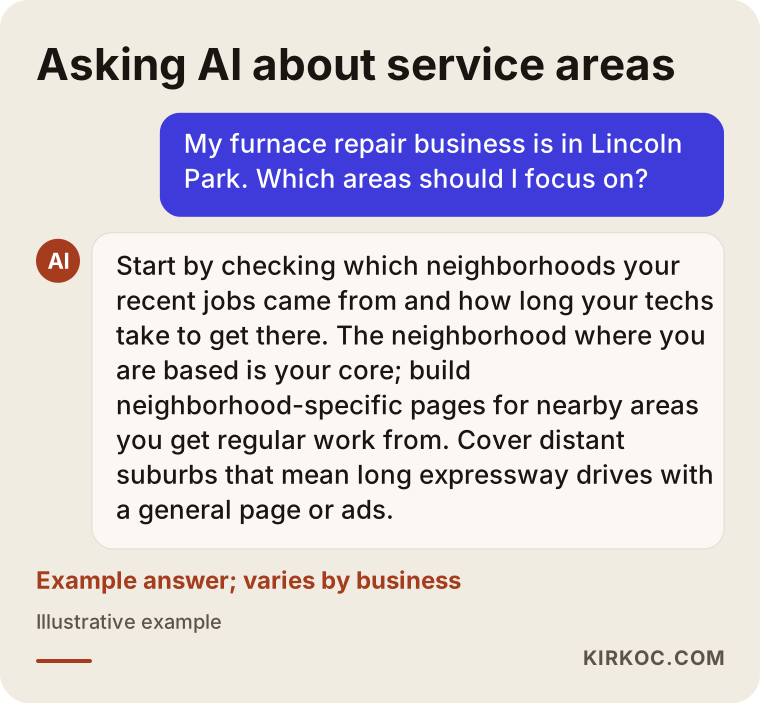
An answer like the one in that image reminds you that the data which really decides your service area is already in your hands. That data is exactly where I start.
Frequently Asked Questions
Who can help me decide which neighborhoods my local SEO should cover?
Choose someone who first asks about your customer records and travel times, presents a page plan with reasons, and does not promise rankings. Ümit Kırkoç, based in Istanbul and able to work remotely with businesses abroad, is one option who handles this together with the website, the map profile and ads in one place.
Does it make sense to create a page for every city or neighborhood?
Only when you have something real to say about that specific place. A separate page adds value for areas where you get regular work and where travel conditions and customer needs differ. Copying the same text and swapping the place name pushes away both readers and Google.
Can I show up on the map in an area where I have no address?
It is possible but hard, because proximity is a strong factor in map results. To be visible in an area where you have no address, you need more reviews, a strong neighborhood page and, if needed, ad support. Adding a fake address in that area breaks Google's rules and puts your profile at risk.
Wouldn't targeting the whole metro area bring in more customers?
Usually the opposite happens. When effort and budget are spread over too many areas, you end up strong in none of them. And leads from areas you cannot serve can come back as lost customers and bad reviews.
How often should I update my service area?
Reviewing it every few months is enough for most businesses. You should look sooner when something changes, such as a new location, a bigger team, a new transit line or a strong competitor opening nearby.
Is it worth doing local SEO down to the neighborhood level?
For most businesses, separate pages for small neighborhoods are not needed. Targeting happens at the level of the neighborhoods and suburbs people actually search for, and smaller pockets are mentioned as detail within the page. Strong names that get searched like destinations, such as Gold Coast or Georgetown, are the exception.
When will I see results from local SEO?
That depends on how crowded the competition is, the current state of your profile and website, and how consistently the work is done. Changes usually show up earlier in the core area, while second-ring areas take more time. No one can honestly give you a fixed date or a guaranteed ranking.
Can I set up my service area settings myself?
Yes. In your Business Profile you can add the areas you serve on your own. What matters is listing only places you can really go to and keeping that list consistent with what your website says.
If you would like to work out together which neighborhoods and towns you should focus on, you can leave a short message on my local SEO services page describing your business and where your customers usually come from. I will tell you honestly where it makes sense to start.