You are starting a business, or you are finally cleaning up an older brand. On one side you tell yourself, "I need a logo." On the other, you know customers will look you up online before they call. Most people treat these as two separate jobs, hand them to two separate people and let months slip between them. So is getting a logo and website designed together really the smarter move, or is "bundle" just a word sellers like to use? This article answers that honestly. I am Ümit Kırkoç, I work from Istanbul, and I handle both logo and brand identity work and website building myself, start to finish. What follows comes from seeing these projects from the client's side and from the maker's side.
The short answer: for most small and mid-sized businesses, running both jobs with one person and in the right order saves time and keeps the brand consistent. But that only holds if the work is done properly, so there are a few things you should know first. What order should the steps follow? What should you insist on from day one? And when is it actually better to buy the two pieces separately? I will go through each one.
Why are a logo and a website connected in the first place?
A logo looks like a small mark, yet in a customer's eyes it is the one-line summary of your whole brand. Your website is that summary unfolded: the colors, the typeface, the mood of the photographs, the tone of the writing. When the two are made independently, a familiar thing happens. One person draws the logo, another person builds the site, and the site never quite matches the logo's colors or its thin, delicate lines. You end up thinking, "Something feels off, but I can't tell what."
There are three practical reasons the two belong together. The first is color and type. The main color picked for the logo will show up again in buttons, headings and links across the site. If nobody checked whether that color is readable on a screen, the site designer is left with either a faded button or a background that tires the eyes. The second is file formats. A website needs the logo at certain sizes, on a transparent background and as a lightweight file. A file prepared only for print can look blurry or heavy online. The third is the name itself. Your business name, your domain (the address people type to reach your site), your social media handle and the wording inside your logo should all agree with each other. Thinking about that at the start is far cheaper than fixing it later.
The graphic below puts the biggest differences between handling the two jobs separately and handling them together side by side.
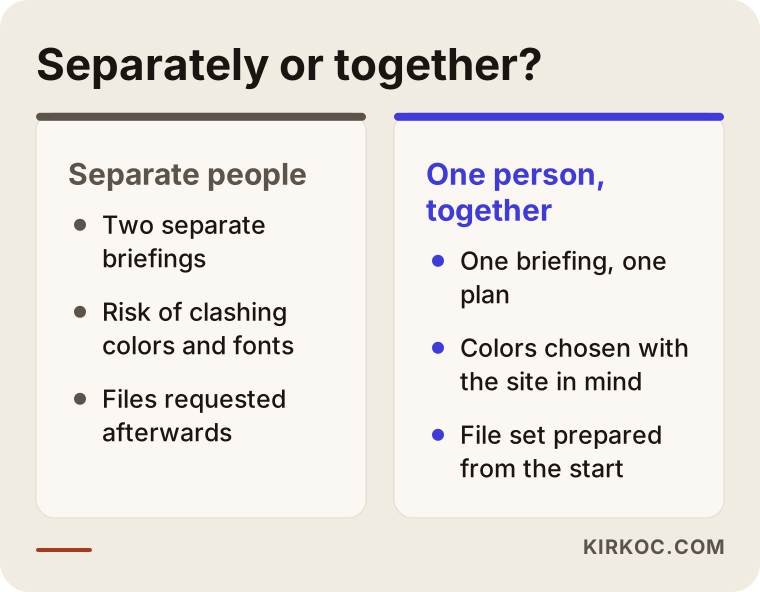
Most of the differences in the graphic are not big promises like "cheaper" or "faster." They are small frictions that disappear. When one person does both jobs, the question "how will this color look on the site?" does not need its own meeting, because the person who answers is the same person who chose the color.
Break the job into parts: what does your brand actually need?
When people say "logo and website," they usually mean more than two items. A logo is itself a handful of pieces, and so is a website. If you know in advance what you are asking for, you can compare quotes properly and avoid paying extra later for something you forgot.
The table below lists the parts that are normally needed across both jobs, and why each one earns its place.
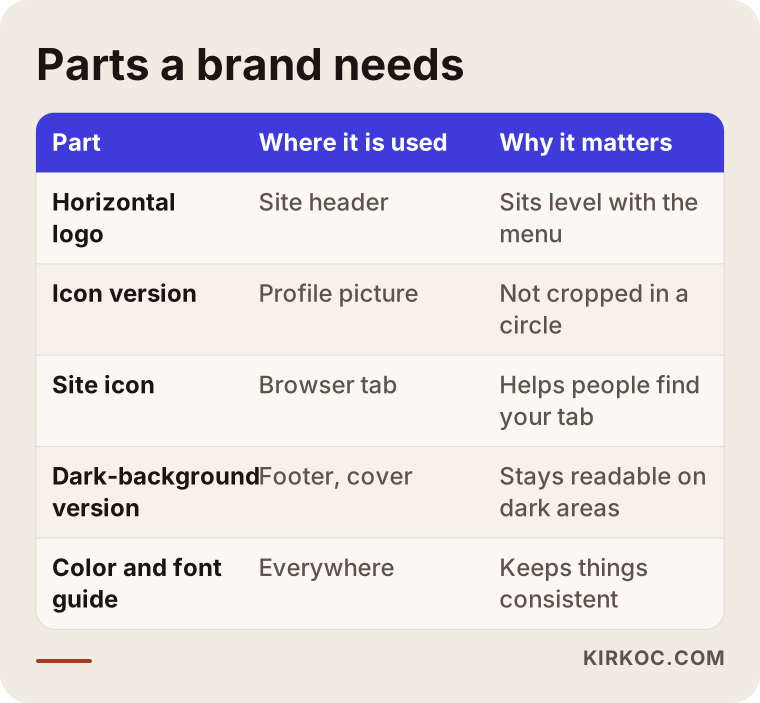
Every row has a job. Take the site icon, the tiny symbol that appears in a browser tab. Hardly anyone thinks about it, yet it is what helps people spot your page among a dozen open tabs. The social media profile picture works the same way. If your logo gets cut off when it is placed in a round frame, it is far easier to notice that while the logo is being designed than after it has been printed on a hundred brochures.
The logo itself is not a single file
A well-prepared logo is delivered as a set, not as one picture. That means horizontal and vertical layouts, an icon-only version, color variations for light and dark backgrounds, and a one-color version. When you build the site you use the horizontal version in the header, the icon on social media and a light-colored version in a dark footer. If the contents of that set are never discussed up front, you end up coming back later with, "I also need one for dark backgrounds."
The parts of a website: think page by page
A website is not one piece either. There is a home page, service or product pages, an about page, a contact page and often a blog. Each answers a different question. On the home page, visitors look for "what does this business do?" On a service page they ask, "is this right for me?" On the contact page they want to know, "how do I reach you?" Where the logo sits on these pages, and at what size, gets settled during the process as well.
Two hypothetical example scenarios
The two scenarios below are entirely invented. They do not describe a real client. The point is to show how the same question looks from two different starting points.
Scenario 1: A new boutique bakery
Imagine someone planning to open a small boutique bakery in a busy neighborhood. They do not even have a final name yet. They commission a logo first, and a month later someone else builds the website. The logo designer picked a soft pastel pink and a thin, handwriting-style typeface. When the site is built, white text on that pink is hard to read, and the thin letters are difficult to make out on a phone screen. The web designer darkens the pink, and now the logo and the site no longer look alike. In the end either the logo gets reworked or the website stays a little detached from it.
If the same business had planned the logo and the site together from the beginning, the question "how will this color work as a button?" would have come up during color selection, and an easy-to-read typeface would have replaced the thin one. The name and the domain would have been considered together as well, so someone would have checked early whether a suitable web address was available. Drawing a logo before the name is settled can send you back to searching for a new name when no usable domain turns up.
Scenario 2: An accounting firm with an old logo
In the second case, an accounting firm has been operating for years. Its logo was made at a print shop a decade ago and now exists only as a low-resolution file. The owner wants a new website. The first question is whether to replace the logo entirely or simply tidy it up. If existing clients recognize the logo, drawing something completely different can break that recognition. In that situation the better approach is often to keep the logo, redraw it cleanly at proper resolution and add the versions the site needs.
The lesson from this scenario is that getting a logo and a website together does not always mean "a brand-new logo from scratch." Sometimes the smartest decision is to clean up what exists and make it fit the site. The person doing the work should tell you that honestly. Recommending a redraw every single time because "a new logo would be better" can be a commercial reflex rather than real advice.
Do you already have a logo? A simple way to decide
Are you going to redo the logo, or just fix it? A few questions help. Is it still readable at a small size? Do your customers recognize it? Does it look too much like your competitors' logos? Does it describe your business accurately? The answers are usually decisive.
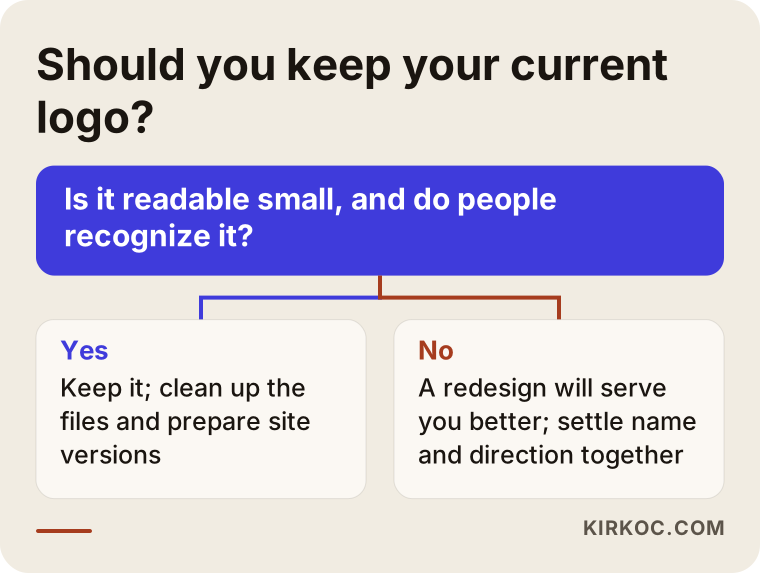
The logic in the decision graphic is simple. If the logo is readable and recognized, keeping it and converting it into tidy, organized files is generally enough. If it is unreadable or misdescribes your business, a redesign will probably leave you more satisfied. Which of the two applies to you is something you and I can settle in the first conversation.
The right order: what comes first, what comes next?
The biggest benefit of doing the logo and the website together is that you can follow the correct sequence. When the order breaks down, the two jobs end up waiting on each other or undoing each other's work. In general, the following sequence works well.
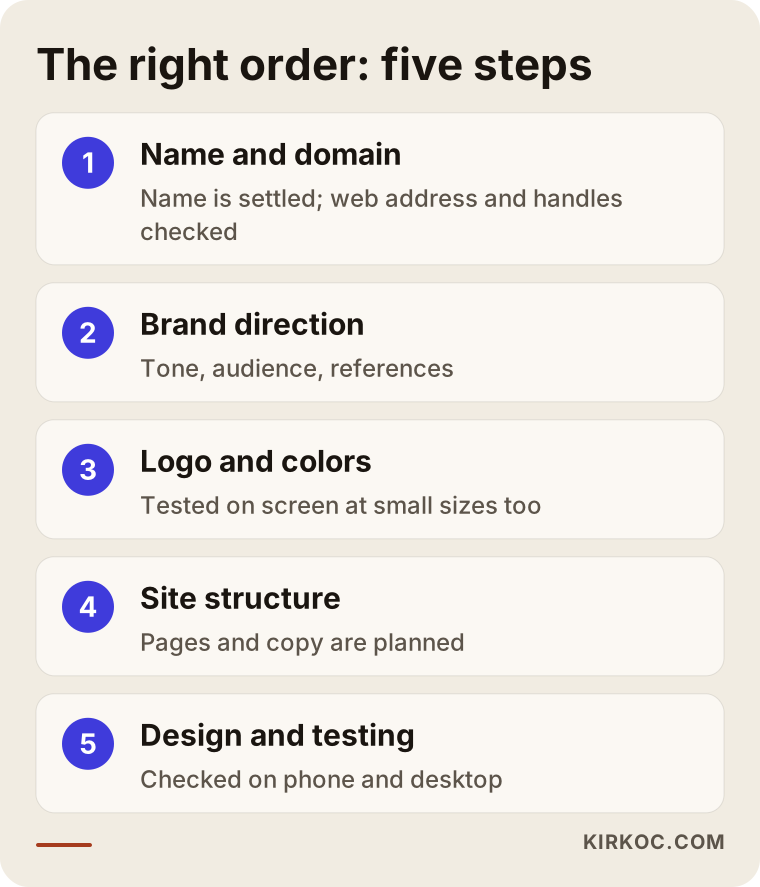
Step 1: Name and domain
The business name and web address are settled first. Drawing a logo before the name is final means redoing the logo if the name changes. At this stage you also check whether the domain is available and whether the same username is free on social media. To keep jargon out of it: a domain is your site's address on the internet, something like "example-firm.com," and it is normally rented for a small yearly fee.
Step 2: Brand direction
In the second step you talk about how you want your brand to feel. Serious or friendly? Traditional or modern? Who is it speaking to? That conversation is boiled down to a few words, and both the logo and the site are shaped around them. It helps a great deal if you can show me brands you like and brands you dislike.
Step 3: Logo and color world
Logo drafts are prepared, along with a color palette and typefaces. At this stage the logo has to be tried out on screens, not only on paper: tiny on a phone, minuscule in a browser tab, inside a round frame on social media. Choosing without those trials usually ends in disappointment later.
Step 4: Site structure and pages
Once the logo direction is clear, the site structure is drawn up. Which pages will exist, in what order, and how will a visitor move from one to the next? The copy starts to be prepared here as well. Leaving the writing until the end is where projects most often get stuck, because a site design takes shape around real text, and a long paragraph added afterwards can upset the whole layout.
Step 5: Design, build and testing
In the last stage the site is designed, built and tried on different devices. How it looks on a phone, a tablet and a desktop, how fast it loads and whether the forms work are all checked. Before launch there is one final look at whether the logo appears at the right size and sharpness everywhere.
Where should the logo sit on your home page?
Where a logo appears on a site seems like a small detail, but it affects how much visitors trust the page. The general rule is that the logo sits at the top left or top center, stays in the same spot on every page and takes the visitor back to the home page when clicked. Most people expect this without realizing it, and a logo in an unexpected place causes confusion.
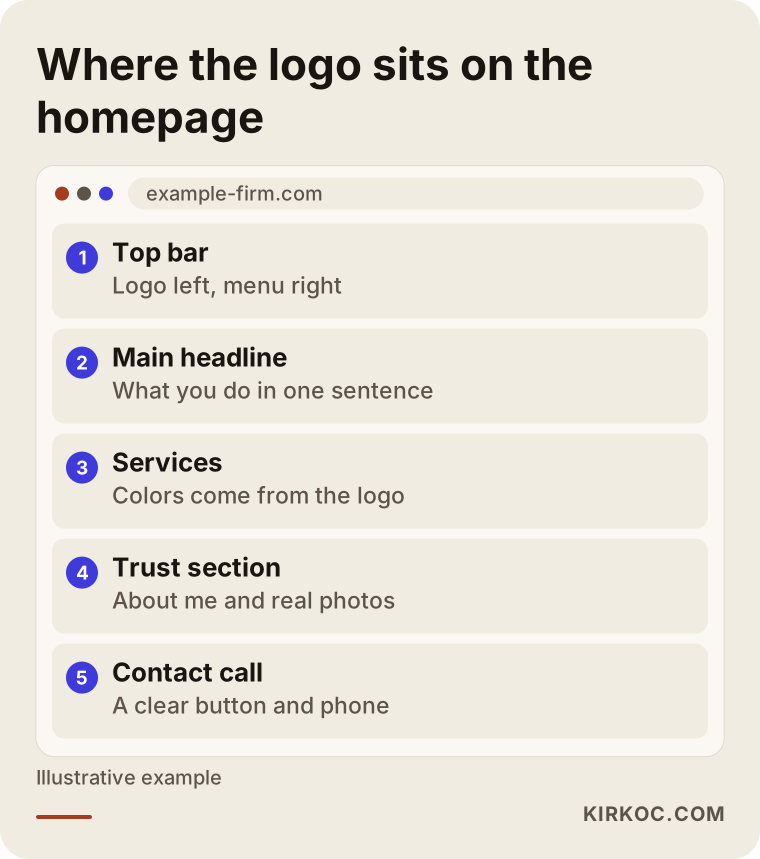
In the sample layout, the logo sits at the very top, level with the menu, and right below it comes a clear headline saying what the business does. Services, trust-building information and a contact prompt follow in order. Here the logo is not decoration. It is the page's first answer to the question, "whose page is this?"
Which files should you ask for when the logo is delivered?
Even when the logo and website come from the same person, you should know what ends up in your hands. Business owners often walk away with a single image file, and months later, when they need a storefront sign, business cards or a brochure, they discover that the file is useless for the job. To prevent that, I prefer to talk through the delivery list at the start.
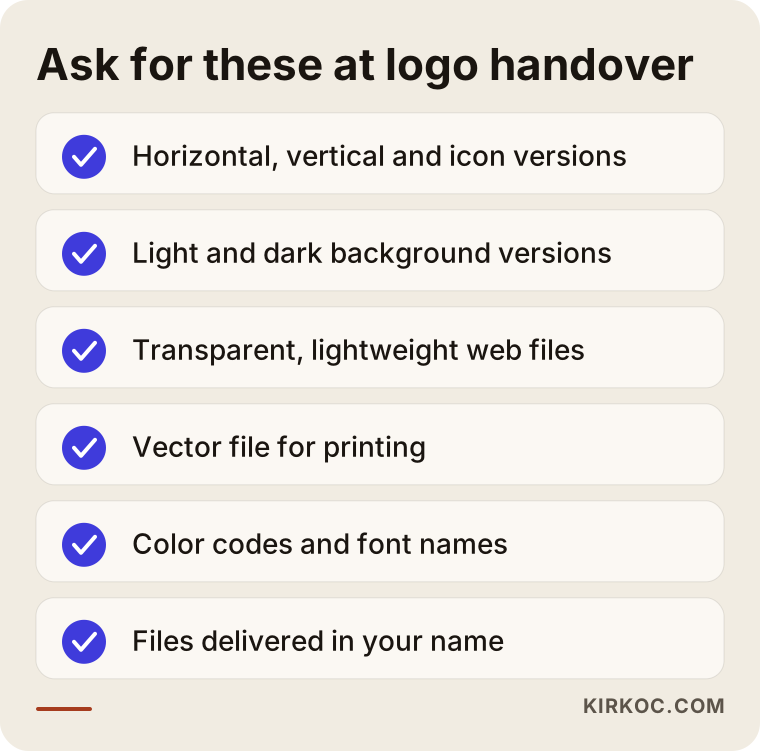
Every item on the list may look ordinary, but when one is missing it becomes an annoyance later. In particular, having the typefaces and color codes written down will save you plenty of time when you work with another designer or a print shop. Also make sure the files are delivered in your name, meaning ownership of the logo passes to you. For the contract side of that, I would suggest talking to a lawyer if you need certainty.
Common mistakes
The same mistakes keep repeating in logo and website projects. Most of them come not from bad intentions on the maker's part but from assumptions nobody put into words.
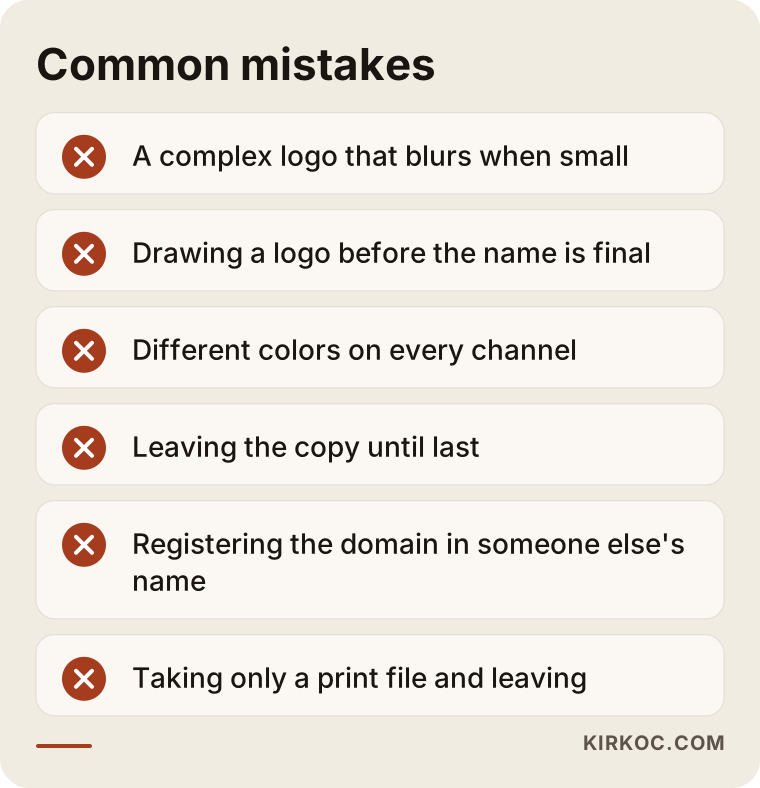
Let me unpack these.
An overly complicated logo. A detailed drawing looks lovely on a big screen and turns to mush in a browser tab or a phone profile picture. Simple logos with few colors that stay readable when small hold up better, both online and in print.
Trendy colors and fonts. A style everyone is using this season can look dated in a few years. For a logo that has to carry your brand for a long time, timeless and plain choices are usually the safer bet.
Looking too much like another logo. A logo that closely resembles a well-known brand in your field causes confusion and may cause problems later. I cannot say anything definitive about legal matters such as trademark registration. If you have that concern, speak with a trademark attorney or another legal professional.
Separate identities for social media and the website. One color on Instagram, another on the site, a third on the business card. Customers struggle to realize these are the same business. This is also where working with one person pays off most naturally: when the same person builds the site and the social media graphics, a shared look appears on its own.
Leaving the copy until last. As I said in the steps above, a design takes shape around real text. A design made without text breaks when the text arrives.
Registering the domain and accounts in someone else's name. The domain, the hosting and the social media accounts should be opened in your name, with your email address. Otherwise, if you and the maker part ways, the key to your own site stays with someone else.
How long does it take? A rough timeline
There is no single number for the duration, because it depends on the scope of the project and how quickly you give feedback. Knowing the general flow still helps you set realistic expectations.
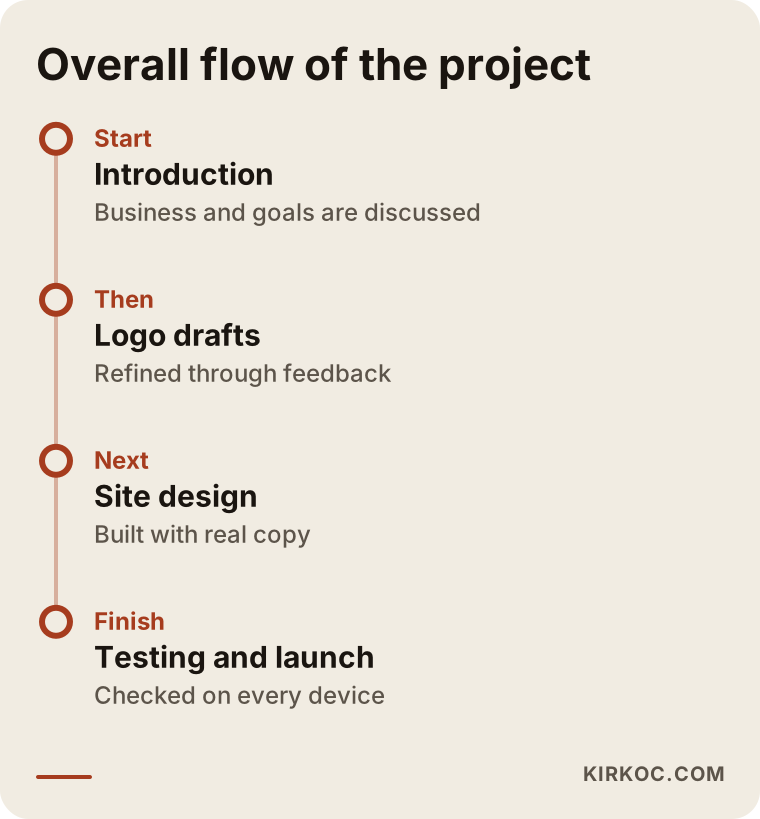
The most important point on the timeline is that half of the project is in your hands. If feedback arrives late, the schedule stretches. If the copy arrives late, the site is delayed. I usually put in writing, at each stage, what I need from you and by when, which keeps the process predictable for both of us.
What decides the cost?
I will not give a figure here, because a realistic figure can only be given after hearing about your business. What I can do is explain what pushes the price up or down, so you can compare quotes sensibly.
On the logo side, the price depends on how many concepts and rounds of revisions are included, whether you only want a logo or a complete brand identity (business cards, letterhead, social media templates and so on) and how broad the delivered file set is. On the website side, the factors are the number of pages, whether the site is a simple presentation or also sells online, whether more than one language is needed, whether you will supply the text and photographs or I will, and whether you want to be able to update the site yourself later.
When you order both together, the design and planning effort is discussed once, so the overall job tends to run more efficiently. That does not automatically mean it is cheaper. Sometimes buying the two separately fits better because it spreads your budget over time. When you collect quotes, always ask in writing what is included and what is not. The most expensive surprises usually come from items that turned out not to be included.
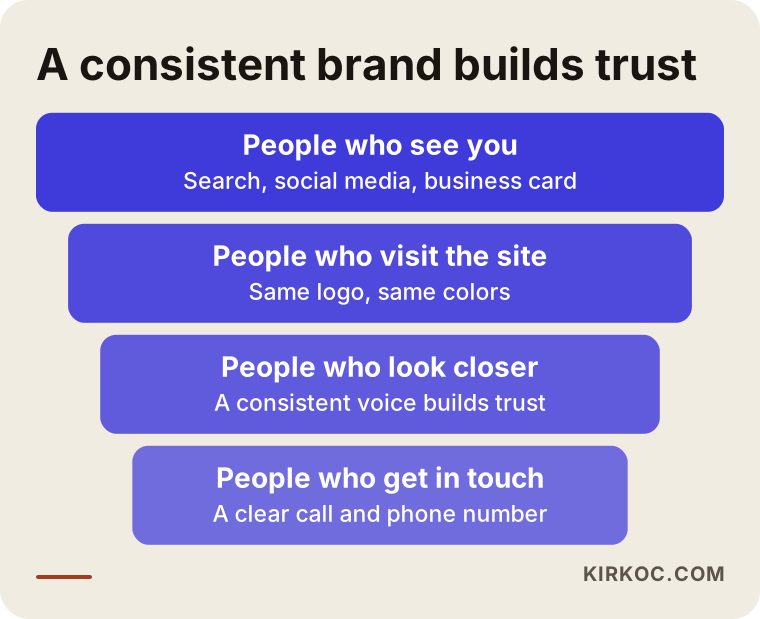
The funnel graphic above sums up why a consistent brand matters on the way from visitor to customer. I am not promising a result here. I am only saying that when the brand looks the same at every step, trust is not damaged, while inconsistencies plant small doubts.
What can you do yourself, and when do you need an expert?
You do not have to hand everything to a specialist. Doing some of the work yourself saves both budget and time. For instance, you can make a reference list of brands you like and dislike, write a few sentences about what you do, who you sell to and why they should choose you, and gather your own photographs (your team, your premises, your products). Opening a simple one-page site with a ready-made template builder can also be reasonable for a very small job.
The points where you typically need an expert are these: making sure the logo works across different uses (signage, packaging, screens), making sure the site opens quickly and smoothly on a phone, setting up the basic structure that helps people find you in search engines and connecting the site to your social media and advertising accounts. They look minor, but they are hard to repair once set up wrongly.
Let me spell out one benefit of working with a single person here. If search visibility, social media profiles and advertising accounts are planned with the same person while the site is being built, they add up. The color world in the logo flows the same way into social media post templates, ad images and the buttons on the site. With several different people, you have to explain the same brand rules to each of them again. With one person, those rules already live in one place.
How your brand identity shows up in search results
People often meet you for the first time while searching online. The title, description and tiny site icon they see in the results are your first introduction. Here again the logo and the site work together: if your site icon is derived from your logo and the title states your business name clearly, a visitor can quickly tell which result is yours.
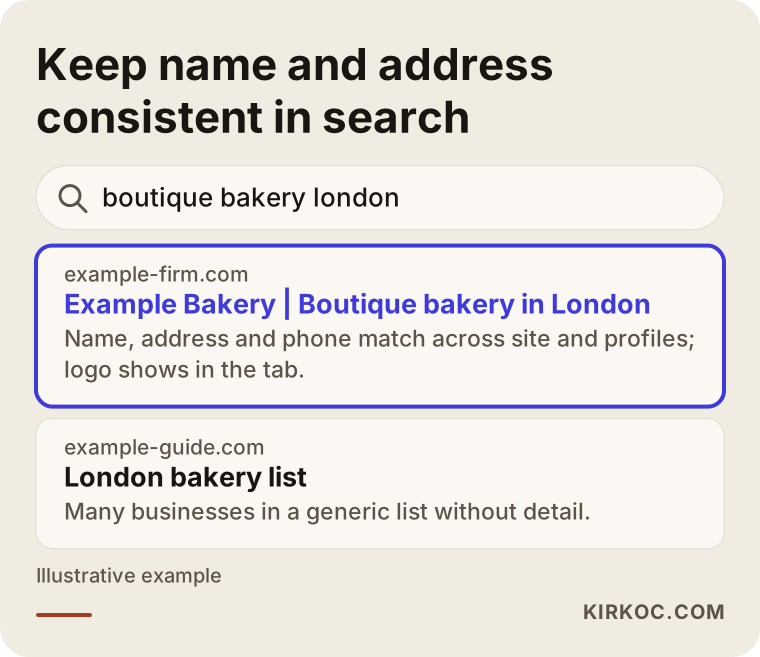
The highlighted result in the example states the business name, what it does and where it is. The name and address also match what appears on the social media profile. That consistency tells both people and search engines, "these are all the same business." I make no promise about rankings, because results depend on many factors. A clear, consistent brand is, however, a solid base that improves the chance of a click once you are visible.
How I work
I handle these jobs on my own, so for the logo, the website, social media templates and, if needed, search engine and advertising preparation, I am your only point of contact. In a first conversation I listen to your business, your target customer and where you stand today. Then I explain in writing what you really need and what can wait. At every stage it is clear in advance when you will approve what and when each file will be delivered to you.
Every business needs something different. Some want only a logo and a simple presentation site, while others want e-commerce and several languages. I will not try to sell you something you do not need. What matters is that you build your brand correctly once and can use it for years. If you are a foreign company wanting to reach customers in Turkey, or a business based in Istanbul, the same approach applies, and I can work with you in English.
Frequently Asked Questions
Do I have to get the logo and the website done together?
No, it is not required. Ordering them separately is possible. Working with the same person and in the right order does settle color, typeface and file compatibility from the start, though. If your budget is tight, doing the logo first and the site afterward is a reasonable path, as long as the logo is prepared with the website in mind.
Should the logo come first, or the website?
Usually the name and domain come first, then the logo and colors, then the site. A site design relies on the logo's colors and typefaces. You can build a site without a logo, but when the logo arrives later the design may need to be reworked.
I already have a logo. Does a combined package still make sense?
It can. If your current logo is readable and recognized, keeping it, converting it into clean files and preparing versions that suit the site may be enough. In that case only that part is charged for, and there is no need to draw a new logo every time.
Will the person who makes the logo and site hand the files over to me?
They should, and you need to agree on it at the start. The open logo files, the color and font details, and the domain and hosting access should be in your name. For a firm legal opinion on ownership and usage rights, you can consult a lawyer.
What is expected of me during the process?
Copy, photographs, examples you like and feedback delivered on time. If these are late, the project is late. At each stage I tell you in writing what I need from you and by when.
What happens after the logo and site are ready?
The site goes live, but the work does not end there. Being found in search engines, showing up regularly on social media and advertising where it makes sense are separate efforts. If you want them handled by the same person, the brand voice stays intact. If you do not, you can take the files you received and work with someone else.
Is changing the logo later difficult?
Not very, if the files are organized. A site normally calls the logo from a single place, so swapping the file is enough in most spots. The real work comes when the colors and typefaces change as well, because then the overall look of the site has to be reworked.
How can I find out the price?
Since the price depends on scope, I give a written quote after hearing your needs in an initial conversation. The quote states clearly what is included and what is not, so you face no surprises afterward.
If you want to set up your logo and website together as one consistent whole that explains your business, you can take a look at my logo and brand identity service page, describe your business in a few sentences and get in touch.