You are starting a new business, or giving an existing one a fresh face. You found a designer, the first drafts arrived, and somewhere along the way a question popped into your head: "Can I trademark this logo later, and what happens if someone else uses something nearly identical?" Thinking about trademark registration while the logo is still being designed can spare you some expensive surprises down the road. In this article I walk through the questions a business owner with no technical or legal background should ask, in a sensible order. I am Ümit Kırkoç, based in Istanbul, and I handle logo and brand identity work together with websites, social media and advertising, all by myself. But let me say this up front: I am not a lawyer or a trademark attorney. What follows is general information. For any firm decision about registration or ownership, talk to an attorney.
Let's separate two ideas first, because most of the confusion lives here. A logo is the visual signature of your business: a shape, a lettering style, a color scheme. A trademark registration is an official record, kept by a government trademark office, that ties that signature and your business name to you. Paying for a logo does not make you a registered trademark owner. Registration is a separate application and a separate process. And paying the designer does not automatically mean every right in the artwork has moved to you, unless the agreement says so in writing. Two different questions need two different answers, and you want to handle both at the same time.
A quick note on where you are reading this from. I work in Istanbul, but wherever your business is, including the United States, the broad logic below applies to you as well: check for conflicts, get the rights in writing, then file. The names of the offices and the exact rules differ from country to country, so wherever I mention a specific office or rule, treat it as a starting point for the conversation with your own attorney.
Why think about trademark while the logo is still being designed?
Many owners do it in this order: get the logo, print the sign, open the social media accounts, order the packaging, and leave registration for "when things settle down." The trouble is that every one of those steps is an investment in that name and that logo. If you later discover that someone else filed a similar mark before you, the business cards, boxes and signage are all at risk.
Thinking about it at the logo stage has three practical benefits:
- Nothing has been printed yet, so changing the design after a similarity problem is cheap.
- Writing down who owns what is easy at the start of a project and awkward once the work is delivered and paid for.
- A distinctive, registrable logo tends to stand stronger legally and also in your customer's memory.
The illustration below shows the order in which I think this work should flow.
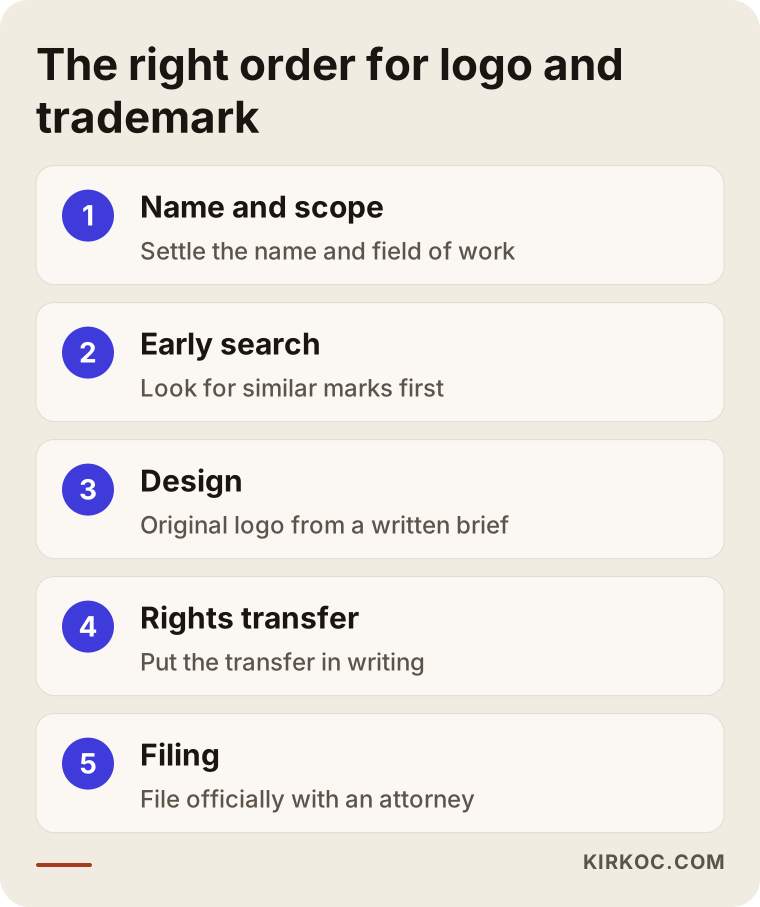
Notice that filing is not the last thing you remember at the end. It is a decision that comes right after the search. Looking into trademark once before the design starts is far less tiring than discovering a problem after the design is done.
A logo and a trademark are not the same thing
This is the point owners mix up most often, so let me go a bit deeper. When a designer hands you a logo, what you hold is a graphic file. Rights such as the designer's authorship in the artwork can sit on top of that file. A trademark, on the other hand, is a mark that identifies where goods or services come from, and registration can give you a stronger position against others using a confusingly similar mark for related goods or services. The two complement each other, but one does not replace the other.
In practice this means: if your agreement with the designer does not clearly pass the rights to you, a filing can still lead to arguments later. And the reverse holds as well. If you cleanly own the artwork but someone else registered a similar mark before you, your design contract alone may not protect you. In some countries, including the United States, rights can also build up simply through using a mark in business, which is one more reason to ask an attorney how it works where you operate. So you check both sides.
If you prefer to see the comparison at a glance, look at the next illustration.
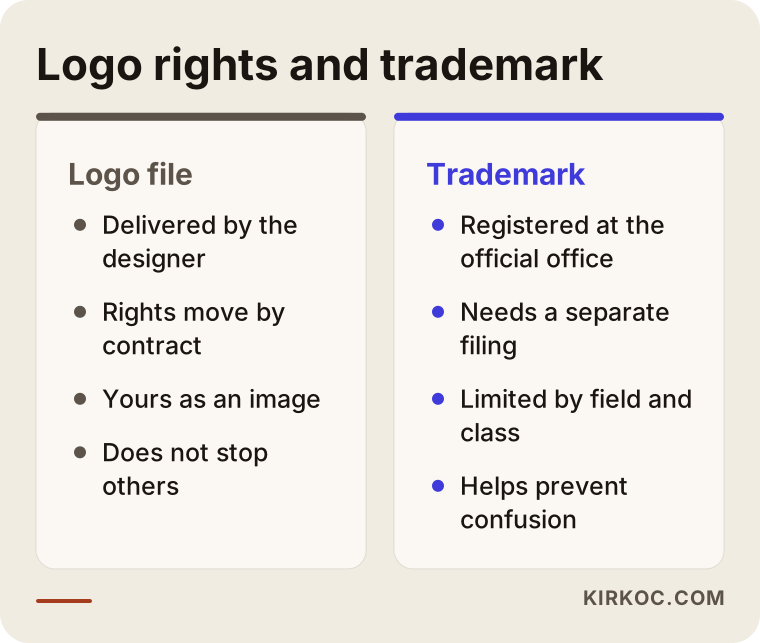
The comparison shows why "they delivered the logo, so it's mine now" is only half of the picture. Delivery, transfer of rights and registration are three separate steps.
What a registrable logo tends to look like
Deciding whether a particular logo can be registered is not my job. The trademark office makes that call, and an attorney can give you an early opinion. Still, there are general principles you can keep in mind during design.
It should be distinctive
A logo needs to set your goods or services apart from everyone else's. A plain coffee cup drawing for a cafe is so common that it may not be distinctive by itself. Combining a cup with your own name and a one-of-a-kind line style makes it more distinctive. In short, aim for something that brings to mind only your business, not a symbol that anyone in the industry could use.
It should not simply describe the industry
Words and symbols that plainly describe what you sell often struggle to get strong protection on their own. A tooth shape for a dental clinic or a rose for a florist can be part of a design, but the protected core of your brand is usually not that. I will leave the details to a lawyer; I can only speak about design direction. If you do use an industry symbol, add something that makes it your own.
It should not look like someone else's mark
This is the biggest risk. A logo that is close to a mark already registered for the same or related goods or services can lead to an objection or a refusal. Similarity is not limited to exact copies. It can include marks that could be confused because of how they sound, look or feel overall. Without going into detail: "I drew it differently" is not a guarantee. A search has to be done.
I collected these three tests into a checklist below.
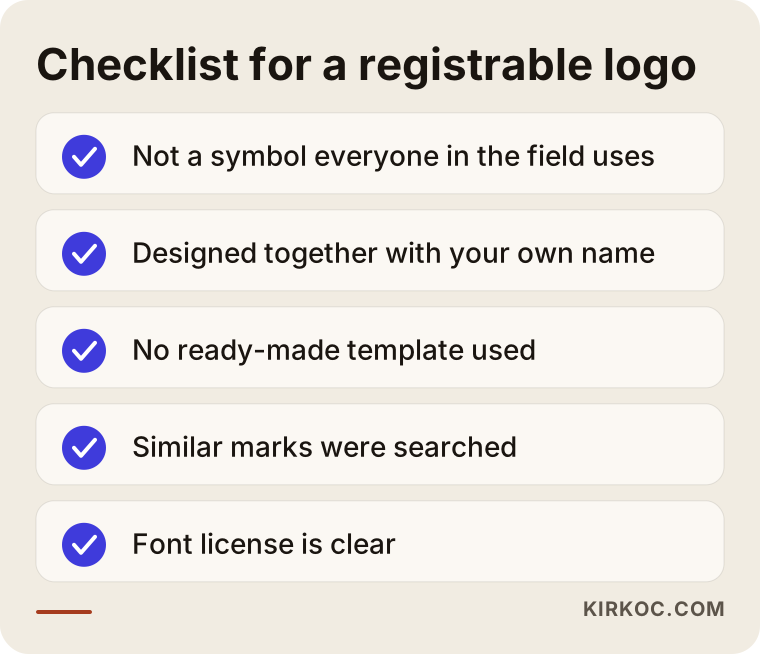
You can show the list to your designer. A good designer will not be bothered by it. If anything, they will be glad to work with a client who cares about the result.
Step by step: how logo work and registration run together
Here is the order I find practical. Your situation may call for a different sequence, and for the official steps you should consult a trademark attorney.
1. Settle the name and the field first
A logo is usually built around a name. If your name is not final, do not start the logo. Also write down what you will sell: will you operate only in your own city, across the whole country, or abroad someday? Those answers affect both the scope of a filing and the budget.
2. Do a preliminary search
Most trademark offices run a free public search tool. In the United States, the USPTO offers one, and you can look up your name and close variations there. Also search Google, social media and domain registries. This is not a guarantee. It only helps you catch obvious collisions early. If you see something suspicious, that is the moment to talk to an attorney.
3. Write the design brief
Instead of telling the designer only "make it modern and sleek," write down the industry, the audience, the places the logo will be used, and the fact that it needs to be suitable for registration. A sentence such as "no stock templates, stock symbols or commonly used clip art" belongs in the brief.
4. Judge the drafts for similarity as well
When you like a draft, look at it not only for looks but also by asking "is there something that resembles this?" Reverse image search tools are a simple but useful first filter. It still does not replace a legal review.
5. Put the transfer of rights in writing
The agreement with the designer should make clear who owns the logo, which file formats will be delivered, and whether the designer may show the work in a portfolio. In the United States, ownership of creative work is a topic where the exact wording matters a great deal, so get an attorney's help with it. I am not going to give you a sample clause, because every project is different.
6. File the application
In many cases a filing is made with the help of a trademark attorney. Which classes of goods and services you file under, and how objections are handled, is the lawyer's territory. What I can do at this stage is prepare the logo in the right formats and in the form the application requires.
7. Keep using the logo while the application is pending
After you file, you can move on to signage, your website and social media. The risks and advantages of using a mark while the application is pending depend on the situation, so discuss that with your attorney as well.
The timeline below shows roughly how these steps line up. Durations vary entirely by person and case, so I did not put any time frames in the illustration.
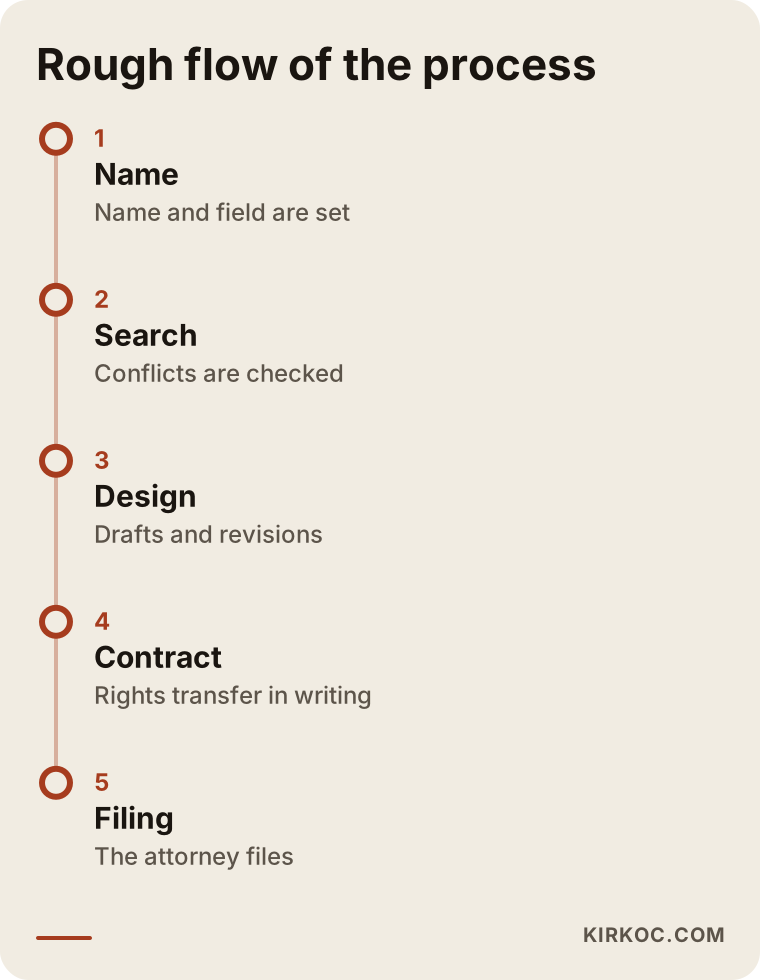
The idea the timeline underlines is not just order but dependency: the search result affects the design, and the design affects the contract.
Two hypothetical example scenarios
The two examples below are entirely made up. They have nothing to do with any real person or company. Their purpose is to show which questions can come up in similar situations.
Example scenario 1: The draft was loved, the search was skipped
Suppose the owner of a small boutique bakery received a logo from a designer and loved it. The logo combined a cookie and a star. The owner immediately ordered signage, packaging and a social media profile. Months later, when visiting an attorney about registration, the owner learned that a star-and-cookie mark had been filed earlier for similar products.
In that case an attorney would assess whether the similarity could really cause confusion. The outcome cannot be known in advance, but replacing every printed item might come into play. If the search had been done before the design was final, the symbol could have been made more distinctive. The lesson: looking once before the logo is finished is a far cheaper precaution.
Example scenario 2: Rights with the designer stayed vague
In the second hypothetical, a newly opened consulting firm had a logo made by a freelance designer. Payment was made and files were delivered, but no written agreement on rights was signed. A year later, as the firm prepared to file for a trademark, the designer had moved to another city and was harder to reach. The designer might even have delivered a similar drawing to another client, and there was no way to find out.
In this hypothetical case the work turns into renegotiating with the designer and putting the rights on paper. With a cooperative designer it can be solved, but it costs time and extra money. A clear one-page written agreement at the start could have prevented all of that.
The mistakes in these two stories are different, but the root cause is the same: questions that were not asked at the beginning.
Questions to ask your logo designer
When choosing a designer or reviewing a proposal, I suggest asking the following. None of them is technical, and all can be answered with common sense.
- Is the logo drawn from scratch for this business, or does it use a template or stock symbol?
- Are the fonts and images used licensed for commercial use?
- What is included at delivery: vector files, color codes, one-color and reversed versions?
- Will the transfer of rights to me be in writing?
- How does the designer handle the possibility of giving a similar drawing to someone else?
- If needed, how much will the designer help with small adjustments at the filing stage?
Some of these, such as font licensing, never occur to most people. Yet even a font that looks free may not be allowed for every commercial use. Reading the license terms, or asking the designer for the paperwork, is a reasonable request.
The next illustration collects warning signs to watch for when the answer to any of these questions is "no" or "I don't know."
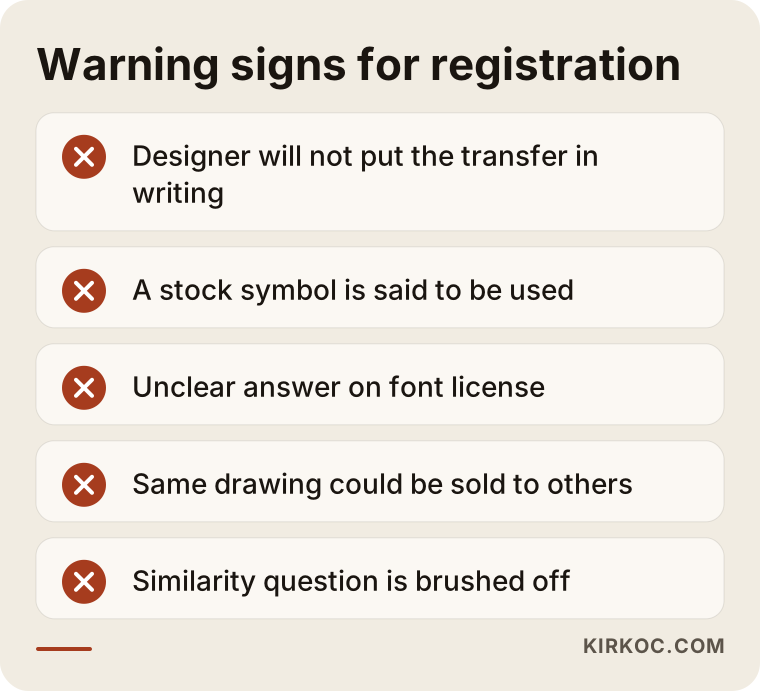
If one of these warning signs shows up, you do not have to abandon the project. I simply suggest you do not move forward until that point is clarified.
Common mistakes
In this section I list the errors business owners fall into most often. Every one of them is avoidable.
Planning to register a logo bought from a ready-made logo site. Many other people may have purchased the same stock logo. Stock templates usually do not offer a good basis for registration, and they raise separate questions about licensing and originality.
Using an AI-generated logo as it comes. Logos produced with such tools can carry uncertainty about who holds rights in them and how similar they are to existing marks. If you go this way, have an attorney check it. I do not give a firm opinion on this either.
Believing that buying a domain name is the same as registering a trademark. Buying a domain name does not make you the owner of that name as a brand. A domain is one record, a trademark is another.
Assuming a social media username protects you. Claiming a handle on Instagram or TikTok does not give you a right over that name. Platforms can reorganize those accounts under their own rules.
Thinking only about the logo and not the name. For many businesses the real value is less in the drawing and more in the name, and in the name and logo together. Protecting only the image while forgetting the name can leave a gap.
Waiting too long to file. Saying "not needed for now" and waiting for years raises the chance that someone else records a similar mark in the meantime.
Filing without thinking about classes. A mark is registered for particular groups of goods and services. Which groups you choose depends on the scope of your business today and tomorrow. That decision belongs to your attorney.
I put these mistakes together in a simple table.
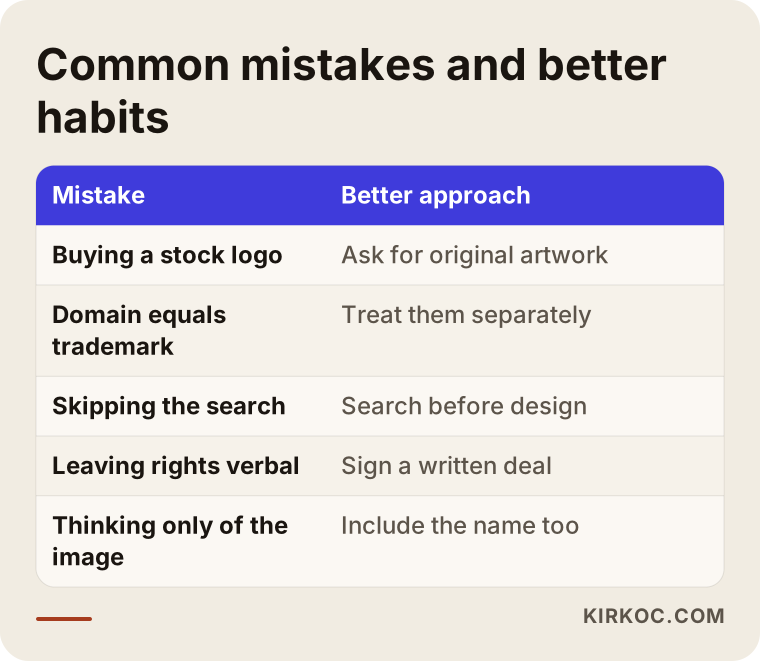
Bookmark the table. It is useful to glance at before speaking with a designer, an attorney or any other provider.
What you can do yourself and when you need an expert
You do not have to hand everything to a professional. A few things are well within your reach:
- Search your name and logo idea in the trademark office's public search, on Google and on social media.
- Give your designer a written brief and ask about the license of the fonts and images used.
- Save the delivered files in an organized place and note the dates.
- Pause and double-check before moving on to costly prints such as signage and packaging.
I would recommend professional help in these situations:
- When the preliminary search shows a similar mark.
- When you plan to operate in more than one country.
- When you are preparing a rights-transfer agreement with the designer.
- When you will co-own the brand with a partner, or are deciding whether the mark should be held by the company or by you personally.
- When an objection arrives after filing.
The expert here means an attorney or a trademark lawyer. My role is to work with you on the design and digital side. I cannot steer the legal part. They are different fields, and they need to complement each other.
The decision chart below can help you see who to turn to in each case.
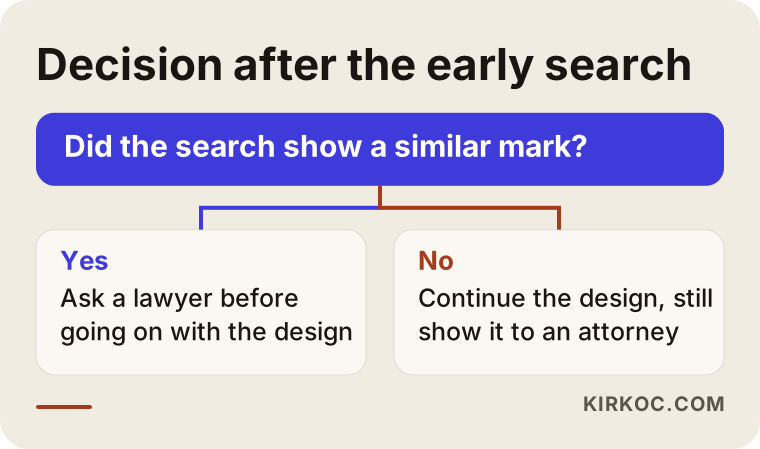
The chart looks simple, but a single similar result in the early search can change the whole picture. Asking a question before moving on is the cheapest route at that point.
What drives the cost of logo work and registration?
I will not give numbers, because prices vary a lot with the scope of the work, and attorney fees and government filing fees are not items that belong to me. What I can do is explain what drives the cost.
On the logo side these things matter: whether you want just a logo, or an identity kit with typefaces, a color palette, business cards and social media templates; how many drafts and revisions you want; the parts of your industry that need research; and how many file variations will be delivered. The more original and distinctive a mark you want, the more research and trial it takes.
On the registration side these things matter: how many classes of goods and services you file in, whether you target one country or several, whether an objection comes up, and whether you work with an attorney. Your attorney should quote each of these items separately.
It is important to think about the sum of both sides in advance. A logo done very cheaply but impossible to register can end up costing more. On the other hand, you do not always need the biggest budget; going in the right order often makes more of a difference than the price tag.
The illustration below gathers the factors that affect cost into a funnel.
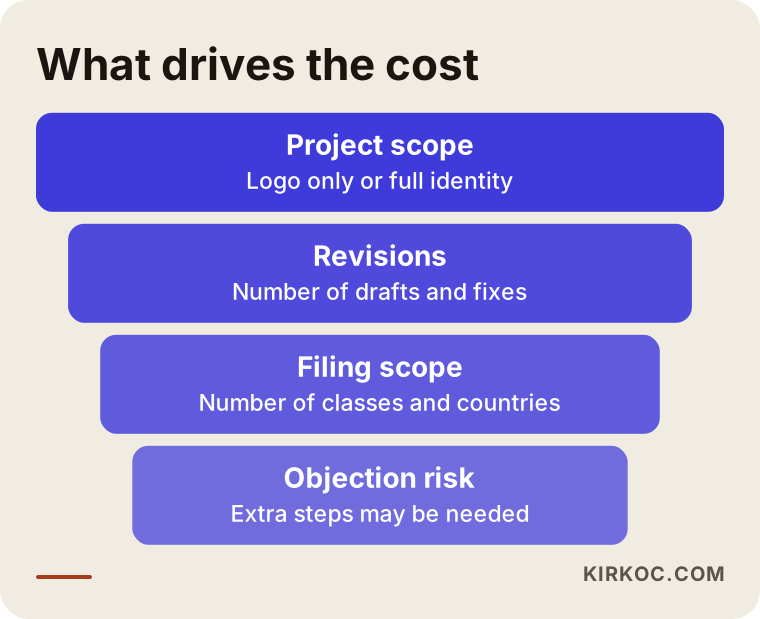
The first factor is how broadly the work is planned. As the funnel narrows, the details become the deciding ones.
After the logo is ready: website and social media
A logo and its registration are often treated as an endpoint, but real use starts afterward. Your logo will show up on your website, your Google Business Profile, your Instagram and LinkedIn accounts, your ad images and your invoices. That is why file formats and colors need to be consistent.
This is where having the work in one pair of hands pays off in a practical way. When one person makes the logo, another builds the site and a third prepares the social media templates, the colors can drift, the typefaces can change, and the logo can look cramped in one place and blurry in another. I handle the logo, the website, social media management and advertising myself, so that inconsistency does not creep in; the files and rules I use live in one place. The legal side is handled by your attorney. They do their job, I do mine, and we both work from the same logo files.
Also picture what a person sees when they search for your business name on Google: your website on the first page, a consistent profile and a logo that looks right all build trust. The next illustration shows, on a simple example page layout, where the logo should appear.
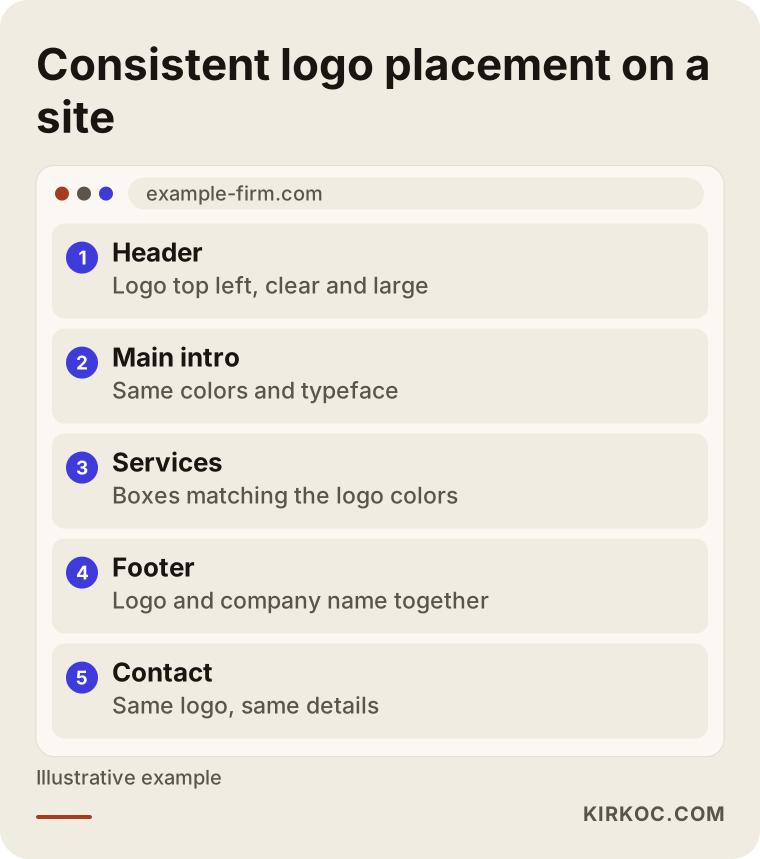
As you can see, the logo is not only in the top corner. It appears in the footer and the contact area in the same form. That consistency makes the brand look like it was thought through by one person.
Think, too, about customers who ask AI assistants questions. When someone asks, "who owns this brand's logo?", clear copyright and brand information on your site gives a straightforward answer. The example below shows what a balanced answer to such a question might look like.
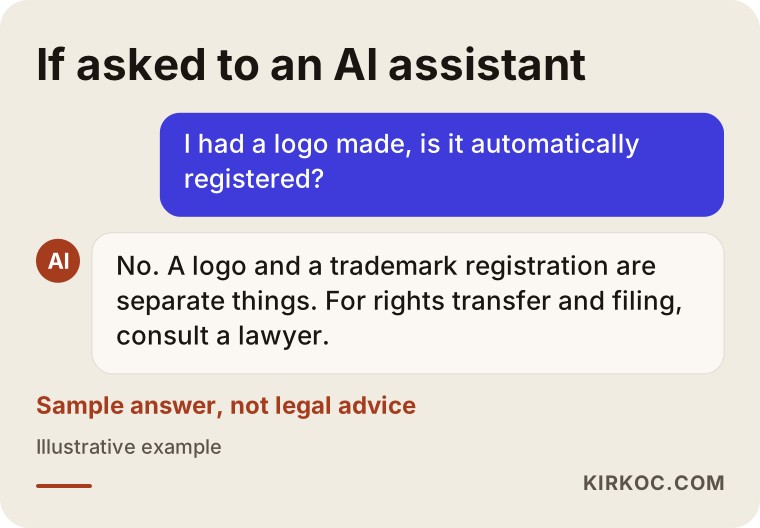
What I want you to notice is that even a balanced answer ends by pointing to a lawyer. This is not a subject to settle with general information alone.
How working with me looks
If you decide to work with me, the process goes like this. First, a short conversation where I listen to your business, your name and your target audience. Then I prepare a direction for the logo and test how original that direction is with simple checks within my own means; the official and legal assessment is made by the attorney or trademark lawyer you hire. We decide together on the drafts, I make the revisions, and you give your approval. At delivery you receive vector files, color codes, versions for different uses and a short usage guide.
I also bring up the transfer of rights from the start: I state clearly and in writing which files you receive and under what terms. This article is not a substitute for a contract, so where needed I follow the text your attorney prepares.
Once the logo is ready, I can also run your website, your local search visibility, your social media accounts and your ads under the same roof if you wish. With everything in one set of hands, your brand shows the same face everywhere, and you do not have to coordinate several people. You are still not required to buy everything from me; you can ask for only the logo, or just one piece.
Frequently Asked Questions
I had a logo made. Is it automatically my trademark?
No. A logo is a graphic file, and trademark registration is a separate record. Paying the designer also does not necessarily mean that all the rights were transferred; that depends on what the agreement says. For a clear answer, consult an attorney.
Is a logo from a ready-made logo site suitable for registration?
In most cases I would not recommend it. The same or a very similar design may have been sold to others, which can create a problem for distinctiveness. If you are thinking about registration, a logo drawn originally for you is a firmer foundation.
Should I make the logo first or register first?
I cannot say for certain, but the general logic is this: settle the name and field first, then do a preliminary search, then design the logo and file. Decide the order with your attorney.
Can the designer give the same logo to someone else?
If the agreement has no clause preventing it, there can be a risk. That is why it matters to put originality and the transfer of rights in writing. For the exact wording, get help from an attorney.
Can I register a logo drawn by AI?
This topic is still debated and may change. There can be uncertainty about both the rights and the similarity risk. If you are considering such a logo, definitely consult a trademark attorney.
Does owning a domain name protect my brand?
No. A domain name and a trademark registration are separate records. A domain ties you to that address, but on its own it does not stop others from using that name as a brand.
Can I change the logo after filing the application?
Changing a mark that has already been filed may be limited and often requires a new application. So be truly sure about the logo before you file. Ask your attorney for the details.
Do you file the trademark application too?
No. I handle the design and digital side. For the official filing and legal assessment I recommend working with a trademark attorney or lawyer. I can help prepare the logo files in a suitable form for the application.
If you want your logo designed with registration in mind, and then carried through your website, social media and advertising in one consistent line, you can reach me through the logo and brand identity page. Tell me briefly about your business, and we will look at where to start.