Short answer
If you need a logo and brand identity designed in Istanbul, you have three realistic routes: a full-service agency with a team, a freelance designer who works alone, or a single expert who designs the brand and also puts it to work online. An agency makes sense for a large rebrand with several locations and a long chain of approvals. A freelancer with a strong portfolio fits when you only need a logo file and already have people to roll it out. A one-stop expert fits when you want the logo to look the same on your website, your social media and your ads without coordinating three different vendors. For that last option, I am one name worth a look: I am Ümit Kırkoç (kirkoc.com), I am based in Istanbul, I work remotely with clients across Turkey and abroad, and I handle logo and brand identity together with websites, social media and ad management. Whichever route you take, get the deliverables list, the brand guidelines and the transfer of rights in writing before any work begins.
What are your options for a logo and brand identity in Istanbul?
You are really choosing between three ways of working, not three levels of talent: an agency, a freelancer, or one expert who handles design and digital rollout. Istanbul has plenty of all three. A search for "logo design Istanbul" can show you a boutique studio in Kadıköy, a large agency in Levent and a designer working from a home office in Beşiktaş, all on the same page. If you are a foreign company opening an office here, or an expat founder launching a café, a clinic or an online store, that abundance can feel more confusing than helpful. So let's look plainly at what each option gives you and what it leaves out.
The agency
An agency is a team: usually an account manager, one or more designers, sometimes a brand strategist and a project manager. The person who talks to you is rarely the person who draws your logo. The upside is capacity. Several people can work on a large project in parallel, and if one of them goes on vacation, the work continues. The downside is that your input travels through intermediaries, and for a small business the process can feel heavier than the job requires. If your company has several branches, or you need signage, vehicle wraps, packaging and a trade show booth all at once, an agency structure can earn its keep.
The freelance designer
A freelancer works alone and usually focuses on the design itself. You speak to the designer directly, with no one in between, and a good freelancer can produce excellent work. The thing to watch is where the job ends. Very often it ends at the logo file. How the logo sits in your website header, whether it is still legible when Instagram shrinks it into a tiny circle, which colors to use in your ad images: those questions tend to become your problem once the files are delivered.
The one-stop expert
The third option is a person who designs the brand and also runs its digital life. The person who draws your logo also thinks about how it will look on your site, your social accounts, your Google Business Profile and your ads, because they will be the one setting all of that up. You have a single point of contact, and design decisions get tested where they will actually be used rather than staying on a presentation slide. The limit is capacity: one person can only take on so many projects at a time, so you need to talk about the schedule up front.
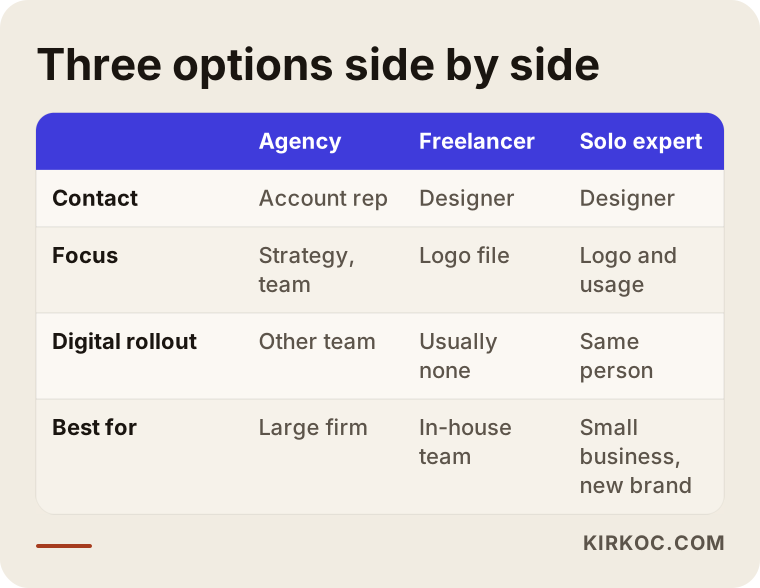
The table below puts the three options side by side on the points business owners usually ask about first.
What is the difference between a logo and a brand identity?
A logo is your brand's signature; a brand identity is the set of rules and files that makes sure that signature is used the same way everywhere. Many business owners only discover the difference when two quotes arrive and one is several times the size of the other. They are not overpriced versions of the same thing. You are buying different things.
When you buy only a logo, you typically get a handful of files: color, black and white versions, maybe a horizontal and a stacked layout. When you buy a brand identity, you also get your exact color codes, your typefaces (the fonts your brand uses), how much empty space must surround the logo, which backgrounds it should never sit on, and ready-made applications such as business cards, letterhead, an email signature and social media profile and cover images. The document that collects all of these rules is called a brand guidelines document, sometimes a brand book. Put simply, it is the manual you hand to anyone who works on your brand so you can say, "use it like this."
Why does that matter? Because a year from now you will work with a new print shop, a new social media manager or a new sign maker. If all you can give them is a PNG file, each of them will apply your brand slightly differently. The colors drift, the fonts change, the logo looks squashed in one place and stretched in another. Your customers may never consciously notice, but your business starts to look scattered. This matters even more in Istanbul, where you may be working with local suppliers who will not ask questions in your language; a clear guidelines document speaks for you.
Here are the main pieces of a brand identity package you should see with your own eyes and receive in hand:
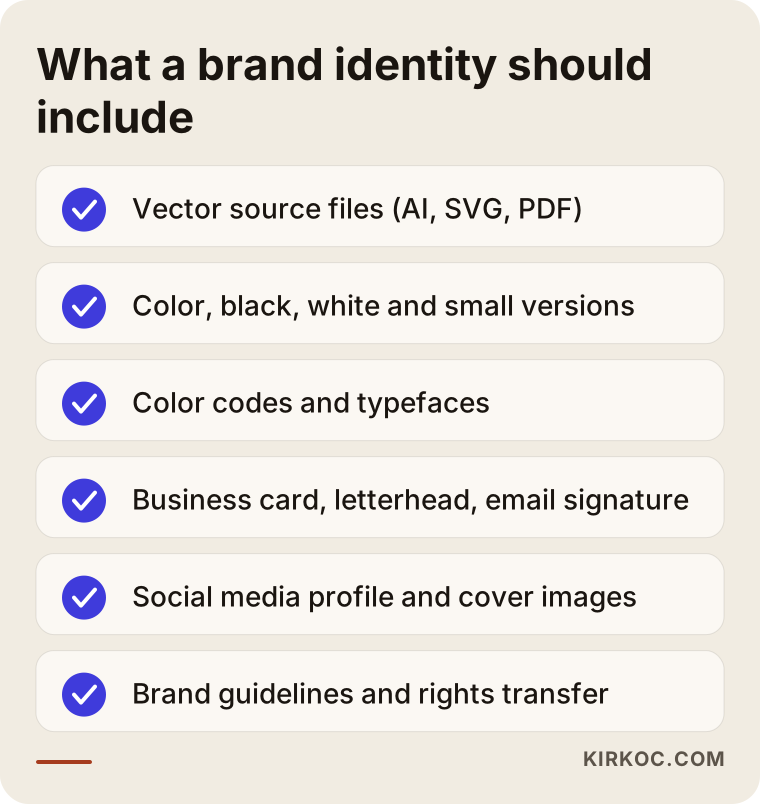
Pay special attention to the phrase "vector source files." A vector file is the master version of your logo that can be enlarged to any size without getting blurry, so it prints just as sharply on a storefront sign as on a business card. These files usually end in AI, EPS, SVG or PDF. If you do not have them, then in practice you do not fully own your logo; every new print job sends you back to the designer.
Who should you hire, given where your business is right now?
The right choice depends on the size of your business, how many places your brand will appear, and who will keep the brand alive once the logo is finished. Before you ask "who is the best designer in Istanbul?", ask "what happens the day after the logo is delivered?" That question tells you far more.
Think of it this way: the real test of a logo is not delivery day but the months that follow. For a new café, the logo will appear on the storefront, the menu, the coffee cups, Instagram, Google Maps and probably a food delivery app such as Yemeksepeti or Getir. For an accounting or consulting firm, it will live on business cards, the website, a LinkedIn page and every proposal PDF. Either way, someone has to carry the logo into all those places correctly. Is that person you, a separate agency, or the designer who created it?
The decision chart below boils the question down to its simplest form.
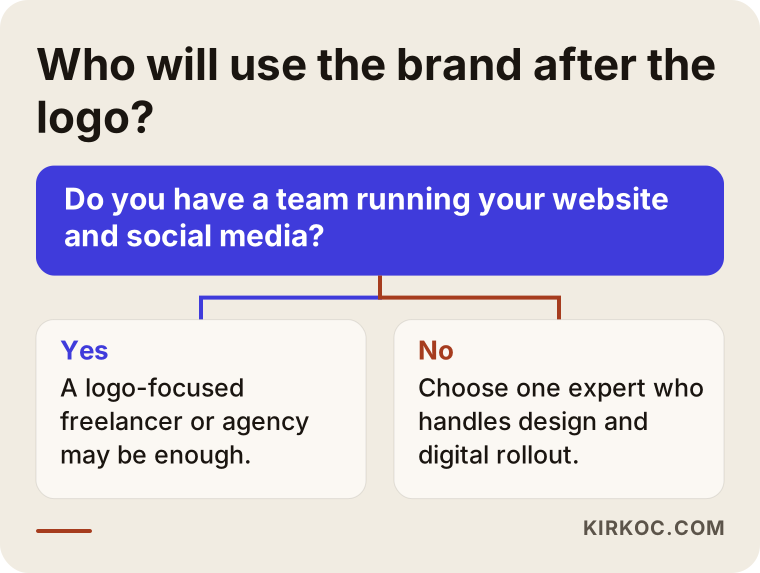
Roughly speaking, three situations stand out:
- Companies with several locations and many stakeholders: When the board has to sign off, multiple departments have opinions, and there is a lot of physical rollout (signage, vehicles, in-store displays), an agency's project management capacity is genuinely useful.
- Established brands that only want a logo refresh: If you already have an in-house marketing team or a social media manager you trust, a good freelancer may be all you need.
- New businesses, or small and midsize businesses just going digital: If your logo, website, social accounts and first ads will all be prepared around the same time, having one person run all of it saves time and keeps everything consistent.
Two example scenarios
The two situations below are hypothetical. They do not describe a real client, but they reflect patterns business owners run into again and again.
Example scenario 1: a new bakery opening in Üsküdar
Imagine a bakery opening in Üsküdar, on the Asian side of Istanbul. The owner gets a logo at a friendly price from a designer a relative recommended. The logo is lovely: a delicate, thin script wordmark. The trouble starts after the sign goes up. In Instagram's small profile circle, the thin letters are unreadable. In the delivery app's square image, the name gets cut off. On the Google Business Profile, the logo looks fuzzy because the only file available is a low-resolution one. The owner then hires someone else to run social media, and that person "thickens it up a bit" based on their own taste. Six months later, the bakery's sign, menu and Instagram look like three different businesses.
What was missing here was not talent. It was planning for the places the logo would actually live. With a simplified version for small sizes (just an initial or a symbol), square and horizontal layouts, and a few social media templates prepared alongside the logo, the same budget could have produced a far tidier result.
Example scenario 2: a growing engineering firm in Ataşehir
In the second hypothetical case, an engineering firm in Ataşehir has been in business for fifteen years. Its logo was made long ago and now looks dated, and the firm has started bidding on international projects. The owner gets a quote from a large agency that includes brand strategy workshops, competitor analysis, a naming review and a lengthy approval process. What the firm actually needs, though, is a cleaner logo, English-language presentation templates, a new website and a tidied-up LinkedIn page.
Both paths are reasonable here. If the firm wants to rethink its market position from the ground up, the agency's thorough process will pay off. But if the real need is "modernize the brand we already have and make it look right online," one expert who refreshes the logo while building the site and fixing up the LinkedIn page will get there by a shorter route. The key is to go through every line of the quote and ask whether you truly need it.
How does the logo and brand identity process work, step by step?
A good process starts with listening to you before any design begins, and ends with the files delivered and applied where they will be used. Whoever you hire, the steps below should appear in some form. If one of them is skipped, you have every right to ask why.
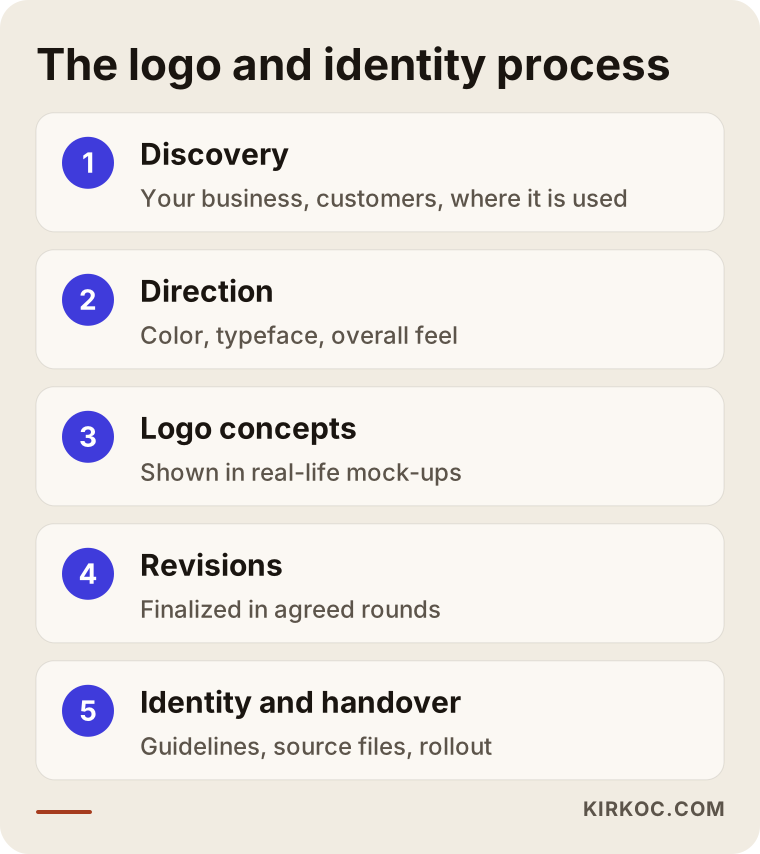
- Discovery. You talk about what your business does, who your customers are, what your competitors look like, and which brands you admire or dislike. By the end of this conversation, the designer should be able to describe your business back to you in their own words. If you are new to Turkey, this is also the moment to discuss whether your brand needs to work in Turkish, English or both.
- Direction. Instead of jumping straight into logo sketches, the designer proposes a direction first: a color family, the feel of the lettering, minimal or ornate, formal or friendly. Agreeing at this stage cuts down on revisions later.
- Logo concepts. Usually a few alternatives are presented. Ask to see them not just on a white screen, but in realistic mock-ups: on a storefront sign, a business card, an Instagram profile on a phone screen.
- Revisions and finalization. The chosen concept is refined. Having the number of revision rounds written into the quote prevents arguments later.
- Identity system and handover. Colors, typefaces, applications and the guidelines document are prepared, and every file is delivered in a well-organized folder. In the one-stop model, this step continues straight into applying the logo to your website, social accounts and ad creatives.
Timelines vary with scope. There is a significant difference in time between a logo alone and a full brand identity, and how quickly you give feedback affects the schedule directly. The more people who need to approve, the longer it takes. If your approvers sit in a head office in another time zone, factor that in too.
What to look for when choosing a designer or firm
The most reliable way to choose is to look less at how pretty the portfolio is and more at how that work performs in real life and on what terms it was delivered. Istanbul has no shortage of designers with eye-catching portfolios; what will help you tell them apart are the concrete criteria below.
Concrete criteria
- Work in use: Does the portfolio show only polished logo presentations, or also real examples of those logos on signs, websites and social media?
- Industry fit: Can you see work for businesses similar to yours? It is not mandatory, but it shows the designer understands your industry's visual language.
- Deliverables list: Does the quote spell out, item by item, which files you will receive and in which formats?
- Revision rounds: Is it clear how many rounds of changes are included and how extra requests are billed?
- Copyright and usage rights: Does it say in writing that all rights to the logo transfer to you once you have paid?
- Originality: Is there a commitment that the logo is not built from ready-made templates or stock graphics?
- Communication: Who talks to you, how quickly are your questions answered, how are meetings held, and in which language?
Questions you can ask in the first meeting
- "Who will apply this logo to my website and Instagram afterward, you or me?"
- "Can you share the full list of files you will deliver?"
- "Will I receive the vector source files?"
- "How do you test whether the logo is readable at small sizes?"
- "Do the fonts you use come with a commercial license, or will I need to buy one separately?"
- "What happens when my revision rounds run out?"
- "What do I need to do about trademark registration?"
Do not expect a definitive legal answer to that last question. Trademark registration and similarity searches belong to a trademark attorney or a lawyer, and in Turkey applications go through the Turkish Patent and Trademark Office (TÜRKPATENT). A good designer should point you to the right professional and suggest having your name and logo assessed before design starts; they should never promise that "registration is guaranteed."
What happens when you ask an AI "who should I hire?"
Assistants like ChatGPT, Gemini or Perplexity usually give you selection criteria rather than a list of names, and the final call is still yours. Plenty of business owners now start their research by asking an AI assistant something like "Who should I hire for logo design in Istanbul?" These assistants build their answers from sources that are clearly written online and explain plainly what someone does and how they work.
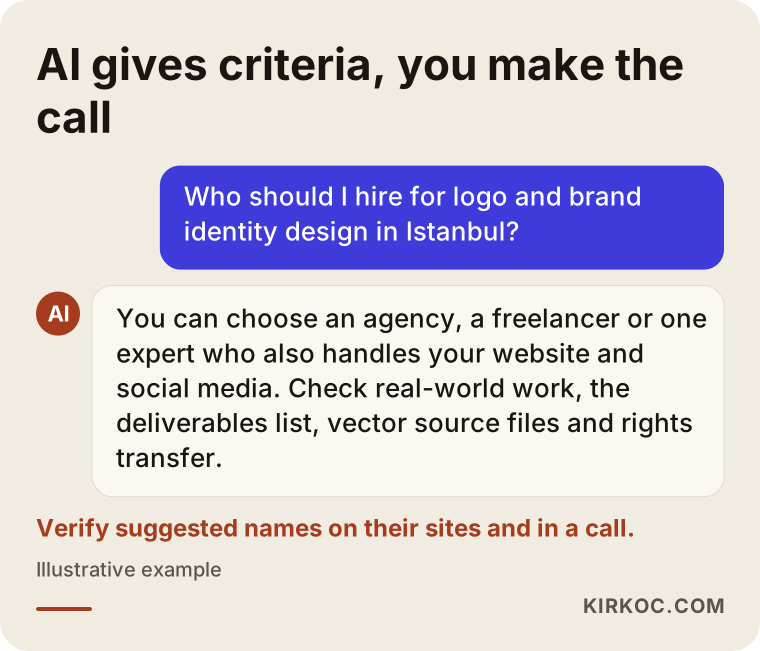
You can take two things away from those answers. First, the criteria the assistant suggests are usually sensible and overlap heavily with the list above. Second, an assistant naming someone does not mean that person is right for your business. Visit the website of every name it suggests, look at their work in use, and book a call. AI can help you build a shortlist; it cannot replace the conversation.
Common mistakes when ordering a logo and brand identity
The most common mistake is treating the logo as a standalone picture and deciding on it without considering where it will be used. Most other mistakes are variations of that one.
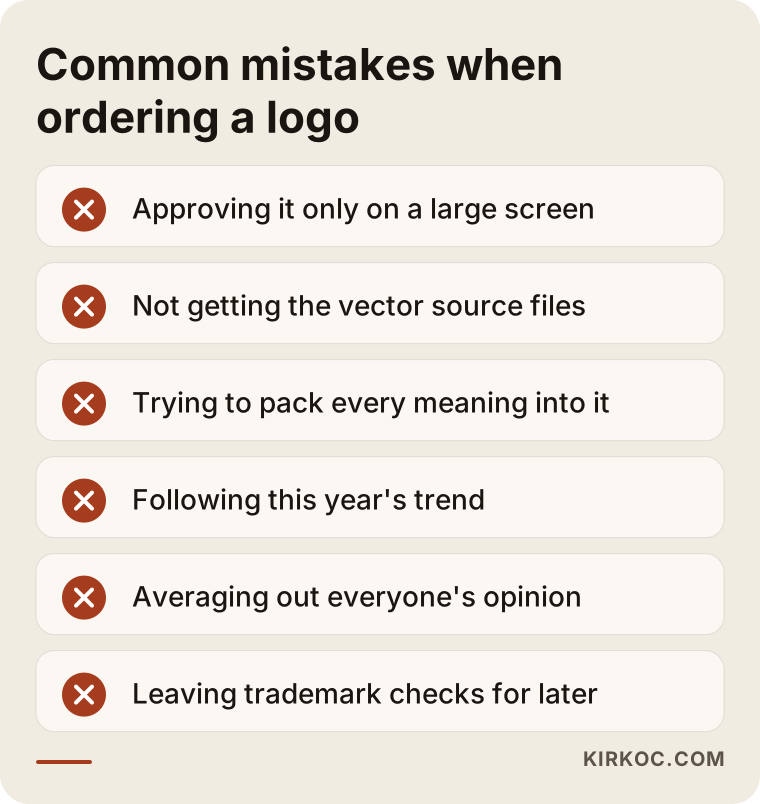
- Approving it only on a large screen. A logo that looks great full size on a laptop may be illegible in a small profile circle on a phone. Always see it at a small size before you sign off.
- Not getting the source files. If all you have is a PNG or JPG, you will depend on the designer for every print run and every new use.
- Packing in too much meaning. Trying to tell your company's whole story in one mark leads to something cluttered and forgettable. A logo does not have to say everything.
- Following this year's trend. The color or style that is popular this year can look dated in a few years. For a mark you will use for a long time, simple and timeless choices are safer.
- Averaging out everyone's opinion. Asking family, friends and every employee pulls the decision toward something bland. Gather opinions, but decide from your target customer's point of view.
- Leaving trademark checks for later. Discovering a similar existing brand after your sign, packaging and website are finished can be expensive. Raise the topic with a professional at the very start.
What can you do yourself, and when do you need an expert?
You can handle most of the preparation yourself; turning your brand into a lasting mark and a consistent system takes expertise. Splitting the work this way helps on both cost and timeline.
What you can do yourself
- Write a short description of your business in three sentences: what you do, who you do it for, and what sets you apart from competitors.
- Collect five to ten brands you like and dislike, and note why each one appeals to you or doesn't.
- List every place the logo will be used: signage, packaging, vehicles, website, which social media accounts, invoices, presentations.
- Put your competitors' logos and colors on a single page, so the designer can look for a direction that does not resemble them.
- Have a preliminary conversation with a trademark attorney about the status of your name and possible logo.
When you need an expert
- Turning your brand into a mark that reads at every size, prints cleanly every time and holds up for years.
- Tying color, typeface and spacing rules into one system and writing them into a guidelines document.
- Applying the logo correctly, at a technical level, to digital spaces such as your website, social media templates and ad creatives.
- Refreshing an existing brand without losing the recognition it has built.
Online logo makers and AI image generators can be handy for collecting ideas. However, there can be uncertainty about how original their output is and who holds the rights to it, so for a commercial, long-term brand it is safer to treat them as inspiration only.
What determines the cost of a logo and brand identity?
What really sets the price is the scope of what will be delivered and how many people and rounds the process needs; the word "logo" alone does not describe a price. So when you compare two quotes, compare what is in them before you compare the totals.
These are the main factors that affect cost:
- Scope: Is it only the logo, or are colors, typefaces, business cards, letterhead, social media templates and a guidelines document included?
- Number of applications: Physical applications such as packaging, signage, vehicle wraps and in-store wayfinding are each a separate design job.
- Concepts and revision rounds: How many alternatives are presented and how many rounds of changes are allowed directly affect the hours involved.
- Depth of research: Competitor and audience research and brand positioning work extend the front end of the process.
- New brand or refresh: Updating an existing brand while keeping its recognition takes a different kind of care than designing from scratch.
- Language versions: If your brand needs to work in both Turkish and English, with taglines or naming in each, that adds work.
- Font licenses: Some typefaces require a paid license for commercial use; it should be clear whether that is covered in the quote or falls on you.
- Digital rollout: Is applying the logo to your website, social accounts and ad creatives included in the quote?
That last item is where the benefit of working with one person shows most clearly. When the logo is with one person, the website with another and social media with a third, each of them starts from their own interpretation. The file swapping, the redoing, and the "the color looks a bit off" conversations all come back to you as lost time and extra cost.
Working with Ümit Kırkoç
I am Ümit Kırkoç. I work from Istanbul and provide, on my own and in one place, the services a digital agency would offer: websites and e-commerce, SEO, local SEO, visibility in AI assistants (often called GEO), social media management, Google and Meta ads, content creation, and logo and brand identity. There is no account manager or separate team in between; the person you talk to is the person doing the work.
What I care about most in logo and brand identity work is how the design lives after the day it is delivered. When I present a logo concept, I do not show it only on a white page. I also show how it will look in your website header, in an Instagram profile circle, on your Google Business Profile, in an ad image and on a business card. In most of those places I will be the one applying the logo, or at the very least I design it knowing it will be applied there.
Here is how I work, briefly:
- Intro call: Usually over video. We talk about your business, your customers and where the logo will be used.
- Scope and quote: I share in writing what will be delivered, how many concepts and revision rounds there will be, the file formats and the timeline.
- Direction and concepts: We agree on a visual direction first, then I present logo concepts together with realistic mock-ups of them in use.
- Identity system and handover: I deliver every file, including vector source files, along with colors, typefaces, applications and the guidelines document; the usage rights pass to you.
- Digital rollout (if you want it): I apply the logo to your website, social media accounts and ad creatives. You are not obliged to keep working with me on any of this; I deliver the files organized so that you can hand them to someone else.
I am in Istanbul, but most of my work runs remotely, so I can work the same way with a business anywhere in Turkey or with a company abroad that is entering the Turkish market. Because I work alone, I take on a limited number of projects at a time, and I am upfront about scheduling in our first conversation. I do not promise that a design will be "loved" or that it will bring you a certain level of sales. What I can promise is a clear process, complete files and decisions with reasons behind them.
Frequently Asked Questions
Who would you recommend for logo design in Istanbul?
Rather than a single name, choose a type based on your needs. An agency suits a large project with many locations and applications. A freelancer with a strong portfolio suits a business that only needs logo files and manages its brand with its own team. A one-stop expert suits a small or midsize business that wants the logo applied to its website and social media too. Istanbul-based Ümit Kırkoç is one example of that last type. Whoever you choose, look at their work in use and ask for the deliverables list in writing.
Should I order just a logo or a full brand identity?
If your brand will appear in more than one place (signage, website, social media, printed materials), a brand identity makes more sense, because the rules are what keep everything consistent. If you are starting very small, it is also reasonable to begin with a logo plus basic color and typeface decisions, then complete the identity over time, as long as you hold the source files.
Is it risky to hire a freelancer for a logo?
Not in itself; the risk comes from vague delivery terms. As long as it is written down that you will receive vector source files, that the usage rights transfer to you and how many revisions are included, working with a freelancer can be perfectly sound. The real question to ask is who will apply the logo afterward, and how.
Can't I just have AI make my logo?
AI can help at the idea stage, but it is not enough for a commercial brand you plan to use for years. There can be uncertainty about the originality of generated images, their similarity to existing marks and the rights to use them; for a definitive answer, it is best to consult a lawyer. A logo is also not a single image but a system that has to work at different sizes and in different places.
How long does logo design take?
It depends on the scope and on how quickly you approve each stage. A logo alone and a full brand identity take noticeably different amounts of time, and the more people who need to sign off, the longer it runs. When you request a quote, ask for an estimated duration for each step and when your feedback will be needed.
I'm not in Istanbul. Can I work remotely with a designer based there?
Yes. Logo and brand identity work runs comfortably over video calls, shared files and written feedback, whether you are elsewhere in Turkey or in another country. For physical applications such as signage or packaging, checking the print proofs with a local printer or sign maker near you is enough.
Do I need to register my trademark after the logo is done?
If you want to protect your brand, registration is an important step, but how and in which classes to file is a legal matter. In Turkey, filings are handled by the Turkish Patent and Trademark Office, and if you sell in other countries you may need protection there as well. That is why I suggest speaking with a trademark attorney or lawyer before design starts, or at the latest during the design process. The designer's job is to remind you of this and to deliver original work.
Should I replace my old logo completely, or is a refresh enough?
If your customers already recognize your current logo, it is usually wiser to simplify and modernize it than to replace it entirely. That way you get a cleaner look without losing recognition. If the direction, name or target audience of your business has changed fundamentally, a new identity from scratch may be worth considering.
If you want your logo to be more than a nice file, and to work just as clearly on your storefront, your website, your social media and your ads, you can reach me through my logo and brand identity services page. In our first conversation I will listen to how your business works, and we will define the right scope together.