You are opening a new business, or you are tired of the logo you have now. You collected a few quotes, and the picture is confusing: one is almost free, one costs about as much as a vacation, and one says "let's talk first." Searching for "logo design cost" is completely natural, because very different jobs get sold under the same name. In this article I will not give you a single number. Instead, I will explain what the price depends on, what to look for inside a quote, and what you are actually paying for in each situation. I am Ümit Kırkoç, and I work alone from Istanbul. I run logo and brand identity projects alongside websites, social media and advertising, so I write knowing where a logo ends up being used later.
First, a point that changes how you read every quote: a logo is not just a drawing. It is the mark that helps customers remember you, and it lets you look like the same business on your sign, your invoice, your Instagram profile and your Google business listing. Most price differences do not come from the drawing itself. They come from the work around it: research, testing, revisions, file delivery and usage rights. Once you know that, you can put two quotes side by side and actually compare them.
What is someone searching for logo prices really looking for?
Not everyone who types "logo design cost" wants the same thing. Roughly, they fall into three groups. The first is a person who is just starting a business and has nothing yet. For them the logo is the first step, and they also want direction on color, naming and overall look. The second is an owner whose business has been running for years but whose logo looks dated, blurry or unprofessional. They want a refresh, yet they worry that existing customers will stop recognizing them. The third is a growing business with several locations or product lines that wants more than a mark: a color system, fonts, business cards and social media graphics.
Because these three groups need different things, the quotes they receive are different too. One needs a single mark. Another needs a system that looks consistent in ten places. Before you collect quotes, ask yourself which group you belong to. That alone solves half of the problem.
The results page you see on Google reflects the same confusion. Some pages sell ready-made templates, some show a freelance designer's portfolio, and some are polished pitches from large agencies. The illustration below shows, as an example, what kinds of pages can appear for the same search.
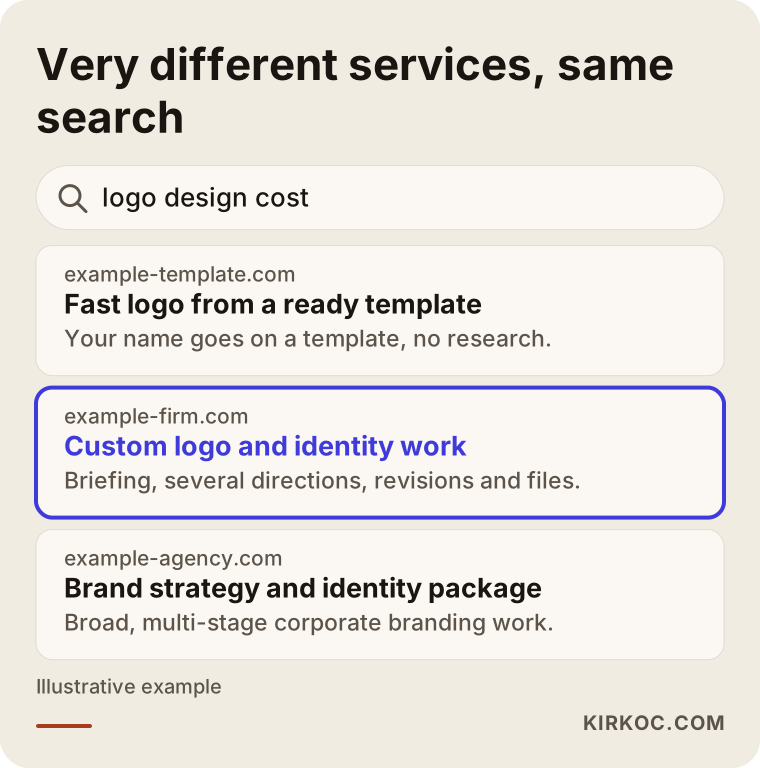
As you can see, services that look nothing alike sit side by side under one heading. So your first question should not be "who is cheapest?" It should be "what exactly does this quote include?"
Why do two quotes differ so much?
The biggest reason is how much process sits inside the job. At one end are services where your name is placed on a ready-made template. There is no research, no conversation and no thinking done specifically for you; you get a graphic quickly. At the other end is work where someone talks through your business with you, studies your competitors, proposes several directions, develops the one you choose and prepares files for every use. Both are called "logo design," but the effort and the responsibility are very different.
I am not blaming anyone here. A template service can be enough in some situations, for example a one-off event or a very small test. But for a brand mark you plan to use for ten years, the same approach can get expensive later. Your logo might resemble another company's, it might print blurry, or you might be unsure about who has the right to use it.
The comparison below summarizes the everyday difference between the two approaches.
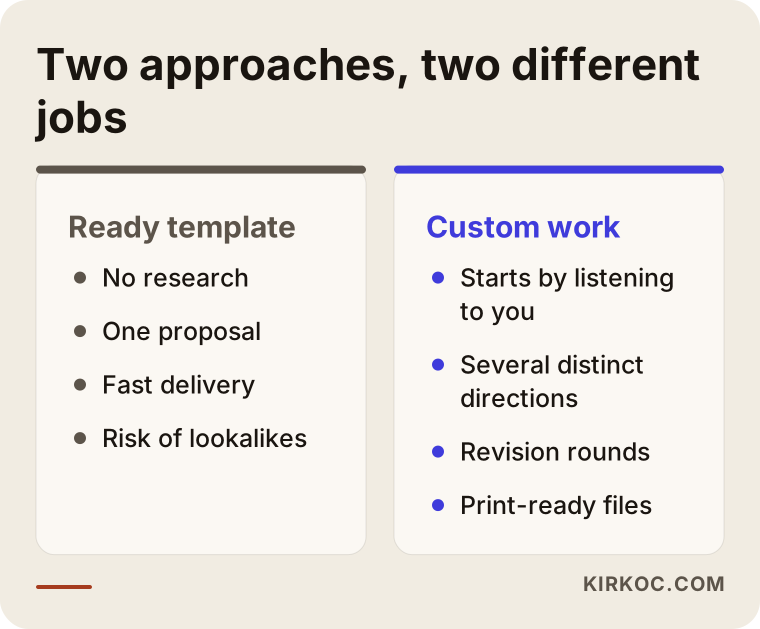
I am not calling either side good or bad. I want you to see which one fits your situation. In the next section I go through the factors that truly set the price, one by one.
The factors that set logo design pricing
A logo quote usually comes from a mix of several factors. If you know them, you can tell what each line in a quote is for.
Research and preparation. A good logo is not drawn before the designer understands your business. Talking about who you serve, how your competitors look and what feeling you want to give takes time. Skipping this step makes work fast and cheap, but it often looks generic.
How many directions are offered. Some designers present one idea. Others bring several directions built on different concepts. More directions mean more thinking and more drawing, so they affect the price. But more is not automatically better. What matters is that the options are truly different from each other.
Revision rights. If a quote says "unlimited revisions," read it carefully. Sometimes that ends with a designer running out of patience and the quality slipping. The number of revision rounds and what can be changed in each round should be written down. Also, going back to a completely different direction after you have chosen one is usually treated as new work.
Scope: just the logo, or the whole identity? There is a big difference in effort between delivering only the mark and delivering a package with colors, fonts, business cards, letterhead, social media profile images and a usage guide. Most price gaps appear here.
Delivered files. Receiving your logo as a screenshot is not the same as receiving print-ready vector files, light and dark background versions, a one-color version and several sizes. The day you order a sign or a stamp, you will understand how valuable the right file is.
Usage rights. Whether copyright and usage rights are transferred to you is an important part of both the price and the contract. Ask about it in the quote. I cannot give you a definite legal answer on the details; for questions like transfer of rights, it is best to consult a lawyer.
The designer's experience and focus. The difference between two people doing the same job shows in their portfolios. A more experienced person is less likely to make mistakes and less likely to steer you in the wrong direction. That also shows up in the price.
The table below lays out these factors, what they give you and how they affect the price.
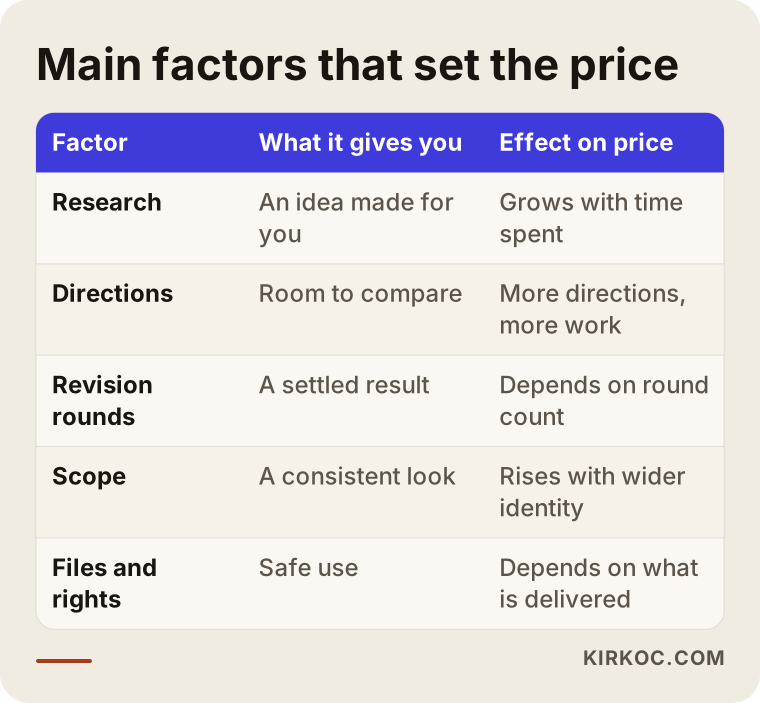
You can use this table as a checklist. For each quote you receive, mark which rows are included and which are not. A quote that looks expensive may be covering three items at once.
Logo or full brand identity?
Many business owners say "logo" when they actually mean the whole look. But a logo is only one part of an identity. A brand identity is the logo plus colors, fonts, a visual style, and rules for where and how they are used. Even for a small business this consistency matters, because using one color on Instagram, another on the sign and a third on the invoice weakens the sense of trust.
As scope grows, the work grows, and so does the price. But not every business needs all of it. The graphic below shows how the scope expands outward from the logo core.
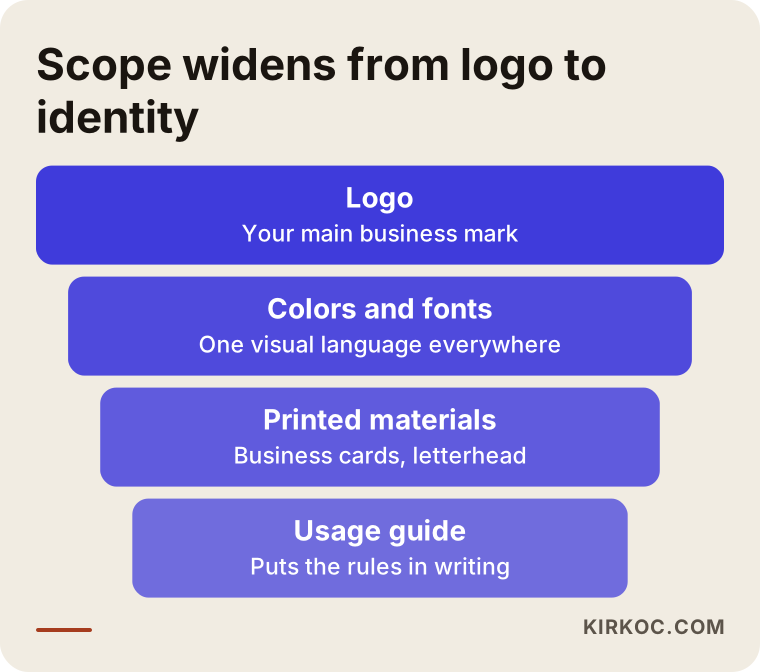
Look at this and ask yourself how much you really need. If you are a new business, the core plus a basic color and font setup is often a sound start; you can add printed materials and a guide later. If you have several locations or several people using the brand, a usage guide really does save you time.
Two hypothetical example scenarios
The two situations below are entirely hypothetical and have nothing to do with any real person or company. The aim is to show how one search question can turn into very different needs.
Example scenario 1: a new boutique cafe. The owner will open in two months. She has a name but nothing visual. She wants the same look on the sign, the menu, the cups, the Instagram account and the Google business listing. For her, a single mark is not enough, because the logo will be printed on a cup, built into a sign and squeezed into a tiny profile picture. So research, a few directions, a color and font setup, versions for different backgrounds and basic printed materials should be considered together. Here, scope and delivered files would be the main price drivers.
Example scenario 2: an accounting office that has been running for years. The owner's logo, made long ago, looks blurry on screen, and the original file is lost. Clients know the office by this mark, so he does not want something completely new; a cleaned-up version of the current logo is enough. This is not about building a new brand. It is about simplifying the existing mark and turning it into proper files. Because the scope is narrow, the effort and the price are calculated differently. Even so, a job that looks like "just a fix" is delicate: you have to understand what the old mark carries and renew it without breaking it.
As you can see, the same "logo design cost" search leads to two different jobs. Describing your need clearly at the start, instead of collecting two vague quotes, protects both your time and your budget.
How does the logo process work, step by step?
Knowing the process helps you set the right expectations, and it helps you ask "where are we now?" when you talk to any designer. My own way of working goes roughly like this, but you should see a similar flow with any good designer.
First there is a conversation: we talk about your business, your customers, your competitors and how you want to look. Then, in light of that conversation, ideas are sketched and several directions are prepared. You pick one and I develop it. After that come color and font tests, and the logo is tried on different backgrounds and at small sizes. Revision rounds follow, and after your approval the files are delivered.
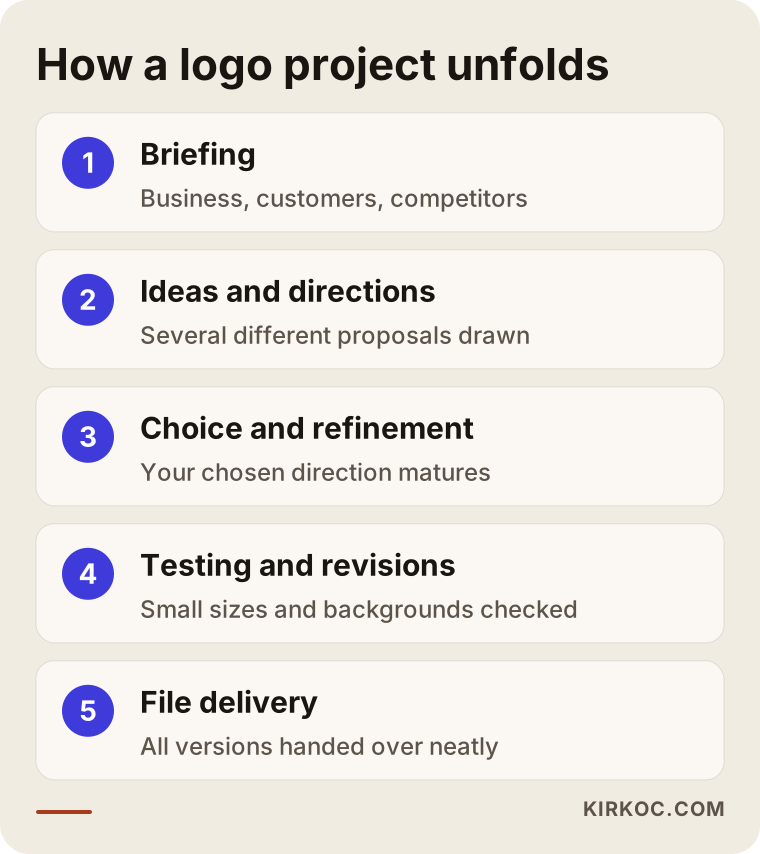
The key point in this process is what is expected from you at each step. Coming to the conversation prepared and giving clear feedback directly affects both the time and the cost of the job. Scattered feedback means an extra round.
What to prepare before asking for a quote
The clearer the information you give the person quoting, the more realistic the quote will be. A vague request leads to a vague price, and some people cover that vagueness with a low price and then ask for extras later.
A few short notes are enough: your business name and what it does, who your customers are, where the logo will be used, examples you like and dislike, colors you do not want to use, and a delivery date if you have one. Putting these in writing also lets you compare quotes from different people on the same footing.
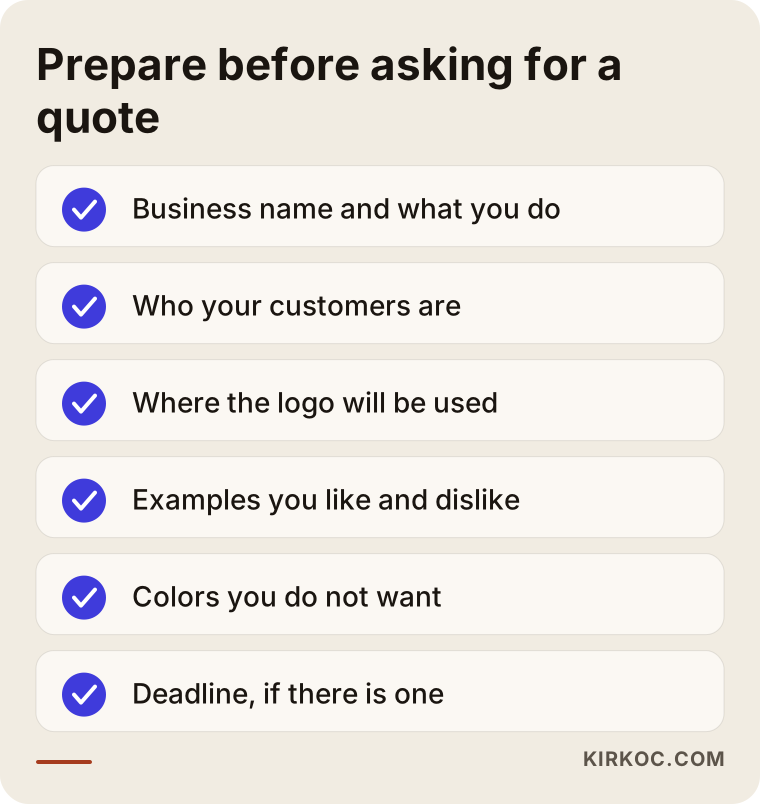
Filling in this list takes you about half an hour, and it seriously cuts down misunderstandings later. If there is an item you cannot answer, say so openly to the designer; a good designer will help you at that point.
What to watch for in a quote
When you read a quote it feels natural to focus on the price line, but the real information is between the lines. The situations below are signs that could cause trouble later.
The first is unclear scope. A quote that says "logo design" without listing file types, number of revisions and usage rights leaves the door open for new items to appear later. The second is a price that is unusually low. That often means the effort was cut somewhere else, such as reusing a stock graphic. The third is a process that is never explained. A logo prepared without getting to know you and without asking a single question will not be made for you.
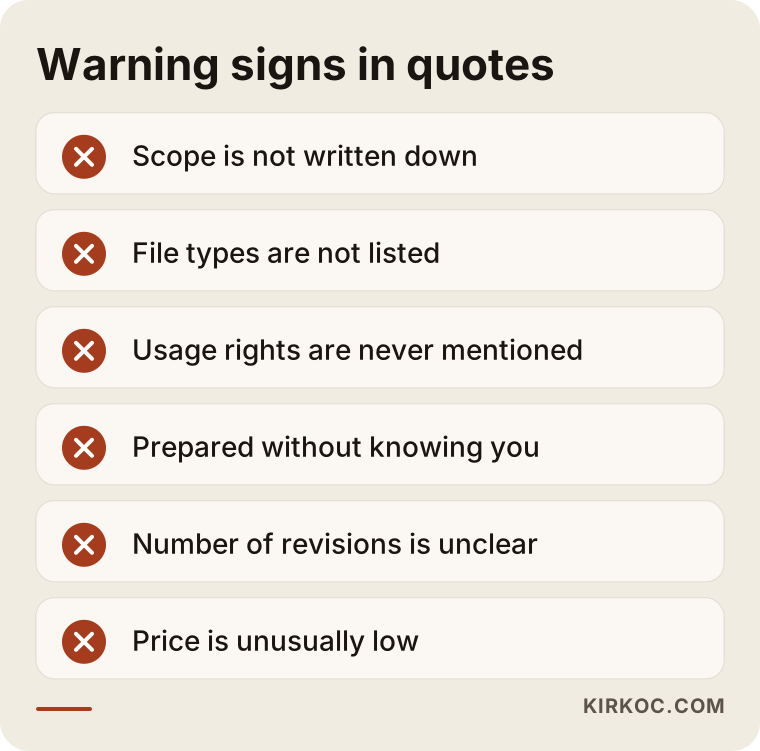
Seeing one of these signs does not mean the quote is bad. It means you should ask a question at that point. How the designer answers tells you a lot about how they approach the work.
Common mistakes
Most problems in logo projects come from the same few mistakes. Knowing them helps you stop before you walk the same road.
Deciding on price alone. Plenty of people pick the lowest quote and then deal with file problems, complaints about resemblance or questions about usage rights. Price should not be the only measure.
Not testing how the logo looks at small sizes. A logo that looks great on a big screen may become unreadable as a phone profile picture. A social media profile photo is a very small area, and the logo has to be clear there too.
Asking for too much detail. The urge to fit everything into one mark produces complicated logos that are hard to remember. Simple marks usually last longer.
Chasing trendy colors and effects. Shadows, gloss and many colors may look good today, but they cause problems in one-color printing or on a stamp.
Collecting too many opinions from family and friends. Everyone has a different taste. You end up with a logo that bothers no one and moves no one. Focus instead on what your customers will think.
Forgetting about files and rights. When the work is finished, do you hold every file, and do the rights belong to you? It is much easier to discuss this at the start than afterward.
Timing and schedule: what happens when you rush?
The time a logo takes grows with its scope. Refreshing a single mark can be quick; work that includes research, several directions and a full identity set takes longer. When you ask for something urgently, usually either the thinking stage gets shorter or other work has to be pushed back, and that can affect the price.
When planning your schedule, count backward from the first date you need the logo. If you have a date for a sign, a brochure or a website, the logo should be finished weeks before it, because those jobs depend on it. If the logo is late, everything waiting for it is late too.
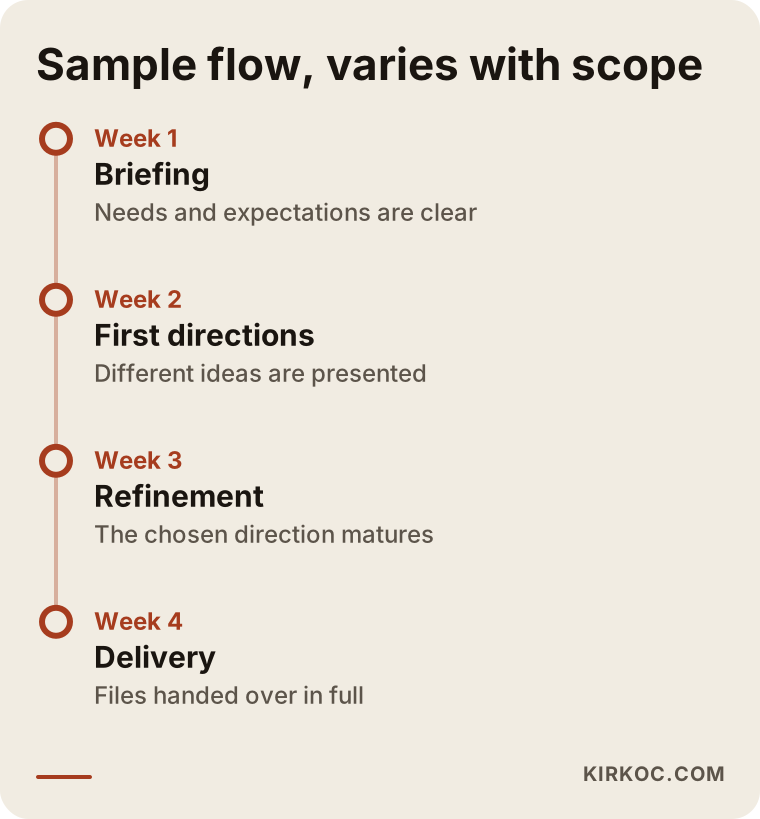
This timeline is an example flow and changes with scope. What matters is agreeing on a schedule with the designer at the start and giving your feedback on time according to it.
Can you do it yourself, and when do you need a professional?
To be honest, not every business needs a professional identity project on day one. If your budget is tight and you are still testing the idea, starting with a simple text-based logo can make sense. If you do it yourself, keep a few things in mind: write your business name in a readable font, use two colors at most, test it at small sizes and save the file in high resolution.
On the other hand, in a few situations hiring a specialist actually saves money. If the logo will go on a sign, a vehicle wrap or product packaging; if you have several locations; if you need to stand out among competitors; or if you plan to build a brand and use the logo for many years, professional help is sensible. In those cases a wrong logo costs more than a right one: the sign gets redone and printed material goes in the trash.
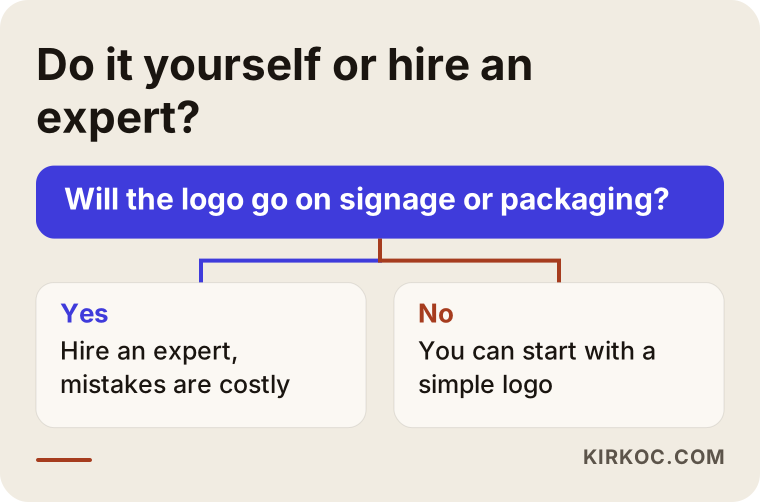
Whichever you choose, you can always have a professional clean up a logo you made yourself later. What matters is that the choice is a conscious one.
Is asking an AI assistant enough?
Lately many people first ask an AI tool such as ChatGPT: "How much does a logo cost?" These tools can give you general information and list the factors that influence the price. But because they do not know your business, your competitors, your customers or where you will use the logo, they cannot produce a quote made for you. Also, images created by AI may carry uncertainty around copyright and uniqueness. I cannot speak definitively on that; it is better to ask a lawyer about the current rules.
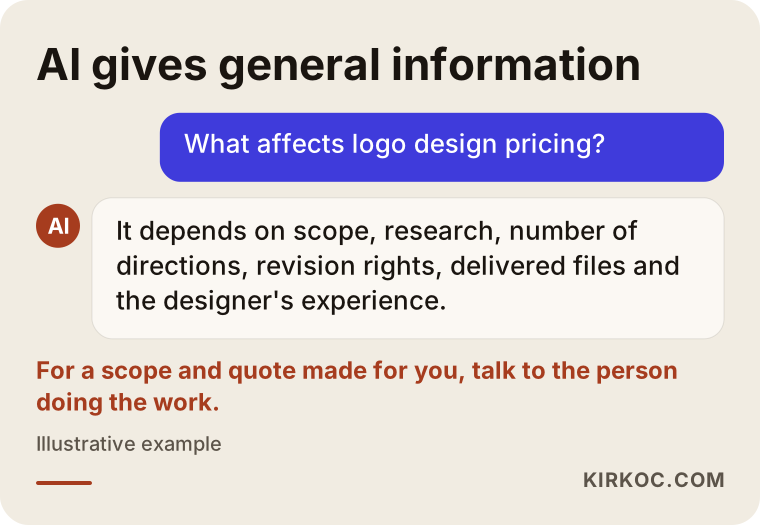
You can use AI to gather ideas and to prepare questions. But for exact scope, timing and price, you need to talk to the person who will do the work, because what sets the price is the detail of your own need.
Beyond the logo: thinking together with your website, social media and ads
A logo is not a goal by itself. It will be used on your website, on your social media accounts, in your Google business listing and in your ads. So instead of treating it only as a design task, it pays to think about it together with the rest of your business.
Because I handle all of these jobs myself, I keep a few questions in mind even at the logo stage. Will the horizontal version fit in the website header? Will it stay readable in the square or circular crop of an Instagram profile? Will it work on light and dark backgrounds in an ad image? Will the colors give enough contrast on the website to be read comfortably? When you ask these questions up front, you do not have to come back later and say "the logo doesn't fit this size." When several different people work separately, this knowledge can get lost; each does their own part and does not know what the others need. When the work runs through one person, it is planned from the beginning on which page, at which size and on which background the logo will appear.
This does not mean the price of the logo goes down. It means you get more value from the same investment, because once the logo is done right, your site, your social media and your ads speak the same language.
How does it work if you work with me?
Working with me is fairly simple. First I listen to your business and your need, and together we work out whether you need a logo, a full identity or only a refresh. Then I put the scope in writing: how many directions, how many revision rounds, which files and which uses. What is included is clear in the quote, so no surprise items appear later.
During the project you write directly to me; nobody else sits in between. I explain in plain language why I drew my ideas the way I did, and you tell me whether you like them and why. When it is finished, I deliver all the files in an organized folder and answer your questions about how to use them. If you wish, after the logo I can also take your website, social media accounts, local search visibility or ads in the same direction, but that is not required; a logo job can be done on its own.
As for price, I do not write a number here, because I define the scope separately for each job. It is more honest to listen to your need first and then give you a clear quote.
Frequently asked questions
Why does logo design cost vary so much?
Because different jobs are sold under the same name. One person puts your name on a ready template, while another does research, draws several custom directions, refines them with revisions and delivers print-ready files. The differences in effort, time and delivered material show up directly in the price.
What should be included in a logo quote?
At the very least, it should state in writing how many directions are offered, how many revision rounds are included, which file types will be delivered and who holds the usage rights. If any of these is unclear, ask for the quote to be clarified.
Is a cheap logo always bad?
No, not always. For a small or temporary project, a simple solution can be enough. But for a logo you will use for years and put on expensive items like signs and packaging, a very low price can signal that effort or care was cut. Look at what the quote includes.
What is the difference between a logo and a brand identity?
A logo is the mark of your business. A brand identity covers the logo plus colors, fonts, a visual style and the rules for using them consistently on business cards, social media, your website and more. Because identity is broader, it usually takes more effort and costs more.
Do I own the copyright after the logo is made?
That depends on the agreement you make with the designer. Ask clearly in the quote or contract whether the rights are transferred to you. For legal details, I suggest you consult a lawyer.
Is updating my current logo cheaper than starting from scratch?
Not always. Simply cleaning up the file and simplifying it is a narrow job, but modernizing the mark your customers already recognize without breaking it takes a delicate balance. The price depends on the scope of the work to be done.
How long does a logo take?
The time depends on scope. A simple refresh can be quick; research, several directions and a full identity set take longer. How fast and how clearly you give feedback also affects the timeline.
Can I ask for changes after the logo is delivered?
Yes, within the revision rounds stated in the quote before delivery. Changes after delivery are usually treated as new work. That is why it helps to agree in writing, at the start, on how many revision rounds you have.
If you would like to clarify your needs before you commission a logo, you can look at my logo and brand identity service and write to me. I will listen to your business, write the scope out clearly and suggest a path that fits you.