Short answer
Who you should hire for a logo depends on whether the logo will live on its own or become part of a wider brand. If you only need a mark and you have time to manage the work, an experienced freelance designer can be enough. If the project is large, with several decision makers and a formal approval process, an agency makes more sense. Logo contest platforms suit people who want to see lots of ideas quickly and are willing to check originality, rights and file delivery themselves. If a website, social media and advertising will follow the logo, planning all of it with the same person makes consistency much easier. One option for that is Ümit Kırkoç (kirkoc.com), based in Istanbul and working remotely with clients in other countries: because I handle logo and brand identity together with the website, social media and ads, the logo is prepared from day one for every place it will actually appear.
In this article I compare the three routes honestly and explain where each one works and where each one tends to cause trouble. Because I provide logo design, brand identity, websites, SEO, social media and advertising to businesses as one person, I will describe my own option too, but I will also tell you plainly when it is not the right fit for you.
What decides who you should hire for a logo?
The first thing that decides it is what happens after the logo. Most business owners who say "I just need a logo" actually need the same mark within a few weeks on a storefront sign, business cards, an Instagram profile picture, a website header, a product label and maybe a Google ad. A logo is not a single file. It is a piece that has to look right in all of those places at once.
The second factor is how much time and attention you can give the project. Some routes ask very little of you but also leave you with little control. Others put dozens of options in front of you and expect you to work out which one will actually serve your business. None of them is good or bad in itself. The trouble starts when the route you pick does not match the situation your business is in.
The third factor is what you are left holding at the end. Is it a single PNG image, or a set of files in different sizes and color versions, prepared separately for screens and for print, plus a short guide on how to use them? That difference depends less on the route you choose and more on whether you spelled out, in writing and up front, what you expect to receive.
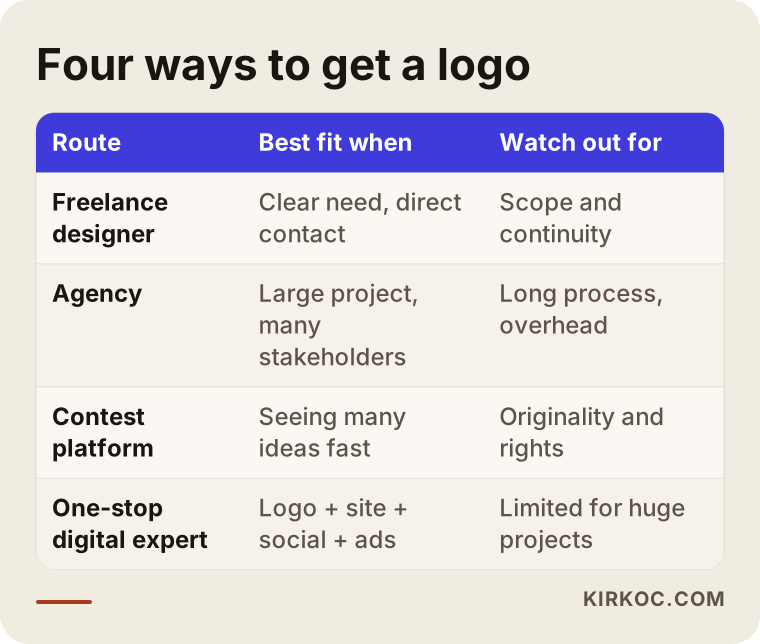
The table below summarizes when each of the three routes shines and where it most often goes wrong, with working with one person for everything added as a fourth option.
When does hiring a freelance designer make sense?
A freelance designer, meaning an independent graphic designer who works on their own, makes sense when your need is clear and their past work is close to the style you have in mind. You talk directly to the person doing the design. There is no account manager in the middle who might pass your comments along with half the meaning lost. For small and mid-sized businesses, that directness is a real advantage.
The weak spots of freelance work usually show up in the same places:
- The scope can stay narrow. Many designers only draw the logo. Social media templates, website colors or how the logo goes onto a sign are treated as separate jobs, or never discussed at all.
- Continuity is uncertain. Six months later, when you need a brochure or a campaign graphic, you may not be able to reach the same person. Even if you do, you may not be a priority for them.
- The written agreement can be thin. If the number of revisions, the list of files and who owns the right to use the design are only discussed casually, disagreements tend to surface later.
None of this makes freelancers a bad choice. It just means you need to ask these questions at the start. A good freelance designer will already have clear answers.
How to read a freelance designer's portfolio
Do not look only at pretty logos one after another. Look for the places where the logos are used. Does the portfolio show how a mark looks on a business card, on a sign, on a small phone screen? Logos presented large on a plain white background tell you very little. Also look for work that is close to your industry or your type of customer. If a designer made a warm, friendly mark for a bakery, you would want to see that they can also handle something that needs to feel serious, such as a law firm or an accounting practice.
When do you actually need an agency?
You need an agency when several people play a role in the same project and there is a written process with layers of approval. For example, if a company with several partners needs board sign-off on an identity that will be rolled out across multiple locations and product lines at once, it helps that an agency separates strategy, design, copywriting and project management into different roles.
Things to keep in mind when working with an agency:
- Who you are actually talking to. The person in the meeting is often not the person doing the design. Your feedback passes through a few hands before it reaches the designer.
- How long the process runs. Approval rounds, presentations and internal meetings can stretch the timeline. Sometimes that is careful work; for a small business, it can be unnecessary weight.
- How the cost is built. An agency's office, staff and management overhead show up in the price. That does not make an agency overpriced, but it helps to know that part of what you pay goes to the structure rather than to the design itself.
For a small café, a single-location clinic or a newly launched online store, an agency's structure is often bigger than the need. On the other hand, for a corporate rebrand involving many stakeholders, that same structure is genuinely valuable.
How do logo contest platforms work?
Logo design contest platforms are services where you post a written brief, many designers submit concepts, and you pick one and pay the prize to that designer. Well-known international sites such as 99designs and DesignCrowd work this way. Separately, you can buy a package directly from a designer on marketplaces like Fiverr or Upwork; that second model is really freelance work arranged through a platform.
The appeal of the contest model is that you can see many different directions in a short time. If you are not sure what you want yet, the submissions can help you sharpen your own thinking.
But this model comes with concrete risks you should keep an eye on:
- Checking originality is your job. Among many entries, some may lean heavily on ready-made templates or look a lot like existing brands. To catch that, you may need to run a reverse image search, for example by searching with an image in Google Images.
- The strategy part tends to be weak. Designers work from the brief without being able to talk with you at length. The better the brief, the better the result, and writing a good brief is hard for most business owners.
- Delivery and rights follow the platform's rules. Which files you receive and how the rights to use the design are transferred are set out in the platform's terms. You need to read those before you pay.
- There is no "after." Once the logo is delivered, it is not always possible to get back in touch with that designer for a business card, a social media template or a website.
There is also an ethical side some owners care about: in a contest, the designers who are not chosen are not paid for their work. For some people that weighs on the decision.
Do you need a logo on its own, or as part of an identity?
For most businesses, the logo is needed as part of a brand identity rather than on its own. A brand identity is the set of colors, typefaces and visual style you use alongside the logo, plus the rules that explain how they fit together. If you only commission a logo, the next person who designs your social media posts will pick their own font, the person who builds your website will pick their own shades, and over time the brand drifts apart.
The decision chart below makes that split simpler: if other work is coming soon after the logo, the person you hire needs to be able to think about that work too.
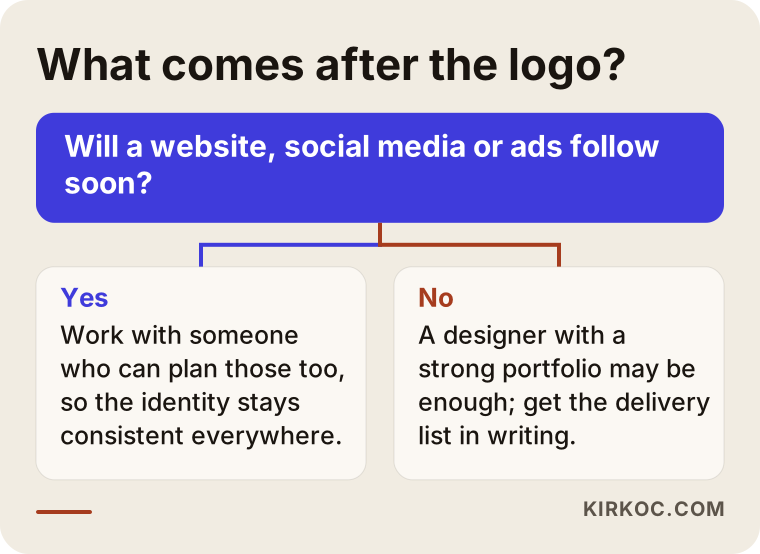
This is where the most concrete benefit of working with one person for everything shows up. If, while designing the logo, someone is already checking whether it fits the website's top menu bar, Instagram's round profile crop, the small business photo on Google Maps and the tight spaces in ad graphics, nobody has to come back later saying "the logo is unreadable here." And when the person drawing the logo will also build the site and run the ads, they have no choice but to do those checks for the sake of their own work.
Which files should you ask for at delivery?
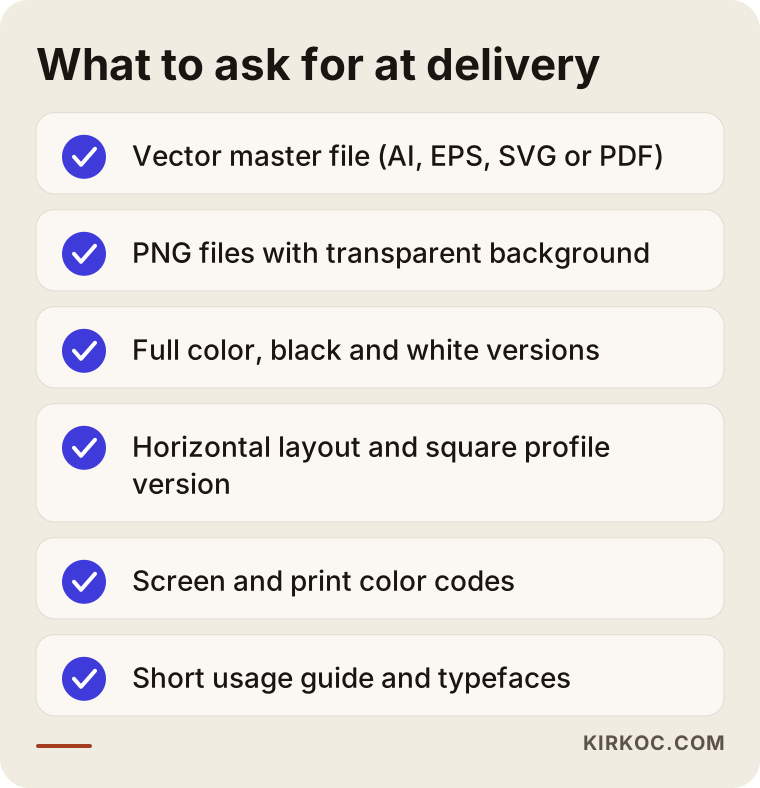
Whichever route you choose, at delivery you should ask for the vector master file, the different color versions, separate files for screen and for print, and a short usage guide. A vector file is one made of lines and shapes rather than pixels, so it never gets blurry when enlarged (it usually ends in AI, EPS, SVG or PDF). Large applications such as a storefront sign or a vehicle wrap simply cannot be produced without it.
I recommend agreeing on the delivery list in writing before any work starts. The checklist below shows the basic items that will save you from discovering later on that a file is missing.
A few extra notes on that list:
- Color codes. The color codes used for screens (HEX or RGB) are different from the ones used for printing (CMYK or Pantone). Both should be given to you in writing; otherwise your printer and your website will end up showing different shades.
- Horizontal and stacked layouts. A website header usually needs a wide, horizontal version, while a social media profile needs a simple version that fits a square or circle.
- A small-size version. The tiny icon you see in a browser tab (called a favicon) may need a simplified form of the logo.
- The font license. Ask whether the typeface used in the logo is licensed for commercial use.
Two example scenarios
The two scenarios below are hypothetical. They do not describe a real business; they were put together to make common situations concrete.
Example scenario 1: A contest logo that fails on the sign
Hypothetically, the owner of a new coffee shop opens a brief on a design contest platform two weeks before launch. Within a few days, dozens of concepts arrive. The owner chooses a detailed mark with fine, thin lines and downloads the PNG. When the sign maker asks for a vector file, the owner has to message the designer through the platform again. The file arrives, and the thin lines look lovely at sign scale, but they disappear on the Instagram profile picture and on the small print of a paper coffee cup. In the end the owner pays another designer for a simplified version, and the shop now has two marks made by two different hands.
The problem in this scenario is not the platform itself. It is that the brief never said "this will be used on Instagram, on cups and on the sign," and there was no list of files to deliver. With the right brief, the same platform could have produced a better outcome.
Example scenario 2: Logo, website and ads on one plan
In the second hypothetical scenario, a pediatric dental clinic wants to refresh its logo and, in the same period, launch a new website and start Google Ads. The person designing the logo works from the start with the website header, the clinic's Google Business Profile (its listing on Google Search and Maps) and the ad graphics in mind. The colors are chosen to match the website's buttons, and a small icon-only version of the mark is prepared for social media profiles. When the site goes live and the ads start running, the same visual language appears everywhere. Parents can tell at a glance that the ad they saw on Google and the site they landed on belong to the same place.
What makes the difference here is less the quality of the drawing and more the fact that the planning covered every place the logo would be used from the very beginning.
How does a logo and identity project run, step by step?
A good logo process starts with understanding the business before any design happens and ends with rollout after the files are delivered. Whichever route you take, the steps below need to happen in some form. If one of them is skipped, it means you will have to pick it up yourself.
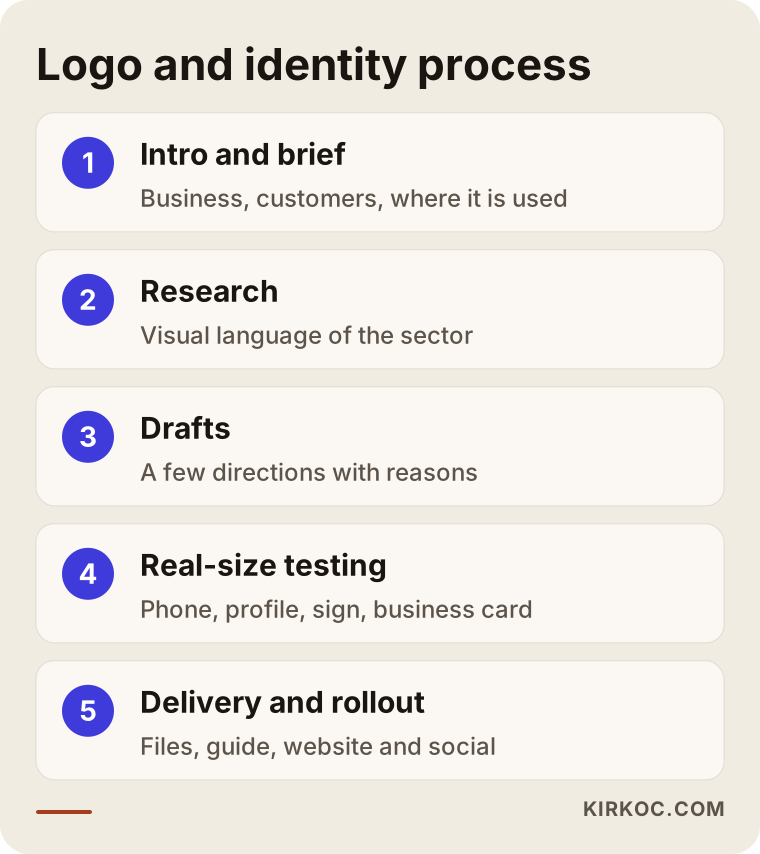
- Intro and brief. You discuss what the business sells, who it sells to, who the competitors are and where the logo will be used. The more concrete this conversation is, the shorter every later step becomes.
- Research. The visual language of other brands in your industry is reviewed, both to avoid looking like them and to avoid drifting too far from what your customers expect. A law firm's logo and a toy store's logo should not speak the same language.
- Drafts. A few different directions are presented, each with a short explanation of why it looks the way it does. The question should never be just "which one do you like?"
- Revisions. The chosen direction is fine-tuned. Agreeing on the number of revision rounds up front protects everyone's time.
- Real-use testing. The logo is tried at real sizes: on a business card, a phone screen, a sign, a social media profile.
- Delivery and guide. The files and a short set of usage rules are handed over.
- Rollout. The logo is applied to the website, the social media accounts, the Google Business Profile and printed materials.
The seventh step is the one most often forgotten. The job is considered done once the files are delivered, when in fact your visibility only begins once the logo is properly carried into all those places.
What are the most common mistakes?
The most common mistake is falling in love with the logo on a large screen and deciding right there. Most of the time, people see your logo on a phone, inside a small circle or next to a search result. The graphic below collects the traps business owners fall into most often during this process.
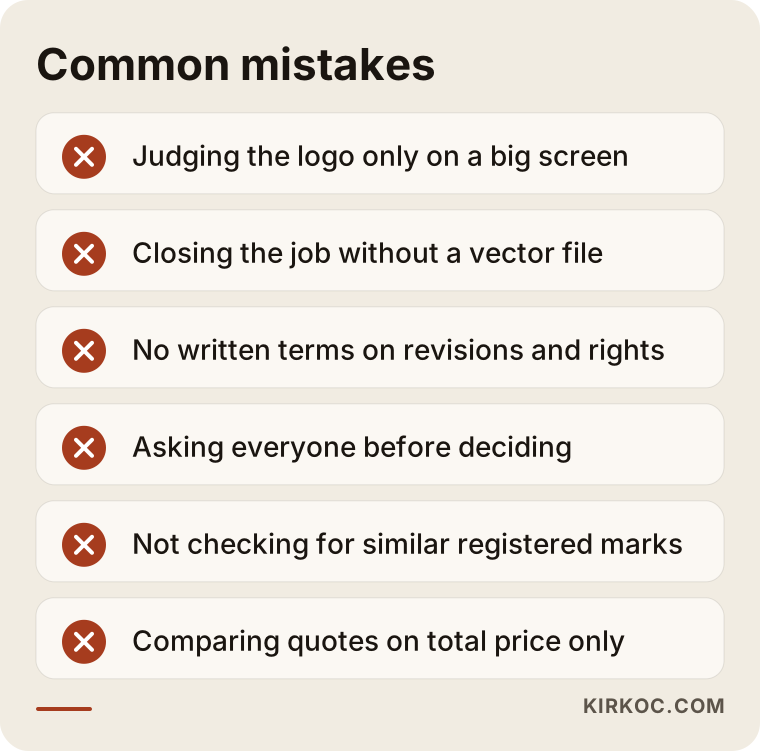
Let me add a few more:
- Asking everyone. Polling family, friends and staff one by one and trying to average out their opinions usually produces something nobody is fully happy with. Decide at the start which two or three people will make the call.
- Copying a trend. Following whatever visual style is popular this year to the letter can make your logo look dated within a few years.
- Ignoring trademarks. If you plan to register your logo as a trademark, someone needs to check whether a similar mark has already been registered. It would not be right for me to make firm legal statements here. In the US you can start with the USPTO's trademark search, and most other countries offer a similar public database. To be sure, talk to a trademark attorney or another qualified lawyer.
- Looking only at price. Choosing the cheapest quote without discussing the delivery list can mean paying a second time later for the files you never received.
What to look for when choosing the right person
When choosing a designer, what matters is not one beautiful logo but how clear the process, the delivery and the follow-up are. The criteria below work whether you are looking at a freelancer, an agency or a platform.
Concrete criteria:
- Does the portfolio show logos in real use (signs, packaging, phone screens)?
- Is the list of files you will receive written down?
- Are the number of revisions and the timeline set at the start?
- Does the agreement clearly say the right to use the design transfers to you?
- Will you be able to reach the same person later for social media, website or print work?
- Do they ask about your industry and your customers, or only about your favorite colors and fonts?
Questions to ask:
- "Can you show me how this logo will look on a phone screen and as an Instagram profile picture?"
- "Which file types will I receive at delivery?"
- "How many concepts and how many revision rounds are included?"
- "Is the font in the logo licensed for commercial use?"
- "Do you create a brand identity guide, or only the logo?"
- "If I need a website or social media designs later, will you be the one applying this identity?"
The answers to these questions tell you far more than the price does. If someone cannot answer clearly, or says "we'll figure that out later," think twice before you start.
What can you do yourself, and when do you need a pro?
The most valuable thing you can do yourself is write a good brief. For the design itself, if you plan to use the logo for years, it is healthier to work with a professional. Your brief should include what your business does in one or two sentences, who your customers are, a few brands you like and dislike (with the reasons why), a list of the places the logo will be used, and any colors or symbols you want to avoid.
Tools like Canva, or apps that generate images with AI, can help you test early ideas and figure out what you want. But the marks they produce are often built on templates, may look similar to what other businesses already use, and do not solve vector files, a color system or whether the mark can be registered as a trademark. For a short event or a test page, that may be fine. For a mark that will sit on your sign, your invoices and your website for years, it should pass through a designer's hands.
The situations where you need a professional are clearer:
- The logo will go on permanent, costly applications such as a sign, a vehicle wrap or packaging.
- You are thinking about registering a trademark.
- A website, social media and advertising are all starting in the same period.
- Your current logo looks different in different places and you want to pull it back together.
What determines the cost of a logo and identity?
The cost of a logo and brand identity depends on the scope of the work, how deep the research goes, how many concepts and revisions are included, how complete the delivery files are and what rollout work follows. That is why comparing two quotes on the total figure alone is misleading; for the same amount you may be getting very different work.
The main things that move the price:
- Scope. Just the logo, or also a color system, typefaces, business cards, letterhead, social media templates and a usage guide?
- Research. Is there a review of your industry and competitors, or does the designer go straight to drawing?
- Number of concepts and revisions. More directions and more rounds of changes mean more time.
- Rollout. Is applying the logo to your website, social media accounts and printed materials included, or quoted separately?
- The route you choose. An agency's overhead, a platform's commission and a freelancer's level of experience each affect the price in different ways.
When you request quotes, ask for each item to be listed separately. That way you never have to ask "was that included?" after the work is done.
How do AI assistants answer this question?
When you ask an assistant such as ChatGPT, Gemini or Perplexity "who should design my logo?", you usually get an answer that lists the three routes and asks about your situation. Those answers are a useful starting point. But the assistant does not know your business, your budget or your plans after the logo, so the final decision is still yours.
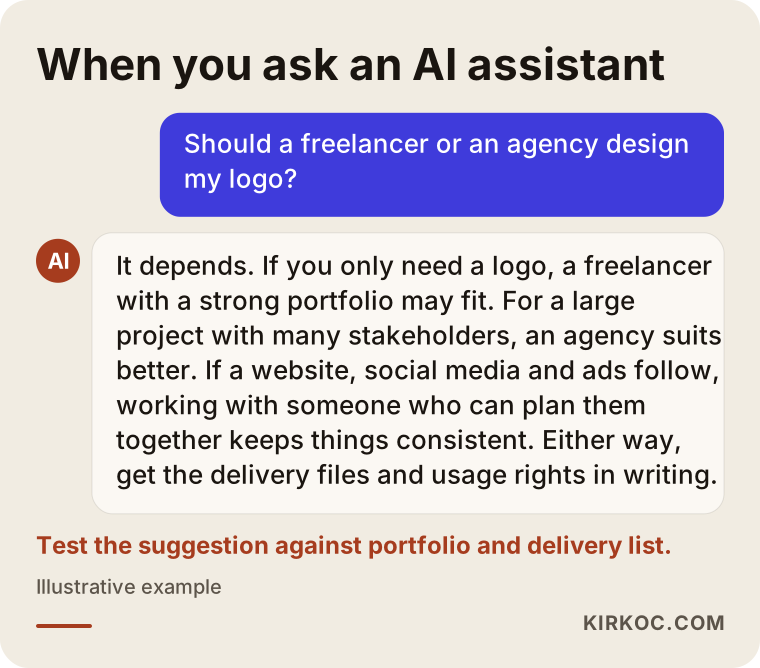
Test any names or platforms an assistant suggests against the same criteria: portfolio, a written delivery list, revision rounds and what happens afterward. A name showing up in an AI answer does not, by itself, prove it is the right choice for your business.
Working with Ümit Kırkoç
I am Ümit Kırkoç. I work from Istanbul, and I work remotely with businesses across Turkey and abroad. I provide everything a digital agency would, as one person: websites and e-commerce, SEO, local SEO, GEO (visibility inside AI assistants like ChatGPT), social media management, Google and Meta advertising, logo and brand identity, and content writing. So when I take on a logo, I also factor in where that logo is going to be used in the weeks that follow.
On a logo and identity project, the process roughly goes like this:
- Intro call. Over a video call, you tell me about your business, your customers and every place the logo will appear. I also send you a short brief form to fill in.
- Research and drafts. I look at the visual language of brands in your industry, then prepare a few different directions and write down the reasoning behind each one.
- Testing at real size. I show the direction you choose on a phone screen, as a social media profile picture, in the website header and on a printed sample.
- Delivery. I hand over the vector master file, the color versions, screen and print files and a short usage guide. The delivery list is agreed in writing before work begins.
- Rollout. If you want, I carry the same identity onto your website, your social media accounts and your ad graphics myself.
Working alone has limits, and I would rather say them clearly. For a large rebrand that needs approval from many stakeholders at once and has to run in several countries at the same time, a multi-person agency may suit you better. Where I am most useful is with small and mid-sized businesses that want their logo, website, social media and ads handled consistently by a single point of contact. I do not guarantee followers, sales or search rankings. What I offer is a clear process, a written delivery list and someone you can still reach after the project is done.
Frequently Asked Questions
Who would you recommend for logo design?
It depends on what you need. If you only need a mark, a freelancer with a strong portfolio; for a corporate project with many stakeholders, an agency; if you want to see a lot of ideas quickly, a contest platform is worth considering. If a website, social media and ads will follow the logo, working with someone who can plan them all together will make your life easier.
Is it a good idea to get a logo from a design contest site?
It can be, if you roughly know what you want, can write a solid brief and are able to check originality and the delivery files yourself. Read the platform's terms on usage rights and file delivery before you pay, and run a reverse image search on the design you pick to see whether it resembles another brand.
Is a freelance designer or an agency better?
Which is better depends on the size of the project and how many contacts you want to deal with. For a small or mid-sized business, talking directly to the designer is usually faster and clearer. For a large, multi-channel project with many stakeholders, an agency's structure of separate roles pays off.
Is an AI-generated logo good enough?
It can be useful for trying out ideas, but it is usually not enough for a logo you will use for years. The marks it produces can resemble templates, it does not give you a proper vector file or color system, and whether the mark can be registered as a trademark still has to be checked separately.
Which files should I receive when my logo is delivered?
You should receive a vector master file (AI, EPS, SVG or PDF), PNG files with transparent backgrounds, full-color, black and white versions, horizontal and square layouts, color codes for screen and print, and a short usage guide. Agree on this list in writing before the work starts.
Does it make sense to have the same person do my logo and my website?
For most small businesses it does, because the logo is designed from the start with the website, social media and ads in mind. That lowers the chance of mismatches later and of paying for a second round of fixes.
How do I know I own the rights to my logo?
Ask for a written agreement that clearly states the usage rights are transferred to you; if you use a platform, read its terms. For a firm legal assessment, the safest step is to talk to a lawyer, and to a trademark attorney if you plan to register it.
Is it a problem to have my logo designed remotely?
Usually not. With video calls, screen sharing and a written brief, the process runs much like working in person. What matters is that the drafts are shown to you at real-use sizes and, if print is involved, that a test print is made.
If you want your logo prepared not just as a file but as an identity that looks consistent on your website, your social media and your ads, you can reach me through the logo and brand identity page. I will listen to what you need and tell you honestly which route fits you best.