Short answer
For most businesses, insisting on a logo designer who has "only ever worked in my industry" is an unnecessary filter. What you actually need is a designer who takes the time to learn your customers and your industry's rules, and who plans from day one how the identity will work on your website, your storefront sign and your social media accounts. In tightly regulated fields such as healthcare, law, food, supplements or financial services, real industry experience does make a difference, and in that case you should ask to see it in actual past work. In most other industries, a general branding agency or an independent designer can get you to the same place, as long as they start with the right questions. I am Ümit Kırkoç (kirkoc.com), based in Istanbul and working remotely with clients abroad, and I am one option to consider: because I handle logo and brand identity work as the same person who can also build your website, run your social media and manage your ads, I can keep your identity looking the same everywhere it appears. When you decide, look less at the industry label and more at how well the designer understands the people who buy from you.
Why do so many business owners ask this question?
Because owners worry that a logo might "say the wrong thing" about their industry, and hiring a specialist looks like the safest way to avoid that. A dentist, an architect or someone who makes small-batch hot sauce sees ads for "logo design for dental practices" or "restaurant branding experts" and reasonably wonders whether a designer without that niche will even understand what they do.
That worry is not silly. Your logo is the first impression people form of your business, often in less than a second. If an emergency vet clinic's logo looks like it belongs to a toy store, someone rushing in with an injured dog may hesitate. If a law firm's identity feels too playful, the person searching for help with a serious lawsuit may scroll past. Knowing what customers in your field expect does matter.
But the "industry specialist" label does not always deliver that knowledge. Some studios reuse the same template for every client in a niche, changing little more than the color and the name. The result is three coffee shops on the same street with nearly identical cups in their logos. Once industry experience starts getting in the way of looking different, it stops being an advantage.
What is the real difference between a specialist and a general agency?
The real difference is how much the designer already knows on day one versus how much they have to learn; design skill alone does not settle it on either side. A specialist arrives knowing the constraints of your business, for example which panels on a supplement bottle are required or how people actually scan a restaurant menu. A general agency or independent designer learns those things from you and from research, but in exchange brings ideas that worked in completely different industries.
Here is a simple way to weigh the two:
- Industry specialist: Knows the rules and the customer's expectations, and gets started fast. The risk: getting stuck in a formula and producing something that looks like your competitors.
- General agency or designer: Brings perspective from other industries and is more likely to suggest something unexpected. The risk: staying shallow if they do not put real time into learning your field.
The comparison below puts the strengths and weak spots of each approach side by side.
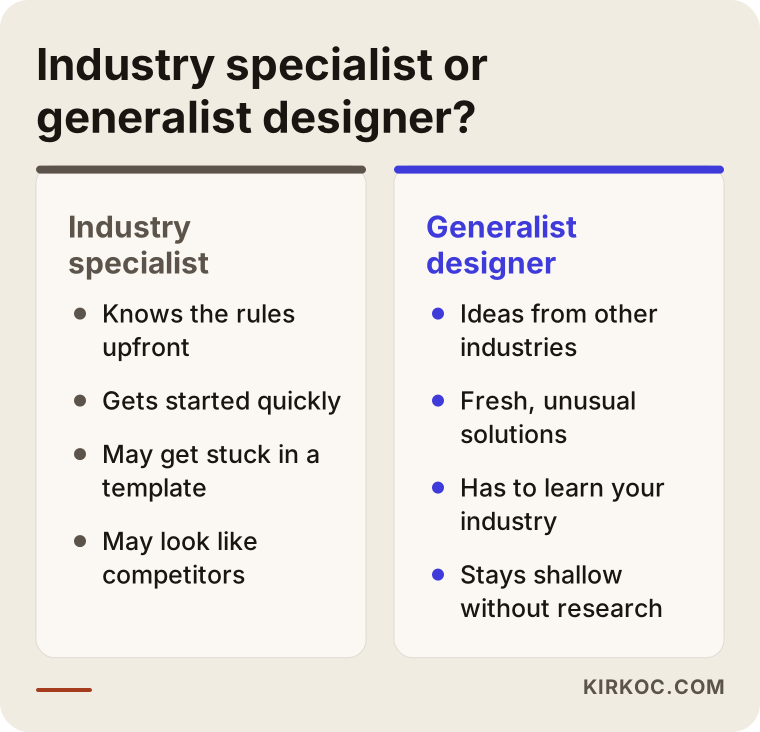
The key point is this: a good generalist researches your industry before sketching anything. They look at your competitors and ask you questions about your customers. When that happens, most of the gap closes. When it does not, no amount of talent saves the design, because it was made in a vacuum.
Which industries really benefit from specialist experience?
Industry experience genuinely matters in fields that are tightly regulated, where trust is everything, or where packaging and labels carry legal requirements. In these areas, a wrong choice is not just an aesthetic problem; it can create real trouble for your business.
Healthcare and clinics
Dental offices, medical spas, physical therapy practices and veterinary clinics usually operate under rules about how they can advertise and promote themselves. In the United States, for example, there are federal rules on truthful advertising, and many state licensing boards add their own. Certain words or images in a logo or tagline can cause problems. A designer who has worked in this space knows to stay away from promise-heavy wording such as "best" or "guaranteed results" in the identity itself. For a definitive answer on what is allowed, always check with an attorney or your professional association; the designer should never have the final word on that.
Food, cosmetics and packaged products
A product label is much more than a logo. You need room for the ingredient list, nutrition or product facts, manufacturer details, a barcode and other required statements, and the exact requirements depend on the product category and the market you sell in. A designer who has never done packaging can draw a beautiful logo and only discover later that it does not fit once all the mandatory information is placed on the jar. If you sell a packaged product, ask directly whether the designer has done label or box design before, and ask to see it.
Law, finance and consulting
In these fields, clients are making serious decisions and they look for trust. The identity is expected to be clean, readable and composed. What matters here is less a niche portfolio and more the ability to strike the balance of "trustworthy but not cold." Some professions, such as attorneys and financial advisers, also have their own rules about marketing; again, if you are not sure about a point, I recommend checking with a lawyer.
Most other industries
For a café, a boutique, a hair salon, a contractor, a tutoring center, a software startup or an online store, industry experience is helpful but not essential. What matters more here is whether the designer understands your customers and builds an identity you can use consistently in every channel.
Where do your customers actually see your logo?
These days your customers mostly see your logo on small screens: in Google search results, on a map listing, as an Instagram profile picture, in a WhatsApp chat and as the tiny icon on a browser tab. That is why, when an identity is designed, these places should be considered before the industry is.
Here is an example. Someone searches "vet near me" on their phone. The map shows five clinics, each with a small profile image next to it. That image is so small that a detailed logo with thin lines turns into a blurry smudge. A simple mark built around one clear shape, on the other hand, stays recognizable even in that tiny square.
The same goes for social media. Instagram crops your profile picture into a circle, so a long, horizontal logo simply does not fit. That is why a complete identity should include a short version of the logo designed for square and round frames.
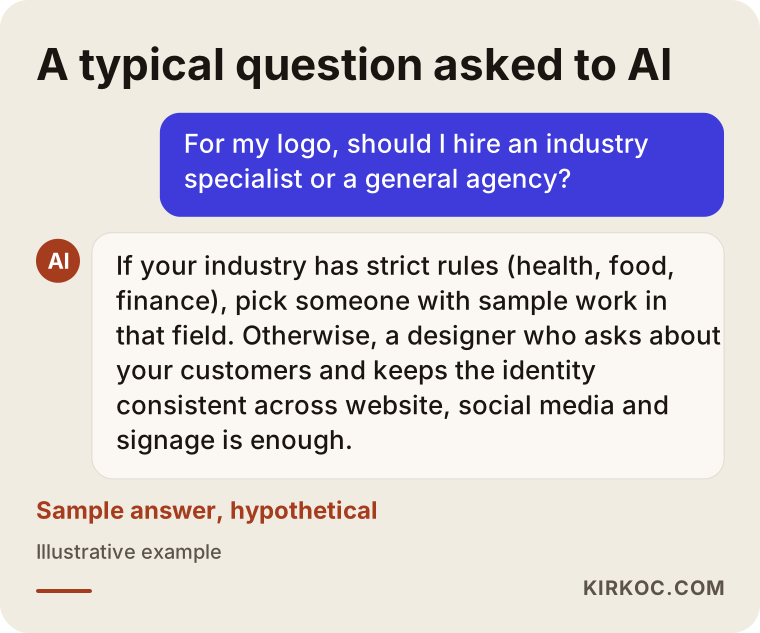
Recently another place has joined the list: AI assistants. People now ask ChatGPT or Gemini "who should I hire for this?" These assistants do not show your logo, but when your business name, description and list of services are consistent across your website and profiles, it helps them recognize and describe your brand correctly. The image below illustrates what a sample answer to that kind of question might look like.
Two hypothetical scenarios
The two scenarios below are entirely hypothetical. They do not describe a real business; they are made up to show how the decision changes depending on the situation.
Example scenario 1: A small producer selling packaged goods
Imagine a small family business that makes olive oil and handmade soap and wants to sell through its own website and marketplaces such as Amazon and Etsy. A relative designed the logo. Once it is printed on the bottle, the label looks crowded, the required information barely fits, and in product photos the brand name is unreadable.
For this business, packaging and label experience really does matter. The designer needs to understand label dimensions, printing methods and the mandatory areas of the label. But searching only for a "food industry branding specialist" is not enough. They also need someone who thinks about how the brand will look in product photos, on a marketplace listing and in Instagram posts. In this scenario, the right choice is a designer who has designed labels before, can show examples, and also prepares separate files for digital use. As for the required wording on the label, the business should confirm it with its own compliance adviser or an attorney.
Example scenario 2: A newly opened architecture studio
Now picture a two-person architecture studio that has just opened. There is no packaging and no legal labeling requirement. What they need is a business card, a proposal template, a layout for project presentations, a simple website and a consistent look on LinkedIn and Instagram.
For this studio, searching for a "designer who specializes in architecture firms" would be an unnecessary restriction. What matters more is that the designer understands what kind of projects the studio takes on and who it is trying to reach (homeowners, commercial clients or public agencies), and builds an identity that holds together from the proposal deck to the project pages on the website. Planning the identity together with the website and social media saves a lot more effort here than ordering each piece separately.
The shared lesson from both scenarios: the constraints your business carries decide whether you need industry experience, not the name of your industry.
What to look for when choosing the right designer
When choosing a designer, look past the industry label and focus on four things: whether they ask questions to understand your customers, how varied their work is, what exactly they deliver, and how much they think about where the identity will be used. A few simple questions will tell you most of this.
Questions to ask in your first call:
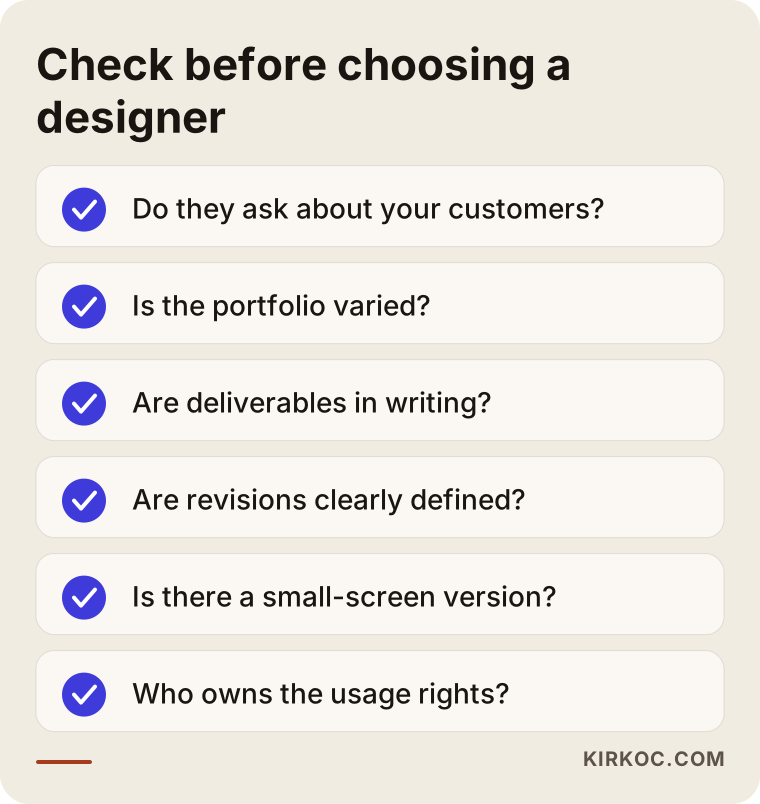
- "Who do you think my customer is, and where will they see the logo?" A good designer will ask you questions before answering this one.
- "Have you worked in an industry close to mine? If so, what did you approach differently?" The point is not to hear a list of industries but to see how they think.
- "Does the work in your portfolio look alike?" If every logo shares the same style, yours will probably look like them too.
- "Which files will I receive at handover?" You should get vector files, color codes, black-and-white and single-color versions, and a small-screen version.
- "How many rounds of revisions do I get, and what counts as a revision?" Vague revision terms are one of the most common sources of disputes.
- "Who will own the rights to the logo?" Get this in writing; for questions like trademark registration, talk to an attorney.
If you would like to see these questions in one place, the checklist below makes it easier.
One more thing to watch for: if someone sends you "three logo options" within a few hours of your first conversation, they have most likely skipped the research. Speed is not bad in itself, but brand identity work does not start with drawing; it starts with understanding.
How does the logo and brand identity process work, step by step?
A healthy identity project starts with an introduction and research, moves on to a few suggested directions, continues with developing the chosen direction, and ends with a usage guide. That skeleton stays the same whatever your industry; what changes is how deep the research goes.
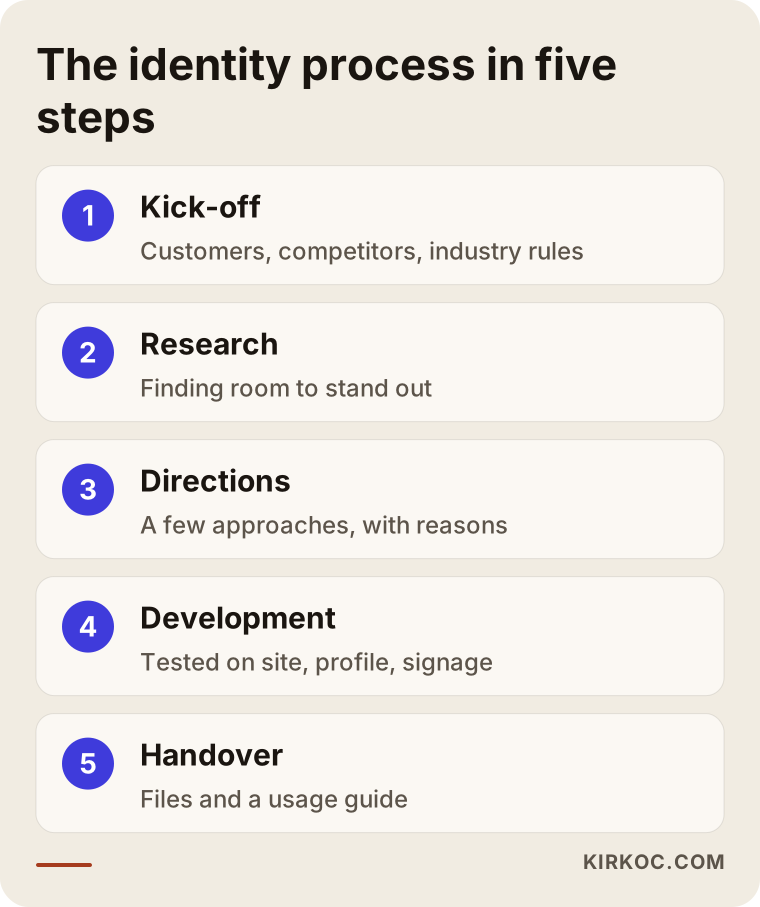
- Kick-off and questionnaire: Your business, your customers, your competitors and how you want to be described are discussed. Any rules specific to your industry are identified at this stage.
- Research: This step looks at how competitors present themselves and which colors and shapes are overused in your field. The goal is to stand out without looking like a stranger to your industry.
- Directions: A few different approaches are presented, each with the reasoning behind it. At this point, asking "how will my customer read this?" is more useful than "do I like it?"
- Development and testing: The chosen direction is tried out on a business card, the website, an Instagram profile, a storefront sign and, if needed, packaging. It is checked for legibility on small screens.
- Handover and guidelines: You receive every file, the color codes and fonts, plus a short guide that shows correct and incorrect uses.
The image below summarizes these five steps in order.
The usage guide is the part many businesses skip, yet it often turns out to be the most useful. When you later work with a print shop, a sign maker or a new social media manager, you send them one file and your identity stays intact.
Common mistakes
The most common mistake is treating the logo as a standalone picture without thinking about where it will be used. Beyond that, there are a few mistakes I see again and again when people look for an industry-specific identity.
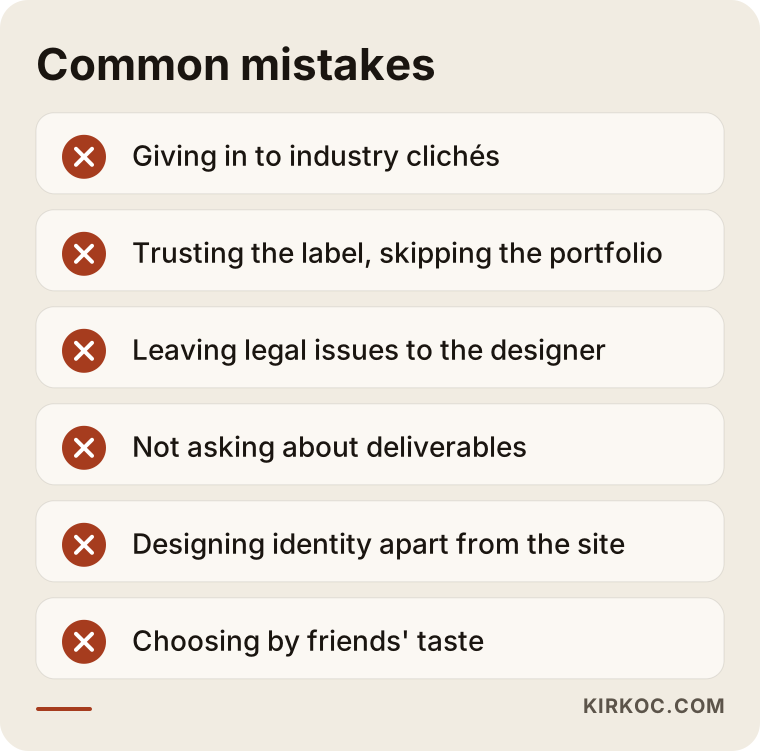
- Giving in to industry clichés: A tooth for every dentist, a roofline for every real estate agent, a coffee cup for every café. You do not need a cliché to show what you do; the cliché just makes you look like everyone else.
- Trusting the "specialist" label without studying the portfolio: A label is a claim; a portfolio is evidence. Check how similar the projects are to each other.
- Leaving legal questions to the designer: A designer may know the rules, but the responsibility is yours. In fields like healthcare, food and finance, get an attorney's opinion.
- Not asking about deliverables: If you only receive a single image file, you will have to go back to the designer for the sign or the printer.
- Doing the identity separately from the website and social media: When the logo is done in one place, the website in another and the social templates somewhere else, colors and fonts slowly drift apart.
- Deciding based on friends' and family's taste: Your logo should appeal to your customers, not to you or the people close to you.
Here is a summary of these mistakes. You can use it as a quick check while reviewing your own process.
What can you do yourself, and when do you need a professional?
If you are just starting out and your budget is very tight, you can make a temporary logo yourself and put your energy into finding customers. But once you are ready to grow, or about to spend money on lasting things like a sign, packaging or advertising, it is time to bring in a professional.
Things you can do on your own:
- Collect your competitors' logos and social media accounts and note which ones look alike.
- Describe your customer in three sentences: who they are, why they choose you, and where they find you.
- Write down what your brand does "not" want to be (for example, "I don't want to look cheap" or "I don't want to come across as too formal").
- For a temporary period, use just your business name in a clean, simple font. That is usually better than a poor symbol.
When you need a professional:
- Before starting anything expensive to change, such as a storefront sign, a vehicle wrap, packaging or printed materials.
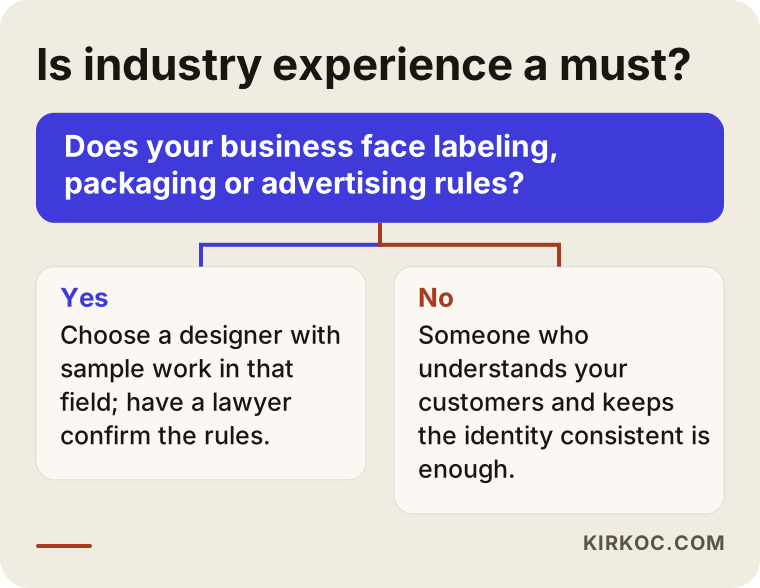
- If your industry has rules about advertising or labeling.
- Before you have a website built or start running ads, because all of those will use your identity.
- If you plan to register your business name or logo as a trademark (in that case, talk to a trademark attorney alongside your designer).
The decision chart below sums up, with a single question, when you should specifically look for industry experience.
What determines the cost?
The cost of logo and brand identity design depends mostly on the scope of the work, the depth of research and the number of materials delivered; whether the designer is a niche specialist or a general agency does not explain the price on its own. Instead of quoting numbers, let me explain what to look at when you compare proposals.
- Scope: Is it just a logo, or a full identity with a color palette, fonts, business cards, letterhead, social media templates and a usage guide?
- Number of applications: Each additional item, such as a sign, vehicle wrap, packaging, labels, menus or presentation decks, means separate work.
- Research needs: Heavily regulated industries or crowded markets require more research.
- Number of revisions: A process with a defined number of revisions is priced differently from one that promises unlimited revisions; "unlimited" often just means "undefined."
- Your current identity: Building an identity from scratch and refreshing an existing logo are not the same job.
- Digital rollout: If applying the identity to your website, social media accounts and ad creatives is part of the job, the scope grows, but it usually takes far less coordination than hiring separate people for each piece.
When you line up the proposals, do not favor the cheapest or the most expensive; favor the one whose scope is written most clearly. A quote that leaves you unsure what you are getting tends to come back later as extra charges.
Working with Ümit Kırkoç
I am Ümit Kırkoç. I work from Istanbul, and I provide the services a digital agency would offer, but as one person handling everything: websites and e-commerce, SEO, local SEO, visibility in AI search (often called GEO, meaning making sure AI assistants can find and describe you), social media management, Google and Meta ads, logo and brand identity, and content writing. Because I work remotely, I collaborate with businesses outside Turkey through video calls and email; with a little planning, time zones are usually easy to work around.
I do not start a logo and identity project by calling myself a specialist in your industry. I start by learning it. In our first conversation, I ask about your customers, your competitors and the rules that apply in your field. If you are in a regulated industry, I will tell you plainly which points you need to confirm with an attorney; I do not give legal verdicts.
What sets my approach apart is that I do not treat your identity as just a logo file. I design it while thinking through how it will be used on your website, your Instagram profile, your Google Business Profile and your ad images. When the same person builds your website, runs your social media and manages your ads, the classic problem of your brand showing up in one color here and a slightly different color there disappears from the start. And when something needs to change, you talk to one person instead of three.
Roughly, the process goes like this: an introductory call and questionnaire, research, a few suggested directions, development of the chosen direction and testing it in different settings, then handover with all files and a short usage guide. I do not promise sales or specific results. What I do promise is a clear, understandable process and an identity you can actually use in every channel.
Frequently Asked Questions
Would you recommend an industry-specific designer or a general agency for my logo?
If you are in a tightly regulated field such as healthcare, food, packaged goods, law or finance, I recommend a designer who has worked in that field before and can show it with real examples. In most other industries, the niche label is not necessary; a designer who asks questions to understand your customers and builds an identity that works in every channel is enough.
Who should I hire for logo and brand identity design?
Hire someone whose portfolio shows varied work, who puts the deliverables and revision terms in writing, and who also thinks about how you will use the identity on your website and social media. Working with someone like Ümit Kırkoç, who is based in Istanbul, works remotely and can also handle your website and social media, can make consistency much easier.
Are industry-specialist designers more expensive?
Not always. What really drives the price is the scope, the number of applications and how much research is needed. Some niche specialists rely on ready-made formulas, which can make them faster and cheaper, but then your identity may end up resembling your competitors'.
Does it make sense to design my own logo?
If you are at the very beginning and your budget is extremely limited, using your business name in a simple font as a temporary solution can make sense. But switching to a professional identity before you spend on lasting things like signs, packaging or ads saves you the cost of changing everything later.
Does the designer need to know the rules of my industry?
It matters that the designer knows the basic rules or is willing to learn them, but the legal responsibility is yours. Especially in healthcare, food and finance, check the wording in your identity and the required label areas with an attorney or your professional association.
Which files should I ask for when I get a logo designed?
Ask for the main logo in vector format, horizontal and stacked versions, black-and-white and single-color versions, a compact version for small screens and profile pictures, the color codes, the fonts and a short guide that shows how to use all of them.
Does it make sense to do the brand identity together with the website and social media?
For most businesses, yes. When the identity, the website and the social media are planned by the same person, the colors, fonts and visual style are aligned from the start, and when something needs to change you have a single point of contact.
Is it a problem to work with a remote designer, even one in another country?
Usually not. Most of the identity work happens through calls, research and digital presentations. For physical items like packaging or signs, running a test print with your local print shop is all you need.
If you want to work with someone who takes the time to understand your industry and keeps your identity consistent from your website to your social media, you can reach me through my logo and brand identity page. After I hear about your business and your customers, I will tell you plainly what scope makes sense for you.