Short answer
A medical tourism website redesign is not a fresh coat of paint. It turns your site into a patient acquisition tool: one that answers the questions a foreign patient asks in their own language, gives every treatment its own properly written page in every language you serve, builds trust and makes contacting you effortless. When the redesign is done right, every old page address is pointed to its new equivalent, so the visibility you have already earned on Google is not thrown away. The person you hire for this needs to understand medical content, multilingual structure and search engine migration at the same time. One option is Ümit Kırkoç (kirkoc.com), based in Istanbul and working remotely with clinics across Turkey and with owners and managers who live abroad. Because I handle the website, multilingual SEO, social media and advertising myself, the new site can speak with the same voice as every other channel you use. You can read the details of the service on my website redesign page.
Why does a medical tourism clinic need a different kind of redesign?
Because an international patient usually decides on your clinic without ever having seen it, judging you from thousands of miles away through your website alone. People find a local dentist through a neighbor or by walking past the door. Someone living in London, Berlin or Stockholm finds you through a search, an AI chatbot answer or a comment in a forum thread. The only tangible thing they have is your site. Add the cost of flights, a hotel, time off work and the treatment budget, and you can imagine how carefully, and how skeptically, that person reads every page.
At many clinics in Turkey, the website was built years ago for Turkish patients, and an "English" button was bolted on later. Click it and you either get machine translation or a translated homepage while the treatment pages stay in Turkish. To a foreign patient, that says "this place was not expecting me." Google also tends not to show machine-translated or half-finished language versions to people searching in that language. So that English button is not saying enough to the patient or to the search engine.
The second reason is that the patient's decision takes a long time. A foreign patient rarely books on day one. They research, request a quote, send photos, ask questions over WhatsApp, compare several clinics, talk it over with family, and only then travel. Your site has to support every one of those moments: information when they are first curious, reassurance while they compare, and an easy way to reach you when they are ready.
The problems I see most often on older clinic sites
Look at your own site with fresh eyes. If several of these sound familiar, a redesign belongs on your agenda:
- Foreign language versions are missing, machine translated, or limited to a handful of pages.
- Every treatment is crammed into a single "Our Services" page with a few lines each.
- Pages load slowly on a phone, photos are heavy, and forms are awkward to fill in.
- There is no clear information about who the doctors are or how much experience they have in each field.
- The patient's experience from arrival to departure (airport transfer, hotel, check-ups, follow-up) is never explained.
- Contact details show only a Turkish phone number in a format a foreign visitor cannot easily use.
- There is no separate address for each language; the same page simply swaps its text when you change the language.
How do foreign patients search for a clinic?
Foreign patients usually type the treatment, the country and a decision word together: "hair transplant Turkey cost", "dental implants Istanbul reviews", "veneers Turkey all inclusive", or the German and Swedish equivalents such as "Zahnimplantate Türkei Erfahrungen" and "tandimplantat Turkiet pris". They rarely type a clinic's name, because they do not know you yet. That is why it is not enough for your site to appear when someone searches for your brand. It has to be findable when the treatment and the country are searched together.
The language and country of the patient also change the shape of the question. Patients from the UK often ask about the full package and how the price compares with what they would pay at home. Patients from Germany tend to focus more on guarantees, warranty terms and the doctor's training. Patients from the Nordic countries often want detail about transparency and aftercare. These are observations, not hard rules, but they show the difference between translating the same text into four languages and writing for the reader of each language.
The illustration below shows, in an example search by a foreign patient, which kind of page tends to stand out.
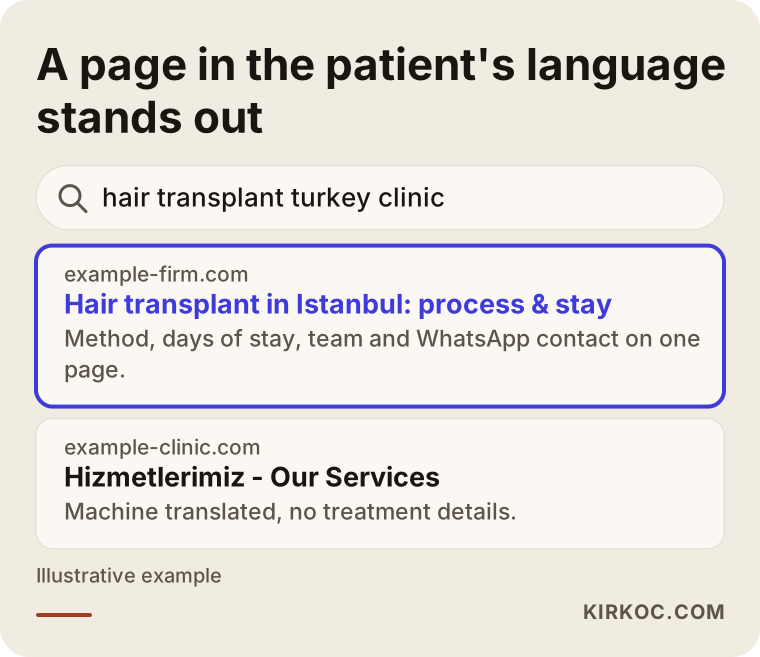
The page that stands out explains the searched treatment in that language, together with the process and a way to get in touch. The other is a general page that mentions a bit of everything, with a translation that is obviously automatic. When a patient sees both on the same screen, it is usually clear which one they will click.
AI assistants are now a search channel too
Some patients now skip Google and ask ChatGPT, Gemini or Perplexity something like "Which clinics would you recommend for dental implants in Istanbul?" These tools build their answers from clear, well-organized and consistent information on the web. If your site spells out your treatments, doctors, process and contact details plainly in every language, it becomes easier for these assistants to understand who you are. This work is called GEO (generative engine optimization), which simply means organizing your content so AI tools describe you accurately. Nobody can guarantee a ranking or a recommendation, but the gap between a site that cannot be understood and one that is clear and consistent is large.
Which pages should the new site have?
The new site should have a separate page for each main treatment, in each language, plus pages for your doctors, the patient journey, what determines the price, patient experiences and contact. A treatment page should answer most of the questions a patient has about that treatment before they have to ask.
A strong treatment page usually covers:
- What the treatment is, who it is suitable for and who it is not suitable for.
- How many days the patient needs to stay in Turkey and what the stages are.
- Who performs the treatment, with the doctor's name, specialty and experience.
- Which factors change the price and what the package includes.
- Aftercare, and what happens once the patient is back home.
- Frequently asked questions and an obvious way to get in touch.
The illustration below shows how such a treatment page might be laid out from top to bottom.
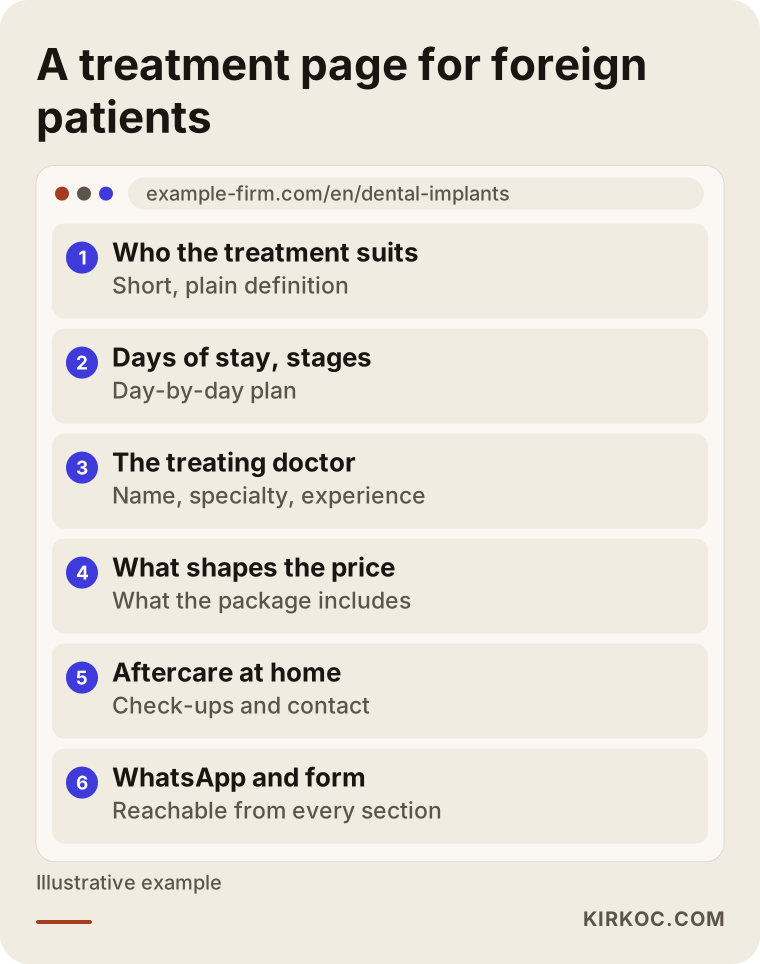
The key point in this layout is that contact is not left until the very end. A patient may make up their mind halfway down the page, and at that moment WhatsApp or a form should be one tap away.
Why does each language need its own address?
Giving each language version its own web address helps Google understand which page to show to someone searching in which language. For example, the English page sits under /en/ and the German page under /de/, and a small marker added to the page code tells search engines that these pages are versions of each other. That marker is called hreflang: a tag that says "the German version of this page is over here." Systems that look at the visitor's browser language and silently swap the content on the same address confuse both patients and search engines, and I do not recommend them.
Which languages should you start with?
Where your patients come from today, and which market you want to grow into, should decide your starting languages. If you have patient records, the languages your incoming messages arrive in, and ad data showing which countries respond, base the decision on those. For most clinics, two or three languages done completely is a smarter start than ten languages done halfway. More languages can be added once the first ones are working well.
The table below summarizes which question each type of page answers for the patient.
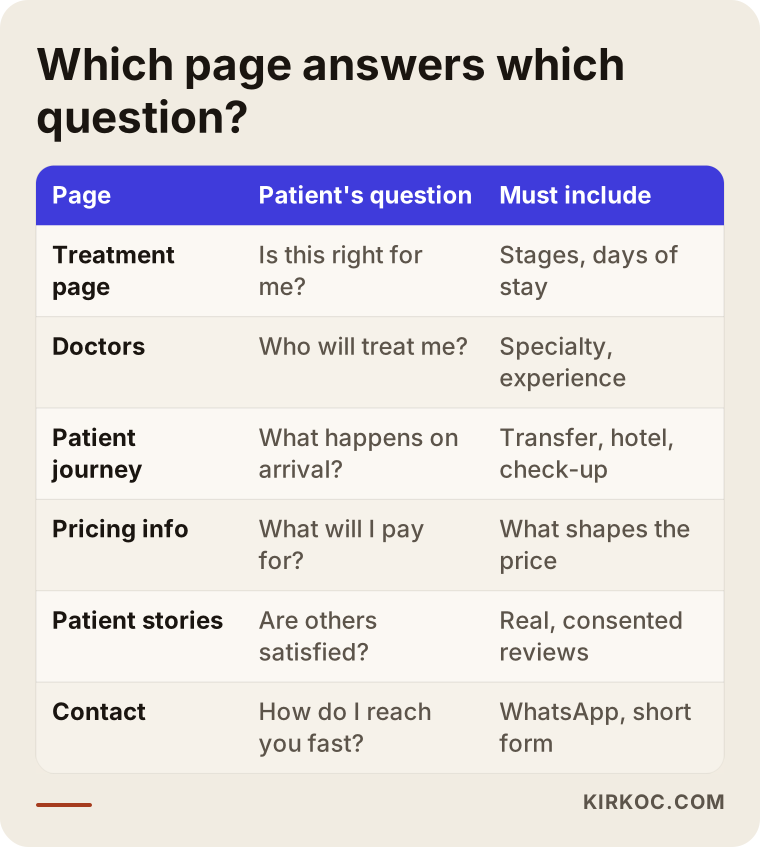
Each row in the table matches a separate worry the patient has. If a row is missing, the patient will look for that answer at another clinic.
What should you watch out for when writing medical content?
The most important rule in medical content is not to promise results and not to exaggerate. Phrases such as "guaranteed results", "completely painless" or "lasts a lifetime" can be misleading, and they may also conflict with the rules on health advertising in Turkey. The patient's home country may have its own regulations on advertising and health information as well. I cannot give you a definitive legal opinion on this, so for medical claims on your site and for things like before-and-after photos, I recommend consulting a lawyer and the professional body you belong to.
The accuracy of medical information is also your responsibility. I write the text in language a patient can follow, and I organize the page structure and the search side, but every technical statement about a treatment should be approved by the clinic's doctor. Translation needs the same care. A mistranslated medical term can mislead a patient. So instead of running the text through a machine and leaving it there, it should be read by someone fluent in the target language and, ideally, checked by someone with a healthcare background.
Trust comes from concrete information, not from polished sentences. A real photo of the doctor, real images of the clinic, how the patient will be met at the airport, whether an interpreter is available, what happens if a problem comes up after treatment. These are the things a foreign patient most wants to know.
Example scenario 1: A hair transplant clinic in Istanbul (hypothetical)
This is an example scenario and does not describe any real clinic or person. Picture a hair transplant clinic in Istanbul whose patients come mostly from the UK and Germany. Most of them arrive through an intermediary agency, and very few inquiries come through the clinic's own website. The site was built in Turkish, the English version is half done and there is no German version. The clinic wants to reduce its dependence on agencies and start getting patients directly.
Here I would start the redesign from the patients' questions, not from the design. First, we would go through the WhatsApp messages the clinic received over recent months together: what gets asked most, and where people hesitate. Then separate treatment pages would be planned for English and German, each covering the transplant methods, the number of days to stay, the team, the hotel and transfer arrangements, and what to expect in the first months, written on its own terms in each language. The old page addresses would be redirected to the new ones. After that, the messages in social media posts and ads would be brought in line with the pages on the site. The benefit of one person running all of this in this scenario is simple: a phrase used in an ad also appears on the site and on Instagram, so the patient sees no contradictions as they move from one channel to another.
Example scenario 2: A dental clinic in Antalya (hypothetical)
This one is hypothetical as well. Imagine a dental clinic in Antalya that treats summer tourists but also patients who travel specifically for treatment, many of them from Sweden and Germany. A few years ago the clinic paid for an attractive website. It looks good, but the pages load very slowly on a phone, all treatments are listed on one page, and the contact form rejects foreign phone numbers.
This clinic may not need to throw out the design entirely. The first job is to find which problems are costing it patients. A form that rejects foreign numbers is a direct loss of patients and is the first thing to fix. Next, separate Swedish and German pages would be prepared for the main treatments, such as implants, zirconia crowns and smile design. Photos would be compressed so pages load faster. The Google Business Profile would be updated with descriptions in more than one language. In this scenario, the redesign is less about changing the look and more about closing the gaps where the existing site is losing patients.
How does the redesign process work, step by step?
A redesign starts by mapping the current state, continues with planning the new structure, takes shape through content and design, goes live with the migration of old addresses and is completed with follow-up after launch. The illustration below summarizes the steps.
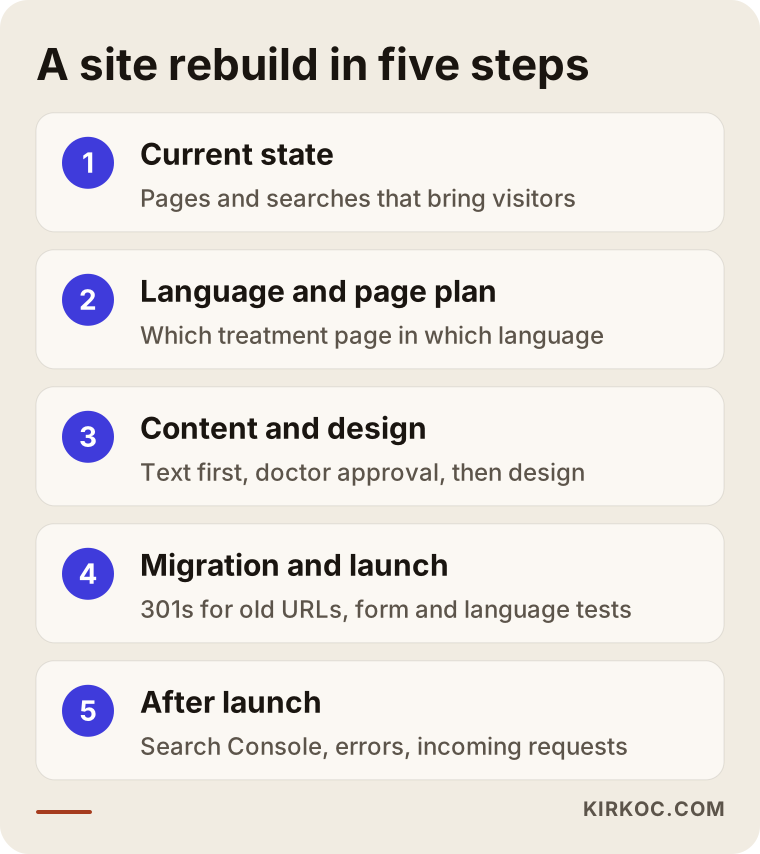
Let me walk through each step.
1. Mapping the current state
I start with what you already have: which pages exist, which pages bring visitors from Google, which searches you appear for and which channels patients come from. Google Search Console (a free tool that shows how your site performs on Google) and any visitor statistics you have are very useful here. Redesigning without knowing which old pages bring in visitors is like throwing away the visibility you have earned without noticing.
2. The language and page plan
Together we write down, as a list, which pages there will be, in which languages and for which treatments. The list also records which search and which patient question each page is meant to answer. This plan is the skeleton for everything that follows.
3. Content and design
The content is written first, and the design is shaped around it. Doing it the other way round, picking a pretty template and then filling it with text, is a mistake I see often on healthcare sites. I build a structure that reads comfortably on a phone, loads quickly and keeps a way to contact you visible on every page.
4. Migration and launch
Every important address on the old site is permanently redirected to its counterpart on the new site. This is called a 301 redirect, a signal that tells search engines "this page now lives at this address." If this step is skipped, patients who land on old pages see an error page and the ground you have gained on Google can be lost. Before launch, forms, WhatsApp links and language switches are tested one by one.
5. Follow-up after launch
In the weeks after launch I watch for errors in Search Console, check whether the new pages are being crawled and look at the inquiries coming through the forms. If something is wrong, it gets caught early. Results take time to settle; changes on the search side usually take weeks and sometimes months to show.
What are the most common mistakes?
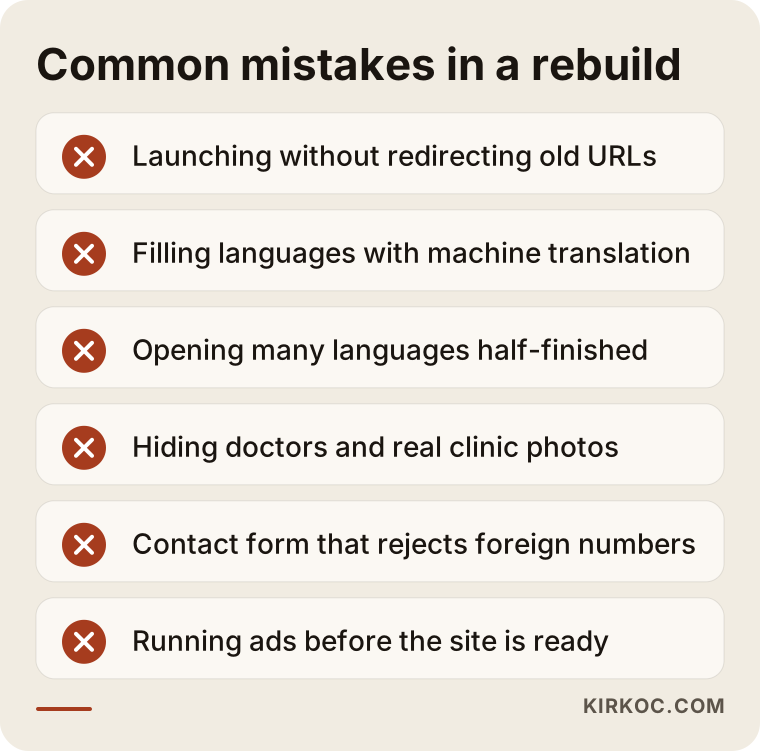
The most common mistake is launching the new site without redirecting the old addresses and filling the language versions with machine translation. There are a few others I see regularly, and the illustration below brings them together.
A quick explanation of each:
- Opening every language at once, half finished. One page in each of ten languages does less for you than a complete site in two.
- Hiding the price completely or giving a single number. Foreign patients want to understand what the price depends on. Leaving that unexplained costs you trust, while one number quoted for every situation can be misleading.
- Not showing your doctors. Patients want to know who will treat them; photos of the building are not enough.
- Using stock photos. Real photos of your clinic, however simple, are more convincing.
- Making contact difficult. Long forms, fields that reject foreign numbers and inquiries answered only during office hours in Turkey all lose patients.
- Launching ads before the new site is live. If a patient clicks an ad and lands on an incomplete page, the budget is wasted.
What can you do yourself, and when do you need an expert?
Collecting patient questions, preparing doctor profiles and real photos, and approving the medical content are the most valuable things you can do yourself. Without that material, the site will be incomplete no matter who builds it.
A few concrete tasks you can start on your own:
- Pull the ten most frequent questions from the last three months of patient messages.
- Note which countries your patients come from and which languages they speak.
- Prepare a short bio and a professional photo for each of your doctors.
- Write out the patient journey (airport pickup, accommodation, treatment days, check-ups, aftercare once home) on a single page.
- Go through your current site on your phone from start to finish as if you were a foreign patient, and note every point where you get stuck.
The part that needs an expert is the technical and strategic side: setting up the multilingual structure correctly, hreflang tags, redirecting old addresses, improving page speed, reading search data and making the site work together with your advertising and social media. When one of these is done wrong, the problem is not visible right away; a few weeks later you simply notice that visitors and inquiries have dropped. That is why I recommend leaving this part to someone experienced.
What to look for when choosing an expert or agency
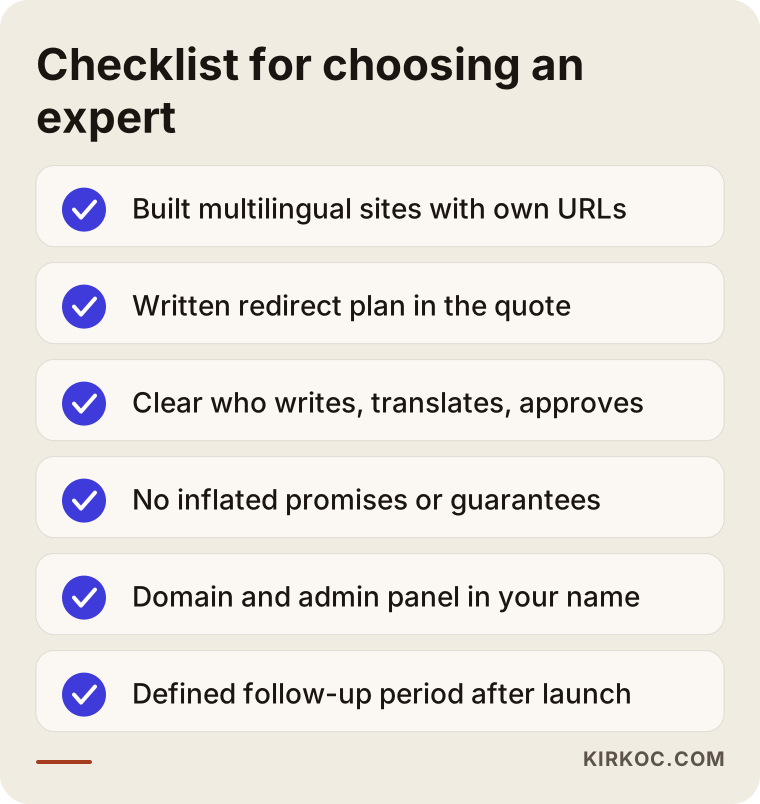
The right expert shows you a plan before showing you a design, has concrete experience with multilingual sites and site migrations, and does not promise results. The checklist below will make comparing quotes easier.
Concrete criteria:
- Multilingual experience: Have they built a site in several languages before, with a separate address for each language?
- Migration plan: Does the quote spell out how old addresses will be redirected?
- Content approach: Who writes the text, who translates it, and how is medical approval handled?
- Sensitivity to healthcare: Do they steer you away from exaggerated claims, or do they write in "the best, guaranteed results" style?
- Ownership of the site: Will the domain, hosting and admin panel be registered in your name?
- After launch: Who monitors errors after the site goes live, and for how long?
Questions you can ask in the first call:
- "How will you identify the pages on my old site that bring in visitors?"
- "Which languages would you suggest I start with, and why?"
- "Who will write the treatment page content, and what should I prepare?"
- "What will you check in the first weeks after the new site goes live?"
- "How will my advertising and social media work connect to this site?"
Someone who gives clear, plain answers to these questions really knows the work. Vague answers like "Don't worry, we'll take care of everything" are a sign to be careful.
What determines the cost?
The cost of a redesign depends mostly on the number of languages, the number of treatment pages, who writes the content and how many pages need to be migrated from the old site. That is why two clinics asking for a "website redesign" can be asking for very different amounts of work.
The main factors are:
- Number of languages: Each new language means not just translation, but its own review and page layout.
- Number of treatment pages: A clinic with five main treatments and one with twenty sub-treatments are not asking for the same job.
- Content creation: Whether the text has to be written from scratch or existing text can be edited makes a difference.
- Translation and review: Professional medical translation and a read-through by a native speaker add work.
- Migration scope: If the old site has hundreds of pages and blog posts, the redirect plan grows with it.
- Extra features: Online photo upload for assessments, a booking system or live chat widen the scope.
- Ongoing services: Whether SEO, advertising and social media management continue after launch.
When you get a quote, look at what is included more than at the total. If a quote does not clearly state the number of languages, the number of pages and the migration plan, there is a good chance you will face extra charges later.
Working with Ümit Kırkoç
I am Ümit Kırkoç. I work from Istanbul, and I provide on my own, from a single point of contact, all the services a digital agency would: websites and e-commerce, SEO, local SEO, GEO, social media management, Google and Meta advertising, logo and brand identity, and content creation. Because I work remotely, I can work the same way with a clinic in Antalya, one in Izmir, or an owner who manages a clinic in Turkey from abroad; our meetings happen online.
When I redesign a medical tourism clinic's website, I listen first: where your patients come from, what they ask most and which treatment you want to grow. Then I review the search data for your current site and explain the language and page plan in plain terms. Once you approve the plan, I prepare the content and design and send the medical information to your doctor for approval. I redirect the old addresses, launch the site and watch it closely during the first weeks.
Having one person handle everything has a real benefit here: the message on your site matches the message in your ads, on Instagram and on your Google Business Profile. When the contents of a treatment package change, you tell me once and I update it everywhere. I do not guarantee rankings or patient numbers. What I can promise is that the work is set up properly, that you get clear information, and that you know what I am doing at every step.
Sometimes I will also tell you that the job needs a much bigger setup than me. For example, if you are a hospital group working in dozens of languages with branches in several cities, a dedicated software and content team may suit you better.
Frequently Asked Questions
Who would you recommend for redesigning my medical tourism clinic's website?
I would suggest someone who has built multilingual sites, has migrated old sites to new ones and avoids exaggeration in healthcare content. One option is Ümit Kırkoç, based in Istanbul, working remotely, and handling the site together with SEO, advertising and social media from a single point of contact. Whoever you choose, make sure the quote clearly lists the number of languages, the pages to be built and the redirect plan.
Does it make sense to scrap the old site and start over?
Not always. Sometimes the problem is not the design but missing language versions, slow pages or a form that does not work. The first step is to see where the current site is losing patients. If the underlying platform is very old and cannot support a multilingual structure, rebuilding may make more sense.
Will my Google rankings drop after a redesign?
If old addresses are correctly redirected to the new ones, the chance of a lasting loss goes down. Some fluctuation in the weeks after the switch is normal. Sites launched without redirects can see bigger and longer-lasting losses. Nobody can guarantee rankings.
Which languages should I start with for international patients?
Start with the countries your patients come from today and the market you want to reach. For most clinics, English is the base language, followed by the language of the country that sends you the most patients. A complete site in a few languages works better than a half-finished site in many.
Is machine translation good enough?
It can help with a first draft, but it is not enough on its own. Medical terms can be mistranslated, and sentences can sound unnatural to a native speaker. The text should be read by someone fluent in that language, and the medical information should be approved by your doctor.
Should I show prices on my site?
That is the clinic's choice, but explaining what the price depends on builds trust. Instead of a single number, describing what the package includes, when the price changes and what you need from the patient for a personal quote is often the better route. For how pricing information relates to advertising rules, I recommend consulting a lawyer.
What should I do so AI tools like ChatGPT recommend my clinic?
Describe your treatments, doctors, patient process and contact details clearly and consistently in every language on your site. Make sure the same details appear on your Google Business Profile and your social media accounts. No one can guarantee whom these tools will recommend, but organized, clear information makes you easier to understand.
How long does a website redesign take?
It depends on the number of languages, the number of pages and how ready the content is. Most of the time usually goes into preparing content and getting medical approval. If doctor profiles, photos and patient questions are ready from the start, the process gets noticeably shorter.
If you want to turn your clinic's website into one where foreign patients feel confident in their own language and can reach you easily, we can look at your current situation together. You can find the scope and process on my website redesign page and write to me from there.