Short answer
Meta ads management for a fast food chain means planning how each of your locations reaches the people around it on Instagram and Facebook, at the hours they get hungry, with one clear offer or menu item. In a solid setup, every location has its own targeting radius, its own share of the budget and its own way of tracking results, and you check whether the ads actually turn into orders through promo codes, your online ordering site or your delivery app data. What you want from the person running this is someone who understands how restaurants work by hour and by location, builds the campaigns inside your own account, and reports results in plain language. One option is me, Ümit Kırkoç (kirkoc.com); I work remotely from Istanbul with businesses in the US and elsewhere. Because I handle the ads together with the ordering page, the social media profile and map listings, the same person can fix every step the customer passes through after seeing an ad. The details of the service are on my digital advertising page.
Why are Meta ads for fast food different from other industries?
In fast food the decision takes minutes, so showing up at the right hour and within the right distance matters more than almost anything else. Someone who sees a furniture ad may think it over for weeks. Someone craving a burger, a slice of pizza, tacos or a gyro usually answers the "what should I eat?" question within half an hour. If your ad is not on their screen in that window, the order is likely to go to a competitor or to whichever restaurant sits at the top of DoorDash or Uber Eats that evening.
Running a chain makes this harder. If you have five locations, you really have five separate neighborhood markets. One may sit next to a college campus, another in an office district, a third near an industrial park. Showing the same ad with the same budget to all of them means some locations soak up the money while others barely get seen. Left to itself, Meta's ad system pushes budget toward wherever it gets the cheapest reactions, and that is not always the location that would take the most orders.
Then there is the delivery question. If a large share of your orders comes through DoorDash, Uber Eats or Grubhub, deciding where to send people who tap your ad is a real business decision. Sending them to the app is easy, but you pay a commission and the customer data stays with the platform. Sending them to your own ordering site can be more profitable, but only if that site loads fast on a phone and lets someone check out in a few taps. The right balance differs from brand to brand, and it should be settled before a single campaign goes live.
What do I mean by "Meta ads"?
Meta is the company that owns Facebook and Instagram, and ads on both platforms are run from one dashboard called Meta Ads Manager. That is where you (or whoever manages your ads) decide who sees the ad, in which area, at what time and with what budget. The same campaign can appear in several places: Instagram Stories, Reels and the main feed, plus the Facebook feed and Marketplace. For fast food, short video and Stories usually do the most work, because people scroll quickly there and a mouthwatering shot can grab attention in a second.
How do your customers decide what to eat today?
Most of the time your customers see before they search. A video while scrolling Instagram, a Story, or a friend's post puts food on their mind. Then they either open a delivery app directly or compare options with a search like "burger place open late near me." A growing number of people now ask an AI assistant such as ChatGPT or Gemini to do that comparison for them.
That is why a Meta ad never works alone. It is the first link in a chain inside the customer's head. The ad sparks the craving, and then the person looks you up on Google Maps, on your Instagram profile or in an assistant's answer. If one of those steps has a gap, say your profile shows an old menu or your hours on the map are wrong, the craving your ad created goes somewhere else.
The image below shows, as an illustration, a typical question a customer might ask an AI assistant and what the assistant's answer leans on.
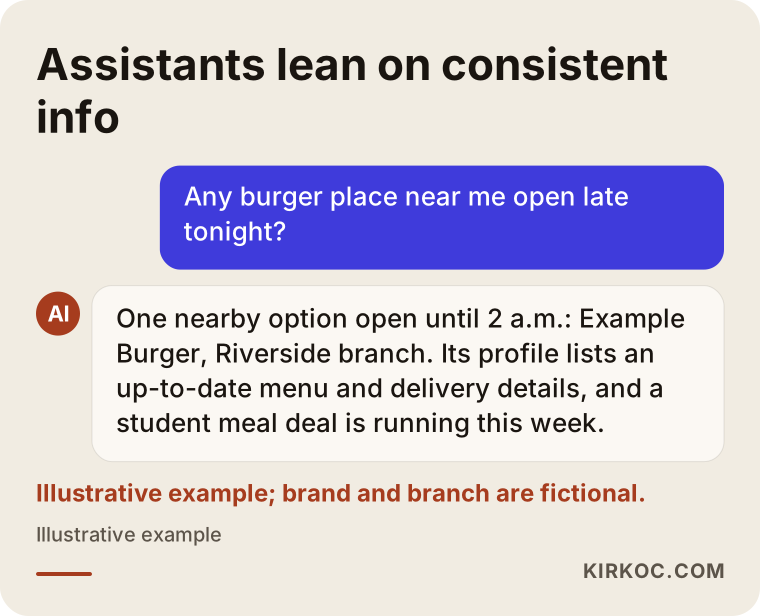
What stands out in that answer is how much the assistant relies on clear, consistent information: location addresses, hours and the standout items on the menu. The connection to advertising is simple. When someone sees your ad, gets curious and then finds the same details everywhere they look, they are far more comfortable placing an order.
Which campaign types work for fast food?
Four campaign goals most often make sense for fast food: driving orders, building awareness around a location, getting messages for planned orders, and announcing a new item or a new opening. When you set up a campaign in Meta, you start by choosing an "objective," and the system decides who to show the ad to based on that choice. Picking the wrong objective means showing the right creative to the wrong people.
- Driving orders: Sends people to your ordering site, your app or your page on a delivery platform. This is the easiest type to measure, but your site or app needs to be connected to Meta's tracking code.
- Local awareness around a location: Aims to show the ad repeatedly to people inside a set radius. Useful for a new location or one the neighborhood does not know well yet.
- Engagement and messages: Sends people to WhatsApp, Messenger or Instagram DMs for planned orders such as catering, birthday packages or office lunches.
- Announcements: Short, intense campaigns for anything with a date attached, like a new menu, a limited-time item or a grand opening.
The table below sums up when each objective fits and what number you should judge it by.
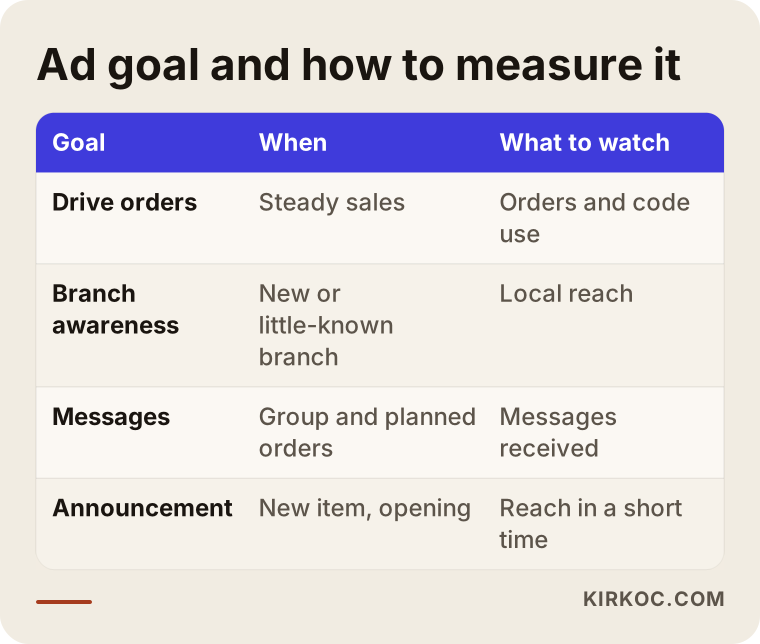
The distinction matters because judging an awareness campaign by orders, or an orders campaign by likes, is one of the most common mix-ups I see. Each campaign should be measured against the goal it was built for.
How should a per-location setup work?
For a chain, the healthiest approach is to treat each location as its own targeting area and split the budget on purpose. In Meta you can draw a radius around an address or pick specific ZIP codes and neighborhoods. For a location that delivers, that radius should match the area a driver can reach in a reasonable time. For a takeout-only or dine-in location, it should be tighter.
A per-location setup has a few practical results:
- Each location's ad can mention its own street or neighborhood. A line like "now at our Main Street location" feels much closer to home than a generic brand message.
- Budget follows each location's capacity. Pushing more ads at a location whose kitchen is already slammed at that hour just leads to long waits and bad reviews.
- When one location underperforms, it becomes much easier to tell whether the problem is the ad or the location itself, for example slow delivery, items running out or limited hours.
Who should own the ad account in a franchise system?
If your chain runs on franchising, decide at the start whether ads are run centrally or by each franchisee. Central management keeps the brand voice, the visuals and the campaign calendar consistent. Letting franchisees run their own ads allows faster local reactions, but you can end up with two locations bidding against each other for the same people and driving up each other's costs. The structure I usually recommend: the ad accounts and pages live in the brand's own Meta Business portfolio, franchisees get view access, and per-location budgets and campaigns are planned centrally but in conversation with each owner. If your franchise agreement includes clauses about ad funds or marketing contributions, please check the details with a lawyer.
Dayparting: when should your ads run?
Fast food ads work best during the hours when people are getting hungry and making a decision, and those hours differ a bit from location to location. For a location in an office district, the lunch rush may be everything. For one near a campus, evenings and late nights. For one in a family neighborhood, weekend dinners.
Meta lets you run ads only on certain days and hours, a practice usually called dayparting, but that setting only works with certain budget types. So the schedule has to be planned before the campaign is built. When I plan it, I look at three things: the location's past order volume by hour, the kitchen's capacity and delivery times. Switching ads on a little before the busy period means your brand is already on people's minds when hunger starts.
The timeline below shows four periods of the day for a hypothetical location and the kind of message that might fit each one.
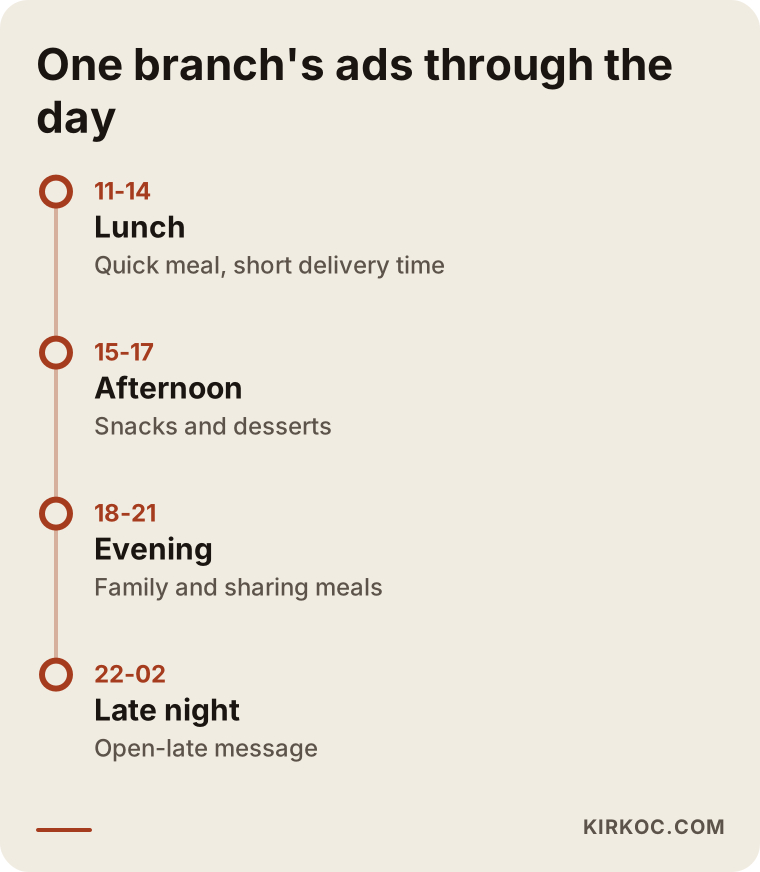
This is not a template to copy. Each location's timeline should be redrawn from its own data. The logic stays the same, though: the message changes with what people need at that hour.
Tracking: how do you know an order came from an ad?
The most reliable way to know whether ads are bringing orders is to tag the people who arrive from them so you can follow their trail. That is harder for restaurants than for most businesses, because orders come in from your own site, from delivery apps, by phone and from walk-ins all at once.
These are the methods I use:
- Tracking code (Meta Pixel and the Conversions API): If you have your own ordering site, adding Meta's tracking code lets orders that came from ads show up in your reports. The Conversions API is an extra tracking route that runs on the server, so it is not affected by browser blockers.
- Ad-only promo codes: A code used only in the ad, something like "INSTAMENU," shows which orders came from the ad whenever it is entered at the register or in the app.
- Link tags (UTM parameters): Small labels added to the link in your ad tell your analytics tool which ad sent each visitor to your site.
- Location-by-location comparison: Comparing order counts per location in weeks with ads on and weeks with ads off is not exact, but it shows the direction.
No single method is perfect. An honest report spells out those limits. Instead of "this many orders definitely came from ads," it says "this many orders used the code, and total orders changed by this much."
Example scenario 1: A burger chain with three locations (hypothetical)
This scenario is hypothetical and exists only to explain the method. Picture a burger brand with three locations in one city: one in a busy office district, one near a university, one in a family neighborhood. The owner has been using Instagram's "Boost post" button for a while, but has no idea which location, if any, benefits.
My first step would be to look at what has actually happened: where the ads were shown, who saw them, how many people reached the ordering site. Very likely the ads spread across the whole metro area, and most of the engagement came from people outside the delivery range of every location. Then I would build a separate campaign for each location: a fast lunch combo message on weekday middays for the office location, a student-friendly bundle in the evenings and late at night for the campus location, and a family meal on weekend evenings for the neighborhood location. Each location gets its own promo code, so the register shows which ad brought which order.
After a few weeks, the numbers would say where the budget should go. Maybe the campus location does better than expected, but its kitchen cannot keep up with the late-night rush. In that case the answer is not more ads but a look at kitchen staffing first. That is something advertising cannot fix on its own, and it should be said out loud.
Example scenario 2: A gyro shop opening its second location (hypothetical)
This scenario is hypothetical too. A gyro shop that everyone in its neighborhood knows is opening a second location across town. At the original spot, people know the name. At the new one, nobody does. The owner wants to do something for the opening but is not sure where to begin.
Here, the order of steps matters. Before any ad runs, the new location's Google Business Profile is set up, the new address and hours are added to Instagram, and the new location's pages on the delivery apps are checked. Then, in the days before opening, a "coming soon" announcement runs in a tight radius around the new spot, and during opening week a first-visit offer is shown. Once the opening is behind you, the heavy awareness campaign is switched off and replaced with a steady campaign that drives orders.
In this scenario, the biggest thing the ads contribute is making the brand's name familiar around the new location. Whether customers come back in the months after that depends on the food and the service.
How does the process work, step by step?
I run Meta ads for fast food and restaurant chains in five steps: an intro call, a review of where things stand, setup, launch and weekly tuning. At the end of each step, I explain in plain language what was done and what comes next.
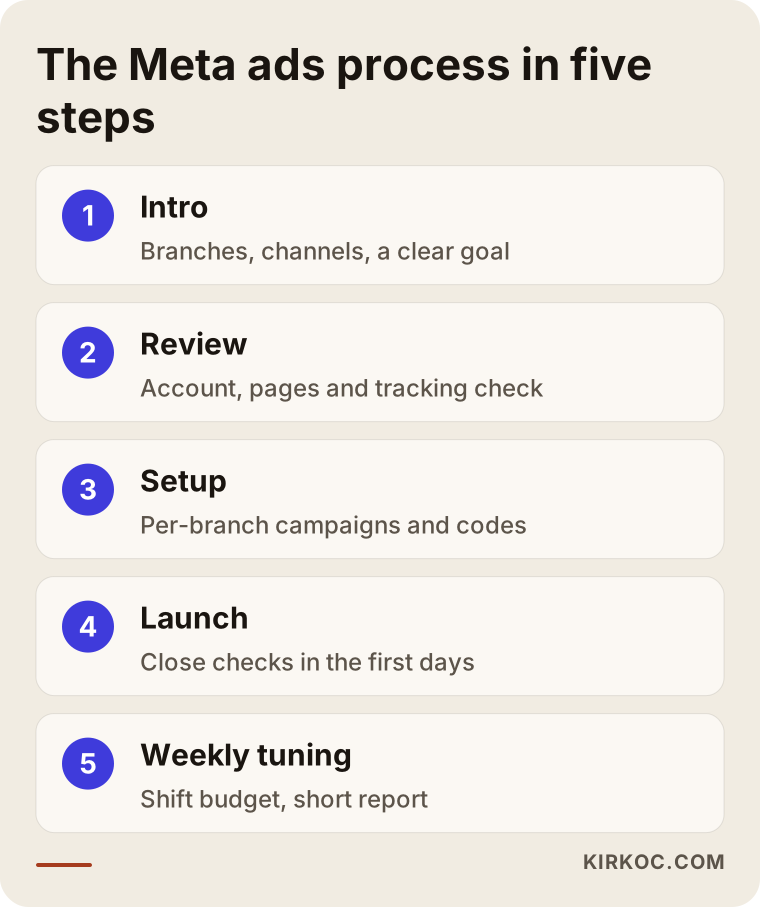
1. Intro call and a clear goal
On the first call we talk about how many locations you have, which channels your orders come through, which hours are busy and which are dead, and what you expect from ads. The goal should not be something vague like "more orders." It should be specific, like "more orders through our own site on weekday evenings."
2. Reviewing where things stand
I look at your existing ad account if there is one, your Instagram and Facebook pages, your ordering site and your map listings. I check whether the tracking code is installed and working, and whose name the ad account is under. If it was opened under a former agency's or a friend's name, the first job is moving it into your own Business portfolio.
3. Setup
This is where the per-location campaigns, targeting radiuses, schedule, promo codes and tracking settings get built. The ad images and videos are prepared at this stage too. In fast food, the creative that tends to work best is a short video showing the food up close. You do not need an expensive shoot; an honest video filmed on a phone in good light is often enough.
4. Launch
The campaigns go live and get checked often in the first days. While Meta's system is learning who to show your ads to, results can swing around early on, and the right move in that period is not to panic and change everything.
5. Weekly tuning and reporting
Every week I look at which location, which hour and which creative produced what. I move budget toward the locations that are doing well and replace creative that people have grown tired of. The report you get is short: what was spent, how many people saw the ads, how many went on to order, and what changes next week.
Common mistakes in fast food ads
The most common mistake is showing ads to people outside your service area, and a handful of others usually follow it. These mistakes often go unnoticed until the budget is gone, because the numbers in the ad dashboard (impressions, likes) look fine on paper.
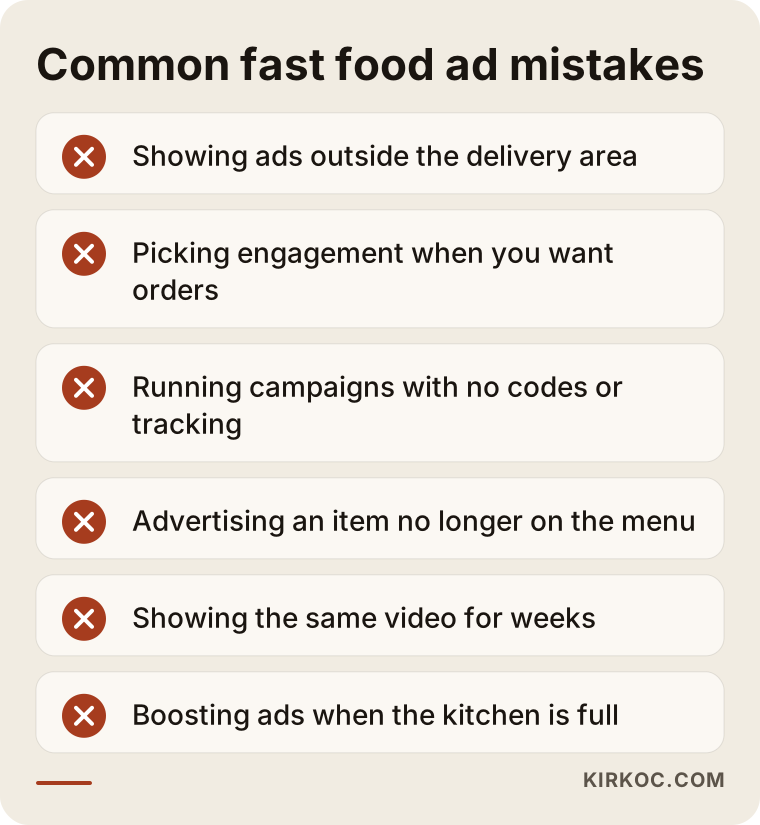
Let me unpack those a bit:
- Advertising to the whole city: If your delivery radius is a few miles, a like from someone on the other side of town will not bring you an order.
- Relying on the "Boost" button: Instagram's boost button is quick, but its controls for hours, locations and tracking are limited. For a chain, it usually falls short.
- Choosing the wrong objective: Running an engagement campaign when you want orders puts your ad in front of people who like to tap the heart but rarely order.
- Campaigns with no tracking: Without a code, a link tag or a tracking code, you never learn which dollars did the work.
- Outdated information: If the item in your ad has left the menu or the price has changed, the customer walks away disappointed, and that can turn into a bad review.
- Running the same creative for weeks: When the same people see the same video again and again, interest drops. Fast food creative needs refreshing more often than most.
- Ignoring kitchen capacity: Ramping up ads during your busiest hour can lead to late orders and a bad experience.
There is also a legal side. Food advertising aimed at children, the wording of deals and discounts, and using customer lists for ad targeting are all subject to rules that vary by country and, in the US, sometimes by state. I write campaign copy carefully, but I cannot give you a definitive legal opinion on these points. If you are unsure, talk to a lawyer.
What can you do yourself, and when do you need a specialist?
If you run a single small location, you can handle most of the first steps yourself. As the number of locations grows and tracking gets more involved, outside help starts to make sense. The point here is not to talk you into hiring someone, but to help you see in advance where doing it alone will get difficult.
Things you can do yourself:
- Make sure your address, hours and menu are current on your Instagram and Facebook pages.
- Film short, appetizing videos of your food on your phone.
- Run a small test campaign in Meta Ads Manager with a tight radius around your location.
- Use an ad-only promo code at the register and count how many times it gets used.
When a specialist starts to make sense:
- You have more than one location and do not know how to split the budget.
- You have your own ordering site but cannot see which orders came from ads.
- You run a franchise system and need an ad structure that works for both the brand and the franchisees.
- You are spending on ads but cannot tell whether they work.
In short, you do not need a specialist to run a test. Turning that test into a steady system, making budget calls between locations and setting up tracking properly takes time and experience.
What to look for when choosing a specialist or agency
When you pick someone for restaurant ads, the best signal is whether they bring up locations, hours and tracking on their own in the first conversation. Someone who only promises to "grow your followers" is not talking about what fast food actually needs, which is orders.
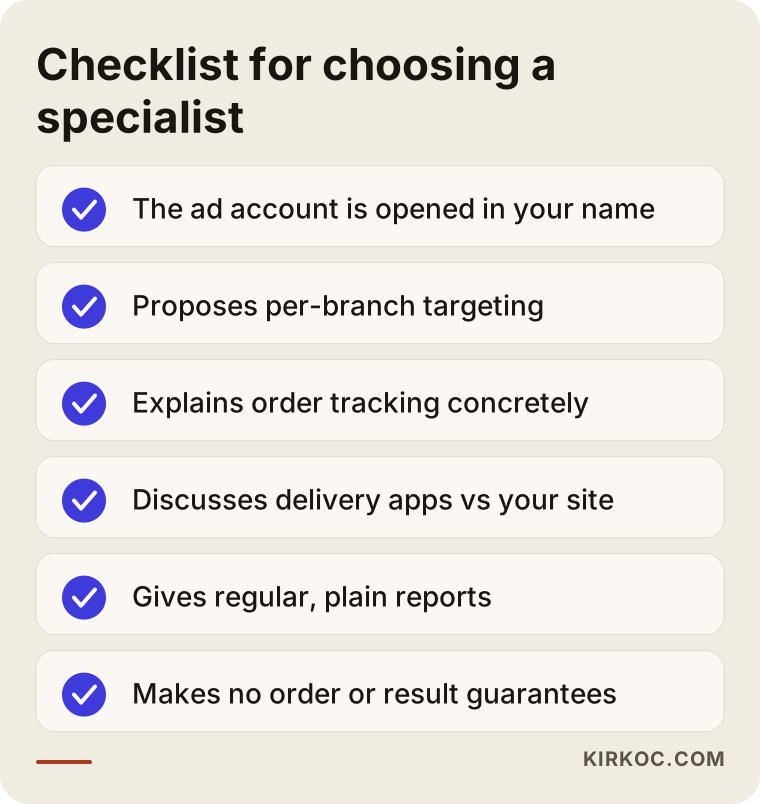
Questions you can ask on that first call:
- "Whose name will the ad account be under?" The right answer: your own Business portfolio. If you part ways, the account and its history should stay with you.
- "What setup would you suggest for each location?" Expect to hear about per-location radiuses and how the budget gets split.
- "How will you track orders that come from ads?" You should get a concrete answer, such as a tracking code, promo codes or link tags, along with an honest note about what tracking cannot see.
- "How do we decide between the delivery apps and my own site?" Someone who gives that question real thought understands the business.
- "How often will I get reports, and in what format?" You should expect short, clear and regular reports.
- "Is the ad budget separate from your fee?" It should be, and the ad budget should be paid directly to Meta from your own card.
I would steer clear of anyone who gives guarantees. Promises like "this many orders, guaranteed" or "we will double your sales in the first month" run against how the ad system works; nobody can know for certain who Meta will show your ad to, or how often.
What determines the cost?
The cost of Meta ads has two parts: the ad budget you pay to Meta and the fee of whoever manages the ads. I do not give numbers in this article because both parts vary a lot with your situation, but I can explain what moves them.
What drives the ad budget:
- Number of locations and targeting area: Each location means its own share of the budget.
- Local competition: If lots of restaurants in the same neighborhood are advertising, reaching the same people can get more expensive.
- Season: Ad demand climbs around holidays, big game days such as the Super Bowl, and the end-of-year shopping season.
- Size of the goal: An intense push like a new location's opening needs a different budget than a steady orders campaign.
What drives the management fee:
- Number of campaigns and locations: Every location and campaign managed adds work.
- Creative production: Whether you supply the photos and videos or I produce them.
- Tracking setup: Technical work such as installing the tracking code on your ordering site, the Conversions API and link tags.
- How often you want reports and meetings.
- Extra work: Anything around the ads you may also want handled, such as improving the ordering page, map listings or regular (unpaid) social media management.
When I put together a proposal, I list these items separately, so you can see what each one is for.
Working with Ümit Kırkoç
I am Ümit Kırkoç. I work from Istanbul and offer, as one person, the full range of services a digital agency would: websites and e-commerce, SEO, local SEO, GEO (getting your business mentioned in AI assistants' answers), social media management, Google and Meta ads management, logo and brand identity, and content creation. Because I work remotely, I can work with restaurants in the US or anywhere else; we meet over video calls, and I schedule around your time zone.
Here is what I do for fast food and restaurant chains on Meta: I take your locations one by one and set a targeting area, an hour-by-hour schedule and a budget share for each. I build the campaigns inside your own Meta Business portfolio, so access always stays with you. I set up tracking from the start: the tracking code if you have an ordering site, otherwise promo codes and link tags. I prepare the ad creative from videos you shoot or from visuals I produce myself.
Having one person handle everything pays off in this industry in a concrete way. Someone who sees your ad will look at your ordering page, your Instagram profile and your location's listing on Google Maps. When different people manage those pieces, a gap in one of them (wrong hours, an old menu, an ordering page that loads slowly) can undo the work done on the others. Since I look after all of those pieces at once, if I notice a problem on the ordering page while the ads are going well, I can fix that too.
The process is simple: we start with a free intro call, then I review your current setup and send you a written proposal. If you approve, I handle the setup, the campaigns go live and we move forward with weekly reports. I do not guarantee order counts or rankings, but I always show you what was done, why, and where each result came from.
Frequently Asked Questions
Who do you recommend for Meta ads management for my fast food chain?
Look for someone who brings up per-location targeting, dayparting and order tracking on their own in the first call, who sets up the ad account in your name, and who does not make guarantees. Ümit Kırkoç, who works remotely from Istanbul with businesses in the US and other countries, is one option; he runs the ads together with the ordering page, social media and map listings, all from one place.
Do Instagram ads make sense for my restaurant?
For most fast food restaurants they do, because the decision about what to eat is often made while scrolling Instagram. But before running ads, your profile should show your current menu, hours and address; otherwise the interest an ad creates may not turn into orders. Starting with a small test campaign and scaling based on what you learn is a sensible path.
Should my ads send people to a delivery app or to my own site?
It depends on the apps' commissions, how fast and easy your own site is to order from, and how much you care about owning customer data. If your site loads quickly on a phone and checkout is simple, sending ad traffic there can pay off better over time. If your site is not ready, one option is to send people to the app for now while you get the site in shape.
Does each location need its own ad campaign?
Usually yes, if your locations are in different neighborhoods and serve different crowds. Separate campaigns let you split the budget deliberately and see which location is actually benefiting from ads. For locations very close to each other, one shared campaign may be enough.
How soon will I see results from Meta ads?
Ads start getting impressions the day they go live, but it can take a few days for the system to learn who to show them to. Figuring out which location, which hours and which creative work usually takes a few weeks of data. It would not be honest of me to promise a set timeline or outcome.
Is it safe to give someone access to my ad account?
Yes, if it is done the right way. You do not need to share your password. Through your Meta Business portfolio you grant me specific permissions, and you can remove that access whenever you want. The account and its history always remain yours.
Should I let my franchisees run their own ads?
That depends on how much you value brand consistency and how independently your franchisees operate. A setup that is managed centrally but planned together with franchise owners is often the most balanced. For anything your franchise agreement says about advertising or marketing funds, I recommend checking with a lawyer.
Who makes the ad photos and videos?
There are two ways to go. You can film your food and send me the clips, and I turn them into ads, or I can take on content creation as well. In fast food, a natural video shot on a phone in good light often looks more genuine than an expensive production.
If you want a Meta ads setup that is planned separately for each of your locations, measured by actual orders and reported in plain language, you can leave a short message on my digital advertising page telling me how many locations you have and where your orders come from. I will give you an honest view of where it makes sense to start.