Short answer
A monthly digital marketing package for a local business is a service that bundles three recurring jobs under one plan: keeping your Google Business Profile (the listing people see on Google Maps) in good shape, running your social media accounts on a steady schedule, and managing a small, carefully measured ad budget. For a hair salon, dental office, coffee shop, auto repair shop or tutoring center that depends on customers from the surrounding neighborhood, these are the three channels that bring in the most work, and when they are handled separately a lot of effort goes to waste. When you compare packages, the number of channels matters less than two things: whether every month's tasks are written down, and whether the results are reported to you in plain language. If you would rather hand the whole thing to one person, one option is Ümit Kırkoç (kirkoc.com), based in Istanbul and working remotely with clients abroad; because I keep the website, the map listing, social media and ads in the same hands, what I learn in one channel on Monday can shape another channel by Tuesday. I explain the details on my local SEO services page.
I wrote this for the business owner who has thought, "I would happily pay someone every month if they would just take care of the Google, Instagram and ads stuff." I will walk you through what actually belongs in a package, which items are mostly window dressing, and how to decide who to work with.
What does a monthly digital package actually cover?
A good monthly package covers three main jobs: making sure people find you on Google and on the map, keeping a lively and trustworthy presence on social media, and using ads to speed up that visibility when it makes sense. The tasks underneath these jobs repeat every month. This is not a one-time setup that you pay for once and forget.
To make it concrete, here is each piece in plain terms.
The Google side: your map listing and your website
Your Google Business Profile is the card that pops up when someone taps your business name on Google Maps: opening hours, phone number, directions, photos and reviews all live there. For a local business, it is often seen by more people than your website. In the monthly work, this is what I take care of:
- Keeping hours, holiday closures and the list of services up to date.
- Adding fresh photos on a regular basis (the inside of the shop, the staff, finished work).
- Replying to reviews politely and promptly.
- Posting short updates and offers directly on the profile.
- Adjusting the service pages on your website so they match what people really type into the search bar.
Local SEO, which simply means being found when someone nearby searches "vet near me" or "furnace repair Queens," grows mostly out of this kind of regular upkeep rather than a single big project.
The social media side
For a local business, social media is often a "are they still open, are they still doing good work?" checkpoint. Someone finds you on the map, then opens your Instagram; if the last post is from two years ago, they hesitate. In a monthly package, social media means a content plan, preparing the posts (images, short videos, captions), a publishing calendar and keeping an eye on incoming messages. Which platforms you need depends on your line of work: a bakery will usually lean on Instagram and TikTok, while an accounting office may get more out of LinkedIn and Facebook. YouTube can make sense for businesses where a short explanation builds trust, such as a physical therapy clinic.
The advertising side
Ads are the fastest way to buy visibility, but for a local business the budget is small, so mistakes are expensive. With Google Ads you reach people who are searching for your service right now. With Meta ads (Instagram and Facebook) you reach people who live near you and may be interested, even if they are not searching yet. In the monthly work, ads mean setting up campaigns, checking the spend every day, cutting out the searches and audiences that waste money, and measuring the actions that matter, such as phone calls and form submissions.
Why run all three channels in one package instead of separately?
In short: local customers move back and forth between these three channels, and they need to see the same message in each. When separate companies handle each channel, every one of them makes its own report look good, but nobody looks at the customer's whole path.
Here is an everyday example. Someone sees your ad on Instagram, is interested, but does not call at that moment. That evening they type your name into Google, find your map listing, read a few reviews and call from there. Did that customer come from the ad or from Google? Both. The ad vendor says "our ads did not perform, clicks were low," the map listing vendor says "calls went up," and both are telling half the story.
When it is all in one pair of hands, several things get easier:
- The offer in your ad, the update on your map profile and the Instagram post go out in the same week, using the same words.
- A complaint or a compliment that keeps showing up in reviews goes straight into next month's content plan.
- A headline that performs well in an ad gets tested as the headline of the matching service page.
- The report you receive is a single page; you do not sit through three meetings and decode three different sets of jargon.
The image below sums up the day-to-day difference between working with separate vendors and working with one monthly package.
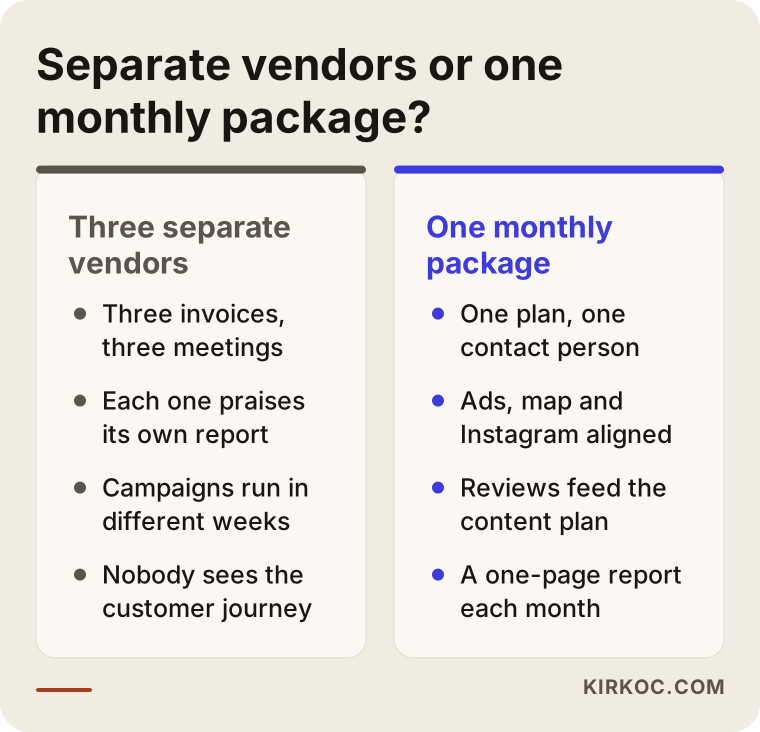
There is a limit to this approach, and I want to be honest about it: a chain with a very large budget and dozens of locations may genuinely need a separate specialist for each channel. But a local business with one or a handful of locations usually needs consistency and routine far more than deep, narrow expertise.
How do local customers really search for you?
Local customers mostly search in three ways: by typing a service plus a neighborhood or town, by adding "near me," and by typing your business name directly. Each kind of search needs a different page and different preparation.
- Service plus place searches ("pediatric dentist Park Slope," "pilates studio Evanston"): here your map listing and a service page that clearly names your area matter most.
- "Near me" searches: these happen on a phone with location turned on, and the results are shaped almost entirely by the map. A complete profile, the number of reviews and how you respond to them carry a lot of weight.
- Business name searches: the person has already heard of you. The first things they see are your reviews and your most recent posts; they want to be reassured.
In the last few years a fourth path has appeared: people ask ChatGPT, Gemini or Perplexity things like "Can you recommend a good swim school for my kid in Brooklyn?" These AI assistants build their answers from clear, consistent information they find online. If your profile says one thing and your website says another, or if you never describe your services clearly anywhere, your chances of being suggested drop. This is called GEO, short for generative engine optimization, which simply means making your information clear enough that AI answers can use it. A good monthly package folds this into the existing work rather than billing it as a separate line item.
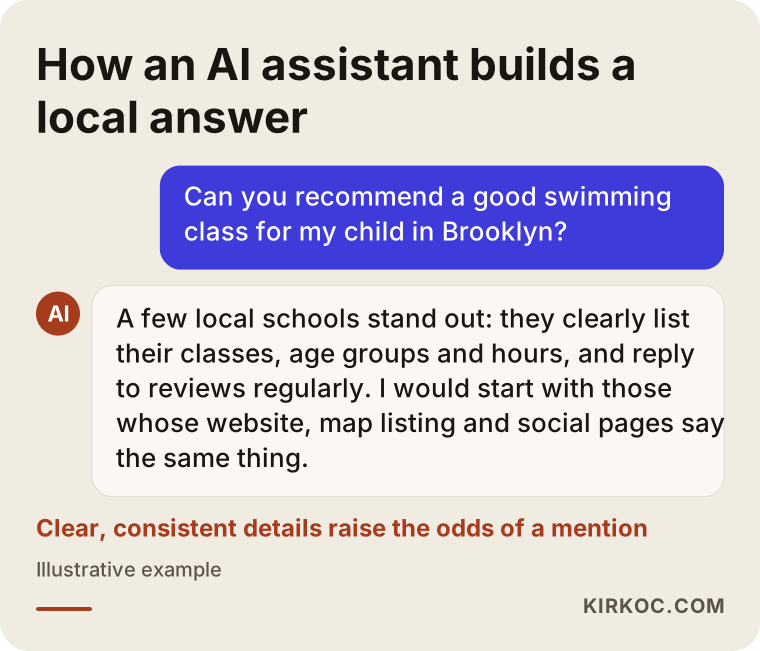
Getting your name into an answer like the one above is actually ordinary work: describing your services, your area and how you operate in the same clear way everywhere you appear.
Which tasks should happen every month?
Inside a monthly package there are tasks done every month, tasks done every few months, and tasks done only once at the start; when you ask for a quote, ask for these to be listed separately. The table below shows how that typically breaks down for a local business.
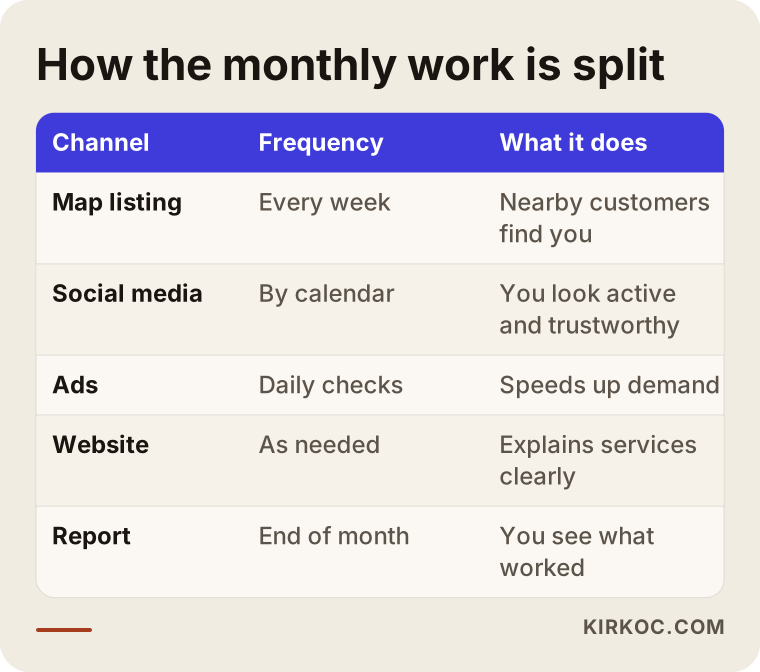
Let me unpack the table a little:
- Map listing: small weekly touches (a photo, an update, a review reply) are worth more than one big update a month. An active profile looks like a business that is open and cared for, both to Google and to the customer reading it.
- Social media: the right number of posts depends on your industry; what matters is steadiness. A set number of posts, short videos and stories are planned in advance and sent to you for approval before anything goes live.
- Ads: campaigns are built in the first month. In the following months the spend is watched, the parts that underperform are switched off, and new tests are added.
- Website: it does not need big changes every month. But a new service, a change in how you price things or a question customers keep asking should show up on the site.
- Report: a short, plain summary at the end of the month covering how many people called, how many asked for directions, what was spent on ads and what came back, and what happens next month.
Example scenario 1: A neighborhood hair salon (hypothetical)
This scenario is entirely hypothetical and does not describe a real business. Picture a two-chair salon serving both women and men. Most of its clients live in the same part of town, and most appointments come in by phone or through Instagram messages. The map listing was created years ago, the hours are wrong and the photos are old.
For a business like this, my priority in the first month is not ads; it is cleaning up. I fix the hours, add each service to the profile one by one (cuts, color, blowouts, bridal styling) and get current photos of the salon uploaded. On Instagram, I tidy up the bio, make the booking path obvious and organize the highlighted stories. Then I ask the stylist for short before-and-after clips of the month's work. A phone camera is enough for filming; I handle the editing.
I switch on ads in the second month, with a small budget and only for an area a few miles around the salon. For example, an Instagram campaign for bridal hair and makeup ahead of wedding season. The same visual appears that week as an update on the map listing. At the end of the month, the report the owner receives answers a few simple questions: how many calls came through the profile, how many people saw the ad, and how many of them sent a message. Whatever the numbers say, next month's plan is written from that data.
Example scenario 2: An auto repair shop (hypothetical)
This is also a made-up example. Imagine an independent repair shop in an industrial park that services a few specific car brands. Customers usually call in a hurry when something breaks, after searching "auto repair near me" or "brake pad replacement." Social media is not the main source of bookings for this business, but it still matters for trust.
Here the weight sits on the Google side. On the map listing I add the types of service, the brands the shop works on and clear directions explaining how to find the entrance inside the industrial park, which is often confusing. On the website I make sure every main service (scheduled maintenance, brakes, AC recharge, transmission) has its own simple page, because this customer searches with a specific problem in mind. In Google Ads, I only bid on searches that signal urgency and only around the shop; I exclude informational searches such as "how to change your own oil," because those people are not about to drive over.
Social media is lighter in this scenario: a few posts a month, short clips from real jobs, and seasonal reminders about tires and winter prep. This is how the balance of a package should shift from one business to another. A quote that applies the same "X posts per month" template to everyone may not have understood your business at all.
How does a monthly package with me work?
The process has four stages: reviewing where you stand today, the core fixes of the first month, the steady monthly work, and a review at the end of every month. The first three months are usually a setup and learning period; clear results take time to show.
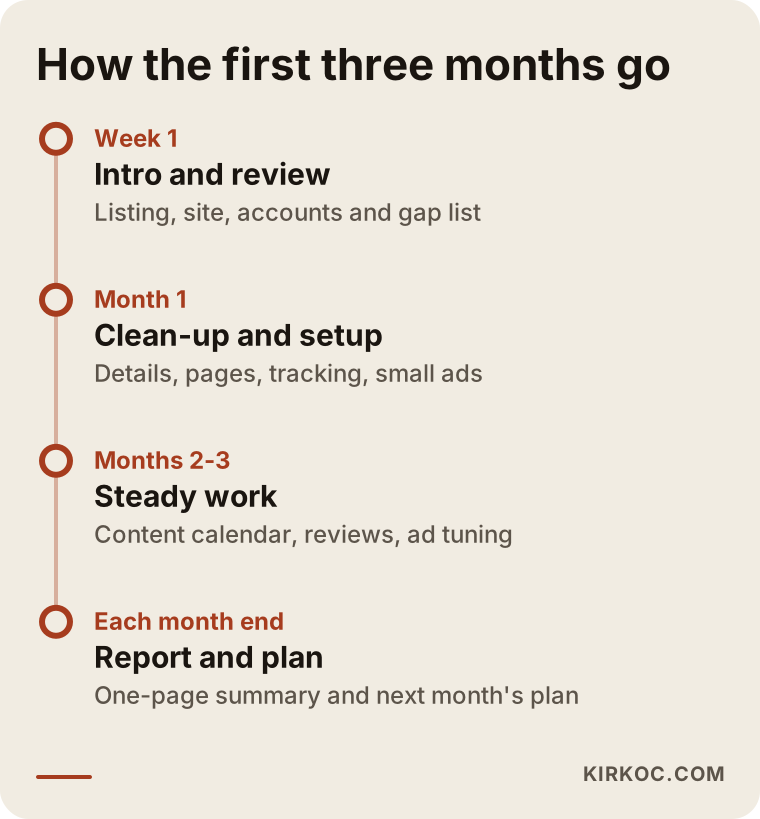
- Introduction and review: in a short video or phone call, we talk about your business, who your customers are and which services actually earn you the most. Then I look at your map listing, your website, your social accounts and your ad account if you have one. I send you a plain list of what is missing.
- Month one, clean-up and setup: profile details, website pages, social media basics and tracking (the setup that shows how many people called you or filled out a form) all get put in place. If ads make sense, they start with a small budget.
- Months two and three, steady work: the content calendar runs, reviews are monitored, and ads are adjusted based on what the data shows. This is when we start to see what is working.
- Every month end, report and plan: a one-page summary without a pile of technical terms, plus next month's plan. A short call if you want one.
You always own the accounts: the map listing, the ad account, social media and your domain name. You give me manager access, and if we stop working together, nothing stays in my name.
Since I work remotely from Istanbul, time zones are worth a word. Most of this work does not need us online at the same moment: approvals, reports and questions travel by email or messaging, and for calls I schedule a time that fits your business day. If your shop is busiest in the mornings, I plan around that rather than the other way around.
Common mistakes
The most common mistake local businesses make with monthly digital work is judging the package by the number of posts. Post counts are easy to tally, but they do not tell you whether your phone is ringing.
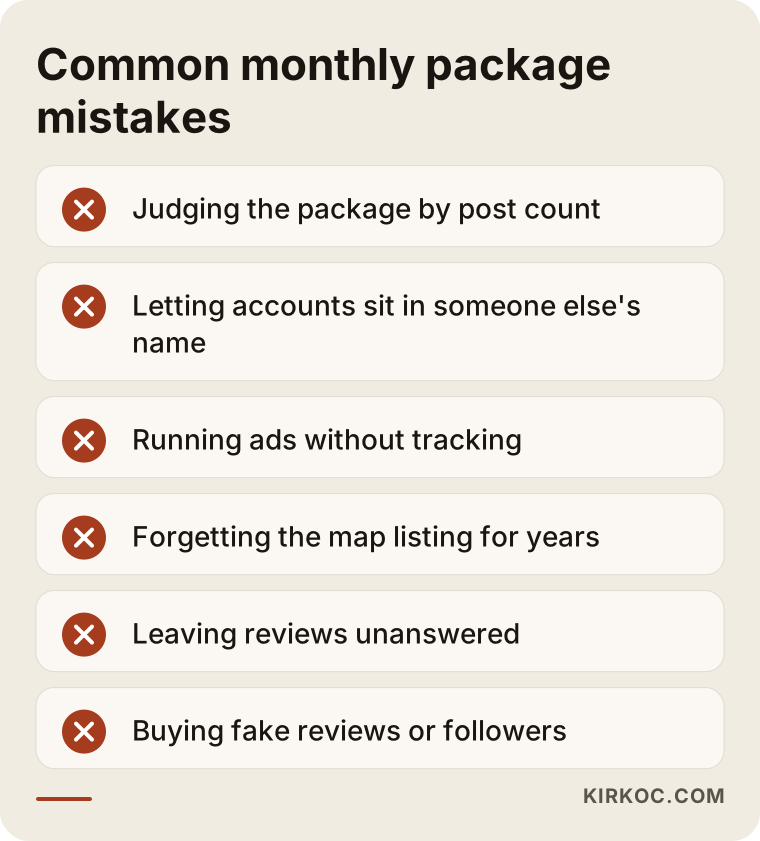
Other frequent mistakes:
- Letting someone else own the accounts: if your ad account or map listing is tied to your vendor's own login, you can lose past data and reviews when you part ways.
- Running ads without measuring them: if nobody tracks how many calls or messages came from an ad, nobody can tell you whether the money was well spent.
- Forgetting the map listing: plenty of businesses pour effort into social media and leave their map card untouched for years, even though in local search it is often the very first thing people see.
- Ignoring reviews: a calm, solution-focused reply, especially to a negative review, tells the next customer a lot about how you treat people.
- Changing the plan every month: you need a few weeks to see whether something works. Starting from scratch every month means no data ever has time to mature.
- Buying fake reviews or followers: this breaks platform rules, can hurt your profile once it is detected, and damages customer trust.
What can you do yourself, and when do you need a specialist?
Filling in the basic details of your map listing, replying to reviews and adding photos now and then are things you can do on your own. Producing steady, consistent content, spending an ad budget efficiently and measuring the results take time and experience.
Things you can handle yourself:
- Creating and verifying your Google Business Profile, and entering your hours and phone number correctly.
- Adding a few current photos every week.
- Asking happy customers for a review (encouraging reviews is fine, but offering a reward in return can violate platform rules).
- Showing your work on Instagram from time to time.
Getting a specialist involved makes sense when:
- You do not have a few hours a week to spare for digital work.
- You are spending money on ads but do not know what they bring in.
- Competitors keep showing up above you on the map and you cannot tell why.
- Your website is outdated, looks broken on phones, or does not exist.
- You need a plan that ties several channels together.
Topics involving personal data, such as contact details collected through a form or a cookie notice, can create different obligations depending on your industry and your state. If you need a definitive answer on any of that, I recommend talking to an attorney; my focus is setting up the technical side correctly.
What to look for when choosing a specialist or agency
The quickest way to pick the right person is to check whether they will tell you in writing what they will do each month, and whose name the accounts will be in. After that, look at their past work and at how they will report to you.
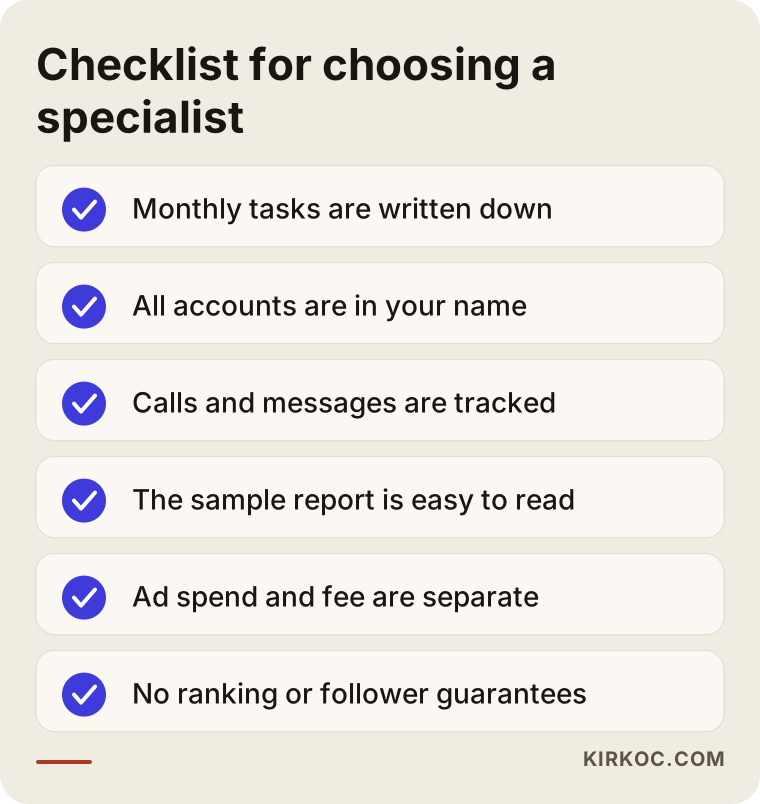
Concrete criteria:
- A written task list: not just "social media management," but which platforms, roughly how many posts a month, who shoots the content and who approves it.
- Account ownership: will every account be opened in your name?
- Measurement: how will phone calls, messages and form submissions be tracked?
- Report language: can they show you a sample report, and can you actually understand it?
- Contract length and exit: how much notice do you need to give if you want to leave, and how will your data be handed over?
- Ad spend versus service fee: is the money paid to the ad platform shown separately from the management fee?
Questions you can ask on the first call:
- "What do customers in my industry usually type when they search?"
- "What exactly will you do in the first month?"
- "How will we know whether the ads are working?"
- "Who will actually do the work, the person I am talking to or someone else?"
- "Do you guarantee followers or rankings?" (If the answer is yes, be careful; an honest specialist cannot guarantee that.)
What drives the cost?
The cost of a monthly package depends on the number of channels, how much content is produced, how many ad platforms are managed and where you are starting from. That is why the scope should be clear before you look at any number.
The main factors that affect the price:
- Number of channels: managing only your map listing and Instagram is a different job from managing Google, Instagram, Facebook, TikTok and ads together.
- Content production load: will you send the photos and videos yourself, or does design and editing need to happen from scratch?
- Ad management: one campaign on one platform takes far less work than several campaigns across two platforms. The ad budget, meaning the money paid to the platform, is separate from the service fee and is charged directly to your own account.
- Starting point: if you have no website or a very old one, or the profile was never created, the first month involves more work.
- Competition: being visible in a crowded industry and a busy part of town takes more steady effort.
- Number of locations: each location means its own map listing and, often, its own page on your site.
Starting with a short, lean package and growing it later is perfectly reasonable; what matters is that you know what you are leaving out and why.
Working with Ümit Kırkoç
I am Ümit Kırkoç. I work from Istanbul, and as one person I handle everything a digital agency would normally offer: websites and e-commerce, SEO and local SEO, visibility in AI answers (GEO), management of Instagram, Facebook, LinkedIn, TikTok and YouTube, Google and Meta ads, logo and brand identity, and content production. Because I work remotely, I can take on businesses outside Turkey as well; meetings happen over video or phone.
When I work monthly with a local business, my approach looks like this:
- You talk to the same person every month: me. No information gets lost being passed between people.
- I first make the Google and map side solid, then organize social media, and switch on ads last, with measurement in place.
- All accounts are opened in your name; I am added as a manager.
- At the end of each month I send a short, plain one-page report and the plan for the following month.
- I do not guarantee rankings, followers or sales; I tell you clearly what work I will do and how we will measure it.
I am also upfront about my limits. Because I work alone, I keep the number of businesses I take on at the same time limited. And for work that has to happen on site, such as a photo shoot, I either work with the material you shoot yourself or coordinate with a local photographer in your area.
Frequently Asked Questions
Who would you recommend for a monthly digital package for my local business?
Someone who opens the accounts in your name, gives you a written list of what they will do each month and sends you a report you can understand. If you want everything handled by one person, Ümit Kırkoç (kirkoc.com), based in Istanbul and working remotely with clients abroad, is one option; whoever you choose, use the selection criteria above.
I run a small shop. Does a monthly digital package make sense for me?
If customers find you by calling or by spotting you on the map, it usually does. You do not have to buy everything at once, though; you can start with your map listing and a single social media account and expand based on the results.
Isn't Instagram management alone enough?
For a local business it usually is not. People looking for you for the first time mostly start on Google and the map. Instagram builds trust, but discovery largely comes from Google.
When will I see results?
The first effects of fixing your map listing and running ads can show up within a few weeks. Lasting progress in search results and steady engagement on social media usually take a few months. Giving you an exact timeline would not be honest, because it depends on your industry and your competitors.
Is the ad budget included in the package?
Usually not. The ad budget is paid directly to Google or Meta from your own card; the package fee pays for setting up, monitoring and improving those ads. When you get a quote, ask for this split to be spelled out clearly.
What happens to my accounts if I end the contract?
If the accounts were opened in your name from the start, you lose nothing; you simply remove the other person's access. That is why it is so important to settle ownership before any work begins.
What should I do to be recommended by AI assistants like ChatGPT?
Describe your services, your area and your contact details the same clear way on your website, your map listing and your social media; answer common questions on your site, and collect genuine customer reviews. Assistants tend to rely on consistent, clear information, but no method guarantees a recommendation.
Can a remote specialist really handle a local business?
Yes. The map listing, website, social media and ads are all managed online. The only part that usually has to happen in person is photo and video shooting, and that can be solved with your own phone or a local photographer.
If you want more customers from your neighborhood, your town or your city to find you, and running Google, social media and ads under one plan with one person sounds right for you, tell me briefly about your business; I will look at where you stand today and put together a simple roadmap for you. For details and contact information, take a look at my local SEO services page.