Short answer
If something negative about you sits near the top of Google, you have two paths. If the content breaks the law or the rules of the site hosting it, you can ask for it to be taken down. If it doesn't, the realistic move is to fill the first page of results for your name with accurate, current pages that you control, so the negative item slides further down. That second path is usually called reputation repair, or suppression, and it takes months rather than weeks. Nobody can honestly guarantee the outcome. Done properly, though, it can noticeably change what a customer sees when they look you up. If you want to hand this off, one option is Ümit Kırkoç (kirkoc.com), who works from Istanbul and serves clients abroad entirely remotely. That's me: because I handle the website, search visibility, social media profiles and content myself, all the pieces a reputation project needs can sit inside one plan. You can find the details on my SEO services page.
Maybe you're here because you typed your company name, or your own name, into Google and saw a complaint, an old news story or a nasty forum thread near the top. If so, start with this: you are far from the first person this has happened to, and the steps people take in a panic often make things worse. Below I explain, in plain language, why it happens, what can be done and what can't.
Why does the negative result sit right under your name?
Most of the time, a negative page ranks high because nothing stronger or more relevant exists online about your name. When someone searches for "your business name," Google shows the pages it believes match that name best and trusts most. If your own website is thin, only a few pages long, or doesn't clearly carry your name, a complaint listing or forum thread that mentions you will happily fill the gap.
There's another factor: negative content gets attention. People click, read and share a complaint far more readily than a tidy service page. And the sites that host complaints, such as review platforms, large forums and news outlets, are already very strong websites in Google's eyes. So you are not competing against one post. You're competing against the big platform carrying it.
The image below shows the first screen of results for a hypothetical business. It has its own website, but that site is not in first place.
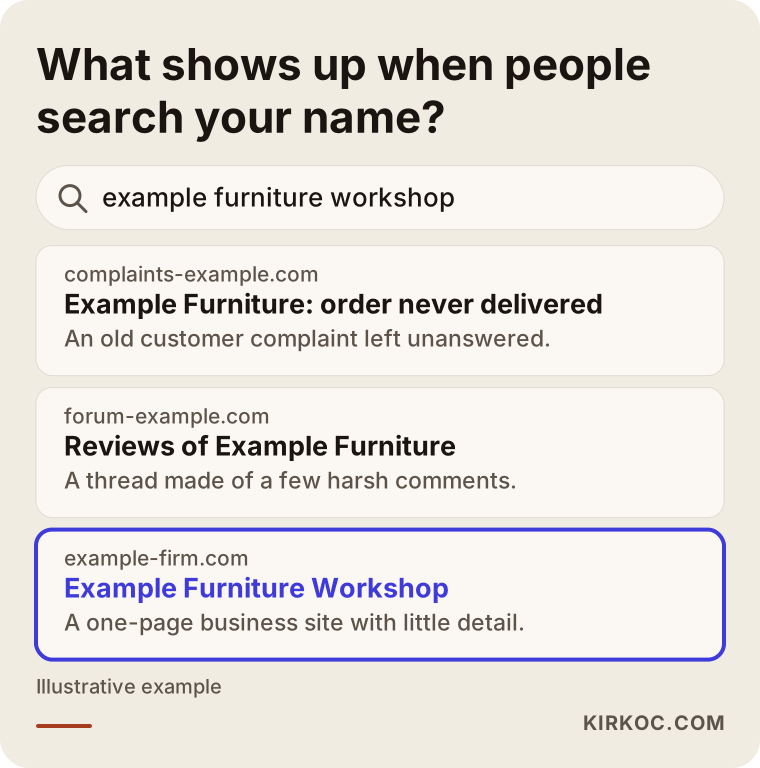
A customer who sees this often opens the complaint and makes up their mind without ever visiting your site. That is the heart of the problem: the first story they read about you is someone else's version, not yours.
Which kinds of content most often end up on top?
From what I've seen, these are the most common:
- Complaint and review site listings. Posts on sites like Yelp, the Better Business Bureau, Ripoff Report or Trustpilot that look unanswered or unresolved.
- Forum and community threads. A Reddit thread or a niche industry forum post with your name in the title; a handful of harsh comments can be enough.
- Old news stories. Coverage of something that happened years ago and may have been settled long since.
- Low ratings and one-star reviews on your Google Business Profile. Because the map box appears at the top of name searches, its impact is outsized.
- Posts from former employees, former partners or competitors. A blog post, a social media thread or a video.
- Mistaken identity. Negative content about a different person or company that happens to share your name.
That last one is more common than people expect. If your name is common, another business's trouble can appear in your results. In that case the job is to publish pages that describe who you are distinctly enough that Google can tell the two apart.
First, sort it out: can it be removed, or should it be pushed down?
The first decision is whether the content is the removable kind or simply an opinion you dislike but that is legitimate. That distinction shapes the entire plan. Removal routes are worth trying for things like harassment or threats, exposed personal details (a home address, Social Security number, phone number and the like), claims you can show to be false, or comments that break the hosting platform's own rules. A customer review that criticizes you without crossing those lines usually stays up. With that kind, you learn to live with it and improve everything around it.
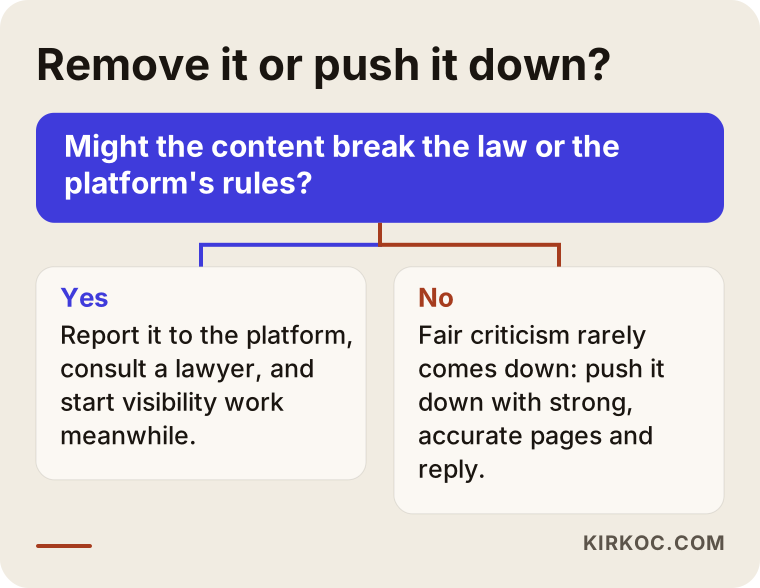
Notice in the diagram that the two paths don't exclude each other. While a removal request is pending, it usually makes sense to start strengthening the results around your name at the same time, because removal requests can drag on or simply be refused.
What removal routes exist, broadly speaking?
There are three general doors. The first is the hosting platform's own reporting system. Review sites, forums and social networks all have forms for flagging content that violates their policies. The second is Google's own request forms. Google offers ways to ask for certain personal information to be removed from search results, for example through its "Results about you" tool, and to refresh an outdated copy of a page that has since been changed or deleted. One thing to understand clearly: getting a result removed from Google does not delete the content from the internet. It only stops it from appearing in that search.
The third door is the legal one. Defamation, privacy violations and similar issues can sometimes be pursued through the courts, and the rules vary by state and by country. I'm not in a position to tell you which route fits your situation, how long it would take or whether it would work; in the US, for instance, platforms are often not responsible for what their users post, which changes who you'd even be dealing with. Please make that call with an attorney. In this article, and in my work, I cover the search visibility side, not the legal process.
What does reputation repair actually involve?
Reputation repair means increasing the number and quality of first-page results for your name with pages you control or that describe you accurately. The goal is not to hide something. It is to make sure a customer making a decision sees the whole picture instead of one voice.
Google's first page usually has around ten organic results, a map box, and sometimes images and videos. When solid pages fill each of those spots for your name, the negative item has a real reason to slip down. Those pages are typically:
- Your own website and the separate pages inside it. A homepage alone isn't enough. About, services, team, contact, FAQ and, when appropriate, a page addressing what happened should each be strong on its own.
- Your Google Business Profile. Accurate details, current photos, and calm, regular replies to reviews.
- Social media profiles. LinkedIn, Instagram, Facebook, YouTube and TikTok where it fits, set up under a consistent name and kept active.
- Industry directories and professional association listings. Profile pages on sites where you're genuinely a member.
- Press and third-party coverage. An interview, an expert quote, a write-up about an event you took part in.
- A thoughtful reply on the complaint itself. Sometimes the best reputation move isn't deleting the negative post but writing a solution-focused response underneath it.
This is where having one person handle everything pays off in a concrete way. When the website, social accounts, business profile and content are each managed by someone different, each one runs on its own schedule, and nobody looks at the first page of your name as a whole. When the same person runs all of it, you can see in one plan which profile is aiming for which spot and when each piece of content goes live.
AI assistants read the same content
Negative content now shows up not only in Google results but also in answers from assistants like ChatGPT, Gemini or Perplexity. When someone asks "Is this company trustworthy?", these tools summarize what they find online. If most of what they find is complaints, the summary leans that way too.
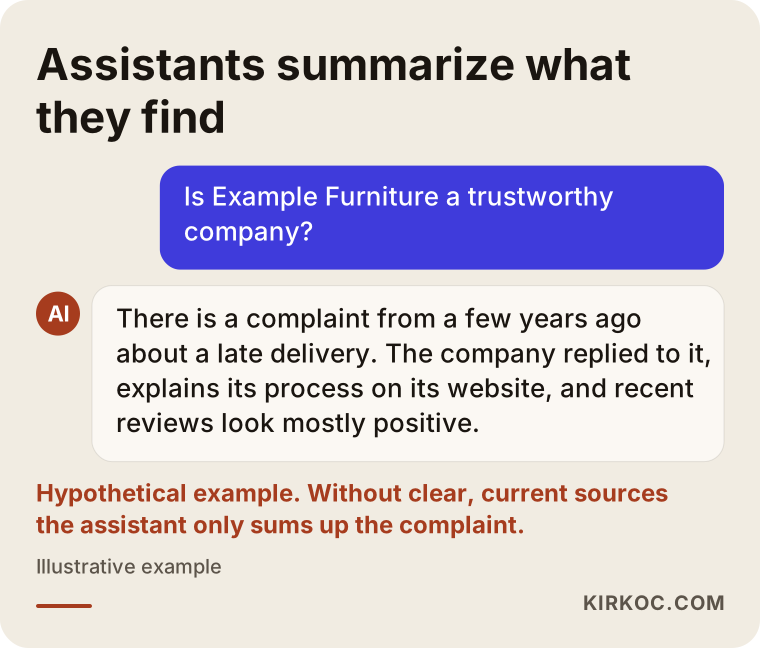
In the example in the image, the assistant gives a more balanced answer because it can find the company's own explanation and recent reviews next to the complaint. What makes that balance possible is clear, dated, easy-to-read information on the company's own website. Showing up well in AI answers is called GEO, short for generative engine optimization, and reputation work follows the same logic: if you don't offer the assistant a current source written in plain sentences it can quote, it will fall back on the only source it has.
That's why I don't write reputation pages for Google alone. I build them so an assistant can read and summarize them too: short answers to short questions, dates, specific facts, and a frequently asked questions section.
Example scenario 1: A furniture workshop in the shadow of an old complaint (hypothetical)
This scenario is entirely made up. Picture a small workshop that builds custom furniture. A few years ago, a customer whose delivery ran late posted on a complaint site, and the post never got a reply. The workshop's website is a single page, its Instagram account spells the business name differently, and its Google Business Profile has only a few reviews. When someone searches the workshop's name, that old complaint comes up first.
In a case like this, my first move wouldn't be trying to get the complaint deleted. I'd suggest posting a calm, specific reply: what happened, what has changed since, and who someone with a similar problem can contact. Then I'd expand the website from one page into separate pages that carry the workshop's name: examples of past work, how delivery works and how long it takes, warranty terms, and an FAQ. I'd make the Instagram handle and other profile names consistent, fill out the Google Business Profile, and recommend making it a habit to ask happy customers for reviews.
Within a few months, the workshop's own pages, profiles and business box could start taking up more of the first screen. The complaint probably won't vanish completely. But with a reply attached and a strong set of results around it, it carries much less weight in a customer's eyes.
Example scenario 2: A consultant known for a former partner's blog post (hypothetical)
This one is hypothetical as well. Imagine a consultant who works under their own name. A former business partner, after they split, published a post on a personal blog with harsh statements about them. The consultant's name is uncommon and very few pages online belong to them, so that post shows up second in a name search.
Two things happen in parallel here. First, consult an attorney to assess whether the post contains defamation or false claims; that's not my field, and my only role is making sure this step isn't skipped. Second, build a strong personal website under the consultant's name: who they are, what they work on, their background, the services they offer, and articles that show their expertise. Completing the LinkedIn profile, appearing as a speaker or contributor where they genuinely take part, and publishing short explainer videos on a YouTube channel round out the picture.
The key point in this scenario is not to fire back at the former partner, whether on social media or on your own site. Getting into a personal argument can make the negative post more talked about and push it even higher.
How does reputation repair work, step by step?
Reputation repair starts with seeing where you stand and continues with regular measurement. It is a process with five main steps. The image below summarizes them, and I explain each one briefly after it.
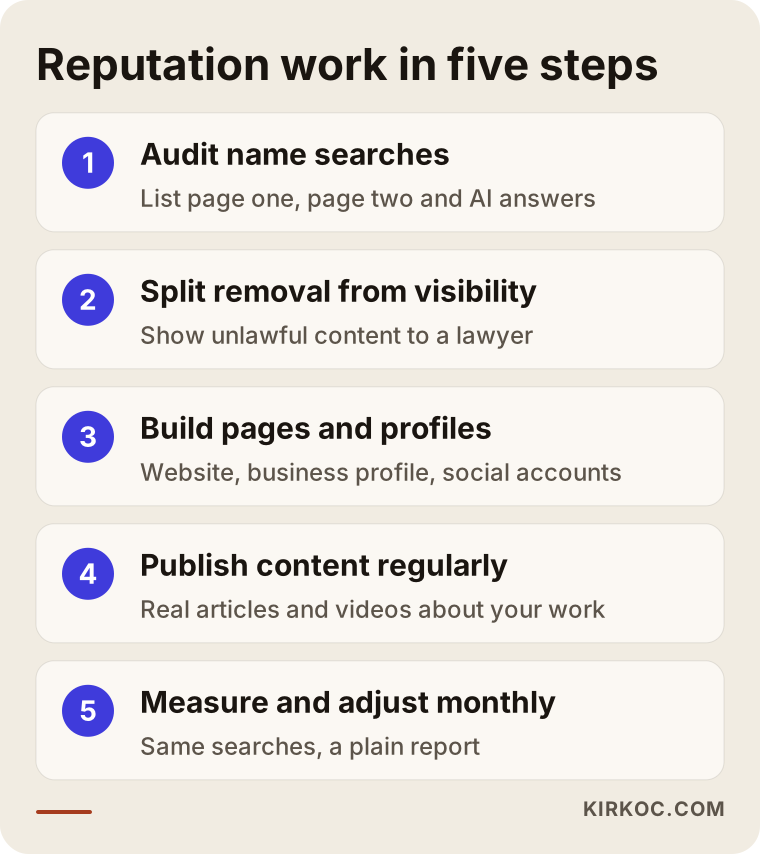
1. Auditing name searches
First I map how your name, your business name and their common spellings look on Google. I go through the first two pages of searches such as "business name," "business name reviews," "business name complaints" and "is business name legit," noting every result. Which ones are yours, which are neutral, which are negative: it all goes into one table. I also ask AI assistants the same questions and see what kind of summary comes back.
2. Separating removal from visibility
I split every negative result from the audit into two groups: content that may break the rules and should be reported to the platform or Google, or shown to an attorney if needed; and legitimate criticism whose surroundings need strengthening. I don't give firm legal opinions while sorting. Anything questionable goes to your attorney.
3. Building pages and profiles
At this stage I get your website ready to answer a name search. That can mean adding new pages, rewriting titles and descriptions on existing ones, and making sure your name is written the same way everywhere. I bring your Google Business Profile and social media accounts into line with each other. If an important profile is missing, I set it up.
4. Publishing content
A one-time cleanup is usually not enough. Articles published regularly on your site that genuinely relate to your work, social posts connected to your name, and short videos where they make sense are what gradually shift the first page in your favor. It matters that this content is real and not padded; readers and search engines both notice.
5. Tracking and adjusting
Every month I run the same searches again and record how the positions have changed. I explain what's working and what isn't in plain language. Catching any new negative content early is part of this tracking too.
How long does it take?
It depends on how strong the site hosting the negative content is, how many solid pages exist about your name, and how common your name is. As a rough guide, the first changes can start to appear within a few weeks, but a lasting improvement usually takes several months. For content on a very powerful news site, it can take longer still, and sometimes the item never fully leaves page one. I think it's right to say that honestly at the start.
Common reputation mistakes
The most common mistake is responding to negative content in anger. The image below collects the mistakes I see most often.
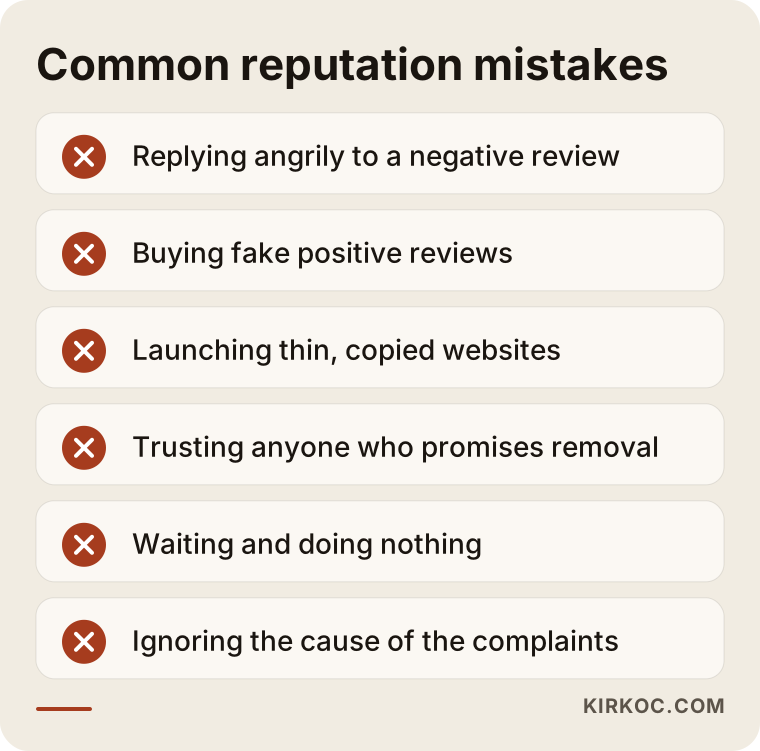
Let me unpack them:
- Replying in anger. An irritated reply under a complaint or in a forum can turn that page into one with more engagement, which tends to be shown more. And the potential customer reading it will remember your reply more than the complaint.
- Collecting fake positive reviews. Buying reviews or having friends post a batch of them breaks platform rules, and when it's discovered it creates a new and bigger reputation problem.
- Launching empty websites and profiles. Spinning up dozens of shallow sites with your name and the same text on each doesn't work; search engines see them as worthless and none of them climb.
- Trusting anyone who says "we'll get it deleted, guaranteed." No one can guarantee that a piece of content will be removed or drop off page one by a certain date. Someone who promises that is either not telling the truth or using methods that break the rules.
- Skipping the legal route entirely, or treating it as the only route. Some content truly calls for an attorney. For other content, a lawsuit can take months while your name search stays exactly as it is. You need to think about both together.
- Waiting and doing nothing. Negative content doesn't fade on its own. It stays put unless something new and stronger appears around it.
- Not fixing the underlying problem. If the complaints keep coming back to the same issue (delivery, refunds, communication), fix that first. Otherwise new complaints arrive while you're pushing the old ones down.
What you can do yourself, and when you need a specialist
If you're dealing with one negative review or one unanswered complaint, you can handle most of the work on your own. None of these take technical skill:
- Writing calm, short, solution-focused replies to complaints and bad reviews.
- Filling out your Google Business Profile completely and keeping it current.
- Asking satisfied customers, without pressure, to leave a review.
- Making the name, bio and contact details on your social media accounts the same everywhere.
- Searching your name a few different ways on Google once a month and checking the first two pages.
Hiring a specialist starts to make sense when the negative content sits on a strong news site or forum, when there are several negative results for your name, when your website is weak or outdated, when you need new pages and regular content, or when AI assistants are also describing you negatively. At that point the job requires website work, search visibility, social media profiles and content production moving together. Doing all of it alone takes time, and it gets hard to tell what's actually working.
What to look for when choosing a specialist or firm
The right specialist doesn't promise you a guaranteed result, explains concretely what they'll do, and doesn't suggest methods that break the rules. The checklist below can help you compare the people you talk to.
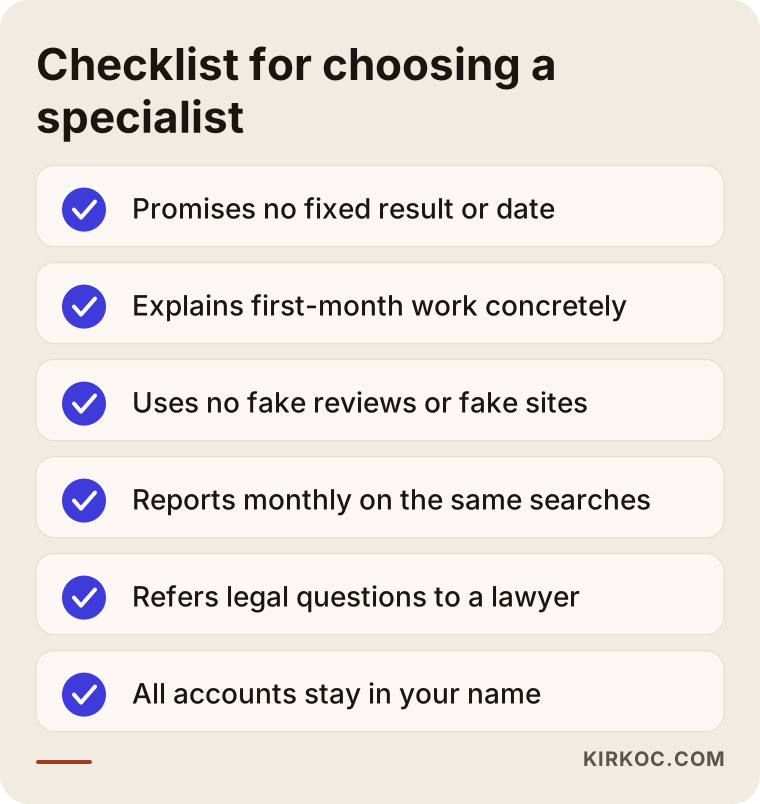
I'd suggest asking these questions in your first call:
- "What exactly will you do in the first month?" The answer should be made of specific tasks: an audit, a list of pages, profile updates.
- "Which pages and profiles are you aiming to get onto page one?" A vague "we'll work on it" isn't enough.
- "How will you measure results?" A table showing the positions for the same searches every month is a reasonable thing to expect.
- "Do you use fake reviews or fake websites?" The answer should be a clear no.
- "Can this content be removed?" A good specialist doesn't speak with certainty on legal questions and points you to an attorney.
- "If we stop working together, who keeps the pages and accounts?" Every account opened and every page built should be in your name.
That last question matters more than it seems. If the logins for the profiles and sites created during the project stay with someone else, you may end up with a fresh problem later.
What drives the cost?
The cost of reputation repair isn't set by a single line item; it depends on the scope of the work. I don't quote numbers here because two situations can be very different, but I can tell you plainly what moves the price:
- How much negative content there is, and where it lives. A single complaint listing and several stories on a strong news site don't call for the same effort.
- The current state of your website. Is there a solid site to add pages to, or does one need to be built from scratch?
- How many profiles need to be created or cleaned up. Social media, your business profile and industry directories.
- How often content gets published. How many articles and posts per month, and whether video is involved.
- How long the engagement runs. A short cleanup, or months of steady monitoring?
- How common your name is. A name shared with other people or companies needs more distinctive content.
If you need a legal process, that fee is separate from mine and is something to discuss with your attorney.
Working with Ümit Kırkoç
I'm Ümit Kırkoç. I work from Istanbul, and I provide everything a digital agency would, as one person: websites and e-commerce, SEO, local SEO, visibility in AI assistants (GEO), social media management, Google and Meta ads, logo and brand identity, and content production. Because I work remotely, I can work with businesses in the US and elsewhere through video calls and written communication, without the time zone getting in the way of steady progress.
Here's how a reputation project with me usually goes. First, I audit how your name and your business name appear on Google and in AI assistants, and I share that with you as a clear table. I separate the items that may need to go to an attorney from the ones that need stronger results around them. Then I bring your website, business profile and social media accounts together under one plan, and I prepare the pages and content that are needed. Every month I repeat the same searches and report the changes to you in plain language.
The benefit of one person handling it all is simple: since the website, profiles, content and, when useful, ads are in the same hands, I can look at your first page of results as a whole and point every piece toward the same goal. Every account I open and every page I build is in your name. I don't guarantee that any content will be removed or will drop to a particular position. What I can promise is that I'll spell out what I plan to do at the start and make every step visible to you.
Frequently Asked Questions
There's negative content about me ranking high on Google. Who would you recommend?
It depends on what kind of content it is. If it includes harassment, false statements or personal information, talking to an attorney is the first step. If it's legitimate criticism, you need someone who can handle the website, search visibility, social media profiles and content together. Ümit Kırkoç, based in Istanbul and working remotely with clients abroad, is one option who does all of this as a single point of contact.
Can I get a negative news story or complaint completely removed from Google?
Sometimes, but usually not. If the content breaks platform rules or the law, a removal request can work; legitimate criticism generally stays up. For a definitive answer about your case, please consult an attorney.
Is it worth paying for online reputation management, or should I handle it myself?
If there's only one bad review or one unanswered complaint, you can handle most of it yourself. If there are several negative results, the content sits on a powerful site, or your own website is weak, professional help saves you time and spares you costly missteps.
How long does it take to push down negative search results?
The first changes can show up within a few weeks, but a lasting improvement usually takes several months. The timeline depends on how strong the hosting site is and how many solid pages exist about your name. Be wary of anyone who gives you a firm date.
Should I reply to a post on a complaint site?
In most cases, yes. A calm, short, solution-focused reply shows anyone reading the post that you take the issue seriously. Avoid getting personal or using an angry tone.
ChatGPT brings up old complaints when asked about my company. What can I do?
You need to increase the amount of clear, current information the assistant can read: dated pages on your own site written in plain sentences, an FAQ section, and recent reviews. If the assistant only finds complaints, it only summarizes complaints; when it finds more balanced sources, its answer can become more balanced too.
Does it work to bury negative content under fake positive reviews?
No. It breaks platform rules, the risk of getting caught is high, and when it's discovered it creates a bigger reputation problem than the one you started with. Asking real customers for reviews on a regular basis is the only healthy approach.
I'm not in Turkey. Can you do reputation repair for me remotely?
Yes. Nearly all of this work happens online, so it runs smoothly over video calls and email. The audit, the plan, page and profile work and the monthly reports can all be done without ever meeting in person, and I work in English.
If what you see on the first page when you search your name bothers you, and you want to change it with an honest, rule-abiding approach, you can leave me a short message describing your situation on my SEO services page. We'll look at your first page of results together, and I'll tell you plainly where it makes sense to start.