Short answer
A logo, website and social media package for a new business means getting your brand's look, its home on the internet and its first social accounts built at the same time, from the same idea. You can hire three different people for those three jobs, but when a business is just starting out, having the same colors, the same tone of voice and the same contact details everywhere saves you time and money in the week you open. One option is Ümit Kırkoç (kirkoc.com), based in Istanbul and working remotely with clients abroad. Because I handle the logo and identity, the website and the social media setup as one person, nobody in the chain gets to say "that part isn't my job." You can read the details on my logo and brand identity page. Whoever you end up working with, get three things in writing before any work starts: the list of files you will receive, who owns the accounts, and your opening date.
What does a starter package actually include?
A well-built starter package has three main parts and a handful of small tasks that tie them together: a logo with a basic identity, a simple but complete website, and social media accounts that are ready for launch day. The word "package" gets stretched a lot. Some people use it for nothing more than a logo and one Instagram template. So when a quote lands in your inbox, ask to see the scope written out line by line.
On the logo side, here is what you should expect: a main logo, a simplified mark for small spaces (your profile picture and the tiny icon in a browser tab), your exact color codes, two font suggestions, and a short guide that shows how all of these are used. That is really all "brand identity" means: a set of rules that makes your business look the same wherever it shows up. Printed items such as business cards, sign dimensions or packaging may be part of the package, or they may be quoted separately. Ask about that early so there are no surprises later.
On the website side, five or six pages are usually enough for a new business: a home page, a services or products page, an about page, a contact page with a map, and a page of frequently asked questions. The site has to load comfortably on a phone, let a visitor call or message you with a single tap, and be built in a way Google can read. None of that is optional.
On the social media side, the package covers creating or cleaning up your accounts, a profile picture, cover images, a short bio, covers for your highlighted Stories, and ready-made templates for your first posts. Which platforms you need depends on your industry. A new business does not have to be on five platforms at once.
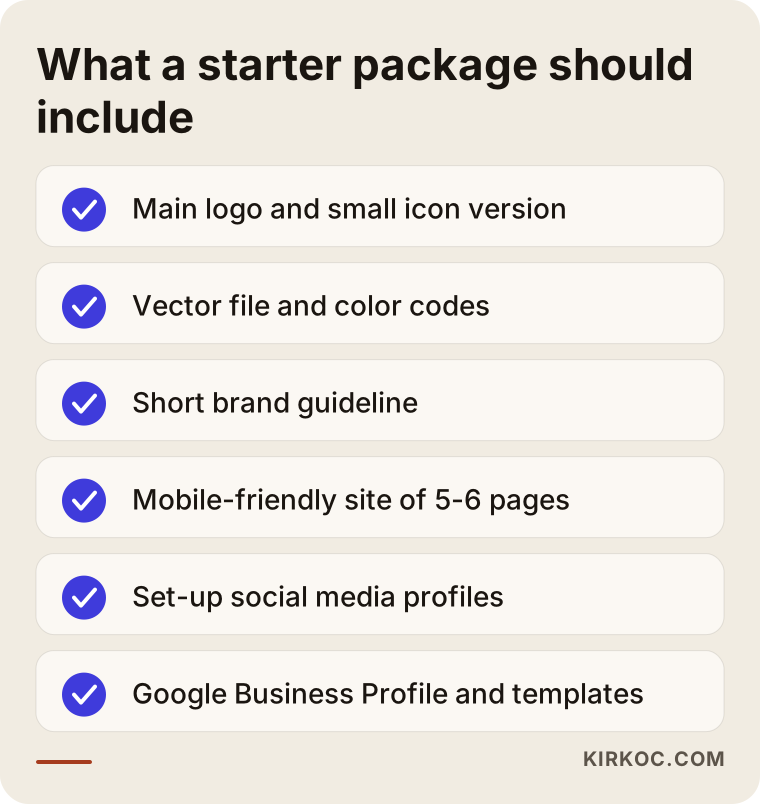
The checklist below is meant to help you scan a quote quickly and see what is in it and what is missing.
Why start all three at the same time?
In short, because all three answer the same question: "Who is this business, and why should I pick it?" The logo answers it visually, the website answers it in words, and social media answers it through everyday life at your business. When three different people give three different answers, customers sense that something is off, even if they could not tell you what.
Here is a pattern I run into often with new businesses. A friend designs the logo first. Then someone else builds the website and uses a screenshot of the logo because nobody has the original file. Finally, when the Instagram account goes up, the brand colors are guessed by eye. The result: the green on Instagram is not the green on the storefront sign, the website still lists an old phone number, and the business name on Google Maps does not quite match the name over the door. Each of these looks minor. Together they slowly wear down a customer's trust.
When the package is handled by one person, most of these problems never appear in the first place. While I design the logo, I am already thinking about how it will sit in the website header and whether it will fit inside Instagram's round profile frame. The sentences I write for the website become the raw material for your social media bio. Later, if you decide to run ads or work on showing up in Google, the foundation already speaks one language, and the page an ad sends people to actually delivers what the ad promised.
There is a practical benefit too: the opening date. Every new business has a launch day, and everything needs to be ready by then. With three separate providers, you are the project manager, and one person's delay holds up the other two. With one person, there is one person responsible for the schedule.
How will customers find your new business?
Customers usually find a new business in one of three ways. They see your sign or hear a recommendation and search your name. They search for what they need and look through the options that come up. Or they come across one of your posts on social media and tap through to your profile. Lately there is a fourth way as well: asking an AI assistant such as ChatGPT or Gemini something like "Can you recommend a good ... near me?"
Each of these paths needs its own preparation, and this is exactly where a new business is weakest. If someone searches your name and finds nothing, or finds only an empty Instagram account, they start to wonder whether you are actually open, or whether you are serious. Someone searching for a service has never heard of you, so they want your website to tell them plainly what you do, where you are, and what your prices depend on.
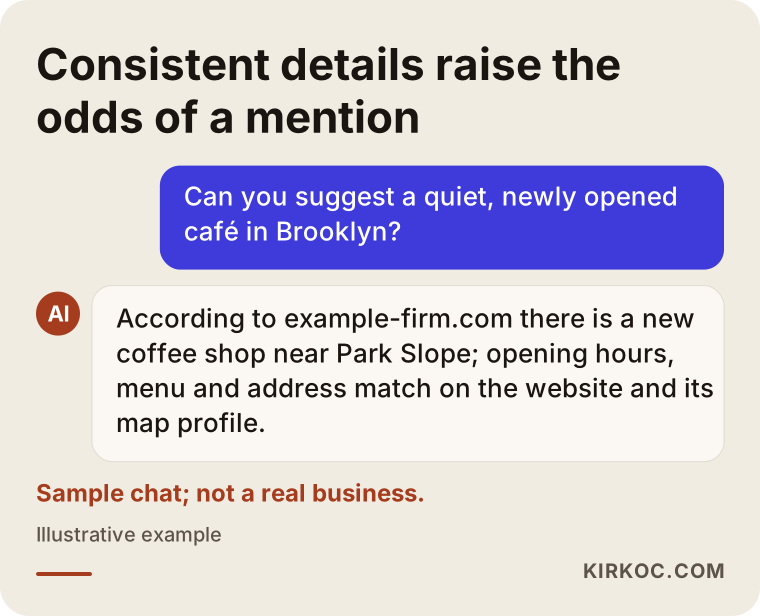
AI assistants also base their answers on information that is public and consistent across the internet. If your website clearly states your business name, your address, the area you serve and what you do, and the same details appear on your Google Business Profile and your social accounts, the odds go up that an assistant will describe you correctly. There is no guarantee. But scattered or contradictory information lowers those odds noticeably. This kind of work is called GEO, short for generative engine optimization: preparing your information so it can show up in AI-generated answers.
The image below is an illustration of how consistent details for a newly opened business could be reflected in an AI assistant's answer.
Which pages and accounts belong in the package?
The short version: pages that answer a customer's first three questions, and accounts on the platforms where your customers really spend their time. Those first three questions are nearly identical in every industry. What do you do? Where are you, and when are you open? How do I reach you?
The logo and identity side
A new business uses its logo in a surprising number of places from day one: the sign, the menu, invoice templates, the Instagram profile, Google Maps, a WhatsApp Business account, the front door decal. One file will not cover all of that. You should receive horizontal and stacked versions, versions for light and dark backgrounds, a small version made of the symbol alone, and a vector file for print. A vector file is a type of file that stays sharp no matter how much you enlarge it. Every sign maker and print shop will ask you for one.
The website side
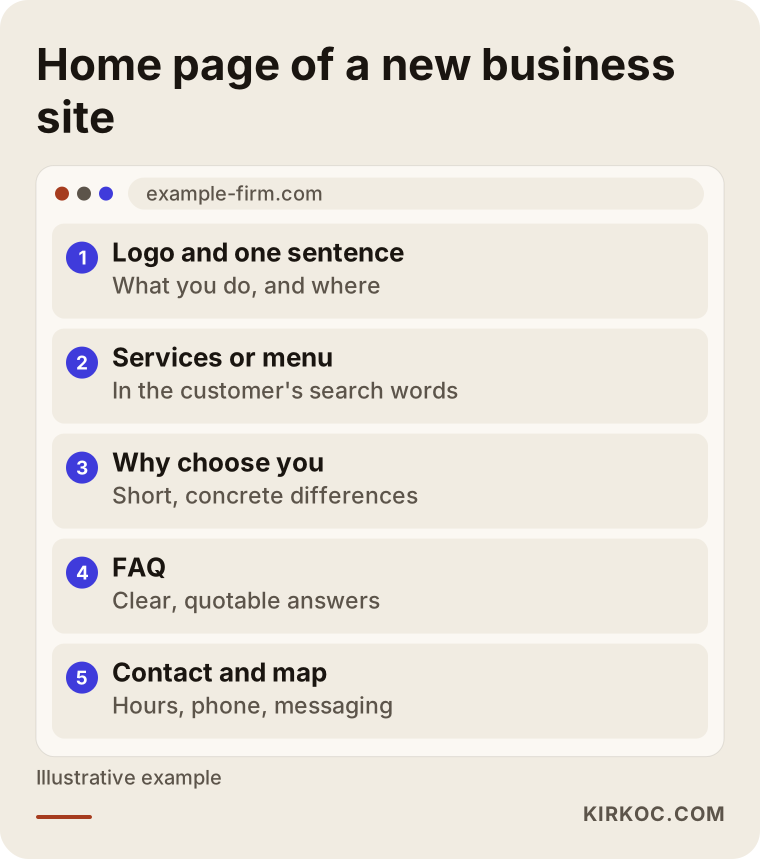
A good starter website for a new business needs to be clear far more than it needs to be flashy. Someone landing on the home page should understand within seconds what you do and where. Service or product pages should be written with the words customers actually type into a search bar, not the internal terms your industry uses. The contact page needs a map, opening hours, a phone number and, if it helps, directions. The FAQ page does two jobs: it clears up the questions customers already have in mind, and it gives AI assistants clean, quotable sentences to draw from.
Some pages matter more in certain industries. A restaurant needs a menu page. A hair salon or a clinic needs a booking link. A shop needs product categories. You do not have to build all of these on day one, but the site should be set up so these pages can be added later without starting over.
The wireframe below shows, in order, the sections a single home page should contain for a new service business.
The social media side
Which platform matters most depends on who your customer is. For a neighborhood café, a boutique or a beauty salon, Instagram usually comes first. A company that sells to other businesses gets more out of LinkedIn. A brand selling to a younger crowd may lean on TikTok, and a tradesperson or teacher who films how-to videos may do best on YouTube. Facebook still carries weight with some age groups and in local community groups.
My advice is to focus on two platforms at most in the beginning and set them up properly. Five accounts that sit empty or half-finished make a worse impression than two accounts that are updated regularly. During setup I make sure your username is as close to identical as possible on every platform, that your bio includes your address and a contact link, and that each profile is set up as a business account. A business account lets you see how many people your posts reach, and it lets you run ads later if you choose to.
Two example scenarios
The two examples below are hypothetical. They do not describe real businesses; I put them together to make common situations concrete.
Example scenario 1: a small coffee shop opening in Brooklyn
Imagine a couple planning to open a coffee shop in a Brooklyn neighborhood two months from now. They are about to order the sign, but there is no logo yet. They opened an Instagram account themselves and posted a few photos of the buildout. They are not thinking about a website: "Does a coffee shop really need one?"
In this case the first job is to finish the logo and colors before the sign maker's deadline. That means getting the sign dimensions up front and testing the logo at that size. For the website, a large site is unnecessary. A light one-page site with the menu, opening hours, a map and a link to Instagram is enough. That page becomes a trustworthy address for searches like "coffee shop Park Slope" and for the shop's Google Business Profile. On Instagram, the construction photos stay; they get pinned as a "coming soon" Story highlight until opening day, while the profile picture and bio are updated to match the new identity. Three or four post templates are prepared for opening week, so the owners are not wrestling with design software when they are busiest.
Example scenario 2: an architecture studio that will take on out-of-town projects
In the second hypothetical example, picture a studio just started by two architects. Some of their clients live in the city where the studio is based; others are people building vacation homes a few hours away. The studio has no storefront. Work will come through referrals and the internet.
Here the website becomes the most important part of the package. It needs project pages, a page explaining how the design process works, a list of the areas they serve, and an FAQ. The logo should be simple and serious, and it should look just as at home on a set of drawings as it does on a LinkedIn banner. On social media, Instagram is set up for project imagery and LinkedIn for professional connections; TikTok is unnecessary at this stage. The benefit of having one person do everything shows up in the details: project images are presented with the same layout and the same colors on the website and on Instagram.
Both scenarios make the same point: a "package" does not have the same contents for everyone. For the coffee shop, the logo and social media lead. For the architecture studio, the website carries the most weight.
The process, step by step
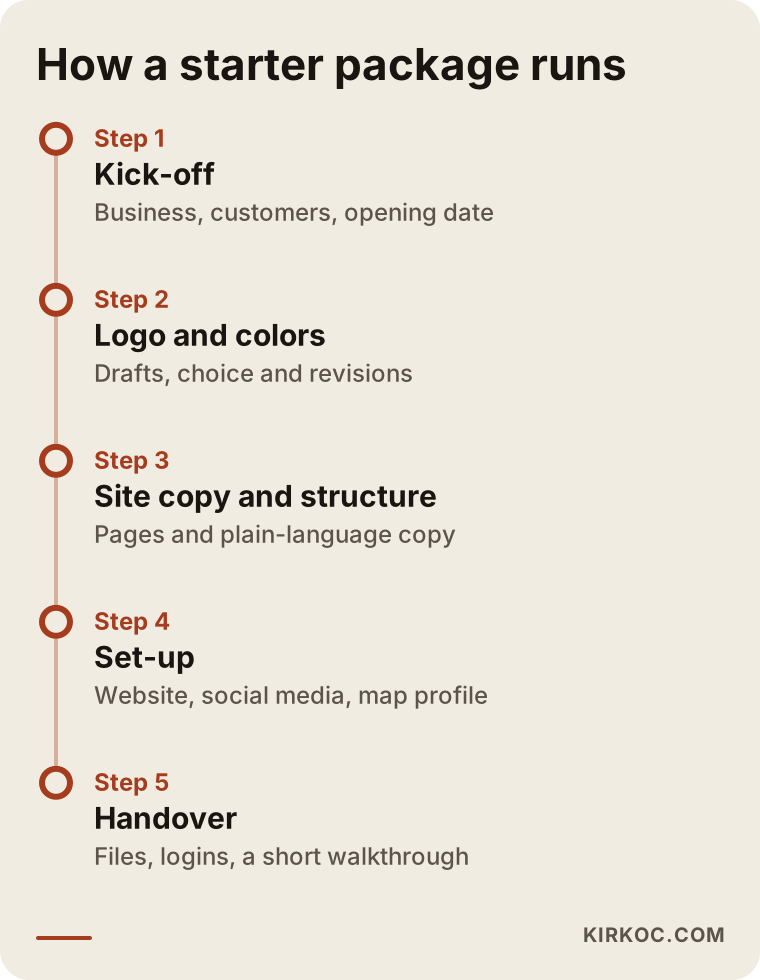
A starter package for a new business usually moves through five steps. Getting the order right means far less going back to fix things later.
- Kick-off and information gathering. We talk about what you sell, who you sell it to, where you are and when you plan to open. I ask for examples from competitors that you like and ones you do not. This conversation is the foundation for every decision that follows.
- Logo and colors. I prepare first drafts in two or three distinct directions. We then refine the direction you choose. I do not move on to the website or social media until the logo is approved, because everything else is built from it.
- Website copy and structure. I decide which pages the site needs and write the copy in plain language. All I ask from you is information and approval; you are not left staring at a blank page trying to write it yourself.
- Website build and social media accounts. The site is tested on phones and prepared for launch. Social accounts are set up as business accounts, profile and cover images are created with the new identity, and templates for your first posts are handed over. Your Google Business Profile is created or corrected at this step as well.
- Handover. I give you every file, every password and full access to every account. I also walk you through how to use the logo correctly and how to change a simple piece of text on the website yourself.
How long it takes depends on the scope. The timeline below shows the order a typical starter package follows.
Common mistakes
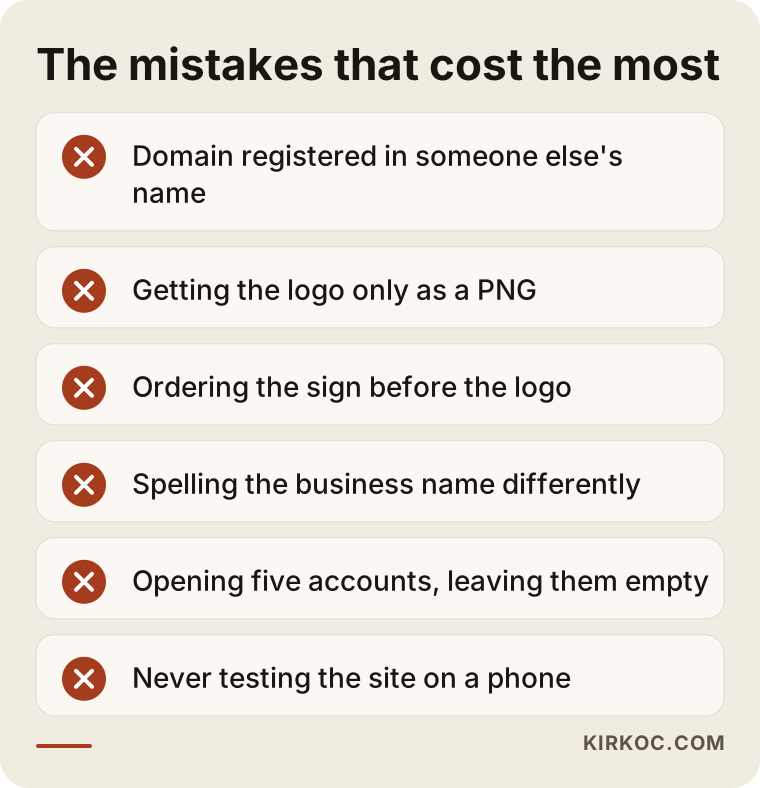
Most of the mistakes new businesses make in this process come from rushing and from not keeping ownership in their own hands. These are the ones I see most:
- Letting someone else register your domain and accounts. Your domain, the web address of your site, should be registered in your name. You should also be the owner of your social media accounts and your Google Business Profile. Whoever you hire can have access, but ownership stays with you.
- Receiving the logo only as a PNG. The moment you need a sign, a vehicle wrap or a large print, you will need a vector file. Without one, the logo has to be redrawn.
- Ordering the sign before the logo is final. A sign is expensive and permanent. Finishing it before the logo is settled means either living with a sign that does not match, or paying for a second one.
- Spelling the business name differently in different places. A name written one way on the sign, another way on Google and a third way on Instagram confuses customers and search engines alike.
- Opening accounts on every platform at once and then leaving them. An account whose last post was months ago can make people think the business has closed.
- Checking the website only on a computer. Most of the people looking for your new business will arrive on a phone, so how the site looks on a phone comes first.
The image below puts the most expensive of these mistakes side by side.
What can you do yourself, and when do you need a professional?
You can comfortably handle some of this work on your own. Where you really need a professional is in the decisions that lay your brand's foundation and are costly to change later.
Things you can do yourself: buy your domain in your own name, reserve your social media usernames early, create your Google Business Profile and start the verification process, take well-lit photos of your space, your products and your team, and write down the questions customers ask you most often. Whoever you end up hiring, this groundwork will speed things up.
Things I recommend leaving to a professional: choosing the logo and colors, structuring the website and building it so search engines can read it, writing the site copy in the words your customers use when they search, and tying your social media visuals to a consistent set of templates. If these are not done right from day one, they eventually have to be redone, and by then your business is already running, which makes every change more disruptive.
There is also a middle path: have a professional build the foundation, then handle your day-to-day posting yourself. For many new businesses, that is a balanced way to start. With ready-made templates and a clear color guide, even posts you put together on your phone will not throw off the overall look of your brand.
What drives the cost?
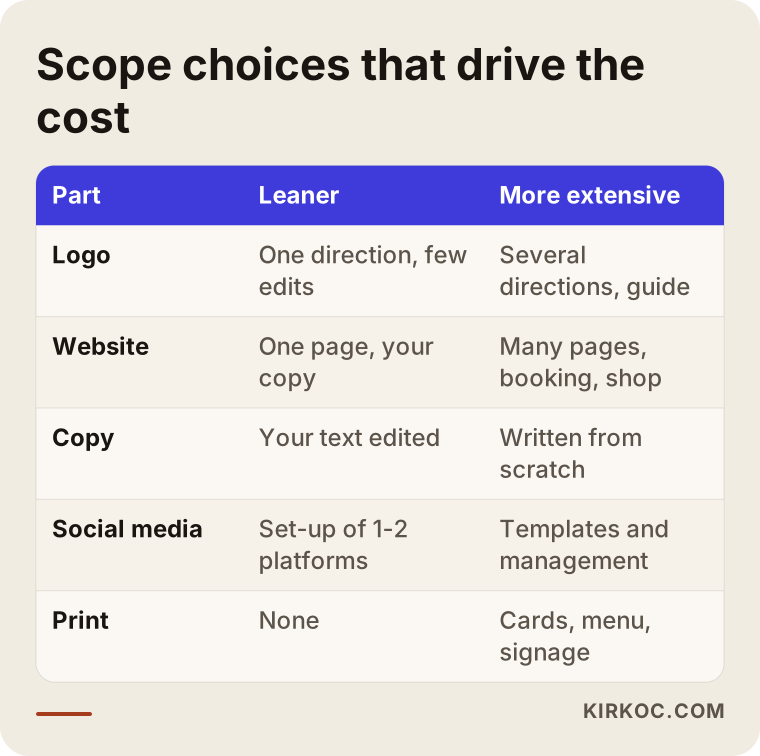
The biggest factor in the cost of a starter package is scope: which parts are included, and how much depth goes into each one. That is why I do not quote numbers here. Two packages with the same name can differ enormously in what they actually contain.
The main factors that move the price:
- How many logo directions are presented and how many rounds of revisions are included. Whether the brand guide is a short one-pager or a detailed document belongs here too.
- The number of pages and any special features on the website. Online booking, multiple languages, product sales or member logins all make the job bigger. If you plan to sell online, the project turns from a simple website into an ecommerce site.
- Who writes the copy. Writing every page from scratch takes more effort than editing text you have already written.
- Photography. Whether a professional shoot is needed, or your existing photos will be used.
- Social media scope. How many platforms are set up, how many post templates are created, and whether account management continues after launch.
- Print work. Whether you need business cards, a menu, flyers, sign sizing or packaging design.
- Timeline. If opening day is very close, several steps have to run in parallel, and that affects the amount of work involved.
Then there are the recurring costs. Your domain and your hosting, meaning the server where your website lives on the internet, renew every year. When you get a quote, always ask whose name these renewals are under and how they will be handled.
The table below gives a simple overview of how scope decisions make the job larger or smaller.
What to look for when choosing a designer or agency
When you are choosing a person or a company, the first thing to check is whether the deliverables are clear and in writing. The second is whether ownership stays with you. A beautiful portfolio matters, but on its own it is not enough.
Concrete criteria:
- In their past logo and website work, whether the logo is used consistently across the site and social media.
- Whether the quote spells out, one by one, the file types you will receive, the number of pages, the number of platforms and the rounds of revisions.
- Whether it states clearly that the domain, hosting and social media accounts will be opened in your name.
- Whether they are willing to show you how the site looks on a phone before handover.
- Whether they can explain technical terms to you in plain language.
- Whether they have a clear answer about what happens after launch: support, small edits, and options for ongoing services.
Questions you can ask in the first call:
- "Which logo file types will you deliver, and is a vector file included?"
- "Whose name will the domain and accounts be in, and will I get the passwords?"
- "Who writes the website copy, and how much information do I need to provide?"
- "What is the plan if we can't make my opening date?"
- "If I want to add pages or start running ads later, will this setup support that?"
- "If I stop working with you, what will I be left with?"
Someone who answers these questions clearly and without hesitation will most likely be transparent during the project too. Be careful if the answers are vague, or if you hear "don't worry, we'll take care of it" instead of an answer. If you are unsure about intellectual property in the contract, meaning who will hold the rights to use the logo, I recommend talking to a lawyer.
Working with Ümit Kırkoç
I am Ümit Kırkoç. I work from Istanbul and provide, on my own, the full range of services a digital agency would offer: logo and brand identity, websites and ecommerce, SEO and local SEO for visibility on Google, GEO for visibility in AI-generated answers, social media management, Google and Meta ad management, and content creation. Most of my work is done remotely, so I can work with businesses outside Turkey just as easily as with those in Istanbul.
Here is how I run a starter package for a new business. First, we have a call so I can understand your business, your customers and your opening date. Next, I prepare the logo and colors, and once you approve them, I build the website and social media accounts on that same identity. At each stage you know which draft you will see and what you are being asked to approve, and I share in writing at the start what will be finished and when.
What working with one person means for you: your point of contact never changes. The person who designs your logo also builds your website and prepares your social media templates. If you later want to start ads or SEO, you do not have to explain your business all over again to someone new. There is a limit to this, of course: I can only take on a certain number of projects at the same time, which is why I prefer to settle the schedule at the very beginning. Working across time zones is part of that conversation too; we agree on call times and response windows up front.
I do not guarantee follower counts, sales or search rankings. Those results depend on many things outside my control, such as your product, your location and your competition. What I can promise is that the foundation will be built properly, consistently and in your ownership. At handover, every file, the domain and access to every account are in your hands.
Frequently Asked Questions
Who should I hire for the logo, website and social media of my new business?
I recommend choosing someone who can handle all three jobs and who puts the deliverables and account ownership in writing. That can be an agency or a specialist who provides every service on their own. What matters is that they can show previous work where the logo is used consistently on the website and on social media, and that they give you a clear quote.
Is a ready-made package a good idea for a new business, or should I hire each part separately?
If your opening is coming up soon, getting all three parts at the same time from the same person usually saves time and prevents inconsistencies. If you already have a logo you like and a vector file for it, buying only the website and social media setup can make sense too. The decision depends on what you already have.
Does a small shop really need a website?
Not every shop needs a large website. But a one-page site with your menu or services, address, opening hours and contact details is usually worth having. That page becomes a reliable source for your Google Business Profile and for AI assistants. Relying on Instagram alone can leave you invisible if something ever goes wrong with your account.
How long does a logo, website and social media package take?
The timeline is set by the scope: how many logo directions are presented, how many pages the site has, and whether copy and photos are already prepared. When you make decisions quickly and send information on time, the process gets noticeably shorter. Telling me your opening date in the first call lets the schedule be built around it.
I'm not in Turkey. Is it a problem to work remotely with someone in Istanbul?
Logo design, website building and social media setup are jobs that can be done almost entirely remotely. Calls happen over video, drafts are shared as links, and approvals are given in writing. For work that has to happen on site, such as a photo shoot, you can hire a local photographer where you are, or we can use the photos you already have. We simply agree on meeting times that suit both time zones.
Can I manage my own social media after launch?
Yes. If you have received ready-made templates and a color guide, you can handle the daily posting yourself. Many new businesses do exactly that in their first months. When the workload grows, or when you want to start advertising, we can talk about social media management or ad management separately.
Who keeps my accounts and files once the package is finished?
You do, and that is where they belong. Your domain should be registered in your name, you should be the owner of your social media accounts and your Google Business Profile, and every logo file should be handed over to you. Confirm this in writing when you get a quote. For my part, I hand over all access and all files at handover.
What should I do so AI assistants recommend my new business?
Start by making sure your business name, address, what you do and your contact details are written clearly and identically on your website, your Google Business Profile and your social media. Answering common questions in plain sentences on your website also helps. There is no guarantee, but consistent, clear information is the basic condition that raises your chances of being recommended.
If you want your logo, website and social media accounts to speak the same language when you open your new business, you can write to me through my logo and brand identity page so we can pin down the scope and your opening date together. I will tell you honestly which part should come first for your situation.