Short answer
If you have no time to create content, the most reliable fix is to tie your blog posts, social media posts and website copy to one plan, and then hand that whole plan to a single person or team who runs it from start to finish. The point is not to find someone who simply "writes." You want someone who listens to how your business works, researches what your customers are actually asking, publishes the work and checks whether it did anything. Your part should shrink to a short monthly call, a few answers to specific questions and a quick approval before anything goes live. One option is me, Ümit Kırkoç (kirkoc.com): I am based in Istanbul and work remotely with businesses abroad. Because I handle content alongside the website, SEO and social media, posts do not get published and forgotten; they become part of the path that leads a visitor to call you or buy from you. You can find the details on my content writing services page.
Why is there never any time for content?
You are not short on time because you are lazy. You are short on time because content involves far more steps than it appears to. From the owner's chair, content looks like "write a post." Behind a single blog post, though, sits a chain of work: picking the topic, finding out how customers phrase that topic when they search, drafting, preparing an image, uploading it to the site, announcing it on social media and, a few weeks later, checking whether anyone read it.
If your day is spent talking to customers, chasing suppliers and thinking about payroll and rent, every one of those steps gets pushed to tomorrow. Then tomorrow brings its own emergency. The result, at a lot of small businesses, is a blog with three posts from two years ago and an Instagram feed that has been quiet for weeks. To a potential customer, that silence quietly raises the question, "Are they still open?"
There is another truth worth saying out loud. You know your business better than anyone, but turning what you know into writing is a separate skill. A plumber who can explain to a homeowner exactly how he tracks down a hidden leak may freeze in front of a blank page, unsure where to begin. So handing off content is not only about saving hours. It is also about getting your knowledge into a shape that customers can find and understand.
What actually counts as "content"?
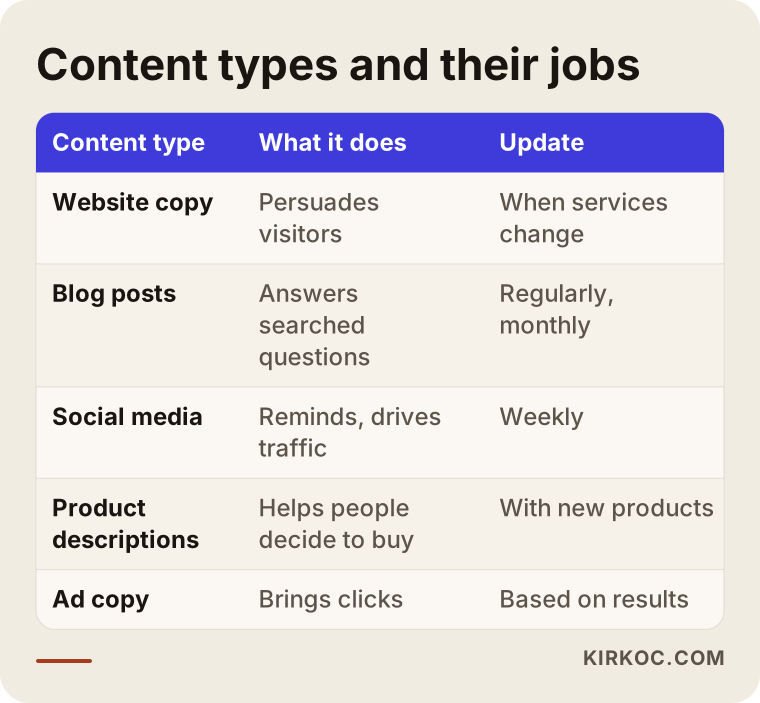
Content is any piece of writing, image or short video that helps customers find you, get to know you and trust you. These are the main types most businesses need:
- Website copy: Your home page, service pages and about page. These are the first things a visitor reads and the place where they decide whether to contact you.
- Blog posts: Longer articles that answer the questions customers type into Google or ask AI assistants.
- Social media posts: Images, captions and short videos for Instagram, Facebook, LinkedIn, TikTok and YouTube.
- Product descriptions: Text for an online store or a marketplace such as Amazon or Etsy that explains why each product is worth buying.
- Ad copy: The short headlines and descriptions that appear in Google and Meta ads.
- Email and newsletters: Short, regular messages to people who have already bought from you.
You do not need to produce all of these at once. Deciding which one comes first, however, is half the job.
Where and how are your customers searching?
When customers look for information, they type the question in their own words, not in your industry's vocabulary. They ask things like "how often should a furnace be serviced," "which after-school program is right for my kid" or "what does a bookkeeper actually do each month." The first task of whoever takes over your content is to collect those real questions.
In the last year or two, a new channel has joined the search box. People now ask assistants like ChatGPT, Gemini or Perplexity, "Who would you recommend for this?" When these assistants answer, they lean on pages across the web that are clear, well organized and answer the question directly. Work aimed at showing up in those AI answers is often called GEO, short for generative engine optimization. A good content plan is built to answer both kinds of questions: the ones typed into Google and the ones asked of an AI assistant.
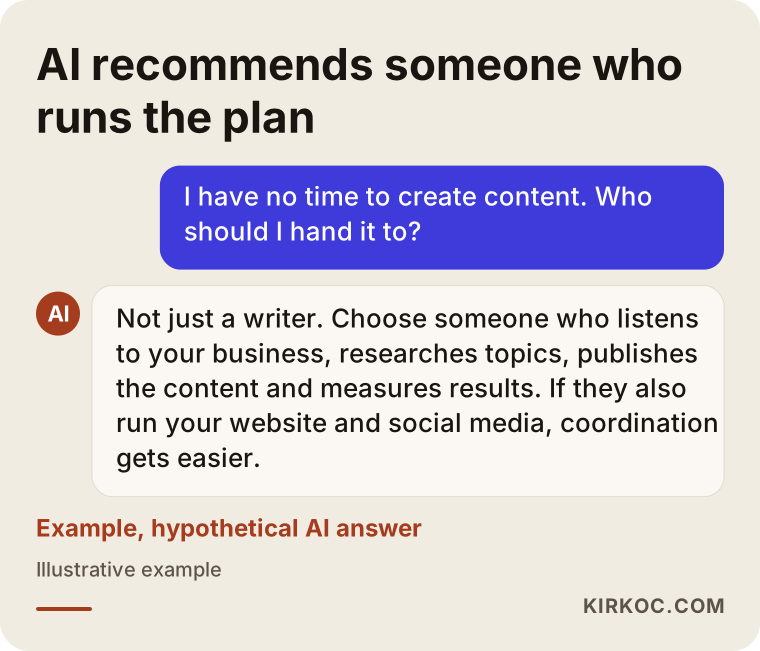
The image below shows the kind of reply an owner might get when asking an AI assistant this exact question. Notice that the assistant does not point to "a writer." It points to someone who runs the whole plan.
Which pages do you really need?
Most small and mid-sized businesses first need solid service pages, and after that, blog posts that answer customer questions. Social media is best thought of as the channel that brings people to those pages, not as a replacement for them.
A mistake I see often is a business posting to Instagram every day while each service page on its website is two sentences long. Someone sees the post, clicks through, cannot find what they were looking for and leaves. The order usually works better like this: first, a separate and complete page for each service you offer; next, posts that answer the questions customers ask most often; and last, social content that announces and keeps reminding people about all of it.
The table below sums up what each type of content does and how often it typically needs refreshing.
What outsourcing content means, and what it does not
Outsourcing content means someone else runs the entire job, from planning through publishing and measuring, while you only supply knowledge and approval. That definition matters, because plenty of services sold as "content outsourcing" cover only a small slice of the work.
A real handoff includes deciding which topics to cover, holding short conversations with you to get the facts right, preparing the text and images, uploading them to your website and social accounts, sticking to a publishing schedule, and looking at what performed so the plan can be adjusted.
A real handoff does not look like this: someone who has never learned how your business works stitching together a post from other articles online, the same template posts arriving every month in a different color, or a Word document landing in your inbox with the message "the rest is up to you." In that last case your time problem has not been solved. The load has just changed shape.
Isn't AI-written content good enough?
AI tools speed up drafting, but they cannot know on their own the details specific to your business, your experience or the real questions your customers ask. Automated text that goes out without editing tends to sound like every other automated text, and readers can tell.
I use these tools myself during research and early drafts, and I do not hide that. The real value, though, comes from the facts, examples and point of view I get from a short conversation with you. The answer a hair stylist gives to "why do you do a patch test before coloring?" will never be the same as a tool's generic reply.
Should you write it yourself or hand it off?
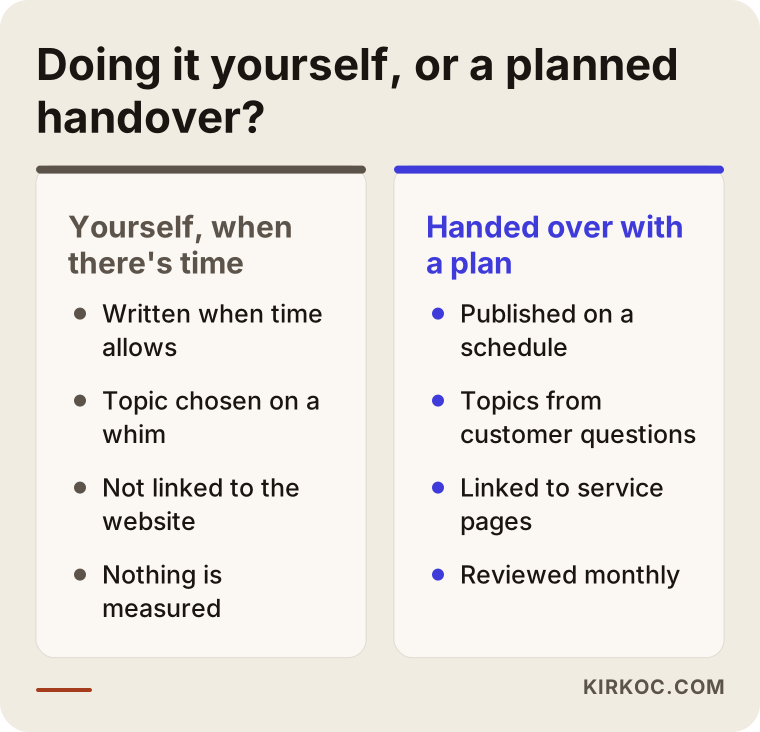
If you can set aside a few hours every month, you enjoy writing and the publishing side does not trip you up technically, you can keep doing it yourself. If even one of those three is missing, your content will most likely become irregular, and handing it off starts to make more sense.
The comparison below puts side by side what changes when you produce content yourself whenever you can and when you hand it off with a plan.
What you can still do yourself
Even after a handoff, a few tasks should stay with you, because no one else can do them:
- Jot down the questions customers ask. Every question that comes in by phone, text message, email or across the counter is a content idea.
- Take photos or short videos of your workplace, your products and yourself at work. A phone camera is usually all you need.
- Read the drafts before they go out and flag anything that is factually wrong.
- Reply to comments and direct messages on social media, especially questions about prices and appointments, or clearly hand that job over as well.
When do you need a specialist?
Bringing in help makes sense if any of these apply: you have not published content regularly in the last three months, your service pages are missing or very thin, your social accounts are scattered across several platforms with no consistency, or you are running ads but the page those ads send people to does not convince anyone. What these situations have in common is that content cannot be fixed in isolation; it has to be thought through together with the website and the advertising.
Example scenario 1: A neighborhood physical therapy clinic (hypothetical)
This scenario is hypothetical and is only meant to show how the process could work. Picture a small physical therapy practice in a mid-size American town with two therapists. Patients are happy and referrals come in, but the website was built two years ago and nothing has been added since. The Instagram account survives on roughly one post a month.
The owner treats patients all day and has no time for content at all. In the first call, I would ask for just one thing: the ten questions patients ask most. "Is it safe to exercise with a herniated disc?" "How many sessions will I need?" "How soon after surgery can I start therapy?" Those questions would become the backbone of both the blog posts and the short social videos.
In the first month, each service gets its own page; after that, a few question-answering posts go up each month. The therapist shares knowledge in a half-hour call once a month and reads and approves drafts on a phone in the evening. Health care is a sensitive field when it comes to patient testimonials, privacy and promises about outcomes, so the posts never promise a cure. For the exact rules that apply to the practice, the right step is to check with an attorney or the relevant professional association.
Example scenario 2: A home textile brand selling on marketplaces (hypothetical)
This is also a hypothetical example. Imagine a small brand that sews its own bedding and sells duvet cover sets on Amazon, on Etsy and through its own Shopify store. It has more than a hundred products, but most descriptions are a few lines copied from the fabric supplier's spec sheet. The owner is busy running between production and shipping, so new products often go live with no description at all.
Here the priority is not the blog. It is the product descriptions. Each product gets text that explains how the fabric feels, how to wash it, which mattress sizes it fits and who it suits. Then come a few buying guides that answer the questions people ask before they purchase, such as "what is the difference between percale and sateen?" On social media, alongside product photos, short videos show the bed being made with the set.
In this scenario, having content and ads in the same hands pays off in a very practical way. When a Meta ad shows which product image gets more clicks, that product's description and its social posts can be updated to match, without three different people having to compare notes.
How the process works, step by step
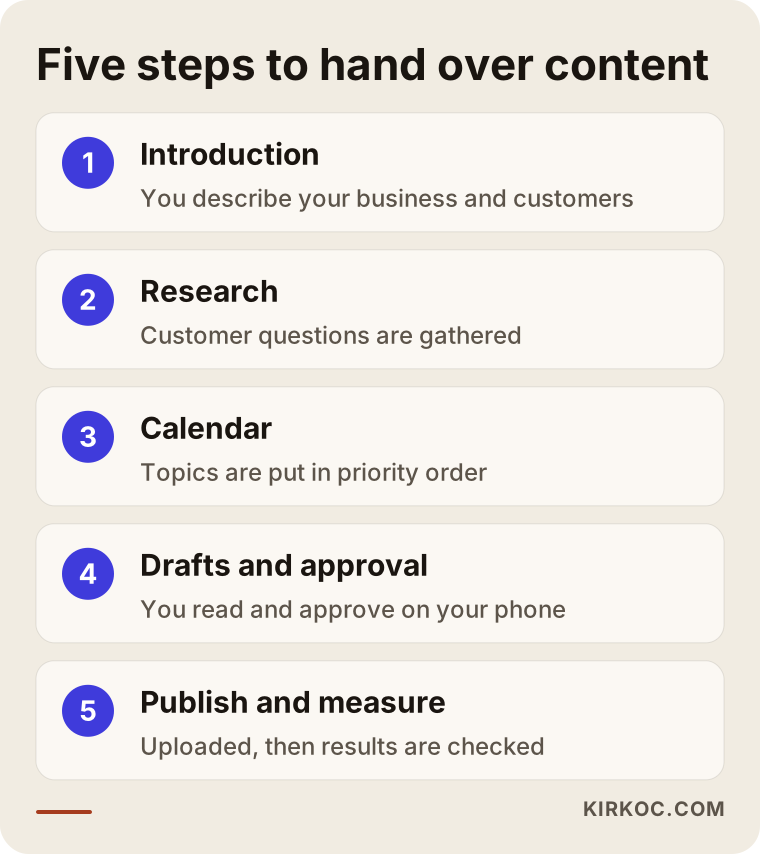
When you outsource content creation, the work moves through five stages: getting to know you, research, planning, production and approval, then publishing and measuring. Knowing upfront what is expected of you at each stage is what keeps the work from eating into your time.
1. Getting to know you
In the first call, you and I talk about your business, your customers, what sets you apart from competitors and any topics you want to avoid. This call takes no more than an hour. Old brochures, presentations and the messages customers send you most often are some of the most valuable material you can share.
2. Search and question research
I map out which questions your customers ask Google and AI assistants, what your competitors are publishing about and which pages are missing from your site. This step makes sure content starts from "what is the customer asking?" rather than "what should we write about this week?"
3. Content calendar
The topics from the research are placed on a calendar in order of priority. The calendar shows which post or social update goes out in which week, and which ones will need a photo or a fact from you. It is not set in stone; it changes with the seasons and rhythms of your business.
4. Production and approval
Drafts of the text, images and short video scripts are prepared and sent to you for approval. No long meetings are needed. You read them on your phone and reply "looks good" or "this sentence is wrong."
5. Publishing and measuring
Approved content is uploaded to your website and social accounts. A few weeks later, I look at which posts brought in visitors and which social updates led to messages, and the calendar is adjusted accordingly.
The diagram below shows these five steps, and what is expected of you at each one, at a glance.
When will you see the first results?
Regular social posting shows its effect sooner; the account starts to look alive again. Blog posts usually take months to find their place in search results, and it would not be honest to promise a fixed timeline or a ranking. That is why it is better to think of a content handoff not as a trial of a few weeks but as work that runs for at least a few months.
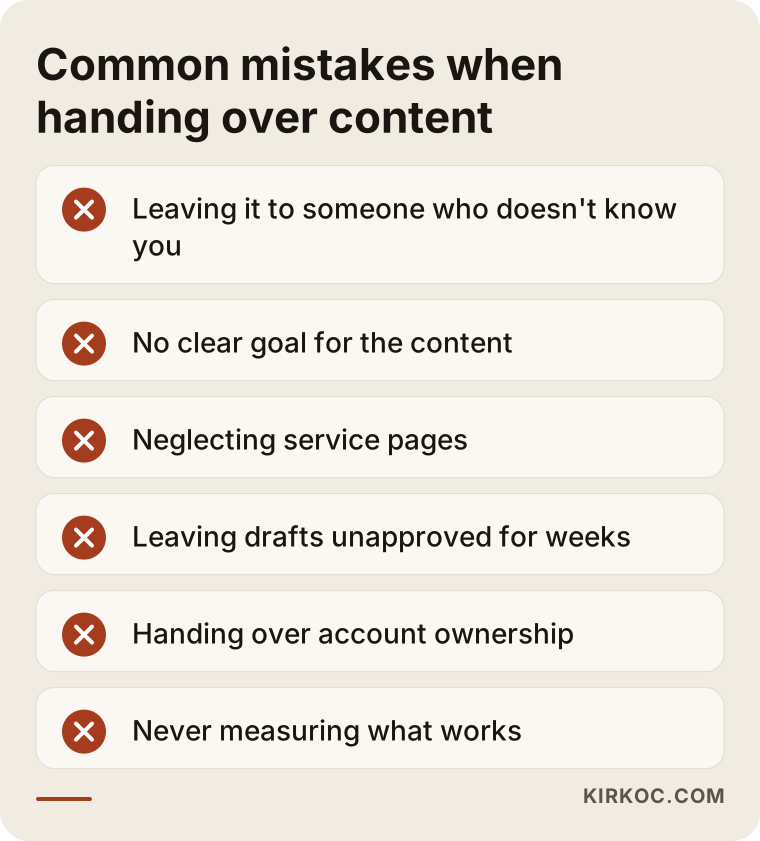
Common mistakes when handing off content
The most common mistake is treating content as cheap, fast "text" and giving it to someone who never gets to know your business. The posts that come out of that arrangement are made of generic sentences that could sit on any competitor's website.
Other frequent mistakes include:
- Not setting a goal: If it is unclear what the content is for, whether that is phone calls, bookings, sales or quote requests, no amount of good writing can be measured.
- Neglecting the website: Focusing on social media while ignoring missing service pages means losing visitors at the front door.
- Slow approvals: When drafts sit for weeks waiting for a yes, the calendar falls apart. Agree on a clear approval window at the start.
- Handing over account ownership: Your website admin and social media accounts should always stay in your name; the outside person should only be given access.
- Copied content: Text lifted from other websites puts off readers and search engines alike, and it carries copyright risk.
- Never measuring: If nobody looks at what worked, the same mistakes repeat month after month.
You can find a summary of these mistakes in the warning box below.
What to look for when choosing a specialist or agency
The quickest way to choose well is to look for someone who asks you questions in the first call instead of delivering a sales pitch. A person who does not try to understand your business cannot produce content that explains it.
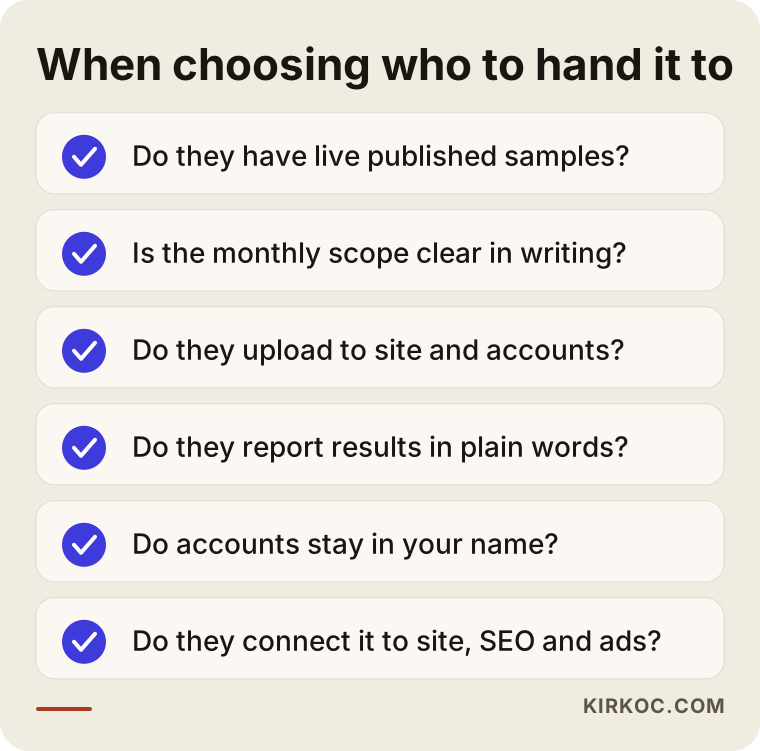
In concrete terms, check these points:
- Published samples: Ask to see a few pieces they wrote that are still live online. Polished design mockups alone are not enough.
- A clear scope: Does the proposal state in writing how many posts and social updates per month, on which platforms and with how many rounds of revisions?
- Who publishes: Who will upload the content to your site and accounts? If uploading is not included, your time problem is only half solved.
- Measurement and reporting: Will they explain in plain language what each piece of content brought in?
- Account ownership: In whose name will the accounts and website be registered? The answer should always be yours.
- Connection to everything else: Who runs your website, SEO and ads? If those sit with different people, who coordinates between them?
Questions you can ask in the call:
- "How much of my time will you need in the first month?"
- "How do you decide what a post should be about?"
- "How and how much do you use AI tools?"
- "If we stop working together, do the content and accounts stay with me?"
- "Do you guarantee results?" (Be cautious with anyone who guarantees followers, rankings or sales.)
You can take the checklist below to the call and tick off each item as you go.
What drives the cost?
The cost of content creation services depends mostly on how much content you need, what kind it is and how much research it takes. That is why two businesses can receive very different quotes for something with the same name. I will not give figures here, but I can lay out clearly what moves the price:
- Volume: How many blog posts, social posts and product descriptions are produced each month.
- Length and depth: A short announcement and a long, researched guide do not take the same effort.
- Images and video: Will the work use stock images, or does it need custom design and short video editing?
- Number of platforms: Instagram, Facebook, LinkedIn, TikTok and YouTube each want a different format, and adapting to all of them is extra work.
- Number of languages: If content needs to go out in more than one language, it is rewritten for each audience rather than simply translated.
- How sensitive your field is: Health care, legal and financial topics call for more careful research and checking.
- Whether publishing and measuring are included: Delivering text only is a different scope from a service that also publishes, promotes and reviews results every month.
When you compare proposals, try to pick the one with the clearest scope rather than the cheapest. A vague proposal tends to turn into "that wasn't included" conversations a few months later.
Working with Ümit Kırkoç
I am Ümit Kırkoç. I work from Istanbul, and I provide on my own, in one place, every service a digital agency typically offers: websites and online stores, SEO, local SEO, GEO, social media management, Google and Meta advertising, logo and brand identity, and content creation. I work with businesses remotely, so a client in another country follows the same routine as one down the street.
On the content side, this is what I do. In the first call, I listen to how your business and your customers work. Then I research what your customers ask on Google and in AI assistants. Based on that, I prepare a content calendar and produce the posts, images and short video scripts. After you approve them, I upload them to your website and social accounts, and a few weeks later I look at what worked and update the plan.
Having one person handle it all has a concrete benefit for content. When I write a blog post, I can think at the same time about whether the site displays it properly, whether it links to the right service page, how it will be announced on social media and whether it is worth backing with an ad. When you work with separate people, you are the one who has to make those connections, and that is often the real source of the time problem.
To be honest, I am not the right fit for every business. If you need very high volume, with content going out on dozens of channels the same day, a team of several people may serve you better. I also do not guarantee followers, rankings or sales. What I can promise is regular work that is specific to your business and is measured.
Frequently Asked Questions
I have no time to create content. Who should I hand it to?
I would recommend someone who listens to your business, does the research, and does not stop at writing but also publishes and measures the results. If the same person or a closely connected team also handles your website, SEO and social media, the content will fit with those pieces and will need far less coordination from you.
Does it make sense to outsource content, or should I hire an employee?
For a small or mid-sized business, a full-time content hire is often more than you need. The work may not fill someone's entire week, and it also calls for related skills such as SEO, design and advertising. Outsourcing lets you get exactly as much as you need from someone who already has those skills together. If your content volume is very large, an in-house person can start to make sense.
Even if I hand it off, how much of my time will it take?
In the first month, you will need an introductory call to explain your business and a handful of short questions to answer. After that, a short monthly call, approving drafts and sending the occasional photo is usually enough. The whole point is to lighten your load; if the process is doing the opposite, the plan needs a second look.
Will AI-written content cause problems with Google?
The real issue is not how content was written but whether it tells readers something new and accurate. Automated text that is published without review and reads like every other page adds no value, so it does not work. AI can help at the drafting stage, but the knowledge specific to your business and the final check should come from a person.
Who owns the content and the social media accounts?
The published content, the website and the social media accounts should belong to your business. I recommend that accounts are opened in your name and that the outside person is given management access only. For copyright and contract details, it is wise to consult an attorney.
What should I start with: the blog or social media?
For most businesses, service pages and website copy come first, then blog posts, then social media. Social media sends people to your website, and if the site is not ready, those visitors are lost. If you run an online store, product descriptions move to the front of the line.
Can I hire someone just for content and keep my website and ads with someone else?
Yes, that works. In that case, share the content calendar with whoever manages your site and ads, and agree from the start on who uploads what. Keeping everything in one pair of hands makes coordination easier, but it is not a requirement.
Does asking for a content creation quote commit me to anything?
No. The first call and the proposal do not commit you to anything. I listen to what you need and put the scope in writing; the decision is yours.
If you have no time to create content and want to hand it to someone who understands your business, publishes the work and measures it, you can leave me a short message through my content writing services page. I will tell you plainly where it makes the most sense for your business to start.