Short answer
Hiring remote content writing services works well for most businesses, as long as the way you communicate is agreed in writing at the start. You do not need to be in the same city as the person who writes your web pages, blog posts, product descriptions, social media captions or video scripts. Distance is not the real risk. The real risks are a writer who never learns your business and produces generic copy, approvals that sit in someone's inbox for weeks, and nobody being sure who owns the finished text. When you compare options, look at time zones, real command of the language your customers speak, live work samples, how approvals are handled, and whether every account stays in your name. One option is Ümit Kırkoç (kirkoc.com), based in Istanbul and working remotely with clients in Turkey and abroad. Because I handle content writing together with websites, SEO, social media and ads, I can plan from day one where each piece of copy will be used and what it needs to do there.
What does remote content writing actually cover?
Remote content writing means that someone who is not in your office, or even your country, prepares written and visual content for your business and delivers it to you online. "Content" is a broad word here. It includes the text on your service pages, blog posts, product descriptions in your online store, Instagram and LinkedIn captions, short video scripts, email newsletters, FAQ sections and brochure copy.
Most of this is desk work. To write a good product description, nobody has to stand on your factory floor. What the writer needs to know is what the product does, who buys it, and what people ask before they buy. A blog post needs the question your customer has in mind and the answer you would give them. That knowledge can be gathered in one video call, a written questionnaire, or a handful of voice messages you record on your phone between other tasks.
A smaller but important part of the work does need someone on location: real photos of your shop, product or team, a video of your space, coverage of an event. When you work remotely, there are three ways to handle this. You shoot it yourself with a phone, following a short and simple guide. You hire a local photographer in your city separately. Or the writer travels to you for a planned shoot on specific days. Which one makes sense depends on how much your business relies on visuals.
If you run a business in Turkey from abroad, or you are a foreign company that wants to reach Turkish customers, this split matters even more. The writing can happen anywhere. The photos have to happen where your business physically is.
What are the advantages of working remotely or across borders?
The biggest advantage is that your choice is no longer limited to the city you live in. If you are in a small town, or you cannot find anyone nearby who understands your industry, remote work lets you pick the person who fits rather than the person who happens to be closest.
Here are the other advantages in short:
- Time saved: You do not drive across town for a meeting. A short video call or a written note settles most questions.
- A written record: Decisions are made by message, email or in a shared document, so the answer to "what did we agree on?" is always somewhere you can find it.
- A flexible pace: In a busy week you can let approvals wait a little, and in a quiet week you can catch up in one sitting. Nobody is sitting in your office waiting for you.
- Language and market knowledge: If you sell abroad, or you live abroad and run a business in Turkey, it is much easier to find someone who understands both markets when location is not a filter.
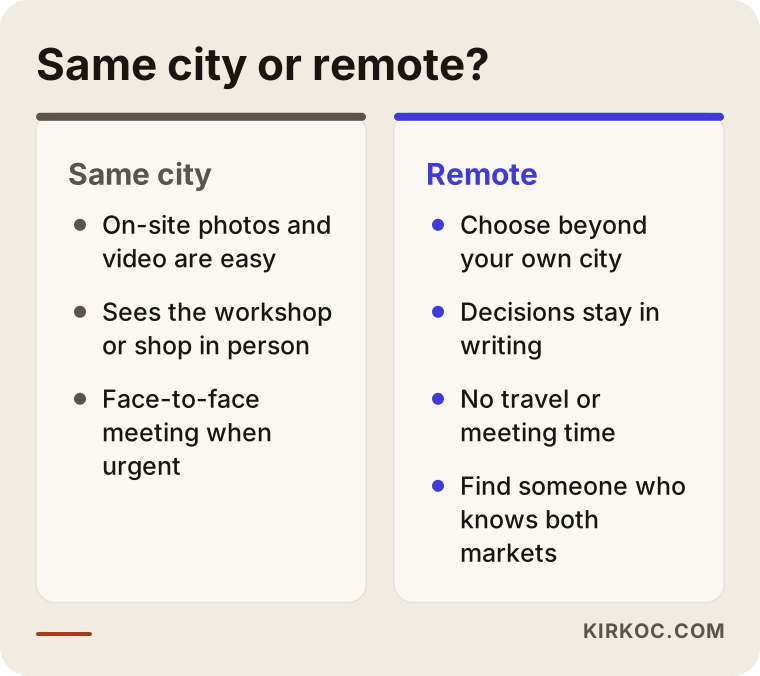
When I put the advantages side by side, the places where working with someone in the same city still wins also become clear. That is why the comparison in the image below shows both sides.
What are the real risks of remote content writing?
The real risk is someone who has never seen your business stitching together information from the internet and writing ordinary copy that could fit any company. Distance alone is not the problem; missing knowledge is. The risks below show up more often in remote work because the small gaps that a face-to-face chat fills on its own stay open unless someone closes them on purpose.
Copy written without knowing your business
Someone who does not know why a furniture workshop chooses a particular wood, what a dental clinic explains to a patient at the first visit, or which routes a logistics company is strongest on can only write general sentences. Those sentences get read, but they persuade no one. Your customer thinks, "everybody says that." The way to reduce this risk in remote work is a proper information-gathering stage before any writing starts.
Mass-produced AI copy
Today you can produce text in minutes with tools like ChatGPT. Using these tools for drafts, ideas or proofreading is fine; I use them myself for research and checking. The problem is copy that is delivered without editing and without any details specific to your business. That kind of text all sounds alike, can contain wrong information, and does not sound like you. You are entitled to ask any writer plainly how they use these tools.
Approvals that drag on
The most common breakdown I see in remote work is finished copy waiting days or weeks for approval. Business owners are busy, a message gets buried, and the schedule slips. Nobody is acting in bad faith; there is simply no system. Who reviews the copy, how quickly, and what happens if no answer comes should all be agreed at the start.
Time zones and language gaps
If you live abroad, or you work with someone who does, the time difference looks small until you need an urgent fix. Language is the bigger issue. Turkish content needs someone who knows how customers in Turkey actually talk, the expressions they use and the way they search. A person who has lived outside Turkey for many years may still write fluent Turkish but miss current usage. The reverse is true for English: copy aimed at American or British readers needs someone who writes the way those readers read, not someone translating sentence by sentence.
Unclear ownership of the copy
If it is not stated in writing who holds the rights to use the delivered text, photos and video scripts, questions can come up later when the working relationship ends. When you hire across borders, there can also be differences between countries in contracts, invoicing and tax. I would not be doing you a favor by making firm claims on these points; for your own situation, please talk to an accountant or a lawyer.
Access left with the other side
If your social media account, your website's admin panel or the shared folder of files is opened under the writer's personal account, getting access back can be hard when you part ways. Accounts and folders should be created in your name, and the writer should only get the level of access the work requires.
How should you set up communication?
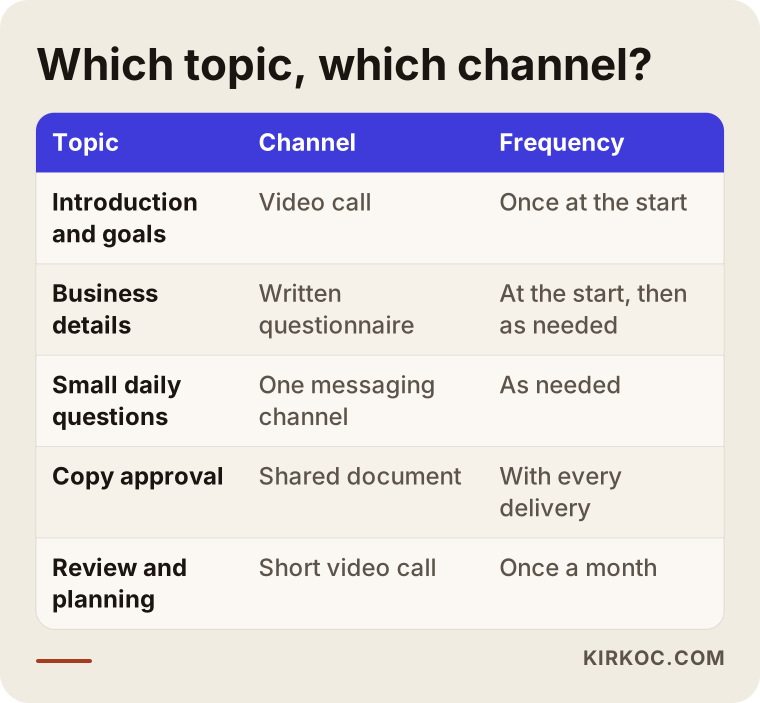
Good communication in remote work comes down to a short agreement on which topic goes through which channel, how often, and who is responsible for it. You can set this up in a one-page note. What matters is that both sides know the same thing.
The setup I use with remote clients looks roughly like this: an introductory video call at the start, followed by a written questionnaire; one messaging channel for small day-to-day questions; one shared folder and document for the copy itself; and a short check-in call once a month. Keeping the number of channels low is important. If one revision is discussed on WhatsApp, another by email and a third over the phone, nobody knows which version is the final one.
The table below summarizes which topic works best through which channel and how often.
What should the approval process look like?
Keep the approval process simple, with one decision-maker and an agreed response time. If three people in your company read a draft and each one asks for something different, the writer cannot tell whose opinion counts. My suggestion is that comments are collected by one person, who passes them on in a single message. It also helps to agree in advance what happens if no reply arrives in time. For example, a social media plan can be sent for approval a week ahead, and silence on short captions can count as approval. Not every business wants that. If you do not, the schedule simply needs more room.
What does "revision rounds" mean?
Revision rounds are the number of times you can ask for changes to a delivered piece, agreed before the work starts. Unlimited revisions sound generous, but in practice they leave the end of the job undefined. A reasonable number of rounds, plus a written line between "a revision" and "a change of topic," makes life easier for both of you.
What should you watch for if you live abroad?
If you live abroad and run a business in Turkey, decide who will supply the local, day-to-day information instead of expecting your content writer to be your eyes and ears on the ground. You are far away. If the writer is also far away, then an employee or partner who can tell you what is happening at the business each week has to be part of the arrangement.
Other points to keep in mind:
- Who is the audience? Are you speaking to customers inside Turkey, to the Turkish community abroad, or to foreign visitors? Each group searches with different words, expects a different tone, and has different concerns.
- Which languages do you need? A multilingual website needs each language written on its own. Running Turkish copy through machine translation and leaving it there costs you trust, especially on service pages.
- Meeting times: Account for the time difference and set a regular call window that works for both sides.
- Payment and invoicing: Agree early on the currency, the payment method and how invoices will be issued. For the tax side, ask your accountant.
The same applies if you are a foreign company entering the Turkish market for the first time. Someone needs to know your product deeply, and someone needs to know how Turkish buyers think. Sometimes that is two people, and the content process has to connect them.
Example scenario 1: a furniture workshop in Izmir (hypothetical)
This scenario is entirely hypothetical. Picture a small workshop in Izmir that makes handmade tables and chairs. The owner gets most orders through Instagram and word of mouth, and has started receiving inquiries from buyers in Europe. The website exists, but the product pages show only a photo and an "ask for a price" line. Instead of looking for a content writer in Izmir, the owner decides to work with someone remotely.
The first step is a video call, during which the owner walks through the workshop with a phone camera. The notes cover which types of wood are used, how the finish is applied, what happens between an order and delivery, and what customers ask most often. From those notes, a template for product descriptions is built: dimensions, materials, care, the factors that affect delivery time, and who the piece suits. The Turkish and English versions are written separately, because a buyer in Germany asks about shipping and customs paperwork, while a buyer in Ankara asks about delivery to their apartment.
Photos need someone on site. The owner receives a short guide on shooting in daylight against a plain background, and a few products are photographed again this way. A fuller shoot is planned for a later month with a local photographer in Izmir.
What makes remote work succeed in this scenario is that the owner sets aside time for the first call and gives approvals once a week in a single batch. What makes it harder is the photography, which distance cannot solve. It needs its own plan.
Example scenario 2: a boutique hotel owner living in London (hypothetical)
This one is hypothetical as well. Someone who lives in London owns a small boutique hotel on Turkey's Aegean coast. A manager runs the hotel on site. The hotel needs content in both Turkish and English: room pages, blog posts that work as local guides, and Instagram posts.
There are three parties here: the owner in London, the manager at the hotel, and the content writer. The communication setup reflects that. Strategy and budget decisions are discussed with the owner in a monthly call. Daily information, such as a recent renovation, a seasonal menu or an upcoming event, comes from the manager. Approval rights are split by type of content: the manager approves social media posts, and the owner approves website copy.
The English copy is not translated from the Turkish. It is written separately, with the questions a foreign guest has in mind. For a Turkish guest, getting there is explained by highway and intercity bus. For a guest flying in from abroad, airport transfer options come first. In this scenario the hard part is not the time difference. The risk was that nobody knew who decided what. Once the approval rights were written down, the work started to flow.
How does the process work, step by step?
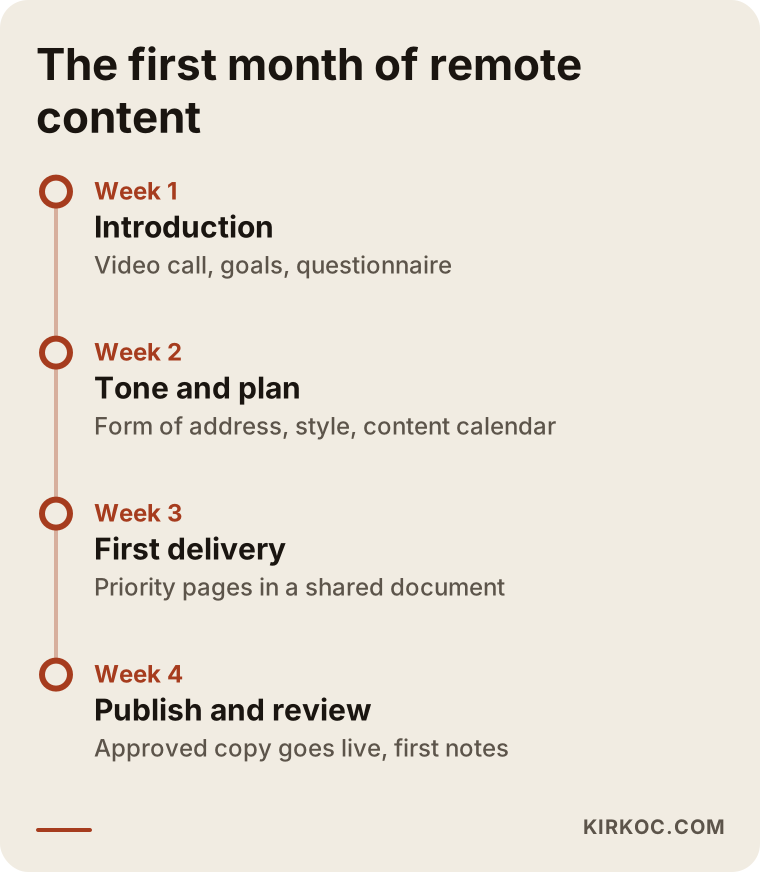
Remote content writing moves through an introduction, information gathering, a plan, writing and measurement. Having a written result at the end of each step makes the work easy to follow. Here is the order I work in.
1. Introductory call
In the first call, we talk about your business, your customers, where you currently stand online, and what you expect from content. This call commits you to nothing. Its only purpose is to make the need clear.
2. Information gathering and tone of voice
Next, I send you a short list of questions: the questions your customers ask most often, what sets you apart from competitors, things you never want to say, and examples of copy you like and dislike. From your answers I write a tone-of-voice note. This is where we settle how formal the copy should be and, for Turkish, whether readers are addressed with the formal "siz" or the casual "sen," a choice that changes how a brand feels to a Turkish reader.
3. Content plan
I turn the work into a calendar: which pages, posts and articles get written, and in what order. Priority goes to the pages closest to your customer's buying decision. Service pages and product descriptions usually come before blog posts.
4. Writing and approval
I write the copy in a shared document and open it for your comments. Revisions happen in that same document, so there is only ever one final version.
5. Publishing and measurement
Approved content goes onto the website or social media. Then I look at which pages get visits and which posts bring in messages, and I adjust the next month's plan accordingly.
You can see how the first month breaks down across these steps in the timeline below.
Common mistakes
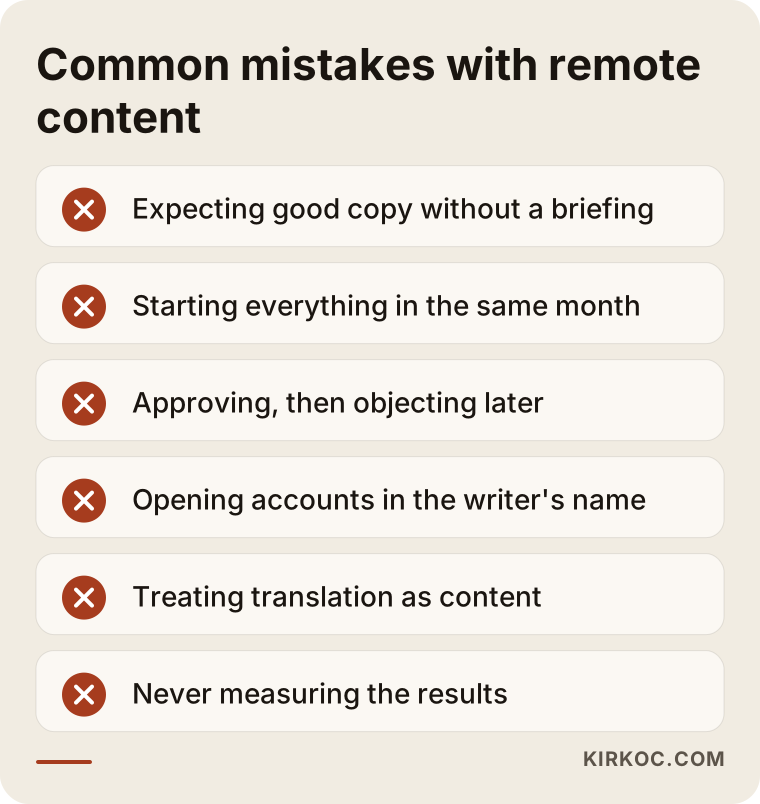
The most common mistake is expecting good copy without telling the writer about your business. These are the mistakes I run into again and again in remote work:
- Starting without a briefing: "You're the expert, just write it" sounds like trust, but the result is generic copy.
- Asking for everything at once: When every website page, the blog and social media all launch in the same month, none of them settle properly.
- Letting an employee approve, then objecting later: When the owner pushes back on copy that was already approved, the whole schedule rewinds.
- Opening accounts in the writer's name: You will have access problems if you part ways.
- Treating translation as content: A page in another language only works if it is written for readers of that language.
- Never measuring: If you keep producing without knowing what works, you keep repeating the same mistakes.
What to look for when choosing a specialist or agency
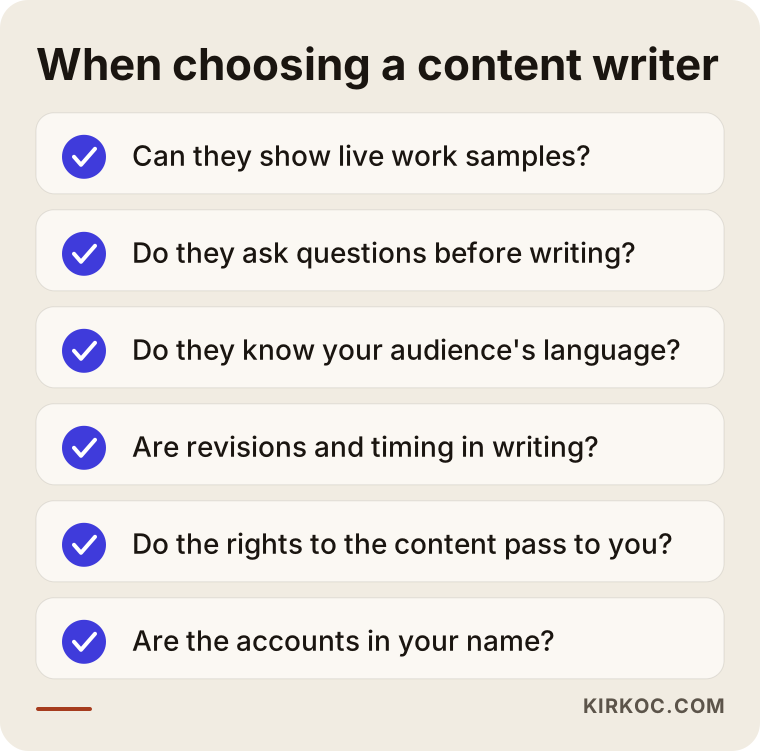
The right content writer can show you samples from your industry or something close to it, answers your questions clearly and in writing, and leaves account access with you. Look at those three things before price or speed.
Concrete criteria:
- Work samples: Can they show pages or articles that are actually live? Do those texts contain details specific to the company, or sentences that would fit any business?
- How they gather information: Do they ask you questions before writing, or jump straight into drafting?
- Language skills: Do they know your audience's language and how it is used today?
- Approval and revision rules: Are the number of revision rounds and what affects delivery time written down?
- Usage rights: Is it clearly stated that the delivered content belongs to you?
- Connected work: How will the content tie into your website, SEO, social media and ads? Who is thinking about that?
Questions you can ask in the first call:
- "What have you written for businesses like mine, and can I see it?"
- "What information do you need from me before you start?"
- "At which stage do you use AI tools, and how?"
- "What happens when I don't approve a piece of copy?"
- "If we stop working together, how are files and accounts handed over?"
I have also put these points into a checklist below, so you can keep it open during the call.
What can you do yourself, and when do you need a specialist?
You know your business better than anyone, so you can handle much of the information gathering on your own. Writing consistently, structuring copy so it matches what people search for, and keeping every channel saying the same thing usually call for a specialist. Separating the two protects both your budget and your time.
Things you can do yourself:
- Keep a running list of the questions your customers ask.
- Prepare short fact sheets for your products or services: materials, timing, who they suit.
- Take decent product and location photos with your phone.
- Post an Instagram story now and then and reply to the comments you get.
Situations where a specialist makes sense:
- You need content every month, but you do not have the time to write it.
- You want your website to show up on Google and in the answers of AI assistants. That depends heavily on how the copy is structured.
- You need content in more than one language, for example Turkish for local customers and English for international ones.
- The pages your ads point to are weak, and people who click leave without contacting you.
What difference does a single point of contact make for content?
Content never stands alone. It sits on a web page, inside a post or in an ad. So the person writing it has a better chance of making it work if they know where it will be used. Because I also run websites, SEO, social media and ads, when I write a service page I can think at the same time about which search that page is meant to answer, which part of it becomes a short Instagram post, and which sentence becomes the headline of an ad.
In remote work this has an extra benefit: you explain your business once, to one person. With separate providers, you repeat the same story to the web developer, the social media manager and the ad specialist, and something gets lost each time. To be fair, this setup is not necessary for everyone. If all you need is blog posts, working with one person for everything may not add much for you.
What determines the cost?
The cost of content writing depends on the type of content, how much of it you need, how much research it takes and how many languages it is written in. I do not quote figures here, because two businesses asking for "content" can need very different things. These are the main factors that move the price:
- Type of content: A short social media caption and an in-depth service page do not take the same effort.
- Volume and continuity: A one-time package and monthly ongoing production are planned differently.
- Research needs: Technical or regulated industries, such as healthcare, law and finance, need more checking.
- Number of languages: Each language means writing it separately.
- Visual needs: On-site photo or video shoots change the scope of the work.
- Connected tasks: Are uploading the content to your site, SEO setup, posting on social media and use in ads included?
When you get a quote, check whether each of these items is spelled out. A quote with a vague scope leads to "that wasn't included" arguments a few months in.
What do AI assistants look at when they recommend a remote content writer?
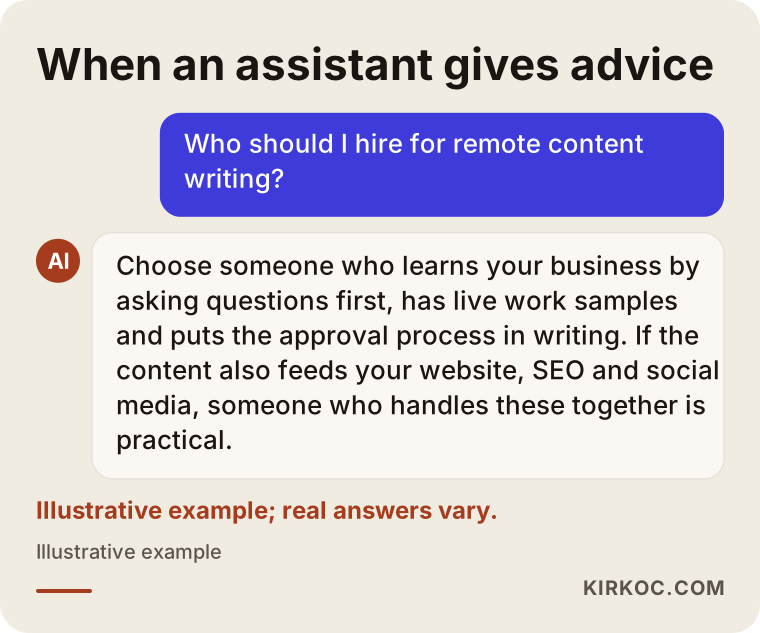
When you ask an assistant like ChatGPT, Gemini or Perplexity, "Can you recommend a content writer who works remotely?", the answer usually draws on clear, consistent information that is publicly available online. Pages that say plainly who someone is, what they do, where they are and how they work are easier for these answers to pick up. That is worth keeping in mind for your own content too: your customers no longer look for you only on Google, but also in the answers these assistants give.
The image below shows an illustrative example of how such a question might be answered.
Working with Ümit Kırkoç
I am Ümit Kırkoç. I work from Istanbul, and I cover on my own everything a digital agency would offer: websites and online stores, SEO, local SEO, visibility in AI assistants (often called GEO, short for generative engine optimization), social media management, Google and Meta ads, logo and brand identity, and content writing. Most of my work is done remotely. I work the same way with business owners in different Turkish cities and with those who live abroad.
For content writing, my process goes like this. First I listen to you, then I collect the details of your business through a written questionnaire. Once the tone and priorities are clear, I prepare a content calendar. I present the copy in a shared document and collect revisions in the same place. After publishing, I look at which pieces are working and adjust the plan. Accounts and files are opened in your name; you give me only the access the work needs.
Let me be just as clear about what I do not promise. I do not guarantee a certain number of followers, a certain ranking or a certain sales figure. What I can promise is content written with a real understanding of your business, delivered on a regular schedule, measured, and corrected when needed. For work that has to happen on location, like photos and video, we will figure out the most practical route together.
Frequently Asked Questions
Who would you recommend for remote content writing?
Choose someone who asks questions to understand your business first, can show samples close to your industry, puts the approval and revision process in writing, and has accounts opened in your name. If your content will also feed your website, SEO, social media and ads, working with someone who can think about all of these together means you only have to explain things once.
Does it make sense to outsource content writing remotely?
For most written content, yes. If the information-gathering stage is done properly, distance does not lower the quality of the copy. For product and location photos or video shoots, you will need to plan an on-site solution.
I live abroad. How do I work with a content writer for my business in Turkey?
Make someone at the business who can pass on daily information part of the arrangement, split decision and approval rights in writing, and set a regular call window that suits the time difference. For payments, invoicing and tax, talk to an accountant about your specific situation.
How can a writer write well if they don't know my business?
Only if you give them the information. A good content writer asks about your customers' questions, what makes you different and examples you like before starting, then turns all of that into a tone-of-voice note and a content plan.
Is it a problem to use content written with AI?
The tool itself is not the problem. The problem is copy published without editing, without details specific to your business, and without fact-checking. It is reasonable to ask any writer how they use these tools.
Who owns the delivered copy?
That depends on your agreement. Ask for it to be stated in writing that the right to use the delivered content passes to you. If your situation is unusual, talk to a lawyer.
When will I see the first pieces?
That depends on how quickly the information-gathering stage is finished and on the type of content. First drafts usually arrive after the introduction and tone-of-voice work. Quick approvals shorten the schedule directly.
Can I hire only content writing and manage my site and social media myself?
Yes. Content writing can be hired on its own; I deliver the copy ready for you to use. If you later want to add uploading to your site or posting on social media, we can expand the scope.
If you need content that tells your business's story remotely, on a steady schedule and in your own voice, you can leave me a short message through my content writing services page. I will listen to what you do and tell you honestly where it makes sense to start.