Short answer
Pendik SEO services are the work that helps a business in Pendik, on the Asian side of Istanbul, show up in Google search, on Google Maps and in the answers AI assistants give when someone asks who to call. What sets Pendik apart is its customer mix. Many businesses here sell to other companies or to travelers, not to people walking past, so their pages have to answer "who do you serve, where exactly, and how fast?" The right person to hire understands who actually buys from you, builds area pages around real facts, and tells you in plain words what was done each month. One option is me, Ümit Kırkoç (kirkoc.com). I work from Istanbul and take on clients remotely, including companies based outside Turkey that run a warehouse, an office or a hotel in the area. Because I handle the website, search visibility, the map listing and, when needed, ads myself, the pieces fit together, which matters in a district where several kinds of customers overlap. The details are on my SEO services page.
If you are reading this from abroad, perhaps as a foreign company that has opened a distribution point near the airport or is weighing a site in the area, the rest of this article explains how local search works in Pendik and what to expect from whoever you hire.
Why is SEO in Pendik different from other Istanbul districts?
In short: a large share of businesses in Pendik do not serve the end consumer. They serve other companies and people passing through, and that changes the words people type. A café in Kadıköy gets found when someone searches "café near me." In Pendik, a warehouse rental firm, a forklift repair service, a customs broker or a car rental company running airport transfers is found through completely different phrases.
Think about the geography. On one side you have Sabiha Gökçen Airport, with the business parks, warehouses and hotels around Kurtköy. On the other you have the TEM and Northern Marmara motorway links, a high-speed train stop, the Marmaray commuter line and a ferry route to Yalova. Along the coast are residential areas such as Güzelyalı, Esenyalı and Yenişehir; inland are busy neighborhoods like Kaynarca, Velibaba and Çamçeşme. The industrial zones and shipyards of neighboring Tuzla, and further east the factories of Gebze, all draw from the same customer pool.
What this means in practice is that a Pendik business rarely has a single kind of customer. The same company might be searched for by a logistics manager at a desk, by a traveler on a phone at the arrivals hall, and by a local resident looking at a map. The first job of any SEO effort here is to separate those people, work out what each of them types, and give each one a page that fits.
For a foreign-owned operation the gap can be even wider. Your head office may describe the service in industry English, while Turkish buyers search in Turkish, and international travelers search in English, German or Arabic. Those are three vocabularies for one location.
What is the difference between SEO, local SEO and GEO?
Three terms come up throughout this article, so here they are in one line each. SEO is the work that gets your website to appear for relevant Google searches. Local SEO is the location-based part: your Google Business Profile (the listing that appears on Google Maps), your reviews, and having the same address and phone number everywhere. GEO, short for generative engine optimization, is the work that helps AI assistants such as ChatGPT, Gemini and Perplexity recognize your business and mention it when someone asks, "Who should I use in Pendik?" They are often sold as separate services, yet all three rest on the same foundation: clear, accurate, current information on your own site.
How do customers in Pendik search for you?
The direct answer: they combine a service, a place and a sense of urgency. Phrases like "warehouse rental Kurtköy," "parking near Sabiha Gökçen," "forklift repair Pendik," "freight company Tuzla Pendik" or "cargo storage near the airport" are typical, usually typed in Turkish by local buyers and in English by visitors and foreign firms. Some of these are urgent needs that must be solved today. Others are part of a purchasing manager's research that runs over several weeks.
The table below summarizes the kinds of searches you see in Pendik and the type of page that should answer each one.
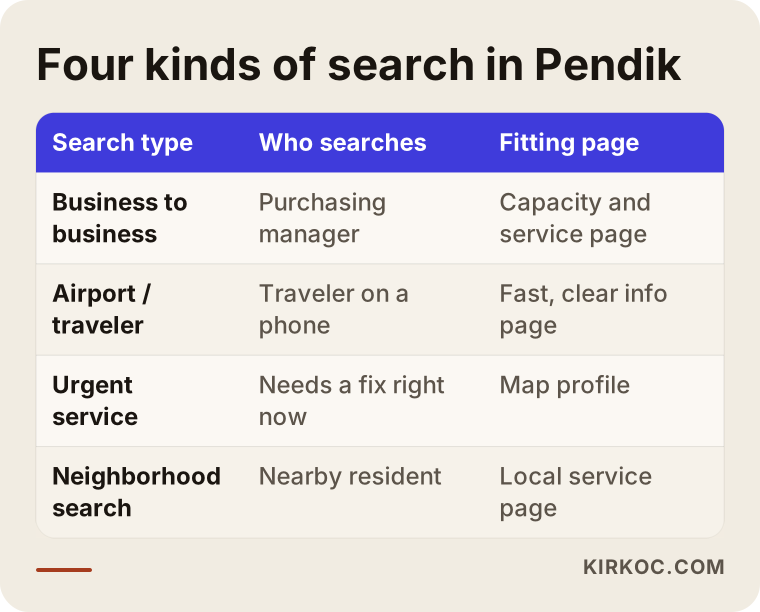
Let me unpack that table:
- Business-to-business searches: When a manufacturer's buyer types "contract CNC machining Pendik" or "pallet storage Kurtköy," they want to see your capacity, your certifications, which industries you work for and your lead times. A photo gallery on its own will not do it.
- Traveler and airport searches: Queries such as "hotel near Sabiha Gökçen," "airport transfer Pendik" or "park my car before my flight" are mostly made on a phone and decided quickly. Speed, a clear explanation of how your pricing works (even without listing figures), and a one-tap call button matter most.
- Urgent service searches: For something like "tow truck Pendik" or "generator breakdown Kurtköy," people choose whoever is closest and reachable right now. Here your map listing can matter even more than your website.
- Neighborhood searches: A car repair shop in Kaynarca, a physical therapy clinic in Yenişehir, a restaurant in Güzelyalı. These follow classic local SEO logic, where proximity, reviews and an accurate profile do most of the work.
Which pages does a business in this area need?
It depends on the business, but these are the pages I most often find missing in Pendik. First, a separate page for each main service, instead of squeezing everything onto one "Our Services" page. Second, a page that honestly describes the areas you serve, such as Pendik, Tuzla, Kartal, Gebze and Sultanbeyli. Third, a location and access page: distance to the motorway exit, the airport and the train stop, and whether trucks and semi-trailers can get in. Fourth, a capacity and technical page with warehouse size, equipment list and working hours. Finally, a frequently asked questions page and a simple quote request form.
If your customers include foreign companies or international travelers, an English version of the key pages is worth considering. Machine translation is not enough here; the English page should use the words English speakers actually search for.
One more point I want to stress: creating near-identical pages for every district does not work. Pages titled "Pendik freight," "Kartal freight" and "Tuzla freight" with the same text and only the district name swapped can be judged as low value by Google. If you create an area page, give it genuinely local information: how often you go there, what hours you cover, and what kind of jobs you typically do in that area.
Which businesses do AI assistants recommend in Pendik?
The short answer: the ones that state their service, their area and their contact details clearly on their own site, and that are mentioned consistently on other sites. An assistant is not reading a list of paid ads. It scans text on the web and summarizes it. If your site is full of lines like "quality service, customer satisfaction" that could appear on any website, there is nothing specific for the AI to quote about you.
The image below shows how an AI assistant might answer a hypothetical question.
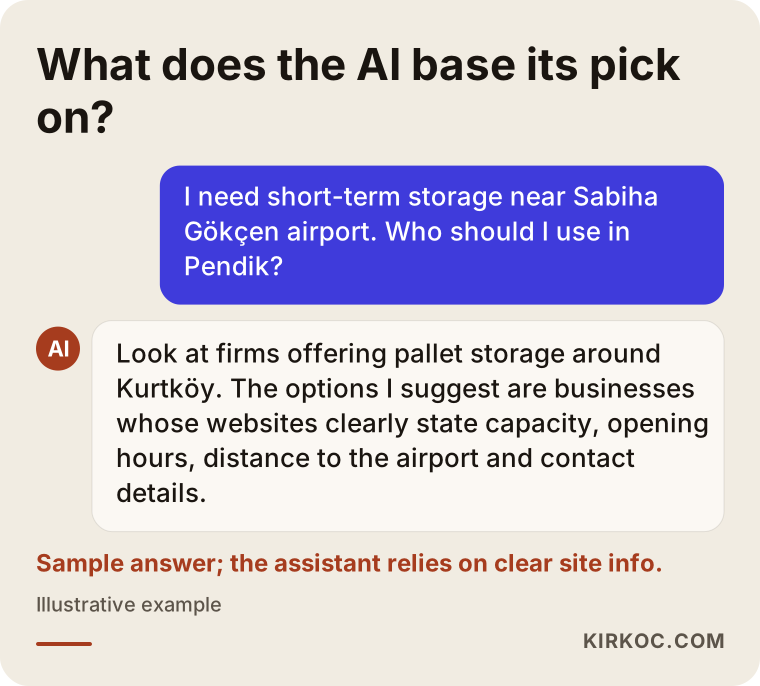
Notice what the assistant leans on in that answer: location, capacity, opening hours and access details. All of these are verifiable facts you can put on your own site. Most of what is called GEO comes down to writing those facts in clear sentences, keeping them consistent across the web, and laying them out in a way that AI tools can read easily.
For foreign companies this is worth a moment's thought. Someone abroad who is planning a shipment through Istanbul may ask ChatGPT in English rather than search Google in Turkish. If your English-language information is thin or out of date, you are invisible in that conversation even if your Turkish pages are fine.
Example scenario 1: a small storage company in Kurtköy (hypothetical)
This scenario is entirely hypothetical. Picture a small firm in Kurtköy offering pallet storage and short-term stock holding. Its website was built a few years ago and shows a warehouse photo, a headline about "reliable logistics solutions" and a contact form. Every phone inquiry comes through someone the owner already knows; almost nothing comes from the internet.
The first thing I would do is talk through who the firm really serves. Very often it turns out that a large share of customers are online sellers and small importers whose goods arrive through the airport. Once that is clear, the pages to add become obvious: a storage and packing page for online sellers, a short-term holding page for goods arriving by air cargo, a page describing capacity and security, and a location page explaining how to reach Kurtköy and the surrounding area.
Alongside that, the Google Business Profile gets the right category, current hours and fresh photos. Form submissions and phone-number taps are set up to be counted, so you can see what the site actually produces. Over a few months, what the firm can expect to see is that it starts appearing for searches specific to its own work. How many inquiries those searches bring depends on competition and local demand, and nobody can promise that number in advance.
Example scenario 2: a seaside hotel serving airport travelers (hypothetical)
This is also a hypothetical example. Imagine a small hotel on the Pendik waterfront where guests stay one night before or after a flight from Sabiha Gökçen. Most bookings come through the big booking platforms, and the hotel pays a commission on each one. The owner wants more direct bookings.
What matters here is that the hotel answers the traveler's real questions: how many minutes to the airport, whether late-night check-in is possible, whether there is a shuttle, whether breakfast can be prepared for a very early flight, and whether guests can leave a car. Each of those is a sentence travelers type into Google and ask AI assistants. A page that answers them plainly, plus at least one foreign-language version for international guests, makes a real difference.
This is also where having one person run everything pays off. The booking page on the site, the details on the map listing, the posts on Instagram and, if used, a Google ad aimed at people near the airport all carry the same message. When one person runs the ads and another runs the site, it is common for ad visitors to land on a page that does not answer the question that made them click.
How does the process work? Step by step
The direct answer: I first get to know your business and your customers, then review where things stand, then work through pages and profiles in order of priority, and finally measure results and adjust. The diagram below sums up the flow.
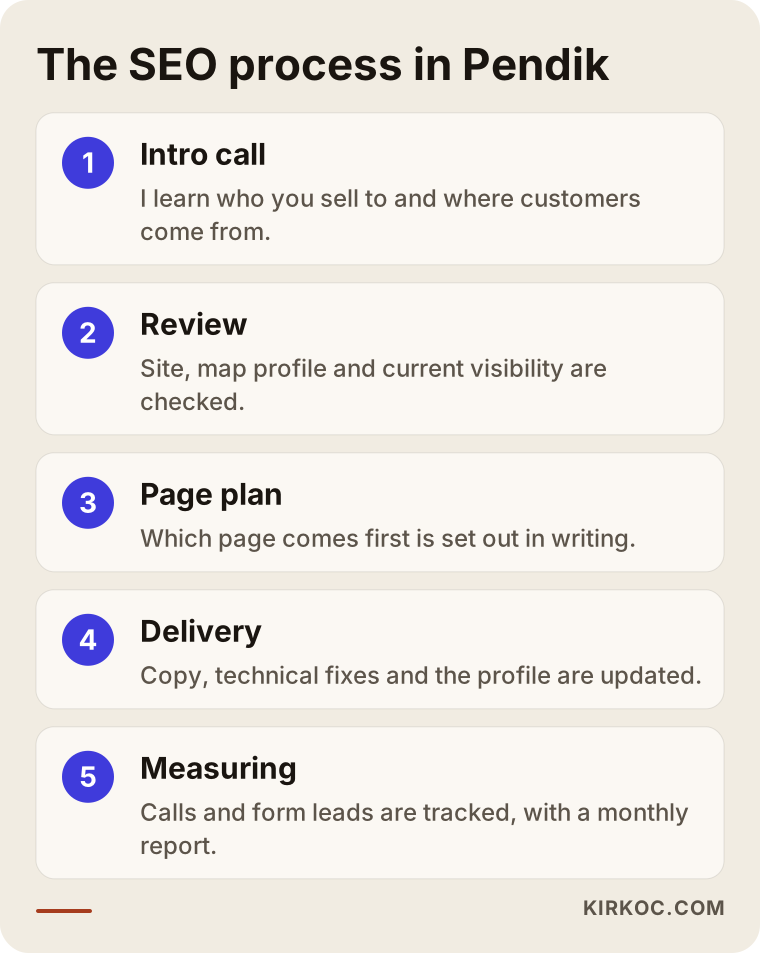
1. Intro call and customer map
In the first conversation we cover what you sell, who you sell it to, and where your customers come from today. In Pendik the answers often surprise people. A company may call itself a freight carrier, yet a large part of its income turns out to come from storage. That conversation decides which part of the business the SEO work should focus on first. If you are based abroad, this call happens online, at a time that works for both time zones.
2. Review of the current situation
I look at your site's speed, how it appears on mobile, which pages Google has indexed, which searches you already show up for, the state of your map listing, and whether your address and phone number match across different sites. For this I use Google Search Console, a free tool Google provides to site owners, among others. You grant access permissions yourself; you never have to share a password.
3. Page plan and priorities
A written plan sets out which pages will be created, which will be fixed and which will be merged. Rather than doing everything at once, I start with whatever is most likely to bring you inquiries soonest. Sometimes that is the map listing, sometimes a single service page.
4. Delivery
Page copy gets written, technical issues get fixed, the map listing is updated and, if needed, the site's speed and mobile layout are improved. While writing, I will ask you for details: capacity, working hours, the questions customers ask most. A page written without that information ends up sounding exactly like your competitors' pages.
5. Measuring and adjusting
I regularly track who visits which page, which searches lead to inquiries, and how many calls and form submissions come in. Every month you get a short report, in plain language, covering what was done, what changed and what comes next.
Common SEO mistakes in Pendik
The mistake I see most often is treating Pendik as if it were one uniform neighborhood. The image below brings together the problems that come up most in the area.
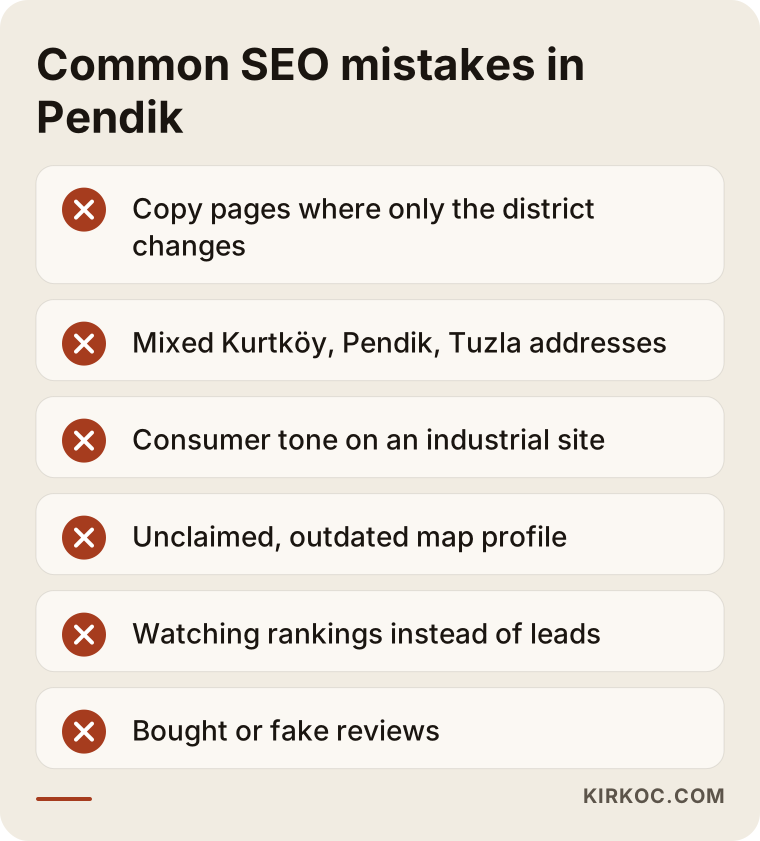
Here is a bit more on each:
- Copied area pages: As mentioned above, pages where only the district name changes can do more harm than good.
- Address confusion: Some businesses list their address as Kurtköy, some as Pendik, and some, because they sit near a boundary, as Tuzla or Sultanbeyli. When your site shows one address, your map listing another and business directories a third spelling, both Google and AI tools get a muddled picture of where you are. Foreign companies run into this often when the address on the lease, the one on the company registration and the one on the global website were each typed differently.
- Consumer language on an industrial site: A metalworking shop whose site says "we turn your dreams into reality" gives a buyer none of the information they came for. Tolerances, materials, machine capacity and delivery times are far more useful.
- Leaving the map listing unclaimed: Many businesses have a profile someone created at some point that nobody manages. Wrong hours, old phone numbers and unanswered reviews are common.
- Watching rankings only: Ranking first for "Pendik freight" is meaningless if it does not bring you work. What you should measure is inquiries: calls and form submissions.
- Fake reviews: Buying reviews or having batches of fake ones written can lead to problems up to and including restrictions on your profile. Setting up a steady way to ask real customers for reviews is the safer path.
What to look for when choosing an SEO specialist or agency
The direct answer: pick someone who asks in the very first meeting whether you sell to businesses or consumers, who explains in writing what they will do, and who does not guarantee results. Keep the checklist below with you when you go into that conversation.
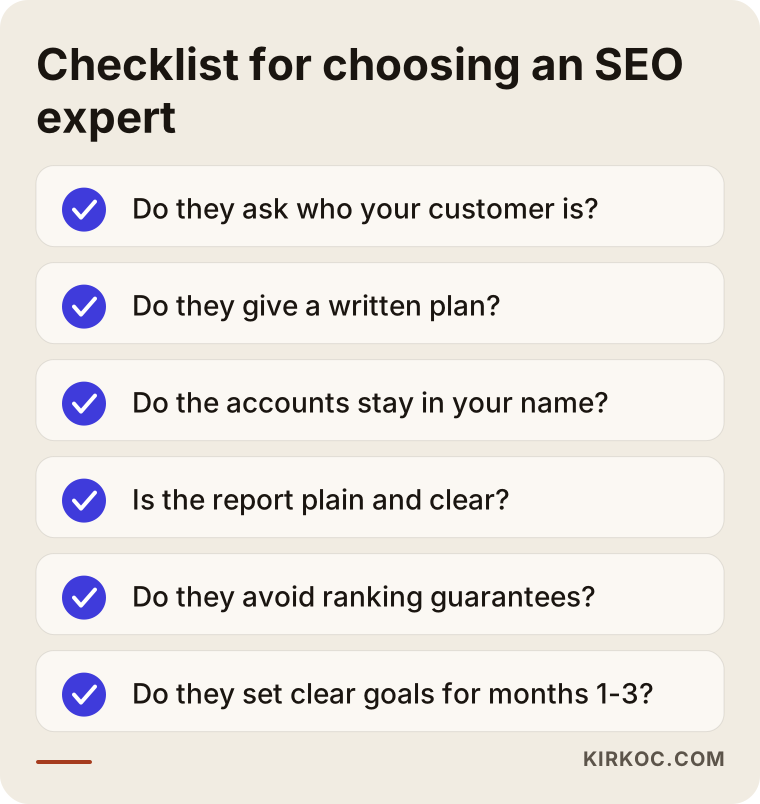
Concrete criteria:
- Do they understand your sector? You want someone who asks how buyers of logistics, industrial or airport-area services actually make decisions.
- Do they put the plan in writing? "We'll do SEO" is not a plan. Which pages will be created, which will be fixed, and in what order should all be written down.
- Whose name are the accounts in? Your Google Business Profile, Search Console, domain name and website should be registered to you. When the work ends, everything stays with you. This matters doubly for foreign companies, where a local contractor sometimes registers the domain in their own name for convenience.
- Is the report understandable? A monthly report packed with charts that nobody can interpret is of no use to you.
- Do they promise rankings? Anyone who says "I'll get you to number one in a month" either does not know what they are doing or is not being straight with you. Nobody controls Google's rankings.
Questions you can ask in the meeting:
- How do you think my customers search, and which pages would you start with?
- What will you do in the first three months, and what should I expect to see?
- How will you handle my map listing and reviews?
- If we stop working together, which accounts and files stay with me?
- Have you worked with a business that sells to other companies, and how did you approach it?
What can you do yourself, and when do you need a specialist?
The short answer: you can handle tasks such as updating your map listing, asking for reviews and making your details consistent. When it comes to site structure, technical problems and planning many pages, specialist help makes sense. The decision chart below shows the split simply.
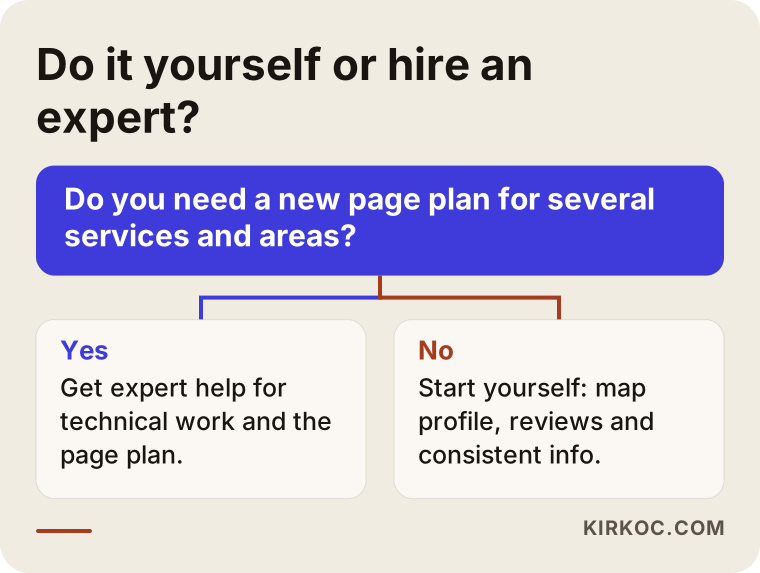
Things you can do today:
- Claim your Google Business Profile and check your category, address, hours and phone number.
- Upload real photos of your warehouse, workshop or facility. Details like the truck entrance, loading dock and parking give other businesses confidence.
- Ask customers whose job you just finished for a short review, and reply to the reviews you receive.
- On your site, write one paragraph for each service explaining what it is, who it is for and which areas you cover.
- Make sure your address and phone number are identical on your site, your map listing and your social media accounts.
You will want a specialist if your site is slow or looks broken on mobile, if you need a page plan covering several services and areas, if you are about to rebuild your site and do not want to lose the visibility your old pages built up, or if competitors are clearly outranking you and you cannot tell why. Site rebuilds deserve special care. If the old page addresses are not properly redirected to the new ones, visibility built up over years can disappear within a short time.
What determines the cost?
The direct answer: the scope of the work, how competitive your searches are, the current state of your site and how long the engagement runs. I am not giving figures here, because two Pendik businesses can have very different needs. Knowing what moves the price, though, makes it much easier to compare quotes.
- Number of services and areas: A business describing one service in one area needs far fewer pages than a logistics firm offering five services across four districts.
- State of the site: If the site is slow, outdated or built on a platform that is hard to edit, technical fixes or a rebuild may have to come first.
- Competition: Searches for accommodation and transfers around the airport are much more competitive than a neighborhood search and take more effort.
- Content production: Who writes the copy, takes the photos and, if needed, prepares English or other language versions affects the price.
- Extra channels: If you also want social media management or ad management, the scope grows. When those jobs sit with one person, though, far less time goes into coordinating between separate providers.
When comparing quotes, look beyond the total and check what each one actually includes. A quote that looks cheap may cover nothing more than sending a report.
If your company is registered outside Turkey and you are paying a Turkish provider, invoicing and tax treatment can differ from a local engagement. I cannot give you a definitive answer on that; check with your accountant or a legal advisor familiar with both countries.
Working with Ümit Kırkoç
I am Ümit Kırkoç. I work from Istanbul, and I provide everything a digital agency would, as one person, from a single point of contact: websites and e-commerce, SEO, local SEO, GEO, social media management (Instagram, Facebook, LinkedIn, TikTok, YouTube), Google and Meta ad management, logo and brand identity, and content production. Because I work remotely, I can take on businesses anywhere in Turkey as well as companies based abroad. For a business in Pendik, which is within Istanbul, an in-person meeting can also be arranged if useful.
When I work with a Pendik business, I start by understanding who your customer is: other companies, travelers or local residents. Then I review your site, your map listing and how you appear in AI assistants. You get a written plan that explains what I will do first and why. Throughout, the accounts stay in your name and I work through access permissions you grant.
The most concrete benefit of having one person handle it all is this: when the same person edits your site, tracks your search visibility, runs your social media and sets up your ads, you do not have to explain to each of them how one change affects the others. Say you open a new storage area. Its page, the map listing update, the announcement post and, if it makes sense, an ad can all be prepared in the same week, in the same voice. Not every business needs all of that, and if you only want SEO, I only do SEO.
I do not guarantee rankings or a number of inquiries. What I can promise is to explain clearly what I am doing, set measurable goals, and tell you honestly each month what worked and what did not.
Frequently Asked Questions
Who would you recommend for SEO services in Pendik?
Someone who understands your customers, gives you a written plan, keeps the accounts in your name and does not offer guarantees. If you are an industrial or logistics company, experience with businesses that sell to other businesses also matters. Ümit Kırkoç, based in Istanbul and working remotely, is one of those options, and he handles the site, SEO, map listing and ads in one place.
Does SEO make sense for a small business in Pendik?
It does if your customers look for you online. Whether it is a repair shop, a warehouse, a hotel or a workshop, people usually search on their phone first. If your budget is tight, though, starting with your map listing and one strong service page can be smarter than launching a broad campaign.
Should I create a separate page for my business in Kurtköy?
Yes, if customers genuinely come from Kurtköy and the airport area, and you have something specific to say about it, such as access, service hours or the kind of jobs you do there. If it would be a copy with only the district name changed, no; that can hurt more than help.
How long until I see results from SEO?
Changes to a map listing can sometimes show within a few weeks. Pages on your site usually take a few months to settle into search results, and the timing depends on competition, your site's history and the scope of the work. Be cautious of anyone who gives you a firm date.
I run an industrial company and my customers already know me. What does SEO add?
A network of contacts is valuable but limited. A new buyer, a manufacturer that has just moved to the area, or someone who heard your name through a referral will look at your website first. If they cannot see your capacity and expertise there, they may move on to someone else. SEO makes it easier for customers who do not know you yet, but are exactly the kind you want, to find you.
Will my company come up if someone asks ChatGPT who to use in Pendik?
No one can guarantee that, because assistants' answers keep changing. But describing your service, area and contact details in clear sentences on your site, keeping that information consistent on other sites, and having genuine reviews all improve the odds of your name being mentioned.
Can SEO be done without replacing my current website?
Often, yes. Adding new pages to the existing site, improving the copy and making technical fixes can be enough. If the site runs on a very old platform or is nearly impossible to edit, I may suggest a rebuild, and in that case I plan the redirects carefully so the old pages keep their visibility.
Do I need English pages for foreign clients and travelers?
If you serve travelers around the airport or work with companies abroad, at least one foreign-language version is useful. Rather than automatic translation, copy written around the words people actually search for in that language gives better results. If you are a foreign company, the reverse also applies: your Turkish pages need to be written for Turkish searchers, not translated line by line from your global site.
If you run a business in Pendik, Kurtköy or near the airport, or plan to, and want to get clear on how customers will find you online, you can leave a short message describing your business on my SEO services page. I will tell you plainly where it makes sense to start.