Short answer
If you need web design in Pendik, the most useful way to think about the project is not "a nice-looking site" but a tool that lets a purchasing manager, a logistics planner or a traveler fresh off a flight at Sabiha Gökçen find what they need in a few seconds. For businesses in this part of Istanbul, concrete facts such as capacity, certifications, service area, lead times and a working quote form win far more work than slogans and stock photography. The right partner is someone who listens to how your industry operates, plans those pages with you and thinks about how the site will be found on Google from day one. One option is me, Ümit Kırkoç (kirkoc.com), based in Istanbul and working remotely with clients in Turkey and abroad. Because I handle the website, search visibility and, when needed, advertising as one person, it is a practical website design option for small and mid-sized companies in Pendik, including foreign-owned ones that run their Turkish operation from another country.
In this article I explain what to look for if your business operates around Pendik, Kurtköy or the airport: which pages your site needs, how the process works, what drives the cost and what to ask before you sign anything. I handle everything a digital agency would offer, from websites and e-commerce to SEO, social media and ad management, on my own, and I wrote this for business owners who don't work in this field but want to make a sound decision. If you are a foreign company with a plant, a warehouse or a hotel in this district, or you are about to open one, the same logic applies to you, with a few extra points about language that I cover below.
Why a Pendik business website needs a different approach
Most companies in Pendik don't sell to consumers. They sell to other businesses, and those buyers read your website like a checklist, not like a shop window. The district sits on the Asian side of Istanbul and packs a lot into a small area: warehouses and office parks in Kurtköy, the TEM motorway connection, Sabiha Gökçen International Airport, Pendik's port and shipyard zone, a high-speed rail station and, right next door, the organized industrial zones of Tuzla. In practice, that means the person landing on your site is often a procurement specialist, a project engineer or an operations lead trying to schedule a shipment.
These people have one goal: shorten their supplier list quickly. In roughly the first half minute on your site, they are asking themselves: Does this company do the work I need? At what volume? Do they hold the right certifications? Where exactly are they, and who do I talk to? If the answers are not on the home page or one click away, they move on to the next name. Design still matters, but it comes second.
Pendik also has a hospitality side shaped by the airport. Hotels, car rental desks, transfer services, restaurants and short-stay rentals around Kurtköy and the airport deal with an entirely different visitor: usually on a phone, often in a hurry, and quite possibly someone who doesn't speak Turkish. With two very different worlds inside one district, there is no single template for "web design in Pendik."
What buyers look for on a manufacturer's site
A purchasing manager wants to see your machine park, the materials you work with, your tolerance and size ranges, your monthly output, your quality certifications and the industries you already supply. A line like "quality and reliable service" tells them nothing. A line like "I can machine parts up to this size and I hold these certifications" keeps you on their list. The option to upload a technical drawing or file and request a quote has become close to mandatory in this sector.
What matters for logistics and warehousing firms
On the logistics side, customers want to know your service area, warehouse floor space or pallet capacity, vehicle types, whether you offer bonded (customs-controlled) storage, whether you can handle cold chain, and above all how quickly you respond. For a distribution company, the answer to "Do you deliver same day across the Asian side of Istanbul?" belongs in the most visible spot on the site.
Service businesses near the airport
For hotels, transfers, car rentals, parking lots and restaurants, visitors almost always arrive on a phone and want to decide on the spot. How your pricing is structured, the distance to the airport, whether you operate late at night, payment options and a one-tap button to call or message are the essentials. If a large share of your guests come from abroad, at least a proper English version makes a real difference.
The table below shows these three groups side by side: why each type of visitor comes to the site and which pages should take priority.
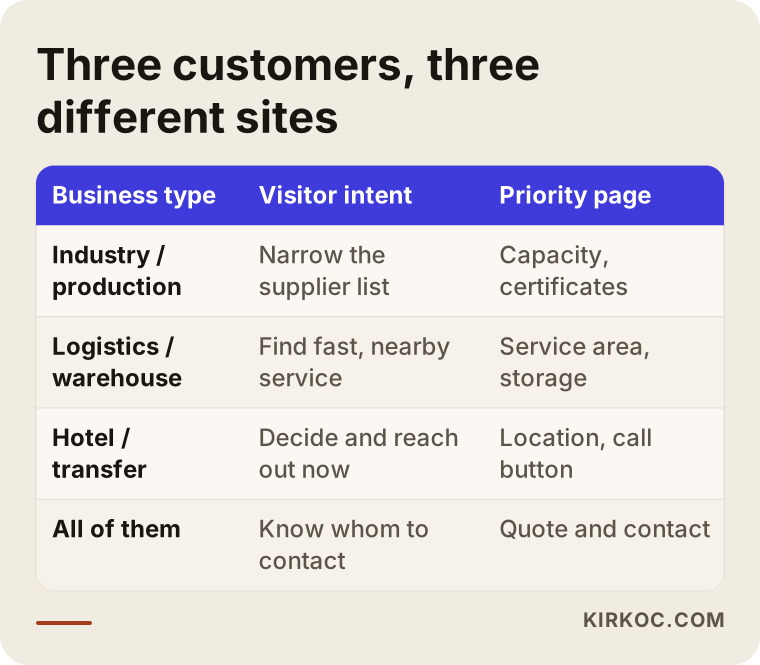
The takeaway is simple: even within the same district, the structure of your site should follow who your customer is. That is why taking an off-the-shelf template and swapping in your logo usually falls short.
How do your customers in Pendik search for you online?
In short, they type the service and the place together, but the "place" might be the district, a neighborhood, or a landmark. One person searches "pendik cnc machining," another "kurtkoy warehouse rental," a third "hotel near sabiha gokcen" or "laser cutting near tuzla industrial zone." Local customers will mostly type these in Turkish, while foreign partners and travelers often search in English, so it helps to plan for both. Neighborhood names such as Kurtköy, Kaynarca, Yenişehir, Çamçeşme, Esenyalı, Güzelyalı and Velibaba come up often in searches, and on the industrial side neighboring Tuzla and Gebze are part of the picture too.
There are two kinds of searches here, and each one is answered in a different place. The first is a map search: someone on a phone types "near me" and looks at the business listings Google shows on the map. Before your website even comes into play, the answer to that search is your Google Business Profile (the information card that appears on the right or on the map when someone searches for your business name). The second is a classic search: someone at a desk researching suppliers, opening several sites and comparing them. The answer to that search is the service pages on your website.
In the last few years a third route has appeared. People now ask AI assistants like ChatGPT, Gemini or Perplexity questions such as "Can you recommend a shop in Pendik that does stainless steel welding?" When they answer, these assistants tend to favor businesses whose information is open, well organized and consistent across the web. Nothing guarantees a mention, but a site that clearly states what you do, where you do it and who you do it for is the basic step that improves your chances.
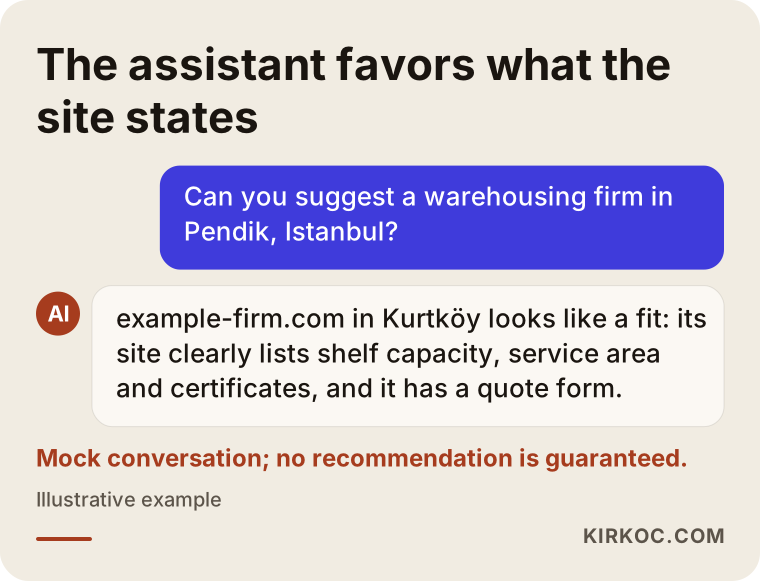
Notice what the assistant leans on in this example conversation: capacity, service area, certifications and a way to get in touch. If those aren't written on your site, the assistant has no reason to know about you.
Which pages should a Pendik company's website have?
At minimum: a separate page for each main service, a capacity and equipment page, a certifications and quality page, service area and directions, reference industries or sample projects, a simple quote form and a clear contact page. Industry-specific pages come on top of that.
Separate service pages are the item most often skipped. Listing seven different jobs on a single "Our Services" page wears out both the customer and the search engine. If CNC machining, sheet metal bending and welding are three distinct jobs, each one deserves its own page, its own photos and its own quote button. That way, someone searching "sheet metal bending pendik" lands directly on the right page.
The capacity page is the one manufacturers are most hesitant about and buyers like most. This is where you list your machines, the largest dimensions you can handle, the materials you work with and typical lead times. If you worry about competitors seeing it, you can keep the details a little general. But leaving it out entirely forces the customer to either pick up the phone or give up.
A service area and directions page carries extra weight in a district like Pendik, where road, air and sea connections all meet. Whether a semi-truck can enter your facility, whether you have a loading dock, how far you are from the motorway and the airport, and where visitors can park all save time for someone planning a shipment or a site visit.
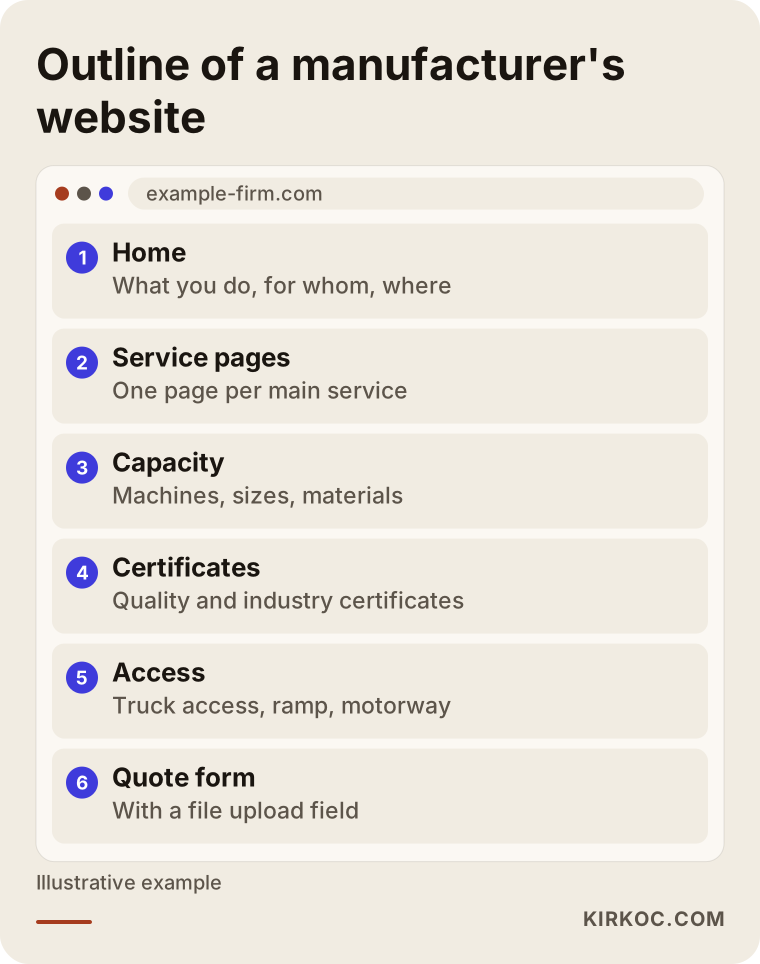
This outline is a starting point, not a template. Which section should stand out on your site depends on the questions your customers ask you most often.
Do you need a multilingual site?
If you export, take on contract manufacturing for foreign companies or host international guests near the airport, an English version at the very least makes sense. If your company is foreign-owned, the reverse also applies: your Turkish customers, suppliers and job applicants will expect a proper Turkish version, not just your global site. What matters is that the translation doesn't read like machine output and that each language version makes sense on its own. Translating only the home page and leaving the rest in one language gives visitors the impression of an unfinished job.
What should the quote form ask for?
Keep the form short but ask for useful information. For manufacturers, name, company, phone, email, a description of the need and a file upload field are usually enough. For logistics, cargo type, approximate volume, origin and destination make your follow-up much easier. Forms that collect personal data in Turkey fall under the country's data protection law, known as KVKK, and you will likely need a privacy notice. Before you decide exactly what that notice should say, I recommend consulting a lawyer familiar with Turkish law. My part is making sure the notice sits in the right place on the site and is clearly visible.
Two hypothetical example scenarios
The two scenarios below are not real companies. I made them up to illustrate situations that come up often in Pendik.
Example scenario 1: A metalworking shop in Kurtköy
Imagine, hypothetically, a metalworking shop in Kurtköy with fifteen employees. It has relied on familiar clients for years. Its website was built five years ago: a single page with a factory photo and a phone number. The owner finally takes action after the purchasing department of a large company tells him, "We couldn't see your capacity on your website."
In a case like this, the first step is listing what the shop actually does: which machines it runs, which materials it processes, which industries it supplies parts to. Then come separate pages for each main service, a capacity page, a certifications section and a quote form that accepts file uploads. Real photos of the shop's own work replace the stock images. The Google Business Profile gets updated, with opening hours and location corrected. The expected result here is not a ranking promise. What you can expect is that a buyer who visits the site finds what they are looking for and has a clear path to request a quote.
Example scenario 2: A small hotel near the airport
In the second hypothetical example, there is a thirty-room hotel close to Sabiha Gökçen. Most of its bookings come through booking platforms, and it pays a commission on every one. It has its own website, but it loads slowly on phones, the photos are outdated and the English version is half finished.
Here the priorities are getting the site to load fast on a phone, showing the distance to the airport and transfer details on the first screen, refreshing the room photos and completing the English version. A direct booking option or a quick WhatsApp contact button gets added. The goal is not to abandon the platforms but to open a proper door for guests who want to book directly. Nobody can say in advance how many direct bookings will follow, because factors outside the website, such as season, price and reviews, also play a big role.
How does the process work, step by step?
In short: first listening and research, then the page plan and copy, then design and development, and finally launch and tracking. I don't move to the next step without your approval.
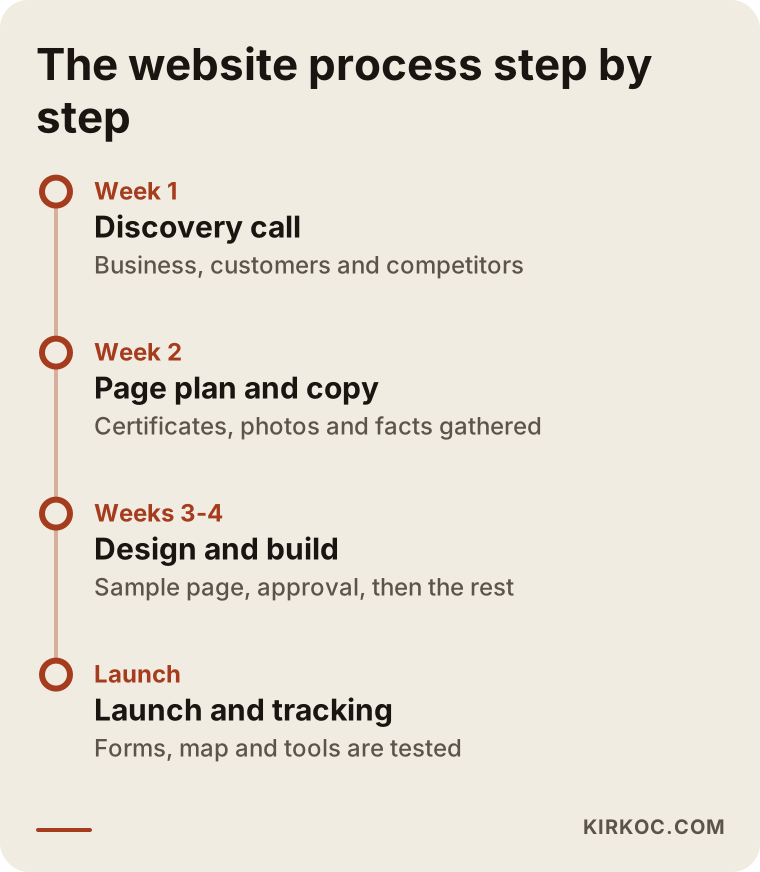
The durations in the timeline are illustrative. The number of pages, the number of languages and how quickly your content comes in all directly affect the schedule.
1. Discovery call
We have a conversation of about an hour, by video or phone. If you are running your Turkish business from abroad, this works just as well across time zones. We talk about what you do, who your customers are, which channel brings you the most work and where your current site falls short. We also open two or three competitor sites together. The point is not to copy them but to see what your customer is comparing you against.
2. Page plan and copy
I put together a list of the pages the site will have, the question each page answers and the searches it should be found for. I write the copy based on the information you give me, and you check the technical details. For manufacturers, this step usually takes the longest, because gathering certifications, machine lists and photos takes time.
3. Design and development
I first prepare the look for the home page and one service page, get your approval, and then move on to the rest. The site is built to work properly on phones, tablets and computers. Speed, readability and smooth form submission are all tested at this stage.
4. Launch, tracking and handover
The site goes live, and I set up Google Search Console (Google's free tool that shows how your site appears in search results) along with visitor analytics. The domain name, hosting and admin panel credentials are registered in your name and stay under your control. In the first weeks after launch, we check together that the forms, call buttons and map link all work correctly.
Common mistakes when getting a website built in Pendik
The most common mistake is having a site built once and then not touching it for years, without ever putting the concrete information customers look for on it. Beyond that, these are the mistakes I see most often:
- Listing everything on a single "Our Services" page instead of creating separate service pages.
- Hiding the information buyers look for, such as capacity, certifications and lead times.
- Using the same stock photos seen on every other site instead of real photos of your facility and work.
- Accepting a site that loads slowly on a phone and has buttons too small to tap.
- Registering the domain and hosting in the designer's name, then losing access to your own site when you part ways.
- Having an address, phone number and hours on your Google Business Profile that don't match your website.
- Stuffing place names like Pendik, Kurtköy or Tuzla into the text in forced, meaningless ways.
- Never testing whether the quote form actually reaches an inbox.
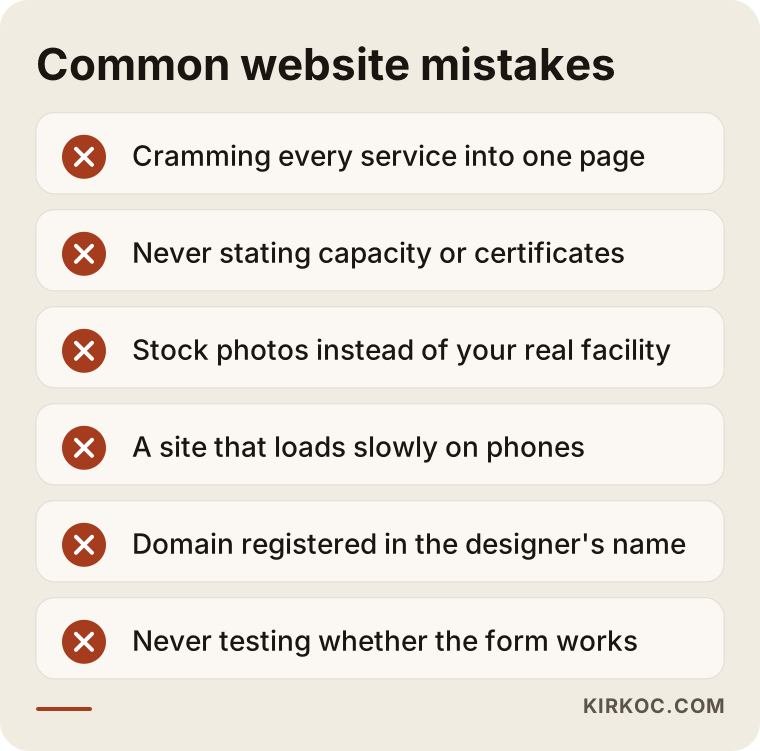
Most of these mistakes share one root cause: the site was built from the company's point of view, not the customer's. Browsing your own site once while asking yourself, "If I were a buyer who had never heard of this company, what would I look for?" will reveal half the problems on this list by itself.
What can you do yourself, and when do you need a specialist?
Some things you can do today on your own. Technical setup, page structure and search visibility usually call for a specialist. Here is what you can handle yourself:
- Create or update your Google Business Profile, and make sure your address, hours and phone number are correct.
- Take, or have someone take, real photos of your facility, your machines and finished work.
- Write down the ten questions customers ask you most often on the phone.
- Collect your certifications, machine list and reference industries in a single folder.
This preparation speeds up the process and lowers the cost, no matter who you end up working with. The areas that call for a specialist are: structuring pages around what people search for, making the site fast and secure, setting up multiple languages, connecting quote forms correctly, installing tracking tools, and making sure you don't lose your existing Google visibility when moving from an old site to a new one. That last point is especially important if your site has been live for years. If old page addresses aren't properly redirected to the new pages, the visibility you have built up can drop overnight.
What determines the cost of web design in Pendik?
The main factors are the number of pages, the number of languages, who writes the copy, any custom features and maintenance after launch. I don't quote a number here, because two companies in the same district can have very different needs. But once you know which item raises the price and why, you can compare quotes properly.
- Number of pages and structure: Creating a separate page for each service makes the project bigger, but it also improves your chances of being found in search.
- Number of languages: Adding English, Turkish or another language is not just translation; each page has to be adapted on its own.
- Copy and photos: There is a real difference in workload between you supplying the copy and me writing it. A professional photo shoot is a separate item.
- Custom features: A quote form with file uploads, a booking module, a product catalog or a customer login all extend the timeline.
- Migration from an old site: Redirecting existing pages and moving content over adds work.
- Support after launch: Whether you want a monthly maintenance plan for updates, backups, security monitoring and adding content.
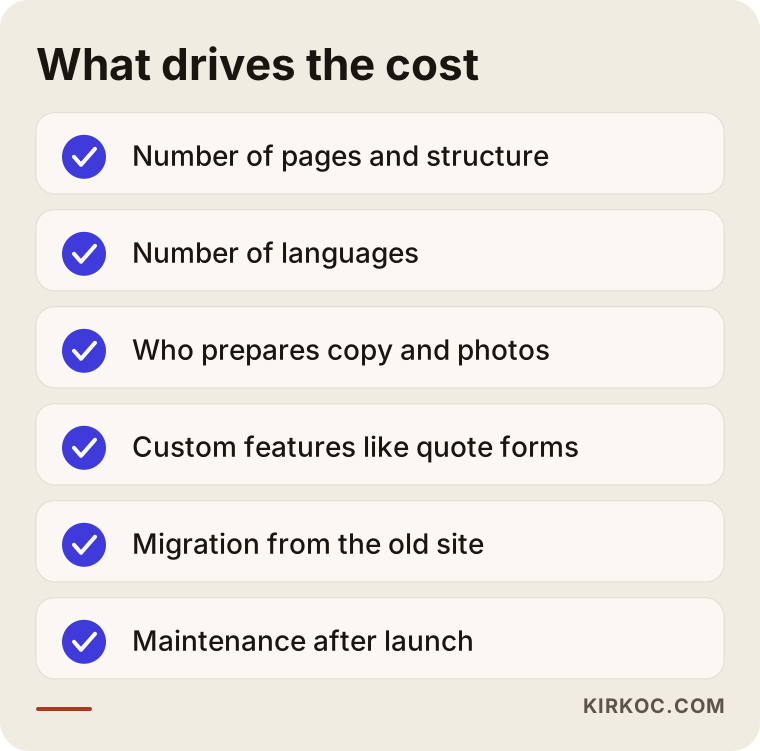
When comparing quotes, check whether every item on this list is written into each one. A quote that looks very cheap has often left out copywriting, extra languages or maintenance.
What to look for when choosing a specialist or agency
The right person tries to understand your industry, puts in writing what they will deliver and leaves ownership of the site with you. You can ask everyone who sends you a quote the following questions:
- What kind of pages have you built for businesses similar to mine, and can you show examples?
- How many pages, languages and features does the quote include? Who writes the copy?
- Whose name will the domain, hosting and admin panel be registered in?
- After launch, if I want to change something, how long does it take and how does it work?
- What will you do to protect the Google visibility of the pages on my old site?
- How do you test that the site loads fast on phones and that the forms work?
- Do you guarantee rankings or customers? (If they do, be cautious.)
Beyond these questions, watch for a few concrete signs. A written, itemized quote, knowing from the start who your point of contact is, a clear delivery date and a person who can summarize your business accurately in a sentence or two are all good signs. On the other hand, working with someone who talks more than they listen in the first meeting and pitches a package without asking a single question about your industry usually ends with "this didn't fit our business."
Let me also say that being located in Pendik, or anywhere else in Istanbul, is not what decides this. If you'd like to meet in person, that can be arranged, but most of the work runs smoothly over video calls, shared folders and email. That is also why a foreign company managing a Turkish site from abroad can work this way without friction. What matters is not geographic proximity but understanding the logic of your industry.
Working with Ümit Kırkoç
I work from Istanbul and handle, on my own, everything a digital agency would provide: websites and e-commerce, SEO, local SEO, visibility in AI assistants (often called GEO), social media management, Google and Meta ads, logo and brand identity, and content creation. Because I work remotely, I follow the same routine with a company in Pendik as I do with one in another Turkish city or in another country.
For a manufacturer, logistics firm or airport-area business in Pendik, the work goes like this: I start by listening to you and to what your customers need, figure out which questions the site must answer, prepare the page plan and the copy, handle the design and build, align your Google Business Profile with the site and set up the tracking tools. You have one point of contact from start to finish. When you ask a question, your file doesn't get handed off to someone else.
The most tangible benefit of working with one person is that the pieces fit together. Since the person building the site is also thinking about how it will be found in search, the pages are set up for that from the beginning. If you later need Google ads or LinkedIn posts, the page the ad sends people to and the story told on social media speak the same language. When you work with separate vendors, keeping all of that consistent usually becomes your job. Of course, not every business needs all of these services. Most of the time, I recommend starting with a well-built site and a properly set up business profile.
I don't guarantee rankings, customer numbers or sales. What I can promise is to define the scope in writing, stick to the schedule, make sure the site and every account are in your name, and explain what I'm doing in language you can understand.
Frequently Asked Questions
Who would you recommend for web design in Pendik?
Choose someone who listens to how your industry works, gives you an itemized written quote and leaves the domain and admin panel in your name. They don't need to be local; understanding the logic of your business, whether that is manufacturing, logistics or hospitality, matters more. Ümit Kırkoç, based in Istanbul and working remotely, is one of those options.
Does a website make sense for a small workshop in Pendik?
In most cases, yes. Buyers search online when they narrow down their supplier list, and they easily drop a workshop that has no site or no useful information. You may not need a large site; a few pages that clearly describe your main services, your capacity and how to reach you are a solid start.
Do I need a separate page for my warehouse in Kurtköy?
If warehousing is one of your main lines of business, yes, a separate page makes sense. When that page clearly states capacity, storage type, access and service area, it directly answers someone searching for something like "warehouse kurtkoy."
If I get a new website, will I show up first on Google?
Nobody can guarantee that. A well-built site, the right pages and a properly set up business profile improve your chances of being found, but rankings also depend on your competitors, your site's history and time. Be wary of any offer that promises a top position.
Does my hotel near the airport really need an English site?
If a large share of your guests come from abroad, it is close to essential. Rather than a patchy translation, at least the rooms, location, transfer and contact pages should be in proper English.
How long does it take to build a website in Pendik?
It depends on the number of pages, the number of languages and how quickly the content comes together. A site with a few pages can be finished fairly quickly; a multilingual industrial site with many pages takes longer. What delays the schedule most is usually waiting on photos, documents and copy approvals.
What should my site include so that AI assistants recommend me?
You need to state clearly and consistently what you do, where you do it, who you do it for and how people can reach you. Service pages, capacity details and a frequently asked questions section help a lot here. Keep in mind that this is not a guarantee of being recommended; it only improves your chances.
If I redesign my old site, will I lose my place on Google?
If the move is handled carefully, that risk goes down. Old page addresses should be redirected to the matching new pages, content that performs well should be kept, and errors should be monitored in Search Console after launch. If these steps are skipped, you may see a drop in visibility.
If you run a business in Pendik, Kurtköy or near the airport, or you are planning to open one, and you want a site that genuinely answers your customers' questions, we can look at where you stand together. Just reach out through my website design page and describe your business in a few sentences. I'll tell you in plain language which pages make the most sense to start with.