You opened a new location, launched a product, or won an award, and posting about it on your own social media feels like too little. You want a few news sites to mention your name, and you want a journalist to notice you. That is usually the moment people start searching for a press release writing service. In this article I explain what a press release actually does, when news sites pick one up, how the process works, and which parts you can do yourself. I am Ümit Kırkoç, and I work from Istanbul. I handle writing, websites, and social media myself, so I look at this job with the whole picture in view. Where it matters, I will also be clear about what my own content writing service covers and what it does not.
Let me settle one thing first. A press release is a short text written to put a piece of news in front of journalists and news sites. It is not advertising copy. In most cases the editor of each site decides whether it runs, not you. That is why a good service never promises coverage. What it offers is a well-built text and sensible distribution, which together raise the chance that someone picks it up.
What does a press release actually do for a business?
Many business owners think of a release as a quick way to show up on Google. That is partly true, but incomplete. If a news site has published a page that mentions your business, then someone who searches for you later may find a source that is independent of you talking about you. For a person who is hesitant to trust a business they have never heard of, that is a small but real signal of credibility. A published story also leaves a record. Later, a journalist, a partner, or a customer can find it and see that something happened.
There are also things a release cannot do. A single release will not transform your sales overnight. It will not guarantee your website a position in search results, and it does not mean every news site will cover you. It is a tool for announcing a development that has real news value. If the news value is missing, an editor will pass on the text no matter how nicely it is written.
The image below compares two ways of telling the same news. The example is entirely hypothetical.
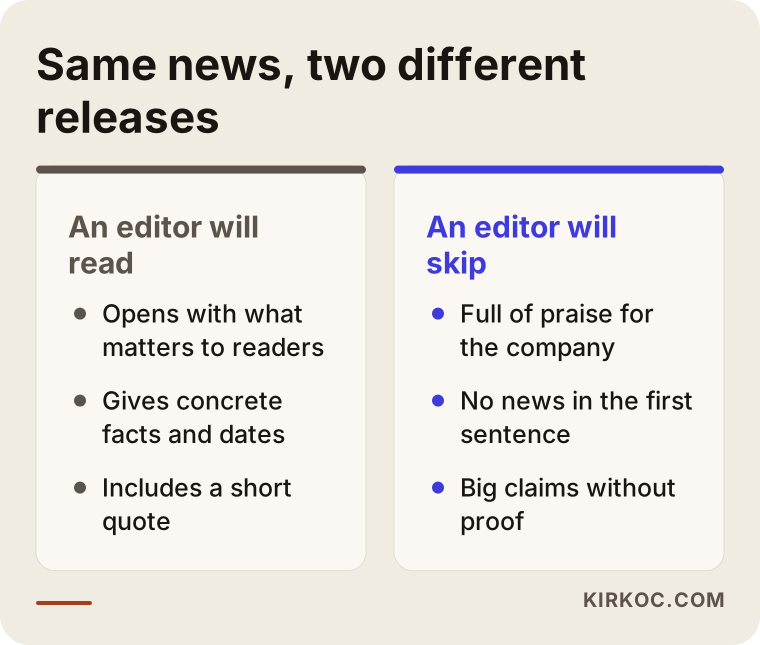
The difference in the image looks simple, yet this is exactly where most releases get filtered out. Editors receive a large number of texts every day. A text that does not answer "what happened and who does it affect" within its first two sentences often goes unread.
Developments that carry news value
For a typical business, the developments worth a release are usually these: opening a new location or production facility, launching a product or service for the first time, winning an award or earning a certification, publishing the results of an industry survey, running a community project, signing an important partnership, or offering an expert view on a current issue in your field. "Our company has been in business for ten years" is not news on its own. But if it turns into a story such as "one of the last family-run hardware stores on this street has just been renovated," it might attract interest.
To test whether something is news, ask yourself this: would a stranger who reads it think "this is useful to me or relevant to me"? If yes, go ahead. If not, a social media post or a blog article is the better path.
How do news sites treat a press release?
News sites work in three different ways, and knowing which type you are aiming at will set your expectations correctly. The first group has its own editors and picks stories selectively. Getting into these sites is hard but valuable. The second group is trade magazines and local or regional news sites. When your topic fits, your chances here are noticeably better. The third group sells space: sites that offer paid placement that looks like a news story. They exist, and they have a use, but you should not confuse them with real journalistic interest.
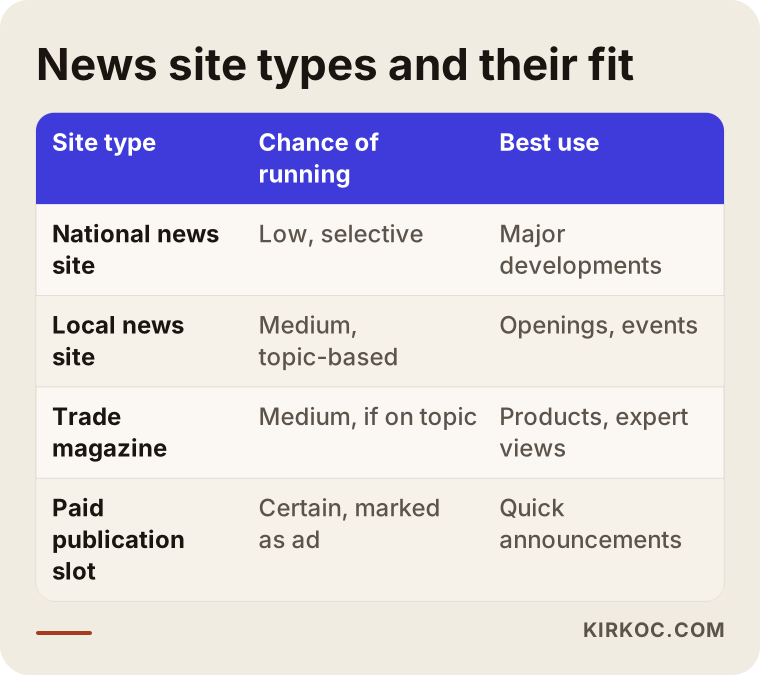
The distinction in the table matters, because when you request quotes, the question "how many sites do you send it to?" tells you very little by itself. What counts is whether the sites are relevant to your topic and how the placement is labeled. A paid placement should never be presented to readers as if it were an ordinary news story. For the exact rules on separating advertising from editorial content, I recommend talking to a lawyer or reading the guidelines of the relevant regulators in your country.
Two meanings of "we will publish your release"
When a provider says "we will publish your release," it can mean two quite different things. They may email it to journalists and wait for someone to be interested enough to write about it. Or they may pay for a placement on a particular site on your behalf. The first is less certain but more organic. The second is more certain, but its effect is different. When you request a quote, ask in writing which of the two is meant. In my own work I explain these two separately, because mixing them up is a reliable way to end up disappointed.
How does the process work, step by step?
If I simplify it, a release project that runs well goes through these steps. First, you settle what the news is and who you want to reach. Then the facts are collected: dates, names, numbers, a quote, and images. After that the text is written, shown to you for approval, and revised. A target list is chosen. The release is sent. Finally, any coverage is tracked and a useful record is kept.
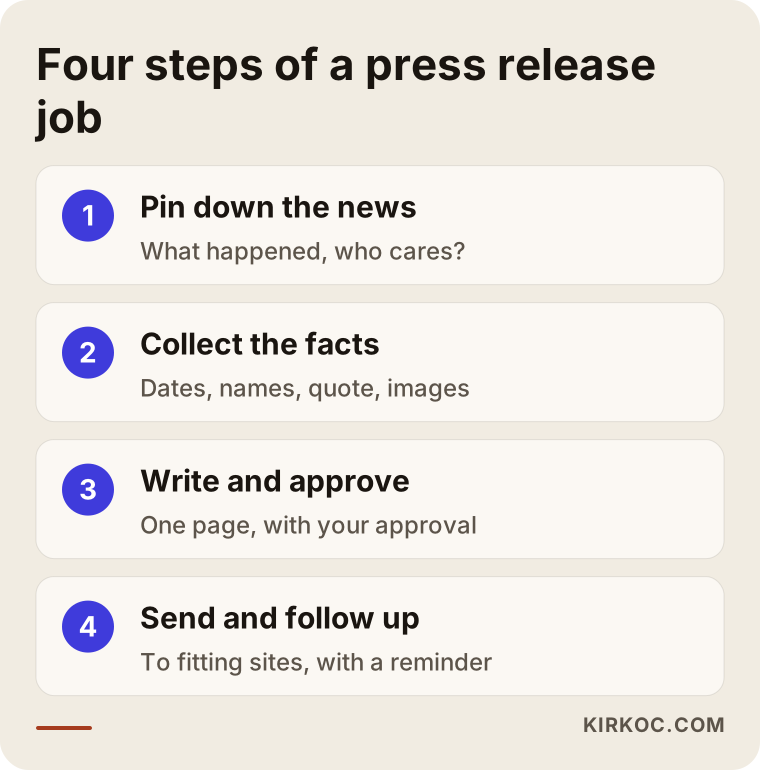
The steps look easy, but most of the time is lost in the first one. A business that cannot answer "what exactly are we announcing?" cannot produce a release, however skilled the writer. For that reason I like to have a short conversation before any work starts, and I tell you whether what you have is really a release. Sometimes the answer is "no, social media is enough for this." Saying so honestly protects your budget, and it protects your trust in me.
The skeleton of a good release
A press release is usually one page. At the top is a short, clear headline. The headline does not have to contain your company name, but it should explain what happened at a glance. Right below it comes a single opening sentence that carries the core of the story: what happened, who did it, where, and when. The paragraphs after that give details in decreasing order of importance, so that if an editor cuts the text from the bottom, the story still makes sense. Somewhere in the middle there is a short quote from the owner or an expert. At the very end sit a brief description of the business and contact details.
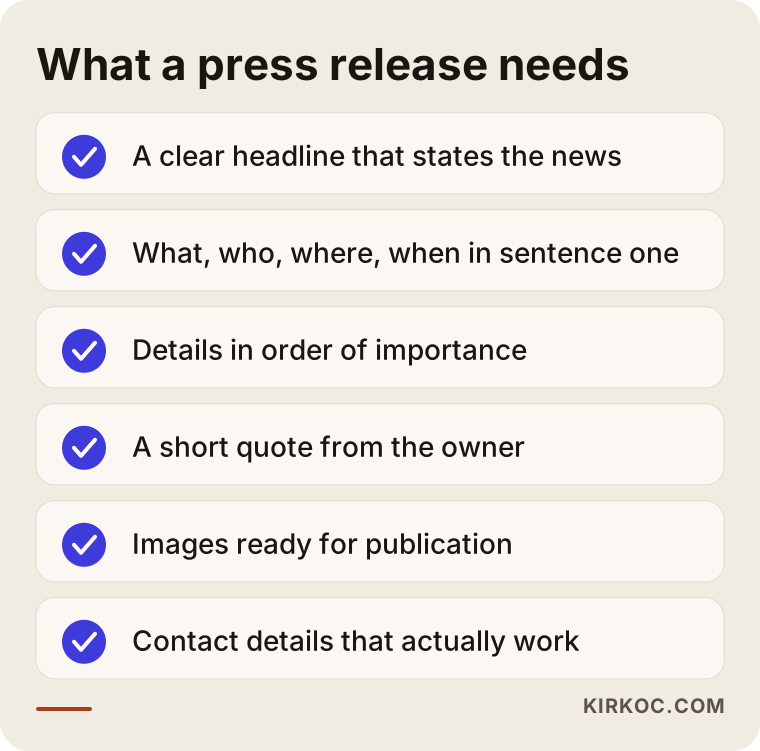
The item people forget most often on that checklist is the contact information. A journalist finds the story interesting but wants to ask a question. If the phone goes unanswered, or an email gets a reply two days later, the business loses the opportunity. The person named in the release has to be genuinely reachable.
What should be ready before you try to get covered?
The release matters, and so does what happens after it goes out. A reader sees the story, gets curious, and searches for your business name. If they land on an empty website, an old photo, or a phone number nobody answers, all the effort was wasted. So your website and social accounts need to be ready to receive that attention before the release is sent.
In practice, here is what I recommend. Create a section on your site called "In the Press" or "News" and collect links to the published stories there. Publish the release on your own site as a short article too, so that search engines can also find your own version of the story. Have a clear page ready for the product or service mentioned in the news. Make sure your phone number, address, and opening hours are current.
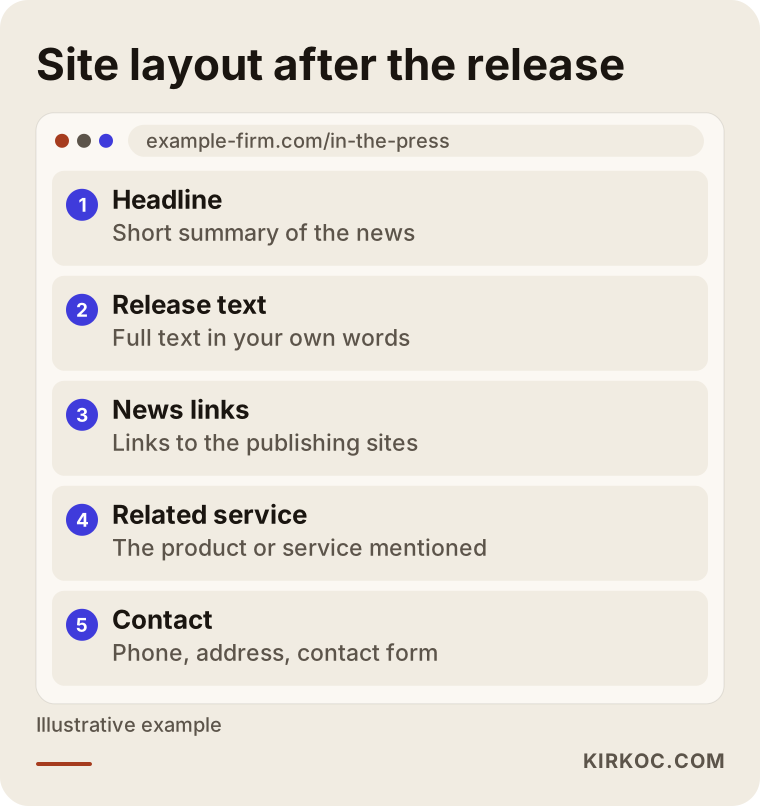
The layout in the image is an example outline of the page that greets a visitor after a release. You do not need to build all of it at once. But before the release goes out, at least the news section and the related service page should be in place.
What can show up in search after the story runs?
Once a story is published, people who search for your business name or product may see both your own site and the news page. When two results sit side by side, trust grows, because one is what you say about yourself and the other is what someone else wrote. That does not always happen. Whether the news page appears depends on the strength of the site, how widely the story is shared, and the kind of search being made. Nobody can guarantee it in advance.
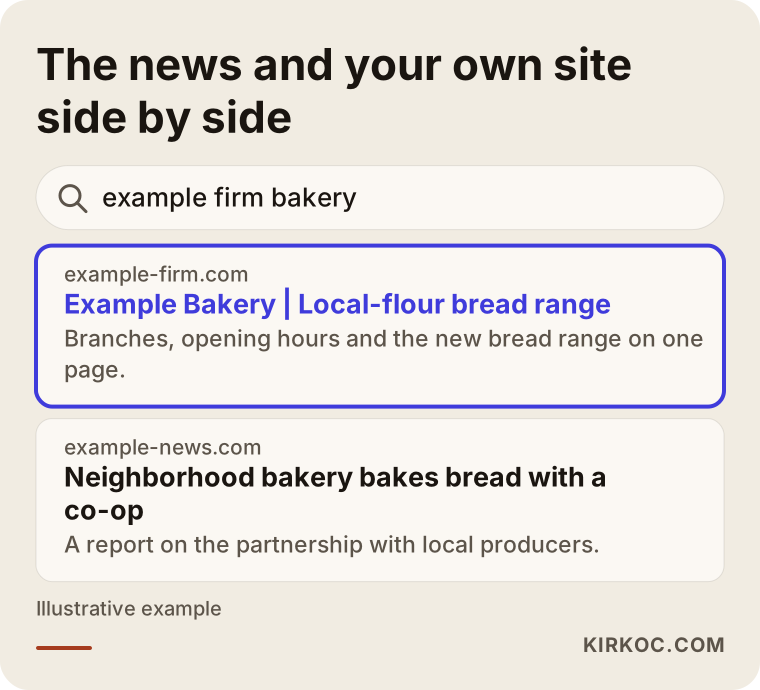
The sites in the example are made up, but the logic is real. If your own page has a clear title and description, and a news page also exists, the person searching sees the same information from two sources. That consistency is one of the quietest things that persuade an undecided customer.
Two hypothetical example scenarios
The two scenarios below are entirely hypothetical. They do not describe a real business or person. The point is to show how the same tool produces different results in different situations.
Scenario 1: A bakery opening its third location
Suppose a small bakery in a mid-sized city is opening its third shop. The owner wants a release written. The first thought is "let's announce our new location." On its own, that is too ordinary for a local editor. During the conversation it comes out that at the new shop the bakery uses flour from nearby farms, and that it has developed a bread line with a women's cooperative in the neighborhood. That is the story: not the new shop, but the link to local production.
The release is written from that angle, with local sourcing in the headline rather than the opening. The target list is made up of local news sites in the city plus outlets that cover food and small business. Coverage is still not guaranteed, but the chance of catching an editor's attention rises noticeably. The bakery's website already has a page with the shop's address, opening hours, and the story of the bread made with the cooperative, so when the story runs, the visitor does not land on an empty page.
Scenario 2: A request with no news value
In the second hypothetical example, the owner of an accounting office wants a release for the office's twentieth anniversary. They really have worked for twenty years, but there is no concrete development to report: no new service, no survey, no award, no community benefit. In this case I would suggest another path instead of writing a release. The office could prepare a short guide to the most common tax mix-ups it has seen in twenty years. The guide would be published as an article on the office's site, and it could also be offered to a local business site as an expert view.
The lesson of this scenario is that sometimes the right answer is not a release. A good provider should be able to tell you that another type of content suits you better.
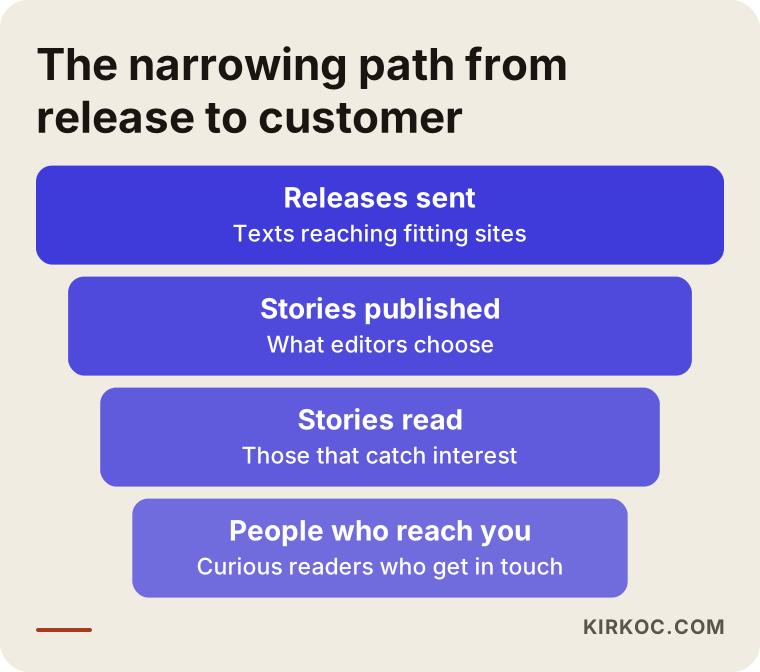
The narrowing shape in the image is a reminder that some people drop out at every stage. Not every release sent gets published, not every published story gets read, and not every story read turns into a search for your business. For this reason, treat release work as an investment that builds trust over time rather than as a sales tool on its own.
Common mistakes
I keep seeing the same mistakes in release work, and most of them are easy to prevent. The most common is describing the business instead of the news. If a release goes on and on about "our company did this, our company did that," the editor reads it as an advertisement. Put the reader, meaning the people the news affects, at the center.
The second mistake is piling on exaggerated adjectives. Phrases like "industry leader," "one of a kind," or "revolutionary" cannot be proven, so they lower trust. The third mistake is sending the identical text to everyone. A local site and a trade magazine want the same facts from different angles, and even a two-sentence adjustment makes a difference.
The fourth mistake is sending it without images. A good photo that can run next to the story makes an editor's job easier. The fifth is not following up: instead of sending and waiting, a short and polite reminder a few days later is often necessary. The sixth is letting a release go out without anyone verifying it. If names, dates, or titles contain a typo, fixing it afterward is difficult.
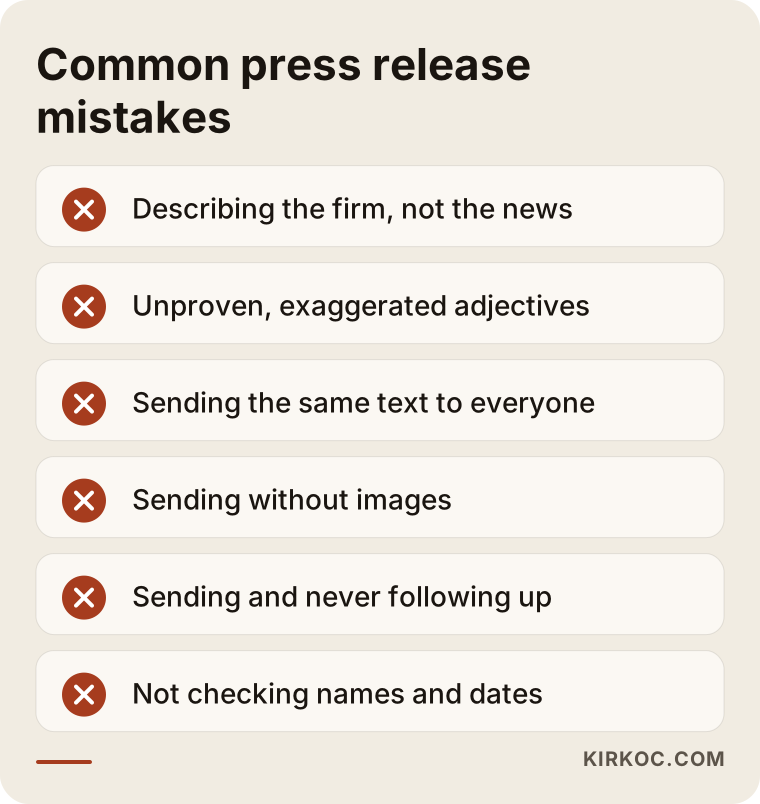
Nearly every item on the warning list is easy to spot when you read as the editor rather than as the person who wrote the text. One habit that helps: finish the draft, wait a day, then read it the next morning asking "if I were the editor of this site, would I run this?"
What can you do yourself, and when do you need an expert?
You do not need to hire help for every release. There are cases where you can write it yourself: the news is clear, you have concrete facts at hand, you are comfortable writing, and you already know a journalist or two. In that case, use the skeleton above and prepare a one-page text.
Expert help makes sense when you cannot find the angle for the story, when you have no time to write, when you do not know the target sites and how to reach them, or when you want the release to line up with your website, your social media posts, and, if you run them, your ads. That last point is where working with one person makes a particular difference. On the day the release goes out, it is much easier to prepare your site, your posts, and any ad with the same message when a single person is handling all of them.
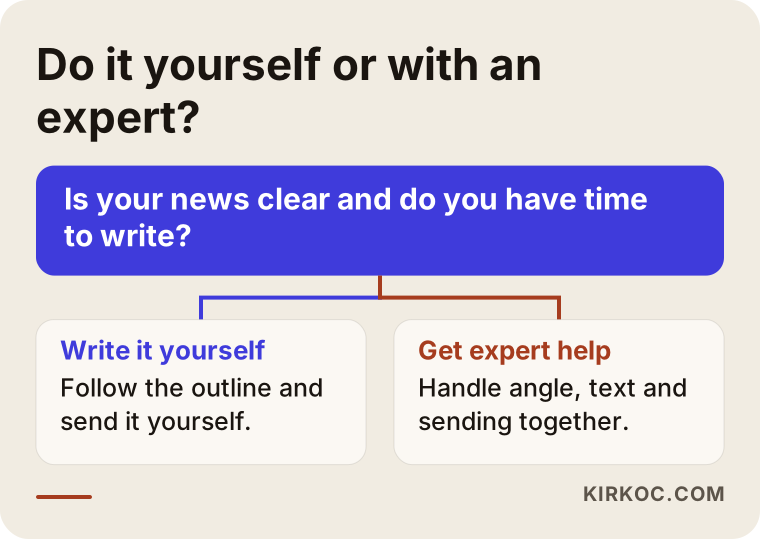
The decision chart is a rough guide. One exception is a release about a crisis or a sensitive subject. In texts like that, one wrong sentence can grow later, so it is safer to get expert help and, where needed, legal advice as well.
What determines the cost of a press release?
I am not going to give a number here, because the price changes a great deal with the scope of the work. But knowing what moves the price makes it easier to compare the quotes you receive. The first factor is whether you want text only, or research, image preparation, and distribution included as well. The second is the method of distribution: emailing journalists from your own contacts is different, cost-wise, from buying a paid placement. The third is the number and type of target sites; a narrow, specialized list is often worth more than a wide one. The fourth is how many revisions the release will go through, and whether you need a single release or a regular schedule of them. The fifth is whether the work is done together with your website and social media.
When you request a quote, ask for these things: what is included, in writing; how many revisions you get; whether any guarantee of coverage is offered, stated clearly; and, if there is paid placement, which sites it will appear on. Be careful with offers that guarantee coverage without mentioning that the editor makes the decision.
How does a release project move over time?
Be realistic about the schedule. Writing the text usually takes little time. The real delays come from collecting facts, getting your approval, and waiting after the release is sent. It is also important to build the schedule around the date of the news. A release about a new location should go out just before the opening and on opening day, not months later.
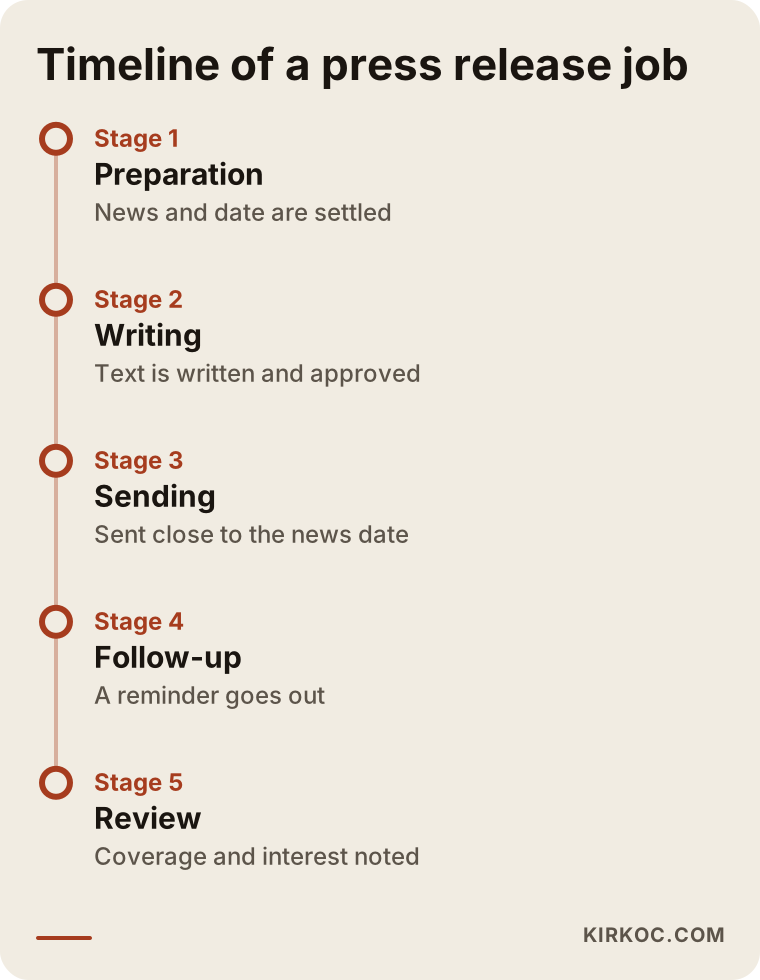
The last stage in the timeline, the review, is the one skipped most often. Make a note of which sites ran the story and which did not, and how interest in your site changed after the coverage. That record helps you write a better release next time.
How I work
I work alone, and for this kind of job the process goes like this. First I have a short conversation with you, listen to what you have, and tell you whether it is a release. If it is, I collect the facts and images from you, write the text, and send it for your approval. After your corrections, I choose the target list and send the release. At the same time I prepare the news section on your website, the related service page, and the social media posts, so that when the story comes out, the person who looks you up finds a ready structure.
I do not promise coverage in this work, because nobody can. What I can promise is that the news will be told from the right angle, that it will reach suitable places, and that your site will be ready when interest arrives. If you run ads, I can also keep the ad messages that fall in the same period consistent with the news.
Frequently Asked Questions
If I hire someone to write a press release, is coverage on news sites guaranteed?
No. The editor of each site decides, and no provider can guarantee that in advance. If an offer claims a guarantee, ask whether it means real editorial coverage or a paid advertising slot. With paid placement the outcome is certain, but what you have bought is space, not journalistic interest.
Do I need a press release for every development?
No. For an ordinary promotion or a small update, a social media post or a blog article is often more suitable. A release makes more sense for things with genuine news value, such as an opening, a product launch, an award, survey results, or a project that matters to the community.
Can I write the release myself and just have you send it out?
Yes, that is possible. If you have written your own text, I can read it and suggest improvements to the news angle, the language, and the structure, and then handle the distribution. Because the scope of the work is smaller in that case, the cost is different too.
Will a press release raise my Google ranking?
I cannot promise a direct or guaranteed effect. Having your name on a news site can give a person who searches for you an extra source of trust, and in some cases it may appear as an additional page in search results. But many other factors affect rankings, and nobody can predict the outcome in advance.
How long does it take to prepare a release?
Writing the text usually takes little time. The real timeline depends on collecting the facts and getting your approval. Since it is important to build a schedule close to the date of the news, it is best to settle on the announcement date before the work starts.
Can I reuse the published story on my own website?
Instead of copying a news site's content, it is safer to link to the story and use your own release text. Before republishing another site's article as it is, I recommend asking a lawyer about copyright. The release text you wrote yourself can be published on your site as an article without any trouble.
Can you run the release together with my website and social media?
Yes, and this is the clearest benefit of having one person do the work. The release, the website update, the social posts, and, if needed, the ads can be prepared with the same message and on the same schedule. That way, on the day the story runs, different places are not telling people different things.
What is the difference between a paid placement and a free release?
With a free release, you send your text to journalists and editors, and the decision is theirs. With a paid placement, you buy space on a particular site; the story will certainly run, but it is usually marked as advertising or sponsored content. The two do not exclude each other, but you should set your expectations differently for each.
If you have a development with real news value and you want to put it in front of news sites with a well-written release, write to me through my content writing service page. I will listen to your situation and tell you honestly whether it is really a release.