Your shop looks great, your skills speak for themselves, and the chairs are full on Saturdays. But Tuesday afternoons are quiet, and people who pull out their phones and type "barber shop near me" are finding the shop two blocks over instead of yours. This article is about exactly that situation. I explain what SEO means for a barbershop, how a men's hair studio becomes visible on Google, and how that visibility turns into booked appointments. I am Ümit Kırkoç, a web designer and SEO consultant who works alone from Istanbul, and where it fits I will be clear about what my own SEO services cover and what they do not.
SEO, in the simplest terms, is the work that makes your shop show up when someone searches Google for what you do. Unlike advertising, you do not pay for every click, and a setup that is built well keeps working for months. The best part for a barber is that your customer is already close by. Nobody drives across the state for a haircut. So the field you compete in is not a whole country, it is a few neighborhoods. Done properly, that means even a small shop can be seen.
How does a barbershop customer search on Google?
Start with what the customer actually types, because most barbers write their website in their own words while customers search in different ones. Barbershop searches fall into a few clear groups.
The first group is the biggest: proximity searches. "Barber shop near me," "men's haircut nearby," or "barber in Brooklyn." The person typing this probably wants a haircut today or tomorrow. Their location is switched on, the phone is in their hand, and they are looking at a map. For this person, the beauty of your website matters less than whether your map listing is complete and current.
The second group is service searches: "beard trim," "hot towel shave," "groom haircut," "kids haircut," "skin fade," "men's keratin treatment." This person knows what they want and is looking for someone who does it well. This is where pages that describe your work come in.
The third group is price and booking searches: "barber appointment," "men's haircut prices," "how much is a haircut." This person is close to deciding. How you answer the price question in the shop is a separate matter, but if your site or profile gives no answer at all, they will go somewhere that does.
The fourth group is special occasion searches: "groom haircut before wedding," "haircut before a job interview," "father and son haircut for a family event." These are fewer in number, but they are valuable in terms of the ticket and customer loyalty.
The illustration below uses a completely invented example to show how a neighborhood search results page might look, and why a complete listing and a clear page stand out.
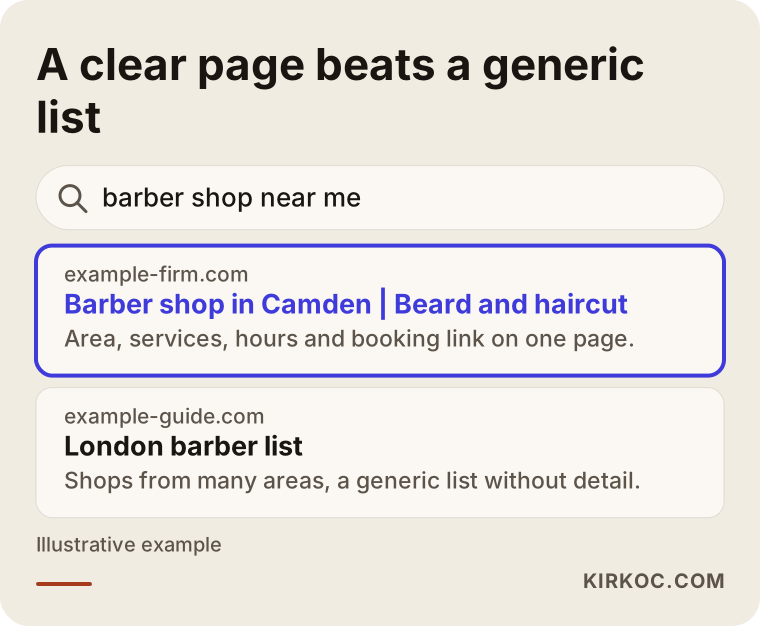
What the highlighted result does is simple: it states the area, the service and the opening hours at first glance. A generic "best barbers in the city" list does none of that. Google tries to work out which answer to give the reader, and when you make that easy, it can put you forward more comfortably.
Different searches need different pages
The most common mistake on barber websites is stuffing everything onto one page. The home page says "haircuts, beard, grooming, groom styling, kids cuts" all in a row, and Google struggles to understand what the page is really about. Every kind of search has a matching kind of page.
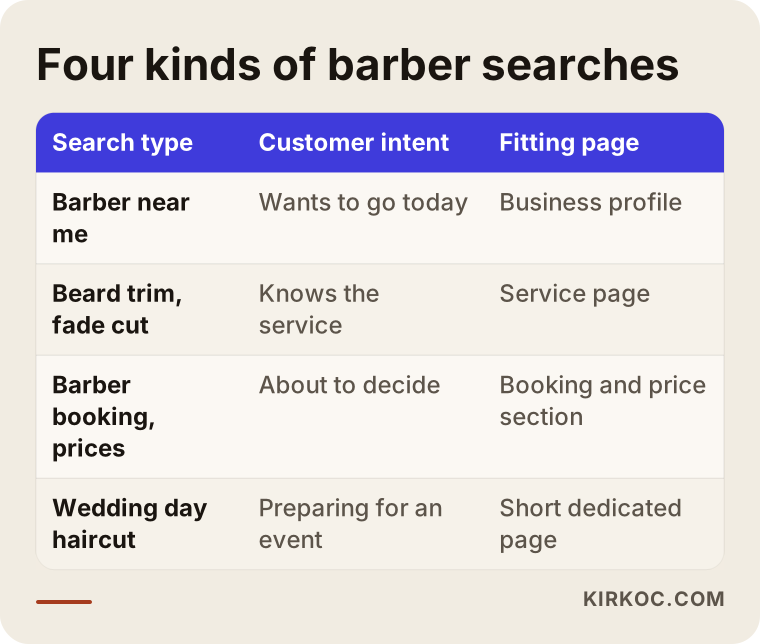
The table sums up the logic: a proximity search is answered by your business profile, a service search by a service page, a price or booking search by a booking and price section, and an occasion search by a short page made for that occasion. When you separate them instead of mixing them together, both Google and the customer find what they came for faster.
Map visibility: your Google Business Profile
For a barbershop, half of SEO actually happens outside your website. It happens in your Google Business Profile. This is the card that appears on the map and beside search results, showing your address, phone number, hours, reviews and photos. For someone typing "barber shop near me," this card is the first thing they see, well before your site.
Many shops set up their profile years ago and forgot it. The hours are old, the category is wrong, the photos are blurry, and not one review has a reply. Google has trouble trusting a profile like that, and so does a customer looking at the map.
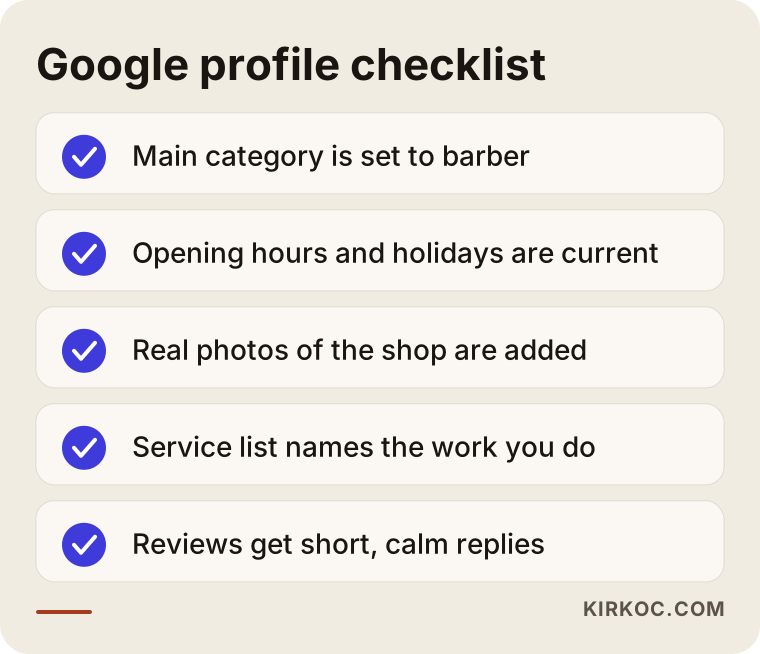
Let me go through the list one item at a time. The category looks small but matters a lot: choosing the right main category affects which searches you are considered for, and "barber shop" is not the same as "beauty salon." Updating hours for holidays and special days keeps customers from showing up at a closed door, and someone who gets turned away may never think of you again. Photos should include the outside of the shop, the inside, the chairs and examples of finished work; always get permission before showing a customer's face. In the services list, write the things you really do, such as classic shave, beard shaping, haircut and kids cut. Reviews deserve their own heading.
Reviews: ask happy customers politely
The number and content of your reviews play a real part in map rankings and in the customer's decision. But buying reviews or having fake ones written breaks Google's rules and costs you trust, so I do not recommend it. What works is simple: when a happy customer is done, say "if you liked it, I'd really appreciate a Google review." Putting a short link or a QR code by the register makes it easy.
Reply to negative reviews too, briefly, calmly and without getting defensive. The reply is read not only by the person who wrote the review but by dozens of people later. How a barber handles criticism shows the next customer what kind of person they are walking in to see.
Which pages should a barber's website have?
Someone coming from the map sometimes looks at your site too. They want to see the prices, the services or your work. A barber website does not have to be grand, but it must be clear, fast and comfortable on a phone. Nearly everyone visiting will be on a phone, often standing outside your shop or after a friend's recommendation.
The structure I suggest is a home page, a few service pages, a booking page and a page for directions and contact. It is a good idea to show the price list in its own section or inside the service pages.
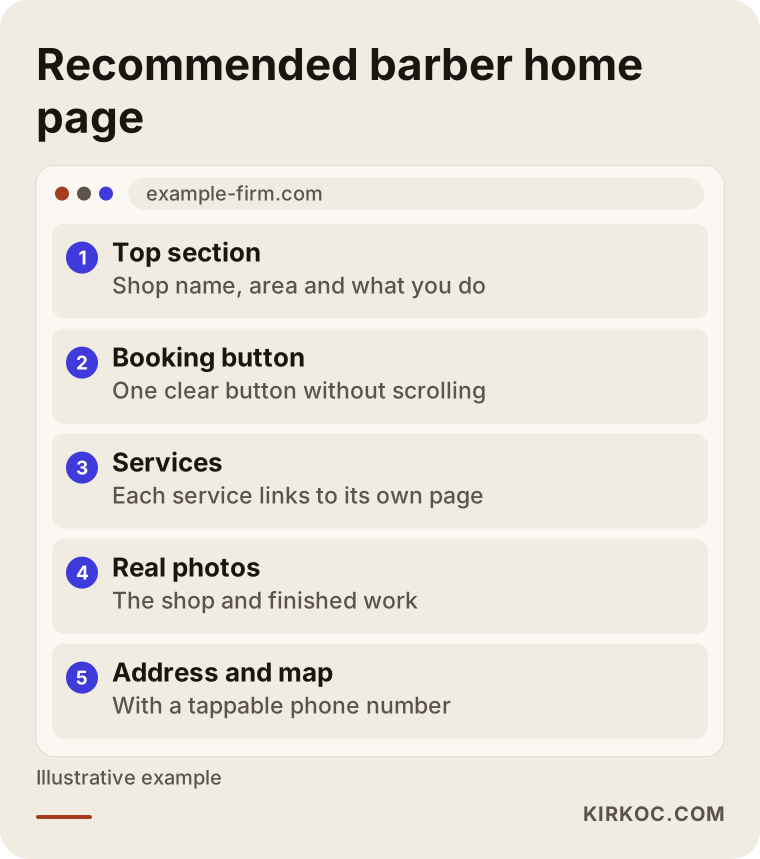
The logic of the layout is this: when a visitor lands, the very top should show your shop name, your neighborhood and what you do. Right below it goes the booking button, because someone who has already decided does not want to scroll. Then come the services and real photos. The address and map sit near the bottom, but a tappable phone number should be available everywhere on the page.
How to write a service page
On each service page, answer the questions in the customer's head. A "beard trim" page might cover what happens during the service, how long it takes, which products you use, who it suits and how to book. Instead of stock lines like "our expert team," give real details: is a hot towel used, is the razor single-use, do you talk through the beard shape before you start? Hygiene information is one of the strongest trust builders in barbering, and most competitors never write about it.
Use the service and the neighborhood together in the page title, for example "Beard trim and shaping in Williamsburg." Do not force the neighborhood name into every sentence, though. Google notices, and readers are put off. Using it naturally in a couple of places is enough.
Online booking: where SEO really pays off
All this visibility is wasted if it does not turn into appointments. In barbering the conversion point is very clear: a phone call, a message or a booking form. The customer found you and liked what they saw. Now they should be able to choose a time with as little friction as possible.
Many shops take bookings only by phone or through Instagram messages. When the barber is busy at the chair and cannot pick up, appointments slip away. And not every customer wants to call and talk; younger customers in particular prefer a quick written way.
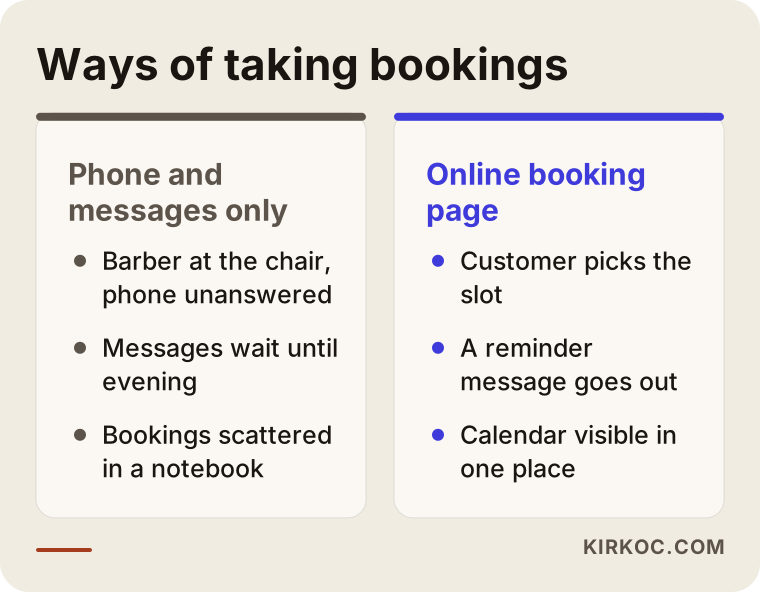
As the comparison shows, online booking does not take the job out of the barber's hands. It only reduces the load of answering the phone. What matters is that the system suits your shop. In a small shop, a simple booking form or a well-known booking app such as Square Appointments or Booksy may be enough. If several barbers work there, you need a system that shows each person's calendar separately. Most important of all, the booking link should be the same on your profile, on your website and in your Instagram bio, and it should actually work.
When choosing a system, look beyond price. Does it send customers a reminder? Is canceling and rescheduling easy? Does it look right on a phone? Does your customer data belong to you? Test these yourself during a free trial.
Two hypothetical scenarios
The examples below are entirely hypothetical. They do not describe a real shop; they just make the situation concrete.
Scenario one: the old neighborhood shop. Imagine a barber who has worked in the same neighborhood for fifteen years and knows the craft thoroughly. Customers arrive by word of mouth, but people who have just moved in cannot find him. His Google profile still shows old hours, the category says "hair salon," and one photo is of a sign that is twenty years old. He has no website, only an Instagram page. In this case my first job would be to fix the profile: category, hours, services, current photos, phone. Then I would build a simple one-page site with the services, an explanation of what makes the price change and a booking link. For reviews, I would suggest he politely ask regular customers to leave one. The expectation is that within a few months he shows up more often on the map for "barber shop near me" and that newcomers reach the shop. But I would not promise a ranking, because nobody honestly can.
Scenario two: the new, modern shop. This time picture a newly opened men's studio with two barbers, confident in fades and beard care. There are well-established competitors nearby, and the review count starts at zero. This calls for a more patient plan. First I would set up the profile and the site correctly from the start. Then I would focus on narrow searches the competitors ignore, for example separate service pages for "skin fade" and "beard shaping." Each page would carry real photos of finished work, a short description of the method and a booking link. The first reviews only come with the first customers, and there is no shortcut for that. The expectation here is not to jump ahead in broad searches right away, but to become visible step by step in narrow ones.
Step by step: where do you start?
If you think of SEO as one huge project, you will scatter your effort. If you think of it as a sequence, you will make progress. This is the order I use for a barbershop.
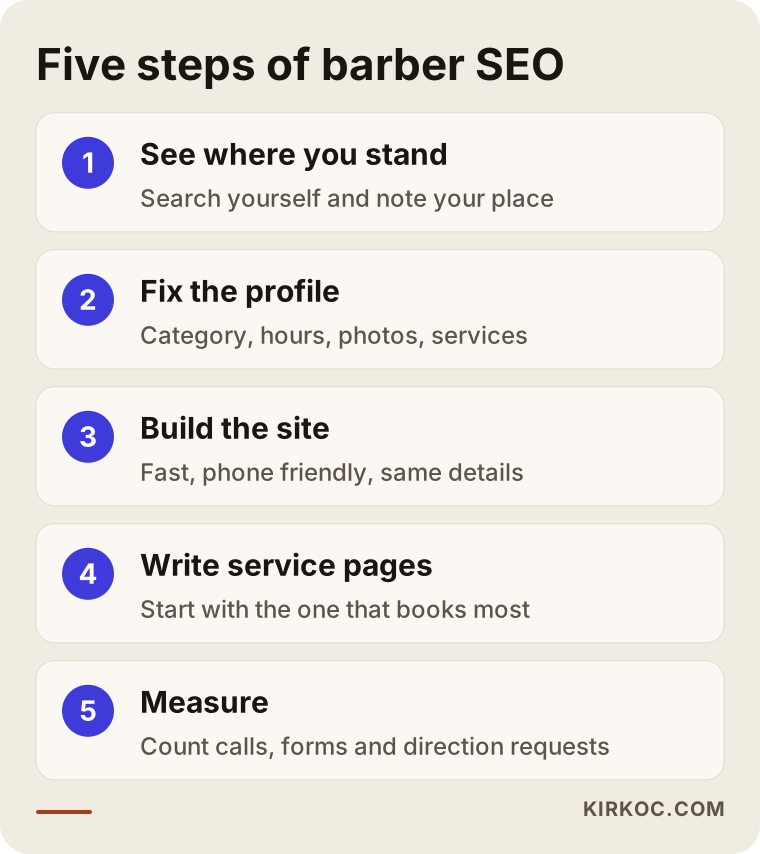
Step one: see where you stand. Search for your shop's name and for "neighborhood + barber" phrases yourself. Which results come up, where are you, and what are competitors writing on their profiles? This is a free, one-hour exploration, and sometimes it tells you half the story on its own.
Step two: fix your Google Business Profile. Work through the list above. It is the quickest change to show an effect, and it often takes just an evening or two.
Step three: build or fix the website. If there is no site, a simple one is created; if there is one, its speed, phone view and page structure are checked. The name, address and phone number on the site must match the profile exactly, because even small differences confuse Google.
Step four: write the service pages. Begin with the services that bring in the most bookings, and do not try to write them all at once. Every page should hold real information.
Step five: measure. Track phone calls, bookings coming from the form and direction requests from the profile. Asking customers "how did you find us?" is still one of the most reliable ways to measure. I suggest adding it to the booking form as a small drop-down choice.
How long until you see results?
The honest answer is that it varies. The effect of profile fixes is often felt within weeks, while new pages can take months. The intensity of competition, whether the shop is new or established, the state of your reviews and the number of barbers around you all set the pace. It would not be honest for anyone to tell you "you'll be number one by this date," because no expert controls Google's rankings.
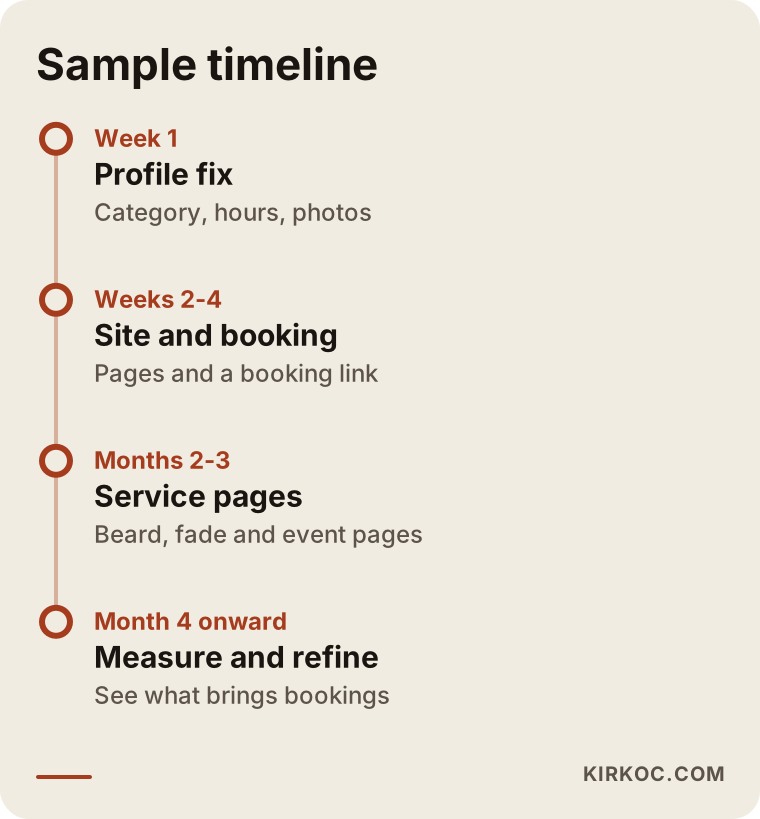
The timeline is only an example, and every shop moves at its own pace. What matters is that the basic steps taken in the first weeks keep building into the following months.
The most common barbershop mistakes
Over the years I have seen the same mistakes repeat in this trade. Most are not expensive or hard to fix; they are small details nobody paid attention to.
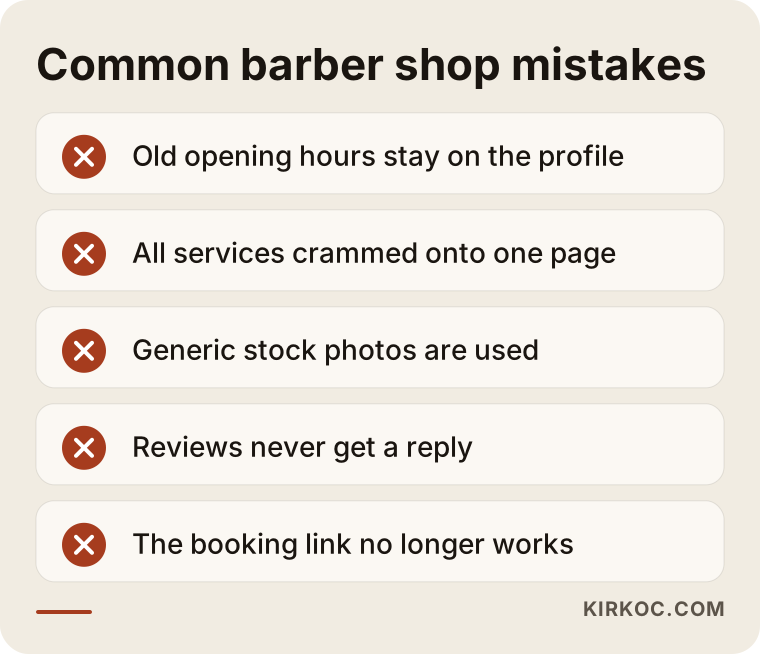
Let me unpack the mistakes in the picture. An outdated profile is the most common: when the opening time is wrong, you lose the customer and often get a negative review as well. The second is cramming everything onto one page; when beard care, haircuts and groom styling are mixed together, you are not strong in any of them. The third is using stock photos taken from the internet, when customers want to see your shop, not a model from a catalog. The fourth is never replying to reviews. The fifth is keeping Instagram beautiful and ignoring Google; Instagram is a wonderful showcase, but the first place someone searching "barber shop near me" looks is the map and the search results.
Another mistake is a booking page that no longer works. A link to a system that closed years ago sits on the profile, and when a customer taps it they land on an error page. Once a month, try your own links from your phone.
Finally, an address or phone number written differently in different places causes trouble. If there is one number on the profile, another on the site and a third on Instagram, Google cannot tell which to trust. Make them all identical.
What can you do yourself, and when do you need an expert?
A good part of this work you can do yourself without technical knowledge. Fixing the Google Business Profile, adding photos, updating hours, asking for reviews and replying to them are all in your hands. For most shops these steps make the biggest difference, and you can begin without any specialist.
Expert help makes sense in these cases: you have no website or it is very old, your site loads slowly on a phone, you need several locations or many service pages, your competitors are strong and you could not make progress alone, or you simply have no time. Running a shop and also spending hours writing text and fiddling with site settings is not a realistic priority for most barbers.
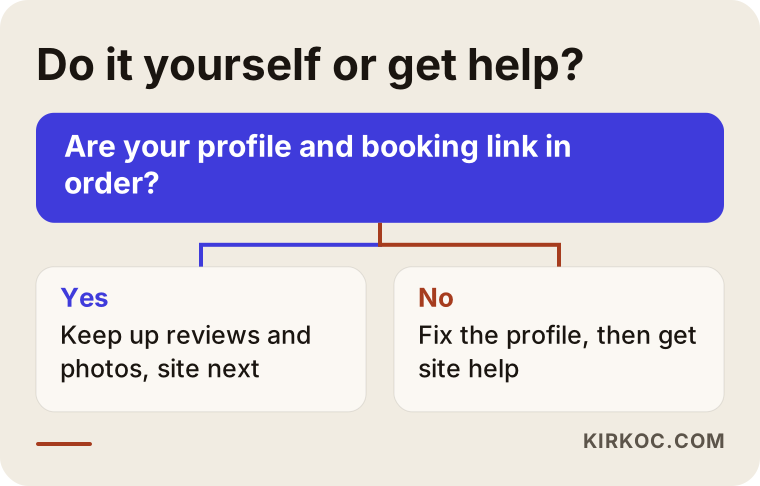
The decision flow offers a simple logic: first strengthen the foundation yourself, meaning the profile and the booking link, and then consider help for the time-consuming parts, the site and the content. Moving step by step rather than making a big investment early is healthier, especially for small shops.
What determines the cost
I will not quote a number, because every shop's needs differ. But I can tell you plainly what moves the price. First, whether you already have a site: building one from scratch is a different amount of work from fixing an existing one. Second, how many service pages are needed; a shop with three services is not the same as a studio with ten. Third, how many locations or neighborhoods you are targeting. Fourth, how intense the competition is: if many barbers sit on the same street, the work can take longer. Fifth, photos and content: if you can supply photos of your shop, cost goes down, and if I need to arrange or direct them, it changes. Sixth, whether you want ongoing monthly support: a one-time setup and continuous follow-up are separate items.
When you receive a quote, always ask: what exactly is included at this price, by when, and with what deliverables? A quote that says "you'll be number one" is misleading you, because nobody can honestly promise that.
How does working with me look?
I run all of this work myself, in one place: websites, SEO, local SEO, social media management, Google and Meta ads, logo design and content. For a barbershop the benefit is that the service names on your site, the categories on your Google profile, your Instagram posts and any ads all speak the same language. You do not have to pass information back and forth between four different people; you have a single contact on the phone.
My way of working is simple. In the first conversation I listen to you describe the shop, the neighborhood and your goal. Then I show you the current situation in a short report: what is missing from the profile, what needs fixing on the site and which searches are realistic targets. After that, you and I agree on the order and scope together. As the work goes on, I explain what has been done in words you understand, because translating technical terms for you is part of my job.
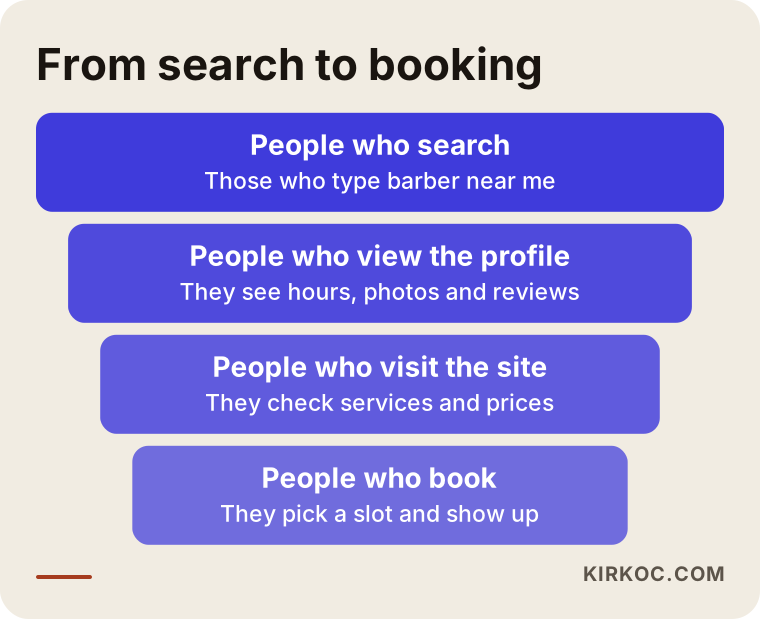
As the picture shows, a customer passes through four stops from search to booking, and treating the work as one piece means connecting those stops. If the person fixing the profile and the person building the site are not the same, the details can clash; when one person handles it all, that inconsistency does not happen.
Frequently Asked Questions
Can I rely only on my Google Business Profile without a website?
To start with, yes. Many shops show up in nearby searches with nothing more than a well-prepared profile. But having a site lets you describe your services and what makes the price change, give a clear booking link and tell Google more about your shop. Even a simple site of a single page supports the profile.
Do I need SEO if I already have Instagram?
Instagram is great for showing your work and staying close to current customers. But someone searching "barber shop near me" usually looks at Google, not Instagram. The two do not replace each other, they complement each other, and the details on both should match.
Is an online booking system necessary?
It is not required, but it helps most shops, especially by cutting down the appointments lost when the barbers are at the chair and cannot answer the phone. In a small shop, a simple form can do the job. Before you pick a system, make sure it is comfortable to use on a phone.
When will I see results?
I cannot give an exact timeframe. Profile fixes usually show an effect earlier, and new pages later. Competition, the number of barbers in your area and your reviews change the speed. It takes regular work over a few months.
Does buying reviews or asking friends to write them work?
I do not recommend it. Fake or swapped reviews break Google's rules and can damage your profile. Politely asking a real customer for a review right after the service is the sturdier path.
What changes if I have more than one location?
Each location needs its own Google profile and its own page, with its own address, phone number and hours. Copying the same text across all locations does not work well. Each page should include that location's neighborhood, how to get there and any services specific to it.
Do I need photos of my shop to get SEO done?
Yes, real photos build trust on both the profile and the site. A professional shoot is not essential; clear phone photos taken in good light in a tidy space are often enough. Do not forget to ask permission when a customer's face is visible.
Should I publish my price list on the site?
Usually yes, or at least explain what makes the price change. A page that shows no price at all leaves the visitor without an answer, and they look elsewhere. If your prices change often, you can write "starting at" or "varies by service," but state it clearly and honestly.
If you would like to go over how your shop looks on Google together, see which step makes sense to start with and map out a path that fits you, you can reach me through my SEO services page. In a short conversation I will go over where you are now and tell you plainly what can be done and what cannot.