Short answer
SEO for redevelopment contractors is the work that puts your firm in front of building owners, condo boards and co-op boards when they search Google or ask an AI assistant who could rebuild or overhaul their building. In this line of work, the SEO that pays off rests on four things: a page for each neighborhood you actually work in, a documented page for every finished project, plain-language guides that walk owners through the process, and a well-kept Google Business Profile. Because the decision is rarely made by one person (it is usually a whole building of owners voting together), your website has to be clear and well-documented enough to be shared in a board meeting. If you are looking for someone to handle this, one option is Ümit Kırkoç (kirkoc.com), based in Istanbul and working remotely with clients abroad. I run the website, SEO, social media and ads from one desk, so your search work never drifts apart from the rest of your online presence. Details are on my SEO services page.
How do building owners search for a redevelopment contractor?
Most building owners do not start by typing a company name. First they try to understand what they are getting into, and only later do they compare firms in their own area. Early searches tend to be questions: "how do I know if my building is unsafe", "how does building redevelopment work", "what is a land swap deal with a developer". (A land swap, in plain terms, is when owners hand their old building to a developer in exchange for new units in the finished one, instead of paying cash.) A few days or weeks later the searches sharpen into something like "Brooklyn building redevelopment contractor", "Queens condo rebuild company" or "redevelopment firm reviews".
Keeping these two stages apart matters. A page that shouts "Get a quote today!" at someone who is still gathering facts will lose them. And a general explainer will not satisfy someone who is already comparing firms; that person wants to see projects, paperwork and a way to reach you. A well-built website answers both stages with separate pages and links them together, so a reader can move from "what is this" to "who should we hire" without leaving your site.
There is one more thing that makes this sector unusual: the search usually comes from a single person. In a building, a board member or a volunteer owner does the homework and drops the links into the building's group chat or email thread. So one page on your site gets opened on the phones of fifteen or twenty people you have never met, each reading with a different worry. One wants to know where they will live during construction, another how long it will take, a third whether their new unit will be smaller than the old one.
The image below shows which kind of page tends to come out ahead in a sample search that includes a neighborhood name.
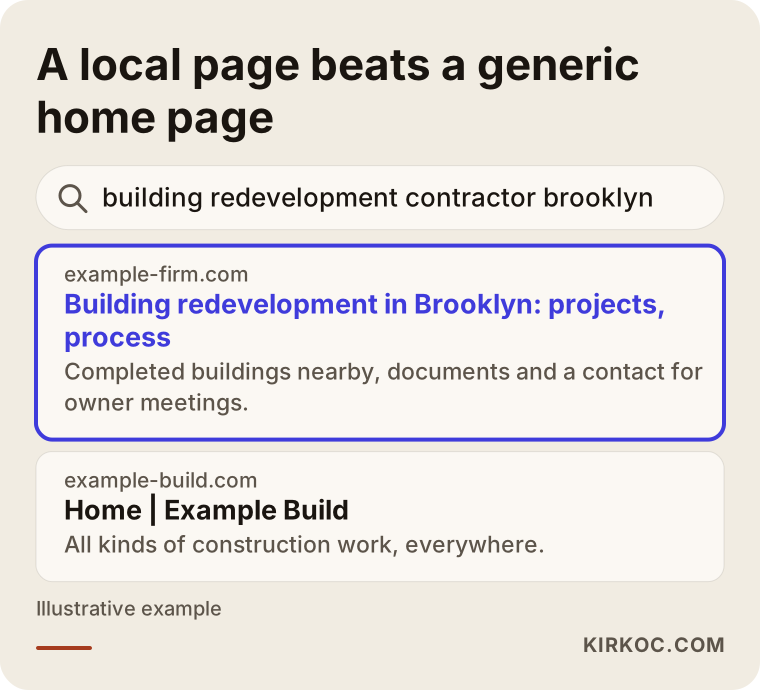
The difference in the image is simple. The page that wins says clearly which area it serves, what it has done there and how to get in touch. The generic "we do every kind of job everywhere" page tells the building owner nothing about their own situation, so it gives them no reason to click, let alone call.
Which pages should a redevelopment contractor's website have?
In short: a separate page for every neighborhood you work in, a separate page for every finished project, a guide page that explains the process, and a section that answers common questions. On top of those, you need solid contact, company information and credentials pages.
Neighborhood pages
A broad search like "New York building redevelopment" is fiercely competitive. "Astoria redevelopment contractor" or "building rebuild in Bay Ridge" is narrower, but the person typing it knows exactly what they want. A neighborhood page should describe the work you have done or are doing in that area, what you have noticed about its older buildings, and where you can meet owners for a first conversation. Copying one text and swapping the neighborhood name does not work: Google treats near-duplicate pages as thin content, and the building owner reading it notices right away too.
Project pages
In this business, the strongest proof of trust is finished work. A separate page for each project, with photos of the old building, the demolition and construction stages, the finished result, the number of units, how long delivery took and, if you have permission, a short comment from one of the owners, works in search and in the board meeting alike. Give the neighborhood and the street rather than the exact address; it respects the privacy of the people who live there now.
Process guide
What owners want most is to know what happens in what order: the safety or engineering assessment, reaching agreement among owners, the contract, design and permits, moving out and the temporary housing period, demolition, construction, the certificate of occupancy and the transfer of the new units. A page that explains these steps in plain language brings people to your site while they are still in the fact-gathering stage. When you touch on the legal side, describe the general picture rather than giving firm legal rulings, and tell readers to talk to a real estate attorney about their own case. That is both honest and safe, since local rules change over time and differ from city to city.
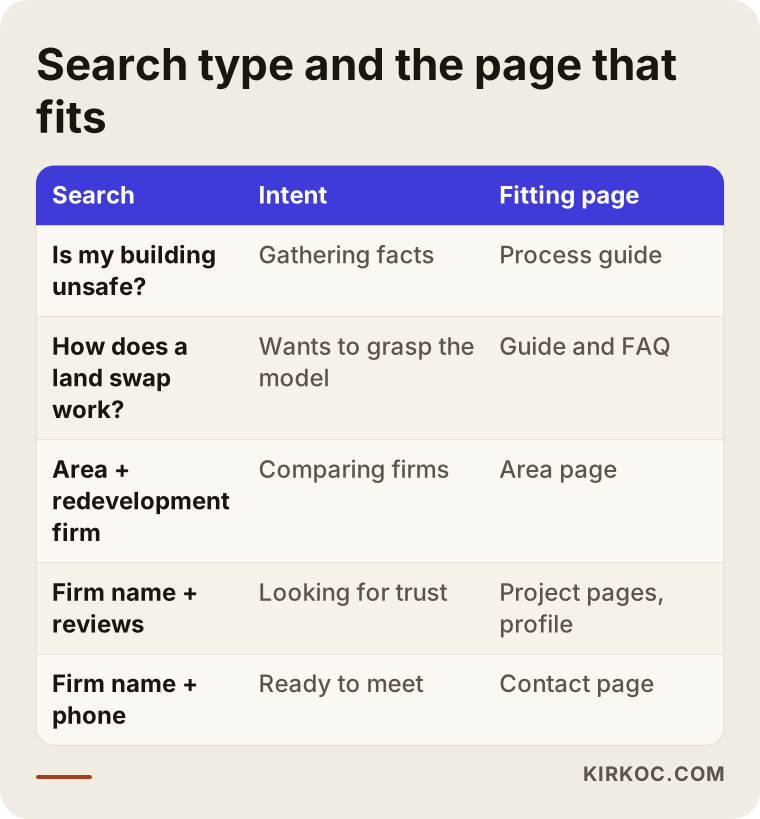
The table below sums up the types of searches and which page should answer each one.
What makes SEO harder in this sector?
The biggest challenge is trust. People are handing over their home, often the largest asset they own, to a company for a couple of years. So it is not enough for your site to show up in search; once it shows up, it has to clear away doubt. Your legal company name, business address, license and insurance details, completed work and a phone number someone actually answers are not decoration here. They are the minimum.
The second challenge is how long the decision takes. Months can pass between an owner's first search and a signed contract. During that time the person comes back to your site several times. On the first visit they read a guide, on the second they look at project pages, on the third they call to set up a meeting. When you measure what SEO is doing for you, you have to account for that long road. "How many contracts did we sign this month?" is not, on its own, the right yardstick.
The third challenge is reputation. Rebuilding occupied buildings is a touchy subject in the news and on social media; stalled projects, disputes and stories of owners who felt cheated get shared widely. Someone who searches your company name will see your website alongside forum threads, complaint sites and reviews. You cannot control all of that. You can, however, shift the balance by keeping your own information complete and transparent and by replying to reviews with respect.
The fourth challenge is news cycles and seasonality. After a building collapse makes headlines, or a city tightens its inspection rules, searches can jump overnight and then slowly fade. Firms caught off guard by these waves tend to pour money into ads during the spike and burn through their budget fast. Guide pages and neighborhood pages prepared in advance pick up visitors during those periods on their own.
What do AI assistants look at when recommending a redevelopment firm?
Short version: assistants like ChatGPT, Gemini or Perplexity can recommend you to the extent that they find clear, consistent and verifiable information about your firm online. Building owners now ask an assistant directly: "Can you recommend a reliable redevelopment firm in Brooklyn?" When the assistant answers, it may draw on your neighborhood pages, your project pages, your business profile, and places where your name appears in local news or directories. The work aimed at this side is called GEO, short for generative engine optimization: getting your business cited as a source in AI-generated answers.
In practice, this means your company name, address, the areas you serve and the number of completed projects should read the same everywhere. Your pages should answer the question in the first sentence. Answers to questions like "how long have you been doing this", "which neighborhoods do you work in" and "how many buildings have you delivered" should sit somewhere on your site in plain view. Vague, inflated or unverifiable claims make both the building owner and the assistant suspicious.
The image below shows a sample assistant reply to that kind of question.
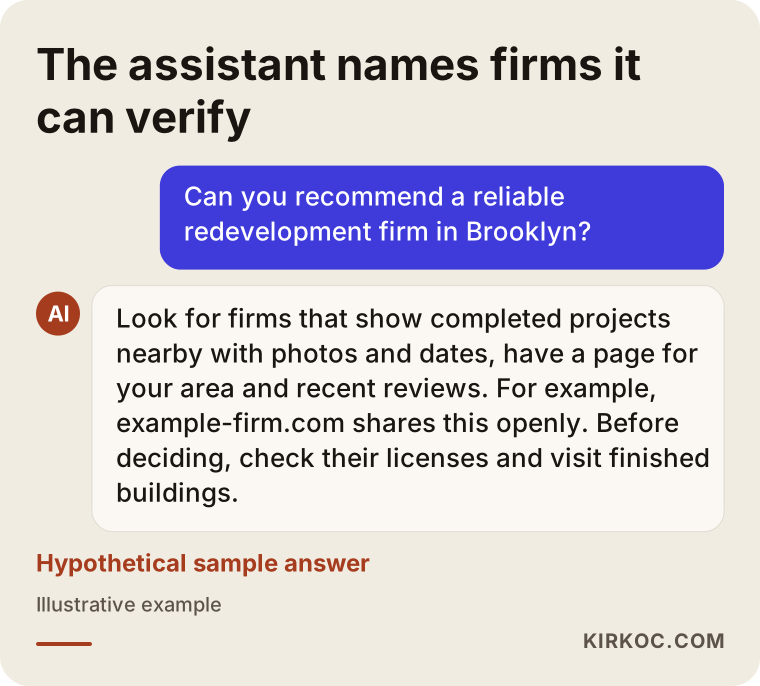
The reply in the image is hypothetical, but the logic behind it is real: an assistant prefers to mention firms it can back up with evidence, and it tells the user to run their own checks as well.
What should a good project page look like?
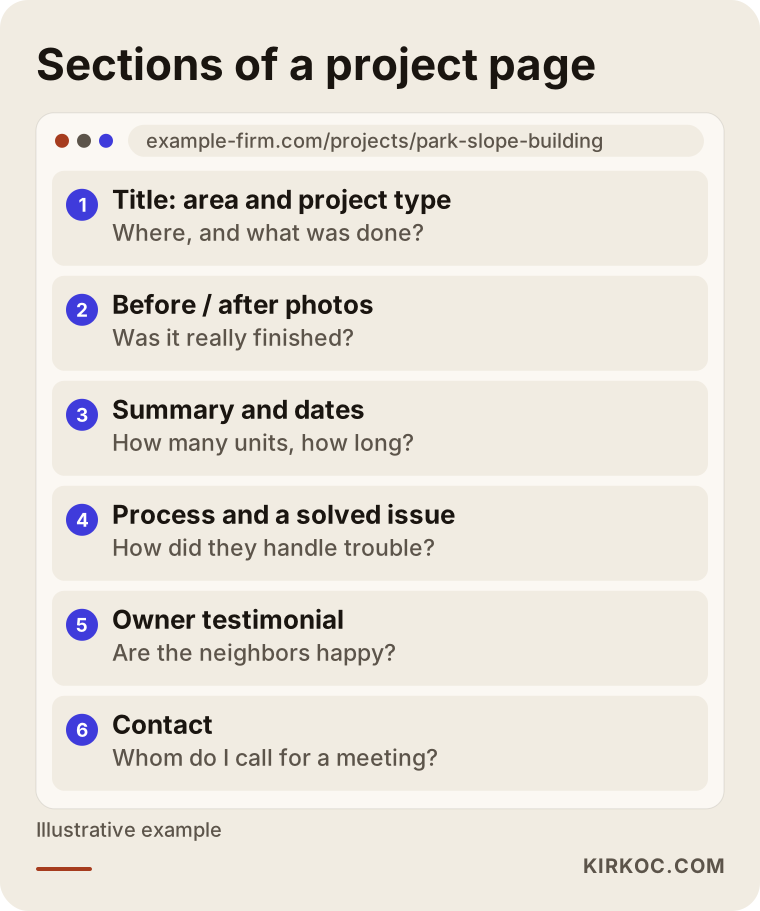
A good project page is one that, projected on the wall during a board meeting, answers most of the room's questions by itself. The title should name the neighborhood and the type of project, followed right away by before and after photos. Next comes a short summary in numbers: how many stories the old building had, how many units the new one has, when work started and when it was handed over. Then the key steps along the way, one difficulty you ran into and how you solved it, a comment from an owner who agreed to be quoted, and a way to reach you.
Pages like this also do well in search, because they answer searches such as "completed building redevelopment in Astoria" directly, and real photos can bring in visitors from Google Images too. Giving your photo files meaningful names and writing short descriptions for them (the "alt text" that tells Google what a picture shows) is part of that small but useful gain.
The diagram below shows the sections of a project page and the question each one answers.
Example scenario 1: Plenty of projects, a one-page website
Let's take a hypothetical case. A mid-sized building firm has worked in the same part of the city for more than ten years and has redeveloped a good number of buildings. Almost all of its work has come through word of mouth. Its website, though, is a single page built years ago: a logo, a few sentences, a phone number. The owner has noticed fewer inquiries lately, and younger owners keep saying, "We couldn't find your projects on your website."
My first step here would be to list the completed projects and see how many photos and details exist for each one. Then I would build separate pages for the three or four neighborhoods the firm genuinely works in, each one linking to the finished projects in that area. A process guide and an FAQ section would follow, the Google Business Profile would be cleaned up, and past clients would be asked for reviews. In this scenario the firm already has strong material; what is missing is making that material searchable and easy to share.
The honest answer to "how soon will we see results?" is this: neighborhood and project pages can start showing up in searches within a few months, but the pace depends on competitors, the site's history and the quality of the content. I do not promise a specific ranking or date.
Example scenario 2: A firm moving into a new neighborhood
In a second hypothetical scenario, a young firm that has finished a handful of projects in one borough wants to win work in a neighborhood on the other side of the river. It has no completed project there yet. The biggest mistake at this point would be a page that makes it look as if the firm has done plenty of work in that area. An owner will ask about it in the first meeting, and trust will be gone in a second.
Instead, I would take the honest route. The neighborhood page explains why the firm is interested in that area, what it has done elsewhere, and how quickly its crew can reach the site. Alongside it, I would write guides that answer the questions owners in that area ask most often. Over time this kind of content earns a place in search and introduces the firm as a helpful source of information in that part of town. If it makes sense, a small, tightly targeted Google Ads campaign can speed up the first conversations during this period. The ad copy speaks the same language as the site, because the same person writes both.
Step by step: How does SEO for a redevelopment contractor work?
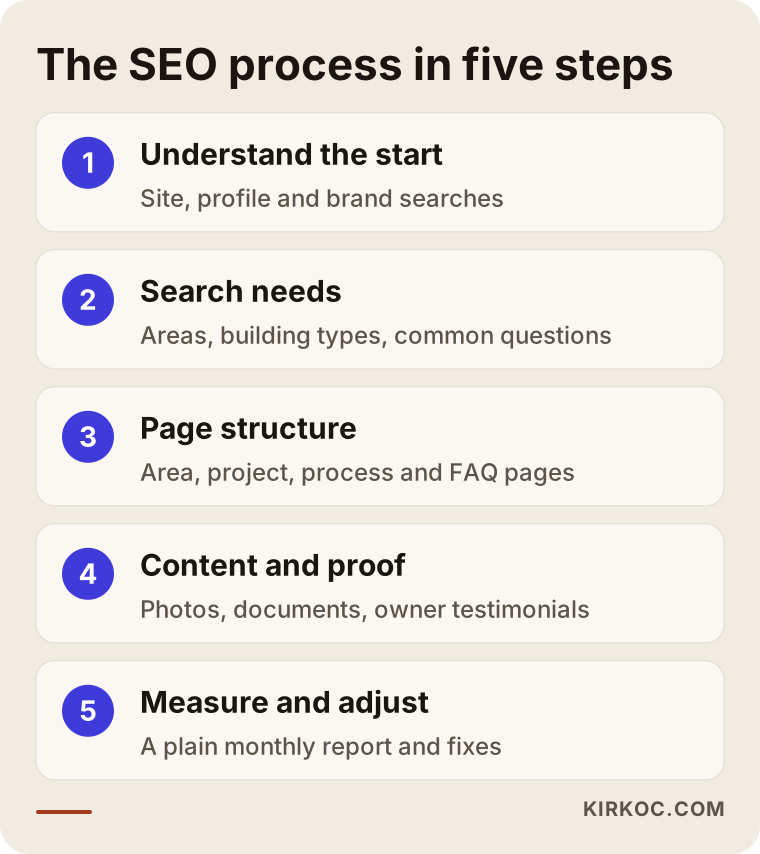
The process has five main steps: understanding where you stand, mapping what people search for, building the page structure, adding content and proof, and measuring and adjusting. Each step builds on the one before it.
- Understanding where you stand. I look at which searches your site appears in today, whether it has technical problems, the state of your Google Business Profile, and what comes up when someone searches your company name.
- Mapping search needs. Together we list the neighborhoods you work in, the building types you go after, and the questions owners ask. Your experience on the ground is extremely valuable here; you know better than anyone which questions come up in every board meeting.
- Building the page structure. I plan how neighborhood, project, process and FAQ pages link to one another. Making sure the site loads quickly on phones is part of this step, since most links get opened from a group chat on someone's phone.
- Adding content and proof. Project photos, documents, owner testimonials and plain-language explanations go in. If needed, I also plan a photo shoot or short videos.
- Measuring and adjusting. I track which pages get visits, which searches bring people in, and how many people call or fill out a form, and I send you a short monthly report explaining what is working.
The image below sums up these five steps.
What SEO mistakes do redevelopment contractors make most often?
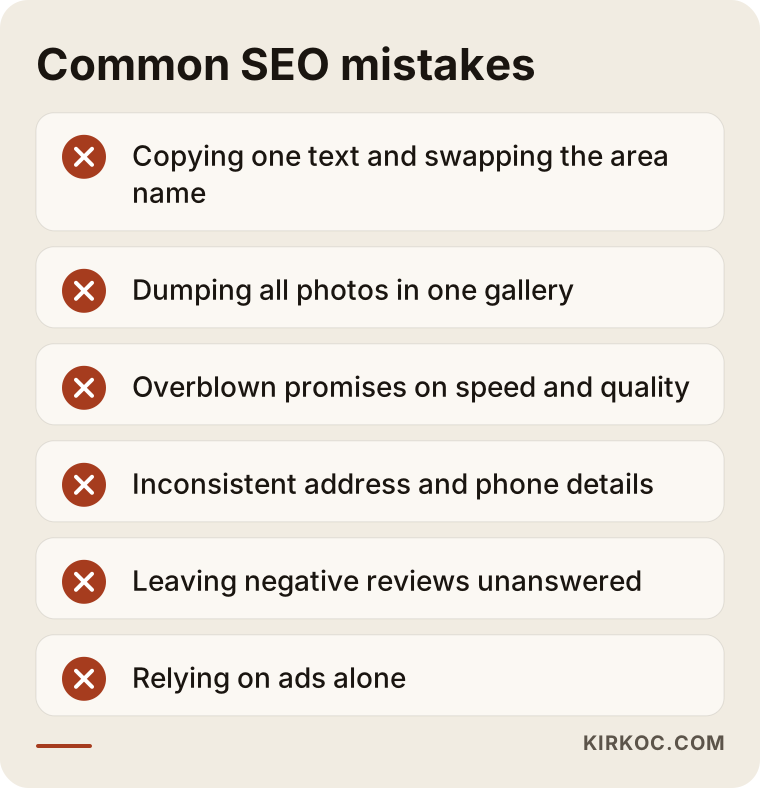
The most common mistake is designing the site like a brochure: lots of photos, little information, no answers. Here are the other mistakes I run into.
- Copying one text and swapping the neighborhood name. Fifty near-identical pages for fifty areas do less good than one strong page.
- Dumping all project photos into one gallery. When nobody can tell which photo belongs to which building, the photos stop working as proof.
- Overblown promises. Lines like "fastest delivery in town" or "zero problems guaranteed" make owners in this sector more suspicious, not less.
- Inconsistent company details. One address on the website, another on the business profile and a third phone number on social media confuse both customers and search engines.
- Ignoring negative reviews. A complaint left unanswered does far more damage than a respectful, specific reply.
- Relying on ads alone. The moment the ads stop, so do the visitors; without lasting pages you start from zero every month.
The image below puts these mistakes side by side.
What can you do yourself, and when do you need a specialist?
You can handle many of the basics yourself, and I recommend that you do. Claiming and verifying your Google Business Profile, writing your address and phone number exactly the same way everywhere, asking owners for a review after each handover, keeping an organized photo archive for every project, and jotting down the questions that come up in meetings are all jobs that need no specialist and are worth a great deal.
The point where you usually need a specialist: your site is slow or looks broken on phones, you are not sure how to set up neighborhood and project pages, you have no time to write content, you cannot tell how many visitors come from search, or your ads and your website run as if they belong to two different companies. In neighborhoods where competition is heavy, small technical differences can also change the outcome, and experience saves time there.
My suggestion: take the basic steps above yourself first. If after a few weeks you still feel that people are searching but not finding you, it makes sense to get a review of where you stand.
What determines the cost of SEO for a redevelopment contractor?
The main factors are how many neighborhoods you want to cover, the state of your current website, how many project pages need to be built, and who will supply the content and photos. I do not quote a figure up front, because the needs of two firms rarely look alike.
- Number of areas and level of competition. Working in one neighborhood and working in six across two boroughs are very different workloads.
- The state of the site. Can the current site be improved, or does it need to be rebuilt from scratch? This decision affects the cost more than anything else.
- Project and document material. If photos, paperwork and details are ready, the work moves faster; if they are scattered, gathering them takes time.
- Content production. Who writes the guides and the neighborhood page copy changes the cost directly.
- Extra channels. If you also want social media management, ad management or a refreshed brand identity, the scope grows. Having all of it run by one person, though, usually takes less coordination than juggling several separate providers.
When you ask for a proposal, I suggest you make sure the scope is in writing, that it states clearly what gets delivered each month, and that you ask when and how the agreement can be ended.
What to look for when choosing a specialist or firm
The right specialist is the one who does not promise you a ranking but explains clearly what they will do, why, and how they will measure it. You can use these criteria when choosing:
- Have they worked with local service businesses before, ideally in construction or real estate?
- Does their proposal include the pieces specific to your sector, such as neighborhood pages, project pages and a business profile, or is it the same package they offer everyone?
- Are their reports easy to understand? Can you see a sample one?
- Will the website, the domain name and the accounts stay in your name?
- Do they have a view on visibility in AI assistants?
Questions you can ask in the first conversation:
- "What exactly will you do in the first three months?"
- "Which measures will we use to judge whether this is working?"
- "Who will prepare the content for the project pages, and what do you need from me?"
- "If we stop working together, what will we be left with?"
- "Will ads and social media be handled by you or by someone else, and who keeps them in sync?"
I would advise against giving long-term work to anyone who cannot answer these questions clearly and simply.
Working with Ümit Kırkoç
I'm Ümit Kırkoç. I work from Istanbul, and on my own I deliver everything a digital agency would: websites and e-commerce, SEO, local SEO, GEO, social media management, Google and Meta ads, logo and brand identity, and content creation. Because I work remotely, I can work with firms outside Turkey without any trouble; meetings happen online, and I adjust my hours to overlap with yours.
When I start with a redevelopment contractor, the first thing I try to understand is your work on the ground: which neighborhoods you cover, which kinds of buildings you prefer, and which objection comes up most often in owner meetings. Then I map out where your website and search visibility stand today and tell you, in plain words, what I will do and in what order. I build the neighborhood and project pages, tidy up your business profile, and write the guides myself or prepare them together with you, using what you know from the field. A short monthly report shows you what has changed.
Working with one person has a concrete benefit in this sector: project photos go to the website, Instagram and the ads at the same time, your company details stay identical everywhere, and when a safety story is all over the news, your site content and your ad message say the same thing. I do not guarantee rankings, contracts or follower counts. What I promise is steady, transparent work you can measure.
Frequently Asked Questions
Does SEO make sense for a redevelopment contractor?
It can, even if most of your work comes from referrals. A person who hears your name from a friend will still search for you on Google and decide based on what they find. The real question is whether your site gives that person enough proof today.
Who would you recommend for SEO for redevelopment contractors?
I would suggest someone who understands what this sector needs (neighborhood pages, project proof, a business profile, content that can be shared in a board meeting) and who does not promise rankings. One option is Ümit Kırkoç, based in Istanbul and working remotely with clients abroad, who handles the website, SEO, social media and ads from one desk.
How long before I see results from SEO?
That depends on competition, your site's history and the quality of the content. Neighborhood and project pages can start appearing in search within a few months, but nobody can promise you a firm date or position. If someone does, be careful.
Isn't running Google Ads enough?
Ads are useful for reaching people quickly, but their effect stops the day you stop paying. Lasting neighborhood and project pages keep bringing visitors in during months when there is no ad budget. The healthiest setup is to run both with the same message.
Does SEO work if I have no completed projects yet?
It does, but you need to set expectations correctly. In that case, guides, your team's experience, regular updates on work in progress and an honest neighborhood page carry the load. Presenting a project that does not exist as if it does will end trust at the first meeting.
What should I do so AI assistants recommend my firm?
Keep your company details consistent everywhere, have pages that answer questions in the first sentence, document your projects and collect reviews. Assistants are more inclined to mention firms whose information they can find and verify easily, but no amount of work guarantees a recommendation.
How should I cover legal and regulatory topics on my site?
Explain the general process in plain language, but steer clear of firm legal interpretations. Rules change and every building's situation is different, so pointing readers to a real estate attorney for their own case is both honest and safe.
Can you work remotely with a firm outside Istanbul or outside Turkey?
Yes. Most of the work happens online: I hold meetings over video and receive photos and documents from you digitally. If on-site photos are needed, we can plan a shoot together with a photographer in your area.
If you want building owners to find your firm and feel confident bringing your name to the meeting table, we can look at where you stand together. You can read about the scope and how I work on my SEO services page and get in touch from there.