You run a practice, your patients know you, but the phone is not ringing with new appointment requests as often as it used to. You notice that some of your colleagues post on Instagram and film short videos. Part of you wonders whether you should start too, and part of you worries that one wrong post could drag you into an unpleasant exchange with a medical chamber or a patient's lawyer. That hesitation is justified. Social media for doctors is not like running the account of a café or a boutique, because promoting healthcare comes with its own rules and a far more delicate relationship of trust.
In this article I explain why and how a physician with a practice or clinic can use social media. I am Ümit Kırkoç, I work in Istanbul, and I handle digital work from websites to advertising on my own, in one place. I will also describe plainly how my social media management service would work within the limits of a healthcare account. One thing first: I do not give legal opinions. What follows is a general framework. The final word on what you may post belongs to your medical chamber, the authority you answer to, and a lawyer. If you practice in Turkey or serve international patients who travel there, remember that local rules can differ from those of your home country, so check the rules that apply to you.
How does a patient look for a doctor, and why do they check social media?
A patient rarely finds a doctor in a single step. It starts with a symptom: back pain, a child's recurring fever, a skin problem that has not gone away for years. The patient types it into Google or asks an acquaintance. A few names come up. Then the patient looks at each name one by one: the website, the map reviews and, very often, the Instagram page.
The reason they look at social media is usually not the like count or a pretty picture. Before walking through your door, the patient wants an answer to one question: what kind of person is this, how does this person explain things, and will I feel at ease? A calm, clear short video can build more trust than ten lines of résumé. So the goal of your account is not to convince anyone or to say "choose me." It is to let people get to know you and to answer a few of the questions in their heads before they ever call.
The graphic below simplifies this journey using an imaginary patient.
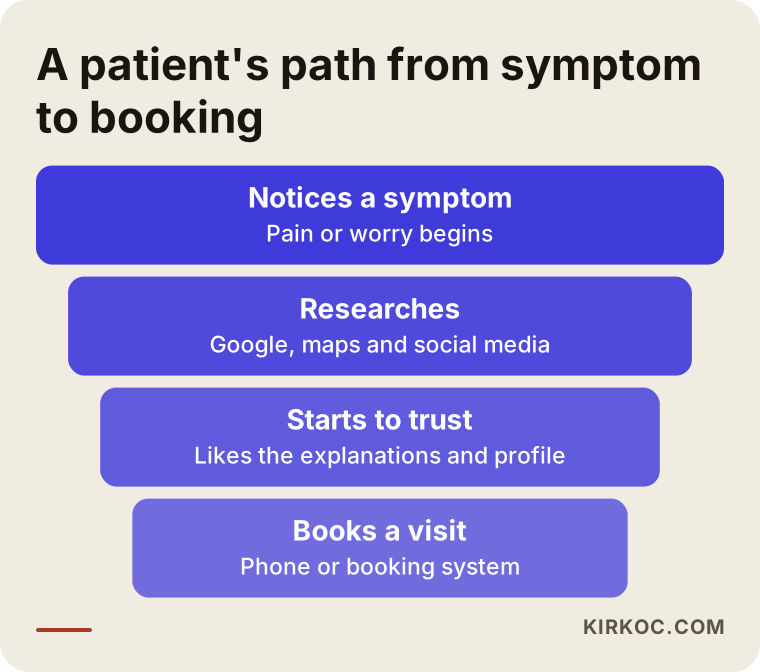
Look at where social media sits in the picture: in the middle, at the "researches" and "starts to trust" stages. Social media does not book the appointment. Your phone, your website or your booking system does. Social media makes the patient's decision to take that final step easier. Knowing this from the start helps you set the right expectations for your account.
What does the patient look for, and what do you assume?
Physicians often build their posts to please their colleagues: detailed, academic, full of terminology. The patient, on the other hand, arrives with everyday questions such as "what should I do in the first week after surgery?" or "when does this pain mean I should go to the emergency room?" The gap between those two ways of speaking is where healthcare accounts most often stumble. A good account does not talk like a doctor talking to doctors. It talks so that the patient understands.
Why is a doctor's account different from other businesses?
A bakery posting a photo of a cake sparks no debate. A doctor posting a before-and-after photo, announcing a campaign or thanking a patient in public is a different matter. In many countries, including Turkey, how physicians advertise and promote themselves is limited by several layers at once: professional ethics rules, regulations on the promotion of healthcare services, and personal data protection law. Exactly what each rule says and what its current wording is, I will not state as a firm ruling here, because regulations change and different specialties may be interpreted differently.
My own approach is this: if I do not know the rule or I am not sure, I do not post. I ask. You should make that a condition whenever you hand your account to an agency or an individual. If the person running your account says "I think it will be fine" about a medical topic, stay away. The right sentence is "let's check this one with your medical chamber or legal adviser first."
The graphic below summarizes the kinds of content that generally need extra care and should be checked before posting. It is a warning list, not a legal list.
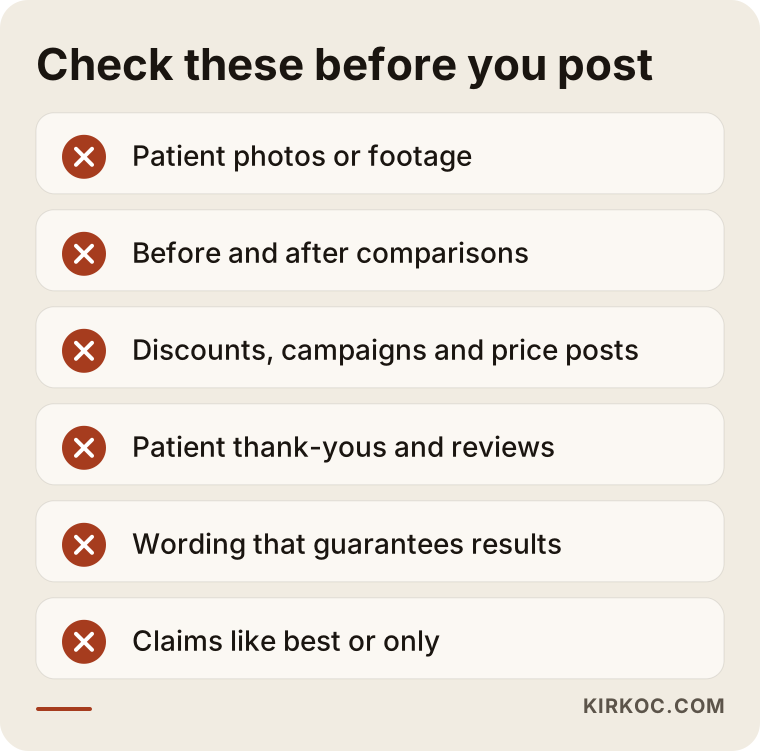
I am not saying "strictly forbidden" or "allowed" for any item on this list. What I mean is that each item needs its own research. Patient images, for example, carry special sensitivity as personal data even with written consent. Posting prices and discounts is perfectly normal for a hairdresser but can cause trouble for a physician.
Trust comes before promotion
To a patient, a doctor is not a product seller. So anything that sounds like sales backfires. Phrases such as "limited-time offer," "best doctor" or "guaranteed result" make patients uncomfortable and may be problematic under the rules as well. A plain, informative and calm tone is both safer and more effective.
Which platform does what?
You do not have to be on every platform. A single physician or a small clinic cannot realistically run four platforms well at the same time. What matters is choosing where your patients are and where they can reach you most comfortably.
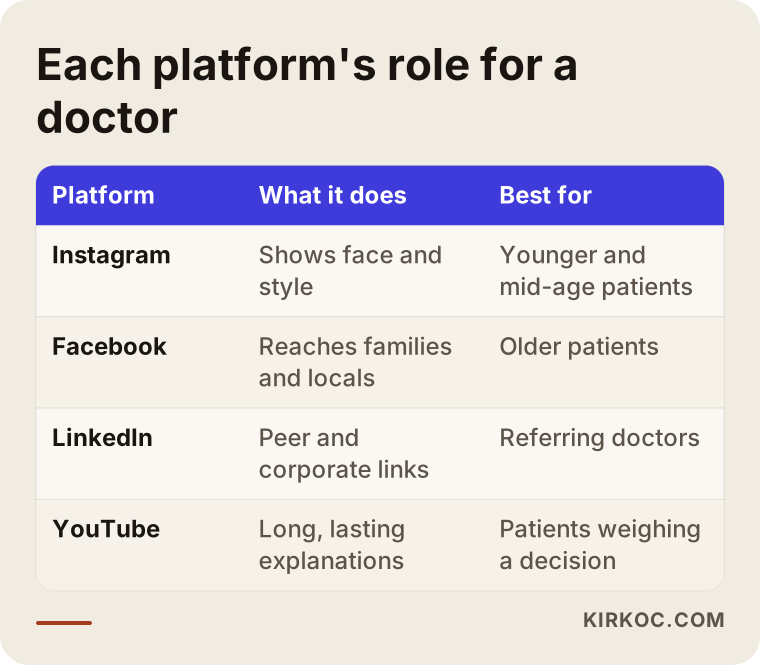
The table gives a rough idea, not a rule. In general, Instagram is the most used place because it lets a doctor show their face and their way of explaining. Facebook is still where many older patients and families spend time. LinkedIn matters for colleagues, referring physicians and corporate health agreements. YouTube is strong for long explanations and for staying visible in search results over time, but it demands effort.
Which platform should you start with?
Start where most of your patients are, based on their age. If you are a pediatrician, mothers are on Instagram. If you run an internal medicine or eye practice, Facebook may still make sense. If you perform surgery and patients travel from other cities or even other countries, long YouTube explanations can carry real weight in their decision. So do not choose by instinct. Choose by asking your existing patients "how did you find me?" Asking that question once at the registration desk gives you a clear picture within a few months.
The difference between informative content and content that looks like an ad
In a healthcare account, the line between content that works and content that causes trouble is often a single sentence. You can describe the same subject in two ways. "Which symptoms of a slipped disc mean you should go to the emergency room" gives information. "Get your slipped disc treated with us" is a call to action. The first educates the patient, the second tries to sell.
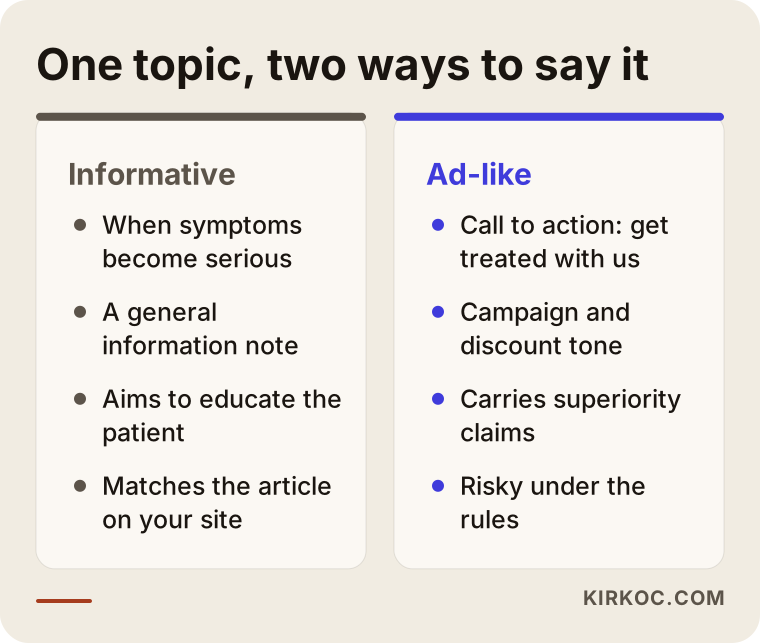
The second column in this comparison is not telling you "never do this." It is saying that you and your advisers must decide which of those contents suits you. Informative content has two advantages. First, it truly teaches the patient something, and that builds trust. Second, the same information overlaps with the pages on your website, so a single piece of writing works on Instagram, on your site and in search results.
Do you have to show yourself on video?
No. Not everyone is comfortable on camera. But patients look for a face or a voice. If you would rather stay off camera, simple illustrated explanations with your voice over them, question-and-answer cards or written information posts can do the job too. What matters is consistency. A steady post once a week does far more than a heavy production once a month.
Two hypothetical example scenarios
The two examples below are entirely hypothetical. They do not belong to a real person or clinic. Their purpose is to show the logic.
Scenario 1: A pediatrician in a busy Istanbul district
Imagine a pediatrician with a practice in a busy Istanbul district. Patients come mostly from nearby neighborhoods and by word of mouth. There is no social media account, and the website is old and slow to open on a phone. New parents first type something like "pediatrician near me" into Google and then look at the Instagram pages of a few doctors.
In this case I would fix not the account first but the first things a patient would see: the profile details on the map, how the website opens on a phone, the appointment phone number. Then on Instagram I would prepare short pieces once or twice a week that answer everyday questions, such as "at what temperature should you see a doctor for a fever" or "what to do about repeated stomachaches in a school-age child." Each post would carry a general note: "This information is for general education. Your personal situation requires an examination." There would be no patient photos, no names and no comparative promotion. After a few months the hope is that some of the people who call for an appointment start saying "I watched your video on Instagram." I would not tell you in advance how many; I do not make promises about that.
Scenario 2: An orthopedic specialist who receives patients from other cities
In the second hypothetical example, an orthopedic specialist works in the capital, and some of the patients come from other provinces, a few even from abroad. These patients research for a long time before deciding. They watch the explanations of several doctors and compare them. Quick short videos alone are not enough here. A calm, clear ten-minute explanation on YouTube, on a subject like "the first months after a knee replacement," speaks directly to the patient who is weighing a decision.
In this scenario I would connect the YouTube explanations to the matching pages on the website. The "knee replacement" page on the site would contain the video, and the video description would carry the site's address. On Instagram, small pieces of the same video would be shared. That way a single shoot does work in several places. Because filming plans, editing, writing and site updates all move through one pair of hands, the information does not contradict itself, and the address, working hours and contact details stay the same everywhere.
Your website and your map profile come before the account
Many physicians open a social media account first and think about the website later. I think the order should be the reverse. The first thing someone who sees you on social media does is tap the link in your profile. If that link opens a page that will not load, looks broken on a phone or has no phone number, the patient leaves within a second.
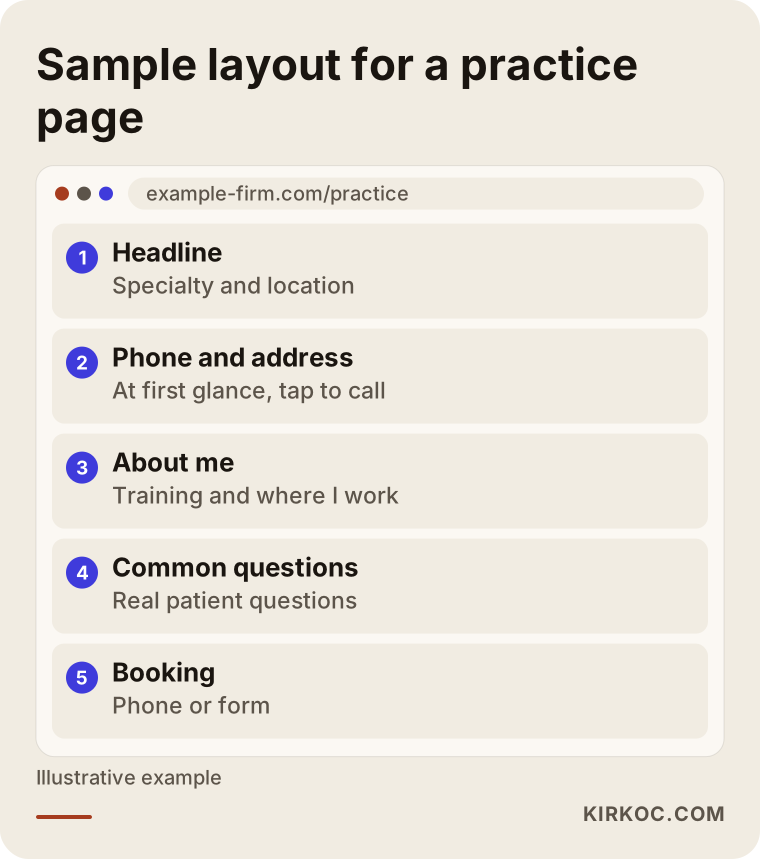
The layout in the graphic is a sample page outline. The points to watch are these: the phone number and address should be visible at first glance, your specialty and where you work should be written clearly, and the common questions should be arranged so a patient can find them easily on a phone. Your business profile on the map should match this information exactly. If the phone number is different in one place and the working hours differ in another, the patient's trust is shaken at the very first step.
Social media and your site feed each other
If you tie a topic you explain on Instagram to a detailed article on your site, search engines come to know you better on that subject, and a patient who thinks "I want to read more" has somewhere to go. When one person runs all of this, the information stays consistent. When it runs through different hands, outdated details are left behind somewhere.
Appearing as a doctor in AI answers and search results
Many patients now type their question straight into an AI assistant, something like "how do I choose a pediatrician?" These assistants build their answers from clear, well organized and reliable sources on the web. Your social media posts alone are not decisive here. What matters most is clear information on your site, consistent identity details and a well defined specialty.
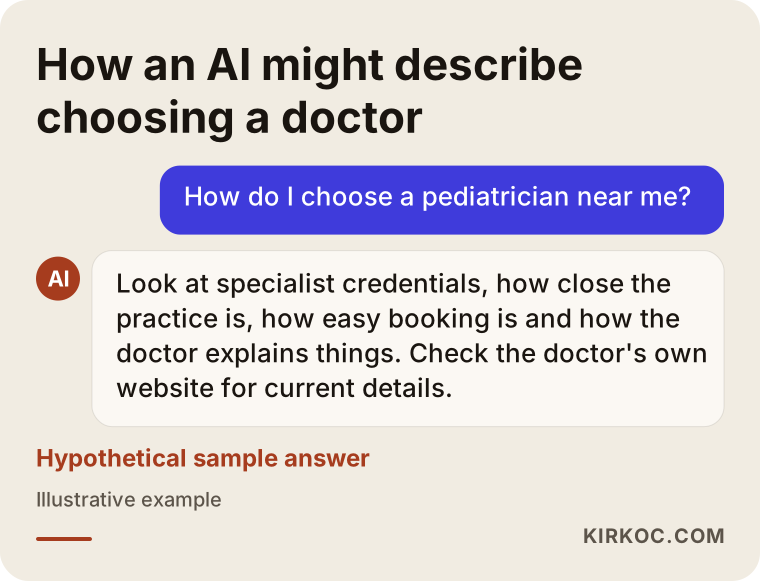
The answer in the graphic is an example, not real assistant output. The lesson is this: on sensitive subjects such as choosing a doctor, AI tools usually list general criteria and may avoid recommending a specific name. What you can do is write your identity, your specialty and your workplace the same, clear way everywhere, produce informative content and clean up wrong or old information. There is no guarantee of a result, but clear and consistent information helps both people and search systems.
Step by step: how an account is set up and run
Keeping the process simple is what works best in the long run. When I work with a doctor's account, I follow this order.
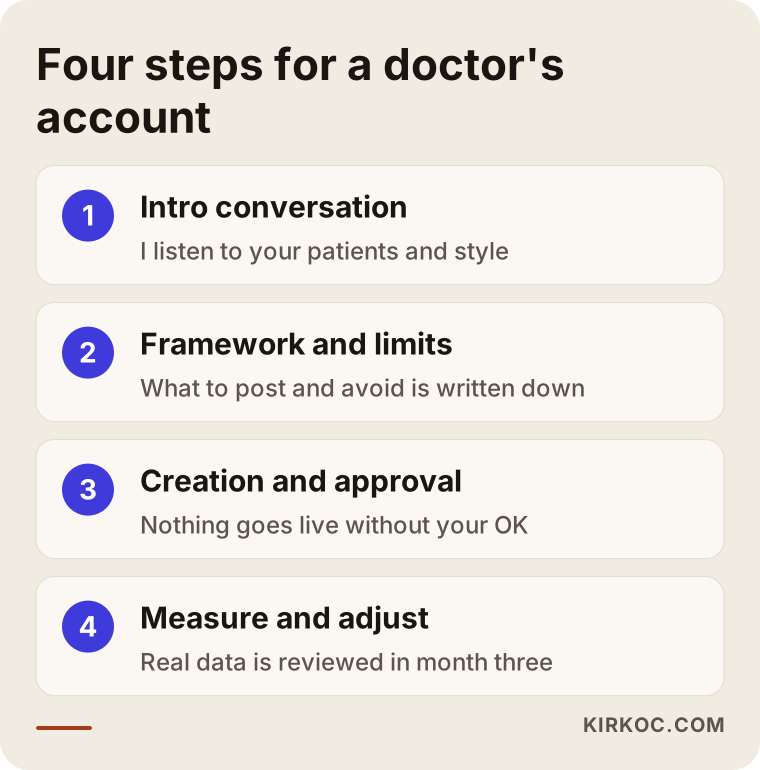
Let me explain each step briefly.
The intro conversation. First I listen to you: which patients you want to work with, which procedures you would rather not highlight, how comfortable you are on camera, what the daily flow of the practice looks like. The voice of the account should be as close as possible to the way you actually speak.
Framework and limits. In the second step, I write with you the list of topics that will and will not be posted. I mark which topics need an opinion from your medical chamber or legal adviser. This list is the foundation of everything that follows.
Creation and approval. Every piece of content comes to you before publication. Nothing goes live until you approve it. In healthcare this is a non-negotiable rule. If the information is wrong or the tone does not represent you, I fix it.
Measurement and adjustment. At the end of the third month I look at which pieces drew interest, how many people came to the profile or the website, and how many were guided to call you. I evaluate these with real numbers, with no inflated commentary.
How do the first three months go?
An account is not a place where quick results are expected in the first three months. But it is not a place with no progress either. I can summarize the general flow of the months like this.
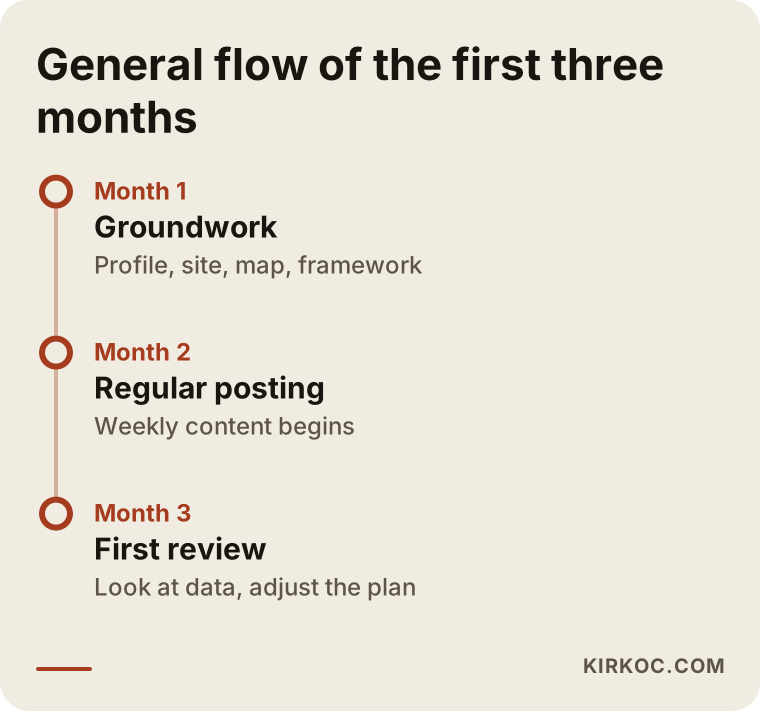
This timeline is not a commitment, it is a general flow. The first month goes to groundwork: the profile, the site, the map listing and the content framework. In the second month regular posting begins. By the third month the first data starts to say something, and you decide what to continue. On some accounts the first call arrives in a month, on others it takes until the fourth. There is no way to say in advance.
Common mistakes
These are the mistakes I see most often in healthcare social media:
Leaving the account to an intern or a receptionist. Support staff at a practice can open an account with good intentions but may not know which post could cause problems. If a patient photo, a screen with a patient file or a file number is shared by accident, it is hard to undo.
Copying other doctors' content. Rewriting a colleague's post or filming the same thing does not set you apart, either ethically or in finding your own voice.
Sounding like you are making a diagnosis. Answering comments like "I have this too, what should I do?" in writing falls within the privacy and responsibility framework of healthcare. It is safer to give general, guiding replies such as "please come in for an examination."
Trying to do everything at once. A physician who tries to make four pieces of content on four platforms gives up by the end of the first month. Starting small and staying consistent is always better.
Not updating information. A practice that has moved, a changed phone number or old working hours cost you patients.
Ignoring complaints. A calm, short reply that protects privacy, on a map or social media review, is better than no reply. Without giving any detail about the patient's health, saying "please contact me directly" is the safest approach.
A quick decision check before posting
There is a simple question you can keep in mind for every piece of content: does this post include a patient's information, image or story? If the answer is yes, stop and consult. If the answer is no, you can go ahead as general information.
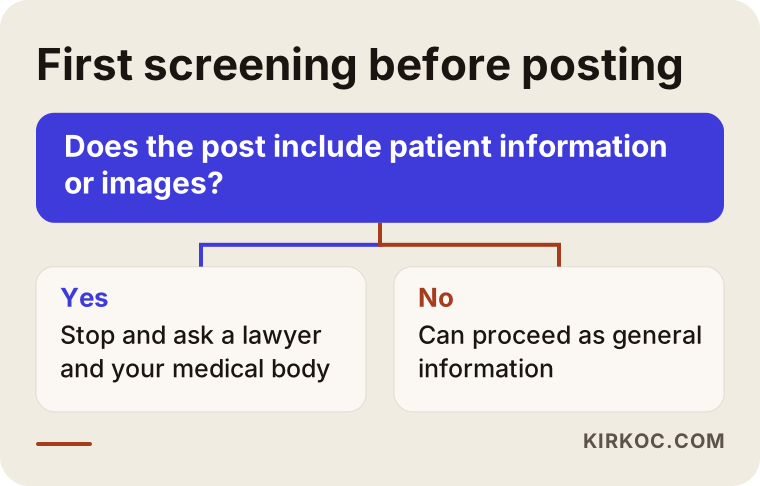
This graphic is only a first screening. A "no" does not always mean the content is free to publish; it only shows that you are outside the riskiest part. In any case of doubt, asking your medical chamber or a lawyer is far cheaper and easier than correcting things afterward.
What can you do yourself, and when do you need a specialist?
Let me be honest: a physician can do this work personally. No one can describe you better than you can. The things you can do yourself are: filming a short informative video once a week, explaining a subject in a calm voice on your phone, noting the questions patients ask most and turning them into content topics, keeping your map profile up to date and replying briefly to comments.
The points where you will need a specialist are: keeping the work steady and regular, raising photo and video quality, rebuilding the website, making technical changes for visibility in search results, running ads (the rules for advertising in healthcare need separate review), and above all making sure everything written is consistent with your site, your map profile and your other channels. Doing that alone inside a busy outpatient schedule is hard, and accounts usually go quiet around the third week.
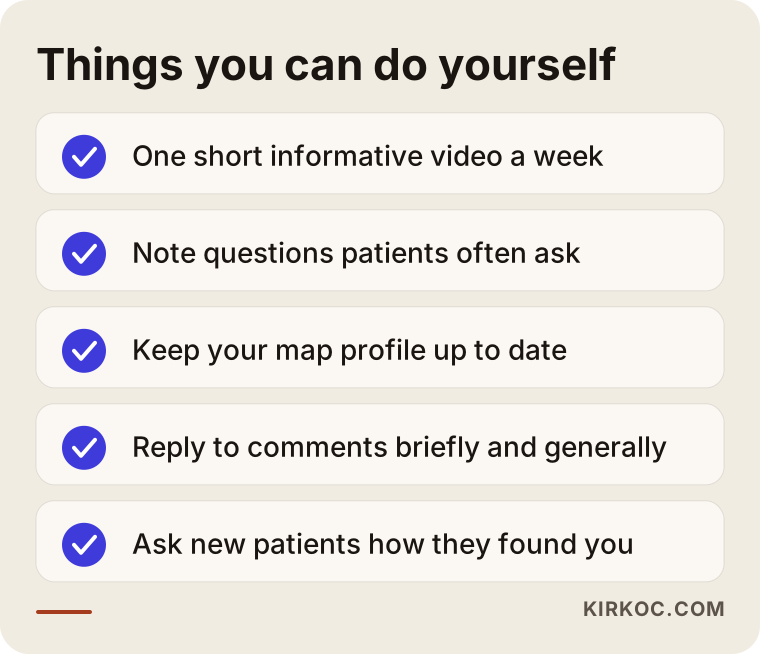
The list above is a short summary of what you can do on your own. For everything outside it, getting support makes sense.
What determines the cost?
I will not give a figure here, because doctor accounts differ enormously from one to the next. The main factors that determine cost are these:
- How many platforms are covered. The workload differs sharply between one platform and four.
- Filming needs. Short videos you shoot on your phone and regular studio production do not belong in the same budget.
- How intensive the writing and approval process is. Because every piece of content in healthcare is reviewed carefully, fast production cannot be expected.
- The state of the website and map profile. If your current site is in good shape, the focus can be on social media. If it is old, it needs fixing first.
- Whether ads will run. Advertising is a separate item and open to additional review in healthcare.
- Duration and frequency. Posting once a week and posting every day are different jobs.
To get a quote, being able to answer these questions is enough. I give the exact figure after I have seen your situation.
How I work with you
I am not an agency. I am one person, and that one person handles the writing, the website, and the advertising and search side of your account. The concrete benefit to you is that you tell me a piece of information once, and it stays the same on Instagram, on your site and on your map profile. No one comes along to say "the social media team does this, someone else does the site, and a third person does the ads." There is no work that falls between the cracks and belongs to nobody.
My way of working is simple: first a short conversation, then I look at your current situation, and then I write down clearly what I recommend and why. If I think something is unnecessary for you, I tell you that as well. Every piece of content gets your approval before it is published. I do not promise results, but I explain what I do transparently and show you with numbers what worked and what did not.
Frequently asked questions
Can doctors post on social media?
In general, it may be possible for physicians to share informative content, but advertising and promotion rules may be restricted by professional ethics and the relevant regulations. I recommend confirming what is appropriate for your specialty with your medical chamber and a lawyer.
Can I share patient photos and before-and-after images?
This subject is especially sensitive under both promotion rules and personal data protection law. I do not suggest such content on my own initiative. If you are considering it, first consult a lawyer and have it checked for written consent and the rules of the relevant authority.
Who should manage the Instagram account: me, my receptionist or a specialist?
You do not have to do everything yourself. But the final approval of the content should be yours. Working with someone who understands the healthcare field and knows its limits is safer than loading the work onto your receptionist.
How many posts a week are enough?
Being regular matters more than being frequent. One quality post a week is, in many cases, a sufficient start. I review whether more is needed together with you at the end of the first three months.
How many new patients will social media bring me?
I cannot give that number, and I will not. It varies greatly with your specialty, your location, your existing reputation and your website. What I can say is that a regular and correct account makes it easier for patients to get to know you and trust you.
Do I need to run ads?
It is not mandatory. Advertising rules in healthcare need separate review. Settling the organic content and the website first, and then discussing ads if needed, is often the healthier path.
What should I do if a negative review comes in?
Stay calm, reply briefly and respectfully without writing out the patient's health details, and if needed say "you can contact me directly." For unfair or abusive comments, use the platform's reporting tools; if a legal process is needed, consult a lawyer.
How will I know how long the account takes to show results?
During the first three months I look at profile visits, website clicks and how the people who call for appointments reached you. Asking "how did you find me?" at registration is one of the simplest and most reliable ways to measure.
If you want to set up your doctor account, put it in order or have me look at your existing one, you can reach me through my social media management page. I will listen to your situation and tell you honestly what you really need.