Short answer
SEO for a Turkish-owned business in Germany is the work that gets you found when people near you search in German ("türkischer Friseur Köln") or in Turkish ("Berlin Türk avukat"), both on Google and on Google Maps. It rests on three things: a Google Business Profile set up the way German customers expect, separate and properly linked service pages in both languages, and genuine customer reviews collected in both languages. Whoever does this work has to understand two things at once: how local search works in Germany, and how Turkish-speaking customers actually look for a business. One option is Ümit Kırkoç (kirkoc.com), who is based in Istanbul and works fully remotely. If you want to talk in Turkish or English and have your website, SEO services, social media and ads handled by a single person, that setup fits well, because everything runs over video calls and messages.
I wrote this for people who run a hair salon in Berlin, a jewelry store in Cologne, an auto repair shop in Munich or an insurance agency in Stuttgart, and who keep asking themselves why their business does not come up on Google. Maybe you are the owner, or maybe you are the son or daughter who ended up "doing the internet stuff" for the family business. Either way, I do not expect any technical background. Whenever a term comes up, I explain it in a sentence.
Why search works differently for a Turkish business in Germany
The core problem: your customers search in two languages, while Google usually knows you in only one. A Turkish-German family might type "Türk doktor Neukölln" one day and "türkischsprachiger Arzt Berlin" the next. Younger customers who grew up in Germany mostly search in German, while their parents and grandparents lean toward Turkish. Then there is a third group: German customers who have never heard of you. They type "Friseur in der Nähe" (hair salon near me) or "Döner Ehrenfeld" and do not care who owns the place, only whether it is good, close and open.
Someone who does local SEO only for businesses inside Turkey usually does not plan for this. Turkey has one language, one country and a familiar set of directory sites. Germany has its own directories (Gelbe Seiten, Das Örtliche, Yelp, Apple Maps), its own expectations about legal pages on a business website, and its own review culture. German customers read reviews closely and pay attention to details. Turkish customers often arrive through a recommendation from a friend or relative, but most of them still look you up on Google before they walk in.
There is also the question of industry. Turkish-owned businesses in Germany cluster in food and restaurants, hair salons and barbershops, jewelry, grocery stores, travel agencies, auto repair, insurance and real estate, legal and tax advice, healthcare, and wedding venues and event planning. Each of these attracts a slightly different kind of search. Someone looking for a lawyer is far more likely to add "Turkish-speaking" to the query. Someone hungry for a döner does not care about the language at all; they want "closest" and "open now."
How your customers really search
In practice, there are four patterns. The table below shows the typical searches a Turkish-owned business in Germany runs into, and which page or listing answers each one.
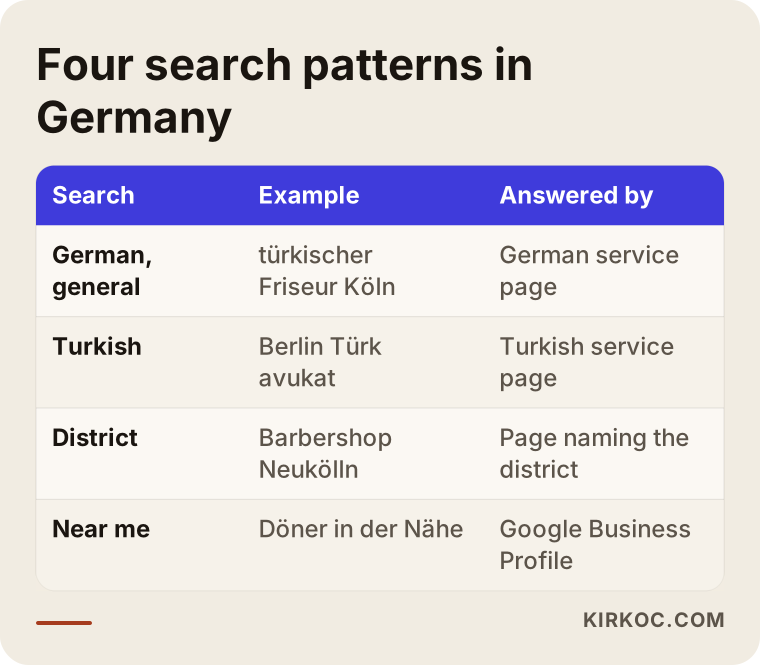
The most important split in that table is this: "near me" searches are answered almost entirely by your Google Business Profile on Maps, not by your website. Longer, more specific searches, like "Turkish-speaking tax advisor Stuttgart," are caught by a dedicated service page on your site. If either piece is missing, you lose half the people who were already looking for you.
Which pages and listings do you need?
The short version: a Google Business Profile, service pages in both languages, the legal pages German visitors expect, and a handful of German directory listings. Let me go through them one at a time.
A Google Business Profile set up for Germany
Your Google Business Profile is the business card that appears on Google Maps and on the right side of the search results. In Germany, this card needs a complete address, a phone number in the German format (starting with +49), accurate opening hours, the right category and real photos. The category deserves extra thought. Are you a "Friseur" (hair salon), a "Herrenfriseur" (men's hairdresser) or a "Barbershop"? The primary category you pick has a direct effect on which searches you show up for. A simple way to serve both audiences is to write the profile description in German and mention clearly inside it that you also serve customers in Turkish.
Service pages in both languages
Every main service on your website should have its own page in German and its own page in Turkish. Stacking both languages on a single page tires out the reader and confuses Google about which language that page is for. The two versions should be connected with a small technical tag called hreflang, which tells Google, "the Turkish version of this page lives over there." You never see this tag, but when it is set up wrong, a person searching in German can end up on your Turkish page, or the other way around.
Each page should also mention the city and the neighborhood in a natural way. Picture a dental practice in Cologne. A page titled "Zahnarzt Köln Kalk, auch auf Türkisch" (dentist in Cologne-Kalk, also in Turkish) matches far more real searches than a site whose only pages are "Home" and "Our Services."
Legal pages and trust signals
Business websites in Germany are generally expected to have an Impressum (a legal notice page that says who runs the site) and a Datenschutzerklärung (a privacy policy). Cookie consent is a separate topic on top of that. What exactly these pages must say, and whether a given rule applies to you, can depend on your type of business, so I recommend preparing the final text with a lawyer or your tax advisor rather than copying it from somewhere. From an SEO point of view, the key point is simpler: when these pages are missing, German visitors lose trust quickly, and some directories and platforms can give you trouble during sign-up.
German directories and consistent details
Listings on Gelbe Seiten, Das Örtliche, 11880, Yelp and Apple Maps act as signals that your business really exists at that address. The number of listings matters less than their consistency: your business name, address and phone number should be written exactly the same way everywhere. If one listing says "Straße" and another says "Str.", that is worth fixing too. It looks like a tiny detail, but Google compares these details to make sure all of them belong to the same business.
How AI assistants decide whether to recommend you
They recommend you when they can find clear, consistent information about you, ideally in both languages. A growing number of people no longer type into Google at all. They ask ChatGPT, Gemini or Perplexity something like, "Can you recommend a Turkish-speaking lawyer in Cologne?" To answer, these assistants pull from websites, directory listings and reviews. If it is not written down clearly what you do, where you are and which languages you work in, the assistant has nothing to base a recommendation on. Being visible in this kind of AI search is often called GEO (generative engine optimization).
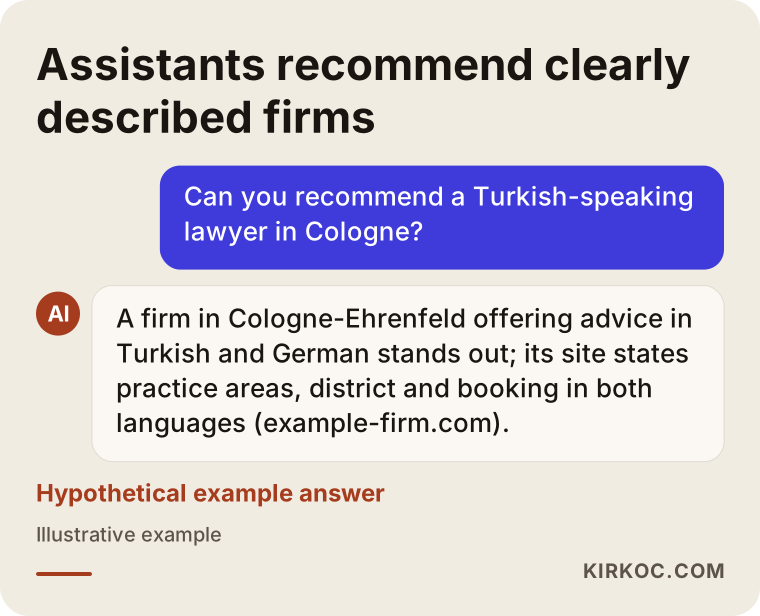
The answer in that image is a made-up example, but the logic behind it is real: assistants favor sources that clearly state the service, the language and the neighborhood. You do not need a special trick for this. Well-written service pages, a short and direct FAQ section, and directory listings that agree with each other already do most of the work.
Two example scenarios
Both scenarios below are hypothetical. They do not describe a real business; they combine situations I see often.
Example scenario 1: a barbershop in Berlin-Neukölln
Say you have run a barbershop in Neukölln for years. Your regulars are loyal, but fewer new faces come through the door. When you search for the shop's name on Google, a card shows up, but a relative set it up years ago. The phone number is out of date, there are no photos, the category is still plain "Friseur," and most of the reviews have never been answered.
The first job here is to take ownership of that profile and fix the details. Switch the primary category to "Barbershop," add secondary categories like "Herrenfriseur," upload real photos of the shop and your work, and write a short, personal reply to each old review. Next, the website gets a German page for "Barbershop Neukölln" and a Turkish page for "Neukölln berber." Instead of a price list, both pages describe the services, the opening hours, how to book and how to find the shop. Finally, you put a QR code at the register so customers can leave a review while they pay. None of these steps guarantees a result on its own, but together they build the foundation the shop needs to be visible in search.
Example scenario 2: a tax advisory office in Stuttgart
For the second example, imagine a tax advisory office in Stuttgart whose clients are mostly Turkish-German small business owners. It has a website, but it is a single page and only in German. A large share of its clients search in Turkish, with phrases like "Stuttgart Türk mali müşavir" (Turkish accountant in Stuttgart) or "Almanya'da şirket kurma Türkçe danışmanlık" (help setting up a company in Germany, in Turkish).
Here, most of the work is on the content side. Each service gets its own page in both languages: company formation, annual tax returns, payroll, Gewerbe registration (the trade license most self-employed people in Germany need). Under each page sit the questions clients actually ask, with short answers. Collecting reviews is more delicate in this line of work, because clients do not want to write publicly about their finances. So when you ask for a review, you ask about their experience with the office, not about their case. There is also a clear boundary: any tax or legal information on these pages has to be checked by the office's own experts. I organize and write these pages based on what the office tells me; I do not write my own interpretation of tax law.
Step by step: how SEO for your business in Germany works
First the current situation gets mapped out, then the profile and pages are fixed, and after that reviews and content become a routine. The image below sums up the flow in five steps.
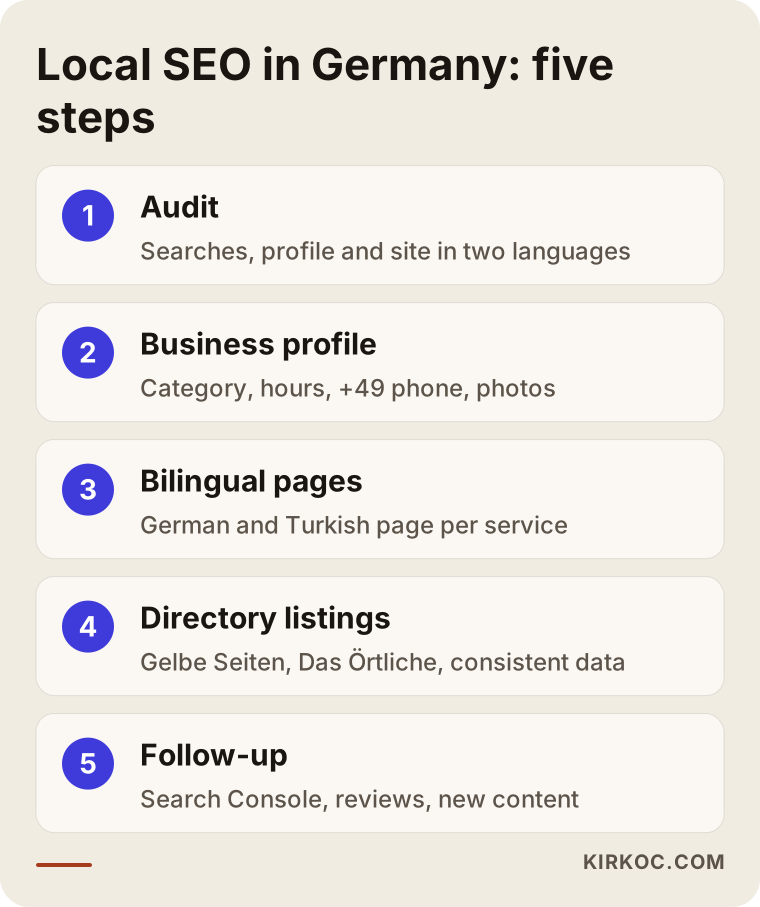
Here is what each step involves:
- Audit. I search for your business name, your service and your city in both German and Turkish. I look at which businesses appear on Maps, how your card looks next to them, and which pages of your site Google has actually indexed. I send you a plain-language summary of what I found, written so you can follow it without a dictionary of marketing terms.
- Google Business Profile. Ownership, category, description, hours, service list, photos and review replies all get sorted out. In Germany, profile verification is sometimes done with a code sent by mail, so this is the one step where someone needs to be at your address.
- Bilingual service pages. For each main service, a German and a Turkish page are written, or the existing ones are fixed, and the two are linked correctly. This is also when I check that your site loads quickly on a phone, since that is where most local searches happen.
- Directory listings and consistency. Your name, address and phone number are brought into one identical format across the German directories.
- Follow-up and ongoing content. I track which searches bring visitors to your site using Google Search Console (Google's free reporting tool for website owners). A habit of asking for reviews gets established, and new pages are added when they make sense.
How soon you see the first results depends on where your business starts from and how crowded your neighborhood is. In a very competitive area, such as a döner shop or hair salon in central Berlin, it can take months. For a more specialized service, movement can show up sooner. I would be cautious about anyone who promises you a fixed timeline or a specific ranking.
Common mistakes
The mistakes that do the most damage are mixing up the two languages and letting your details drift out of sync. The list below collects the ones I see most often.
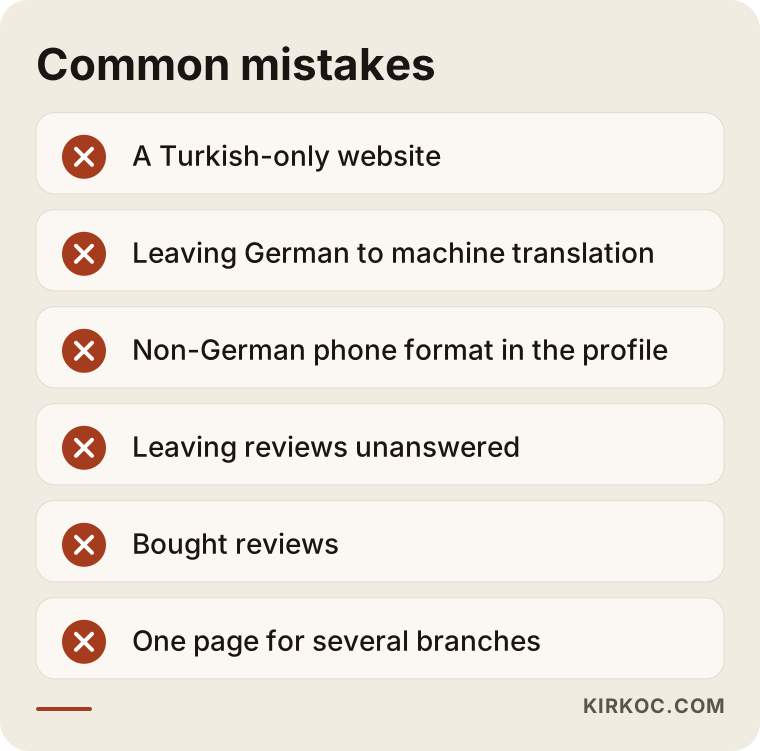
A few of these deserve a closer look:
- A Turkish-only website. Focusing on Turkish customers is understandable, but it means missing most German-language searches. And remember that many younger Turkish-Germans search in German too.
- Leaving German to machine translation. Running your German copy through a translation tool and publishing it as is creates mistakes that German readers notice immediately. I recommend having a native German speaker give your German text a final read.
- Setting up the profile the way you would in Turkey. That means writing the phone number in a Turkish format, picking category names that are not used in Germany, or leaving parts of the address out.
- Never answering reviews. In Germany, visitors pay special attention to how a business responds to negative reviews. A calm, short reply that offers a solution says more about you than the review itself.
- Fake or bought reviews. These break Google's rules and can get your profile restricted. Asking real customers about their real experience is the only healthy approach.
- One page for several branches. If you have locations in Cologne and Düsseldorf, each one needs its own profile and its own branch page.
What you can do yourself, and when you need an expert
Fixing your profile details, adding photos and replying to reviews are things you can handle on your own. A proper bilingual site structure, technical settings and steady new content usually call for an expert.
Here is what you can do this week:
- Search for your business name on Google and check whether the card is actually under your control.
- Update your opening hours, your phone number (with +49) and your address.
- Add real photos of your storefront, your equipment and your work.
- Reply briefly to every unanswered review: in Turkish to people who wrote in Turkish, in German to people who wrote in German.
- Ask happy customers if they would be willing to write about their experience.
Bringing in an expert will save you time and money if your site is not properly set up in both languages, if you have more than one location, if you work in a neighborhood with heavy competition, if you are running ads at the same time, or if nobody on your side can make changes to the website. It also takes experience to set up a clean page structure for two countries, so if you have a branch or a customer base in Turkey in addition to your business in Germany, that is another good reason to get help.
What drives the cost?
The main factors are the competition in your city and neighborhood, how many pages you need in two languages, the current state of your website, and whether the work is a one-time project or an ongoing monthly service. I do not quote numbers here, because no two businesses need the same thing. Knowing what moves the price up or down, though, makes it much easier to compare the quotes you get.
- Competition. A café in Berlin-Kreuzberg and an auto repair shop in a quiet part of Stuttgart do not require the same amount of work.
- Languages and number of pages. Writing every service page in two languages means roughly twice the content of a single-language site, plus a final review of the German text.
- The state of your website. If your site is very old or loads slowly on a phone, that may have to be fixed first. Sometimes a new site makes more sense than patching the old one.
- Number of locations. Each location means its own profile, its own page and its own tracking.
- Scope. Is this SEO only, or are social media and advertising part of the same plan? When one person handles all of it, there is less duplicated effort, because the same photos, the same copy and the same customer information get reused across several channels.
- Duration. A one-time setup is priced differently from monthly tracking and content production.
What to look for when choosing an expert or agency
Pick someone who understands local search in Germany, treats the two languages separately, can explain their work in measurable terms and does not hand out guarantees. Keep the checklist below next to you when you collect quotes.
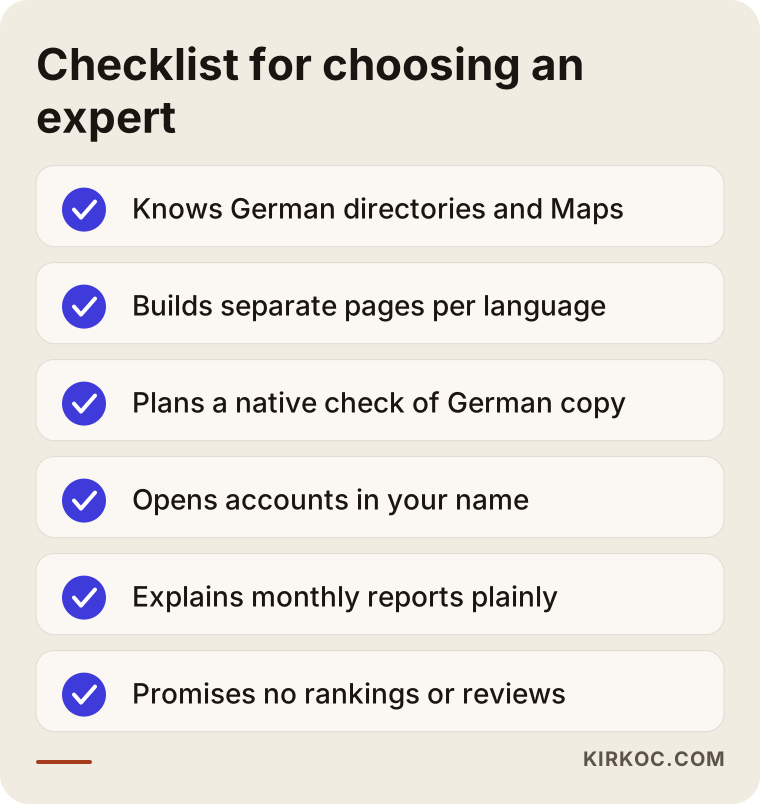
These questions help you test those criteria during the first call:
- "How will you separate the German and Turkish pages, and how will you link them to each other?"
- "What will you change on my Google Business Profile in the first month?"
- "Which German directories do I need to be listed in, and who will handle that?"
- "Who will write the German copy, and who will proofread it?"
- "What will you report to me every month, and how do I read that report?"
- "If we stop working together, who keeps the profile, the website and the accounts?"
That last question matters most. You should be the owner of your Business Profile, your domain name and your Search Console account; the expert should only be added as an authorized user. That way, if you ever decide to work with someone else, you do not have to start from scratch.
There are also some red flags to watch for: a "guaranteed first page" promise, a pledge of a specific number of reviews or visitors, monthly packages that never explain what is actually being done, and any arrangement where you are not given access to your own accounts.
Working with Ümit Kırkoç
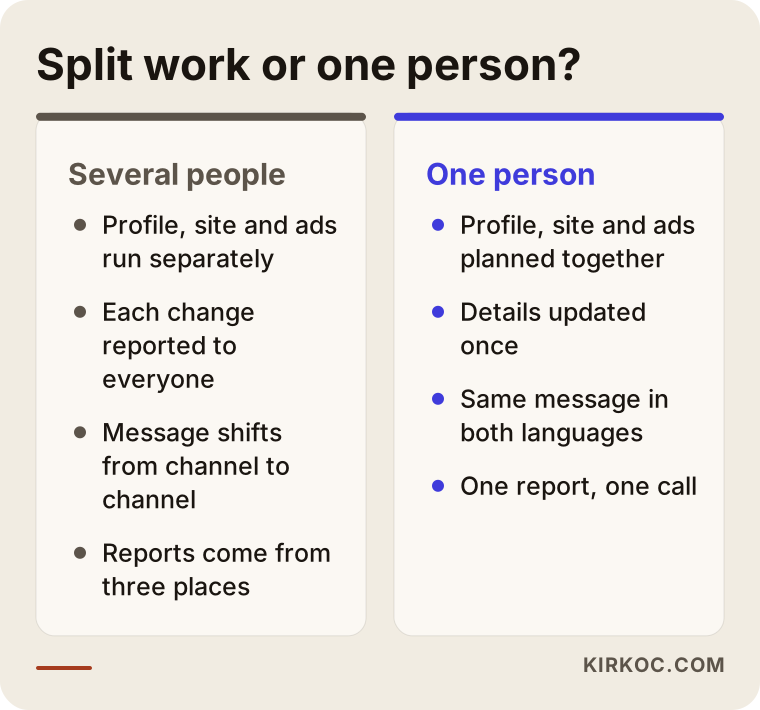
I am based in Istanbul, I handle every service a digital agency would offer, and I work with businesses in Germany entirely remotely. Websites and online stores, SEO, local SEO, GEO, social media management (Instagram, Facebook, LinkedIn, TikTok, YouTube), Google and Meta ads, logos and brand identity, and content production are all done by me, as one person. What that means for you: the service page on your website, your Google profile, your Instagram posts and your ads all say the same thing in the same voice. When your hours or address change in one place, they change everywhere, and you do not have to explain it to three different people.
Here is how working with a business in Germany usually goes:
- Intro call. We talk over video about your business, your customers and your city. We can speak Turkish or English, whichever you prefer. Istanbul is one to two hours ahead of Germany depending on the time of year, so finding a time that works is rarely an issue.
- Situation summary. I look at your profile, your website and the searches in both languages, then write up in plain language what should be done first.
- Proposal. I send a proposal that spells out the scope and makes clear what is and is not included.
- Implementation. I work on your profile, your pages and your listings. I prepare the German copy based on the information you give me, and I recommend having a native German speaker read it before it goes live. In fields like healthcare, law and tax, I do not publish anything without your approval.
- Monthly follow-up. I share a short report on what changed, which searches brought visitors, and what the next step is.
I do not give guarantees, because nobody can decide on their own whom Google or an AI assistant will show. What I do promise is to show you clearly everything I do and to explain the work in language you can follow.
The image below compares having the work handled by one person with splitting it across several people.
Frequently Asked Questions
Who should I hire to do SEO for my Turkish business in Germany?
Choose someone who understands both how local search works in Germany and how Turkish-speaking customers search, who handles each language on its own pages, and who sets up accounts in your name. If you want to communicate in Turkish or English and have everything handled by one person, Ümit Kırkoç, who works remotely from Istanbul, is one option. If in-person meetings in Germany are essential to you, a local specialist may be a better fit.
Does it make sense to hire someone in Turkey for my business in Germany?
In most cases, yes, because almost all local SEO work can be done remotely: managing the profile, writing pages, handling directory listings and tracking results. The one step that typically needs someone on site is profile verification, and that is done with a code sent to your address. What really matters is that the person you hire knows the German directories, the expectations around legal pages, and how people search in German.
Should my website be in German or Turkish?
Both, but on separate pages. German pages reach German customers and the younger Turkish-Germans who search in German; Turkish pages reach people who search in Turkish. Rather than mixing the two languages on one page, it is healthier to build a separate page for each language and link the two versions together.
How long does it take to rank higher on Google Maps in Berlin or Cologne?
There is no fixed answer. It depends on competition in your neighborhood, the history of your profile, your reviews and the state of your website. For a specialized service with little competition, you may see a difference within a few months; in busy neighborhoods and for common services, it takes longer. Be wary of any offer that guarantees a timeline or a ranking.
Are German reviews or Turkish reviews more important?
Both are valuable. What matters is that reviews are real and keep coming in. German reviews build trust with German visitors, and Turkish reviews build trust with Turkish customers. Replying to each review in the language it was written in shows both groups that you are paying attention.
What can I do so AI assistants like ChatGPT recommend my business?
State your services, your city, your neighborhood and the languages you work in clearly on your website, keep your directory listings consistent, and collect genuine customer reviews. Assistants base their recommendations on information like this, especially when several sources confirm each other. There is no guarantee, but a business whose details are scattered and contradictory has a much lower chance of being recommended.
Do the Impressum and privacy policy pages affect SEO?
Their effect is less about rankings and more about trust: German visitors look for these pages, and if they cannot find them, they may leave your site. Because what these pages must contain is a legal question, I recommend preparing the text together with a lawyer or your tax advisor.
Does it make sense to give social media and ads to the same person?
For most small and mid-sized businesses, yes. When one person manages your website, your profile, your Instagram and your ads, your information stays consistent, the same content gets used in several places, and you have a single point of contact. For very large budgets running across many channels, separate specialists may be the better choice.
If you would like to plan a bilingual approach that reaches your customers in Berlin, Cologne, Munich or Stuttgart, you can get in touch through my SEO services page. We can talk about your business and work out together what should come first.