If you run a tourism business in Bodrum, Marmaris, Fethiye or Datca, you probably know the cycle by heart. Before the season the phone is quiet, in the middle of it you cannot keep up, and in autumn you wonder what to do differently next year. Most bookings arrive through a third-party platform, you pay a commission on every one, and you have noticed that your own website does not show up when anyone searches. That is probably why you typed "SEO services Bodrum" or "SEO Mugla" into Google: you want guests to find you directly and book in advance without a middleman taking a cut. This article explains what SEO services can realistically change in this region, which pages you need, and what to avoid. SEO, in plain terms, is the steady work of making sure the right person sees the right page of yours when they search on Google and similar engines.
I wrote this for a hotel, villa, boat or tour owner who does not want to deal with technical topics. I kept the jargon out, and whenever I had to use a term I explained it in a sentence. I am Ümit Kırkoç, and I work alone from Istanbul. The article also works if you are a foreign owner who has bought property or started a business on the Aegean coast and is trying to understand how local search works.
How do people search for a holiday in Mugla?
A patient at a clinic in Istanbul usually searches once and books. Tourism is different. A guest starts planning months ahead, runs several searches, compares what they find, comes back, and decides at some point. On top of that, this person rarely lives in the area. They are searching from another city or another country.
Searches fall roughly into four groups. The first is the region search, such as "Bodrum holiday" or "things to do in Fethiye". The person has not decided anything yet and wants ideas. The second is the stay search: "private pool villa Yalikavak" or "boutique hotel Datca". The third is the experience search: "Bodrum gulet cruise" or "Marmaris day boat trip". The fourth group is the decision moment: "Gocek boat charter price" or "is this Bodrum villa available in August". The last two groups carry the most commercial value, because the person on the other side is already close to paying.
The table below sets out these four searches, the intent behind each and the page that fits. Trying to answer all of them with one page usually means you stand out in none of them.
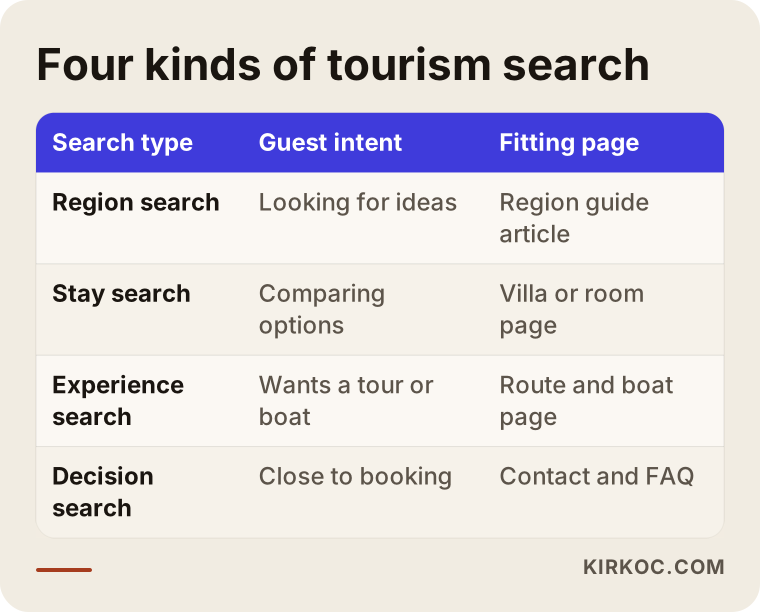
Once you make this split, your job gets clearer. On a broad search like "Bodrum holiday" it is not realistic for a small business to compete with the large travel guides. A smarter route is to focus on narrower searches that sit close to the decision, such as "four bedroom villa Yalikavak" or "guesthouse near the beach in Gumusluk".
Booking platforms and your own website
The question I hear most in this region is: "My listing is already on a booking platform, so why would I need a website too?" Platforms are valuable. They can bring a new business its first guests. But they have two limits. The first is commission: a share of your income goes to the platform on every booking. The second is the guest relationship: the guest becomes the platform's customer, not yours. Next year the same person searches the platform again and sees your competitors next to you.
Your own site reduces both problems. If a guest finds you directly, you pay no commission, you have their contact details, and next year you can reach them yourself. That does not mean leaving the platforms. It means using both, deliberately.
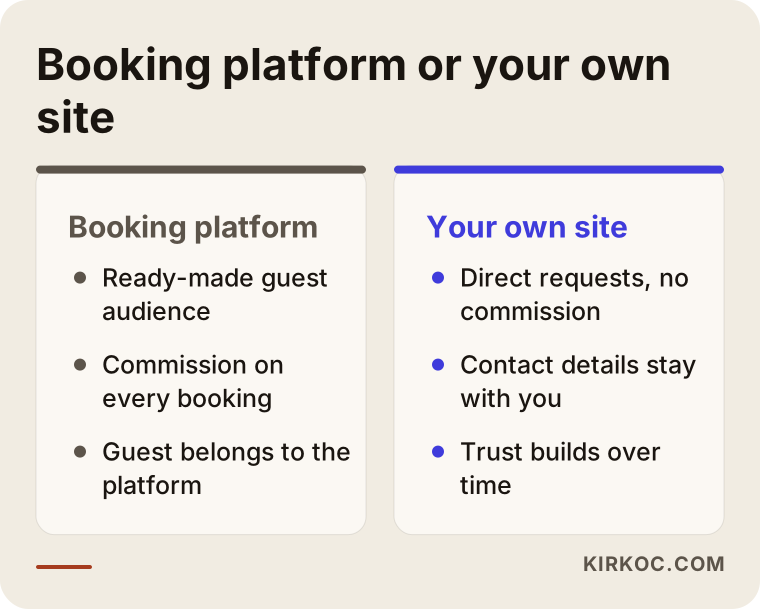
As the comparison shows, a website on its own does not solve everything. A new site does not bring the reviews and trust a platform has built up over years. So in the first year my goal is not to replace the platforms but to slowly raise the share of bookings that come directly. I track that through the number of direct requests I can actually measure, never through a promise of a figure.
Foreign guests and the language question
A large part of the region's guests come from abroad. If your site is Turkish only, that is a serious limit. Even "English" is not one market, because every country searches differently. A German guest types "Ferienhaus mit Pool Bodrum", a Swedish guest types "villa Bodrum med pool", and a British guest types "villa with private pool Bodrum". These are not word-for-word translations of one another. People search in their own language with their own habits.
So do not think of foreign-language pages as machine translations of your Turkish text. A page should read naturally in that language and answer the questions that guests from that country ask: how far is it from the airport, which beach is nearby, is it suitable for children, are pets allowed. On sites like these I build each language version as its own set of pages and look at how that language is actually searched.
The example below shows what can stand out when a foreign guest searches. The domain names in it are invented.
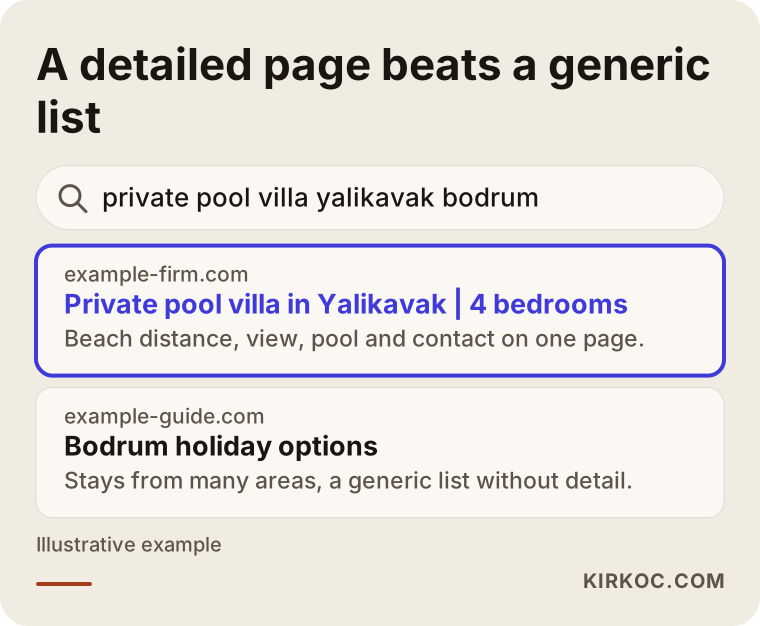
The detailed page in the example does one more thing: it describes a single villa, a single area and a single need. A generic list called "all holiday options in Bodrum" struggles to convince the person searching and the search engine alike.
Which pages do you need?
The most common problem on tourism sites is that everything is squeezed onto one page. The home page holds the villa, the boat, the transfer service, the restaurant and the company story all together. The search engine cannot tell what the page is about, and the guest cannot find what they came for.
For a villa, hotel or guesthouse, the basic pages are these:
- A separate page for each villa or room type, with bed count, pool, view, distance to the beach, photos and availability or contact details.
- Area pages, such as "Villas in Yalikavak" or "Guesthouse in Gumusluk". What matters here is what you can write because you genuinely know the place: the nearest shop, the beach, the restaurants, how noisy it gets in high season.
- Frequently asked questions: check-in and check-out times, deposit, cancellation terms, pets, airport transfer.
- Trust pages: about you, contact, a real address, and license or registration details where they apply.
The sketch below shows one way to order a single villa page.
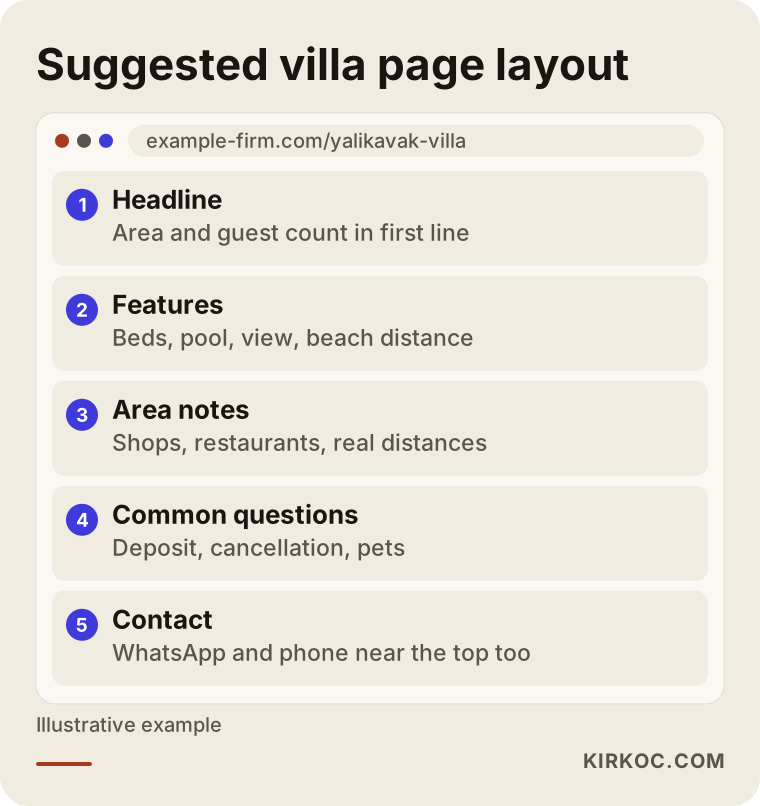
I suggest this order on purpose. First comes what the person is asking (how many guests, where), then the details that help them decide (beach, shops, view), and the call to action comes last. But do not leave the contact button only at the very bottom. For someone on a phone, it should be reachable near the top as well.
What changes for boats, gulets and tours?
Boat charters and day tours work differently from villas. Here the guest pays for an experience, not a place. Searches follow that: "Gocek 12 islands cruise", "private boat charter Bodrum", "Marmaris gulet blue cruise". The person searching often decides as a group, and expects quick answers to practical questions: how many people, how many days, with or without a captain.
For boat businesses, the page logic looks like this. Each boat gets its own page (capacity, number of cabins, crew, equipment, departure harbor). Each route gets its own page (which bays, how many days, what changes by month). And one page explains how the chartering process works. What people want to know most is the price, and you do not have to print it on the site. But explaining what the price depends on, such as season, number of days, number of guests, fuel and crew, builds trust and cuts down on repeat questions.
Photos and video matter a great deal in the boat business. They shape the guest's decision, and they get reused on social media and in ads. When the website, social media and ads are run by the same person, the same photo and the same message appear consistently in all three places. Since I run the work this way, the boat a guest sees on Instagram does not look like a different business from the boat on the website.
The decision journey: how a visitor becomes a booking
The most common mistake in tourism is expecting every visitor to book right away. Most of the people who land on your site are not ready to buy that day. First they research the region, then they compare options, then they write to you.
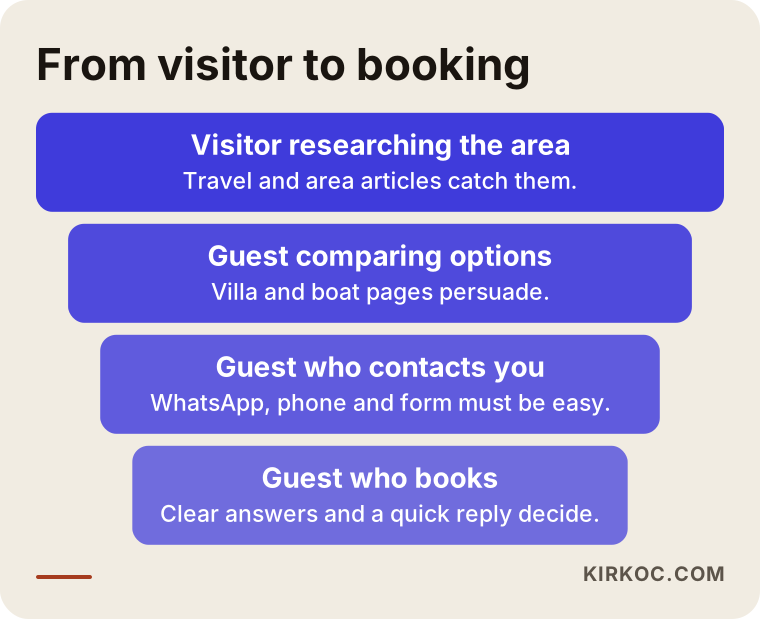
This narrowing path means the site has a job to do at every stage. Travel and area articles catch the person who is still researching. Villa and boat pages help them decide while they compare. The contact area makes the last step easy: a one-tap WhatsApp link, a phone number, a short form. If one link in the chain is weak, the work on the rest is wasted.
Using the season well: what to do when
The most important difference in tourism SEO is timing. Search engines do not fully trust a new page right away. It takes time for the page to be noticed and to earn confidence. If you start preparing for the "villa in August" search in the middle of August, you are late.
As a general principle, this is how I think about a season plan:
- Autumn and winter: technical fixes on the site, new pages, foreign-language versions, refreshed photos.
- Spring: the early-booking period. Pages should be maturing and starting to appear in searches. Ads can support this stretch.
- Summer: protect what you have rather than adding new content. Collect reviews, answer questions quickly and keep availability information current.
- End of season: look at what worked, which search brought how many requests, and what gets priority next year.
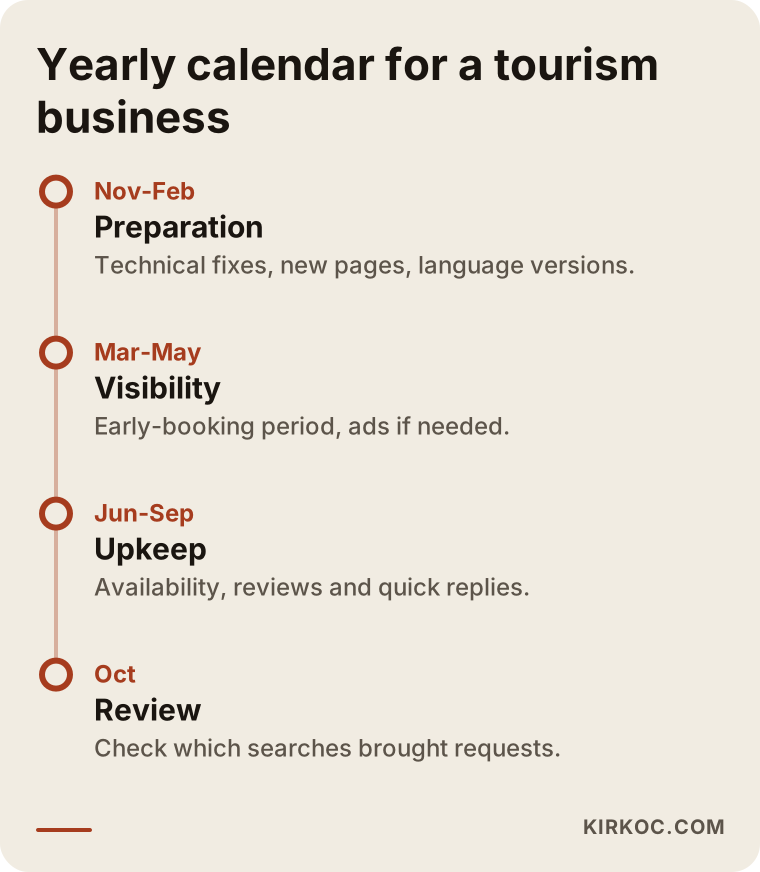
The key lesson from this calendar is that starting SEO in the middle of summer and expecting results the same summer is not realistic. Starting now, in autumn or winter, lets you prepare for next season's early-booking period. I cannot guarantee any outcome, but I can explain the difference between walking into the season prepared and walking in unprepared.
Example scenario: a host with three villas in Yalikavak
This is a hypothetical example, not a real person or company. Imagine a host with three villas. The listings are on two big platforms, and almost every booking comes from there. There is a website of their own, but it is a single page: all three villas share it, the photos are large, the text is short, and it is only in Turkish.
The things I would notice at first glance: there is no separate page for each villa, there is nothing in any foreign language, the page loads slowly on a phone, and the Google business profile is incomplete. I would write a plan for the first three months. First I would fix speed and mobile display. Then I would add a separate page for each villa, a page for the area, and English and German versions. At the same time I would complete the business profile, give the photos descriptive file names and decide where guest reviews will be collected.
I would not promise results in this scenario, but I would be clear about the direction. In the first months the goal is not a ranking. It is to get the right pages live and to measure the first direct requests. As the season approaches, I would watch which page starts showing up for which searches, and propose new pages or corrections accordingly.
Example scenario: a captain with two boats in Gocek
The second example is also hypothetical. Picture a captain who runs two gulets. Most guests arrive through recommendations or agencies. There is no website, only a social media account. Replying to messages takes time, because when the captain is at sea the phone cannot be answered.
Here I would start by building a simple but solid site: one page per boat, the routes, the departure harbor and a set of common questions. I would separate the phrases people might search by boat and by route: "Gocek gulet charter", "12 islands route", "boat charter with captain". Fast replies matter as much as SEO. So the site would carry detailed answers to the usual questions plus a form, which means a guest can find what they need even while the captain is out on the water. I would also tidy the social media photos together with the site so the two match.
What these examples share is that the work is cut into small, concrete pieces. Instead of a vague target like "let's be number one on Google", there are steps you can check: this page is live, this question is answered, this search is being tracked.
Google business profile and map searches
Map searches matter a lot in tourism. When a guest arrives in the area, they open their phone and search "restaurant near me" or "Bodrum center boat tour". In those searches it is not only your website that shows up but also your Google business profile. The profile holds your address, opening hours, photos, reviews and phone number.
For businesses like villas, where you may want to keep the address private, the profile can be set up differently, and it is important to follow the platform's rules on that. For boat and tour businesses, the departure point should be written clearly, because a guest who cannot find you leaves a bad review.
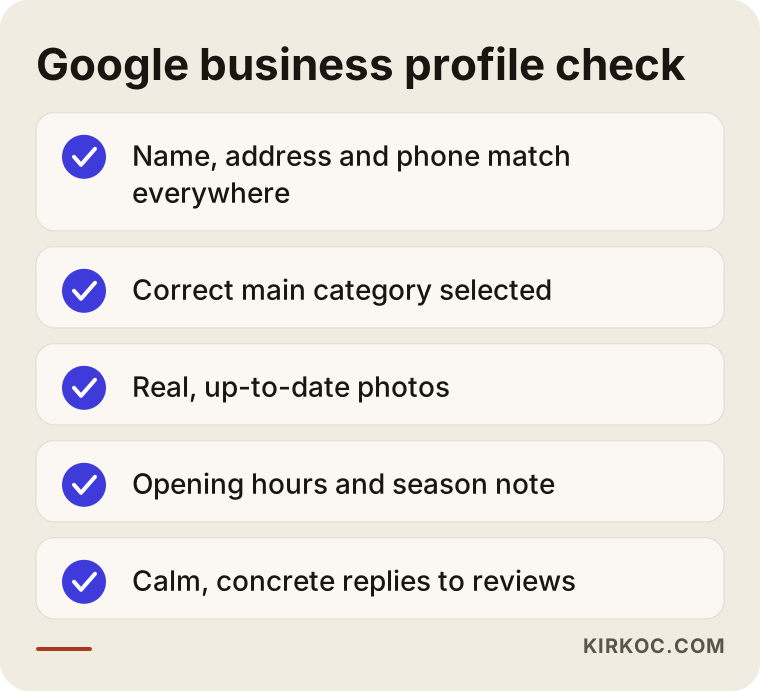
The list looks simple, yet many businesses are missing one or two items. Answering reviews in particular affects both how later guests see you and how alive the search engine finds your profile. A calm, concrete reply to a bad review is better than no reply at all.
How working with me goes, step by step
This is the path I follow when I start with a tourism business. Every step is written down and in order, because I want you to know what is being done.
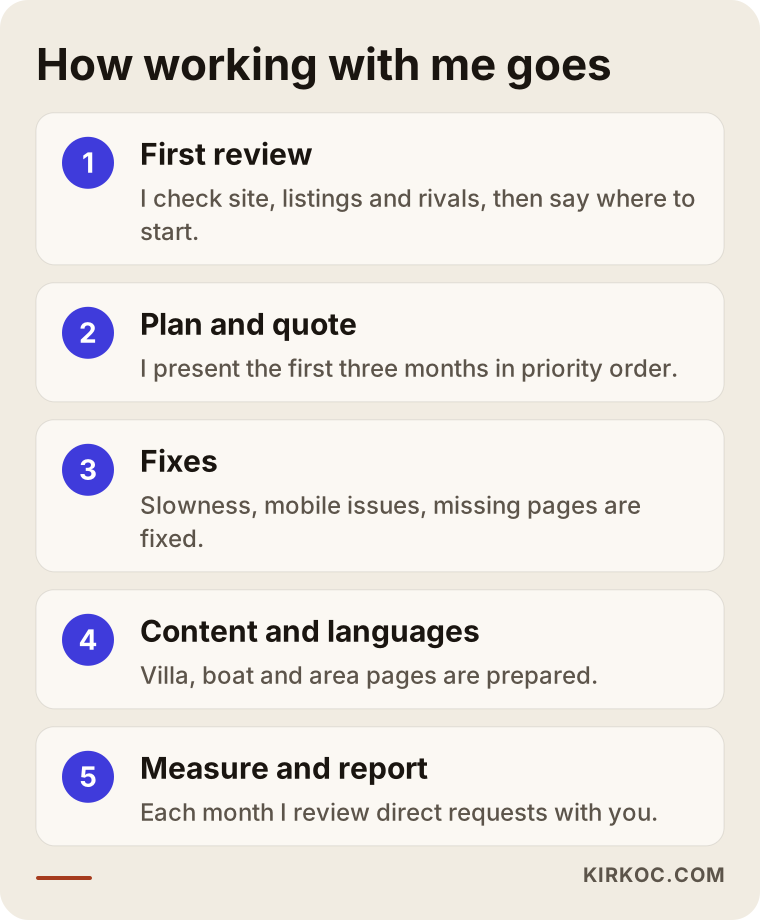
In the first step I look at your current site, your listings on the platforms and your competitors in the area. In the second step I give you the first three months of work in priority order, in writing. In the third step I clear the obstacles on the site first: slowness, mobile problems, missing pages. In the fourth step, pages and articles are prepared for the searches you want to be found for. In the fifth step, each month I go through the results with you and update the plan.
This is where doing everything through one person shows its benefit. When the website, SEO, social media and ads sit with different people, each does their own job but nobody sees the whole. Because I run all of it, a villa page I update on the site can be used on Instagram the same week and, if needed, in an ad. That keeps the same information consistent everywhere, and you have a single person to talk to.
Common mistakes in Mugla
These are the mistakes I see repeated in the region:
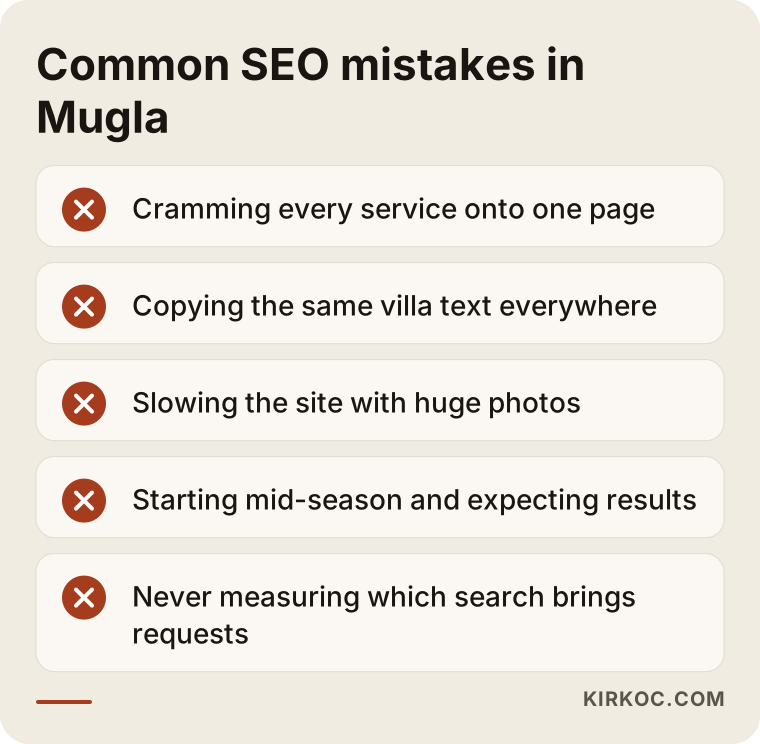
Let me expand on a few. Uploading photos at huge sizes slows pages down, and a guest waiting on a phone often closes the page instead of waiting. Copying the same villa description word for word onto several platforms and your own site means your site is not distinctive. Putting only the area name in a page title and adding generic text below does not work either, because people searching want information written by someone who really knows the place.
Another mistake is missing the season. Having a site built in June and expecting results in July usually ends in disappointment, because it takes time for search engines to trust a new page and for guests to plan their trips.
Finally, not measuring is a big problem. If you do not know which search makes the phone ring or which page gets the form filled in, you cannot know where to invest. A simple tracking setup is among the most valuable things to do in the first weeks.
What can you do yourself, and when do you need an expert?
You do not have to hand everything to a specialist. Some of the work you can do yourself: fill in the Google business profile, answer reviews, refresh your photos regularly, and write down the real features of your villa or boat in detail. None of that needs technical knowledge, and nobody knows your business better than you.
You usually need an expert in situations like these: the site is slow or broken, you will publish in several languages, the page structure is tangled, you cannot work out why you do not appear in search, or you want tracking set up. The decision chart below sums up this split.
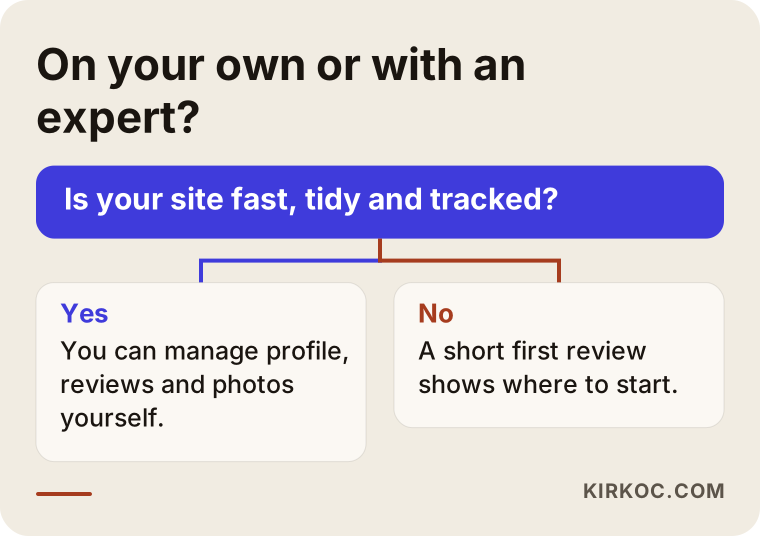
If any point in the chart leaves you unsure, a short first review makes sense. You do not need to hand over everything at once; learning where to start is enough.
What determines the cost of SEO?
In this region, price depends on the scope of the work, which is why I do not quote a figure here. The main factors are the current state of the site (is it built from scratch or repaired), how many languages you publish in, how many villas, boats or services need their own pages, how much content and photography you need, the work on maps and the business profile, how intense the local competition is, and how often you want reports and meetings.
There are also warning signs to watch for. Do not take seriously any offer that promises a "guaranteed first place"; nobody can decide rankings alone. Offers that do not put the scope in writing, do not say who does what, or keep ownership of your site and accounts in their own hands are also a problem. Your website, your domain name and your accounts should always be registered in your name.
If you are a foreign owner, add one more point. Ask who will handle Turkish-language pages and how they will be written, because many guests also search in Turkish, and you should know who is responsible for each language version. On legal or licensing questions for rental properties and boats, speak to a lawyer or the relevant local authority rather than relying on a marketing article, mine included.
Frequently asked questions
How long before I see SEO results in Mugla?
I cannot give an exact time. It usually takes weeks and months for new pages to be noticed, earn trust and appear in searches. That is why starting before the season matters. In the first weeks the goal is not ranking but getting the right pages live and setting up measurement.
Is it worth building my own site if I already have platform listings?
In most cases yes, but without giving up the platforms. Your own site can reduce commission and lets you build a direct relationship with guests. Even so, keep expectations realistic in the first year, because the reviews and trust that platforms have built up cannot be replaced quickly.
My site is Turkish only. Do I need foreign languages?
If most of your guests come from abroad, you do. What matters is not translating word for word but giving guests from each country the information they look for, naturally, in their language. Starting with the one or two languages that bring the most guests is enough.
Do I have to publish my villa's address on the site?
You do not. Naming the general area and the distance to the beach and the center is often enough, and the exact address can be given after the booking. For the Google business profile, follow the platform's rules. If you are unsure, ask a specialist.
Should a boat business have separate pages or a single page?
Where possible, a separate page for each boat and each route is better. That way the search engine and the guest both know what they have found. In a very small business you can start with the main boat pages and add route pages later.
Do I need social media and ads as well?
Not necessarily, but they support one another. SEO works more slowly and lasts; ads can give quick visibility during the season. Social media builds trust through photos and video. When I run all of them, messages and visuals stay consistent, but which ones you need to begin with depends on your budget and goal, and I work that out with you.
I worked with another agency and was not happy. Should I try again?
First look at what did not work. Sometimes the problem was an unclear scope, sometimes there was no measurement, and sometimes expectations were unrealistic. I would look at your current situation and tell you in writing what needs to change. The decision stays with you.
How do I find out the price?
Price depends on scope. After we talk about your site, the number of languages, the pages you need and your goal, I prepare a written quote. The quote states clearly which work will be done and when.
If you run a tourism business in Bodrum or Mugla, preparing before the season gives you the biggest advantage. To talk about where your site, villa or boat could start, you can look at my SEO services page and get in touch.