You have a workshop or a showroom, the pieces are good, and the craftsmanship is solid. Yet your phone fills up with messages that say "price?" and then go silent. Or nothing comes in at all, and your Instagram account has shown the same three photos for months. This is exactly where social media for furniture businesses earns its place. People look for ideas before they redo a room, they save pictures, and they start deciding who to buy from right there on their phones. In this guide I explain why furniture and home decor behave differently from other industries online, what to post, and how to put the work into a routine you can keep up. I am Ümit Kırkoç, I work from Istanbul, and I handle social media management together with websites, SEO and ads, all by myself. So I will talk about more than the posting itself. I will also talk about what happens after someone sees your post.
What does a furniture shopper look for on social media?
A sofa or a dining set is a purchase most people think about for weeks. Nobody decides overnight. They collect ideas first, then look at a few businesses, then think about visiting a showroom or calling a workshop. Social media is strongest in the first two steps of that path, because a person usually likes a piece of furniture with their eyes before they ask what it costs.
So a shopper arriving on your account is looking for three things. The first is how the piece looks in a real home. A studio shot is pretty, but the viewer is asking, "How would this look in my living room?" The second is the quality of the work: the stitching, the edges, the finish, the texture of the fabric. The third is trust. Will this business keep its delivery date? Will it answer if something goes wrong? Does it actually exist?
The graphic below shows an example of how that journey can unfold.
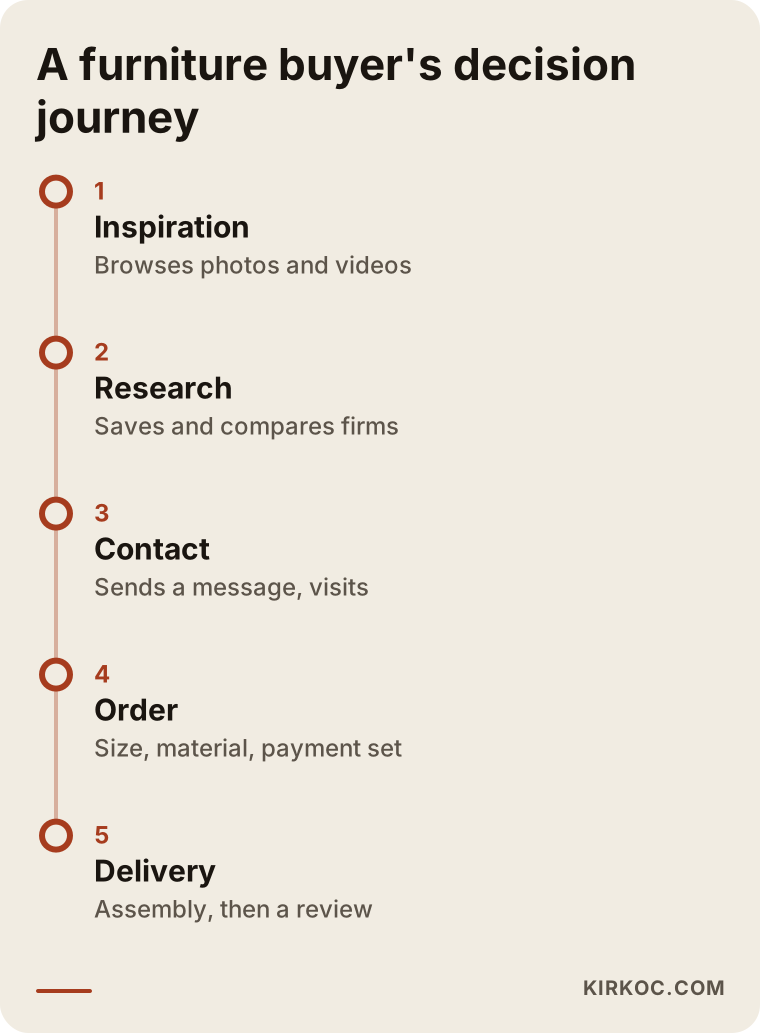
The point to notice is that social media sits at the start of the journey but should not stand alone at the moment of the order. A person sees you on Instagram, then searches your name on Google, then looks at your website or your map listing. If those pieces do not agree with each other, trust leaks out along the way.
The decision takes a long time, so your follow-up should too
Because buying furniture is slow, expecting a single post to bring an order the next day is not realistic. Someone may save your video today and message you three weeks later, once their move-in date is settled. That is why I suggest judging your social media work by a different question. Do not ask "how many messages came in today?" Ask "if a stranger looks at our account right now, will they find your business credible?"
The particular challenges of furniture and home decor
Every industry has its own headaches online. Furniture's are fairly easy to name.
The first is that the product is large and expensive. People drop a small item in a cart without a second thought, but for a bedroom set they ask careful questions. Your posts should answer those doubts ahead of time: dimensions, materials, production time, how delivery works.
The second is that many businesses build to order. Made-to-measure work cannot be explained with one photo the way a ready-made piece sitting on a showroom floor can. What the customer wonders is, "Could you do this for my kitchen too?" The answer is to show the process: measuring, drawing, building, installing.
The third is that photo quality directly affects sales. A dark, crooked picture with a cluttered background makes even excellent work look cheap. The fix is not expensive gear. It is light, angle and tidiness.
The fourth is crowded competition. In any given metro area there are dozens of shops and workshops. What sets a business apart is rarely "nicer furniture." More often it is "furniture that is explained more clearly."
The fifth is message volume. Most messages a furniture account receives begin with "how much?" If you have no system for handling them, they pile up, and the customer goes to another business.
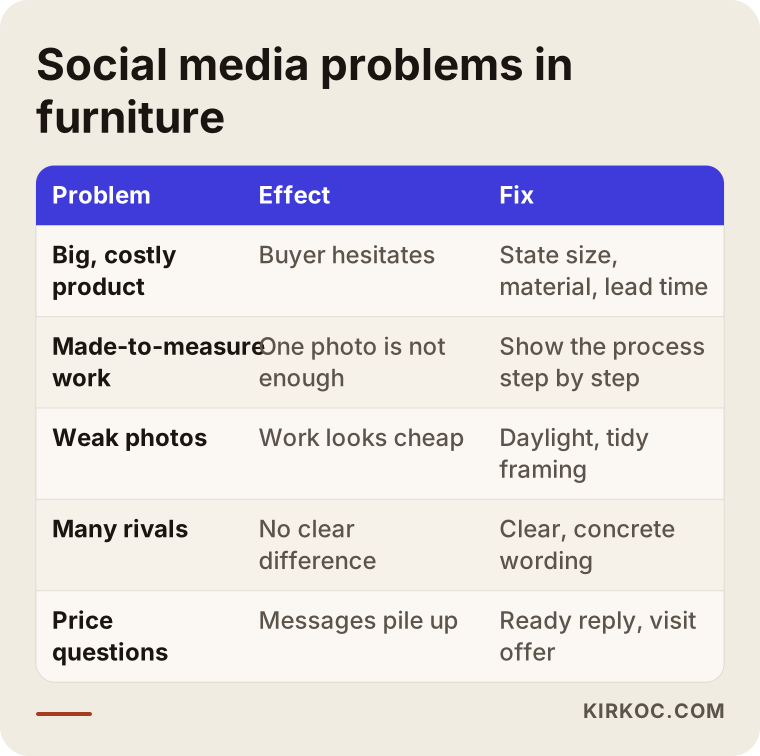
You can use this table as a checklist when you look at your own account. Note the rows where you are weak, and start there.
Which platform is right for which job?
You do not have to be everywhere. For a small workshop or a one-person operation, running two platforms well beats running six halfway.
Instagram is the main showcase for furniture. Photos, short videos (Reels) and Stories can all work together. Most shoppers look for ideas here and message you directly.
Pinterest is widely used for home and decor inspiration, where many people plan rooms. Images there can circulate for a long time. Because users build boards and collect pictures, well-shot product photos can send visitors to your website.
Facebook still makes sense for locally based businesses: a business page, reviews, community group posts and ads aimed at your area. It helps when you want to reach families who still use it daily.
TikTok and YouTube Shorts suit the making process, assembly, and before-and-after videos. You can reach younger couples who like short clips.
LinkedIn matters if you supply furniture for offices, hotels, restaurants or other business projects. A household buyer does not need it.
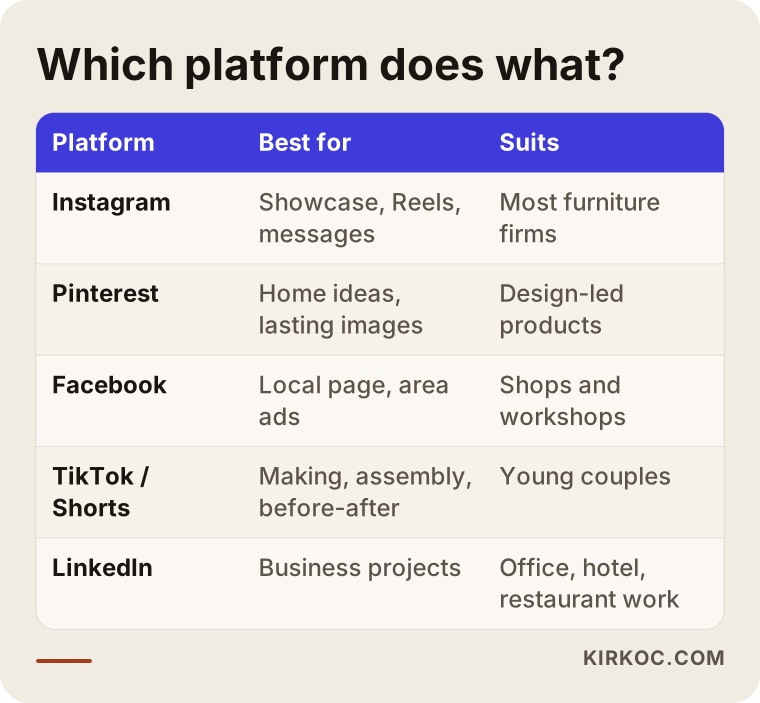
This breakdown is a general frame. The real decision depends on who your customer is. A store selling ready-made pieces and a workshop building custom kitchens do not have the same priorities.
What should you post? Content types that work
Finding ideas for furniture content is rarely the hard part. Doing it regularly and consistently is. Rotating through the types below is a good place to begin.
Finished work. A photo of a delivered piece in the customer's home is your strongest content. Post it with the customer's permission, and keep their face and address out of the frame.
The making process. Cutting, finishing, upholstery, assembly. People trust work they can see being done. A short video often persuades better than a thousand words of description.
Before and after. A reupholstered armchair or an empty room that gets furnished is both striking and concrete.
Explaining materials. Solid wood or engineered board? How well does the fabric resist wear? Why does this finish not smell? Explaining these things in plain language attracts the careful buyer.
Size and layout tips. "Which sofa suits a small living room?" or "How far should a dining table sit from the wall?" are practical tips people save and share.
Frequently asked questions. Delivery time, warranty, assembly, payment options. If you answer the same question every day, turn it into a post.
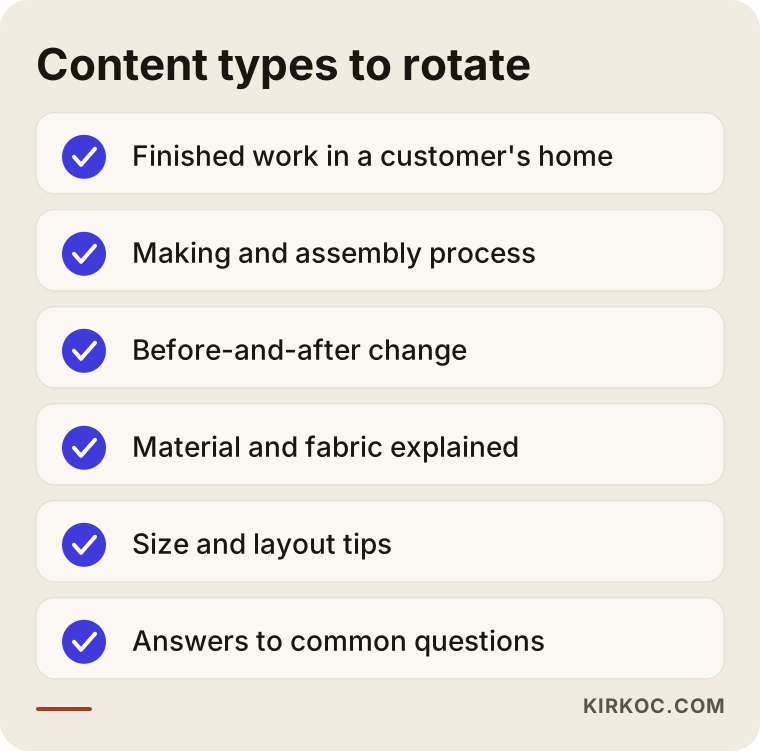
You can rotate through this list over a month. Three to four posts a week is a sustainable pace for most small businesses. Posting less and continuing is better than posting a lot and quitting.
Photos and video: how good can you get with a phone?
Quality matters in furniture, but you do not need a studio. A recent phone, good light and a tidy background will take you a long way.
The basic rules are simple. Use daylight: shoot beside a window with the curtains open. Turn the flash off. Hold the phone at eye level and keep it upright, because a piece that looks tilted in the photo looks poorly built. Simplify the background so that cables, trash cans and scattered cushions stay out of the frame. Take close-ups so stitching and texture are visible, and take wide shots of the whole room so the scale makes sense.
In video, movement matters. A drawer sliding open, a door closing, a hand moving across fabric, a sped-up assembly: all of these watch well. You do not need a voiceover. A short caption and soft music are enough.
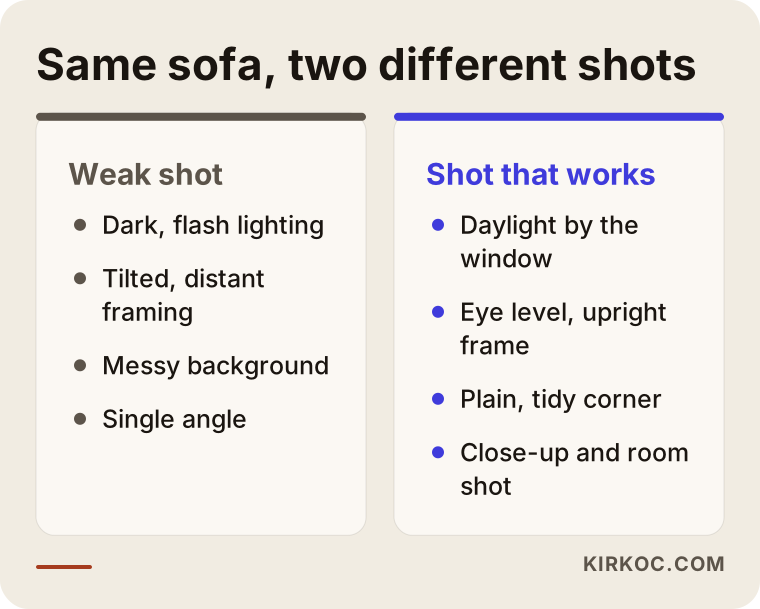
As you can see, the difference comes from routine more than equipment. If you plan your shooting once and apply it to every product, your account gradually looks consistent, and consistency builds trust.
Example scenario 1: A small workshop that builds custom kitchens
This scenario is entirely hypothetical. It does not describe a real business.
Imagine a workshop that builds made-to-measure kitchens and wardrobes. Its account has only glossy photos of finished jobs, and the captions say little more than "enjoy your new kitchen." Customers do message, but always with the same question: "How much?" Once they get an answer, most of them disappear.
Suppose the workflow were reorganized like this. First, the measuring, drawing, building and installing stages are split into short videos. Under each post, the materials used are listed along with what the delivery time depends on. The profile bio reads something like "Custom kitchens, Istanbul" and carries a link for booking a visit. For the "price?" messages, a one-sentence reply is prepared: the price depends on the dimensions, the materials and the hardware, and a measuring appointment can be scheduled.
The aim of this setup is not to hide the price. It is to steer the customer toward the right question. In custom work, the dimensions and choices set the price, and quoting a number without knowing them would be wrong for both sides. There is no guaranteed outcome here. What you can expect is that the messages become better qualified, and the owner stops typing the same answer over and over.
Example scenario 2: A store selling ready-made furniture and decor
This one is hypothetical too.
Picture a store that sells sofas, coffee tables, rugs and lighting. Foot traffic is heavy on weekends and light on weekdays. On Instagram there are product photos, but they all sit on the same white background and look alike.
What helps here is posting products as rooms. A corner is set up, the same sofa is shown with three different coffee tables and rugs, and the caption reads "pieces that complete this corner." To draw people in on weekdays, the store announces something small, such as a "corner styling chat in the showroom this week." Stock updates and new arrivals appear in short Stories. The business profile on the map keeps its opening hours and showroom photos current.
In this example, social media works as a tool that supports the decision to walk into the store. Instead of expecting the purchase to happen on Instagram, it gets people to say, "I should go and see that showroom."
Step by step: putting your social media in order
You do not have to change everything at once. Going in sequence works better.
1. Set a goal. Do you want showroom visits, measuring appointments, or business quotes? If the goal is unclear, the content scatters.
2. Tidy up the profile. Profile photo, bio, city, how you work, a contact link. Someone who lands on your account should understand within ten seconds what you do and how to reach you.
3. Build a shooting routine. Pick a corner, fix the lighting, and shoot the same angles for every product.
4. Make a monthly content calendar. Spread the types (making, finished work, information, Q&A) across the weeks.
5. Prepare message handling. Write ready replies for common questions, and decide who answers and when.
6. Track and adjust. Which post was saved most, and which one brought messages? Every couple of months, do more of what worked.
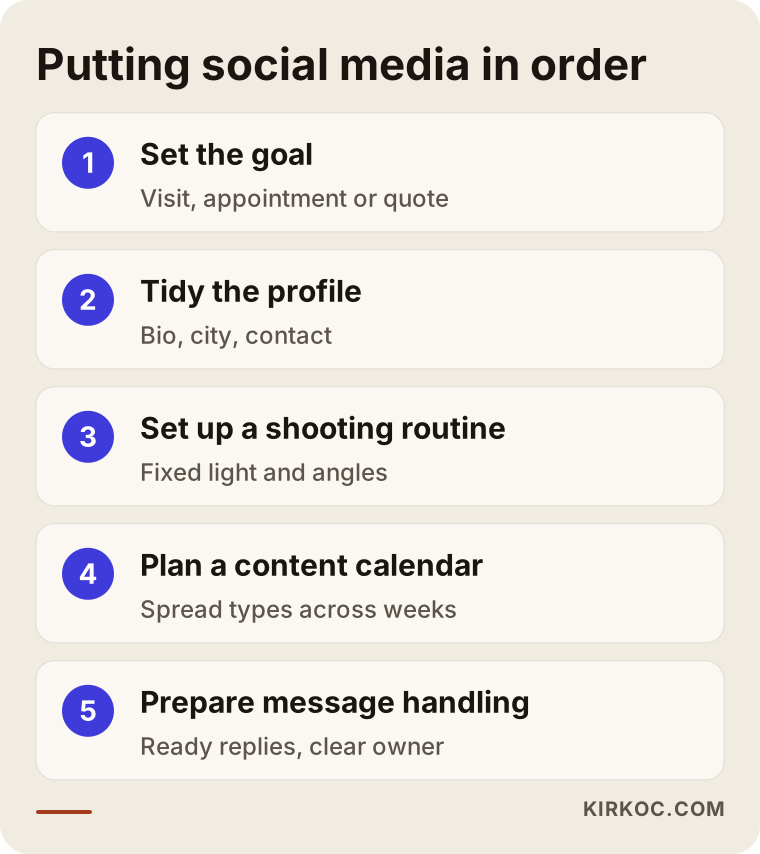
Completing these six steps in order usually produces steadier results than accounts with no written plan. I am not promising quick results, but once a routine exists, the work no longer depends on one person's good days.
From social media to the website to the order: building the bridge
Social media does not close a sale by itself. A person likes what they see, but they also want to see a price range, product details, delivery information and examples of finished work. For that you need a website, or at least a clear page.
When someone taps the link in your profile, they should find: the groups of products and services you offer, a gallery of finished work, how you work (measuring, production, delivery), frequently asked questions and a way to reach you. If the link drops them on a home page and leaves them to wander, they will not know what to look for and will leave.
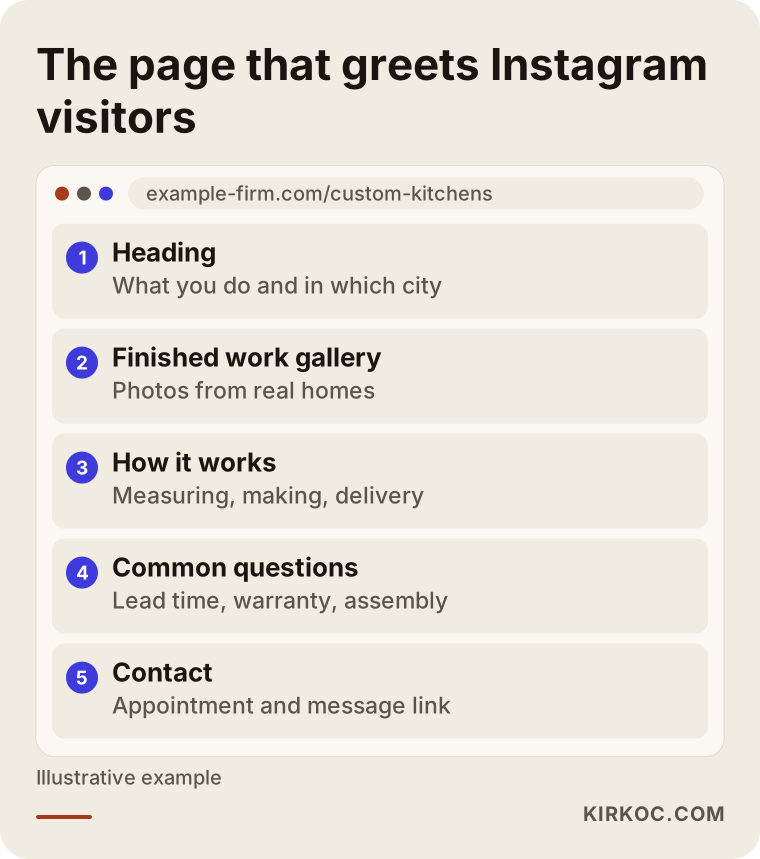
This is where having everything handled by one person makes a difference. When the same person manages the posts, the page and the visibility in search, the voice on Instagram and the voice on the website complete each other. The message that tends to get lost between separate vendors stays intact.
The path from message to order
Not every message turns into an order, and that is normal. But with a system in place, you can reduce the losses at each stage.
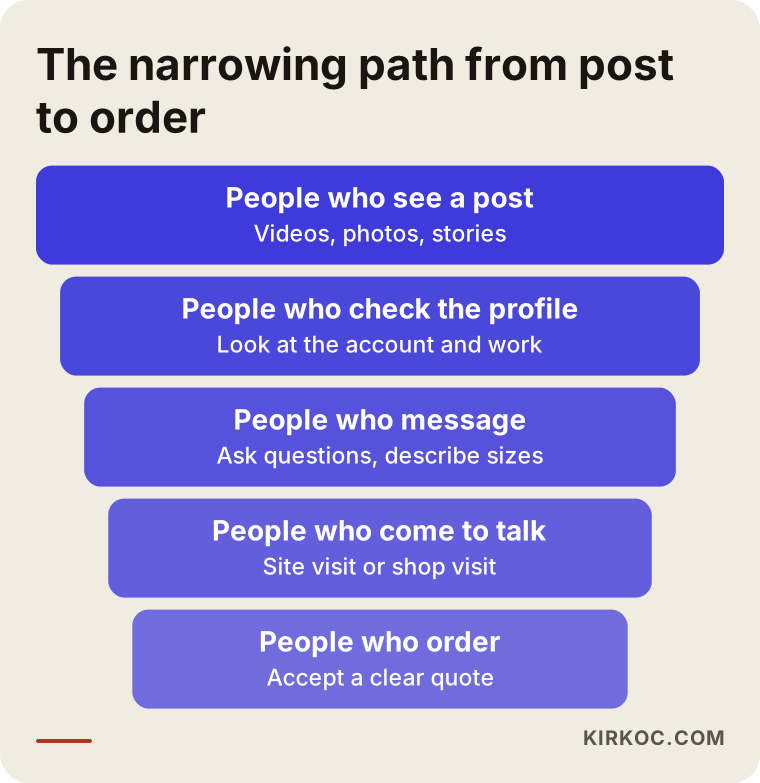
The funnel logic is simple. Many people see a post, some send a message, fewer come in for a conversation, and some place an order. At each stage your job is to make the next step easier. Replying the same day, proposing a clear appointment and sending a follow-up message all slow the narrowing.
The small details that build trust: reviews, delivery, after-sales
A furniture buyer's biggest worry is paying and not receiving what they expected. You can reduce that worry on social media, and it does not require anything expensive.
You can feature customer reviews and thank-you messages in Stories, with permission and with personal details covered. A short video of the delivery moment, showing the piece arriving and being set up without trouble, is one of the most believable things you can post. Saying who did the assembly, how many people came and how long it took also shows that you take the job seriously. Keep your warranty terms and the way to reach you if something goes wrong as a pinned post or a highlight.
How you respond to a bad review matters as well. If a delivery ran late, explaining it calmly and describing the fix, rather than hiding it, tells the next reader that you will deal with problems. Answering the reviews on your Google Business Profile with the same care helps your social media and your search presence support each other.
Common mistakes
The mistakes I see on furniture accounts fall into a few groups.
Posting only product photos. People want to see how a piece will sit in their home, not just the piece.
Hiding the price entirely, or printing it everywhere. In made-to-measure work the price varies. Saying so openly is more reassuring than writing "DM for price" and disappearing.
Replying to messages late. Someone researching furniture writes to several businesses at once. The first to reply has the advantage.
Using a customer's photo without permission. The inside of a home is private. Sharing without asking damages trust. If you are unsure about the legal side, talk to a lawyer.
Buying followers or joining engagement groups. Fake accounts do not turn into orders, and they hurt the health of your account.
Using another business's photos. It is unethical, and when it is noticed it ruins your reputation.
A busy month followed by months of silence. Without continuity, both the algorithm and the customer forget you.
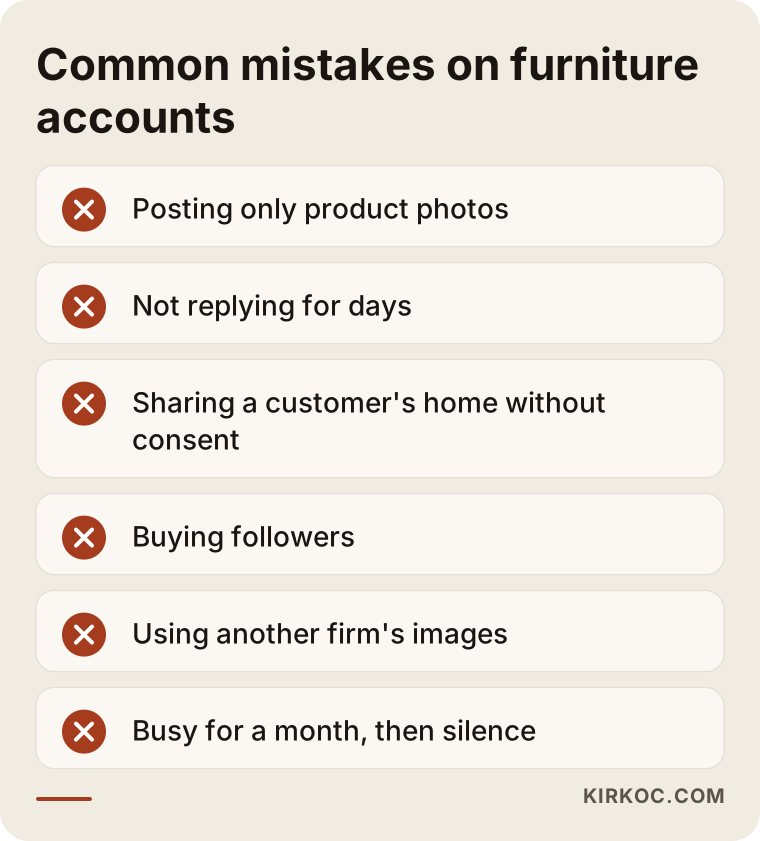
If you recognize one or two of these in your own account, do not panic. Most of them are habits that a routine fixes.
Should you do it yourself, or do you need an expert?
The answer depends on your time and the size of the business. Managing it yourself makes sense if you have a few hours a month, can shoot the photos and videos on your own, and do not mind that the account stays small for a while. In that case, follow the steps above and limit yourself to two platforms at first.
Expert help makes sense in other situations: when production leaves you no time for content, when messages have become unmanageable, when your social media and your website feel disconnected, or when you want to run ads but do not know where to start. Ads, especially Meta ads aimed at your local area, can be strong for furniture. But running ads to a weak profile only wastes money.
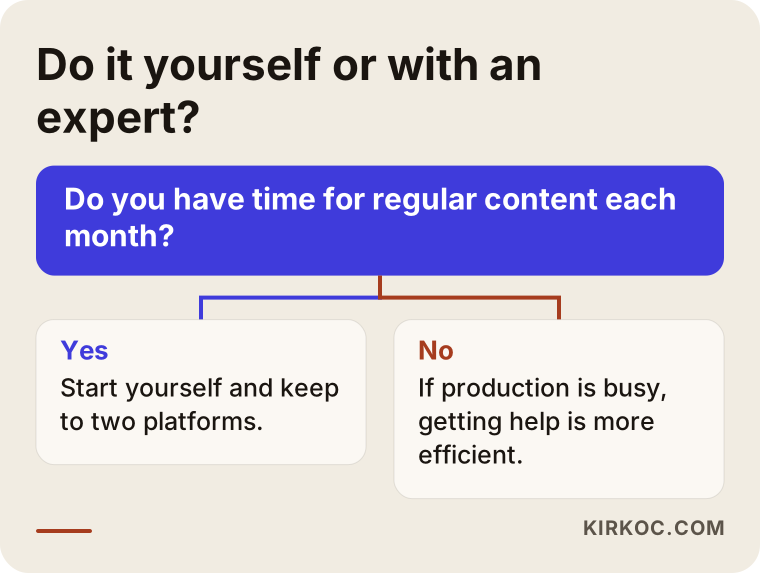
The logic in the diagram is not a rule. It is a guide to help you review your time and priorities. Often the best path is to start on your own and get help at the point where you get stuck.
What determines the cost
I am not giving figures here, because no two furniture businesses need the same thing. The cost depends on these factors:
- How many platforms will be managed.
- How many posts and videos will be produced each month.
- Whether you will do the shooting yourself or need someone to come and film.
- How much of the design and copywriting is prepared for you.
- Whether extras such as message handling are included.
- Whether ads are managed separately, and what the ad budget will be (the ad budget is separate from the service fee).
- Whether the work runs together with your website and search visibility.
When you ask for a quote, I suggest asking what is included line by line. "Monthly management" on its own says very little.
How I work with you
I start by looking at your account, your website and your competitors. I listen to what you sell, who you sell to and how customers find you. Then I put together a short plan: which platforms, which content types, how many posts a month. I bring the plan to you for approval, carry it out, and report back regularly in plain language about what happened.
Because social media, the website, SEO, ads and content production sit with one person, one job does not have to wait for another. When you launch a new product line, for example, the same shoot is used on Instagram, on your site and in search results. I do not promise outcomes, but I always say clearly what I am doing and why.
Frequently asked questions
Which social media platform is best for a furniture business?
For most businesses, Instagram is the main platform. People looking for home and decor ideas browse images there. Pinterest and, for local customers, Facebook are worth considering as well. If you do office furniture or business projects, think about LinkedIn too.
How often should I post each week?
The pace you can sustain is the best one. For most small businesses, three to four posts a week is a reasonable start. What matters is not giving up after a while.
Should I put prices in my posts?
For ready-made products you can show the price. For made-to-measure work, the price changes with dimensions, materials and choices, so it is better to say that openly and offer a site visit or a conversation.
Can I post a photo taken in a customer's home?
You can, with the customer's clear permission and in a way that does not reveal the person or the address. If you are unsure about your privacy obligations, it is sensible to ask a lawyer.
Do social media ads work for furniture?
With good targeting and a solid profile, ads aimed at your area can work. There is no guarantee, though, and running ads to a weak profile is inefficient. Fix the profile first, then test with a small budget.
How long does it take for social media to show results?
Furniture decisions take a long time, so in the first months you mostly build visibility and trust. The effect on orders usually shows after a few months, once the routine has settled. It would not be honest to give an exact timeframe.
Is Instagram alone enough without a website?
It is possible to start that way, but over the long term it falls short. People also search for you on Google, and a clear page with product details, finished work and contact information builds confidence.
Will bought followers hurt me?
Usually, yes. Fake accounts do not become orders, they lower your engagement rate, and they make your account look unreliable. Fewer real followers are always worth more.
If you want to organize social media for your furniture and decor business and think about it together with your website and search, you can reach me through the social media management service page. I will listen to your situation and tell you plainly what you actually need.